
South America Data Center Battery Energy Storage Market Size and Share
Market Overview
| Study Period | 2021 - 2032 |
|---|---|
| Forecast Data Period | 2027 - 2032 |
| Base Year Market Size (2026) | USD 0.51 Billion |
| Market Size (2027) | USD 0.58 Billion |
| Market Size (2032) | USD 1.15 Billion |
| Growth Rate (2027 - 2032) | 14.76 % |
| Market Concentration | Medium |
Major Players *Disclaimer: Major Players sorted in no particular order Image © Mordor Intelligence. Reuse requires attribution under CC BY 4.0. | |
South America Data Center Battery Energy Storage Market Analysis by Mordor Intelligence
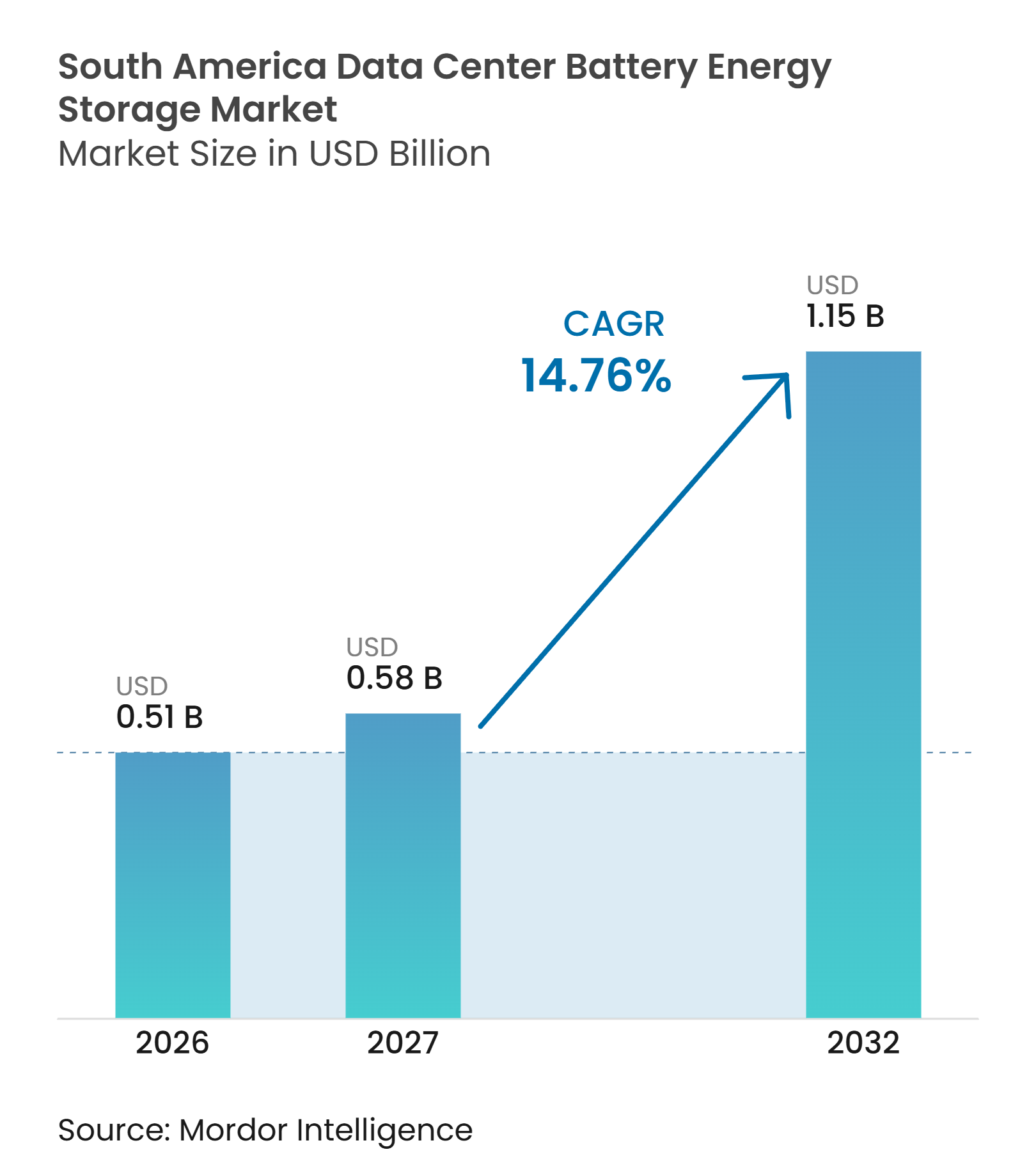
The South America data center battery energy storage market size was valued at USD 0.51 billion in 2026 and estimated to expand from USD 0.58 billion in 2027 to reach USD 1.15 billion by 2032, at a CAGR of 14.76% during the forecast period 2027-2032. Demand is tied to new hyperscale and colocation campuses, where uninterrupted power systems are planned with the facility rather than added after construction. AI workloads also raise the need for batteries that can handle rapid changes in power demand. Renewable generation is creating a second use for storage, especially where solar output and grid availability do not align. Chile and Brazil offer the strongest opportunity because data center investment, renewable electricity, and grid constraints occur together. Import costs, currency exposure, and difficult upgrades at older sites continue to slow some projects.
Key Report Takeaways
- By battery chemistry, LFP held 37.18% of the South America data center battery energy storage market share in 2026, while sodium-ion is projected to expand at a 15.05% CAGR through 2032.
- By system component, battery cells and modules accounted for 35.44% of the South America data center battery energy storage market share in 2026, while energy management software is projected to expand at a 15.30% CAGR through 2032.
- By primary application, UPS and short-duration backup accounted for 45.61% of the South America data center battery energy storage market size in 2026, while renewable energy integration is projected to expand at a 15.92% CAGR through 2032.
- By storage duration, below-1-hour systems accounted for 56.11% of the South America data center battery energy storage market share in 2026, while above-4-hour systems are projected to expand at a 16.31% CAGR through 2032.
- By data center size, hyperscale facilities held 57.19% of the South America data center battery energy storage market share in 2026 and are projected to expand at a 16.62% CAGR through 2032.
- By data center type, colocation facilities held 60.27% of the South America data center battery energy storage market share in 2026, while cloud service providers are projected to expand at a 16.89% CAGR through 2032.
- By geography, Brazil held 36.29% of the South America data center battery energy storage market share in 2026, while Chile is projected to expand at a 15.61% CAGR through 2032.
Note: Market numbers in this report are based on Mordor Intelligence's proprietary estimation framework, which combines nine months of actuals with Q4 projections for base year 2026.
Market Trends and Insights
Drivers Impact Analysis of South America Data Center Battery Energy Storage Market*
| Driver | (~) % Impact on CAGR Forecast | Geographic Relevance | Impact Timeline |
|---|---|---|---|
| Hyperscale and Colocation Capacity Expansion | +4.2% | Brazil and Chile core, Colombia and Peru secondary | Short term (≤ 2 years) |
| AI, Cloud Computing, 5G, and Edge Workloads | +3.9% | Brazil, Chile, and Colombia | Short term (≤ 2 years) |
| Renewable Integration and Grid-Congestion Management | +3.5% | Chile primary and Brazil | Medium term (2-4 years) |
| Tier III and Tier IV Power Reliability Requirements | +2.8% | Brazil, Chile, Colombia, and Argentina | Medium term (2-4 years) |
| Data Center Development in Renewable-Rich Chile and Brazil | +2.2% | Brazil and Chile | Short term (≤ 2 years) |
| Battery Storage as a Diesel-Reduction and Resilience Asset | +1.6% | Brazil, Argentina, and Peru | Long term (≥ 4 years) |
| Source: Mordor Intelligence | |||
Hyperscale and Colocation Capacity Expansion Drive Battery Investment
Hyperscale campuses and multitenant colocation sites remain the main demand base for the South America data center battery energy storage market. Larger facilities require substantial UPS capacity to support high-value tenant workloads. Ascenty opened its third Chilean data center in September 2025 with an initial capacity of 16 MW. The company also announced SCL04 and SCL05 projects with 150 MW of combined capacity. This pipeline places battery requirements in campus planning, rather than in later retrofit work. Tier III and Tier IV designs require redundancy, making dependable battery capacity a core infrastructure purchase.
AI, Cloud Computing, 5G, and Edge Workloads Elevate Battery Requirements
AI workloads change how data center operators assess short-duration power support. Rapid changes in accelerator demand can put pressure on power quality inside a facility. ZincFive reported that 52% of surveyed data center professionals identified AI dynamic power and power quality as critical storage decision factors in 2026. This was higher than the 37% reported in 2025. Edge deployments also need local backup because urban locations may limit diesel equipment. The South America data center battery energy storage market therefore benefits from both large AI campuses and smaller distributed facilities.
Renewable Integration and Grid-Congestion Management Create Storage Demand
Chile is pairing strong renewable generation with a grid that cannot always move power to where it is needed. The country curtailed more than 6,000 GWh of renewable electricity in 2025. Storage can shift some of this output to periods of higher demand. IRENA expects South America to reach 10 GW of battery storage capacity by 2030. Data center operators with renewable power agreements can use on-site batteries for both backup and energy scheduling. This makes battery projects more useful than systems designed only for UPS service.
Tier III and Tier IV Power Reliability Requirements Set Battery Floors
Availability certifications influence equipment specifications across the South America data center battery energy storage market. Tier III designs require concurrent maintainability, which in turn requires redundant power paths. Tier IV designs add fault tolerance and can require more battery capacity per megawatt of IT load. Cirion received Tier III Design Documents certification for its SAN2 facility in Quilicura during 2026. The facility has 20 MW of hyperscale-class capacity and redundant power and cooling systems. These requirements support demand for systems with documented performance and service plans.
Restraints Impact Analysis of South America Data Center Battery Energy Storage Market*
| Restraint | (~) % Impact on CAGR Forecast | Geographic Relevance | Impact Timeline |
|---|---|---|---|
| High Imported Equipment Cost and Currency Exposure | -2.1% | Brazil primary and Argentina | Short term (≤ 2 years) |
| Integration Complexity With Existing UPS and Electrical Infrastructure | -1.6% | Brazil, Colombia, and Peru | Medium term (2-4 years) |
| Limited Local Cell Manufacturing and Qualified Integrator Capacity | -1.3% | All markets, especially Argentina, Peru, and Colombia | Medium term (2-4 years) |
| Fire-Safety Certification, Interconnection, and Commissioning Delays | -0.9% | Brazil and Chile | Medium term (2-4 years) |
| Source: Mordor Intelligence | |||
High Imported Equipment Cost and Currency Exposure Compress Project Economics
Import costs are a material barrier for operators that source cells and power electronics from abroad. Brazil applies several taxes to imported electronic equipment. The February 2026 Gecex action raised duties on certain servers, network equipment, and data-processing hardware. Battery projects can face a similar cost problem because cells, converters, and management equipment are largely imported. Currency volatility adds uncertainty to equipment budgets that are commonly set in USD. These conditions can extend payback periods and delay replacements of older lead-acid equipment.
Integration Complexity With Existing UPS and Electrical Infrastructure Extends Timelines
Older facilities were commonly designed around valve-regulated lead-acid batteries. Lithium systems can require revised protection settings, new thermal controls, and updated power conversion firmware. Battery management systems must also communicate with existing SCADA and building management systems. These engineering tasks can extend commissioning, especially at brownfield sites. Fire safety and grid interconnection reviews can add further sequencing requirements. The South America data center battery energy storage market is therefore more accessible to projects that address integration early in design.
*Our forecasts treat driver/restraint impacts as directional, not additive. The impact forecasts reflect baseline growth, mix effects, and variable interactions.
South America Data Center Battery Energy Storage Market Segment Analysis
By Battery Chemistry:
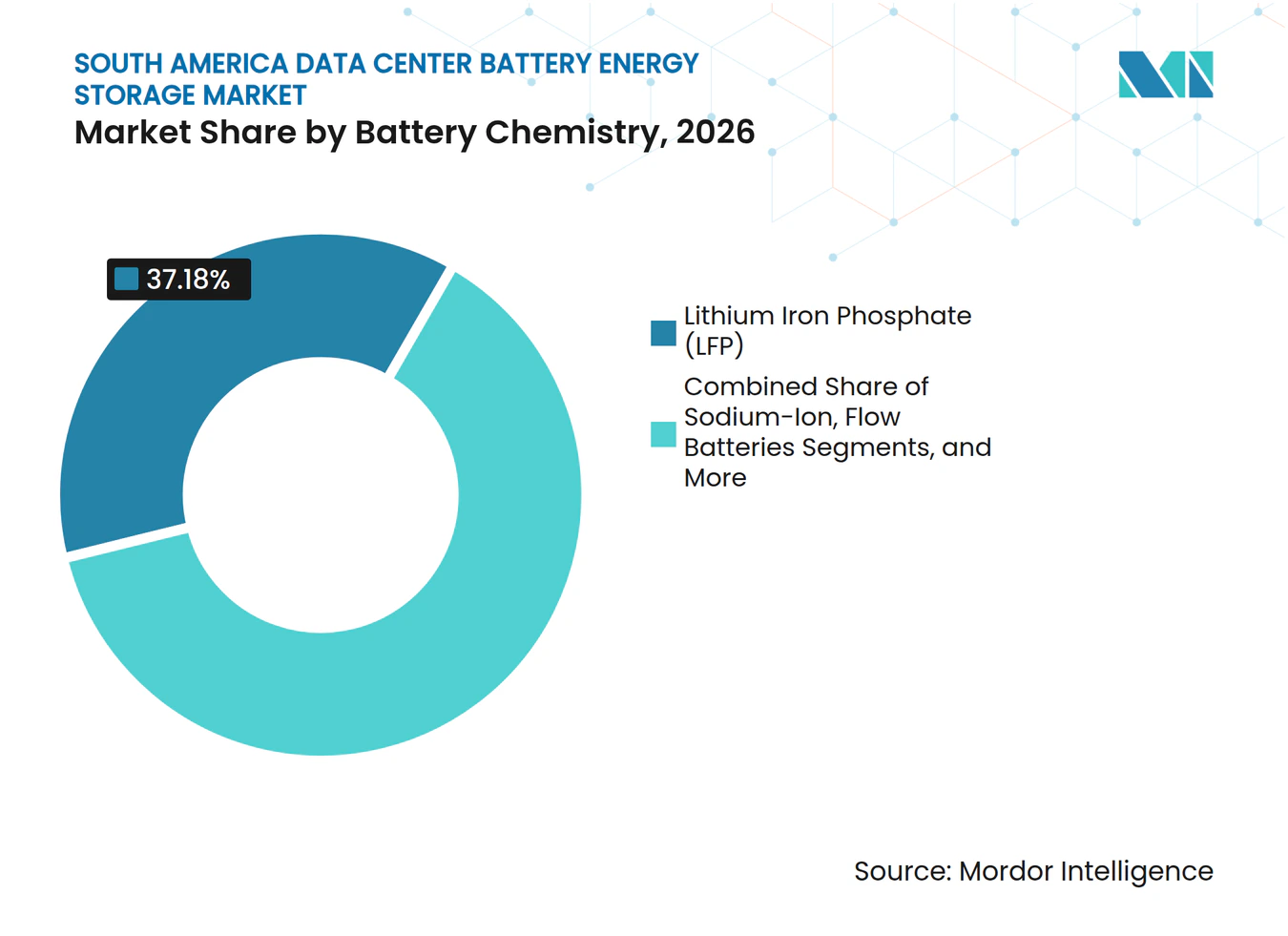
LFP Leads While Sodium-Ion Builds a Safety CaseLFP held 37.18% of the South America data center battery energy storage market in 2026. Its thermal stability and long cycle life suit the regular cycling expected in UPS applications. LFP is also familiar to integrators and operators who already use lithium systems. CATL supplied LFP containers to Grenergy for the Oasis de Atacama project in Chile. It also introduced its 9 MWh TENER Stack in Brazil during 2025. These deployments demonstrate the scale at which LFP systems are becoming available in the region.[1] As a result, LFP continues to strengthen its position as the preferred battery chemistry for large-scale data center energy storage deployments across South America.
Sodium-ion is projected to expand at a 15.05% CAGR through 2032. The chemistry is relevant when operators want to reduce thermal runaway concerns. ESS introduced its Bridge sodium-ion system in July 2026 for data center and critical infrastructure uses. The system uses modular 1.2 MWh blocks and can operate from -40°C to 50°C. This design may reduce the need for complex HVAC in selected applications. LFP is likely to remain more common in short-duration systems, while sodium-ion broadens the choices available for dense AI facilities.



By System Component:
Hardware Holds the Largest Value While Software ExpandsBattery cells and modules accounted for 35.44% of the South America data center battery energy storage market in 2026. The battery stack is the central capital item within a storage system. Racks, cabinets, battery management systems, and power conversion equipment add the functions needed for safe operation. Fire detection, ventilation, and suppression equipment also become more important in high-density installations. NFPA 855 provides safety guidance for stationary energy storage systems. These requirements reinforce the need for qualified hardware providers and system integrators.
Energy management software is projected to expand at a 15.30% CAGR through 2032. Operators need software that can monitor battery condition and coordinate dispatch decisions. Fluence expanded its AI-enabled tools for asset optimization during 2026. FlexGen also updated HybridOS with battery management functions in February 2026. Such platforms can align UPS readiness with peak shaving, grid services, and renewable power scheduling. This capability is particularly relevant when a single battery asset serves multiple operating purposes.
By Primary Application:
UPS Anchors Revenue While Renewable Integration AcceleratesUPS and short-duration backup accounted for 45.61% of the South America data center battery energy storage market size in 2026. This application protects IT equipment during grid disturbances and transfer events. It is required in practice for facilities seeking strong availability credentials. Many operators size backup systems beyond a basic bridge period because local grid conditions can vary. Longer backup periods also reduce reliance on diesel generators at urban facilities. This established requirement gives the South America data center battery energy storage market a steady base of replacement and new-build demand.
Renewable energy integration is projected to expand at a 15.92% CAGR through 2032. Chile’s curtailment shows why renewable electricity does not always match facility demand. Storage can charge during high solar availability and discharge later in the day. Atlas Renewable Energy has developed BESS del Desierto in Chile as a large standalone storage project. The project provides a regional reference for dispatchable battery capacity. It supports confidence in similar designs for large data center campuses.
By Storage Duration:
Sub-Hour Systems Lead While Extended Backup Gains GroundBelow-1-hour systems accounted for 56.11% of the South America data center battery energy storage market size in 2026. This reflects the historical UPS role of carrying IT loads until backup generation begins. Many installed systems were built for 5 to 15 minutes of battery autonomy. Replacement projects often preserve this familiar operating model. Lithium upgrades can fit this specification while using less space than older batteries. The segment remains important because it addresses the broadest existing installed base.
Above-4-hours systems are projected to expand at a 16.31% CAGR through 2032. Operators need longer discharge periods when batteries replace diesel use or support renewable power agreements. Chile’s delayed Kimal-Lo Aguirre transmission project reinforces the value of localized energy flexibility. Long-duration storage can also allow sites to participate in selected grid programs. Flow batteries may suit some long-duration applications because their power and energy capacity can be scaled separately. LFP configurations remain relevant where a 4 to 8-hour system meets the operating requirement.
By Data Center Size:
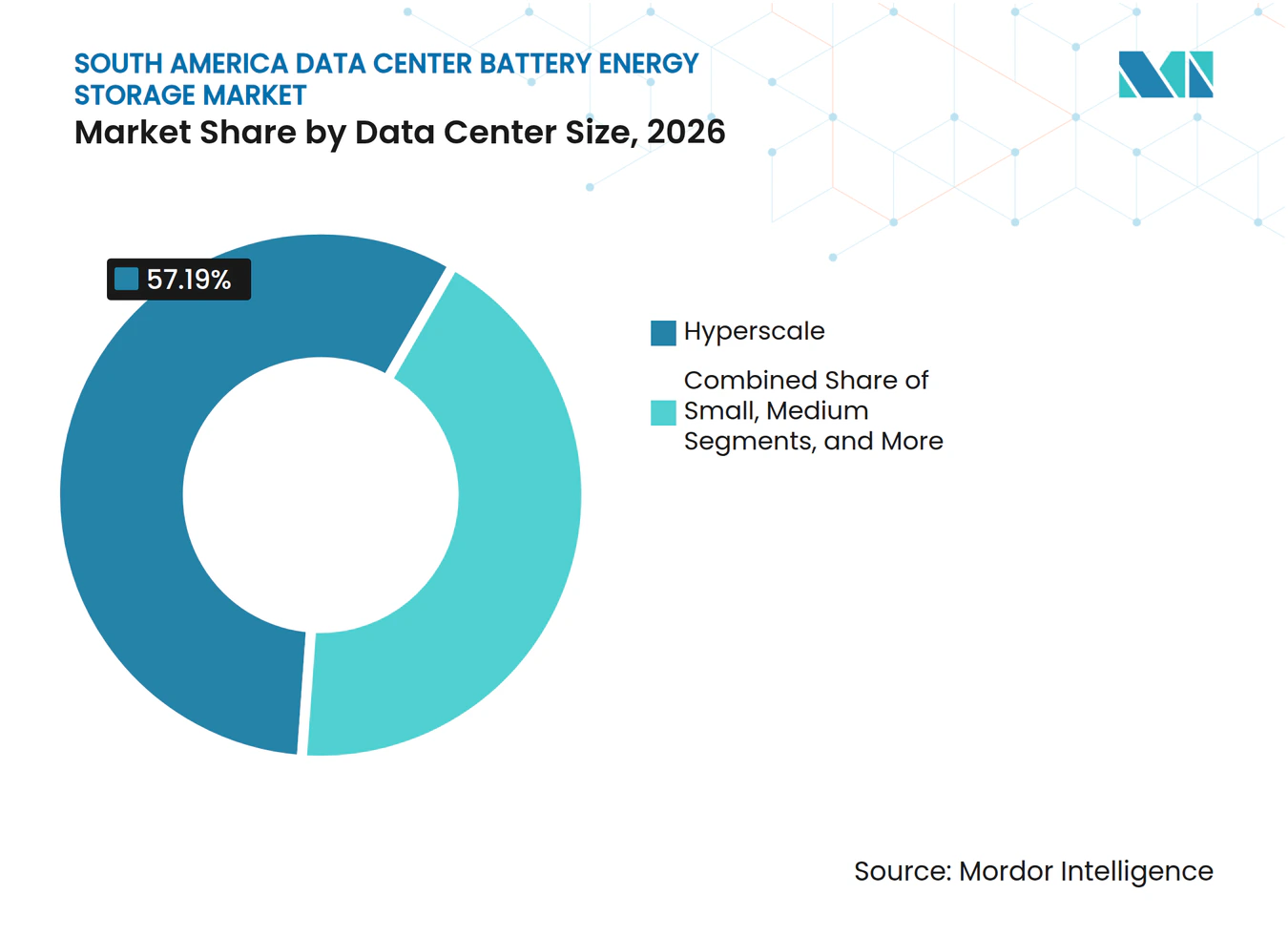
Hyperscale Facilities Lead Demand and ExpansionHyperscale facilities accounted for 57.19% of the South America data center battery energy storage market in 2026. They also benefit from shared substations, cooling systems, and engineering teams. These features can reduce the unit cost of installing large battery banks. Actis launched the TERRANOVA platform in December 2025 to develop capacity across Brazil, Mexico, and Chile. The platform plans to invest USD 1.5 billion and may deploy up to 1 GW of data center capacity. Such projects bring storage decisions into early master planning.
Hyperscale facilities are projected to expand at a 16.62% CAGR through 2032. Large cloud campuses require consistent power delivery to support demanding compute loads. Their procurement scale also supports multiyear agreements with battery suppliers. Medium and large facilities continue to serve enterprise, government, and regional cloud requirements. Smaller edge sites are relevant in telecom, retail, and financial service deployments. These sites can face higher integration costs because their electrical layouts and procurement volumes vary widely.

By Data Center Type:
Colocation Leads While Cloud Providers Increase InvestmentColocation facilities accounted for 60.27% of the South America data center battery energy storage market in 2026. A shared battery system can serve several tenants at a single site. This spreads the cost of power infrastructure across a wider revenue base. Equinix confirmed more than USD 419 million of investment across São Paulo, Rio de Janeiro, Bogotá, and Santiago between 2025 and 2026. The sites use battery backup systems to support high-availability service. This keeps colocation operators central to regional battery procurement.
Cloud service providers are projected to expand at a 16.89% CAGR through 2032. Their self-built campuses can specify batteries from the beginning of the design process. Amazon announced a USD 4 billion investment in cloud infrastructure in Chile in May 2025. The first AWS Region in Chile was expected to begin operations in the second half of 2026. These investments require UPS capacity and can also support the integration of renewables. Enterprise and edge facilities remain important but generally have less leverage in specialized battery procurement.
Geography Analysis
Brazil
Brazil held 36.29% of the South America data center battery energy storage market share in 2026. The country has the region’s largest concentration of operational data centers and digital infrastructure investment. Equinix invested USD 270 million in Brazil between 2025 and 2026, including expansions in São Paulo and Rio de Janeiro. The first phase of its RJ3 site was planned with more than 550 cabinets. Renewable generation supports demand for storage when transmission constraints affect delivery. Brazil’s proposed ReData regime also links data center eligibility to clean or renewable electricity and water-use requirements.[2]These factors reinforce Brazil’s position as the leading market for data center battery energy storage adoption within South America.
Chile
Chile is projected to expand at a 15.61% CAGR through 2032. Renewable electricity is widely available, but transmission constraints have led to material curtailment. This makes batteries useful for both campus resilience and electricity scheduling. AWS committed USD 4 billion to develop its first Chilean Region in 2025. Chile’s 2024 energy transition legislation also supported faster treatment of certain transmission investments. The combination of hyperscale demand and renewable power gives Chile a distinct role in the South America data center battery energy storage market.
Colombia, Argentina, Peru, and the Rest of South America
Colombia is attracting large-campus investment as operators seek new locations outside the region’s largest hubs. ODATA committed USD 1.3 billion for its BG02 and BG03 facilities in Cundinamarca. BG03 is designed for up to 120 MW of IT capacity. Argentina is preparing a dedicated battery-storage tender to reduce pressure on the Buenos Aires grid. Peru requires new nonconventional generation plants to include battery infrastructure from 2028, under changes to COES Technical Procedure No. 20. These policy developments may provide operating experience to support later campus-level storage projects.
Competitive Landscape
Market Concentration
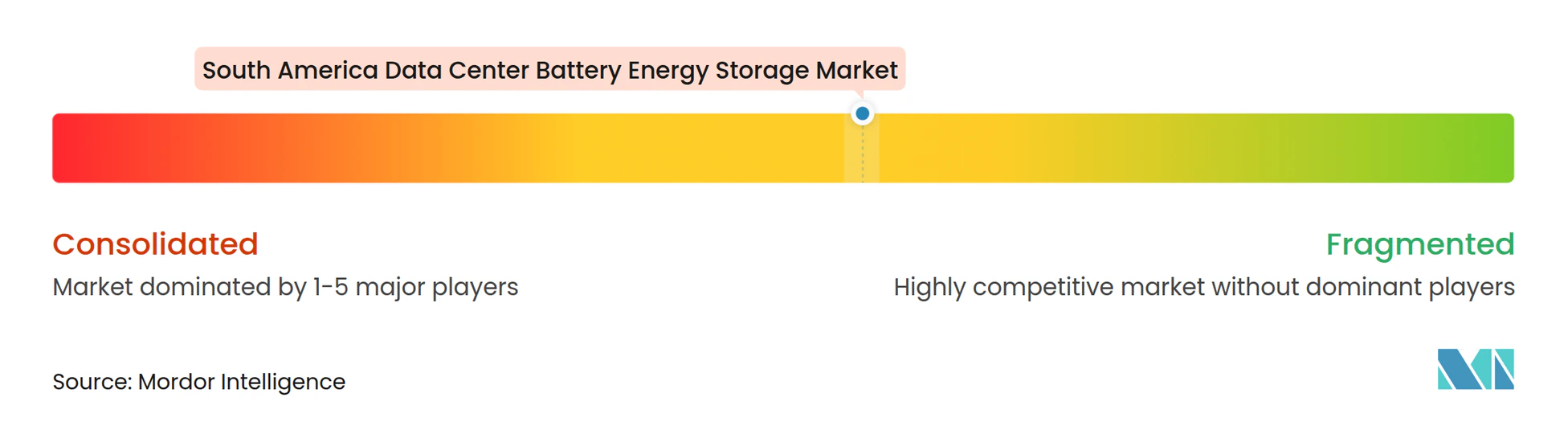
The South America data center battery energy storage market has a concentrated cell-supply layer and a broader system-integration layer. CATL, BYD, Hithium, CALB, Sungrow, and REPT BATTERO compete across LFP supply, system format, delivery timing, and local support. CATL opened a regional office in Chile in 2025. It also introduced the 9 MWh TENER Stack at Smarter E South America in Brazil. BYD signed a 3.5 GWh storage supply agreement with Grenergy for Oasis de Atacama Phase 6. These moves show how suppliers are using large project delivery and regional presence to build credibility.
Established UPS suppliers remain relevant for sites that use lead-acid systems or are pursuing advanced lithium designs. EnerSys identified data centers as a key growth area in its fiscal 2026 reporting. The company combined lead-acid, power electronics, and lithium capabilities through internal centers of excellence. Saft Groupe, Exide Technologies, GS Yuasa, and Leoch Technologies also serve the broader backup power market. New suppliers must demonstrate dependable delivery, compatible systems, and evidence of compliance. The NFPA 855 framework raises the importance of fire testing and documented system safety.
Software and services are an open area for differentiation. Fluence Nispera and FlexGen HybridOS offer platforms for dispatch and asset performance management. ZincFive raised USD 30 million in December 2025 to expand production of nickel-zinc UPS systems for AI-focused facilities. Its approach emphasizes safety and response to dynamic power needs. The competitive landscape will depend on local execution, safety documentation, and the ability to link backup power with energy-management value.[3] Vendors that combine advanced energy management capabilities with proven reliability and safety performance are expected to gain a competitive advantage in the evolving market.
South America Data Center Battery Energy Storage Industry Leaders
-
BYD Company Limited
-
GS Yuasa International Ltd.
-
ZincFive, Inc.
-
Sungrow Power Supply Co., Ltd.
-
EVE Energy Co., Ltd.
- *Disclaimer: Major Players sorted in no particular order
South America Data Center Battery Energy Storage Market Companies Covered in this Report
- Contemporary Amperex Technology Co., Limited
- BYD Company Limited
- Sungrow Power Supply Co., Ltd.
- Trina Storage
- Hithium Energy Storage Technology Co., Ltd.
- EVE Energy Co., Ltd.
- Gotion High-tech Co., Ltd.
- CALB Group Co., Ltd.
- REPT BATTERO Energy Co., Ltd.
- Farasis Energy (Ganzhou) Co., Ltd.
- Narada Power Source Co., Ltd.
- Pylon Technologies Co., Ltd.
- Dyness Digital Energy Technology Co., Ltd.
- Shenzhen Highpower Technology Co., Ltd.
- ZincFive, Inc.
- Saft Groupe S.A.
- EnerSys
- Exide Technologies
- GS Yuasa International Ltd.
- Leoch International Technology Limited
Recent Industry Developments in South America Data Center Battery Energy Storage Market
- October 2026: EnerSys reported Q2 fiscal 2026 net sales growth of 8% year over year, with data centers confirmed as a key growth vector across energy systems. The company’s power electronics center of excellence reduced component validation time from weeks to days, enabling it to support a major communications customer with a full solution in 1 quarter. The same delivery previously required up to 18 months. EnerSys said its lead-acid, power electronics, and lithium centers of excellence were intended to speed product development and improve validation work.
- September 2026: Grenergy reported that the 1,100 MWh Gabriela phase of the Oasis de Atacama BESS project in northern Chile became operational on September 2, 2026. The project added dispatch capacity to one of South America’s largest solar-plus-storage complexes. It demonstrated multi-gigawatt-hour operating capability that data center operators with renewable power agreements can use as a regional reference for campus storage designs.
- August 2026: ENGIE brought BESS Libélula and BESS Los Loros into commercial operation in Chile on August 28, 2026, adding 251 MW of battery storage. Los Loros hosted Chile’s first field pilot of Grid Forming technology under operating conditions on September 21, 2026. The pilot demonstrated grid-support capability that may influence the energy architecture selected for large critical-power facilities.
- July 2026: ESS Tech launched ESS Bridge, a 1.2 MWh modular sodium-ion BESS for AI data centers, utilities, and critical infrastructure. The system operates from -40°C to 50°C and scales to 4.8 MWh in a 20-foot container footprint. It does not present thermal runaway risk. The product therefore addresses fire-suppression complexity that is material in high-density battery installations.
South America Data Center Battery Energy Storage Market Report Scope
The South America Data Center Battery Energy Storage Market comprises battery storage systems and related energy management technologies used by data centers across Brazil, Chile, Colombia, Argentina, Peru, and other South American countries to improve power reliability, optimize electricity costs, enable renewable energy use, and enhance operational resilience. Battery energy storage systems are increasingly deployed to address grid instability, support data-center expansion, and facilitate sustainable power management strategies.
The South America Data Center Battery Energy Storage Market Report is Segmented by Battery Chemistry (Lithium Iron Phosphate [LFP], Nickel Manganese Cobalt [NMC], Lead-Acid, Sodium-Ion, Flow Batteries, and Other Battery Chemistries), System Component (Battery Cells and Modules, Battery Racks and Cabinets, Battery Management Systems [BMS], Power Conversion Systems [PCS], Thermal Management and Safety Systems, and Energy Management Software), Primary Application (UPS and Short-Duration Backup, Extended-Duration Backup Power, Peak Shaving and Load Shifting, Renewable Energy Integration, and Microgrid and Grid Services), Storage Duration (Below 1 Hour, 1-2 Hours, Above 2-4 Hours, and Above 4 Hours), Data Center Size (Small, Medium, Large, and Hyperscale), Data Center Type (Colocation, Cloud Service Providers [CSPs], and Enterprise and Edge), and Geography (Brazil, Chile, Colombia, Argentina, Peru, and Rest of South America). The Market Forecasts are Provided in Terms of Value (USD).
Segmentation Overview
| Lithium Iron Phosphate (LFP) |
| Nickel Manganese Cobalt (NMC) |
| Lead-Acid |
| Sodium-Ion |
| Flow Batteries |
| Other Battery Chemistries |
| Battery Cells and Modules |
| Battery Racks and Cabinets |
| Battery Management Systems (BMS) |
| Power Conversion Systems (PCS) |
| Thermal Management and Safety Systems |
| Energy Management Software |
| UPS and Short-Duration Backup |
| Extended-Duration Backup Power |
| Peak Shaving and Load Shifting |
| Renewable Energy Integration |
| Microgrid and Grid Services |
| Below 1 Hour |
| 1-2 Hours |
| Above 2-4 Hours |
| Above 4 Hours |
| Small |
| Medium |
| Large |
| Hyperscale |
| Colocation |
| Cloud Service Providers (CSPs) |
| Enterprise and Edge |
| Brazil |
| Chile |
| Colombia |
| Argentina |
| Peru |
| Rest of South America |
| By Battery Chemistry | Lithium Iron Phosphate (LFP) |
| Nickel Manganese Cobalt (NMC) | |
| Lead-Acid | |
| Sodium-Ion | |
| Flow Batteries | |
| Other Battery Chemistries | |
| By System Component | Battery Cells and Modules |
| Battery Racks and Cabinets | |
| Battery Management Systems (BMS) | |
| Power Conversion Systems (PCS) | |
| Thermal Management and Safety Systems | |
| Energy Management Software | |
| By Primary Application | UPS and Short-Duration Backup |
| Extended-Duration Backup Power | |
| Peak Shaving and Load Shifting | |
| Renewable Energy Integration | |
| Microgrid and Grid Services | |
| By Storage Duration | Below 1 Hour |
| 1-2 Hours | |
| Above 2-4 Hours | |
| Above 4 Hours | |
| By Data Center Size | Small |
| Medium | |
| Large | |
| Hyperscale | |
| By Data Center Type | Colocation |
| Cloud Service Providers (CSPs) | |
| Enterprise and Edge | |
| By Geography | Brazil |
| Chile | |
| Colombia | |
| Argentina | |
| Peru | |
| Rest of South America |
Key Questions Answered in the Report
What is the South America data center battery energy storage market size?
The sector was valued at USD 0.51 billion in 2026 and is estimated to reach USD 1.15 billion by 2032.
What is driving battery storage demand at South American data centers?
New hyperscale sites, AI power requirements, stronger availability standards, and renewable power integration are supporting demand.
Which battery chemistry leads data center storage deployments in South America?
LFP held 37.18% share in 2026 because it offers thermal stability and a long cycle life for UPS applications.
Why is Chile important for data center battery deployments?
Chile is projected to expand at a 15.61% CAGR through 2032 as hyperscale investment combines with renewable power and grid constraints.
Which data center type uses the largest share of battery energy storage?
Colocation facilities held 60.27% in 2026 because shared power infrastructure serves multiple tenants.
What is the fastest-growing application for data center battery systems?
Renewable energy integration is projected to expand at a 15.92% CAGR through 2032.