
South America Data Center Automation Market Size and Share
Market Overview
| Study Period | 2021 - 2032 |
|---|---|
| Forecast Data Period | 2027 - 2032 |
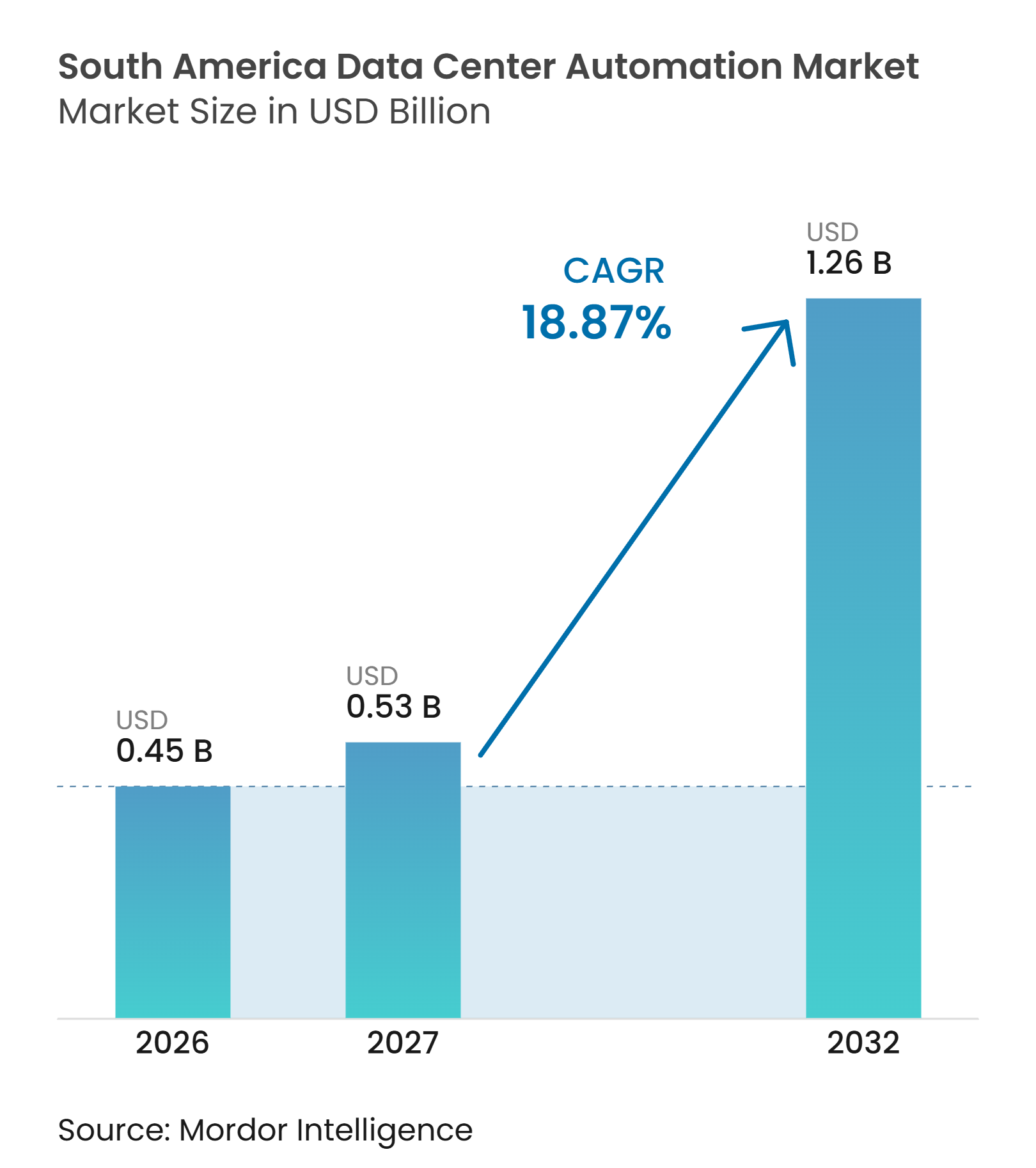
| Base Year Market Size (2026) | USD 0.45 Billion |
| Market Size (2027) | USD 0.53 Billion |
| Market Size (2032) | USD 1.26 Billion |
| Growth Rate (2027 - 2032) | 18.87 % |
| Market Concentration | Medium |
Major Players *Disclaimer: Major Players sorted in no particular order Image © Mordor Intelligence. Reuse requires attribution under CC BY 4.0. | |
South America Data Center Automation Market Analysis by Mordor Intelligence
The South America data center automation market size was valued at USD 0.45 million in 2026 and is projected to reach USD 1.26 billion by 2032, expanding at a CAGR of 18.87% during 2027-2032. The regional pipeline is shifting from general-purpose colocation toward high-density cloud and AI infrastructure, which requires more automated control of power, cooling, and facility operations. New campuses in Brazil, Chile, and Argentina are increasing demand for building management systems, data center infrastructure management platforms, supervisory control and data acquisition systems, and edge controllers. Integrated platforms can shorten commissioning and support lower operating costs where specialist skills are limited. Automation also provides operators with a more practical way to manage power, cooling, security, and IT infrastructure across multiple locations. Tax policy in Brazil, renewable-energy integration, and new cable-linked edge sites may broaden the addressable opportunity, while grid delays and retrofit costs may slow some projects.
Key Report Takeaways
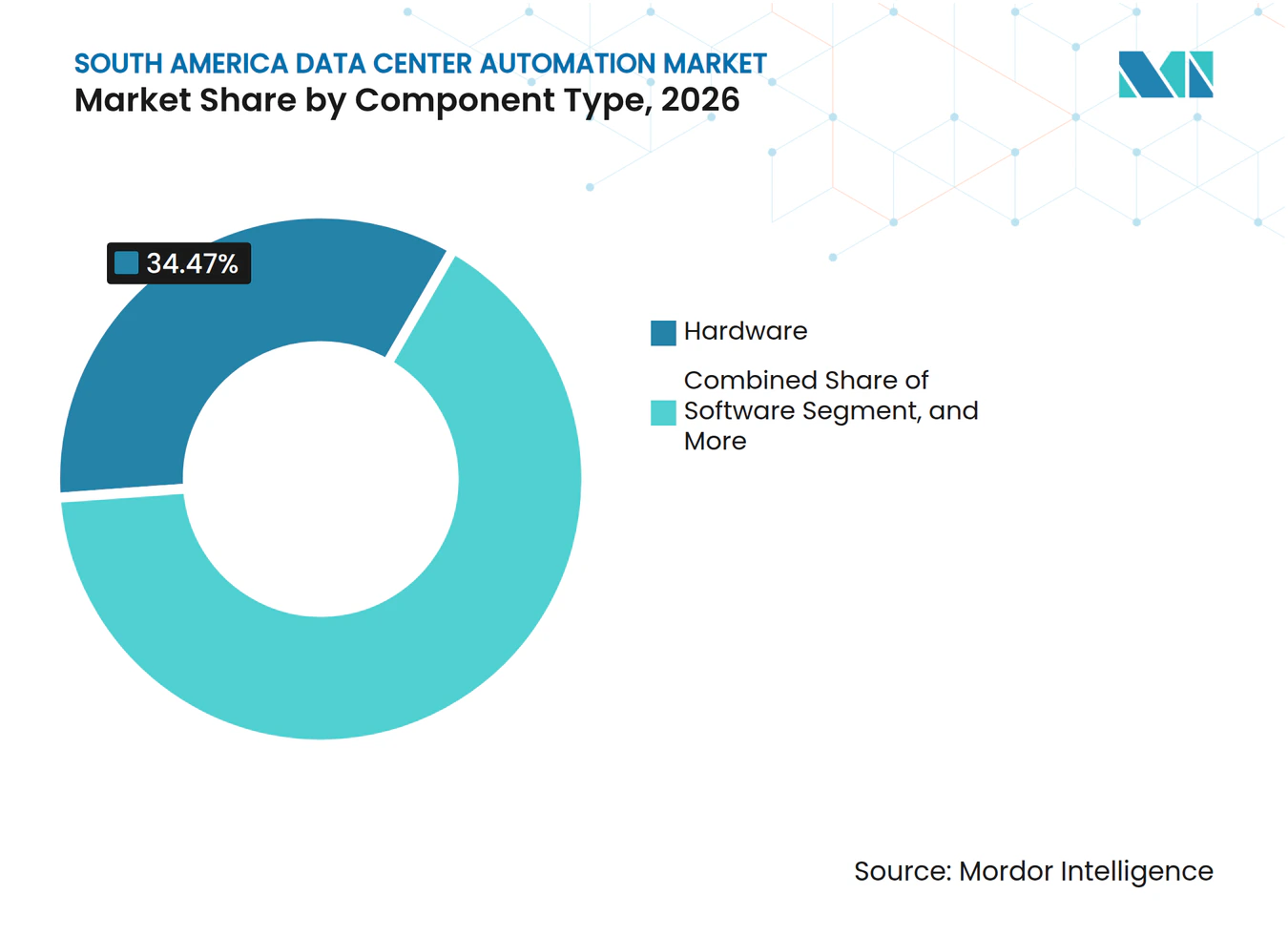
- By component type, hardware held 34.47% of the South America data center automation market in 2026, while software is projected to expand at a 19.47% CAGR through 2032.
- By data center size, hyperscale facilities accounted for 44.92% of the regional total in 2026 and are expected to expand at a 19.63% CAGR through 2032.
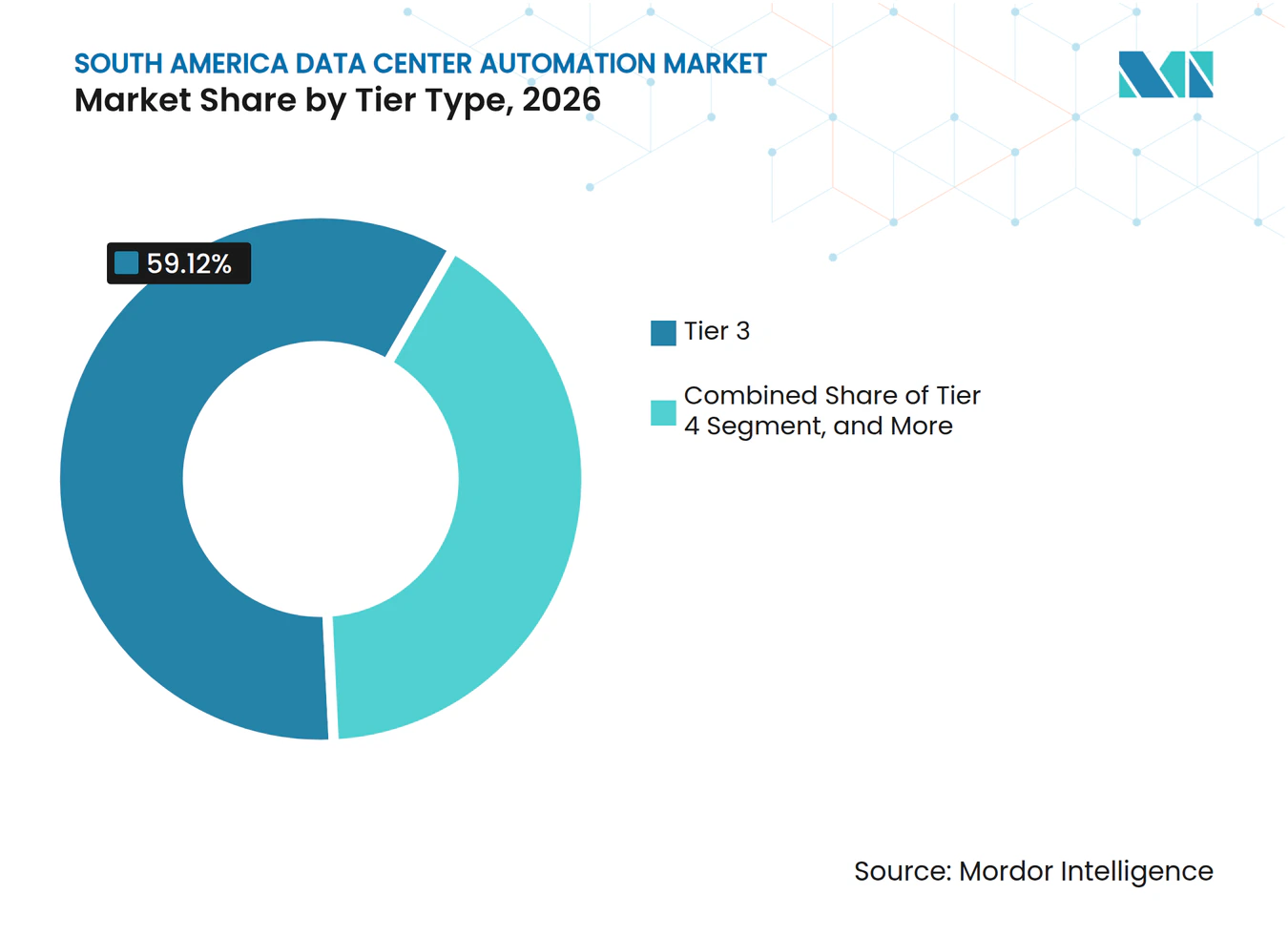
- By tier type, Tier 3 facilities held 59.12% of the South America data center automation market share in 2026, while Tier 4 is projected to expand at a 19.44% CAGR through 2032.
- By geography, Brazil accounted for 68.16% of the regional total in 2026, while Argentina is projected to expand at a 19.68% CAGR through 2032.
Note: Market numbers in this report are based on Mordor Intelligence's proprietary estimation framework, which combines nine months of actuals with Q4 projections for base year 2026.
Market Trends and Insights
Drivers Impact Analysis of South America Data Center Automation Market*
| Driver | (~) % Impact on CAGR Forecast | Geographic Relevance | Impact Timeline |
|---|---|---|---|
| Cloud and Hyperscale Capacity Expansion | +4.8% | Brazil, with spillover to Chile and Argentina | Short term (≤ 2 years) |
| AI and High-Density Compute Driving Autonomous Power and Cooling Control | +4.2% | Brazil, Chile, and Argentina | Short term (≤ 2 years) |
| Cloud, Colocation, and Enterprise Digitalization | +2.8% | Brazil, Chile, and Argentina | Medium term (2-4 years) |
| Renewable-Power Integration and Energy-Optimization Mandates | +2.1% | Brazil, Chile, and Argentina | Medium term (2-4 years) |
| Edge Computing Expansion Along 5G and Submarine-Cable Corridors | +1.8% | Brazil, Argentina, and Chile | Long term (≥ 4 years) |
| Regional Skills and Integration Ecosystem Maturity | +1.2% | Brazil and Chile, with emerging activity in Argentina and the Rest of South America | Long term (≥ 4 years) |
| Source: Mordor Intelligence | |||
Cloud and Hyperscale Capacity Expansion
Cloud and hyperscale investment is making automation a defined capital item rather than an optional operational upgrade in the South America data center automation market. Brazil’s Ministry of Mines and Energy authorized a 5 GW grid connection for Scala AI City in Rio Grande do Sul in May 2025, demonstrating the scale of new power infrastructure entering the regional pipeline. Large campuses need coordinated control of thousands of sensors, actuators, power systems, and failover sequences. These requirements favor integrated data center infrastructure management and supervisory control platforms over separate point tools. The opportunity is strongest where Tier 3 and Tier 4 facilities require repeatable and documented operating procedures. The South America data center automation market, therefore, benefits when new capacity is planned with automation during the design stage rather than installed after commissioning.
AI and High-Density Compute Driving Autonomous Power and Cooling Control
AI workloads increase the need for automated power and cooling control because dense compute environments create tighter thermal operating limits. A 2025 technical article by Jones Lang LaSalle described AI-driven predictive HVAC control that can reduce cooling energy use by 15%-25% in simulations and limited deployments, while improving power usage effectiveness from 1.35 to 1.27 under comparable load conditions. Google has also reported a 40% reduction in cooling energy at one of its facilities through AI-driven cooling optimization. High-density GPU clusters make conventional manual adjustments less suitable because power and cooling conditions can change rapidly. Operators need real-time sensors, predictive controls, and automated response loops to protect equipment availability. This is increasing demand for controllers and software across the South America data center automation market.
Cloud, Colocation, and Enterprise Digitalization
Colocation expansion and enterprise cloud migration are driving demand for automation beyond the largest hyperscale sites. NextStream launched its Intelligent Command Center in November 2025 to centralize real-time management of 10 data centers across South America, combining monitoring of energy, climate control, security, IT infrastructure, and operational performance.[1] Multi-site operators need a common operating view because manual monitoring becomes difficult as portfolios expand. The use of integrated building management, power, and IT service workflows shows how colocation providers are standardizing their operating models. Legacy enterprise facilities also require sensors, energy metering, and remote monitoring before they can be assessed against cloud-provider efficiency expectations. These upgrades create a second demand stream for the South America data center automation market, even where a facility is not being rebuilt.
Renewable-Power Integration and Energy-Optimization Mandates
Renewable power commitments are changing the way operators design and manage data center facilities. In June 2026, GTD and Colbún agreed to supply 100% renewable energy to 3 technology facilities, including the Huérfanos data center in Santiago, with an annual consumption of 2.96 GWh. Chile’s National Data Centers Plan also connects data center development with clean-energy availability and siting criteria for 2025-2027. Such commitments require more accurate power monitoring, energy scheduling, and source verification. Equinix opened SP6 in São Paulo in April 2026 with waterless cooling and liquid-cooling readiness, showing how high-density design is changing thermal management requirements. The South America data center automation market benefits from this shift, as energy management becomes a core part of facility operations and compliance.
Restraints Impact Analysis of South America Data Center Automation Market*
| Restraint | (~) % Impact on CAGR Forecast | Geographic Relevance | Impact Timeline |
|---|---|---|---|
| Grid Interconnection Delays and Reliability Risk | -1.8% | Brazil, Chile, and Argentina | Short term (≤ 2 years) |
| High Upfront Automation and Retrofit Costs | -1.2% | All markets, with greater effect in Argentina and the Rest of South America | Medium term (2-4 years) |
| Shortage of Mission-Critical Automation Specialists | -0.9% | All markets, most acute in Argentina and the Rest of South America | Long term (≥ 4 years) |
| Water-Stress and Environmental Approval Constraints on Cooling Automation | -0.7% | Chile and dense zones in Brazil | Medium term (2-4 years) |
| Source: Mordor Intelligence | |||
Grid Interconnection Delays and Reliability Risk
Grid interconnection remains an immediate constraint for the South America data center automation market. Terranova’s Campinas campus obtained grid approval in early 2026, yet its power plan included a BRL 100 million-plus contract for a GIS substation with Siemens Energy, underscoring the additional infrastructure operators may need to secure. Sites without dependable grid access cannot commission control systems under their intended operating conditions. Power-quality issues can also complicate the operation of programmable controllers, direct digital controllers, and supervisory control systems. Argentine projects outside Buenos Aires may use dedicated renewable microgrids, which can create an automation opportunity but delay standardized commissioning. Vendors may face a gap between facility completion and the full deployment of automation while operators wait for stable power arrangements.
High Upfront Automation and Retrofit Costs
Full automation programs require controllers, sensors, gateways, software licenses, and systems integration services. Retrofit projects can be particularly expensive when older infrastructure lacks standard communications protocols. Brazil’s proposed REDATA regime was intended to change the tax treatment of qualifying data center equipment, but uncertainty about its implementation can affect the economics of smaller projects.[2] Smaller colocation and enterprise facilities must balance initial capital requirements against operating savings across a 10-20-year asset life. Subscription-based monitoring, managed building management systems, and data center infrastructure management access may reduce barriers when an outright purchase is not viable. Those commercial models remain less established in the South America data center automation market than conventional equipment procurement.
*Our forecasts treat driver/restraint impacts as directional, not additive. The impact forecasts reflect baseline growth, mix effects, and variable interactions.
South America Data Center Automation Market Segment Analysis
By Component Type:
Software Leads the Automation Stack EvolutionHardware commanded 34.47% of the regional market in 2026, supported by deployments of programmable logic controllers, direct digital controllers, remote I/O controllers, and precision sensors. Every new facility requires this physical layer before software can process operating data or automate responses. New hyperscale and colocation campuses are specifying controllers and sensors throughout electrical and mechanical systems. Gateways and communication devices are also becoming more important as operators use BACnet, Modbus, and OPC UA to connect legacy systems with newer platforms. Human-machine interface panels and industrial PCs remain relevant where local visibility is needed during network or grid events.
Software is projected to expand at a 19.47% CAGR through 2032, making it the fastest-growing component category. Data center infrastructure management platforms combine power-chain information, cooling telemetry, and IT asset data in common dashboards. They are replacing fragmented building management and supervisory control tools at operators with facilities in several countries. Digital-twin platforms support simulation, capacity planning, and predictive maintenance where high-density AI builds make thermal design more complex. Analytics software for autonomous cooling control is also emerging as a separate category, while design, integration, installation, commissioning, and retrofit services continue to support the South America data center automation industry.



By Data Center Size:
Hyperscale Builds Anchor Regional Automation DemandHyperscale facilities accounted for 44.92% of the South America data center automation market in 2026 and are projected to expand at a 19.63% CAGR through 2032. Their dual leadership reflects the size and technical complexity of large regional campuses. A hyperscale site can require thousands of distributed sensors, redundant controller networks, several supervisory control layers, and real-time data from power distribution units, uninterruptible power supplies, cooling systems, and IT racks. Scala obtained approval in October 2025 for a Tamboré campus in Barueri with 600 MW of capacity across 17 planned data centers. Projects of this scale require integrated automation because manual operating processes cannot manage the full control environment.
Large data centers are the second-largest size group and support demand from multi-tenant colocation expansion in São Paulo, Santiago, and Buenos Aires. Medium-sized facilities show moderate adoption because capital constraints and limited access to integration skills can delay full platform deployment. Small sites have often remained below the cost threshold for integrated building management and data center infrastructure management systems. Subscription monitoring and modular controls are beginning to lower that threshold. This size pattern gives the South America data center automation market high near-term value from hyperscale systems and a longer-term volume opportunity from medium and small installations.
By Tier Type:
Mission-Critical Reliability Standards Reshape Automation AdoptionTier 3 facilities held 59.12% of the South America data center automation market share in 2026. Their N+1 redundancy design makes automated management of power, cooling, and failover both technically necessary and commercially practical. Dual-path systems require coordinated control of parallel uninterruptible power supply strings, automatic transfer switches, and standby generators. Cirion’s SAN2 facility in Chile received Tier III Design Documents certification from the Uptime Institute in April 2026. Tier 1 and Tier 2 facilities have lower automation spending, but they can drive retrofit demand as enterprise rooms are upgraded for cloud migration programs.
Tier 4 is projected to expand at a 19.44% CAGR through 2032. Financial services, government agencies, and AI inference deployments are driving demand for 2N-redundant environments. Tier 4 sites need fault-tolerant controls, hot-standby programmable logic controllers, separate supervisory control communications paths, and ongoing automated testing of backup systems. These requirements increase systems integration fees and demand for enterprise software. Argentina’s RIGI framework is being considered by operators as a possible support mechanism for large infrastructure investments, including more advanced facility builds.

Geography Analysis
Brazil Data Center Automation Market
Brazil held 68.16% of the South America data center automation market in 2026, based on its concentration of hyperscale campuses, colocation facilities, and cable infrastructure. Equinix opened SP6 in Santana de Parnaíba in April 2026 with a USD 114 million investment, advanced cooling, zero-water-evaporation architecture, and liquid-cooling readiness, requiring real-time thermal controls.[3] Equinix reported that its investments in Brazil between 2025 and 2026 exceeded USD 270 million, while Fortaleza’s cable links are extending automation demand beyond São Paulo. Brazil’s national data center policy has linked incentives to energy efficiency and renewable-energy requirements.
Argentina and Chile Data Center Automation Market
Argentina is projected to expand at a 19.68% CAGR through 2032, making it the fastest-growing national market. Wind-rich Patagonian sites support greenfield deployment of supervisory control, building management, and data center infrastructure management platforms. Conecta Infra announced a USD 350 million program to build nearly 6,000 km of owned fiber connecting Chile and Argentina to Brazil’s main data center hubs, supporting multi-site operating platforms and remote management centers. Chile is also gaining attention as a renewable-powered colocation location, with policy direction that emphasizes clean power and appropriate site selection.
South America Data Center Automation Market
The Rest of South America represents a smaller share but remains relevant for edge deployments and cloud-first public digitalization efforts. Uruguay, Colombia, Peru, and Paraguay can add demand at cable nodes and in national or regional facilities. Their opportunity is tied to modular controls, remote monitoring, and managed service models. This pattern gives providers a route to build presence in Lima, Bogotá, and Montevideo before larger local campuses are commissioned.
Competitive Landscape
Market Concentration
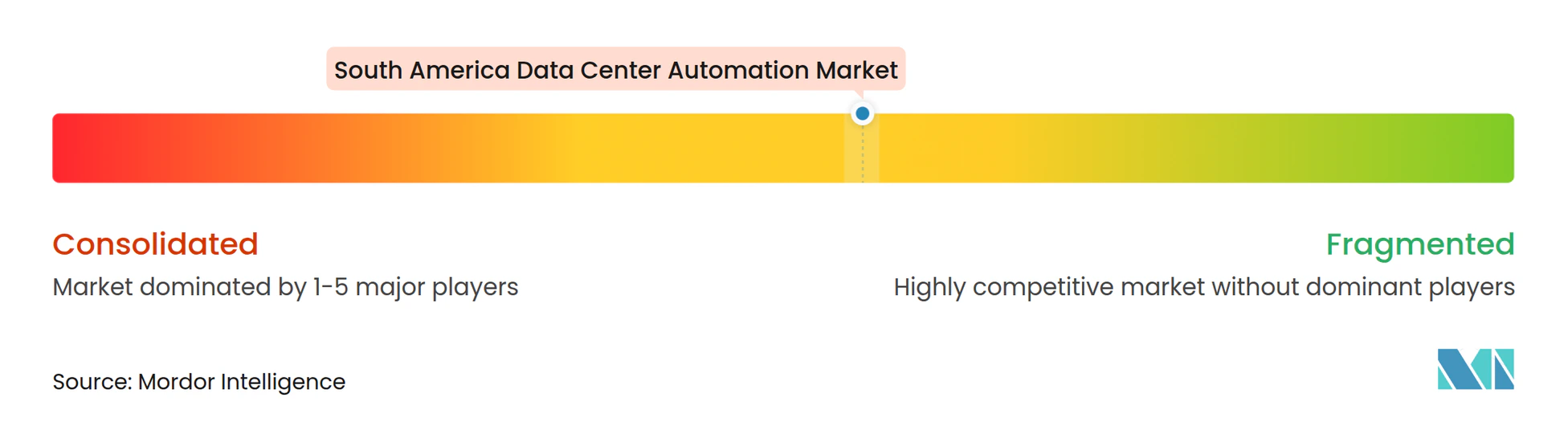
The South America data center automation market is moderately concentrated among Schneider Electric, ABB, Siemens, Vertiv, Honeywell, and Johnson Controls, alongside a fragmented group of regional systems integrators. Large suppliers compete through portfolio breadth across controllers, uninterruptible power systems, building management platforms, power distribution equipment, and related services. ABB deployed its Megaflex uninterruptible power system at a São Paulo colocation facility in April 2026, using a high-efficiency, scalable architecture to differentiate its offering. Siemens Energy also signed a March 2026 contract to supply power infrastructure for Terranova’s Campinas data center sites. These moves show how global suppliers are becoming involved early in campus development rather than limiting engagement to individual equipment orders.
Software and digital platform providers are challenging legacy on-premises systems through remote management, more frequent updates, and greater flexibility in integration. Schneider Electric and Stefanini IHM signed a memorandum of understanding in April 2026 to promote software-defined automation in Brazil.[4] This approach can connect a wider range of equipment through common control and data layers. Tier 4 controls, edge automation near cable landing locations, and subscription monitoring for mid-market facilities are the principal openings.
Competitive differentiation depends on lifecycle support, as data center equipment can remain operational for 15-20 years. Providers that combine power, cooling, monitoring, and services can reduce the number of interfaces that an operator must manage. Regional integrators adapt global systems to local electrical rules, site conditions, and language requirements. The South America data center automation market, therefore, relies on regional implementation partners even when global vendors secure the lead technology contract.
South America Data Center Automation Industry Leaders
-
Schneider Electric SE
-
ABB Ltd
-
Siemens AG
-
Vertiv Holdings Co
-
Johnson Controls International plc
- *Disclaimer: Major Players sorted in no particular order
South America Data Center Automation Market Companies Covered in this Report
- ABB Ltd
- Siemens AG
- Schneider Electric SE
- Honeywell International Inc.
- Johnson Controls International plc
- Vertiv Holdings Co
- Eaton Corporation plc
- Rockwell Automation, Inc.
- Emerson Electric Co.
- Cisco Systems, Inc.
- International Business Machines Corporation
- Microsoft Corporation
- Oracle Corporation
- Hewlett Packard Enterprise Company
- Broadcom Inc.
- Kyndryl Holdings, Inc.
- Equinix, Inc.
- Ascenty Data Centers e Telecomunicações S.A.
- Scala Data Centers Participações S.A.
- ODATA S.A.
Recent Industry Developments in South America Data Center Automation Market
- September 2026: Korkia, a Finnish renewable energy developer, expanded its Chile strategy to include "powered land," pre-permitted, grid-connected sites designed for data center construction. Korkia's Terrazas hybrid project in Coquimbo integrates 280 MW of solar capacity and 1,240 MWh of battery storage, offering an automated renewable energy dispatch infrastructure that data center operators can co-locate with, reducing both permitting timelines and off-take risk.
- July 2026: Solaer Renewable Energies announced a data center campus in Chile's Atacama region combining 197 MW of solar photovoltaic capacity and 500 MWh of battery energy storage, targeting AI and high-performance computing workloads. The battery-integrated architecture requires automated power dispatch and real-time energy-scheduling systems, representing a significant automation scope for control software and hardware vendors.
- July 2026: V.tal and Meta announced progress on the deployment of the Malbec submarine cable extending to Rio Grande do Sul, connecting Porto Alegre, Buenos Aires, and São Paulo with capacity of up to 20 Tbps per fiber pair using technology from Alcatel Submarine Networks. The new route creates an additional digital infrastructure node in southern Brazil that stimulates data center and edge automation demand along a previously underserved corridor.
- June 2026: ODATA advanced Phase 2 of its USD 507 million DC SP04 hyperscale data center project in Osasco, São Paulo, delivering chillers and seven generators to support 24 MW of additional IT capacity. DC SP04 will mark the first deployment in Brazil of ODATA parent company Aligned Data Centers' proprietary Delta Cube (Delta³) air cooling technology, a proprietary system requiring purpose-built automated thermal controls.
South America Data Center Automation Market Report Scope
The scope of the South America Data Center Automation Market includes the adoption of automation technologies designed to improve data center operational efficiency, infrastructure management, resource utilization, and service reliability. The report examines the deployment of automation solutions for IT infrastructure monitoring, workload orchestration, power and cooling management, facility operations, and performance optimization. It evaluates the key market drivers, emerging technological trends, challenges, and growth opportunities shaping the regional market, including the increasing demand for cloud computing, digital transformation, energy-efficient operations, and expanding data center capacity.
The South America Data Center Automation Market Report is Segmented by Component Type (Hardware, Software, and Services), Data Center Size (Hyperscale, Large, Medium, and Small), Tier Type (Tier 1 and 2, Tier 3, and Tier 4), and Geography (Brazil, Chile, Argentina, and Rest of South America). The Market Forecasts are Provided in Terms of Value (USD).
Segmentation Overview
| Hardware | Programmable Logic Controllers (PLCs) |
| Direct Digital Controllers (DDCs) | |
| Remote I/O and Field Controllers | |
| Sensors and Monitoring Devices | |
| Gateways and Communication Devices | |
| Human Machine Interface (HMI) Panels | |
| Other Automation Hardware (Others include industrial PCs (IPCs), edge controllers, protocol converters, industrial network switches, embedded automation controllers, among others) | |
| Software | Building Management and Automation Systems (BMS/BAS) |
| Supervisory Control and Data Acquisition (SCADA) | |
| Data Center Infrastructure Management (DCIM) | |
| Digital Twin Platforms | |
| Analytics and Optimization Software | |
| Other Automation Software (Others include engineering and configuration software, historian software, alarm management software, among others) | |
| Services | Design and Consulting Services |
| System Integration Services | |
| Installation and Commissioning Services | |
| Monitoring, Maintenance, and Support Services | |
| Retrofit and Modernization Services |
| Hyperscale |
| Large |
| Medium |
| Small |
| Tier 1 and 2 |
| Tier 3 |
| Tier 4 |
| Brazil |
| Chile |
| Argentina |
| Rest of South America |
| By Component Type | Hardware | Programmable Logic Controllers (PLCs) |
| Direct Digital Controllers (DDCs) | ||
| Remote I/O and Field Controllers | ||
| Sensors and Monitoring Devices | ||
| Gateways and Communication Devices | ||
| Human Machine Interface (HMI) Panels | ||
| Other Automation Hardware (Others include industrial PCs (IPCs), edge controllers, protocol converters, industrial network switches, embedded automation controllers, among others) | ||
| Software | Building Management and Automation Systems (BMS/BAS) | |
| Supervisory Control and Data Acquisition (SCADA) | ||
| Data Center Infrastructure Management (DCIM) | ||
| Digital Twin Platforms | ||
| Analytics and Optimization Software | ||
| Other Automation Software (Others include engineering and configuration software, historian software, alarm management software, among others) | ||
| Services | Design and Consulting Services | |
| System Integration Services | ||
| Installation and Commissioning Services | ||
| Monitoring, Maintenance, and Support Services | ||
| Retrofit and Modernization Services | ||
| By Data Center Size | Hyperscale | |
| Large | ||
| Medium | ||
| Small | ||
| By Tier Type | Tier 1 and 2 | |
| Tier 3 | ||
| Tier 4 | ||
| By Geography | Brazil | |
| Chile | ||
| Argentina | ||
| Rest of South America | ||
Key Questions Answered in the Report
What is the South America data center automation market size?
The South America data center automation market size was USD 0.45 million in 2026 and is estimated to reach USD 1.26 billion by 2032, at an 18.87% CAGR during 2027-2032.
Which component is expanding fastest in data center automation?
Software is projected to expand at a 19.47% CAGR through 2032 as operators adopt portfolio-level monitoring, digital twins, and automated cooling analytics.
Why are hyperscale facilities important for automation demand?
Hyperscale facilities held 44.92% of the regional total in 2026 and are expected to expand at a 19.63% CAGR through 2032 because they need dense, integrated control systems.
Which country leads regional automation spending?
Brazil accounted for 68.16% of the regional total in 2026, supported by its concentration of hyperscale campuses, colocation sites, and cable infrastructure.
What constrains deployment of automated data center systems?
Grid interconnection delays, high retrofit costs, limited mission-critical skills, and environmental approvals for cooling can delay projects or increase deployment costs.
Which facility tier has the strongest current position?
Tier 3 held 59.12% of the regional total in 2026 because its N+1 redundancy requirements make automated power, cooling, and failover controls necessary.