
South America Data Center Transformer Market Size and Share
Market Overview
| Study Period | 2021 - 2032 |
|---|---|
| Forecast Data Period | 2027 - 2032 |
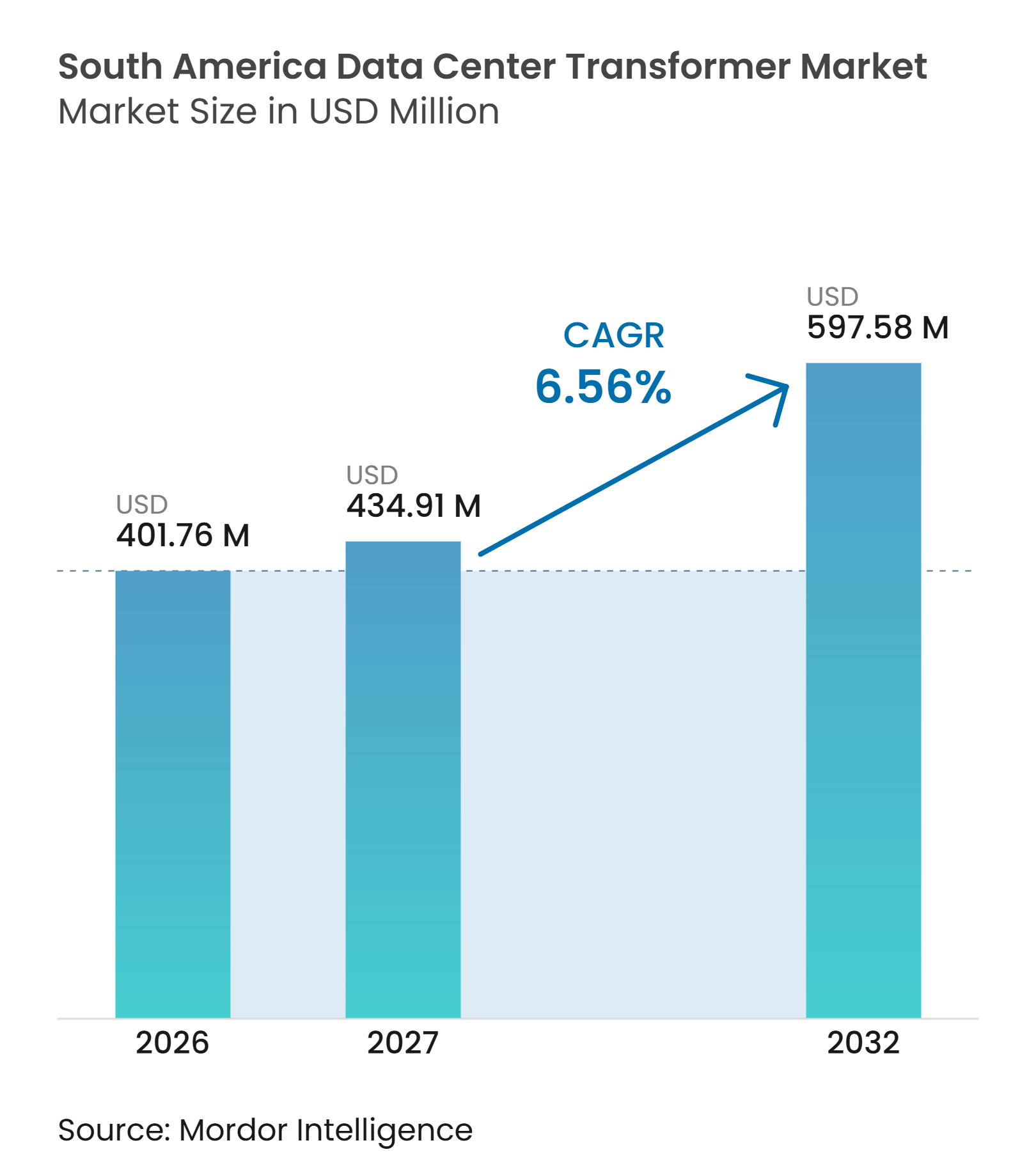
| Base Year Market Size (2026) | USD 401.76 Million |
| Market Size (2027) | USD 434.91 Million |
| Market Size (2032) | USD 597.58 Million |
| Growth Rate (2027 - 2032) | 6.56 % |
| Market Concentration | Medium |
Major Players *Disclaimer: Major Players sorted in no particular order Image © Mordor Intelligence. Reuse requires attribution under CC BY 4.0. | |
South America Data Center Transformer Market Analysis by Mordor Intelligence
The South America data center transformer market size is projected to expand from USD 401.76 million in 2026 and USD 434.91 million in 2027 to USD 597.58 million by 2032, registering a CAGR of 6.56% between 2027 to 2032. Demand is shifting toward equipment that can support larger electrical loads at AI-focused campuses, where dependable delivery and technical support increasingly influence equipment selection. Developers are placing transformer orders earlier because delivery timing can affect project schedules, particularly when grid connection, civil work, and power equipment commissioning must align. Renewable electricity procurement is becoming a site-selection consideration, especially for operators with clean-energy commitments, and this changes the balance between grid availability, renewable supply, and the location of new campuses. Local manufacturing is gaining importance because it can reduce delivery time, transport exposure, and import costs, while also allowing suppliers to coordinate more closely with developers and local contractors. Grid access, transmission upgrades, water availability, land use, and permits can delay the conversion of announced projects into equipment orders, leaving suppliers to manage a pipeline in which project timing can change materially.
Key Report Takeaways
- By transformer type, liquid-immersed units held 63.31% of the South America data center transformer market share in 2026, while dry-type units are projected to expand at a 7.68% CAGR through 2032.
- By power rating, the above-10-to-30-MVA segment accounted for 35.43% of the South America data center transformer market size in 2026, while above-30-MVA units are projected to expand at a 7.53% CAGR through 2032.
- By voltage level, medium voltage units held 51.40% of the market in 2026, while high voltage units are projected to expand at a 7.69% CAGR through 2032.
- By installation, outdoor configurations accounted for 54.73% of the market in 2026 and are projected to expand at a 7.89% CAGR through 2032.
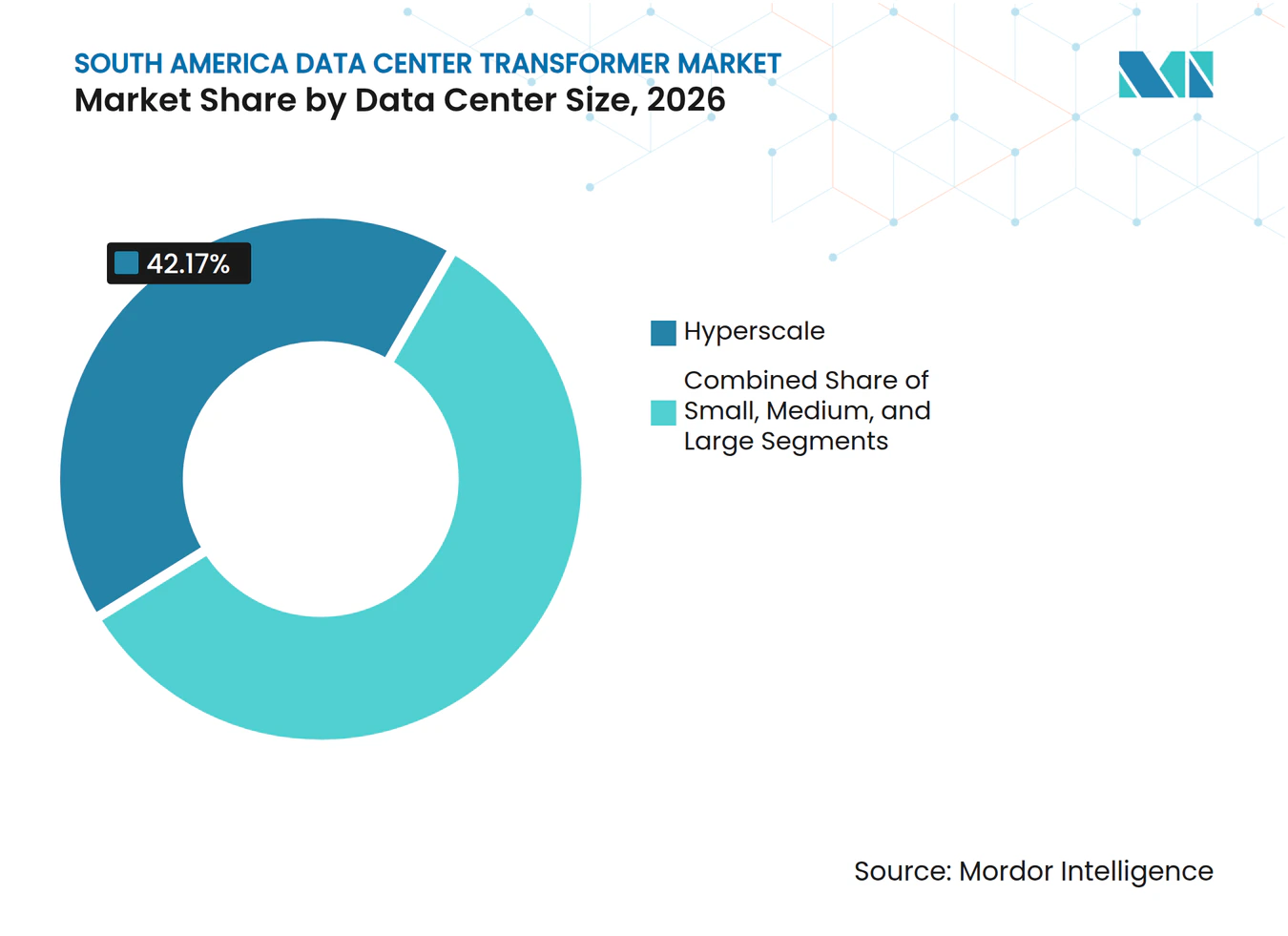
- By data center size, hyperscale facilities held 42.17% of the market in 2026 and are projected to expand at an 8.21% CAGR through 2032.
- By data center type, colocation facilities held 39.46% of the market in 2026, while cloud service providers are projected to expand at a 7.97% CAGR through 2032.
- By geography, Brazil held 48.30% of the market in 2026 and is projected to expand at an 8.10% CAGR through 2032.
Note: Market numbers in this report are based on Mordor Intelligence's proprietary estimation framework, which combines nine months of actuals with Q4 projections for base year 2026.
Market Trends and Insights
Drivers Impact Analysis of South America Data Center Transformer Market*
| Driver | (~) % Impact on CAGR Forecast | Geographic Relevance | Impact Timeline |
|---|---|---|---|
| Hyperscale and Artificial Intelligence Data Center Expansion | +1.6% | Brazil primary, Chile, Argentina | Short term (≤ 2 years) |
| Cloud, Colocation, and Digital Infrastructure Investment | +1.3% | Brazil, Chile | Short term (≤ 2 years) |
| Renewable-Energy Procurement and Green Data Center Development | +0.9% | Brazil, Chile, Argentina | Medium term (2-4 years) |
| Data Localization and In-Country Processing Requirements | +0.8% | Brazil, Chile | Medium term (2-4 years) |
| High-Voltage Grid Connection Requirements for AI Campuses | +0.6% | Brazil primary | Medium term (2-4 years) |
| Local Transformer Manufacturing and Shorter Delivery Lead Times | +0.4% | Brazil | Long term (≥ 4 years) |
| Source: Mordor Intelligence | |||
Hyperscale and Artificial Intelligence Data Center Expansion
Ascenty announced a USD 1.2 billion plan in 2026 for 4 AI-dedicated data centers in São Paulo state. The Sumaré 3 facility alone represents USD 720 million of the planned investment and is intended for hyperscale AI workloads, illustrating the move from general cloud capacity toward facilities designed around computing-intensive AI applications and their associated electrical systems. AI training clusters can require high rack densities, which increases the electrical capacity needed at each campus and raises the need for coordinated transformer, substation, protection, and distribution design. Terranova contracted Siemens Energy in March 2026 for 2 transformers rated at 150 MVA and a 300 MW gas-insulated substation for its Campinas campus. The contract shows how a data center development can require equipment more commonly associated with a transmission project, which increases the importance of proven manufacturing capacity and detailed commissioning plans. These purchases can favor suppliers that can provide high-capacity equipment and secure production slots before construction begins, because late electrical equipment can affect the timing of the entire facility.
Cloud, Colocation, and Digital Infrastructure Investment
Amazon Web Services confirmed a USD 4 billion investment for its first cloud region in Chile, with 3 availability zones scheduled to operate in the second half of 2026. The commitment adds demand for switchgear, step-down equipment, and distribution transformers across the main grid connection as well as the internal power architecture of each availability zone. BNDES approved a BRL 180 million (USD 34 million) credit line for Scala Data Centers in March 2025 to support equipment acquisition and installation, demonstrating that financing for digital infrastructure can support power equipment purchases in addition to the building work itself. Colocation operators can build AI-ready power capacity before they have a signed tenant for every portion of a site, allowing them to respond more quickly when cloud customers need capacity. This approach moves transformer procurement earlier in the development cycle and gives manufacturers more visibility before a facility begins full construction. It also extends demand beyond projects that hyperscalers own directly.
Renewable-Energy Procurement and Green Data Center Development
Renewable supply arrangements are becoming more important where operators seek to meet clean-electricity commitments. OMNIA Data Centers and Casa dos Ventos signed a self-generation agreement in May 2026 for up to 300 MW of average wind capacity for the Pecém Data Center. The agreement is valued at USD 2 billion and uses wind capacity from Ceará and Piauí, linking data center power demand to renewable generation assets in more than 1 state. SkyOnline also signed a 3-year agreement with YPF Luz in March 2026 for 7,200 MWh each year from wind and solar assets. That supply is intended to cover nearly 85% of the electricity demand at its Buenos Aires data center, giving the operator a more direct link between its facility operations and renewable generation resources. Variable renewable generation can raise the importance of transformer configurations that support the relevant grid and power-purchase arrangement, including equipment choices that fit the operating requirements of the site.
Data Localization and In-Country Processing Requirements
Data protection requirements can encourage local capacity when regulated organizations need domestic processing arrangements. Chile's Law 21.719 reached full enforcement in December 2026.[1] The law can increase local infrastructure demand from financial and health care organizations that manage sensitive information. Brazil also applies conditions to international transfers of personal data through its data protection framework, creating an additional compliance consideration for companies deciding where to process information and locate supporting computing infrastructure. These rules can support demand for facilities that need medium-voltage and distribution equipment, as regulated users seek locations that meet operational and data-handling requirements. The South America data center transformer market can therefore benefit from regulated-sector investment even when projects are smaller than hyperscale campuses, because a broad group of users needs dependable local computing capacity.
Restraints Impact Analysis of South America Data Center Transformer Market*
| Restraint | (~) % Impact on CAGR Forecast | Geographic Relevance | Impact Timeline |
|---|---|---|---|
| Long Utility Interconnection and Transmission-Upgrade Lead Times | -1.4% | Brazil primary, Chile, Argentina | Short term (≤ 2 years) |
| High Transformer, Switchgear, and Substation Capital Costs | -1.1% | South America, broad | Medium term (2-4 years) |
| Grid Instability Outside Tier-One Data Center Hubs | -0.7% | Argentina, Rest of South America | Medium term (2-4 years) |
| Water, Land, and Permitting Constraints for Large Campuses | -0.5% | Chile, Brazil Northeast | Long term (≥ 4 years) |
| Source: Mordor Intelligence | |||
Long Utility Interconnection and Transmission-Upgrade Lead Times
Grid access is an immediate constraint on the pace of data center development in Brazil. ONS introduced fixed application windows known as Access Seasons, which lengthened the access-opinion process for some applicants and made connection timing a more visible part of project planning for developers, utilities, and equipment providers. Ascenty submitted an application in January 2025 and faced an estimated additional 16-month wait beyond the standard review period. Renewable projects can reach operation within 2 years, while transmission reinforcement can require up to 5 years. Developers in the Barueri, Campinas, and Vinhedo cluster can need dedicated high-voltage equipment where the existing network cannot absorb additional load, increasing both the upfront engineering requirement and the financing need. This timing gap can defer transformer orders even when the underlying project pipeline remains active, because manufacturers cannot fully convert interest into firm orders without a clear connection schedule.
High Transformer, Switchgear, and Substation Capital Costs
High-voltage substations require substantial investment before a facility can be energized. The Terranova contract for a 300 MW gas-insulated substation and 2 150 MVA transformers exceeded BRL 100 million (USD 18.6 million), for the electrical infrastructure component. That amount excluded civil works, cabling, and commissioning, showing that transformer hardware is one part of a larger power-infrastructure budget that must be funded before a site begins operating. Equipment lead times and constrained production capacity can further increase procurement pressure for buyers, particularly when several large developments seek similar high-capacity units at the same time. The cost is particularly challenging for projects that lack access to major incentive programs or large anchor tenants. These requirements can limit smaller developments while increasing the value of suppliers that offer integrated equipment packages, design support, and reliable after-sales services.
*Our forecasts treat driver/restraint impacts as directional, not additive. The impact forecasts reflect baseline growth, mix effects, and variable interactions.
South America Data Center Transformer Market Segment Analysis
By Transformer Type:
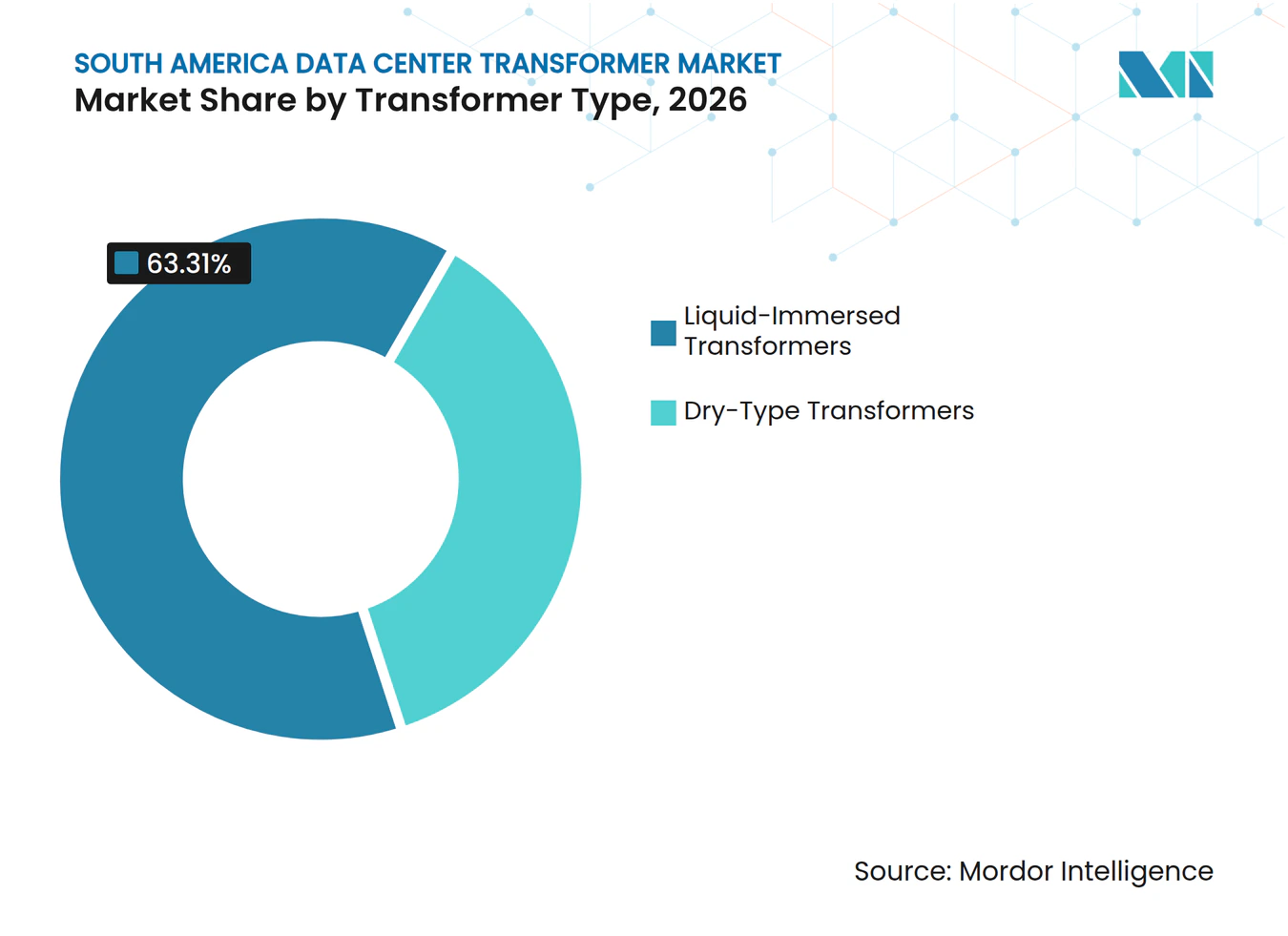
Liquid-Immersed Designs Support Large Campus Power RequirementsLiquid-immersed units held 63.31% of the South America data center transformer market share in 2026. Their thermal capacity makes them suitable for high-MVA outdoor substations that serve large data center campuses, where equipment must operate reliably under sustained electrical loads. Their cost per MVA can also be lower than dry-type alternatives in transmission-level applications, making them a practical choice where developers need large electrical capacity and have sufficient land for outdoor equipment. WEG supplied transformers for Elea's 50 MW high-voltage site in São Paulo, with units manufactured at the company's Gravataí facility and delivered in mid-2025.[2] The supply arrangement shows how local production can support equipment procurement for large projects, especially when developers need equipment that matches local standards, construction schedules, site conditions, technical documentation needs, reliable long-term maintenance access, and ongoing service expectations.
Dry-type transformers are projected to expand at a 7.68% CAGR through 2032. They are suited to indoor electrical rooms and modular data center layouts where fire safety requirements influence equipment selection. Operators building phased sites can integrate dry-type units into prefabricated power modules. This approach can reduce site assembly time and allow developers to commit capital in stages, a consideration for operators expanding capacity in response to tenant demand. Large direct grid connections are more likely to use liquid-immersed units at the interconnection point. Indoor installations can therefore support dry-type demand even as large outdoor substations retain their central role, because space constraints, fire requirements, and modular building designs differ materially from one development to another.


By Power Rating:
Above-30-MVA Units Meet AI Campus RequirementsWithin the South America data center transformer market, the above-10-to-30-MVA band accounted for 35.43% of the South America data center transformer market size in 2026. It remains relevant to colocation and mid-scale cloud facilities that have shaped regional demand to date, where capacity additions can be more gradual than at a hyperscale campus. These units can also be deployed in multiples where a developer needs redundancy and staged expansion, allowing the power system to be expanded as more data halls are brought online. The middle tier can provide steady order volumes for suppliers with established production lines, complementing the less frequent but larger orders for transmission-class equipment. It is therefore important, even as individual campus requirements become much larger.
Above-30-MVA units are projected to expand at a 7.53% CAGR through 2032. Terranova ordered 2 transformers rated at 150 MVA for its Campinas site, showing how one AI campus can create several large-format orders. The equipment was ordered before the start of construction to secure delivery capacity, underlining how purchasing decisions can be made well before a developer begins visible work on the data center site. Sub-10-MVA units continue to serve enterprise and edge facilities in secondary cities and in earlier-stage national markets. The South America data center transformer market will need both high-capacity units for large campuses and smaller units for distributed installations, with product availability shaped by the differing needs of each project type.
By Voltage Level:
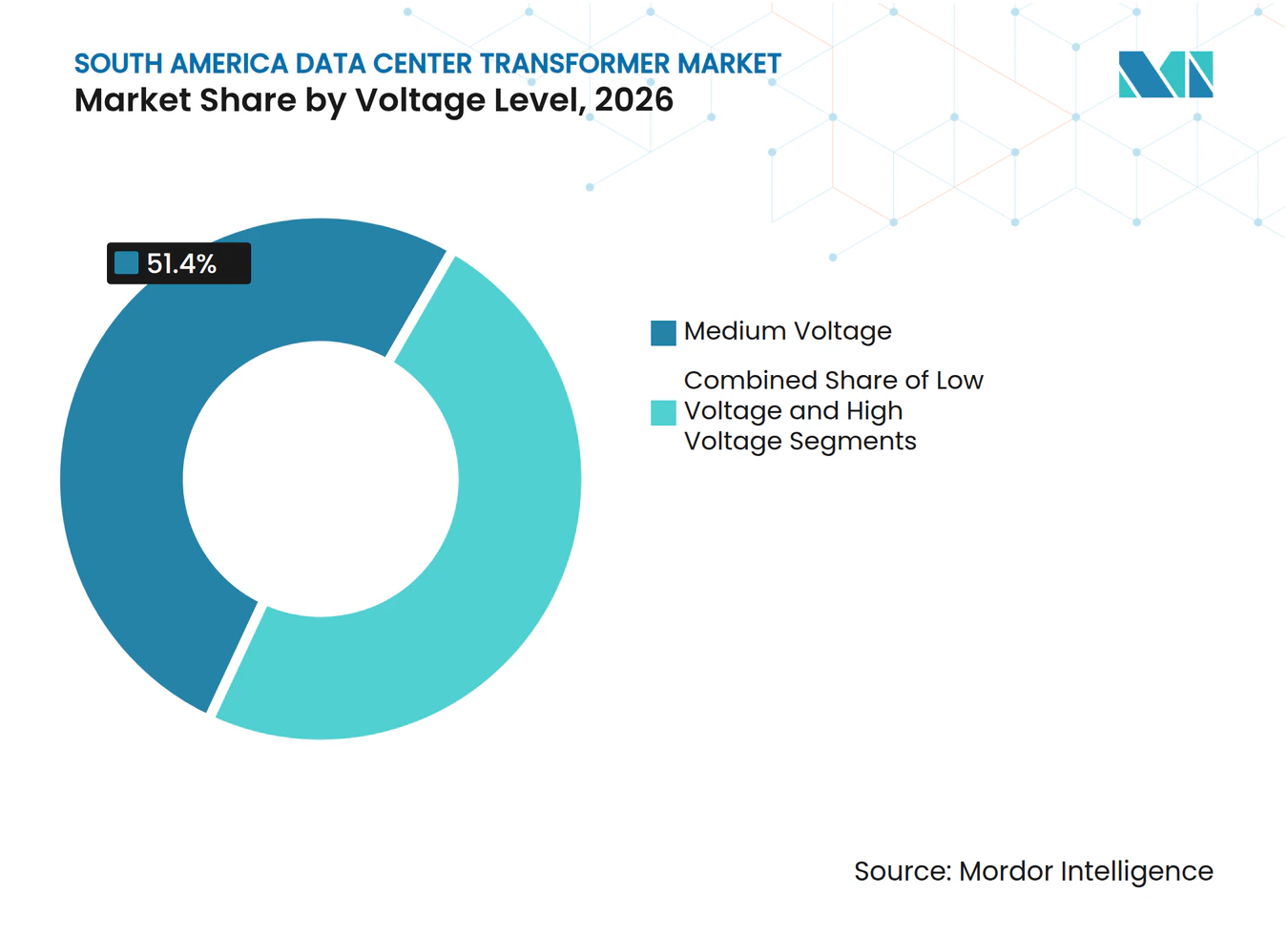
Medium Voltage Remains the Base, While High Voltage AcceleratesWithin the South America data center transformer market, medium voltage equipment held 51.40% of the market in 2026. It supports the distribution architecture of colocation and enterprise facilities that connect through the utility's medium-voltage network. This interconnection model remains common in established Brazilian data center centers, including São Paulo, Rio de Janeiro, and Campinas, where operators have built networks of colocation and enterprise facilities over time. Low-voltage transformers serve internal distribution and are linked more closely to facility fit-out requirements. Demand in this part of the segment is stable, but its pace is lower than the demand created by major grid connections.
High voltage units are projected to expand at a 7.69% CAGR through 2032. Large AI campuses increasingly need direct transmission-level connections because their electrical requirements exceed those of traditional facilities, which changes how power infrastructure is specified and contracted. This shift changes the range of transformer specifications that operators request. Compliance with IEC 60076 remains relevant to tender processes for large power transformers, since developers and operators can use factory acceptance requirements to confirm the equipment meets their technical and operational criteria. Hitachi Energy uses its TrafoStar platform to apply common design and quality-control practices across its factories, which can support factory acceptance requirements.


By Installation:
Outdoor Equipment Aligns With Greenfield Campus DevelopmentWithin the South America data center transformer market, outdoor configurations accounted for 54.73% of the market in 2026. These systems fit dedicated substation compounds that provide access, cooling, and space for expansion, making them appropriate for projects designed to add data halls over several phases. Brazil's São Paulo-area clusters and Chile's Santiago corridor have projects that use this type of site arrangement, reflecting the availability of larger development sites outside dense urban locations. Large liquid-immersed transformers can be located outdoors near the main electrical connection. The design is well suited to campus-style development with substantial electrical loads, because outdoor layouts can accommodate larger equipment, provide service access, and preserve room for later expansion without major changes to the building.
Outdoor equipment is projected to expand at a 7.89% CAGR through 2032. The combination of leading share and the highest installation growth rate shows continued demand for greenfield facilities, which generally provide more freedom to design power infrastructure around future capacity needs. Terranova placed its order for 150 MVA transformers in March 2026, 5 months before the August groundbreaking. Indoor dry-type installations remain relevant for urban and edge sites where building rules make outdoor liquid-immersed equipment less practical. National and local electrical and building requirements can therefore create a separate demand path for indoor systems.
By Data Center Size:
Hyperscale Facilities Combine Leading Share and GrowthWithin the South America data center transformer market, hyperscale facilities held 42.17% of the market in 2026. These projects generate high-value transformer orders because AI workloads require more extensive power infrastructure than conventional sites, including larger substations and more detailed protection and distribution systems. Elea announced Rio AI City in May 2025, with an initial capacity of 1.5 GW and potential expansion to 3.2 GW. The project is designed to use 100% certified renewable energy.[3] It demonstrates the size of electrical infrastructure that a large campus can require, including grid connection planning, transformer selection, internal distribution equipment, and renewable supply arrangements that must be coordinated over several years.
The hyperscale segment is projected to expand at an 8.21% CAGR through 2032. Large facilities continue to serve domestic enterprises and cloud providers that are expanding beyond their first sites. Medium and small data centers remain important to government bodies, financial institutions, and enterprise users with local processing needs, and their procurement activity supports a wider base of regional demand. Their equipment requirements provide an ongoing base for medium-voltage and indoor dry-type units. Hyperscale orders are more concentrated and can affect production schedules for high-capacity equipment. The South America data center transformer market must therefore balance large project orders with recurring demand from smaller facilities.
By Data Center Type:
Colocation Supplies a Broad Customer BaseWithin the South America data center transformer market, colocation facilities held 39.46% of the market in 2026. These operators aggregate demand from cloud providers, enterprises, and public-sector organizations, giving them a continuing need to plan power capacity before each tenant is known. The model is particularly useful in Chile, Argentina, and smaller South American markets where single-tenant ownership remains less established. It concentrates transformer procurement within facilities that serve several customer groups, which can create repeat business for suppliers as the site expands. This makes colocation an important source of recurring power-equipment demand, since operators can add capacity in phases as existing tenants expand and prospective customers request new space.
Cloud service providers are projected to expand at a 7.97% CAGR through 2032. Elea won Petrobras's data center construction and operation tender in September 2025, a BRL 2.3 billion (USD 500 million) agreement. The project demonstrates that enterprise and government contracts can also create substantial transformer requirements. Enterprise and edge sites continue to require medium-voltage and indoor dry-type equipment. Colocation providers can pre-build AI-ready capacity for cloud tenants, which makes the division between the 2 business models less clear.
Geography Analysis
Brazil held 48.30% of the regional market share in 2026 and is projected to expand at an 8.10% CAGR through 2032. The country has the largest regional base of data center infrastructure and a large project pipeline, supporting demand across both new campus development and additions to operating facilities that need more electrical capacity. Brazil's data center inventory reached 706 MW in August 2026, after an increase of 106 MW from December 2025. An additional 660 MW was under construction, while 56% of that capacity was pre-committed. BNDES approved a BRL 180 million (USD 34 million) credit line for Scala in March 2025. Grid-access rules and transmission constraints around São Paulo remain important limits on project execution, so not every announced investment can become a near-term equipment order.
Within the South America data center transformer market, Chile is the region's second-largest data center location by installed capacity, with 66 data centers and 258-280 MW of capacity. Amazon Web Services committed USD 4 billion to its first cloud region in Chile, with 3 availability zones scheduled for the second half of 2026. Its position as a submarine cable landing point supports demand from international cloud providers and latency-sensitive workloads, while its domestic policy setting can support facilities serving local organizations with data and service requirements. Law 21.719 reaches full enforcement in December 2026 and adds data protection requirements that can support local facilities for financial and health care operators. Environmental permitting, land use, and water constraints can affect the timing of large projects, requiring developers to consider local conditions before they set procurement schedules.
Within the South America data center transformer market, Argentina had 40 MW of installed capacity in October 2026, compared with Chile's 258-280 MW. OpenAI and Sur Energy signed a letter of intent in October 2025 for Stargate Argentina, which targets up to 500 MW and potential investment of USD 25 billion. Argentina's RIGI program offers fiscal and customs benefits for qualifying large investments, but its USD 200 million threshold can make incremental projects more difficult, leaving mid-scale operators to weigh infrastructure requirements against the size of their planned capacity additions. Paraguay, Peru, Colombia, and Andean markets provide a longer-term opportunity for the South America data center transformer market. X8 Cloud announced a plan in December 2025 to invest up to USD 50 billion in Paraguay across 30 years. Permits, grid approvals, and capital availability will determine how quickly these projects convert into transformer orders, with outcomes likely to vary widely across national markets.
Competitive Landscape
Market Concentration
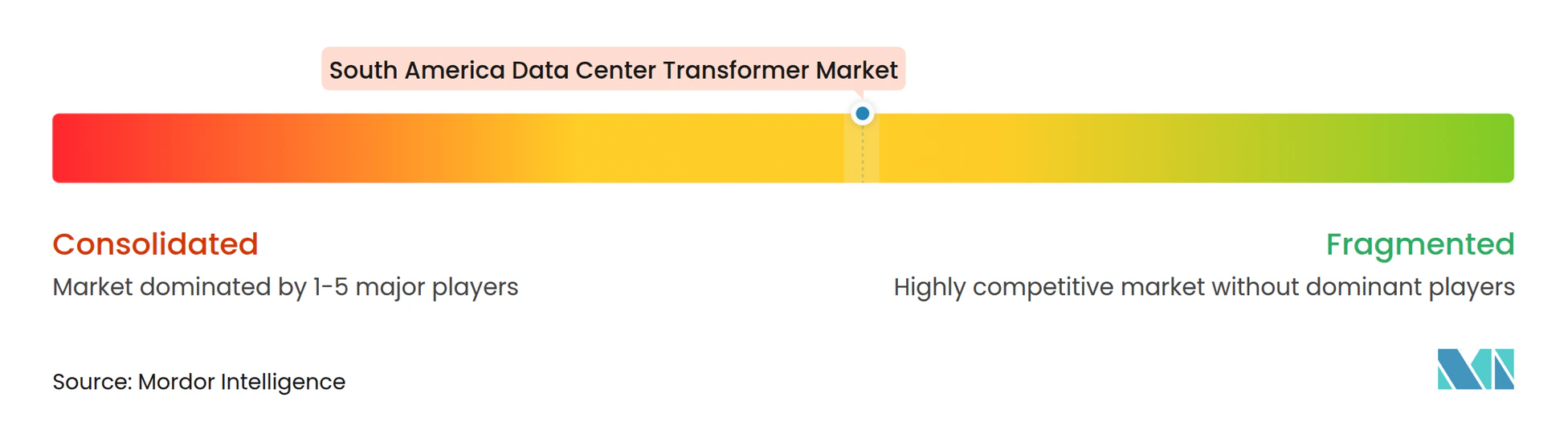
The South America data center transformer market has a moderately fragmented competitive structure. In the South America data center transformer market, ABB, Hitachi Energy, Siemens Energy, Eaton, Schneider Electric, and WEG compete with Brazilian specialists that serve regional customers. WEG has a strong domestic position because it has local manufacturing capability and an agreement to supply Elea's AI-focused project in São Paulo. Its transformers were manufactured at Gravataí and delivered in mid-2025. In the South America data center transformer market, local production can shorten delivery time and reduce exposure to duties and logistics costs, while allowing manufacturers to work more directly with local engineering firms, construction contractors, and owners during project execution. This advantage is especially relevant in price-sensitive projects below 30 MVA, where buyers can compare suppliers closely on logistics, lead time, service availability, and total delivered cost.
Hitachi Energy is investing USD 200 million in Brazil, including a transformer factory in Pindamonhangaba. The first phase covers 46,300 m² and is expected to double the company's local output capacity by mid-2028. Siemens Energy signed a March 2026 contract for Terranova that includes 2 150 MVA transformers and a 300 MW gas-insulated substation. The package brings transformer and substation supply together for a customer that needs coordinated delivery, reducing the number of interfaces that the developer must manage during construction. Eaton and Siemens Energy also announced a June 2025 collaboration around modular data center power plants with standardized on-site generation. Such bundled offerings can reduce coordination requirements for operators that need several elements of electrical infrastructure, which can be important when site commissioning depends on several equipment categories being installed and tested in sequence.
Trafomec Equipamentos Elétricos, Trafo Equipamentos Elétricos, and RMV Transformadores serve parts of the local mid-market with locally produced equipment. Hyosung Heavy Industries, SGB-SMIT Group, and Mitsubishi Electric can compete for project-specific orders above 30 MVA. Argentina and other South American markets have low installed capacity and could allow early suppliers to form long-term supply relationships. Competitive outcomes will depend on manufacturing capacity, delivery schedules, compliance documentation, technical support, and access to local installation partners, rather than on equipment price alone. The South America data center transformer market creates an advantage for suppliers that can meet high-capacity requirements without delaying a project's energization, particularly when power availability is a central condition of project approval. No company shares were provided, so the competitive position of individual suppliers cannot be ranked by revenue. The available evidence instead shows competition between global suppliers with large-project capabilities and local producers with delivery and cost advantages.
South America Data Center Transformer Industry Leaders
-
ABB Ltd
-
Eaton Corporation plc
-
General Electric Company
-
WEG S.A.
-
Mitsubishi Electric Corporation
- *Disclaimer: Major Players sorted in no particular order
South America Data Center Transformer Market Companies Covered in this Report
- ABB Ltd
- Eaton Corporation plc
- General Electric Company
- Hitachi Energy Ltd
- Siemens Energy AG
- Schneider Electric SE
- WEG S.A.
- Toshiba Energy Systems and Solutions Corporation
- Mitsubishi Electric Corporation
- SGB-SMIT Group
- Hyosung Heavy Industries Corporation
- Virginia Transformer Corp.
- Hammond Power Solutions Inc.
- Legrand SA
- TBEA Co., Ltd.
- Efacec
- Celme S.r.l.
- Fuji Electric Co., Ltd.
- Trafomec Equipamentos Elétricos Ltda.
- Trafo Equipamentos Elétricos S.A.
- RMV Transformadores Ltda.
Recent Industry Developments in South America Data Center Transformer Market
- October 2026: Hitachi Energy has announced a BRL 385 million (USD 77 million) investment to expand critical transformer component manufacturing in Brazil. This initiative underscores the company's long-term commitment to advancing Brazil's electricity infrastructure. Furthermore, the expansion aligns with Hitachi Energy’s broader USD 9 billion global strategy to scale production capacity and accelerate the clean energy transition worldwide.
- March 2026: Hitachi Energy announced an additional USD 150 million investment to expand its power transformer manufacturing across Latin America, boosting capacity to meet surging global demand for electrification and accelerate grid infrastructure. The investment deepens Hitachi Energy’s manufacturing footprint and reinforces the region’s role as a key provider of transformers to the Americas, Europe, and other markets. In Colombia, USD 80 million will go toward expanding and improving the efficiency of the Dosquebradas (Risaralda) transformer factory, while in Brazil, USD 70 million will build on previously announced investments to strengthen and accelerate the expansion of the Pindamonhangaba and Guarulhos sites.
- March 2026: Siemens Energy signed a contract exceeding BRL 100 million (USD 18.6 million) with Terranova for a 300 MW gas-insulated substation and 2 440/34.5 kV, 150 MVA power transformers for the Campinas data center campus. The equipment is manufactured at Siemens Energy's Jundiaí plant and is scheduled for delivery in 2027.
- January 2026: RT-One and Hitachi Energy announced a collaboration to power RT-One's AI data center campuses in Uberlândia and Maringá. Each campus has an initial capacity of 100 MW and planned expansion beyond 400 MW per site, backed by BRL 15 billion (USD 3 billion) in total project funding.
South America Data Center Transformer Market Report Scope
The South America data center transformer market comprises the regional demand and revenue generated by electrical transformers optimized for the unique power infrastructure needs of data centers across Latin American nations. This market is rapidly expanding due to accelerating investments in local cloud infrastructure, edge computing, and colocation facilities, particularly across major hubs in Brazil, Argentina, Chile, and other countries in the region.
The South America Data Center Transformer Market Report is Segmented by Transformer Type (Liquid-Immersed Transformers and Dry-Type Transformers), Power Rating (Up to 10 MVA, Above 10 MVA to 30 MVA, and Above 30 MVA), Voltage Level (Low Voltage, Medium Voltage, and High Voltage), Installation (Indoor Installation and Outdoor Installation), Data Center Size (Small, Medium, Large, and Hyperscale), Data Center Type (Colocation, Cloud Service Provider, and Enterprise Data Centers/Edge), and Country (Brazil, Argentina, Chile, and Rest of South America). The Market Forecasts are Provided in Terms of Value (USD).
Segmentation Overview
| Liquid-Immersed Transformers |
| Dry-Type Transformers |
| Up to 10 MVA |
| Above 10 MVA to 30 MVA |
| Above 30 MVA |
| Low Voltage |
| Medium Voltage |
| High Voltage |
| Indoor Installation |
| Outdoor Installation |
| Small |
| Medium |
| Large |
| Hyperscale |
| Colocation |
| Cloud Service Provider |
| Enterprise Data Centers/Edge |
| Brazil |
| Argentina |
| Chile |
| Rest of South America |
| By Transformer Type | Liquid-Immersed Transformers |
| Dry-Type Transformers | |
| By Power Rating | Up to 10 MVA |
| Above 10 MVA to 30 MVA | |
| Above 30 MVA | |
| By Voltage Level | Low Voltage |
| Medium Voltage | |
| High Voltage | |
| By Installation | Indoor Installation |
| Outdoor Installation | |
| By Data Center Size | Small |
| Medium | |
| Large | |
| Hyperscale | |
| By Data Center Type | Colocation |
| Cloud Service Provider | |
| Enterprise Data Centers/Edge | |
| By Geography | Brazil |
| Argentina | |
| Chile | |
| Rest of South America |
Key Questions Answered in the Report
What is the South America data center transformer market size?
The South America data center transformer market is projected to increase from USD 401.76 million in 2026 to USD 597.58 million by 2032, at a 6.56% CAGR from 2027 to 2032.
Which transformer type leads data center demand in South America?
Liquid-immersed transformers lead with a 63.31% share in 2026 because they support high-MVA outdoor substations used by large campuses.
Why are high-voltage transformers becoming more important for data centers?
AI-focused campuses need larger direct grid connections, which supports a projected 7.69% CAGR for high-voltage equipment through 2032.
Which data center customer type creates the largest demand for transformers?
Colocation facilities hold a 39.46% share in 2026 because they serve cloud providers, enterprises, and public-sector customers.
Which country has the largest demand for data center transformers in South America?
Brazil holds 48.30% of regional demand in 2026 and is projected to expand at an 8.10% CAGR through 2032.
What factors can delay new data center power projects?
Utility interconnection timing, transmission upgrades, substation costs, water, land, and permits can delay project completion and equipment procurement.