
Market Overview
| Study Period | 2021 - 2031 |
|---|---|
| Forecast Data Period | 2026 - 2031 |
| Base Year Market Size (2025) | USD 54.84 Billion |
| Market Size (2026) | USD 56.5 Billion |
| Market Size (2031) | USD 67.27 Billion |
| Growth Rate (2026 - 2031) | 3.55 % |
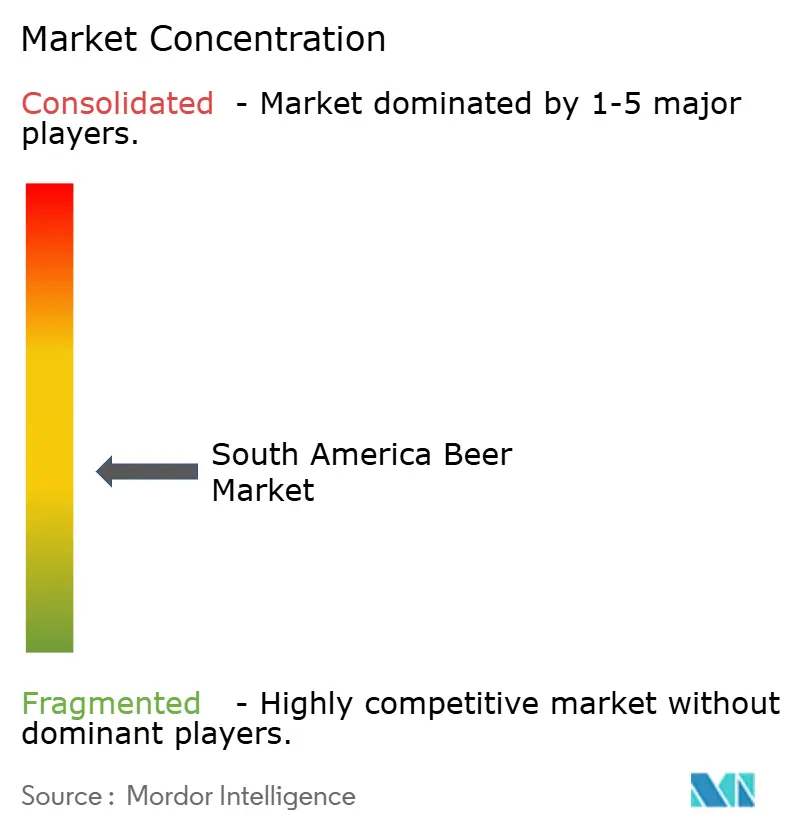
| Market Concentration | Medium |
Major Players *Disclaimer: Major Players sorted in no particular order Image © Mordor Intelligence. Reuse requires attribution under CC BY 4.0. | |
South America Beer Market Analysis by Mordor Intelligence
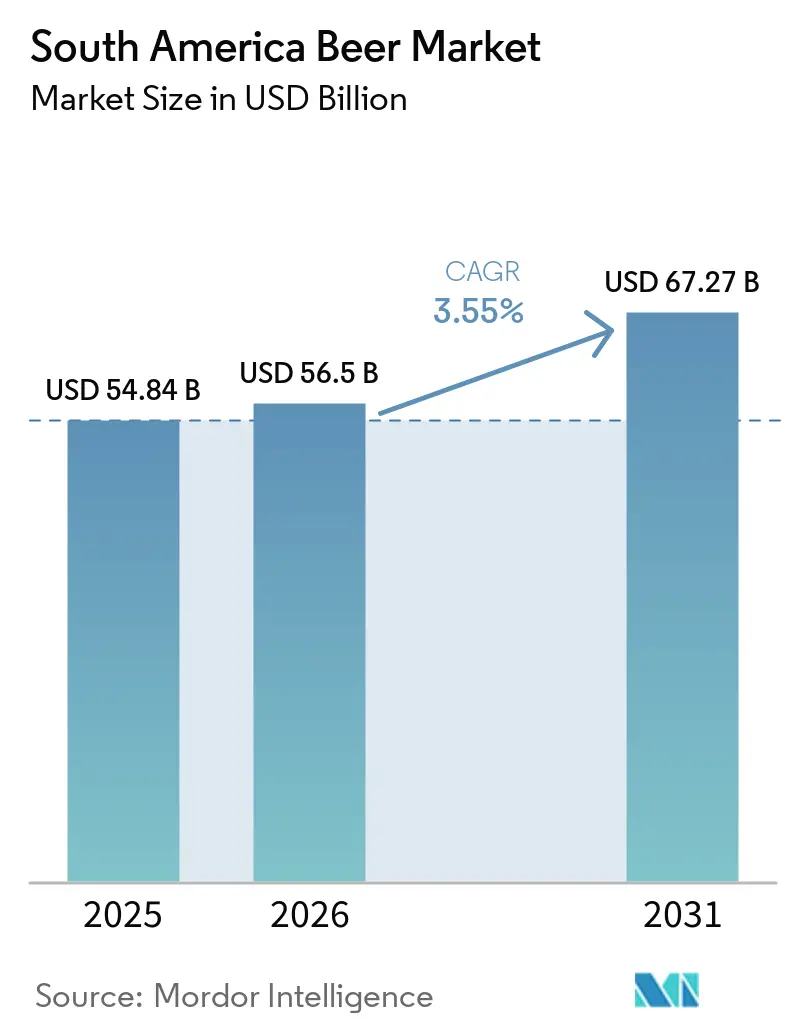
The South America beer market size was USD 54.84 billion in 2025 and is projected to reach USD 56.50 billion in 2026 and USD 67.27 billion by 2031, growing at a CAGR of 3.55% through the forecast period. The South America beer market is supported by urban population growth, consumer spending gains, and investments by large brewers in mainstream and premium capacity. Premium products, non-alcoholic offerings, and digital ordering give producers ways to protect revenue when volume demand is uneven. Brazil remains the region’s value center, although cold weather and pressure on household spending reduced beer volumes in 2025. Peru offers faster expansion, supported by product launches and greater on-premise activity. The South America beer market also faces pressure from new taxes, competing alcohol categories, and a growing preference for ready-to-drink products [1].
Key Report Takeaways
- By product type, lager held 86.15% of the South America beer market share in 2025, while non/low-alcohol beer is projected to grow at a 5.21% CAGR through 2031.
- By category, mass held 78.53% of the South America beer market share in 2025, while premium is projected to grow at a 4.73% CAGR through 2031.
- By packaging type, bottles held a 58.16% share in 2025, while cans are projected to grow at a 3.87% CAGR through 2031.
- By distribution channel, off-trade held a 56.33% share in 2025 and is projected to grow at a 4.05% CAGR through 2031.
- By geography, Brazil held a 47.06% share in 2025, while Peru is projected to grow at a 5.67% CAGR through 2031.
Note: Market size and forecast figures in this report are generated using Mordor Intelligence’s proprietary estimation framework, updated with the latest available data and insights as of January 2026.
South America Beer Market Trends and Insights
Drivers Impact Analysis*
| Driver | (~) % Impact on CAGR Forecast | Geographic Relevance | Impact Timeline |
|---|---|---|---|
| Rising Demand for Affordable Alcoholic Beverages | +0.7% | Brazil, Bolivia, Ecuador, Paraguay | Short term (≤ 2 years) |
| Expanding Premium and Craft Beer Offerings | +0.6% | Brazil, Chile, Argentina, Colombia | Medium term (2-4 years) |
| Growing Popularity of Convenient Canned Packaging | +0.4% | Brazil, Argentina, Chile | Short term (≤ 2 years) |
| Increasing Adoption of Digital Beer Delivery | +0.3% | Brazil, Colombia, Peru | Medium term (2-4 years) |
| Growing Investment in Local Brewing Capacity | +0.5% | Brazil, Colombia, Peru | Long term (≥ 4 years) |
| Growth in Bars, Restaurants, and Nightlife | +0.4% | Brazil, Peru, Colombia, Chile | Short term (≤ 2 years) |
| Source: Mordor Intelligence | |||
Rising Demand for Affordable Alcoholic Beverages
Mass-market beer remains important to the South America beer market because many consumers favor accessible price points and familiar brands available through neighborhood retail. Ambev reported mid-single-digit volume growth for its Brahma and Antarctica core brands in 2025, even as the wider Brazilian beer category declined. This result indicates that value brands can retain demand during periods of lower household spending because they meet routine social occasions without requiring a shift to higher-priced products. Beer also retains an affordability advantage over spirits in many regional markets because excise treatment is generally lower, which protects its position when consumers compare spending across alcohol categories. Legalized online gambling in Brazil may compete for household discretionary spending, adding pressure beyond weather-related volume effects and making recovery more dependent on consumer priorities. These conditions keep price architecture, pack affordability, dependable local availability, and clear brand value central to the South America beer market.
Expanding Premium and Craft Beer Offerings
Premiumization gives the South America beer market a path to improve value per hectoliter even when total volumes soften, which reduces the link between category volume and revenue performance. Ambev reported 17% volume growth in its premium portfolio during 2025, while its core brands declined by high single digits. The company reported a normalized EBITDA margin of 34.9% for Brazil Beer after a 110 basis point expansion, showing the earnings value of a better product mix and the role of premium labels in supporting margins. Heineken commissioned a BRL 2.5 billion brewery in Passos, Brazil, in 2026 with an initial annual capacity of 500 million liters for pure-malt and premium brands. Bavaria also commissioned its Yumbo brewery in Colombia during 2025, supported by fixed-price contracts with local farms that help manage an important production input. These actions show that established producers are investing in premium capacity, brand quality, and more secure inputs in the South America beer market.
Growing Popularity of Convenient Canned Packaging
Cans are gaining a larger role in the South America beer market because they are portable, cool quickly, and can be recycled through established aluminum collection systems. Brazil sold 34.1 billion aluminum cans in 2025, which was the country’s second-highest recorded volume and confirmed the scale of the local can supply chain. Cans represented a significant share of retail beer sales in Brazil and gained 3% to 5% share points each year against glass in the supplied data, which supports continued investment in the format. The 2026 FIFA World Cup is expected to support demand in stadium, event, and outdoor settings where portability matters and returnable bottles may be less practical. Ambev’s annual production of more than 15 billion cans gives it a cost advantage over producers that buy cans in the open market. In Chile, recent craft launches in recyclable aluminum also show that cans are used for premium positioning, product freshness, and mass convenience.
Increasing Adoption of Digital Beer Delivery
Digital ordering is changing how the South America beer market reaches consumers and retailers by creating sales routes that operate alongside traditional stores and wholesale networks. Zé Delivery finished 2025 with 27 million registered consumers, 67 million annual orders, and BRL 4.7 billion in gross merchandise value. AB InBev’s BEES business platform processed USD 13.3 billion in gross merchandise value in the third quarter of 2025, up 11% year over year, which shows the platform’s role in trade ordering. The platform gives the brewer retailer-level sales and inventory information that can support pricing, promotion, assortment, and replenishment decisions. The Ta Da direct-to-consumer model is being extended to Colombia and Peru, taking the approach beyond Brazil and giving the company a more consistent regional model. Smaller delivery providers, including Jão Delivery, indicate that online beverage delivery remains competitive outside the largest cities and has not become a single-company channel.
Restraints Impact Analysis*
| Restraint | (~) % Impact on CAGR Forecast | Geographic Relevance | Impact Timeline |
|---|---|---|---|
| Rising Excise Taxes and Regulatory Compliance Costs | -0.6% | Brazil, Chile, Colombia, Argentina | Medium term (2-4 years) |
| Strong Competition from Wine and Spirits | -0.5% | Argentina, Chile, Uruguay, Brazil | Long term (≥ 4 years) |
| Increasing Health Concerns Surrounding Alcohol Consumption | -0.4% | Brazil, Argentina, Chile, Colombia | Medium term (2-4 years) |
| Strict Advertising and Alcohol Marketing Restrictions | -0.3% | Colombia, Chile, Brazil | Long term (≥ 4 years) |
| Source: Mordor Intelligence | |||
Rising Excise Taxes and Regulatory Compliance Costs
Brazil’s Complementary Law 214/2025 creates a Selective Tax on alcoholic beverages that takes effect in 2027. The tax combines an ad valorem component with a specific charge linked to alcohol content and volume. Higher-alcohol and larger-format products therefore face a heavier burden than lower-alcohol alternatives. Chile applies a 20.5% ad valorem beer excise before VAT, while Argentina applies beer excise of 8% to 14% in the supplied tax summary. These requirements are harder for craft and independent producers to manage because they do not have the same tax and compliance resources as multinational brewers. The result may favor consolidation in the South America beer market, especially in lower-margin product lines [2].
Strong Competition from Wine and Spirits
Wine competes directly with beer in Argentina, Chile, and Uruguay because it has a strong cultural role, local production depth, and on-trade presence. The supplied IWSR data showed Brazil beer volume declining 4% and beer value declining 5% in 2025. It also projected 26% growth in Colombian beer consumption between 2025 and 2035, suggesting that category pressure differs across the region. Ready-to-drink beverages are also becoming a stronger alternative for casual drinking occasions in Latin America. Brewers are responding through flavored and zero-alcohol variants, but these additions require more complex portfolios and distribution. Competition across drinking occasions will remain a constraint on the South America beer market.
*Our forecasts treat driver/restraint impacts as directional, not additive. The impact forecasts reflect baseline growth, mix effects, and variable interactions.
Segment Analysis
By Product Type: Lager Leads While Non/Low-Alcohol Beer Expands
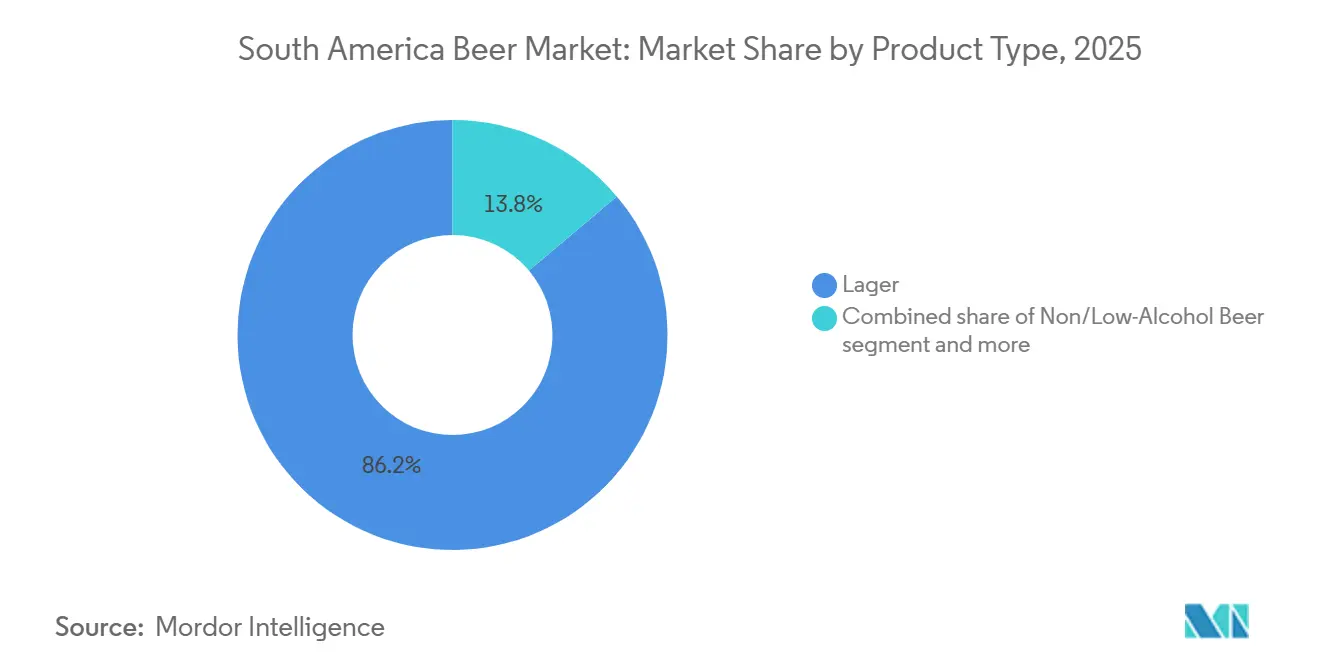
Lager accounted for 86.15% of the South America beer market in 2025, reflecting strong demand for light, refreshing pale lagers in tropical and subtropical countries. Standard-strength lager faced volume pressure in Brazil during 2025. At the same time, Heineken and Ambev invested in capacity and marketing for pure-malt lager. Non/low-alcohol beer is the fastest-growing product type and is forecast to expand at a 5.21% CAGR through 2031. The supplied data showed non-alcoholic beer volume rising 10.4% across Latin America and the Caribbean in 2025, compared with 6.5% globally. Ambev reported nearly 30% growth in its non-alcoholic beer volume in Brazil in 2025.
Backus introduced Cusqueña Trigo Cero Alcohol in Peru during 2025 through supermarkets and bodegas, using both national retail and smaller neighborhood outlets to reach consumers. The launch extended national availability for a locally produced wheat non-alcoholic beer and moved the offer beyond imported alternatives. An Argentine craft brewer also introduced a beer below 0.5% ABV during 2025, showing that lower-alcohol development includes both national brewers and smaller specialists. Ale and specialty products remain smaller parts of the category but benefit from craft events and interest in flavored and locally inspired products across Peru and Colombia. The South America beer industry is therefore seeing competition shift within styles as consumers choose between alcoholic and lower-alcohol alternatives rather than abandoning familiar beer styles entirely. Zero-alcohol products can also reach occasions such as workday lunches and designated-driver settings, which broadens the addressable drinking occasions for established brands.

By Category: Mass Supports Volume While Premium Builds Value
Mass beer held 78.53% of the South America beer market size in 2025, reflecting broad household reach in Brazil, Peru, and Bolivia. Brands such as Brahma, Cristal, Pilsen, and Águila support this position across income groups. Premium beer is forecast to grow at a 4.73% CAGR through 2031. Ambev’s Corona, Stella Artois, Spaten, and Original brands recorded 17% volume growth during 2025. This helped stabilize Brazil Beer net revenue despite a 4.5% decline in total beer volume. Premium products declined 1% in 2025, while core brands declined by high single digits in the supplied data.
Cerpa is seeking to raise premium products to 33% of volume from 5% after its 2025 Coca-Cola distribution agreement, giving the brewer a route to more customers across Brazil. Its strategy illustrates how a mid-tier brewer can use wider distribution to reposition its portfolio instead of competing only on a value offering. The 2026 FIFA World Cup also offers a major platform for premium brand activity in Brazil, Colombia, and Chile, where brewers can link product availability to event consumption. Heineken delayed price increases in Brazil during 2025 by 2 to 3 months relative to Ambev. The supplied data linked that decision to a 1.6 percentage point increase in its Brazil share during the first half of 2025, primarily from the mass tier. The South America beer industry consequently depends on price timing, distribution reach, and product quality when consumers move between mass and premium choices.
By Packaging Type: Bottles Lead While Cans Gain Use Cases
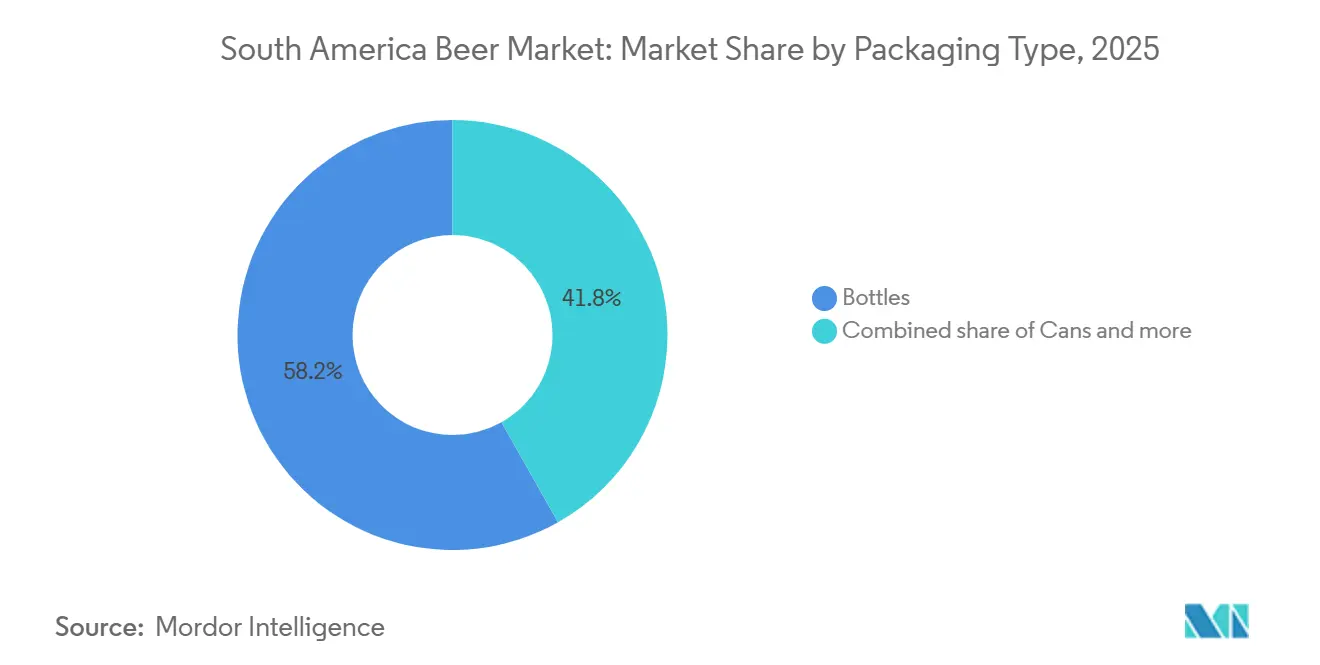
Bottles held 58.16% of the South America beer market size in 2025 because returnable glass remains widely used in households and on-trade venues. The format is especially important in Brazil and Argentina, where return systems reduce material cost per unit. Ambev launched a returnable-glass bottling line in Goiás during 2025 with capacity for 60,000 bottles an hour. The company is also building a BRL 870 million glass facility in Paraná. These investments show that returnable bottles remain strategically important despite faster growth in cans. Kegs and PET continue to serve on-trade and draught demand in Brazil and Peru.
Cans are forecast to grow at a 3.87% CAGR through 2031 in the South America beer market, making them the fastest-growing packaging format in the supplied segmentation. Their convenience fits retail, events, and outdoor use, while aluminum recycling supports packaging claims relevant to listed brewers. Brazil’s 34.1 billion can volume in 2025 provides a large manufacturing base for the format and supports greater retail availability. Ambev’s integrated annual can production of more than 15 billion units helps reduce exposure to aluminum spot-price changes and can shorten supply planning. Smaller producers that buy cans externally do not have the same procurement advantage, particularly when demand rises around large events. The continued use of cans by Chilean craft brewers shows that the format is relevant to premium products, product design, and high-volume retail brands.
By Distribution Channel: Off-Trade Leads Sales and Digital Access
Off-trade held 56.33% of the South America beer market share in 2025 and is forecast to expand at a 4.05% CAGR through 2031. Supermarkets, hypermarkets, and discount retailers underpin this channel in Brazil, Colombia, and Chile. Zé Delivery added a direct-to-consumer route that does not depend on conventional retailer pricing agreements. The platform’s 67 million annual orders and BRL 4.7 billion gross merchandise value in 2025 show its scale. Digital orders also generate consumer and product data that supports more targeted pricing and promotions. These functions make off-trade sales a significant source of information as well as volume for the South America beer market.
On-trade channels held the remaining 43.67% of distribution volume in 2025. Bars, restaurants, and nightlife locations offer an important setting for launching products, establishing premium credentials, and gaining consumer feedback before a broader rollout. Specialty and liquor store chains in Colombia are expanding into secondary cities, widening access to premium brands outside the largest urban centers. Backus invested more than 20% more in on-premise activity in 2025 and employed more than 150 dedicated specialists to improve execution in these accounts. It reported 6% on-trade channel growth during the year, which supports the case for continued investment in this setting. The channel may be smaller by volume, but it continues to play an important role in trial, brand building, and portfolio development for the South America beer market.
Geography Analysis
Brazil held 47.06% of the South America beer market size in 2025, supported by its large population, established beer culture, and developed brewing base. Ambev, Heineken, and Grupo Petrópolis have invested more than BRL 17.5 billion in Brazil since 2020, according to the supplied data. Total Brazilian beer volume fell 4.5% in 2025 amid cold weather in the South and Southeast and pressure on consumer spending. Ambev nevertheless reported stable Brazil Beer net revenue as premium volume rose 17% and non-alcohol volume grew nearly 30%. The country’s bar and restaurant sector generated BRL 495 billion in 2025, maintaining a large on-trade base. The 2026 FIFA World Cup is expected to support demand across retail and on-trade occasions.
Peru is forecast to grow at a 5.67% CAGR through 2031, the fastest pace among the geographic markets in the supplied data. Backus reported FY2025 revenue of PEN 7,910.09 million and attributed 50% of volume growth to product innovation, which links its performance to an active product pipeline. The company also increased its on-premise investment, strengthening exposure to restaurant and bar demand and improving its presence in product trial occasions. Colombia is supported by urbanization and a projected 26% increase in beer consumption between 2025 and 2035. Bavaria has more than 85% domestic share and commissioned a USD 300 million Yumbo brewery in 2025 with 4.2 million hectoliters of annual capacity. These investments position Peru and Colombia as important sources of growth beyond Brazil in the South America beer market, with both countries combining established local brewers and capacity expansion.
Argentina showed 15.6% organic revenue growth in Ambev Latin America South during 2025 under IAS 29 hyperinflation accounting, while demand recovery remained gradual in the supplied material. Chile’s 20.5% beer excise remains below its 31.5% spirits rate, giving beer a formal retail price advantage when consumers compare categories. Chilean brewers received international recognition in 2025, including SOKO’S award for Best Belgian Dark Strong Ale at the World Beer Awards, which gave local producers more visibility. Bolivia recorded mid-teens volume growth for Ambev’s Paceña and Huari brands in 2025. Paraguay and Uruguay remain more stable markets whose outlooks are connected to Argentine purchasing power and wider regional economic conditions. Together, these markets broaden the South America beer market but operate under different tax, income, production, and category conditions that require country-specific planning.
Competitive Landscape
AB InBev’s subsidiaries have strong national positions across the South America beer market. Ambev, Backus, and Bavaria accounted for a significant share of Colombia's domestic market in the supplied data. These positions mean that competition often takes place between a few large brewers within each country, even though regional shares appear less concentrated. Heineken is the main challenger in Brazil in the same period. The supplied material linked this movement to later price increases than those adopted by competing brewers, showing the short-term importance of price execution. Grupo Petrópolis illustrates the pressure on mid-tier companies after a demand slowdown, having obtained financing following its bankruptcy protection process.
Heineken commissioned the BRL 2.5 billion Passos brewery in June 2026 to expand Brazilian production for pure-malt and premium brands. Bavaria commissioned its Yumbo brewery in 2025 with automation, a closed-loop water system, and a target for ISO 50001 energy-management certification by 2027. AB InBev uses the BEES marketplace to collect retailer sales and inventory data that inform pricing, promotions, and customer-level assortment decisions. Zé Delivery similarly gives AB InBev a direct consumer channel and product-level demand information that supports its response to local consumption patterns. Cerpa reached a distribution agreement with the Coca-Cola system in 2025 and projected a 455% increase in South and Southeast Brazil volume in 2026 compared with 2025. These actions show that production investment, distribution partnerships, data access, and digital capabilities are central competitive tools in the South America beer market.
Non-alcoholic beer represents a development area for established brewers because the supplied material placed penetration below 2% in South America. Craft-to-premium products also offer room for brands that can achieve broader distribution without losing their distinctive local positioning. Bolivia and Ecuador have lower per-capita beer consumption than the regional average in the supplied material, which gives brewers different expansion conditions from the mature Brazilian market. Bogotá Beer Company, Tres Cordilleras, Cervejaria Bodebrown, and Cervecería Antares contribute to competitive pressure in premium and craft offerings. Their production scale remains smaller than that of multinational brewers with wider distribution networks, large local portfolios, and data-led commercial tools. The South America beer market therefore combines concentrated national positions with active competition in selected product formats, premium tiers, and local territories.
South America Beer Industry Leaders
-
Anheuser-Busch InBev
-
Heineken N.V
-
Carlsberg Group
-
Ambev
-
Unión de Cervecerías Peruanas Backus y Johnston
- *Disclaimer: Major Players sorted in no particular order
Recent Industry Developments
- September 2025: The Mondial de la Bière festival in Rio de Janeiro drew 40,000 attendees (a record), generating a BRL 35.4 million economic impact per Rio City Hall estimates, with 158 breweries from 15 countries reinforcing Rio's standing as Latin America's largest craft beer festival market.
- July 2025: Grupo RFK inaugurated a BRL 400 million factory in São José dos Pinhais, Paraná, tripling production capacity and creating approximately 300 direct jobs with an estimated 10,000 indirect roles across the beer value chain, per Fundação Getulio Vargas multiplier methodology.
South America Beer Market Report Scope
Beer is an alcoholic drink made from fermented malt sourced from different ingredients like wheat etc. The South America beer market is segmented by product type, distribution channel, and geography. By product type, the market is segmented into lager, ale, and other beer types. Based on the category, the market is segmented into mass and premium. Based on the packaging types, the market is segmented into bottles, cans, and others. Based on the distribution channel, the market is segmented into off-trade and on-trade. It provides an analysis of emerging and established economies across South America, comprising Brazil, Argentina, and the rest of South America. For each segment, the market sizing and forecasts have been done based on value (in USD million) and volume (in Liters).
By Product Type
| Ale |
| Lager |
| Non/Low-Alcohol Beer |
| Other Product types |
By Category
| Mass |
| Premium |
By Packaging Types
| Bottles |
| Cans |
| Other Packaging Types |
By Distribution Channel
| On-Trade | |
| Off-Trade | Specialty/Liquor Stores |
| Other Off-Trade Channels |
By Geography
| Brazil |
| Argentina |
| Colombia |
| Chile |
| Peru |
| Rest of South America |
| By Product Type | Ale | |
| Lager | ||
| Non/Low-Alcohol Beer | ||
| Other Product types | ||
| By Category | Mass | |
| Premium | ||
| By Packaging Types | Bottles | |
| Cans | ||
| Other Packaging Types | ||
| By Distribution Channel | On-Trade | |
| Off-Trade | Specialty/Liquor Stores | |
| Other Off-Trade Channels | ||
| By Geography | Brazil | |
| Argentina | ||
| Colombia | ||
| Chile | ||
| Peru | ||
| Rest of South America | ||
Key Questions Answered in the Report
What is the 2026 value of the South America beer market?
The South America beer market is estimated at USD 56.50 billion in 2026 and is projected to reach USD 67.27 billion by 2031.
What is the forecast growth rate for beer in South America?
The forecast CAGR is 3.55% through 2031. Growth is supported by premium offerings, non-alcoholic products, local investment, and digital sales routes.
Which product type leads regional beer sales?
Lager leads with 86.15% share in 2025. Non/low-alcohol beer has the highest forecast growth rate at 5.21% through 2031, supported by new local launches.
Which country is the largest beer market in South America?
Brazil holds 47.06% share in 2025, supported by its consumer base and brewing infrastructure. Its beer volume declined in 2025, but premium and non-alcoholic products supported revenue performance.