
Market Overview
| Study Period | 2019 - 2031 |
|---|---|
| Forecast Data Period | 2026 - 2031 |
| Base Year Market Size (2025) | USD 0.35 Billion |
| Market Size (2026) | USD 0.37 Billion |
| Market Size (2031) | USD 0.51 Billion |
| Growth Rate (2026 - 2031) | 6.51 % |
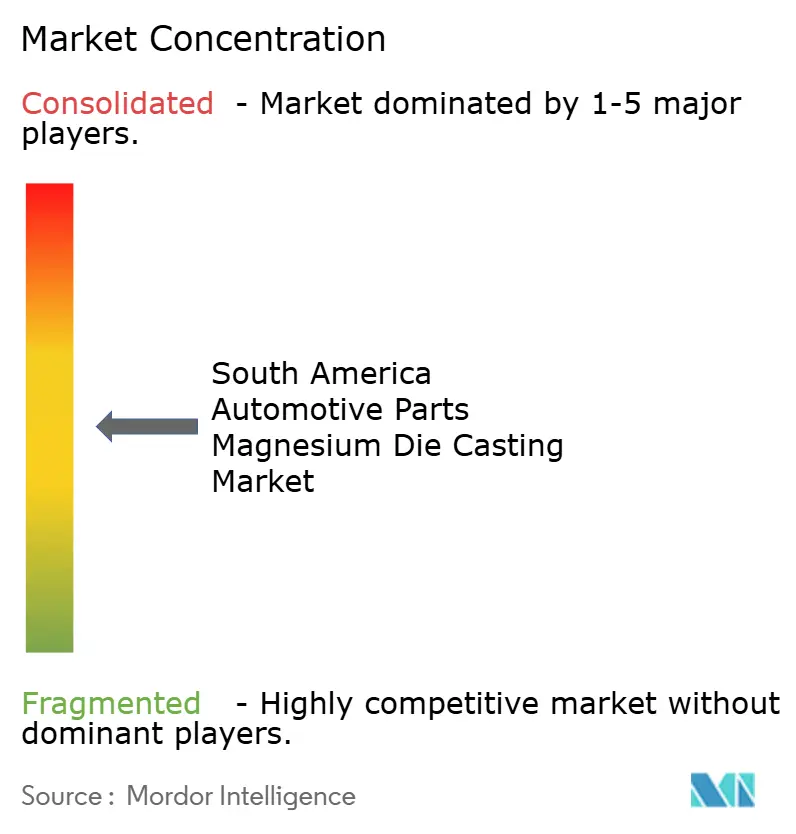
| Market Concentration | Medium |
Major Players *Disclaimer: Major Players sorted in no particular order Image © Mordor Intelligence. Reuse requires attribution under CC BY 4.0. | |
South America Automotive Parts Magnesium Die Casting Market Analysis by Mordor Intelligence
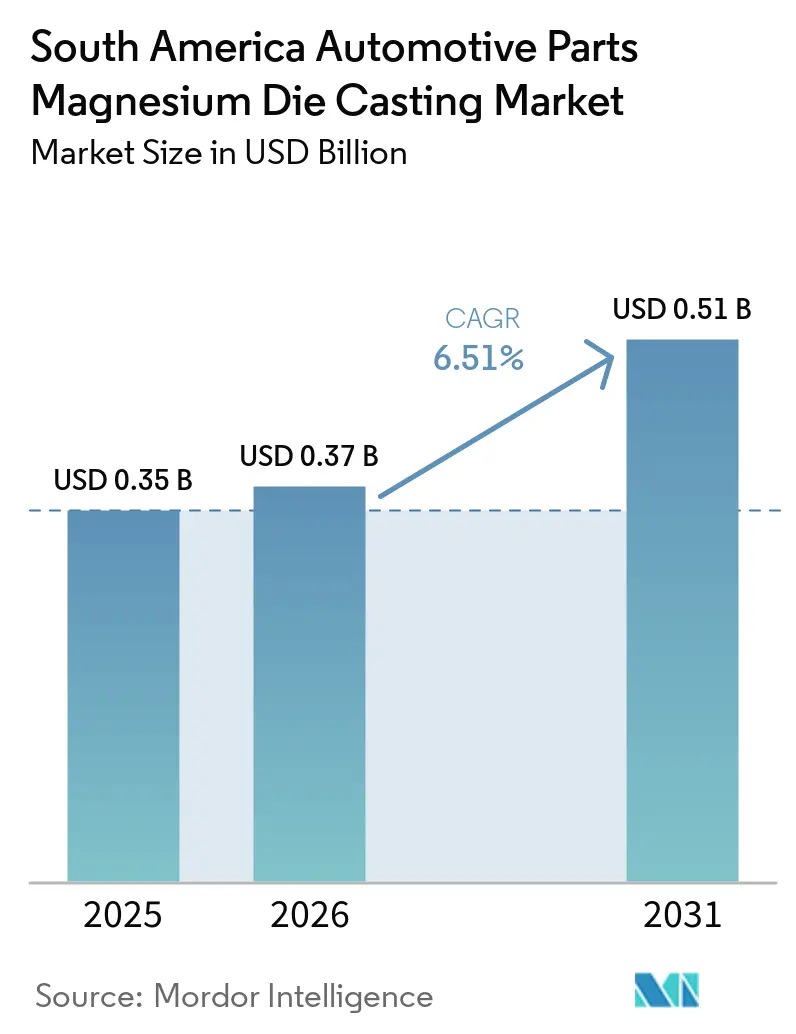
The South America Automotive Parts Magnesium Die Casting Market size was valued at USD 0.35 billion in 2025, and is expected to reach USD 0.37 billion in 2026, and is projected to reach USD 0.51 billion by 2031 at a CAGR of 6.51% during the forecast period (2026-2031). In South America, the expansion of electric vehicle (EV) lines, coupled with carbon-linked fiscal incentives in Brazil, drives growth. Meanwhile, near-shoring under USMCA rules bolsters capacity investments. Currently, pressure die casting leads in volume, but vacuum systems are gaining popularity as automakers seek porosity-free structural components for battery trays and body panels. With passenger cars aiming to reduce weight significantly and mandates encouraging higher recycled content, the demand for magnesium in driveline and chassis parts surges. However, margins face pressure from fluctuating primary-metal prices in China. To mitigate this risk, die casters are turning to closed-loop scrap recovery and forging long-term supply contracts with OEMs.
Key Report Takeaways
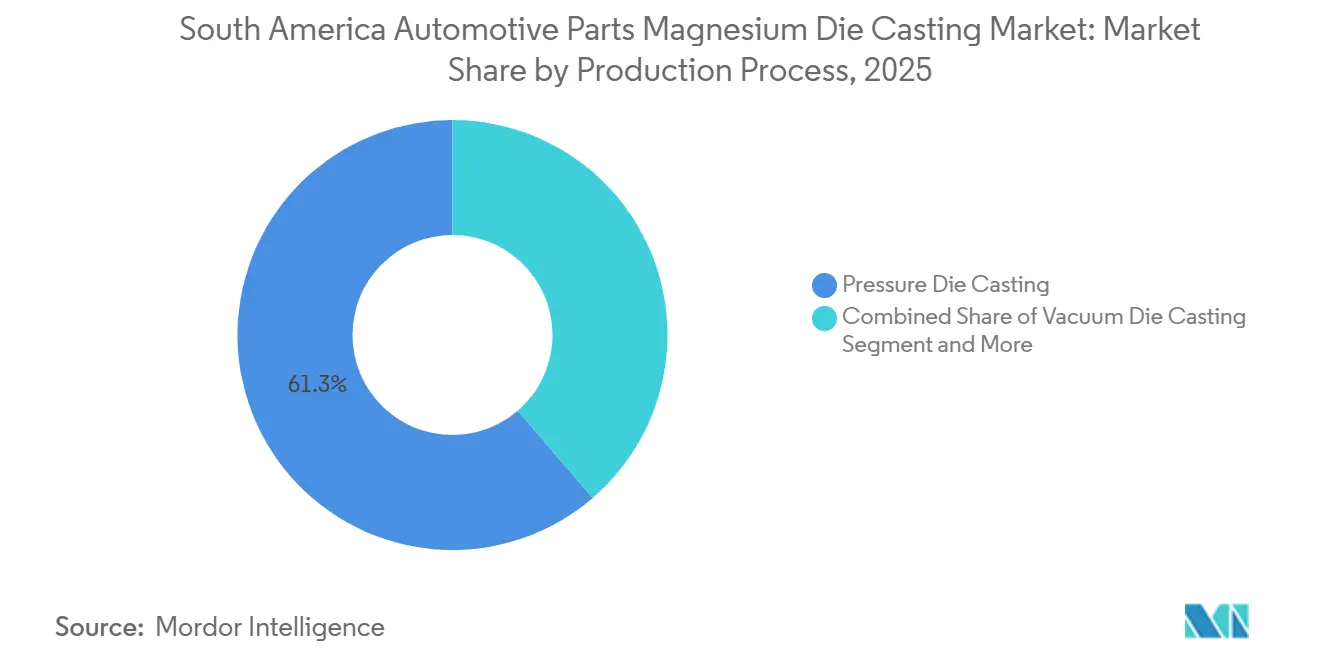
- By production process, pressure die casting led with 61.32% of the South America automotive parts magnesium die casting market share in 2025, while vacuum die casting is forecast to expand at a 7.55% CAGR through 2031.
- By application, driveline and powertrain accounted for 34.46% of the market in 2025; body and chassis are advancing at a 7.53% CAGR to 2031.
- By propulsion, internal combustion engine vehicles held a 54.57% share in 2025, whereas battery-electric vehicles are projected to grow at a 7.61% CAGR over the same period.
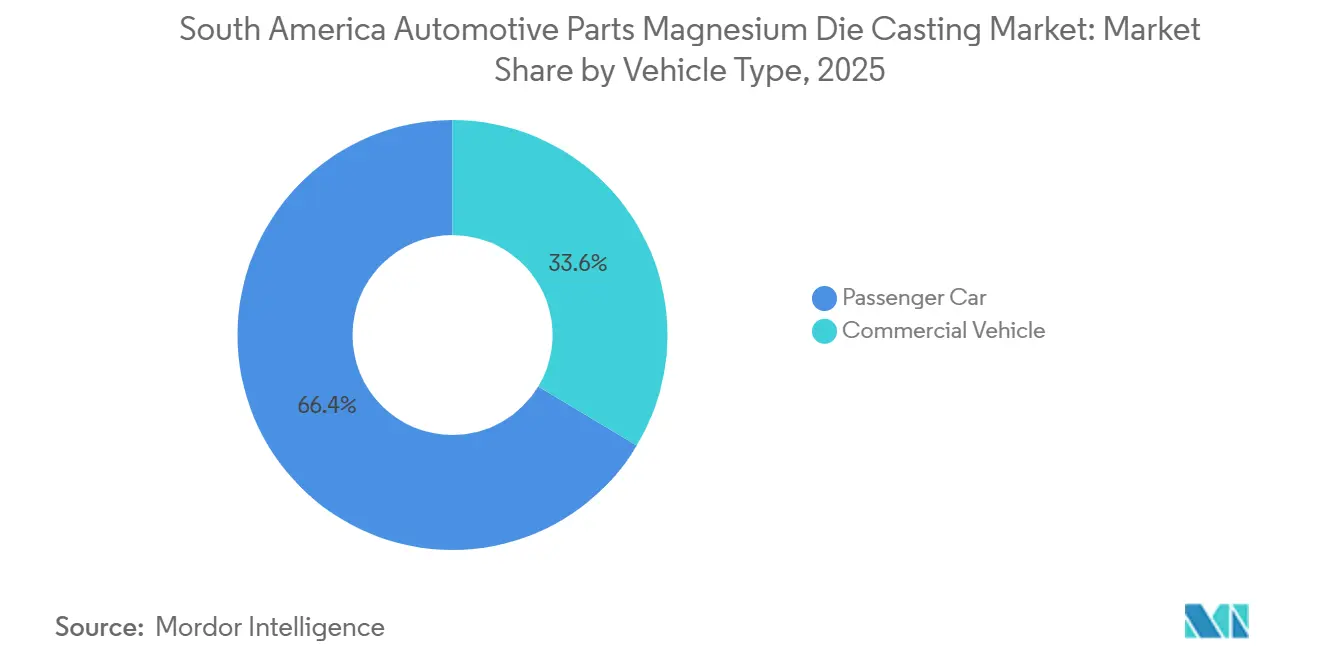
- By vehicle type, passenger cars captured 66.37% of regional demand in 2025 and are set to rise at a 7.57% CAGR through 2031.
- By sales channel, OEM supply dominated with 83.41% share in 2025, and this channel records the fastest 8.64% CAGR toward 2031.
- By country, Brazil controlled 48.74% of the 2025 revenue and posts the highest 8.58% CAGR to 2031.
Note: Market size and forecast figures in this report are generated using Mordor Intelligence’s proprietary estimation framework, updated with the latest available data and insights as of January 2026.
South America Automotive Parts Magnesium Die Casting Market Trends and Insights
Drivers Impact Analysis*
| Driver | (~) % Impact on CAGR Forecast | Geographic Relevance | Impact Timeline |
|---|---|---|---|
| Rapid EV Production Ramp-Up | +2.1% | Brazil, Argentina | Short term (≤ 2 years) |
| Lightweighting Mandates | +1.8% | Brazil, Argentina | Medium term (2-4 years) |
| Near-Shoring of US OEM Supply Chains | +1.5% | Brazil, Argentina | Short term (≤ 2 years) |
| High-Vacuum Structural Casting | +0.9% | Brazil (pilot projects in Chile) | Long term (≥ 4 years) |
| Brazilian Fiscal Incentives | +0.7% | Brazil, limited Argentina | Medium term (2-4 years) |
| Emerging Closed-Loop Scrap Feedstock Networks | +0.5% | Brazil,, early-stage Peru | Long term (≥ 4 years) |
| Source: Mordor Intelligence | |||
Rapid EV Production Ramp-Up Requiring Magnesium Housings & Cooling Plates
In Ramos Arizpe, Saltillo, and São Paulo, battery-electric vehicle lines require motor housings, cooling plates, and battery-tray frames. These components demand high thermal conductivity and minimal mass. Magnesium alloys AE42 and WE43 provide superior conductivity while achieving significant weight reduction compared to aluminum 6061. Magna’s structural-parts plant in Coahuila, with a substantial investment, and Nemak’s facility within the Blazer EV line, are already supplying vacuum-cast inverter casings to General Motors in Texas. This collaboration has notably reduced lead times from several weeks to just over a week. In Brazil, domestic magnesium smelters produce a considerable amount annually. This output plays a crucial role in stabilizing feedstock prices and mitigating fluctuations from the Chinese spot market [1]Magnesium Today, “Global Magnesium Pricing Trends 2021-2025,” magnesiumtoday.com . Additionally, R&D grants, part of the Mover Program, are supporting large-part casting pilots. These pilots have successfully met stringent yield-strength tests, a critical requirement for crash structures.
Lightweighting Mandates For CO₂ & Fuel-Economy Compliance
In response to tightening CO₂ regulations in Brazil, automakers are shifting from aluminum to magnesium alloys to significantly reduce component weight. Brazil’s Mover Program offers tax credits for parts containing a substantial proportion of recycled material, highlighting magnesium’s advantages, including low remelting energy requirements and high recyclability. Similarly, the regulations, aligned with U.S. CAFE standards, are prompting OEMs such as General Motors to establish lightweight EV platforms in Guanajuato and Coahuila. This shift is increasing demand for die-cast steering columns, seat frames, and cross-car beams. USMCA local-content thresholds further increase the importance of regionally sourced magnesium components. In addition, certification requirements under Official Mexican Standards limit competition from lower-cost imports. With compliance deadlines approaching, OEMs are finalizing purchasing commitments, supporting investments in new high-pressure die-casting (HPDC) capacity.
Near-Shoring of US OEM Supply Chains into South American Nations Stimulates HPDC Capacity
USMCA rules, which require a significant percentage of regional value for passenger vehicles, are driving suppliers to set up new high-pressure die-casting cells in northern industrial parks. In Zacatecas, Ahresty is making a substantial investment to boost mold and ingot production, shifting its focus to magnesium as Toyota introduces its electrified pickups. Meridian Lightweight Technologies has positioned its magnesium cell in Ramos Arizpe, directly supporting assembly plants in Texas. This strategic move significantly reduces logistics costs compared to shipping by sea from Asia. As a result, design-to-launch cycles are tightening, OEMs and die casters are increasingly collaborating on tooling funds, and there's a heightened demand for advanced inspection systems, ensuring porosity levels remain within stringent quality standards [2]Meridian Lightweight Technologies, “Product Portfolio and Regional Footprint,” meridianmagnesium.com .
High-Vacuum Structural Casting Unlocks Large Body Parts
Pfeiffer’s Vacu² system reduces cavity pressure to extremely low levels, suppressing porosity and delivering high yield strength. This advancement enables die casters to produce single-piece rear underbodies, consolidating components that previously required numerous stamped parts. Although tooling costs have increased moderately, the investment becomes financially viable at high production volumes because of the significant weight reduction compared with aluminum. Meanwhile, initial projects in Chile are exploring smaller shock-tower castings, with the long-term objective of achieving mass-production readiness.
Restraints Impact Analysis*
| Restraint | (~) % Impact on CAGR Forecast | Geographic Relevance | Impact Timeline |
|---|---|---|---|
| Volatile Imported Magnesium Prices | -1.2% | Brazil, Argentina, Chile, Peru | Short term (≤ 2 years) |
| Competition from Mature Aluminum HPDC Solutions | -0.9% | Global (all South America markets) | Medium term (2-4 years) |
| Scarce Primary Mg Smelting Capacity | -0.6% | Argentina, Chile, Peru (Brazil partially insulated) | Long term (≥ 4 years) |
| Stringent Safety Rules | -0.4% | Brazil (regulatory enforcement zones) | Medium term (2-4 years) |
| Source: Mordor Intelligence | |||
Volatile Imported Magnesium Prices
China dominates the global primary magnesium market, supplying the vast majority of the demand. In recent years, production curtailments in China have significantly driven up prices, marking a substantial increase compared to previous levels. While Brazil's smelting base caters to a portion of the demand, neighboring Argentina and Chile rely heavily on imports. These imports face lengthy shipping delays and high tariffs, adding to the challenges. Additionally, currency fluctuations in the region further exacerbate cost pressures. Without regional hedging tools, die casters are forced to make spot purchases, which can experience significant fluctuations over short periods, thereby squeezing contract profit margins.
Competition From Mature Aluminum HPDC Solutions
Aluminum A380 and ADC12 castings cost significantly less per kilogram and offer exceptionally high recycling rates. In coastal, high-humidity regions, magnesium faces an elevated risk of corrosion, requiring additional coatings that can offset its weight-saving advantages. Ahresty’s expansion in Zacatecas, focused on aluminum ingots, highlights OEMs’ confidence in established aluminum alloys for high-volume vehicle production. Magnesium’s cost premium is justified only when it delivers substantial weight savings, limiting its use to platforms with significant annual production volumes.
*Our forecasts treat driver/restraint impacts as directional, not additive. The impact forecasts reflect baseline growth, mix effects, and variable interactions.
Segment Analysis
By Production Process: Vacuum Technology Gains Structural Ground
Vacuum die casting is on course for a 7.55% CAGR to 2031, driven by battery platforms that need porosity-free castings for crash-critical body parts. The South American automotive parts magnesium die casting market size for vacuum systems is expected to expand as pressure die casting, although still holding 61.32% of the 2025 share, reaches strength limits for new giga-castings. Vacuum presses in Nemak’s Coahuila plant deliver 250 MPa yield strength, enabling single-piece rear underbodies for General Motors EV programs and justifying the price premiums.
Pressure die casting remains preferred for high-volume housings, where 90-second cycles cut costs, but gravity and squeeze die casting maintain niche roles for thick-section or near-net-shape parts. Retrofitting São Paulo plants with vacuum pumps qualifies them for recycled-content credits under Brazil’s Mover Program, while near-shoring boom steers fresh capital straight into vacuum-ready cells. Suppliers without the technology risk are relegated to seat frames and non-structural brackets, thereby shrinking their addressable share of the South American automotive parts magnesium die-casting market.



By Application: Body & Chassis Electrification Surge
Driveline and powertrain castings led 2025 revenue at 34.46%, yet body and chassis components will pace the market with a 7.53% CAGR through 2031. Chevrolet Blazer EV models now feature rear battery-tray frames that are significantly lighter when crafted from magnesium instead of aluminum, boosting their range noticeably. As a result, the market share for magnesium die casting in structural body parts within South America's automotive sector is witnessing an annual uptick, driven by OEMs' focus on enhancing range and ensuring crashworthiness.
As hybrid and fully electric BEV platforms gain momentum, traditional ICE-related castings like oil pans and valve covers are becoming obsolete. This shift redirects production capacity towards components such as battery trays, shock towers, and B-pillars. Additionally, interior structures, notably instrument-panel beams, are seeing increased demand. This is largely because magnesium components are achieving mandated weight-saving thresholds, thereby unlocking valuable tax credits in Brazil. Furthermore, electrical components, especially inverter housings, are on the rise due to vacuum die casting's ability to ensure leak-proof enclosures.
By Propulsion: BEV Thermal Management Drives Magnesium
Internal combustion engine platforms still represent 54.57% of 2025 castings, but battery-electric vehicles expand at a 7.61% CAGR. The South American automotive parts magnesium die casting market size for BEV-specific components escalates as Ramos Arizpe corridor opens new EV lines. A single EV cooling plate in magnesium saves up to 2 kg and dissipates heat more quickly than aluminum, aiding battery longevity.
Hybrid systems supply interim demand, mixing ICE housings with electric motor casings, whereas fuel-cell platforms remain negligible. ICE demand concentrates in commercial vehicles, where cost discipline and corrosion exposure limit magnesium penetration. Over time, as EV infrastructure spreads into Chile and Argentina, BEV castings are expected to outpace ICE demand region-wide.
By Vehicle Type: Passenger Cars Lead Lightweighting
Passenger cars command 66.37% revenue in 2025 and maintain the fastest 7.57% CAGR. OEMs in Brazil deploy magnesium seat frames and door beams to meet recycled-content and CO₂ targets without redesigning entire platforms. Light pickups assembled in South American nations emerge as the next adoption pocket once Ford and General Motors introduce electrified variants.
Commercial vehicles trail because freight operators hesitate to pay the magnesium premium without guaranteed fuel savings. Heavy trucks avoid magnesium for fatigue reasons, while aftermarket repair networks lack certified welders for corrosion-sensitive alloys. The South American automotive parts magnesium die casting market, therefore, skews toward shorter vehicle replacement cycles typical of passenger cars.
By Sales Channel: OEM Integration Dominates
OEM sourcing channels occupy 83.41% share in 2025 and rise on a 8.64% CAGR, reflecting just-in-time integration between casting cells and assembly lines. A Nemak line inside General Motors’ Coahuila plant machines transmission cases within two hours from casting, eliminating six-week logistics. The South American automotive parts magnesium die casting market size is attached to OEM contracts, thus expanding steadily, while the aftermarket remains small due to limited part catalogs and scarce certified repairers.
Absent standardized part numbers and repair protocols, distributors struggle to stock magnesium replacements, holding the aftermarket below a 20% threshold through 2031. Expansion depends on OEM-funded technician training that has yet to materialize at scale.
Geography Analysis
Brazil owns 48.74% of the 2025 demand and is also expanding at a 8.58% CAGR, bolstered by a domestic smelter base with significant production capacity. Additionally, the MOVER Program incentivizes producers by linking tax credits to commitments to use a substantial proportion of recycled content. Most of Brazil's magnesium output is used in passenger cars, where weight reduction commands a significant cost premium and remains a sought-after feature. However, the country's scrap collection infrastructure remains a major challenge. In response, new remelters in Campinas are working to improve feedstock self-sufficiency and comply with MOVER audit requirements.
Along with EMA certification regimes, these factors raise barriers for low-cost imports. Investments such as Ahresty’s project in Zacatecas and Nemak’s strategic acquisition of GF Casting Solutions are expanding vacuum-casting capacity and structural-casting expertise. Furthermore, remelters in Monterrey play a critical role by processing a significant share of U.S. magnesium scrap imports and achieving substantial cost reductions.
Argentina, Chile, and Peru collectively account for the remaining magnesium demand. Argentina hosts several Magna plants that supply regional OEMs; however, currency controls and import tariffs constrain its growth potential. Chile aims to achieve 100% zero-emission light-vehicle sales by 2035 but faces a lengthy permitting queue and low GDP expenditure on R&D, which discourage smelter and foundry investments. Meanwhile, Peru’s lack of OEM assembly limits demand to specialized aftermarket components.
Competitive Landscape
Nemak, Meridian, and Magna dominate the region’s magnesium die-casting landscape, controlling a significant share of production capacity. In the latter half of the decade, Nemak strengthened its position through the substantial acquisition of GF Casting Solutions, adding multiple plants and a proprietary vacuum-casting patent portfolio. This strategic move creates cross-selling opportunities across Nemak’s extensive aluminum customer base. Suppliers with vacuum presses command notable premiums for structural body components, tightening margins for Tier 2 firms that rely on conventional pressure die casting.
Closed-loop scrap represents a growing opportunity, as South America recovers only a small share of its non-ferrous scrap. This gap enables remelters in Monterrey and São Paulo to secure exclusive contracts and offer primary metal at a significant discount to imported material. Collaborations with technology providers, such as Pfeiffer Vacuum and Bühler, enhance porosity control and dimensional tolerances, which are critical for securing giga-casting contracts associated with emerging EV platforms. To stabilize prices and secure capacity, OEMs are entering into long-term volume agreements, reducing flexibility for smaller players.
Official Standards impose stringent compliance requirements, raising capital-entry thresholds. This shift primarily benefits multinational companies that can amortize the costs of systems such as explosion-proof ventilation and dust-collection equipment. Meanwhile, new entrants face lengthy certification processes and ongoing audits, which delay market entry and further strengthen the position of established players.
South America Automotive Parts Magnesium Die Casting Industry Leaders
Gibbs Die Casting Group
Pace Industries
Shiloh Industries Inc.
George Fischer AG
Meridian Lightweight Technologies
- *Disclaimer: Major Players sorted in no particular order

Recent Industry Developments
- February 2026: Nemak, S.A.B. de C.V., announced the successful completion of its acquisition of GF Casting Solutions’ automotive business after receiving all required regulatory approvals and fulfilling all closing conditions.
- July 2025: The introduction of aggressive trade barriers and tariff revisions worldwide compelled automotive OEMs and Tier-1 suppliers to reduce their reliance on transoceanic raw material sourcing. Companies actively reshaped their sourcing strategies to establish highly resilient, localized supply loops within preferred regional corridors.


South America Automotive Parts Magnesium Die Casting Market Report Scope
The scope of the report includes Production Process (Pressure Die Casting and More), Application (Driveline & Powertrain and More), Propulsion (ICE, BEV, HEV, PHEV, and FCEV), Vehicle Type (Passenger Car and Commercial Vehicle), Sales Channel (OEM and Aftermarket), and Geography. The Market Forecasts are Provided in Terms of Value (USD).
By Production Process
| Pressure Die Casting |
| Vacuum Die Casting |
| Gravity Die Casting |
| Squeeze Die Casting |
By Application
| Driveline & Powertrain |
| Interior & Exterior |
| Electrical & Electronics |
| Body & Chassis |
| Wheel & Tires |
| Other Types |
By Propulsion
| Internal Combustion Engine |
| Battery-Electric Vehicle |
| Hybrid Electric Vehicle |
| Plug-in Hybrid Electric Vehicle |
| Fuel-Cell Electric Vehicle |
By Vehicle Type
| Passenger Car |
| Commercial Vehicle |
By Sales Channel
| Original Equipment Manufacturer (OEM) |
| Aftermarket |
By Country
| Brazil |
| Argentina |
| Chile |
| Peru |
| Rest of South America |
| By Production Process | Pressure Die Casting |
| Vacuum Die Casting | |
| Gravity Die Casting | |
| Squeeze Die Casting | |
| By Application | Driveline & Powertrain |
| Interior & Exterior | |
| Electrical & Electronics | |
| Body & Chassis | |
| Wheel & Tires | |
| Other Types | |
| By Propulsion | Internal Combustion Engine |
| Battery-Electric Vehicle | |
| Hybrid Electric Vehicle | |
| Plug-in Hybrid Electric Vehicle | |
| Fuel-Cell Electric Vehicle | |
| By Vehicle Type | Passenger Car |
| Commercial Vehicle | |
| By Sales Channel | Original Equipment Manufacturer (OEM) |
| Aftermarket | |
| By Country | Brazil |
| Argentina | |
| Chile | |
| Peru | |
| Rest of South America |


Key Questions Answered in the Report
What is the 2025 value of the South America automotive parts magnesium die casting market?
The market is valued at USD 0.35 billion in 2025 and is projected to reach USD 0.51 billion by 2031.
Which production process is growing the fastest?
Vacuum die casting is expanding at a 7.55% CAGR because it produces porosity-free structural parts for EV architectures.
Why does Brazil outpace other countries in growth?
Near-shoring under USMCA rules and large EV investments lift Brazil to a 8.58% CAGR, the highest in the region.
How does Brazil’s Mover Program influence magnesium demand?
It mandates over 50% recycled content and ties tax credits to weight reduction, steering OEMs toward magnesium parts.
What is the main supply-chain challenge for die casters?
Volatile imported magnesium prices and limited regional smelting capacity expose producers to cost swings and delays.
Who are the key industry leaders?
Nemak, Meridian Lightweight Technologies, and Magna together hold more than half of the regional casting capacity.
Page last updated on:





