
South America Architectural Services Market Size and Share
Market Overview
| Study Period | 2021 - 2032 |
|---|---|
| Forecast Data Period | 2027 - 2032 |
| Base Year Market Size (2026) | USD 23.45 Billion |
| Market Size (2027) | USD 24.66 Billion |
| Market Size (2032) | USD 31.69 Billion |
| Growth Rate (2027 - 2032) | 5.14 % |
| Market Concentration | Low |
Major Players *Disclaimer: Major Players sorted in no particular order Image © Mordor Intelligence. Reuse requires attribution under CC BY 4.0. | |
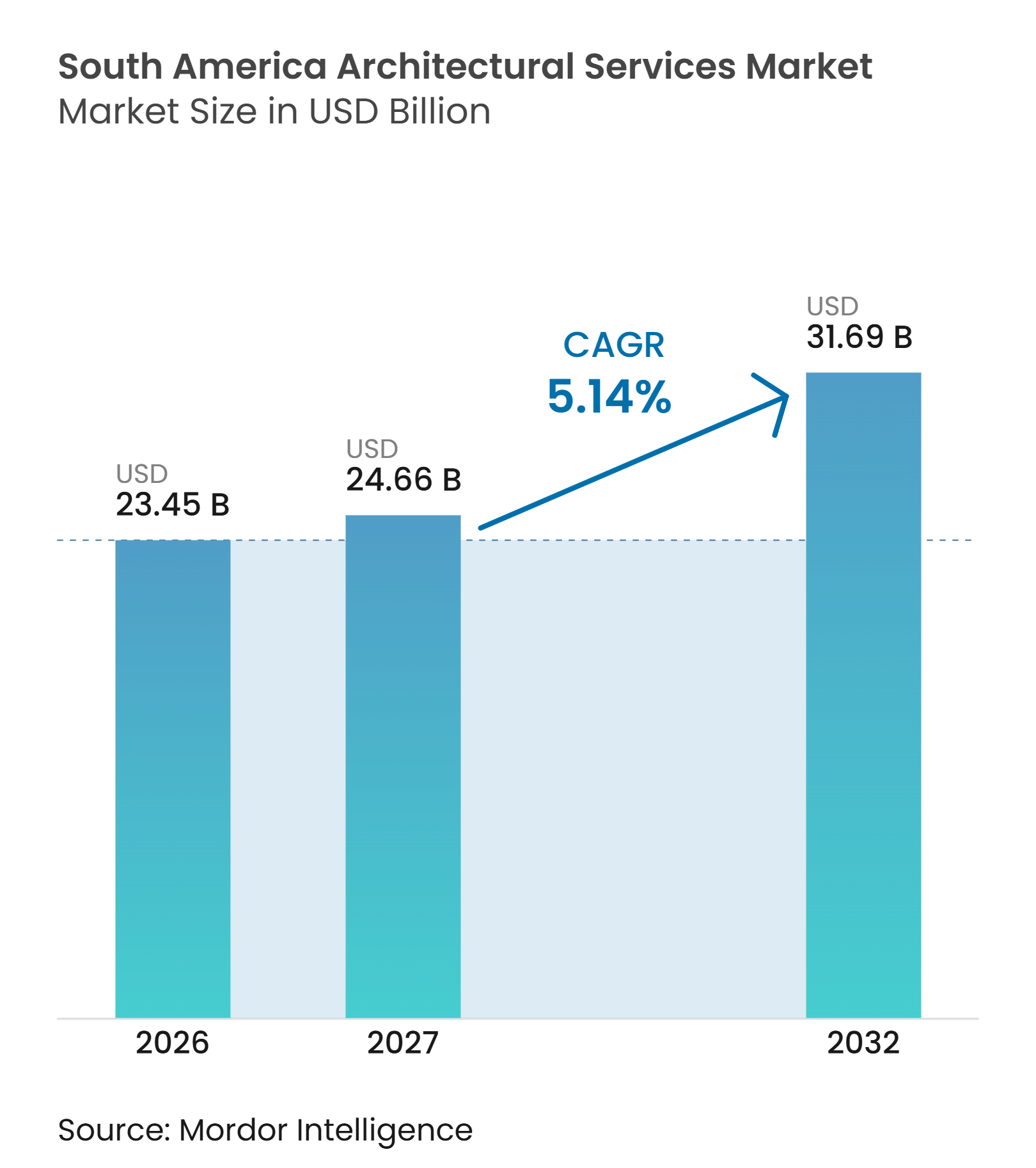
South America Architectural Services Market Analysis by Mordor Intelligence
The South America Architectural Services Market was valued at USD 23.45 billion in 2026 and is estimated to reach USD 24.66 billion in 2027 and USD 31.69 billion by 2032, growing at a CAGR of 5.14% during the 2027–2032 forecast period.
Persistent housing needs, public healthcare upgrades, education modernization, and broad institutional spending continue to support demand across the South America architectural services market, especially where government-backed programs keep project flow active even when private construction slows. Digital delivery standards are also changing how firms compete, because Brazil’s federal Building Information Modeling (BIM) push is making coordinated modeling, documentation quality, and workflow discipline more important in the South America architectural services market. Sustainable design is moving closer to standard practice, as the region already carries a meaningful stock of Leadership in Energy and Environmental Design (LEED)-certified projects, with Brazil holding the largest base and Colombia and Chile also showing established certification activity. The South America architectural services market is also gaining from large urban planning and planned community assignments, where early master planning roles often lead to later design, documentation, and implementation work over longer delivery cycles. Cost pressure and policy uncertainty continue to limit timing and budgets, as Brazil’s construction cost indicators remained elevated in 2026, and foreign direct investment across Latin America and the Caribbean rose by only 1.7% in 2025.
Key Report Takeaways
- By service type, architectural design services captured 41.2% of the South America architectural services market share in 2026, while urban design and master planning services are projected to grow at a 6.11% CAGR between 2027 and 2032.
- By project type, new construction accounted for 69.8% of the South America architectural services market size in 2026, while renovation is projected to grow at a 5.55% CAGR between 2027 and 2032.
- By end-use, residential held 34.5% of the South America architectural services market share in 2026, while infrastructure-linked buildings are projected to grow at a 5.98% CAGR between 2027 and 2032.
- By investment source, private investment accounted for 59.9% of the South America architectural services market share in 2026, while public investment is projected to grow at a 5.77% CAGR between 2027 and 2032.
- By geography, Brazil captured 39.3% of the South America architectural services market size in 2026, while the rest of South America is projected to grow at a 6.18% CAGR between 2027 and 2032.
Note: Market numbers in this report are based on Mordor Intelligence's proprietary estimation framework, which combines nine months of actuals with Q4 projections for base year 2026.
Market Trends and Insights
Drivers Impact Analysis of South America Architectural Services Market*
| Drivers | (~) % Impact on CAGR Forecast | Geographic Relevance | Impact Timeline |
|---|---|---|---|
| Urban Regeneration and Transit-Oriented Development Projects | +1.2% | Brazil, Colombia, Chile, Peru | Medium term (2-4 years) |
| Public Investment in Housing, Healthcare, Education, and Infrastructure | +1.0% | Brazil, Peru, Argentina | Medium term (2-4 years) |
| Logistics Parks, Data Centers, and Industrial Development | +0.9% | Brazil, Colombia, Peru | Short term (≤ 2 years) |
| Green Building Certifications and Net-Zero Design | +0.8% | Brazil, Colombia, Chile | Long term (≥ 4 years) |
| Building Information Modeling, Artificial Intelligence, Digital Twins, and Parametric Modeling | +0.7% | Brazil, Chile, Region-Wide | Short term (≤ 2 years) |
| Climate-Resilient and Disaster-Resistant Building Design | +0.6% | Brazil, Chile, Peru, Colombia | Long term (≥ 4 years) |
| Source: Mordor Intelligence | |||
Expanding Urban Regeneration and Transit-Oriented Development Projects Drive Demand for Architectural Planning and Design Services
Cities across the region are reshaping underused corridors into mixed-use districts, increasing the amount of planning work done before building design begins. This matters for the South America architectural services market because firms that secure early urban design roles often remain involved through documentation, coordination, and later project phases. Large planned communities and transit-linked projects are bringing housing, public space, environmental standards, and civic design into a single assignment[1]. That scale connects land planning with long-duration design opportunities rather than short, isolated briefs. It also raises the value of firms that can handle urban form, public realm planning, and phased implementation with the same client team. As a result, the South America architectural services market is seeing stronger revenue potential in mandates that begin with transit-oriented development planning and extend into downstream architectural packages.
Government Investments in Affordable Housing, Healthcare, Education, and Public Infrastructure Create Opportunities for Architectural Firms
Government programs remain a major stabilizer for the South America architectural services market because they generate steady institutional work across multiple building categories and multiple cities. Brazil’s Novo PAC health program allocated USD 6.5 billion across 32,669 projects in 5,183 municipalities, and 2,911 works were in execution as of June 2026. Peru’s Ministry of Health selected an AECOM-led joint venture in 2024 to support two regional hospitals in Piura and Trujillo under the PRONIS initiative, which keeps concept development, coordination, and digital project management tied closely to architectural delivery[2]. Brazil’s housing pipeline provides additional support, as the federal government announced plans to deliver 85,000 new units under the Minha Casa, Minha Vida program in 2026. These programs broaden the pool of briefs beyond commercial real estate and reduce architectural demand's dependence on private financing conditions alone. That steady public flow provides the South America architectural services market with a buffer when developers delay or rephase discretionary projects.
Growth in Logistics Parks, Data Centers, and Industrial Developments Fueled by Nearshoring and E-commerce Expansion
Technical building demand is becoming increasingly important in the South America architectural services market because industrial facilities, data centers, and logistics assets require greater coordination than standard office or residential work. These buildings place greater emphasis on environmental control, services integration, resilience, security, and documentation accuracy from the earliest design stages. Strategic moves by major firms underscore the seriousness with which this demand is being taken, with Stantec acquiring Page in 2025 and adding expertise in data centers, healthcare, cleanrooms, and advanced manufacturing[3]. WSP also strengthened its technical and infrastructure-oriented advisory profile through the acquisition of Ricardo in October 2025, which expanded rail, energy transition, and broader consulting capabilities. Those moves align with a market in which occupied industrial and mission-critical buildings demand closer collaboration among architects, engineers, and specialist consultants. The South America architectural services market, therefore, benefits when firms can translate industrial growth into technically robust architectural packages rather than treating these projects as standard shells.
Rising Adoption of Green Building Certifications and Net-Zero Design Principles Increases Demand for Sustainable Architecture
Green certification is becoming a standard client requirement, increasing the value of sustainability expertise across the South America architectural services market. Brazil had 1,033 LEED-certified projects in the second half of 2024, while Colombia had 304 and Chile had 301, showing that certified work is already a material part of the regional built environment. In São Paulo, Vista Faria Lima became the first commercial building in the city to receive LEED Zero Energy, LEED Zero Carbon, and LEED Zero Water certifications in 2024. In 2025, the Global Network for Zero certified its first Brazilian net-zero project, demonstrating that advanced sustainability targets are no longer limited to the largest towers. This shift increases the need for stronger materials selection, façade planning, systems coordination, and post-occupancy performance thinking at the design stage. It also helps the South America architectural services market move toward higher-value fee work where technical knowledge and certification experience directly influence client choice.
Restraints Impact Analysis of South America Architectural Services Market*
| Restraints | (~) % Impact on CAGR Forecast | Geographic Relevance | Impact Timeline |
|---|---|---|---|
| High Inflation, Elevated Financing Costs, and Currency Volatility | -0.6% | Argentina, Brazil, Region-Wide | Short term (≤ 2 years) |
| Political and Economic Uncertainty | -0.5% | Argentina, Peru, Colombia, Brazil | Medium term (2-4 years) |
| Complex Permitting and Environmental Approvals | -0.3% | Brazil, Colombia, Chile | Long term (≥ 4 years) |
| Shortage of Specialized Architectural Professionals and Technical Expertise | -0.2% | Region-Wide, Especially Brazil and Chile | Long term (≥ 4 years) |
| Source: Mordor Intelligence | |||
High Inflation, Elevated Financing Costs, and Currency Volatility Constrain Project Viability and Design Budgets
Cost escalation remains a direct restraint on the South America architectural services market because design fees are often pressured when owners try to protect the overall project's viability. Brazil’s national civil construction index rose 0.72% in April 2026, and the accumulated increase over the prior 12 months reached 7%. The Brazilian Chamber of Construction Industry also reduced its 2026 sector growth forecast to 1.2%, down from an earlier 2%, because high interest rates and input costs were weighing on activity. It separately noted higher prices for materials such as concrete, PVC pipes, and Portland cement in April 2026, indicating that cost pressure is not limited to a single narrow input category. When project budgets are revised upward, architectural scope can be reduced, postponed, or split into later phases. That makes the South America architectural services market more vulnerable to discretionary commercial and private development work than to long-planned institutional programs.
Political and Economic Uncertainty Delays Private and Public Construction Investments
Policy uncertainty affects the South America architectural services market because large projects rely on confidence in funding, approvals, and long delivery schedules. The 2026 political calendar across several major countries is keeping some investors cautious, particularly in projects that depend on long concession structures or large multi-year capital commitments. At the same time, foreign direct investment in Latin America and the Caribbean increased by only 1.7% in 2025. That modest increase signals a slower external capital backdrop for commercial real estate, industrial expansion, and complex private developments. Architectural firms feel this first through slower client decisions, longer procurement cycles, and delayed starts on large mandates. Even where underlying demand remains intact, the South America architectural services market can still lose momentum when investment timing becomes less predictable.
*Our forecasts treat driver/restraint impacts as directional, not additive. The impact forecasts reflect baseline growth, mix effects, and variable interactions.
South America Architectural Services Market Segment Analysis
By Service Type:
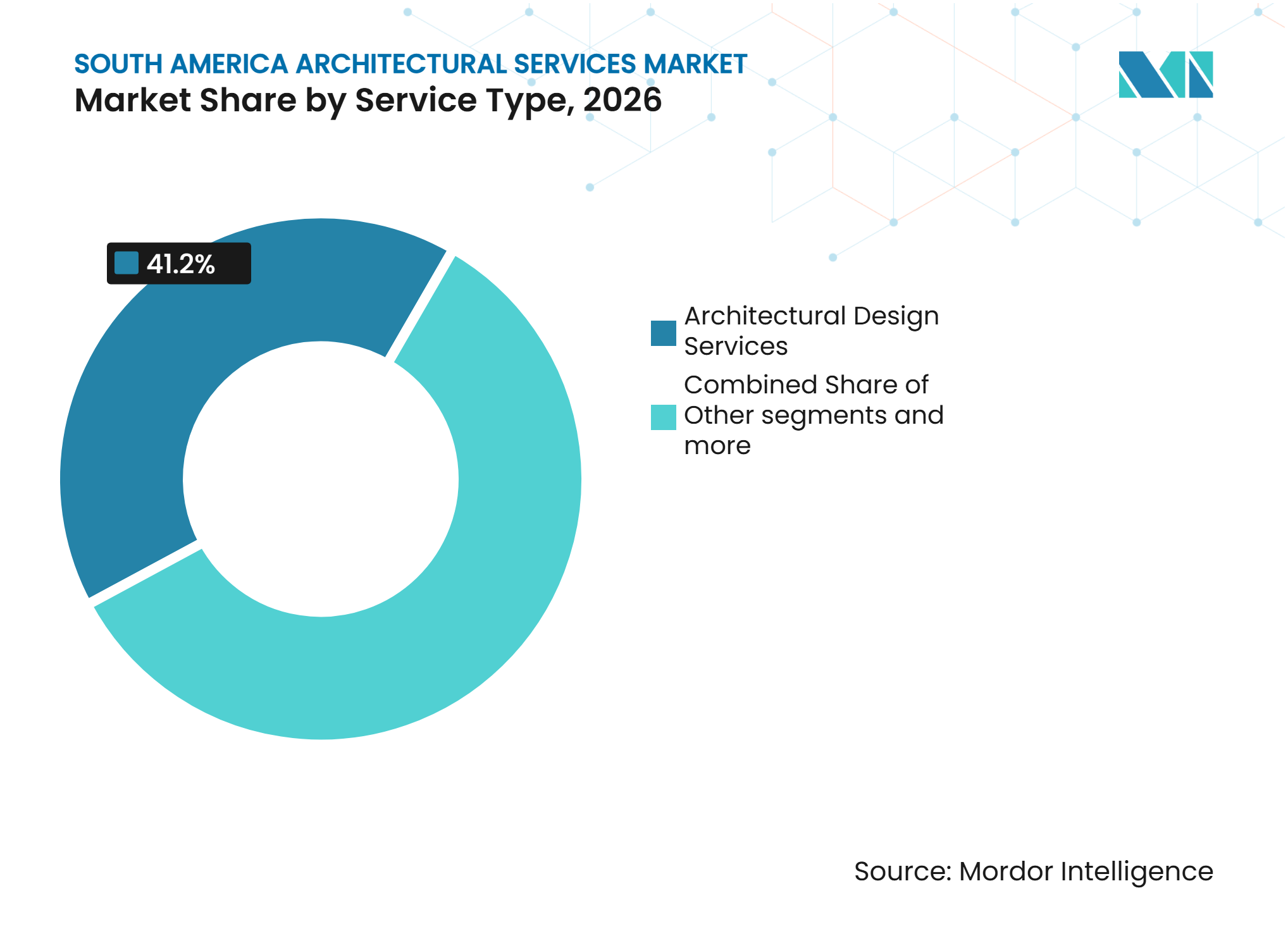
Architectural Design Services Dominate, While Urban Design and Master Planning Services Record the Fastest GrowthArchitectural design services hold 41.2% of the South America architectural services market share in 2026, making it the largest service category. The segment covers the early work that shapes building purpose, layout, appearance, compliance, and client approvals. It remains central because documentation, interiors, planning, and specialist coordination depend on decisions made at this stage. The category serves projects across housing, offices, healthcare, schools, transport facilities, and industrial sites. Its broad use across project types gives firms a dependable base of work. It also explains why core design remains the main revenue contributor in the South America architectural services market.
Urban design and master planning services are the fastest-growing service type and are projected to expand at a 6.11% CAGR between 2027 and 2032. Demand is rising as projects combine housing, public space, transport links, commercial activity, and environmental requirements within one plan. Foster + Partners received approval in June 2026 to proceed with the Maratué masterplan in Puchuncaví, Chile. The USD 2 billion project includes 14,000 homes and is planned to integrate biological corridors with coastal and residential areas. Such work creates longer design cycles and larger coordination requirements than a single-building assignment. It also gives capable studios a route into follow-on work across later project stages. The work usually requires a clear sequence from land analysis to public consultation, detailed planning, and eventual building approvals. That sequence favors firms that can manage design quality while coordinating transport, environmental, and service requirements. It also creates room for local studios to partner with international planners when project sponsors need both regional delivery knowledge and experience with larger planned communities. As more cities focus on compact development, master planning is likely to remain a meaningful source of new work.



By Project Type:
New Construction Remains the Main Source of ActivityNew construction accounted for 69.8% of project-type activity in 2026, making it the largest segment in the South America architectural services market. New housing, hospitals, logistics facilities, data centers, and mixed-use developments support the segment. Brazil’s affordable housing program and public healthcare program are major sources of fresh design and documentation work. New construction also benefits from city expansion, the need for formal residential supply, and the development of technical facilities. Chile’s San Ignacio project in Santiago shows the scale of private development activity, with 15 low-rise buildings and 1,065 apartments planned within a mixed-use scheme. These projects keep new-build design packages at the center of regional activity.
Renovation is the fastest-growing project type and is forecast to increase at a 5.55% CAGR between 2027 and 2032. Older commercial and institutional buildings need upgrades for changing work patterns, accessibility, energy performance, and user needs. Renovation can also appeal to owners seeking shorter development cycles than full demolition and reconstruction. Stadium and public venue upgrades show how retrofit programs can combine technical improvements with commercial repurposing. Digital models can help teams assess existing conditions and identify design issues before major construction begins. This supports a larger role for retrofit work in the South America architectural services market over the forecast period. The segment can also benefit when owners need to improve energy performance, adapt buildings for new tenants, or meet updated accessibility rules. Careful surveys and early technical reviews are important because older structures can contain hidden constraints that affect cost and timing. Firms that combine architectural design with technical coordination can help clients decide whether to retain, upgrade, or replace an existing asset. This makes renovation work relevant to both private building owners and public agencies managing older facilities.
By End-Use:
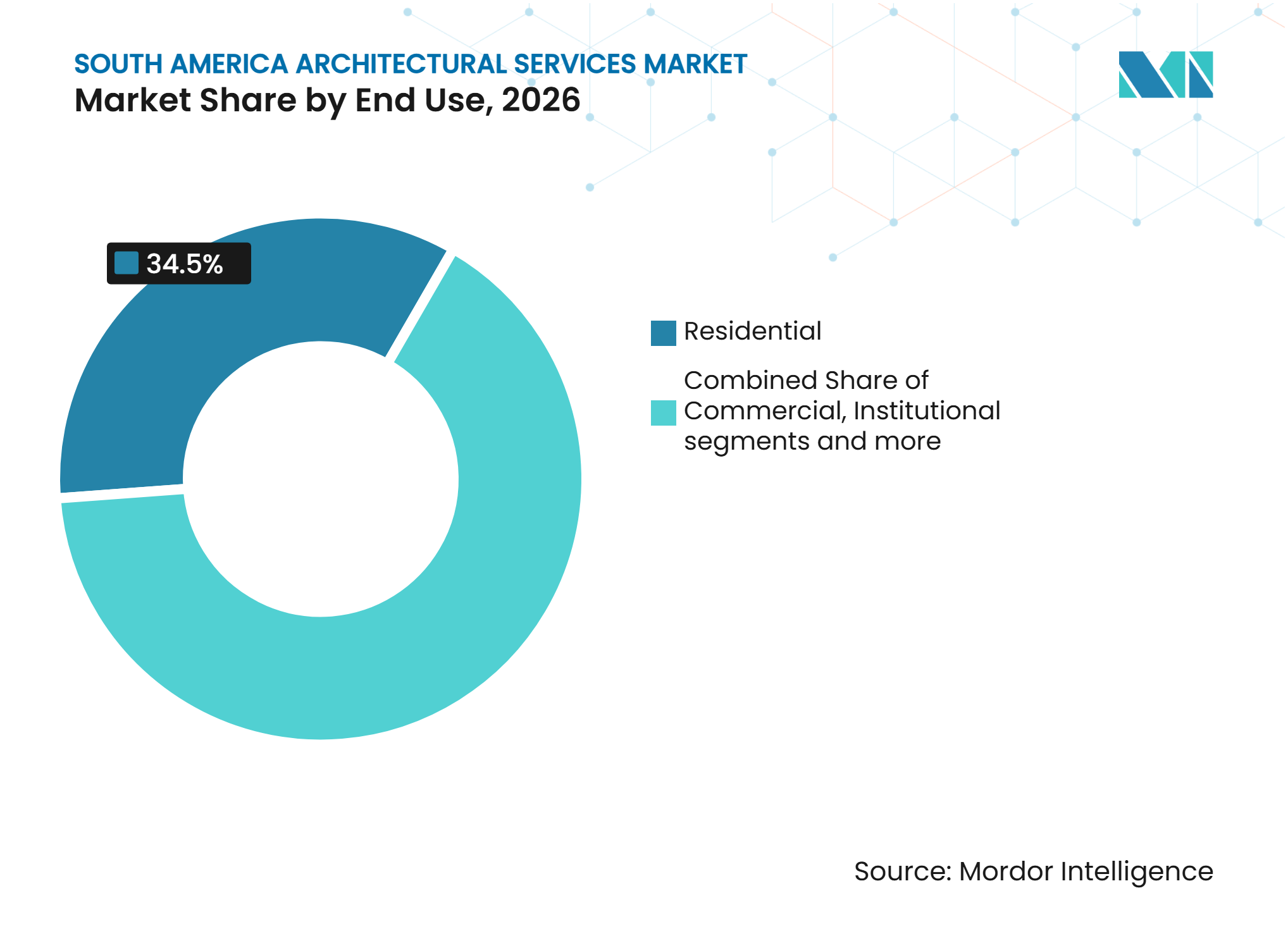
Residential Work Provides the Largest Revenue BaseResidential holds 34.5% of the South America architectural services market share in 2026 and is the largest end-use category. Demand comes from housing shortages, public housing programs, private apartment projects, and urban redevelopment schemes. Brazil’s Minha Casa, Minha Vida program continues to create demand for repeatable residential design and construction documentation. Large planned communities also require architects to coordinate housing types, shared amenities, roads, public spaces, and service access. The segment gives local firms steady work across both standardized and higher-value residential formats. This makes residential design a core source of activity across the South America architectural services market.
Infrastructure-linked buildings are the fastest-growing end-use segment and are projected to grow at a 5.98% CAGR between 2027 and 2032. The category includes transit facilities, water treatment sites, energy-related buildings, data center campuses, and other facilities that combine infrastructure systems with occupied space. These projects require more coordination across safety, circulation, equipment, materials, and operational needs. Brazil’s health infrastructure program is adding demand for building types that need strong technical planning and clear workflow design. Industrial growth also increases the need for specialized supporting buildings within ports, manufacturing areas, and logistics parks. This gives firms with technical coordination experience an advantage in the South America architectural services market. Infrastructure-linked projects often have strict requirements for security, emergency circulation, maintenance access, and continuous operations. Those requirements make early coordination more valuable than it is in many conventional building types. Firms need to manage the relationship between infrastructure systems and the people who use the completed building every day. This technical depth can support more durable client relationships and repeat assignments.

By Investment Source:
Private Investment Continues to Fund Most ActivityPrivate investment accounted for 59.9% of the South America architectural services market share in 2026, making it the largest funding source. Corporate offices, private housing, logistics assets, data centers, and mixed-use projects all rely heavily on private capital. Private developers often create demand across concept planning, detailed design, interior fit-out, and site delivery support. In São Paulo, corporate corridors continue to support demand for office and mixed-use design. The completion of Salma Tower by aflalo/gasperini arquitetos illustrates the role of private investment in premium, sustainability-oriented commercial projects. This keeps private development central to the revenue base of the South America architectural services market.
Public investment is the fastest-growing funding source and is projected to expand at a 5.77% CAGR between 2027 and 2032. Governments are directing more funding toward health, housing, mobility, sanitation, and education assets that need long-term planning and formal design processes. Novo PAC is a major example because it supports thousands of health-related works across Brazil. Publicly funded projects can help firms maintain utilization when private clients postpone commitments due to financing conditions. They also create opportunities beyond capital cities because municipal projects are spread across many locations. This wider distribution improves the resilience of the South America architectural services market. Public programs also create a range of project sizes, from local health units and schools to major hospital and mobility schemes. That variety can help small and medium-sized firms participate alongside larger multi-disciplinary providers. Procurement rules may be demanding, especially where digital coordination is required, but they also encourage more consistent documentation practices. Over time, public investment can support the development of stronger local delivery capabilities.
Geography Analysis
Brazil
Brazil held 39.3% of the South America architectural services market share in 2026, supported by the widest range of project types in the region. Novo PAC allocated USD 6.5 billion to public health infrastructure and created a large pipeline of work across hospitals, clinics, and basic health units. The Minha Casa, Minha Vida program also supported new housing design activity, with the government announcing 85,000 additional units for 2026. Brazil’s federal BIM requirements are shaping public procurement by placing more emphasis on coordinated digital documentation. The country also has a strong base of sustainability-oriented corporate design, with firms such as aflalo/gasperini arquitetos active in certified projects. These factors make Brazil the region’s most established market for large-scale architectural work.
Rest of South America
The rest of South America is projected to grow at a 6.18% CAGR between 2027 and 2032, the fastest rate among the region’s geographic segments. The grouping includes markets where urban growth and larger formal developments are increasing demand for architecture services. Paraguay is attracting more attention from regional practices, including Gómez Platero, which secured the Link Center mandate in Asunción. In Ecuador, landmark mixed-use projects point to growing demand for higher-profile design work. These markets can offer firms new sources of revenue when larger economies experience slower private investment cycles. Their smaller starting base also means that a limited number of sizable projects can meaningfully increase demand.
Argentina, Chile, Colombia, and Peru
Chile, Colombia, Peru, and Argentina represent a diverse middle group within the South America architectural services market. Chile is supported by major private developments, including the USD 2 billion Maratué masterplan and the USD 120 million San Ignacio mixed-use project. Colombia is gaining from industrial development and city-scale sustainable planning, as illustrated by the Ciudad Mallorquín project. Peru is adding healthcare and retail development activity, including Torre Trecca in Lima and Cenco Malls’ USD 600 million investment in 2 shopping centers. Argentina remains more exposed to macroeconomic pressure, but it retains a base of private residential, hospitality, and premium commercial design activity. Together, these countries provide a varied mix of opportunities across housing, retail, healthcare, urban planning, and industrial development.
Competitive Landscape
Market Concentration
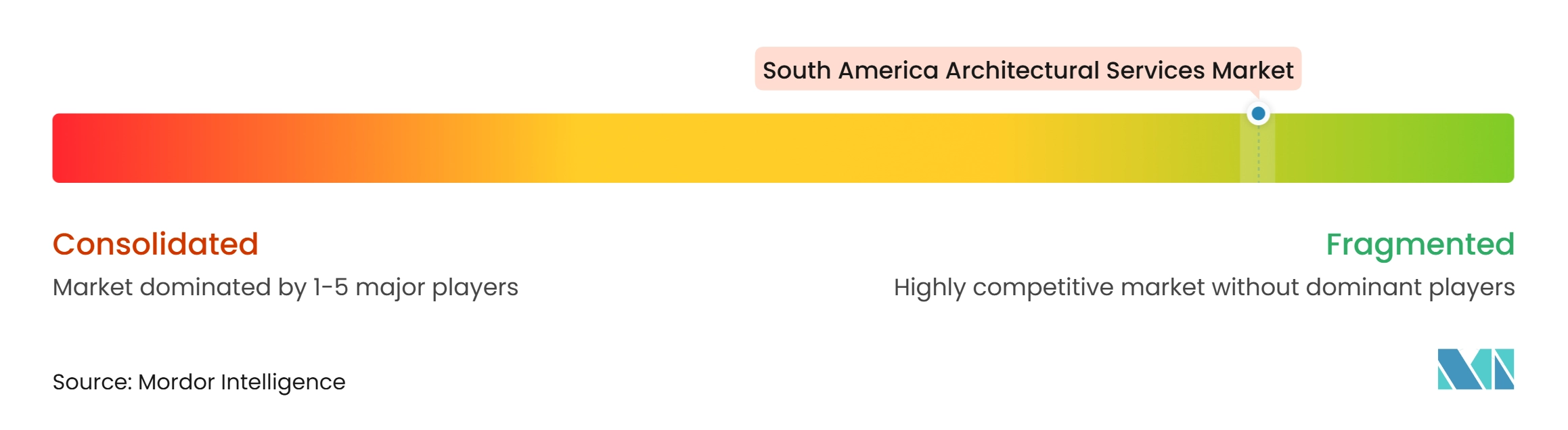
The South America architectural services market is fragmented in nature. AECOM, WSP Global, Stantec, and Gensler compete for large infrastructure, institutional, industrial, and mixed-use assignments. Local and regional firms compete strongly in residential, commercial, and country-specific public work because they understand local clients, approval processes, and delivery practices. Brazilian studios such as aflalo/gasperini arquitetos, Königsberger Vannucchi Arquitetos Associados, and Zanettini Arquitetura retain a strong presence in their home market. This mix of international scale and local relationships keeps competition broad rather than concentrated. At the same time, firms also compete on client service, senior design involvement, technical coordination, digital capability, knowledge of local approvals, and the ability to deliver a project within the expected schedule and budget.
Competition is moving toward technical range, not only design reputation. Firms are being asked to provide stronger digital coordination, sustainability support, technical design, and management of complex project interfaces. WSP’s June 2026 front-end engineering and design contract for Brazil Potash reflects the value of integrated capability in industrial projects. AECOM continues to be relevant in regional healthcare and program management assignments, which require coordination across design, procurement, and delivery. Firms that can combine architectural work with engineering and program oversight are more likely to compete for larger public and industrial mandates.
Smaller studios can still compete effectively when they specialize in digital planning, sustainability, or local execution. BIM, or Building Information Modeling, gives smaller teams a way to coordinate complex information and demonstrate delivery discipline. Sustainability frameworks such as Leadership in Energy and Environmental Design can also help firms show technical readiness for institutional and corporate projects. Local studios remain well positioned where clients need close involvement, domestic regulatory knowledge, and direct access to senior designers. The South America architectural services market is therefore likely to remain fragmented while capability requirements continue to rise.
South America Architectural Services Industry Leaders
-
AECOM
-
Arup Group Limited
-
Gensler
-
Stantec Inc.
-
WSP Global Inc.
- *Disclaimer: Major Players sorted in no particular order
South America Architectural Services Market Companies Covered in this Report
- AECOM
- Arup Group Limited
- Gensler
- Stantec Inc.
- WSP Global Inc.
- HDR, Inc.
- Perkins&Will
- Perkins Eastman
- HKS, Inc.
- Skidmore, Owings and Merrill LLP
- B+H Architects
- DP Architects Pte Ltd
- CallisonRTKL
- MVRDV
- Foster + Partners
- Zaha Hadid Architects
- Estudio Aisenson
- aflalo/gasperini arquitetos
- Königsberger Vannucchi Arquitetos Associados
- Zanettini Arquitetura
Recent Industry Developments in South America Architectural Services Market
- September 2026: The Federal University of Ceará (UFC), in collaboration with the Institute of Architects of Brazil (IAB/CE), launched a national competition for the architectural, urban, and landscape design of its new Arts, Culture and Events Center in Fortaleza. The proposed facility will occupy the former São Pedro Building site in Praia de Iracema. The competition emphasizes accessibility, integration with public spaces, climate-responsive architecture, and environmental sustainability. This initiative gives architectural practices a chance to participate in institutional and cultural infrastructure design.
- June 2026: The municipal government of Cali announced that the second section of the Cristo Rey Integral Corridor received the 2026 Lápiz de Acero Award in the Public Space category. The project was also recognized at the 18th International Architecture Biennial of San José, Costa Rica, in the Urban Project category. The recognition highlights the growing importance of urban regeneration, public-space planning, landscape architecture, and sustainable urban design in Colombian cities.
- January 2026: Cenco Malls announced an investment of USD 600 million in two new shopping centers in Lima, Peru. The investment encompasses retail design, residential towers, and mixed-use components, generating multidisciplinary architectural briefs across the Lima metropolitan area.
South America Architectural Services Market Report Scope
Segmentation Overview
| Architectural Design Services |
| Architectural Documentation & Delivery Services |
| Interior Architecture & Space Planning Services |
| Urban Design & Master Planning Services |
| Others |
| New Construction |
| Renovation |
| Residential |
| Commercial |
| Institutional |
| Industrial and Logistics |
| Infrastructure-linked Buildings |
| Others |
| Public |
| Private |
| Brazil |
| Argentina |
| Chile |
| Colombia |
| Peru |
| Rest of South America |
| By Service Type | Architectural Design Services |
| Architectural Documentation & Delivery Services | |
| Interior Architecture & Space Planning Services | |
| Urban Design & Master Planning Services | |
| Others | |
| By Project Type | New Construction |
| Renovation | |
| By End-Use | Residential |
| Commercial | |
| Institutional | |
| Industrial and Logistics | |
| Infrastructure-linked Buildings | |
| Others | |
| By Investment Source | Public |
| Private | |
| By Country | Brazil |
| Argentina | |
| Chile | |
| Colombia | |
| Peru | |
| Rest of South America |
Key Questions Answered in the Report
What is the South America architectural services market forecast through 2032?
The market is projected to grow from USD 24.66 billion in 2027 to USD 31.69 billion by 2032 at a 5.14% CAGR.
Which service type leads the South America architectural services market?
Architectural design services leads the market with a 41.2% share in 2026.
What is the largest project type in the regional architecture services sector?
New construction is the largest project type, accounting for 69.8% of activity in 2026.
Which end-use segment is growing the fastest?
Infrastructure-linked buildings is the fastest-growing end-use segment, with a projected 5.98% CAGR from 2027 to 2032.
Why is Brazil important for architectural services in South America?
Brazil held 39.3% of regional revenue in 2026 and benefits from large housing, health, public infrastructure, corporate, and industrial project pipelines.
What are the main challenges facing architecture firms in South America?
High project costs, financing pressure, regulatory delays, economic uncertainty, and shortages of specialist skills remain the main constraints.