
Market Overview
| Study Period | 2019 - 2031 |
|---|---|
| Forecast Data Period | 2026 - 2031 |
| Base Year Market Size (2025) | USD 1.08 Billion |
| Market Size (2026) | USD 1.14 Billion |
| Market Size (2031) | USD 1.53 Billion |
| Growth Rate (2026 - 2031) | 5.98 % |
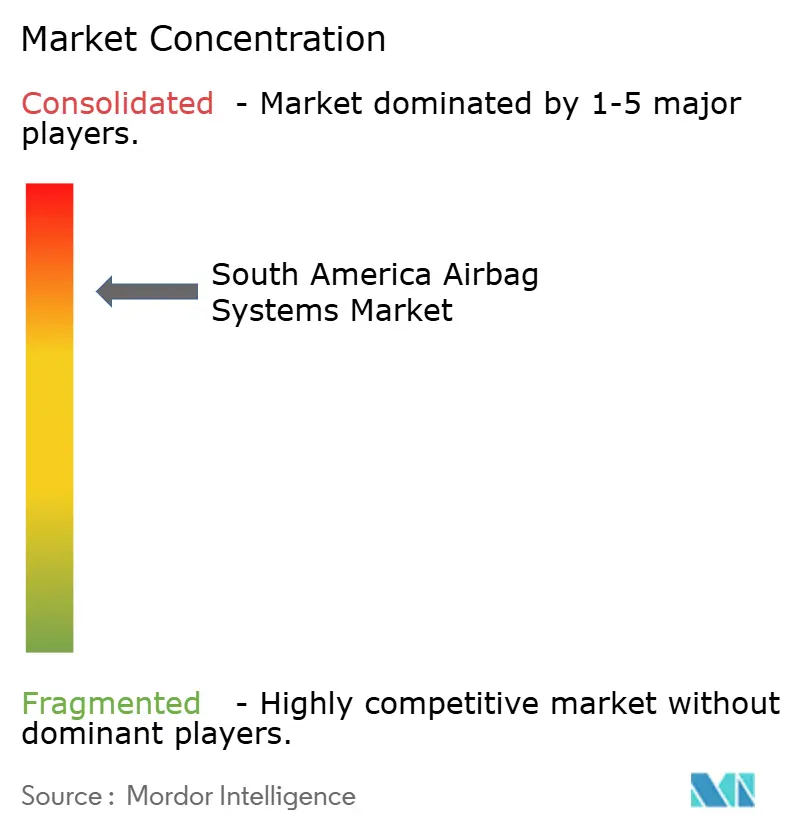
| Market Concentration | High |
Major Players *Disclaimer: Major Players sorted in no particular order Image © Mordor Intelligence. Reuse requires attribution under CC BY 4.0. | |
South America Airbag Systems Market Analysis by Mordor Intelligence
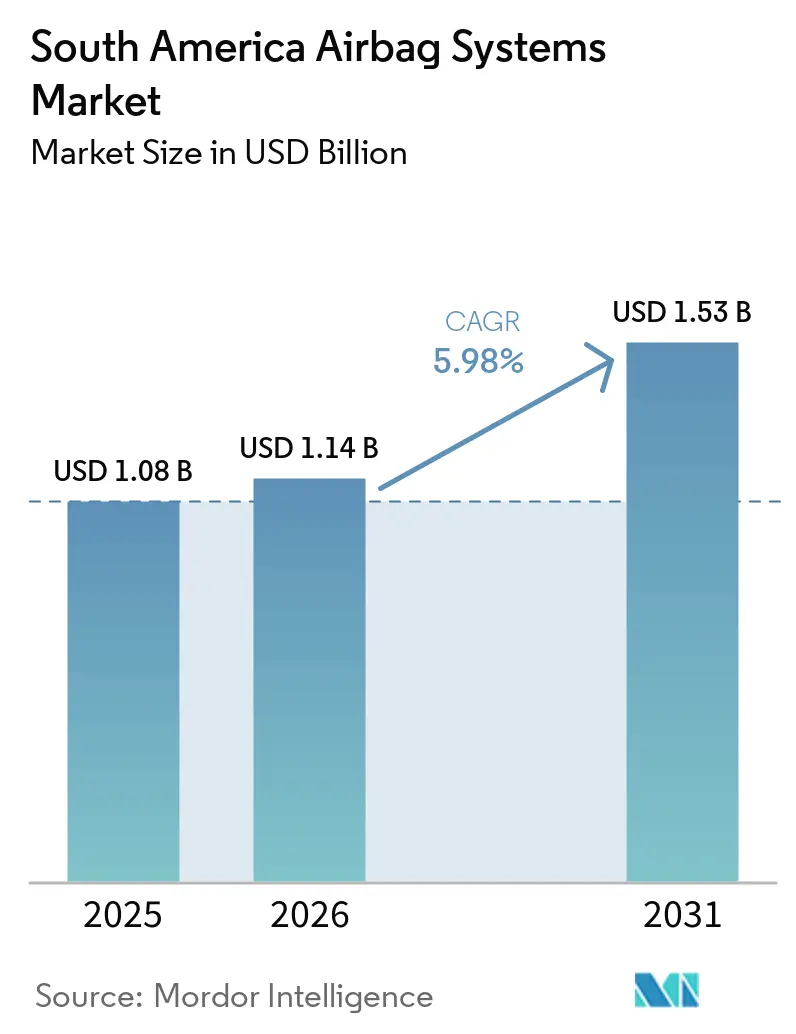
The South American airbag systems market size was valued at USD 1.08 billion in 2025, is estimated at USD 1.14 billion in 2026, and is projected to reach USD 1.53 billion by 2031, growing at a CAGR of 5.98% from 2026 to 2031. The regional market is being shaped by stricter crash-safety rules, new vehicle programs, and a vehicle mix that requires more restraint systems per unit. Brazil remains central because its vehicle production base, certification requirements, and supplier footprint support sustained procurement. Updated Latin NCAP testing raises the importance of side-impact protection and makes broader airbag packages more relevant to vehicle positioning. New local production programs also give suppliers opportunities to win platform contracts early in a vehicle development cycle. At the same time, counterfeit parts, legacy recall exposure, and cost pressure in entry-level vehicles limit the pace of adoption in some applications.
Key Report Takeaways
- By airbag type, front airbags held 46.24% of the South American airbag system market share in 2025, while curtain airbags are forecast to grow at a 6.19% CAGR through 2031.
- By vehicle type, passenger cars accounted for 73.16% of the South American airbag system market share in 2025, while light commercial vehicles are forecast to grow at a 6.23% CAGR through 2031.
- By component, airbag modules held 39.72% of the South American airbag system market share in 2025, while inflators are forecast to grow at a 6.73% CAGR through 2031.
- By sales channel, OEM sales accounted for 88.13% of the South American airbag system market share in 2025, while the aftermarket is forecast to grow at a 7.12% CAGR through 2031.
- By country, Brazil held 52.38% of the regional value share in 2025 and is forecast to grow at a 6.59% CAGR through 2031.
Note: Market size and forecast figures in this report are generated using Mordor Intelligence’s proprietary estimation framework, updated with the latest available data and insights as of January 2026.
South America Airbag Systems Market Trends and Insights
Drivers Impact Analysis*
| Driver | (~) % Impact on CAGR Forecast | Geographic Relevance | Impact Timeline |
|---|---|---|---|
| Stricter Region-Wide Airbag Regulations | +1.5% | Brazil, Mercosur bloc including Argentina, Uruguay, and Paraguay | Medium term (2-4 years) |
| OEM Production Expansion in Brazil | +1.2% | Brazil, with Mercosur production spillover | Short term (≤ 2 years) |
| Rising SUV and Pickup Penetration Boosting Multi-Airbag Count | +0.9% | Brazil and Argentina | Medium term (2-4 years) |
| Growing Consumer Focus on NCAP Safety Ratings | +0.7% | Brazil, Chile, and Colombia | Medium term (2-4 years) |
| Fleet Insurance Incentives for Side-Curtain Airbags | +0.5% | Brazil, with early adoption in Colombia and Chile | Medium term (2-4 years) |
| Localization of Inflator Manufacturing Lowering Cost Barriers | +0.4% | Brazil | Long term (≥ 4 years) |
| Source: Mordor Intelligence | |||
Stricter Region-Wide Airbag Regulations
Safety rules across South America are moving beyond minimum equipment requirements toward crash-performance expectations. Brazil's CONTRAN Resolution 964/2022 requires frontal airbags in M1 and N1 vehicles, establishing a clear baseline for both locally produced and imported models. Resolution 949/2022 also established lateral occupant-protection testing requirements for sedans, SUVs, and pickups. Latin NCAP's 2026-2029 protocol introduced a 60 km/h side-barrier test and a 32 km/h side-pole test, increasing the value of side and curtain protection in vehicle design[1]Latin NCAP, “Latin NCAP Announces Update to Its Assessment Protocol,” Latin NCAP, latinncap.com.. The protocol also considers ISOFIX availability and the ability to deactivate the passenger airbag, thereby connecting child safety features to restraint-system decisions. These requirements encourage automakers to standardize broader airbag packages before a facelift or a new model launch.
OEM Production Expansion in Brazil
Brazil's new vehicle programs create recurring demand for locally supplied airbag systems. General Motors increased its investment commitment in Brazil for hybrid vehicles, manufacturing modernization, and engineering capabilities. Changan and CAOA began local production of the Uni-T SUV in Anápolis in March 2026 as part of a USD 950 million investment cycle for 2026-2028 [2]Changan Automobile and CAOA, “Changan and CAOA Strengthen Long-Term Commitment to Brazil,” CHANGAN ,globalchangan.com . The new platforms require dedicated homologation and give suppliers an opportunity to secure contracts for the duration of each production run. Chinese automakers entering Brazil commonly introduce vehicles with comprehensive safety equipment, which can raise the average number of airbags per locally produced vehicle. The South American airbag system market benefits when local assembly programs combine volume growth with higher safety content rather than relying only on unit output.
Rising SUV and Pickup Penetration Boosting Multi-Airbag Count
SUVs and pickups require more airbags than entry-level cars, increasing system demand even when overall vehicle output changes little. Pickup registrations in Brazil have shown notable year-on-year growth in recent periods. These vehicle types typically use more airbags than many entry-level passenger cars, which are often fitted with a minimal number of units. The additional content includes side and curtain systems that provide protection in side impacts and rollover events. For suppliers, this translates to a higher-value airbag package fitted to each vehicle and supports faster growth in inflators and curtain airbags relative to the South American airbag system market as a whole.
Growing Consumer Focus on NCAP Safety Ratings
Latin NCAP ratings now influence how manufacturers position safety equipment in regional vehicles. Kia standardized 6 airbags and electronic stability control on the Sportage, which earned a 5-star result in the program's final 2025 results. Renault's Brazil-produced Kardian received 5 stars with 6 standard airbags and electronic stability control after the model added vulnerable-road-user braking support in 2025. Hyundai's Tucson also achieved 5 stars after side and curtain airbags were standardized. These examples show that airbag content increasingly supports both product competitiveness and regulatory compliance. Automakers planning models for the current protocol period have a reason to include multi-airbag packages from the initial design stage.
Restraints Impact Analysis*
| Restraint | (~) % Impact on CAGR Forecast | Geographic Relevance | Impact Timeline |
|---|---|---|---|
| Price-Sensitive Entry-Level Segment Limits Adoption | -0.7% | Brazil and Argentina | Medium term (2-4 years) |
| Prevalence of Counterfeit Airbag Imports | -0.5% | Brazil, Argentina, and Colombia | Short term (≤ 2 years) |
| Supply-Chain Disruptions for Specialized Propellant Chemicals | -0.4% | Global supply chain, all markets | Short term (≤ 2 years) |
| Integration Challenges of Center Airbags With Legacy Platforms | -0.3% | All markets, especially older vehicle fleets | Long term (≥ 4 years) |
| Source: Mordor Intelligence | |||
Price-Sensitive Entry-Level Segment Limits Adoption
Entry-level vehicles remain difficult to equip with additional airbags when rules do not require them. Vehicle makers in this category must balance equipment upgrades with the affordability buyers expect. This constraint is more evident in Brazil and Argentina, where imported components and macroeconomic uncertainty can raise sourcing costs. Manufacturers can more easily add 4 or 6 airbags to higher-priced SUVs and pickups, where the safety package is easier to support within the vehicle's price. The result is a split within the South American airbag system market, with stronger content growth in mid-range and premium vehicles. The entry-level segment continues to slow the adoption of optional restraint systems.
Prevalence of Counterfeit Airbag Imports
Counterfeit airbag components pose safety risks and reduce revenue for legitimate aftermarket suppliers. The OECD's recent review identified automotive airbags as a high-risk counterfeit category, with China identified as a major source of such goods. Brazil had millions of vehicles across numerous brands and models subject to Takata inflator recalls, creating significant demand for verified replacement parts. Independent repair channels can allow counterfeit parts to reach vehicle owners without adequate verification of their origin. Suppliers, therefore, need traceable distribution networks and VIN-linked certification for replacement modules. Stronger channel controls would protect both road users and authorized suppliers operating in the South American airbag system market.
*Our forecasts treat driver/restraint impacts as directional, not additive. The impact forecasts reflect baseline growth, mix effects, and variable interactions.
Segment Analysis
By Airbag Type: Curtain Modules Scale With Ejection-Mitigation Rules
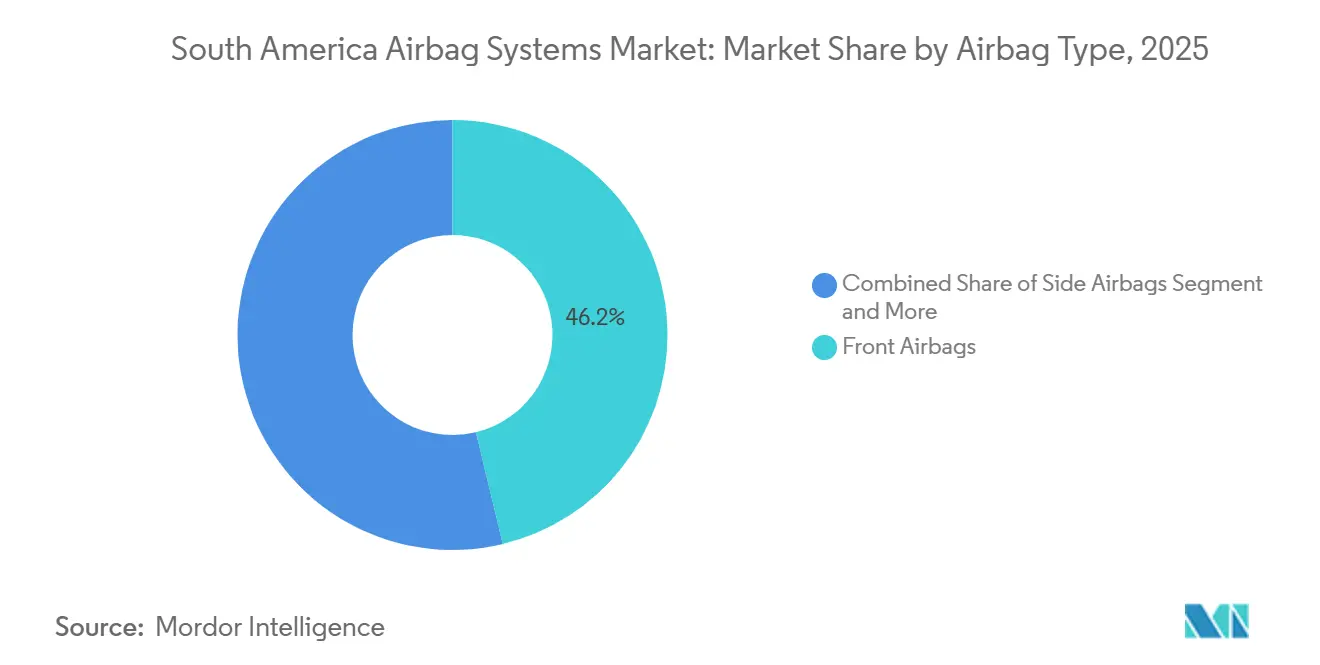
Front modules already penetrate close to 100% of new builds, yet they still generated 46.24% of 2025 revenue owing to sheer volume. Curtain airbags are forecast to grow at a 6.19% CAGR between 2026 and 2031 as Colombia and Chile legislate ejection-mitigation performance, edging their share toward one-quarter of the South America airbag systems market by the end of the decade. Side-thorax units, benefiting from NCAP's pole-impact criteria, account for a significant portion of the market value. Knee airbags serve as a premium feature, distinguishing trims of the Volkswagen Taos and Toyota Corolla Cross. While center and seatbelt airbags hold a minimal share of the market, they're primarily found in high-end crossovers and luxury imports from Germany. Suppliers see the most promise for margin expansion in innovations such as cascading roof rails or door-mounted curtains.
While front modules dominate, offering scale efficiencies, their growth is beginning to plateau. On the other hand, as regulatory timelines come into play in various Andean markets, curtains and thorax units are set to introduce new content layers in vehicles. Future technology trends highlight a shift towards lighter fabrics, sealed seams that reduce fill gas volumes, and AI-driven inflator logic that adapts to occupant posture. Curtailed airbag revenues are expected to drive a significant portion of the growth in South America's airbag systems market.



By Vehicle Type: Passenger Cars Retain Scale, While LCVs Raise Airbag Content per Vehicle
Passenger cars accounted for 73.16% of the South American airbag system market in 2025, reflecting the high volume of this vehicle category in the region. Passenger cars provide the base demand for frontal airbag modules and related electronic controls. Light commercial vehicles are projected to grow at a 6.23% CAGR through 2031. Pickups make up a major part of this expansion because they are used for both personal and commercial transport. These vehicles typically include 4 to 6 airbags as standard safety equipment. The higher system count makes their contribution to airbag revenue greater than vehicle registrations alone suggest. The ongoing pickup-and-SUV shift, therefore, supports airbag demand beyond the passenger-car base.
Medium and heavy commercial vehicles, along with buses and coaches, hold smaller absolute shares. Their safety requirements have historically developed more slowly than requirements for passenger vehicles in the region. Fleet operators are nevertheless placing more weight on occupant protection and insurance considerations. Volvo Trucks made integrated side-curtain airbags standard on its new VNL and VNR models for North America in February 2026 [3]Volvo Trucks, “Volvo Trucks' Industry-First Standard Integrated Side Curtain Airbag Named HDT Top Product,” Volvo Trucks, volvotrucks.us.. The move provides a relevant example as vehicle safety specifications converge across global platforms. South American commercial-vehicle adoption may emerge ahead of formal regulatory schedules when fleet buyers seek broader safety equipment. Established suppliers already serving regional fleets are positioned to address this demand.
By Component: Airbag Modules Lead System Value, While Inflators Gain From Localization
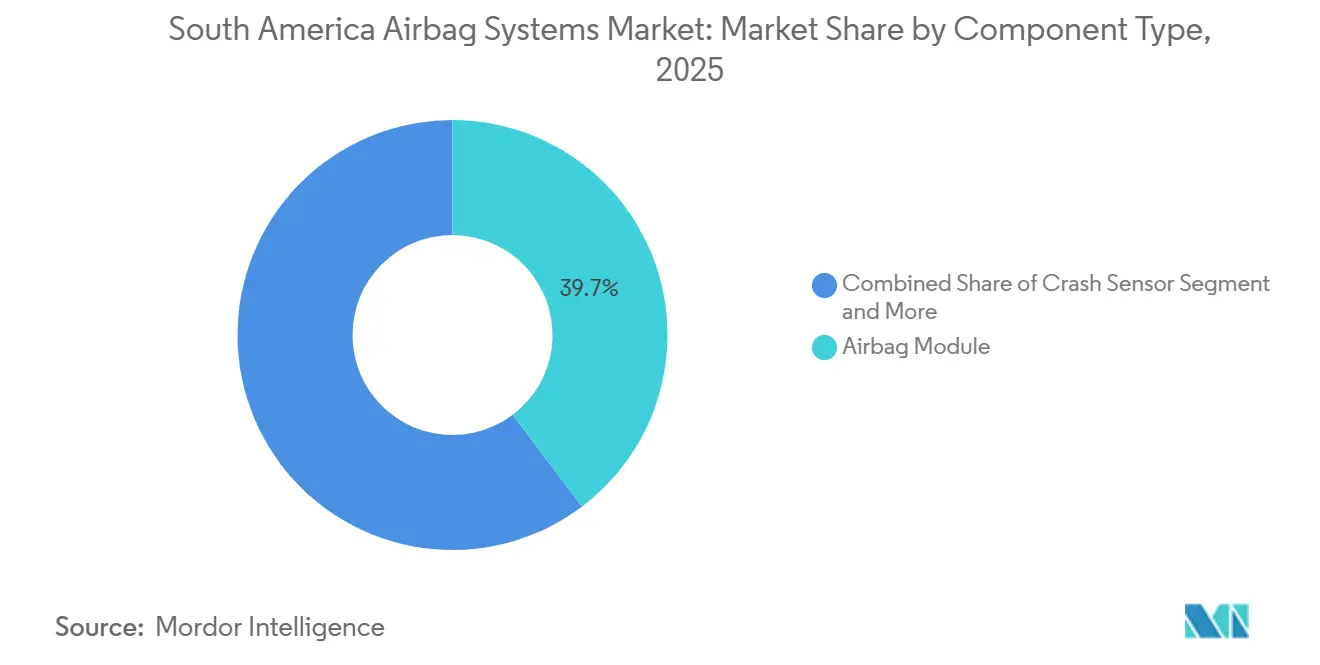
Airbag modules held 39.72% of the South American airbag system market share in 2025 because they combine the cushion, inflator, cover, and housing into a single deployable unit. This assembled module is a high-value part of the overall restraint-system bill of materials. Inflators are forecast to grow at a 6.73% CAGR through 2031. Their growth follows the rising number of airbags installed on each vehicle. It also reflects efforts to build local production capability in Brazil. Autoliv operates an inflator facility in Taubaté, São Paulo, built in response to Brazil's front-airbag requirement. Local manufacturing supports just-in-sequence supply for vehicle plants. It can also reduce exposure to import costs and transport delays.
Crash sensors, diagnostic sensors, and control units provide the electronic backbone of airbag deployment. ZF localized its Generation 7.5 Airbag Control Unit at Limeira, São Paulo. The company stated that the site is the only South American location producing automotive safety electronics at the same technology generation as ZF's global production. Local electronic content strengthens the connection between airbag modules and wider vehicle safety systems. It also reduces the opportunity for lower-priced imports to displace established suppliers. The component mix is becoming more localized in both mechanical and electronic areas. This benefits suppliers that can meet the quality and delivery requirements of Brazilian vehicle plants. Inflator supply remains important because each additional airbag requires a deployment mechanism.
By Sales Channel: OEM Supply Remains Central, While Recall and Repair Needs Support the Aftermarket
Original equipment manufacturer (OEM) sales accounted for 88.13% of the South American airbag system market size in 2025. This position reflects the technical integration required for airbag systems in vehicle platforms. Suppliers must meet design, testing, certification, and delivery requirements before a vehicle enters production. Contracts commonly extend across the full life of a platform. These conditions create switching costs for automakers and support long-standing relationships with Tier-1 suppliers. The OEM channel also benefits directly from new assembly investments in Brazil. It will remain the main route for systems installed in new vehicles.
The aftermarket is forecast to grow at a 7.12% CAGR through 2031, the highest rate among the reported segments. Demand comes from recall remediation, collision repairs, and replacement after airbag deployment. Brazil's large passenger-vehicle fleet provides the installed base for this work. The Takata recall population also creates a need for verified replacement inflators and modules. Counterfeit products remain a major obstacle because they can be priced far below genuine parts. Authorized distributors need stronger traceability and clear proof of component origin. The South American airbag system industry can improve the quality of aftermarket demand by making verified products easier to identify and source.
Geography Analysis
Brazil held 52.38% of the South American airbag system market share in 2025 and is forecast to grow at a 6.59% CAGR through 2031. Brazil's position in the regional market reflects a large vehicle production base, active safety regulation, and the presence of major Tier-1 suppliers. CONTRAN requirements establish a clear baseline for frontal airbag content in M1 and N1 vehicles. Latin NCAP's protocol gives vehicle manufacturers an additional reason to improve side-impact protection. General Motors' substantial investment commitment and new programs from other automakers reinforce demand for localized component supply. Brazil, therefore, combines scale, regulatory enforcement, and new platform demand within a single country.
Argentina is the next-most-important country market in the region. Argentina's vehicle production is closely linked to its economic recovery cycle and its trade relationship with Brazil. Utilities and pickups account for a large share of Argentine vehicle production, which increases the relevance of higher-airbag-content light commercial vehicles. Argentina's imports of airbags and seatbelts grew steadily before consolidating in recent years. Macroeconomic conditions and import controls will continue to shape the pace of demand.
Colombia and Chile are smaller but relevant markets for safety-equipped vehicle imports. Colombia benefits from trade frameworks that support the import of vehicles with broader safety packages. Chile has high vehicle ownership and buyers who respond to Latin NCAP ratings, which can support earlier adoption of optional safety upgrades. Peru, Ecuador, Uruguay, Paraguay, and other countries in the Rest of South America add demand through Mercosur-based distribution channels. Safety regulations in these markets remain less stringent than in Brazil, although road safety advocacy is increasing across the subregion. The South American airbag system market will continue to rely on Brazil for most regional production, while other countries contribute import-led demand.
Competitive Landscape
The South American airbag system market is moderately consolidated among Tier-1 suppliers with established manufacturing capacity in Brazil. Autoliv, ZF Friedrichshafen, and Joyson Safety Systems hold strong positions through local facilities and established OEM relationships. Autoliv generates the majority of its global sales from airbag and steering wheel products. The company operates an inflator facility in Taubaté and a plant in Goiana, Pernambuco. ZF produces airbag control units at Limeira and has localized advanced safety electronics in Brazil. Joyson Safety Systems operates in Jundiaí and Piçarras, supporting its local customer relationships. These localized operations make it difficult for new suppliers to displace incumbents on established vehicle programs.
Notable yet smaller players, such as Toyoda Gosei, Hyundai Mobis, and Daicel, are making their mark. Toyoda Gosei's revenue in the Americas surged, driven by steering-wheel contracts for prominent pickup models. Hyundai Mobis is pioneering PBV-specific airbags and aims to integrate them into an upcoming EV van plant in Brazil. Daicel boasts a hybrid inflator backlog extending into the future, catering to Autoliv and ZF's programs targeting high safety ratings.
Strategic initiatives are leaning towards localization, vertical integration, and sophisticated algorithmic controls. Suppliers are racing to certify AI-driven control units that adjust deployment force based on occupant size. This feature, introduced earlier by Bosch, is being developed in collaboration with Stellantis for regional builds. A competitive edge is emerging in sourcing nylon 6.6 fabric, with new Chinese entrants offering lower prices than established players, though concerns linger over their tear strength. Despite the intensifying competition, established players benefit from scale advantages and long-term contracts, ensuring a robust, albeit not monopolistic, foothold in the South American airbag systems market.
South America Airbag Systems Industry Leaders
ZF Friendrichshafen AG
Autoliv Inc
Hyundai Mobis
Toyoda Gosei Co., Ltd.
Joyson Safety Systems
- *Disclaimer: Major Players sorted in no particular order

Recent Industry Developments
- August 2026: OMODA & JAECOO previewed the all-new Jaecoo 8 PHV and displayed the Omoda 7 PHV at the 2026 Interlagos Festival, expanding its product lineup in Brazil. The Jaecoo seats 8 and features a Sony 14-speaker audio system, a digital instrument cluster, a high-resolution infotainment display, and a 540-degree camera system. On the safety front, the vehicle is equipped with 10 airbags, an ADAS 2.5 suite, and a head-up display, reflecting the growing demand for advanced airbag systems in the automotive market.
- July 2026: Leapmotor Argentina released additional details of the new B10 ultra-hybrid model, marking its first vehicle launch in the market. The B10 features six cameras, six radars, 15 advanced driver-assistance system (ADAS) functions, seven airbags, and a high-strength body structure.


South America Airbag Systems Market Report Scope
The South America airbag systems market report is segmented by airbag type (front airbag, side airbag, curtain airbag, knee airbag, center airbag, and seatbelt airbag), vehicle type (passenger cars, Light Commercial Vehicles (LCVs), Medium & Heavy Commercial Vehicles (MHCVs), and buses and coaches), component (module, crash sensor, inflator, diagnostic sensor, control unit, and others), sales channel (Original Equipment Manufacturer (OEM) and aftermarket), The analysis also covers country-level segmentation, including Brazil, Argentina, Colombia, Chile, and the rest of South America. The market size and growth forecasts are provided in terms of value (USD).
By Airbag Type
| Front Airbags |
| Side Airbags |
| Curtain Airbags |
| Knee Airbags |
| Center Airbags |
| Seatbelt Airbags |
By Vehicle Type
| Passenger Cars |
| Light Commercial Vehicles (LCVs) |
| Medium & Heavy Commercial Vehicles (MHCVs) |
| Buses and Coaches |
By Component
| Airbag Module |
| Crash Sensor |
| Inflator |
| Diagnostic Sensor |
| Control Unit |
| Others |
By Sales Channel
| Original Equipment Manufacturer |
| Aftermarket |
By Country
| Brazil |
| Argentina |
| Colombia |
| Chile |
| Rest of South America |
| By Airbag Type | Front Airbags |
| Side Airbags | |
| Curtain Airbags | |
| Knee Airbags | |
| Center Airbags | |
| Seatbelt Airbags | |
| By Vehicle Type | Passenger Cars |
| Light Commercial Vehicles (LCVs) | |
| Medium & Heavy Commercial Vehicles (MHCVs) | |
| Buses and Coaches | |
| By Component | Airbag Module |
| Crash Sensor | |
| Inflator | |
| Diagnostic Sensor | |
| Control Unit | |
| Others | |
| By Sales Channel | Original Equipment Manufacturer |
| Aftermarket | |
| By Country | Brazil |
| Argentina | |
| Colombia | |
| Chile | |
| Rest of South America |


Key Questions Answered in the Report
What is the forecast for South America airbag systems through 2031?
The value is forecast to reach USD 1.53 billion by 2031 from USD 1.14 billion in 2026, expanding at a 5.98% CAGR.
Which airbag type leads demand in South America?
Front airbags led with a 46.24% value share in 2025 because frontal systems are required for Brazil's M1 and N1 vehicles.
Why are curtain airbags gaining importance in South America?
Latin NCAP's current side-impact testing increases the relevance of curtain systems for vehicles targeting stronger safety ratings.
Why is Brazil important for airbag suppliers?
Brazil accounted for 52.38% of regional value in 2025 and combines vehicle production, regulations, and localized Tier-1 supply.
What limits replacement-airbag demand in the region?
Counterfeit products can undercut authorized components, while the large Takata recall population increases the need for verified replacement parts.
Page last updated on:





