
South America 5G Device Market Size and Share
Market Overview
| Study Period | 2020 - 2031 |
|---|---|
| Forecast Data Period | 2026 - 2031 |
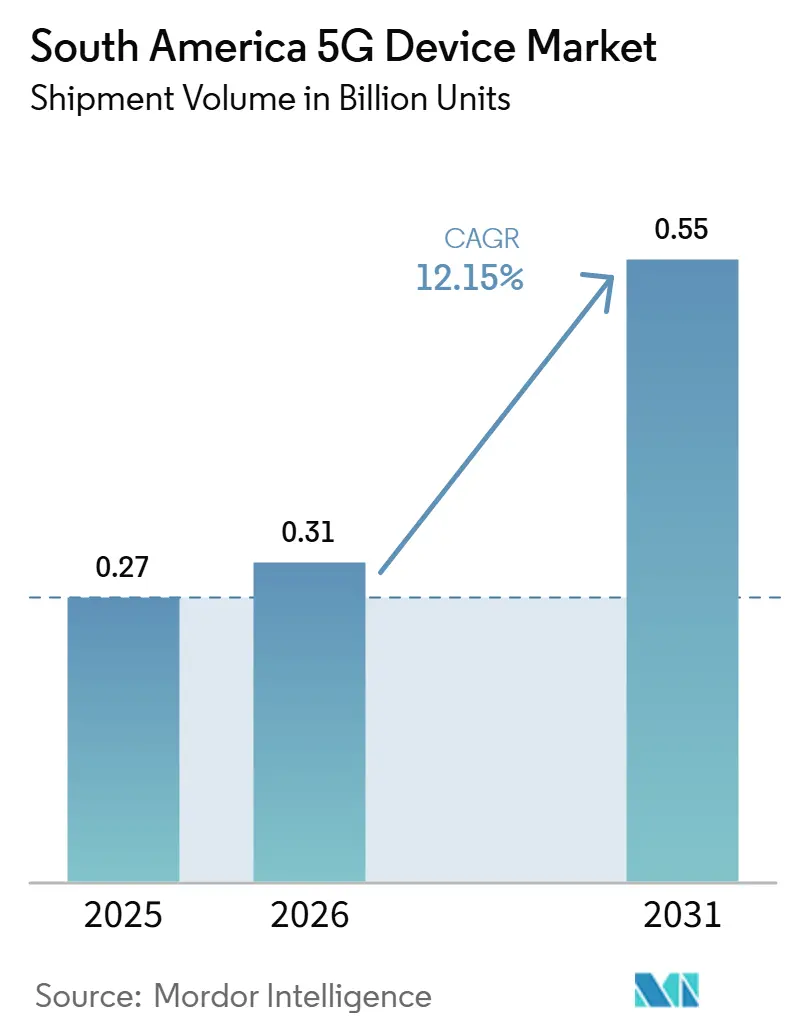
| Base Year Market Size (2025) | 0.27 Billion units |
| Market Volume (2026) | 0.31 Billion units |
| Market Volume (2031) | 0.55 Billion units |
| Growth Rate (2026 - 2031) | 12.15 % |
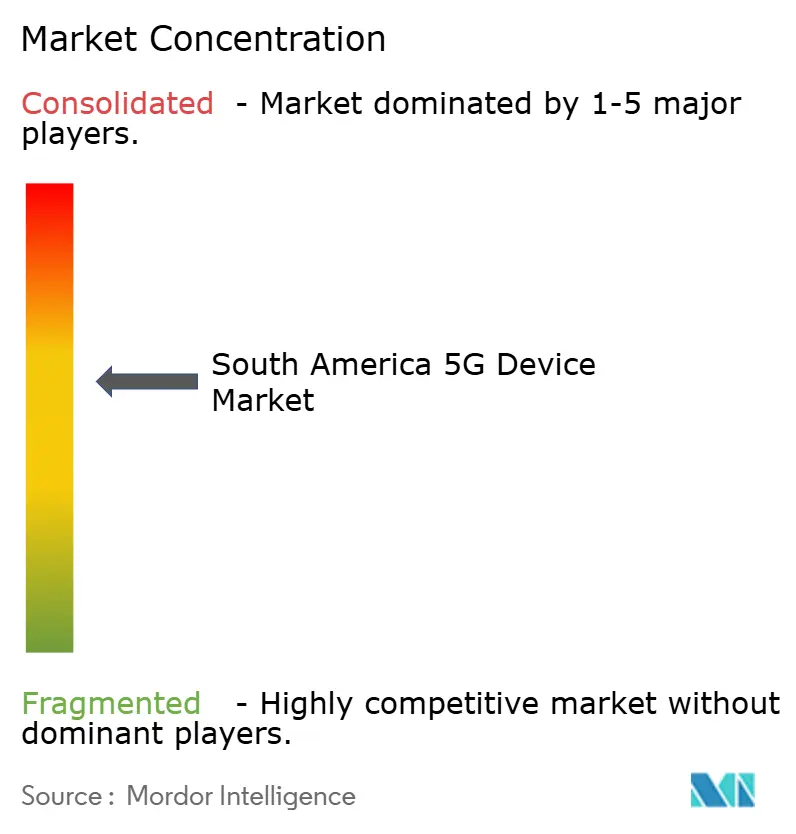
| Market Concentration | Medium |
Major Players *Disclaimer: Major Players sorted in no particular order Image © Mordor Intelligence. Reuse requires attribution under CC BY 4.0. | |
South America 5G Device Market Analysis by Mordor Intelligence
The South America 5G Device Market size in terms of shipment volume is projected to expand from 0.27 billion units in 2025 and 0.31 billion units in 2026 to 0.55 billion units by 2031, registering a CAGR of 12.15% from 2026 to 2031. Wider standalone 5G coverage and lower entry-level handset prices are supporting replacement purchases across the region. Brazil reached 58.1 million 5G accesses in 2025, while 5G coverage extended to 64.94% of the population in 2,019 municipalities. Operator financing is becoming more important because device adoption has not kept pace with network coverage in all consumer groups. Fixed wireless access is also extending demand beyond smartphones, especially where fiber deployment remains costly. These conditions are increasing the need for device makers, operators, and component suppliers to align product availability with subsidy programs and local network rollouts.
Key Report Takeaways
- By form factor, smartphones held 70.80% of the South America 5G device volume share in 2025, while customer-premises equipment (indoor/outdoor) is projected to expand at a 13.40% CAGR through 2031.
- By spectrum support, sub-6 GHz devices accounted for 66.30% of the South America 5G device volume share in 2025, while hybrid (sub-6 GHz and mmWave) devices are expected to expand at a 13.61% CAGR through 2031.
- By end-user industry, consumer electronics held 69.11% of the South America 5G device volume share in 2025, while automotive and transportation are projected to expand at a 13.52% CAGR through 2031.
- By application, enhanced mobile broadband (eMBB) accounted for 61.00% of the South America 5G device volume share in 2025, while fixed wireless access is expected to expand at a 13.89% CAGR through 2031.
- By country, Brazil held 59.31% of the South America 5G device volume share in 2025, while Argentina is projected to expand at a 13.22% CAGR through 2031.
Note: Market size and forecast figures in this report are generated using Mordor Intelligence’s proprietary estimation framework, updated with the latest available data and insights as of January 2026.
South America 5G Device Market Trends and Insights
Drivers Impact Analysis*
| Driver | (~) % Impact on CAGR Forecast | Geographic Relevance | Impact Timeline |
|---|---|---|---|
| Rising 5G-Enabled Smartphone Replacement Cycles | +3.0% | Brazil, Argentina, and Chile, with strongest activity in São Paulo, Buenos Aires, and Santiago metropolitan corridors | Short term (≤ 2 years) |
| Expansion of 5G FWA Device Demand in Underserved Areas | +2.3% | Brazil's Northeast and North, Argentina's Patagonia and Vaca Muerta corridor, and the rest of South America | Medium term (2-4 years) |
| Network Operator Subsidy Programs for 5G Handsets and CPE | +1.8% | Brazil, including Vivo, Claro, and TIM, and Argentina, including Personal and Claro, with early gains in São Paulo, Rio de Janeiro, and Buenos Aires | Short term (≤ 2 years) |
| Enterprise Digitization Driving 5G Routers, Gateways, and Industrial Devices | +1.4% | Brazil's Sao Paulo industrial belt, Minas Gerais, and Rio Grande do Sul, plus Argentina's Vaca Muerta energy sector | Medium term (2-4 years) |
| Growing Demand for 5G Devices With Efficient Power Management and Longer Battery Life | +1.0% | Global demand with spillover into South American consumer and enterprise segments | Medium term (2-4 years) |
| Local Assembly and Import Diversification of Consumer Electronics | +0.7% | Brazil's Zona Franca de Manaus and Argentina's Tierra del Fuego, with early gains in Manaus and Ushuaia | Long term (≥ 4 years) |
| Source: Mordor Intelligence | |||
Rising 5G-Enabled Smartphone Replacement Cycles
Smartphone replacement cycles have shortened since 2024 as 5G coverage reached levels that allow more consumers to use the service. Brazil added 18.2 million 5G connections in 2025, bringing its total to 58.1 million and representing 46.6% year-over-year growth. The increase points to upgrades from 4G-capable devices during carrier promotions, rather than subscriber growth alone. Samsung introduced the Galaxy A06 5G with Vivo at BRL 899 (USD 157) in April 2025, setting a lower reference price for 5G handsets. Motorola, Xiaomi, and Jovi have competed in the same mid-range range as operators promote device upgrades. As 5G handset ownership rises, higher network use can support additional network investment and data-plan upgrades.
Expansion of 5G Fixed Wireless Access Device Demand in Underserved Areas
The gap between fiber deployment economics and population distribution is supporting demand for fixed wireless access customer-premises equipment. Brazil's Ministry of Communications completed a 5G FWA outdoor CPE trial at 3 rural schools in Rio Grande do Norte in July 2025, in partnership with CPQD, Qualcomm, Brisanet, and Intelbras. The trial found that outdoor 5G CPE delivered speeds comparable to those of fiber connections at the tested locations.[1]Ministério das Comunicações, “Tecnologia 5G FWA Se Mostra Solução Eficiente Para Conectar Escolas em Áreas Rurais e Remotas do Brasil,” Governo do Brasil, gov.br Brisanet and Qualcomm announced the Northeast Connected with FWA collaboration in March 2026 to supply subsidized SDX62-based CPE to rural communities. Claro Argentina also began commercial 5G FWA services in Buenos Aires, Córdoba, and other provincial capitals in 2025. Public connectivity objectives in education, health care, agribusiness, and financial services are making this demand less dependent on consumer handset purchase decisions.
Network Operator Subsidy Programs for 5G Handsets and CPE
Device financing programs are helping operators address the gap between 5G network availability and handset ownership. Vivo stated in December 2025 that its 5G coverage reached nearly 70% of Brazil's population, while only 25% of its customers had 5G-capable handsets. It introduced Vivo Pay financing in January 2026, enabling purchases in up to 21 installments without a credit card. Samsung, Claro, Vivo, and TIM have also expanded the availability of lower-priced 5G handsets and device-plan bundles. Operators are pairing handset subsidies with CPE support for FWA subscribers, increasing the number of device types involved in each customer cycle. Argentina's removal of the 16% mobile phone import tariff in January 2026, together with the reduction in internal tax from 19% to 9.5%, lowered the wholesale cost base for such programs.
Enterprise Digitization Driving 5G Routers, Gateways, and Industrial Devices
Private 5G adoption is creating demand for industrial routers, gateways, and modules in steel, mining, agribusiness, and port operations. Usiminas contracted Embratel in January 2025 to deploy a private LTE and 5G network across its Ipatinga plant for industrial automation, logistics, and safety applications. Gerdau also expanded its private 5G project to the Miguel Burnier mining operation in Ouro Preto, following its earlier deployment in Ouro Branco. Nokia expanded its TIM Brasil partnership in March 2026 to modernize 5G networks in 14 states, with planned uses in mining, agribusiness, manufacturing, and logistics.[2]Nokia, “Nokia Expands Partnership With TIM Brasil to Deliver Next-Generation AI-Ready 5G Network With NVIDIA,” Nokia Newsroom, nokia.com These network programs support device procurement where equipment must meet industrial operating requirements. Longer procurement cycles will continue to slow industrial device adoption compared to consumer handset replacement.
Restraints Impact Analysis*
| Restraint | (~) % Impact on CAGR Forecast | Geographic Relevance | Impact Timeline |
|---|---|---|---|
| Premium Pricing of 5G Devices Versus 4G Alternatives | -2.2% | Brazil's prepaid-dominant states, particularly the North and Northeast, Argentina before tariff reform, and the rest of South America | Short term (≤ 2 years) |
| Uneven 5G Network Coverage Outside Major Urban Corridors | -1.6% | Peru, Bolivia, Ecuador, Paraguay, Brazil's Amazon Basin and rural interior, and Argentina's Patagonia and rural provinces | Medium term (2-4 years) |
| Limited 5G Device Affordability in Price-Sensitive Consumer Segments | -1.1% | Brazil's prepaid subscribers in the North and Northeast, and lower-income markets in the rest of South America | Short term (≤ 2 years) |
| Fragmented Spectrum Readiness and Device Band Compatibility Constraints | -0.6% | Markets with delayed spectrum auctions and cross-border device harmonization gaps in the rest of South America | Long term (≥ 4 years) |
| Source: Mordor Intelligence | |||
Premium Pricing of 5G Devices Versus 4G Alternatives
The price difference between 5G and 4G devices remains a major limit on adoption in price-sensitive consumer segments. Brazilian regulator data indicated that 5G smartphones cost 40% to 60% more than comparable 4G handsets in 2025. Import duties, exchange-rate effects, and brand positioning add to the retail premium. The impact is strongest among prepaid customers, who account for the majority of mobile connections in the region. Operators and manufacturers have responded with installment plans, subsidies, and lower-priced 5G models, but those actions have not yet kept pace with network expansion. This mismatch delays device upgrades and operator revenue from 5G service plans.
Uneven 5G Network Coverage Outside Major Urban Corridors
5G availability remains concentrated in capital cities and larger metropolitan areas outside Brazil and major Argentine cities. Rural areas in Peru, Bolivia, Ecuador, Venezuela, Paraguay, Brazil, and Argentina have earlier-stage deployments, limiting the immediate value of purchasing a 5G device. In Brazil, 64.94% of the population had 5G coverage, yet adoption was stronger in higher-income states.[3]Agência Nacional de Telecomunicações, “Anatel Aprova Planejamento Para Novas Licitações de Faixas da Telefonia Móvel,” Governo do Brasil, gov.br Anatel approved a multiband auction roadmap through 2032 covering 450 MHz, 850 MHz, 2.3 GHz, 2.5 GHz, 3.5 GHz, 6 GHz, and 26 GHz bands. New coverage layers can take 12 to 24 months to translate into material handset and CPE demand. Markets without settled spectrum allocations are likely to defer subsidy and device deployment plans.
*Our forecasts treat driver/restraint impacts as directional, not additive. The impact forecasts reflect baseline growth, mix effects, and variable interactions.
Segment Analysis
By Form Factor: Smartphones Lead While CPE Devices Support Faster Growth
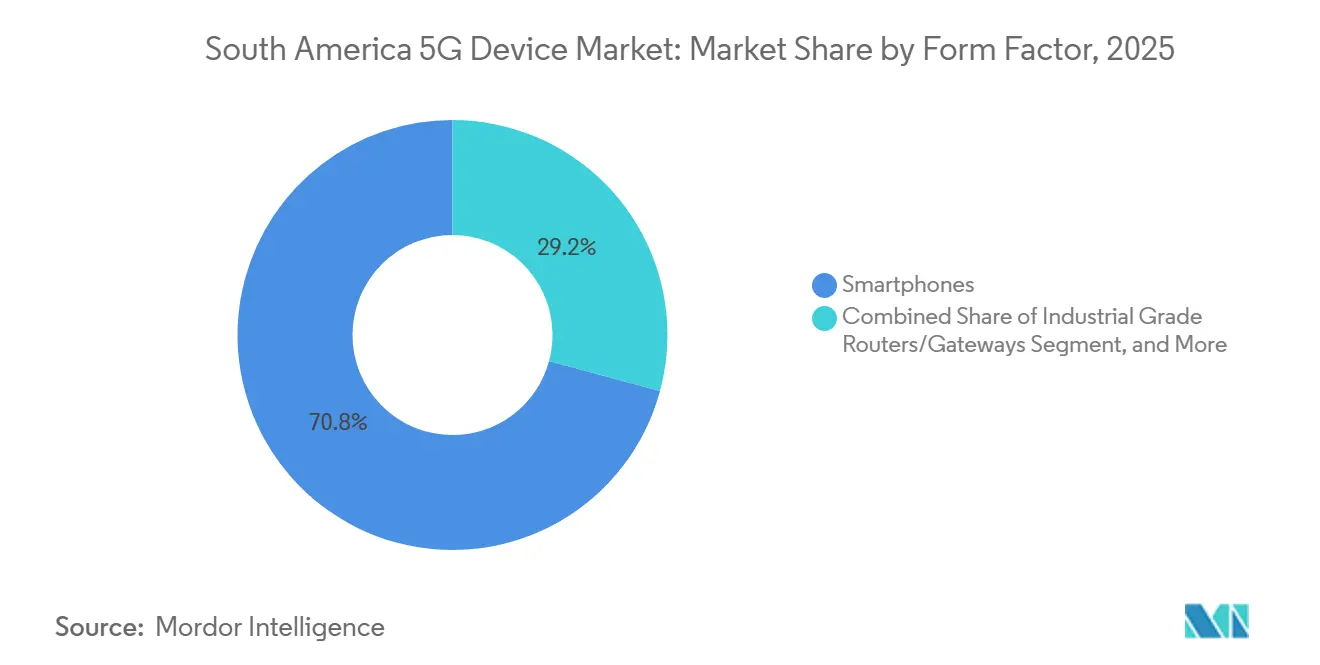
Smartphones accounted for 70.80% of the South America 5G device market share in 2025, reflecting the region's mobile-first connectivity base and the replacement of legacy 4G handsets. Samsung supported shipments through local production in Campinas, São Paulo, and Manaus, Amazonas. Motorola and Xiaomi increased competition in the BRL 1,000 (USD 174) to BRL 3,500 (USD 609) range. Jovi entered Brazil in June 2025 through partnerships with Claro and TIM, offering the V50 Lite 5G at BRL 1,799 (USD 315) via carrier plans. Wearables, XR devices, hotspots, modules, and laptops and tablets had lower volumes, though modules saw increased use in IoT and agricultural automation equipment.
Customer-premises equipment is projected to expand at a 13.40% CAGR through 2031, the fastest rate among form factors. Brisanet, Claro Argentina, and Telecom Argentina have expanded their FWA programs, which created supply pressure on CPE during 2025. Indoor and outdoor CPE is supporting broadband access where fiber deployment is not economical. Industrial-grade routers and gateways have expanded more gradually because enterprise procurement cycles are longer. Deployments by Usiminas, Gerdau, and Nestlé's Caçapava facility show a growing need for dedicated industrial connectivity devices.



By Spectrum Support: Sub-6 GHz Provides Volume While Hybrid Devices Gain Ground
Sub-6 GHz devices held 66.30% of the South America 5G device market share in 2025, supported by Brazil's standalone 5G network architecture. An analysis of 5G readings in Brazil found that 99% originated from the 3.5 GHz C-band in October 2024. This network design has concentrated demand on Sub-6 GHz-compatible handsets and CPE. mmWave devices remained limited to dense venues such as stadiums, airports, and convention centers in São Paulo, Rio de Janeiro, and Brasília. Their use is linked to locations where additional capacity per square meter has clear value.
Hybrid Sub-6 GHz and mmWave devices are expected to expand at a 13.61% CAGR through 2031. Premium smartphone makers are standardizing mmWave support in flagship models, while private network operators are evaluating the band for factory and port automation. Brazil, Uruguay, and Chile have moved ahead with mmWave spectrum auctions, though broad commercial availability remains limited. Qualcomm and Ericsson completed 5G Standalone RedCap trials in Sao Paulo in March 2026 using the RHINO H1 hotspot and Snapdragon X35 modem. Cost-efficient RedCap modules and CPE can drive demand in the Sub-6 GHz ecosystem, while hybrid products address higher-value use cases.
By End-User Industry: Consumer Electronics Retains Scale as Automotive Demand Rises
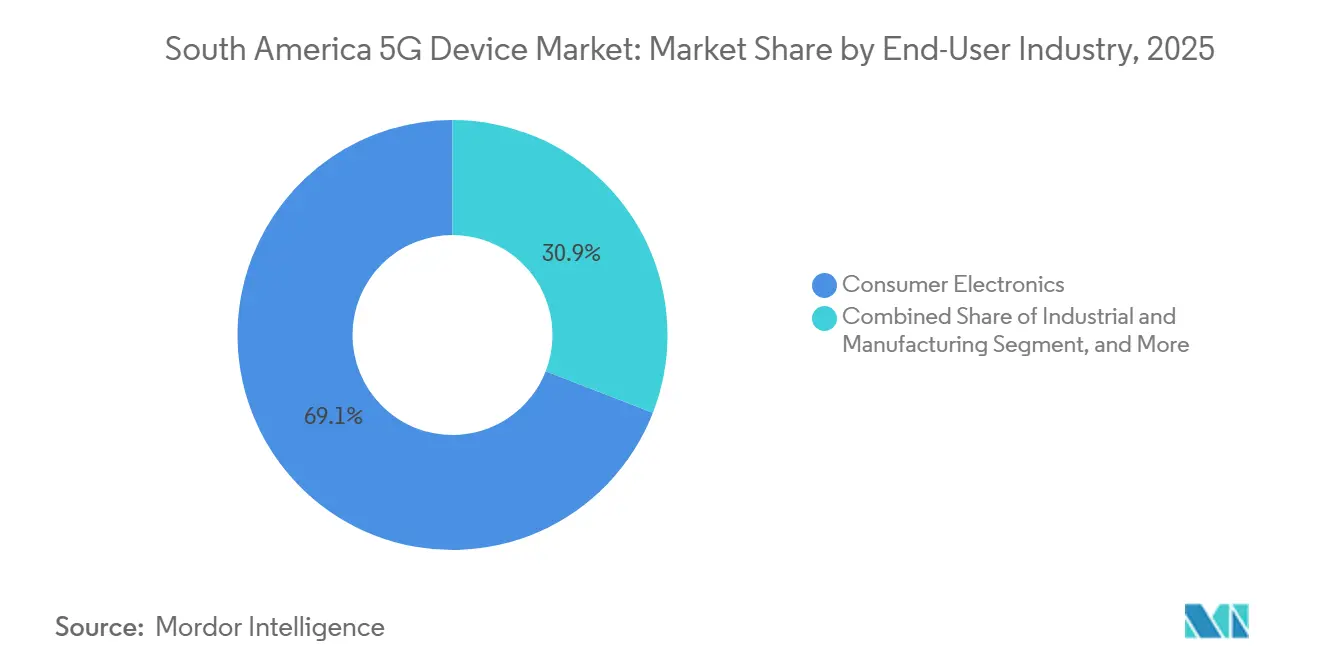
Consumer electronics accounted for 69.11% of the South America 5G device market in 2025, as smartphones, tablets, and consumer CPE remain the main channels for regional device purchases. This concentration makes volumes sensitive to exchange rates, financing availability, and consumer confidence. Industrial and manufacturing represented the next significant end-user vertical through private network deployments at steel, mining, and food-processing sites. Enterprise and commercial users, along with health care providers, are also adopting dedicated connectivity via network slicing capabilities. These uses can support enterprise-grade connectivity without a full private network deployment.
Automotive and transportation is projected to expand at a 13.52% CAGR through 2031, supported by connected vehicle modules, V2X planning, and 5G telematics along highway corridors. Anatel reserved the 5.9 GHz band for V2X equipment certification, which is shaping future equipment requirements. Brazil had not fully built the infrastructure needed for commercial V2X deployment in late 2025, despite connectivity modules appearing in vehicle lines. Energy and utilities are also emerging through grid modernization programs. Neoenergia used Qualcomm's 9205S LTE and 5G IoT modem in its distribution-grid program to target a 30% reduction in maintenance crew travel time.
By Application: eMBB Holds the Base While FWA Expands Fastest
Enhanced mobile broadband held 61.00% of South America's 5G device volumes in 2025, as faster mobile internet on smartphones and tablets remained the most mature use case. URLLC and mMTC applications remained in early stages because 5G network slicing was limited outside major cities. RedCap device trials in Brazil indicated that lower-cost devices for mMTC applications were nearing commercial availability. V2X remains a longer-term application because the network and road infrastructure require further development. Automakers, including Stellantis and Ford, had already included connectivity modules in new vehicle lines sold in Brazil.
Fixed wireless access is expected to expand at a 13.89% CAGR through 2031, making it the fastest-growing application. Rural broadband gaps and public connectivity programs are supporting the South America 5G FWA device market. The Ministry of Communications trial in Rio Grande do Norte demonstrated that outdoor 5G FWA CPE can deliver fiber-like performance in remote school locations. This result changed operator assessments of rural FWA and supported additional CPE procurement planning. CPE and smartphones also draw on Qualcomm and MediaTek supply platforms, which require assemblers and operators to manage component availability across both product groups.
Geography Analysis
Brazil held 59.31% of South America's 5G device market volumes in 2025, supported by its large subscriber base, operator investment, local manufacturing, and broad device ecosystem. Vivo operated 17,184 5G cell sites in 562 cities and served 19.2 million subscribers as of May 2025. TIM Brasil reached 13,189 sites across 705 municipalities and covered 62.3% of the population during the same period. Anatel's 2032 auction roadmap provides a clearer path for continued coverage expansion.
Argentina is projected to expand at a 13.22% CAGR through 2031, making it the fastest-growing national market in the South America 5G device market. The removal of mobile phone import tariffs and lower internal taxes in January 2026 improved the affordability of imported devices. Telecom Argentina deployed 800 5G mobile sites during 2025 and is targeting more than 2,000 by the end of 2026. Claro is also targeting 300,000 FWA subscribers by the end of 2026. ENACOM's 2025 allocation of the 2,300-2,400 MHz band for private mobile networks supports demand for routers, gateways, and modules in mining, oil and gas, and agribusiness.
Chile and Colombia are the most commercially developed markets in the rest of South America after Brazil and Argentina, adding a broader base for the South America 5G device market. Chile uses the 3.5 GHz band for 5G and plans to consult on the allocation of the remaining spectrum. Colombia's 2023 auction provided 80 MHz blocks to each of its 4 operators. Peru, Bolivia, and Paraguay remain at earlier stages of commercial 5G deployment. Differences in spectrum allocation create compatibility and certification challenges for device makers serving multiple countries. As coverage density improves, these markets are expected to add more demand for CPE and modules used in FWA and enterprise applications.
Competitive Landscape
The South America 5G device market is moderately consolidated in smartphones and more fragmented in CPE, modules, and industrial devices. Samsung held 46% of Brazilian smartphone shipments in the first quarter of 2026, supported by its local manufacturing and distribution position. Motorola and Xiaomi compete through pricing and carrier bundle partnerships in the BRL 1,000 (USD 174) to BRL 3,500 (USD 609) range. Samsung, Motorola, Xiaomi, OPPO, and Apple all compete for market share in Brazilian smartphone sales. Product features such as AI-enabled cameras and longer battery life have become important factors in consumer purchasing decisions.
Samsung launched locally manufactured Galaxy S25 devices in Brazil in February 2026 from its Campinas and Manaus facilities, reinforcing its position in the South America 5G device market. It also introduced the Galaxy A07 5G at BRL 1,399 (USD 244) in May 2026, placing a lower-priced option into the entry-level segment. Nokia expanded its TIM Brasil modernization program to 14 states in March 2026, preparing networks for enterprise uses in mining, agribusiness, manufacturing, and logistics. Qualcomm and Ericsson completed RedCap testing in São Paulo during March 2026, demonstrating a platform for lower-cost IoT, FWA CPE, wearable, and industrial devices. These moves are increasing the importance of technology partnerships beyond handset sales alone.
The mid-tier CPE category remains open because government-supported FWA programs and rural deployments require products that meet local certification and price requirements. Huawei and ZTE are established in enterprise and FWA equipment, while TP-Link, Inseego, and regional brands may address new CPE and module opportunities. Anatel's certification framework has heightened the importance of band compatibility and the timing of product approval. Act 14158/2025, effective April 6, 2026, updated RF technical requirements across 6 GHz to 246 GHz. Suppliers with local supply relationships and Qualcomm or MediaTek sourcing can compete for emerging FWA and industrial device demand in the South America 5G device market.
South America 5G Device Industry Leaders
Apple Inc.
Samsung Electronics Co., Ltd.
Lenovo Group Limited
Nokia Corporation
Qualcomm Incorporated
- *Disclaimer: Major Players sorted in no particular order

Recent Industry Developments
- March 2026: Nokia expanded its 5G network modernization partnership with TIM Brasil to 14 states across 4 regions, covering 42% of Brazil's population. Nokia's AirScale deployment included Habrok Massive MIMO radios, Pandion Remote Radio Heads, and NVIDIA AI-RAN integration for enterprise applications in mining, agribusiness, manufacturing, and logistics.
- March 2026: Brisanet and Qualcomm announced the Northeast Connected with FWA collaboration for rural communities in Brazil's Northeast. The program used 5G FWA CPE powered by the Qualcomm SDX62 processor and offered subsidized connectivity plans for residents in socially vulnerable situations. It created a scalable device deployment model for rural areas where conventional commercial density is limited, strengthening FWA equipment availability in the South America 5G device market.


South America 5G Device Market Report Scope
The South America 5G device market volume is measured by the annual shipment of 5G devices (in units), including smartphones, customer-premises equipment, routers, gateways, modules, laptops, tablets, hotspots, and wearables, across sub-6 GHz, mmWave, and hybrid spectrum configurations for applications such as enhanced mobile broadband (eMBB), ultra-reliable low-latency communications (URLLC), massive machine-type communications (mMTC), fixed wireless access (FWA), and vehicle-to-everything (V2X).
The South America 5G device market report is segmented by form factor (smartphones, customer-premises equipment (indoor/outdoor), industrial grade routers/gateways, modules, laptops/tablets, hotspots, and wearables and XR devices), spectrum support (sub-6 GHz, mmWave, and hybrid (sub-6 GHz and mmWave)), end user industry (consumer electronics, industrial and manufacturing, automotive and transportation, healthcare, energy and utilities, and enterprise/commercial), application (enhanced mobile broadband (eMBB), ultra-reliable low-latency comms (URLLC), massive machine-type comms (mMTC), fixed wireless access, and vehicle-to-everything (V2X)), and country (Brazil, Argentina, and Rest of South America). The market forecasts are provided in terms of volume (units).
| Smartphones |
| Customer-Premises Equipment (Indoor/Outdoor) |
| Industrial Grade Routers/Gateways |
| Modules |
| Laptops/Tablets |
| Hotspots |
| Wearables and XR Devices |
| Sub-6 GHz |
| mmWave |
| Hybrid (Sub-6 GHz and mmWave) |
| Consumer Electronics |
| Industrial and Manufacturing |
| Automotive and Transportation |
| Healthcare |
| Energy and Utilities |
| Enterprise/Commercial |
| Enhanced Mobile Broadband (eMBB) |
| Ultra-Reliable Low-Latency Comms (URLLC) |
| Massive Machine-Type Comms (mMTC) |
| Fixed Wireless Access |
| Vehicle-to-Everything (V2X) |
| Brazil |
| Argentina |
| Rest of South America |
| By Form Factor | Smartphones |
| Customer-Premises Equipment (Indoor/Outdoor) | |
| Industrial Grade Routers/Gateways | |
| Modules | |
| Laptops/Tablets | |
| Hotspots | |
| Wearables and XR Devices | |
| By Spectrum Support | Sub-6 GHz |
| mmWave | |
| Hybrid (Sub-6 GHz and mmWave) | |
| By End-User Industry | Consumer Electronics |
| Industrial and Manufacturing | |
| Automotive and Transportation | |
| Healthcare | |
| Energy and Utilities | |
| Enterprise/Commercial | |
| By Application | Enhanced Mobile Broadband (eMBB) |
| Ultra-Reliable Low-Latency Comms (URLLC) | |
| Massive Machine-Type Comms (mMTC) | |
| Fixed Wireless Access | |
| Vehicle-to-Everything (V2X) | |
| By Country | Brazil |
| Argentina | |
| Rest of South America |


Key Questions Answered in the Report
What is the South America 5G device market size?
The South America 5G device market was 0.27 billion units in 2025 and is estimated at 0.31 billion units in 2026. It is forecast to reach 0.55 billion units by 2031 at a 12.15% CAGR.
Which device type holds the largest volume share?
Smartphones held 70.80% of regional 5G device volumes in 2025, supported by the replacement of legacy 4G handsets.
Which 5G application is growing fastest in South America?
Fixed wireless access is expected to expand at a 13.89% CAGR through 2031, supported by rural broadband needs and CPE deployment programs.
Why is Brazil important for 5G device suppliers?
Brazil held 59.31% of regional volumes in 2025 and combines large-scale operator investment, local manufacturing, and a broad consumer device base.
What is limiting the adoption of 5G devices?
Device affordability and uneven coverage remain major constraints. In Brazil, 5G smartphones cost 40% to 60% more than comparable 4G handsets in 2025.
Which end-user area is expanding fastest?
Automotive and transportation is projected to expand at a 13.52% CAGR through 2031 as connected vehicle modules, V2X planning, and 5G telematics gain use.
Page last updated on:





