
South America 5G Core Network Market Size and Share
Market Overview
| Study Period | 2020 - 2031 |
|---|---|
| Forecast Data Period | 2026 - 2031 |
| Base Year Market Size (2025) | USD 310.11 Million |
| Market Size (2026) | USD 370.14 Million |
| Market Size (2031) | USD 901.11 Million |
| Growth Rate (2026 - 2031) | 19.48 % |
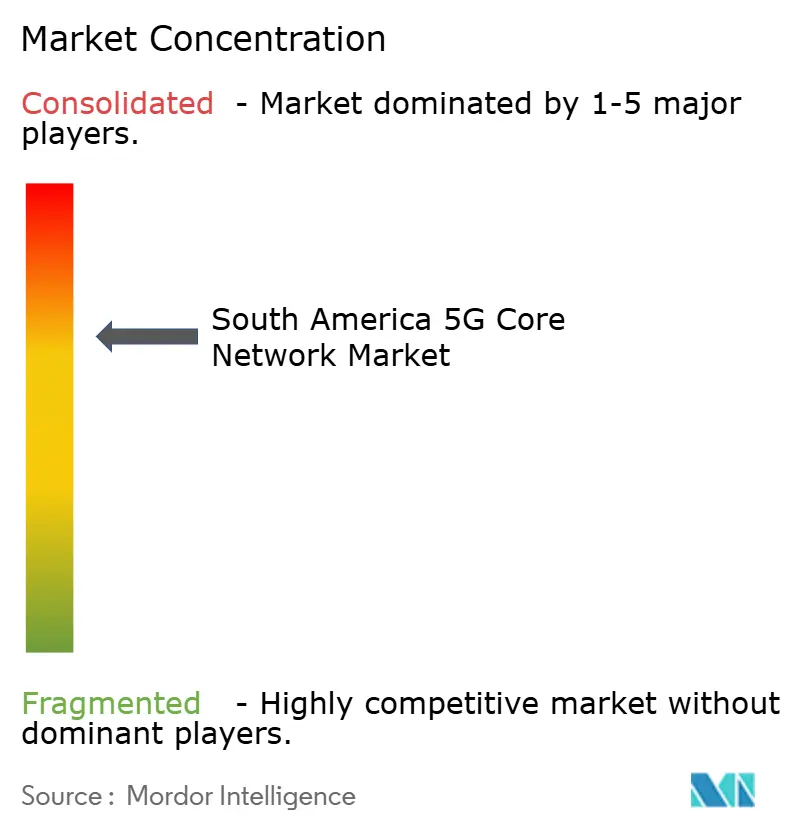
| Market Concentration | Medium |
Major Players *Disclaimer: Major Players sorted in no particular order Image © Mordor Intelligence. Reuse requires attribution under CC BY 4.0. | |
South America 5G Core Network Market Analysis by Mordor Intelligence
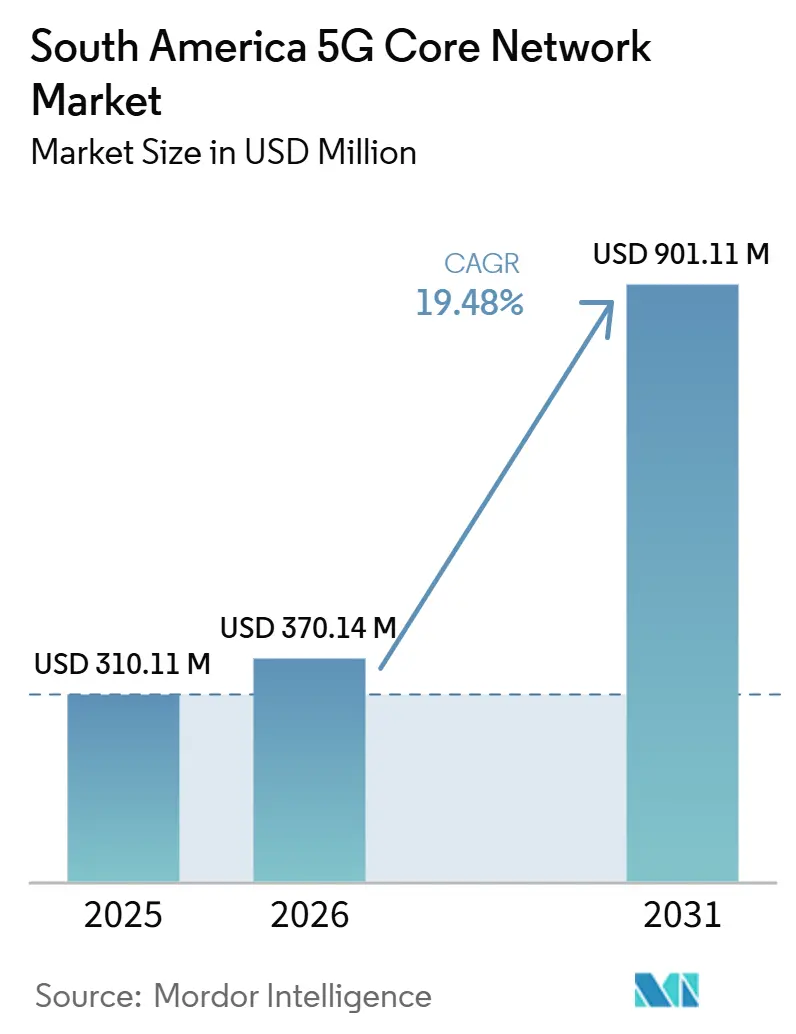
The South America 5G core network market size was valued at USD 310.11 million in 2025 and is estimated to increase from USD 370.14 million in 2026 to reach USD 901.11 million by 2031, at a CAGR of 19.48% during the forecast period (2026-2031). Brazil remains the main source of current spending because its spectrum conditions and coverage obligations have moved standalone deployment ahead of most neighboring countries. The South America 5G core network market is also being supported by investment in cloud-native software, edge capacity, and operational systems to enable standalone services. Public-sector connectivity programs add a second source of demand beyond consumer mobile services. Operators are balancing the need to modernize older systems with the need to demonstrate a clear return on investment from enterprise applications. This leaves room for suppliers that can combine core software, integration, support, and secure cloud deployment.
Key Report Takeaways
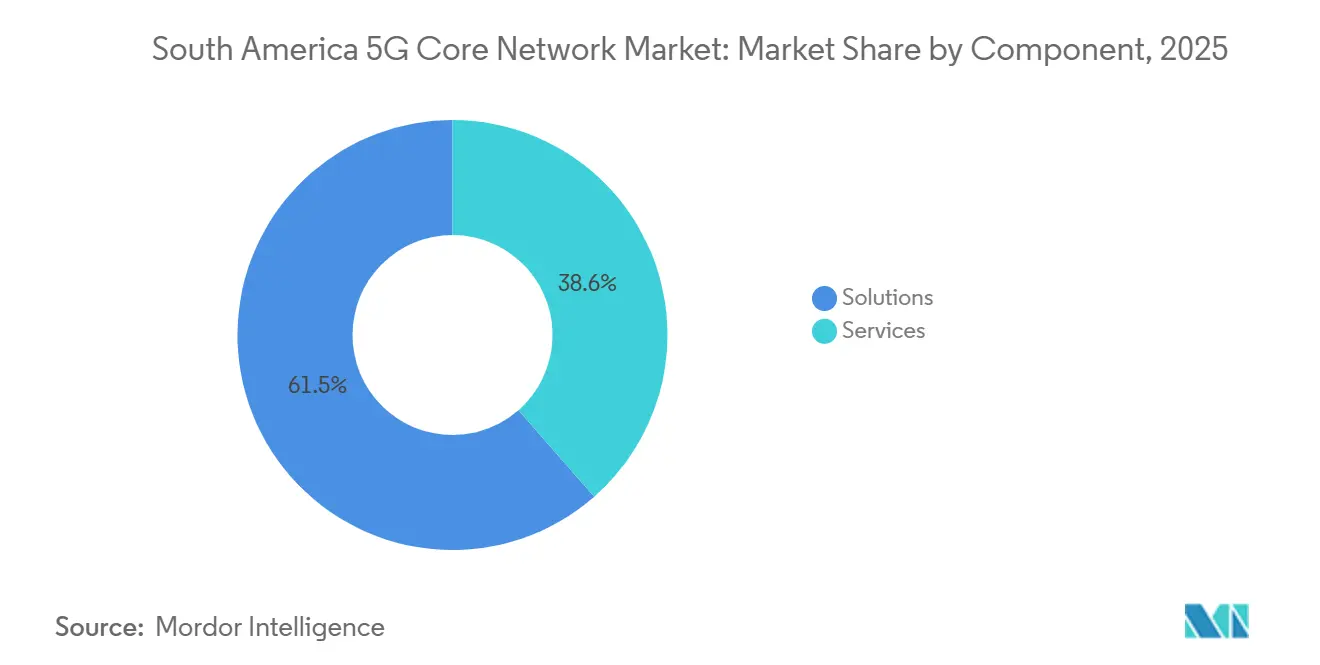
- By component, solutions held 61.45% of revenue in 2025, while services are projected to expand at a 21.39% CAGR through 2031 in the South America 5G core network market.
- By deployment model, on-premises and dedicated deployments accounted for 52.21% of regional revenue in 2025, while hybrid and telco edge cloud deployments are projected to expand at a 20.27% CAGR through 2031 in the South America 5G core network market.
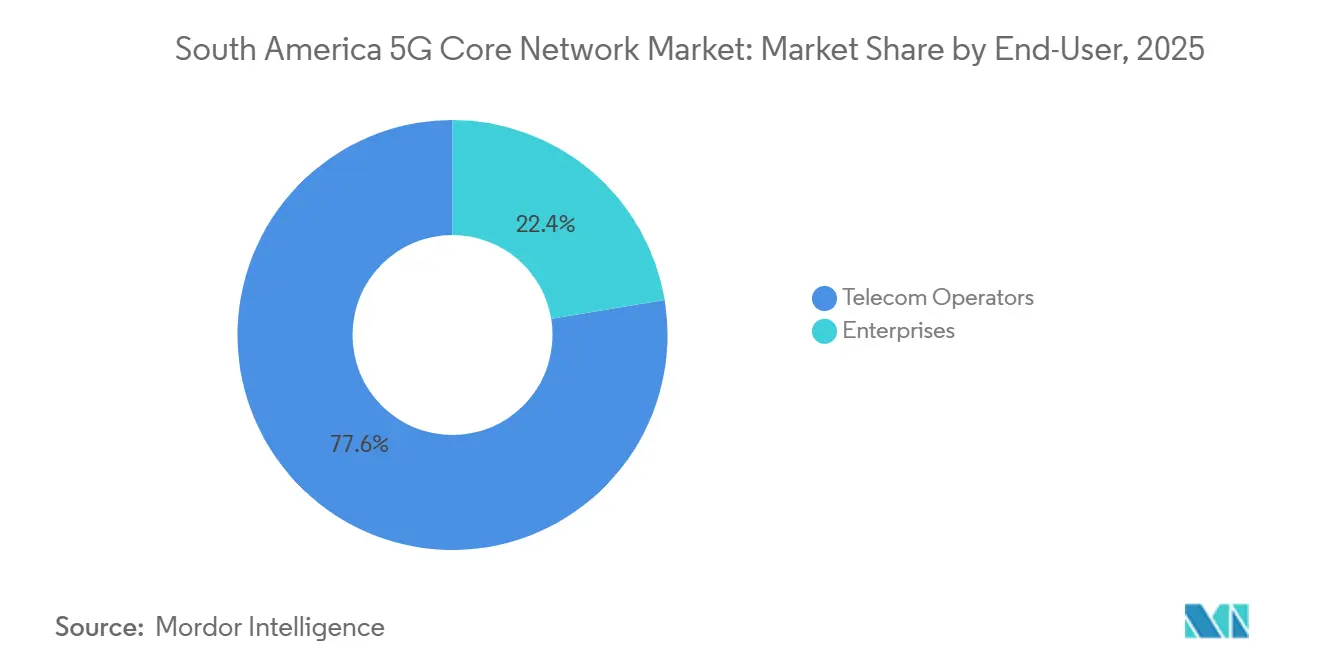
- By end user, telecom operators accounted for 77.60% of demand in the South America 5G core network market in 2025, while enterprises are projected to expand at a 23.19% CAGR through 2031.
- By network function, the user plane function accounted for 20.99% of revenue in 2025, while the network exposure function is projected to expand at a 27.45% CAGR through 2031.
- By geography, Brazil held 69.20% of regional revenue in 2025, while the Rest of South America is projected to expand at a 20.39% CAGR through 2031 in the South America 5G core network market.
Note: Market size and forecast figures in this report are generated using Mordor Intelligence’s proprietary estimation framework, updated with the latest available data and insights as of January 2026.
South America 5G Core Network Market Trends and Insights
Drivers Impact Analysis*
| DRIVER | (~) % IMPACT ON CAGR FORECAST | GEOGRAPHIC RELEVANCE | IMPACT TIMELINE |
|---|---|---|---|
| Rising 5G Standalone Rollouts Across Major South American Networks | +5.2% | Brazil, Argentina, and the Rest of South America | Short term (≤2 years) |
| Operator Shift from Legacy EPC to Cloud-Native Core Architectures | +4.5% | Global, led by Brazil in South America | Medium term (2–4 years) |
| Network Slicing Demand from Enterprise and Public Sector Use Cases | +3.8% | Brazil and South America | Medium term (2–4 years) |
| Public Sector Digitalization Programs Accelerating 5G Core Investment | +2.9% | Brazil, expanding to the Rest of South America | Medium term (2–4 years) |
| Multi-Access Edge Integration for Low-Latency Industrial Connectivity | +2.1% | Brazil, with spillover to the Rest of South America | Long term (≥4 years) |
| Vendor Open RAN and Core Modernization Bundling Strategies | +1.6% | Brazil and South America | Long term (≥4 years) |
| Source: Mordor Intelligence | |||
Rising 5G Standalone Rollouts Driving South America 5G Core Network Market Demand
Brazil’s standalone rollout has put it ahead of the regional deployment cycle and made it the primary source of core network demand. The government stated in March 2026 that 80% of Brazil’s population is expected to have 5G access by the end of 2026, with coverage in more than 2,220 municipalities. These coverage commitments require operators to keep adding standalone capacity and related software. The South America 5G core network market, therefore, benefits from procurement that is tied to regulatory milestones, not only to short-term changes in consumer demand. The pace of rollout can also create work for service providers when device availability, certification, and enterprise use cases take longer to develop. This combination supports continued spending on deployment, testing, operations, and maintenance.
Operator Shift from Legacy EPC to Cloud-Native Core Architectures
Operators are moving from older evolved packet core platforms toward cloud-native core systems that can support 5G standalone services. AMD reported that 33% of surveyed operators had already placed most 5G core functions on cloud-native infrastructure in 2025, while another 30% targeted completion by the end of 2026.[1] The change requires new software, virtualized infrastructure, and operating practices capable of handling distributed network functions. Telefónica and AWS demonstrated a 5G standalone core configuration for Vivo that used network functions from Mavenir, Nokia, and Oracle across cloud and operator facilities.[2] This type of multi-vendor model raises the importance of integration skills in the South America 5G core network market. It also allows operators to centralize control functions while keeping performance-sensitive functions closer to users.
Network Slicing Demand from Enterprise and Public Sector Use Cases
Network slicing is creating a practical reason for enterprises and public agencies to use standalone 5G capabilities. A slice can reserve service characteristics for an application without exposing direct access to the full core network. The Brazilian federal private network connects security institutions through a dedicated 5G-based communications infrastructure.[3] This use case supports spending on secure access, policy control, authentication, and traffic management. It also helps explain why the network exposure function is the fastest-moving network function in the South America 5G core network market. Corporate demand is likely to develop first where applications have clear security, reliability, or latency requirements.
Public Sector Digitalization Programs Accelerating 5G Core Investment
Government digitalization programs are creating a policy-based layer of demand for core network infrastructure. The OECD described Brazil’s digital government approach as one that considers transformation costs and interoperability benefits in public-sector decisions.[4] The federal private network also showed how government agencies can rely on dedicated mobile infrastructure for secure coordination. These programs can support core spending even when consumer revenue conditions are uneven. They can favor vendors that have established public-sector delivery, security, and compliance capabilities. Their procurement cycles may be longer, but the resulting contracts can be broader than a single network software purchase.
Restraints Impact Analysis*
| RESTRAINT | (~) % IMPACT ON CAGR FORECAST | GEOGRAPHIC RELEVANCE | IMPACT TIMELINE |
|---|---|---|---|
| Delayed Spectrum Readiness and Uneven 5G Standalone Timelines | -3.2% | Argentina and the Rest of South America | Short term (≤2 years) |
| High Integration Complexity with Existing 4G and Legacy OSS/BSS Stacks | -2.4% | Global, including South America | Medium term (2–4 years) |
| Currency Volatility Affecting Multi-Year Core Network Procurement | -1.8% | Argentina and South America | Short term (≤2 years) |
| Limited Telecom Capex Outside Tier-1 Operators | -1.4% | Rest of South America | Long term (≥4 years) |
| Source: Mordor Intelligence | |||
Delayed Spectrum Readiness and Uneven 5G Standalone Timelines
Spectrum readiness outside Brazil remains uneven, which slows the start of standalone core investment in several countries. Argentina had around 2,300 5G sites by the end of March 2026, but enterprise monetization of standalone services was still in its early stages. The South America 5G core network market is affected because a core upgrade becomes more difficult to justify when radio deployment, spectrum access, and business demand do not advance together. Bolivia began its 5G spectrum award process in 2026, indicating that its investment cycle is still in its early stages. Some Andean and River Plate markets are also focused on 4G densification before larger standalone programs begin. These differences make regional demand less uniform and concentrate near-term opportunities in countries with clearer spectrum conditions.
High Integration Complexity with Existing 4G and Legacy OSS/BSS Stacks
The move to standalone 5G requires operators to connect new cloud-native functions with older radio, core, and operational systems. AMD found that 83% of surveyed operators planned to place most 5G core functions on cloud-native infrastructure by the end of 2026.[5] Achieving that transition requires combined skills in telecommunications and cloud operations. Existing OSS and BSS systems must support new service models, including network slices and application programming interface services. The integration burden lengthens sales cycles and increases project risk in the South America 5G core network market. It also shifts demand toward suppliers that can provide end-to-end deployment and managed support.
*Our forecasts treat driver/restraint impacts as directional, not additive. The impact forecasts reflect baseline growth, mix effects, and variable interactions.
Segment Analysis
By Component: Solutions Lead Current Deployment While Services Expand Through 2031
Solutions are expected to hold 61.45% of the South America 5G core network market share in 2025, reflecting the need to deploy foundational standalone software before operators expand service layers. Packet-core software represents the central value category because it supports the core traffic and control functions required for a standalone architecture. Network function virtualization infrastructure also plays an important role by providing the computing environment for virtualized functions. Orchestration and management tools help operators coordinate these functions across distributed locations. Vivo’s cloud deployment demonstration showed that core functions from Mavenir, Nokia, and Oracle could operate across public cloud infrastructure and operator data centers. Such deployments show why solution purchases often involve multiple infrastructure and software suppliers.
Services are projected to expand at a 21.39% CAGR through 2031 as the installed base of standalone networks requires deployment, integration, support, and maintenance. Operators need integration and deployment services when they move functions from legacy platforms to virtualized environments. Support contracts become more important after a core goes live, as operators must maintain availability, security, and performance. Consulting and advisory services also support OSS and BSS alignment, network slice design, and application programming interface monetization. Therefore, the South America 5G core network market can generate recurring service revenue after the initial software implementation. This pattern reduces reliance on a single upfront platform sale and increases the value of local delivery capabilities.
By Deployment Model: On-Premises Systems Retain Control While Hybrid Edge Models Advance
On-premises and dedicated systems are expected to account for 52.21% of revenue in 2025, as operators require data control, low user-plane latency, and compliance with sector-specific requirements. This model remains relevant for energy, public safety, and other applications that require predictable local performance. Operators also commonly use this model when cloud availability remains limited, or data residency requirements discourage full public cloud deployment. Local deployments can keep user plane processing close to the radio network and enterprise applications. The South America 5G core network market size for this model reflects the current priority placed on reliable traffic management and operational control. It also reflects that many operators are gradually introducing cloud-native systems rather than replacing every existing platform at once.
Hybrid and telco edge cloud deployment is projected to expand at a 20.27% CAGR through 2031 in the South America 5G core network market, as it combines centralized cloud functions with edge-based user-plane capacity. Vivo’s proof of concept showed that 5G standalone core functions could operate across AWS infrastructure and operator-owned data centers. This approach can keep latency-sensitive processing close to industrial sites while allowing other functions to use centralized cloud resources. Public cloud adoption is also advancing, although operators continue to assess costs for high-volume user-plane workloads. Standards covering edge computing and network slicing provide a common technical basis for these design choices. The deployment model is becoming increasingly important as enterprises seek low-latency, location-sensitive connectivity.
By End User: Telecom Operators Fund Current Demand While Enterprises Diversify It
Telecom operators are expected to account for 77.60% of end-user demand in 2025, as they bear primary responsibility for spectrum obligations, standalone coverage, and national network capacity. Vivo, TIM, and Claro each operate commercial standalone cores in Brazil. Their spending supports the immediate need for software, network functions, and services across the South America 5G core network market. TIM expanded its relationship with Nokia to modernize 5G services in 14 additional Brazilian states, covering around 42% of Brazil’s population. In Argentina, Nokia agreed to evolve Personal’s 5G mobile core through a multi-vendor configuration, beginning in the Buenos Aires metropolitan area.
Enterprises are projected to expand at a 23.19% CAGR through 2031 in the South America 5G core network market, as more sectors assess standalone connectivity for dedicated applications. Manufacturing, energy and utilities, transportation and logistics, public safety, and smart cities are all part of this demand base. Brazil’s private federal network provides a policy-led use case for public safety and emergency communications. Manufacturing projects can use private 5G to support connected equipment and operational data flows. Transportation and logistics users can evaluate the same capabilities where coverage and application requirements are clear. Enterprise demand broadens the South America 5G core network market beyond operator-funded network upgrades.
By Network Function: User Plane Function Supports Current Traffic While Network Exposure Function Enables New Services
User plane function is expected to hold 20.99% of revenue in 2025 in the South America 5G core network market, because it serves as the traffic-forwarding and quality-of-service layer that operators must scale as standalone coverage expands. It manages user traffic and helps enforce service characteristics. Distributed placement of user plane functions can support lower-latency connectivity for industrial Internet of Things and fixed wireless access services. Telefónica reported that an automated self-healing mechanism in its Brazilian 5G core reduced incident resolution time by 30 minutes. This result shows the operational value of virtualized and automated user plane architecture. The South America 5G core network market will continue to require this function as operators expand traffic capacity and edge locations.
The network exposure function is projected to expand at a 27.45% CAGR through 2031 because it enables operators to provide selected network capabilities to enterprise applications via controlled interfaces. It can support authentication, quality-of-service guarantees, and slice selection without exposing the full core network. These features provide a route to monetize secure enterprise services. The remaining functions include access and mobility management, session management, policy control, authentication, network slice selection, network repository, unified data management, and application functions. Together, they form the control-plane environment that supports the user plane and enterprise service layers. Their purchasing patterns remain closely tied to the timing of standalone rollouts and integrated core platform contracts.
Geography Analysis
Brazil accounted for 69.20% of the South America 5G core network market share in 2025, supported by its large operator base and regulatory coverage requirements. The federal government expects 5G access to reach 80% of the country’s population by the end of 2026 across more than 2,220 municipalities. The stated plan also covers 30% of municipalities with fewer than 30,000 residents. These commitments support a deployment pipeline that extends beyond the largest cities and the three main mobile operators. Foreign direct investment in Brazil’s telecommunications sector reached USD 7.44 billion in 2025, up 20.4% from the previous year, with funding directed toward 5G, fixed networks, remote connectivity, and digital infrastructure.
Argentina remains the second-largest national operator base, although currency pressure affects multi-year contracts priced in hard currency. Telecom Argentina reported USD 1.02 billion in capital expenditure in 2025, reflecting accelerated 5G expansion, fiber deployment, and the integration of Telefónica Argentina. The company also reported that the Argentine peso depreciated by 41.0% against the US dollar in 2025. Personal began its core modernization in the Buenos Aires metropolitan area and planned to extend it to Mar del Plata, Tucumán, Rosario, and Córdoba. The country, therefore, has a meaningful pipeline, but real purchasing capacity remains sensitive to currency conditions and the timing of enterprise returns.
The Rest of South America is projected to expand at a 20.39% CAGR through 2031 as early standalone deployments emerge across Ecuador, Colombia, Chile, Peru, Bolivia, and Paraguay. Nokia and CNT launched Ecuador’s first 5G network, with initial service in Guayaquil and surrounding areas. Peru’s 3.5 GHz license holders committed at least USD 502.9 million in network investment, including rural localities and road coverage requirements. Bolivia started its spectrum award process in 2026, while Paraguay’s first 5G rollout began in December 2025. Demand in these countries will develop from a smaller base, but spectrum awards, initial deployments, and coverage obligations create a broader set of future opportunities for the South America 5G core network market.
Competitive Landscape
The South America 5G core network market is moderately to highly concentrated, with Huawei, Ericsson, Nokia, and ZTE holding the broadest commercial presence in core software in the region. Huawei benefits from its established position in earlier mobile network deployments and its integrated radio and core proposals. Nokia’s vendor assessment identified Huawei, Ericsson, Nokia, and ZTE as the leading suppliers in the core vendor landscape. Ericsson remains positioned around cloud-native infrastructure and full-stack core offerings. Nokia addresses both operator core modernization and private network requirements. Each supplier’s ability to combine software, cloud infrastructure, radio access relationships, and local services shapes the competitive landscape.
Several suppliers hold challenger or specialized positions in the South America 5G core network market. Mavenir’s role in Vivo’s cloud-based standalone core demonstration strengthens its relevance for operators seeking cloud-compatible, multi-vendor architecture. NEC, Oracle, Samsung, and Cisco also participate through infrastructure, software, and specialized capabilities. Information technology service providers are extending their OSS and BSS modernization work into cloud-native core migration and network slicing implementation. Nokia has pursued industrial private network opportunities in mining, oil and gas, ports, and related sectors. Ericsson has also secured 4G and 5G connectivity contracts for ports in Brazil.
Strategic moves center on network modernization, broader coverage, and flexible architecture. Nokia expanded its partnership with TIM Brasil in February 2026 to support next-generation, AI-ready 5G services across 14 additional states. Nokia also agreed in January 2026 to evolve Personal’s 5G mobile core in Argentina through a multi-vendor approach. Brazil’s OpenRAN@Brasil program completed Phase 2 in June 2026 and presented a functional national open radio unit prototype. This program could eventually give operators more options beyond fully integrated equipment bundles. Vendors that support interoperability and operational integration may benefit as this architecture matures.
South America 5G Core Network Industry Leaders
-
Huawei Technologies Co., Ltd.
-
Nokia Corporation
-
ZTE Corporation
-
Ericsson
-
Samsung Electronics Co., Ltd.
- *Disclaimer: Major Players sorted in no particular order
Recent Industry Developments
- July 2026: Bosch announced a strategic collaboration with Qualcomm Technologies for Edge AI and Industry 4.0 applications in Brazil, covering computer vision for production-line quality control and advanced industrial monitoring. The partnership underscores 5G private network connectivity as the enabling infrastructure layer for AI inference at manufacturing sites in Brazil’s industrial corridor.
- June 2026: Brazil’s Ministry of Communications launched the Federal Government Private Network, a BRL 1 billion (USD 170 million) sovereign communications infrastructure project that connects the Federal Police, the Brazilian Army, and legislative security forces over a dedicated 5G-based network. Initial activations were in the Federal District, with expansion to Macapá, Rio Branco, Goiânia, and Vitória planned for September 2026.
- June 2026: OpenRAN@Brasil concluded Phase 2, delivering a functional prototype of the nationally developed Open Radio Unit (O-RU) and achieving transmission rates above 1.5 Gbps in laboratory evaluations. The conclusion marked a material step toward disaggregated 5G radio access capability in Brazil, with Phase 3 expanding testbed infrastructure to North, South, and Northeast regions.
- February 2026: Nokia announced the expansion of its partnership with TIM Brazil to modernize the operator’s 5G network across an additional 14 states, covering approximately 42% of Brazil’s population. The contract, announced at MWC 2026, deploys Nokia’s AI-RAN-ready AirScale portfolio, featuring NVIDIA-based AI capabilities, for mining, agribusiness, manufacturing, logistics, and transport.
South America 5G Core Network Market Report Scope
The South America 5G Core Network Market Report is Segmented by Component (Solutions [Packet-Core Software. NFV Infrastructure, and Orchestration and Management], and Services [Integration and Deployment, Consulting and Advisory, Support and Maintenance]), Deployment Model (On-Premises/Dedicated, Public Cloud, and Hybrid and Telco Edge Cloud), End-User (Telecom Operators, and Enterprises [Manufacturing, Energy and Utilities, Transportation and Logistics, Public Safety and Emergency, and Smart Cities and Municipalities]), Network Function (Network Exposure Function, User Plane Function, Application Function, Unified Data Management, Session Management Function, Network Slice Selection Function, Policy Control Function, Network Repository Function, Authentication Server Function, and Access and Mobility Management), and Country (Brazil, Argentina, and Rest of South America). The Market Forecasts are Provided in Terms of Value (USD).
| Solutions | Packet-Core Software |
| NFV Infrastructure | |
| Orchestration and Management | |
| Services | Integration and Deployment |
| Consulting and Advisory | |
| Support and Maintenance |
| On-Premise/Dedicated |
| Public Cloud |
| Hybrid and Telco Edge Cloud |
| Telecom Operators | |
| Enterprises | Manufacturing |
| Energy and Utilities | |
| Transportation and Logistics | |
| Public Safety and Emergency | |
| Smart Cities and Municipalities |
| Network Exposure Function (NEF) |
| User Plane Function (UPF) |
| Application Function (AF) |
| Unified Data Management (UDM) |
| Session Management Function (SMF) |
| Network Slice Selection Function (NSSF) |
| Policy Control Function (PCF) |
| Network Repository Function (NRF) |
| Authentication Server Function (AUSF) |
| Access and Mobility Management (AMF) |
| Brazil |
| Argentina |
| Rest of South America |
| By Component | Solutions | Packet-Core Software |
| NFV Infrastructure | ||
| Orchestration and Management | ||
| Services | Integration and Deployment | |
| Consulting and Advisory | ||
| Support and Maintenance | ||
| By Deployment Model | On-Premise/Dedicated | |
| Public Cloud | ||
| Hybrid and Telco Edge Cloud | ||
| By End-User | Telecom Operators | |
| Enterprises | Manufacturing | |
| Energy and Utilities | ||
| Transportation and Logistics | ||
| Public Safety and Emergency | ||
| Smart Cities and Municipalities | ||
| By Network Function | Network Exposure Function (NEF) | |
| User Plane Function (UPF) | ||
| Application Function (AF) | ||
| Unified Data Management (UDM) | ||
| Session Management Function (SMF) | ||
| Network Slice Selection Function (NSSF) | ||
| Policy Control Function (PCF) | ||
| Network Repository Function (NRF) | ||
| Authentication Server Function (AUSF) | ||
| Access and Mobility Management (AMF) | ||
| By Country | Brazil | |
| Argentina | ||
| Rest of South America | ||
Key Questions Answered in the Report
What is the projected size of the South America 5G core network market by 2031?
The South America 5G core network market is forecast to reach USD 901.11 million by 2031, from USD 370.14 million in 2026, at a CAGR of 19.48%.
Which country leads 5G core spending in South America?
Brazil led regional revenue with a 69.20% share in 2025, supported by standalone 5G coverage obligations and large operator deployments.
Which component is expanding fastest in the South America 5G core network market?
Services are projected to expand at a 21.39% CAGR through 2031, driven by the need for integration, deployment, support, and maintenance.
Why are hybrid and telco edge cloud deployments gaining adoption?
Hybrid and telco edge cloud is projected to expand at a 20.27% CAGR by combining centralized cloud functions with low-latency edge processing.
Which users will create the strongest new demand for 5G core capabilities?
Enterprises are projected to expand at a 23.19% CAGR through 2031, led by manufacturing, public safety, energy and utilities, transportation and logistics, and smart cities.
What network function has the highest forecast CAGR?
The network exposure function is projected to expand at a 27.45% CAGR through 2031 because it enables controlled enterprise access to authentication, quality-of-service, and network-slicing capabilities.