
Market Overview
| Study Period | 2020 - 2031 |
|---|---|
| Forecast Data Period | 2026 - 2031 |
| Base Year Market Size (2025) | USD 10.79 Billion |
| Market Size (2026) | USD 13.56 Billion |
| Market Size (2031) | USD 38.61 Billion |
| Growth Rate (2026 - 2031) | 23.31 % |
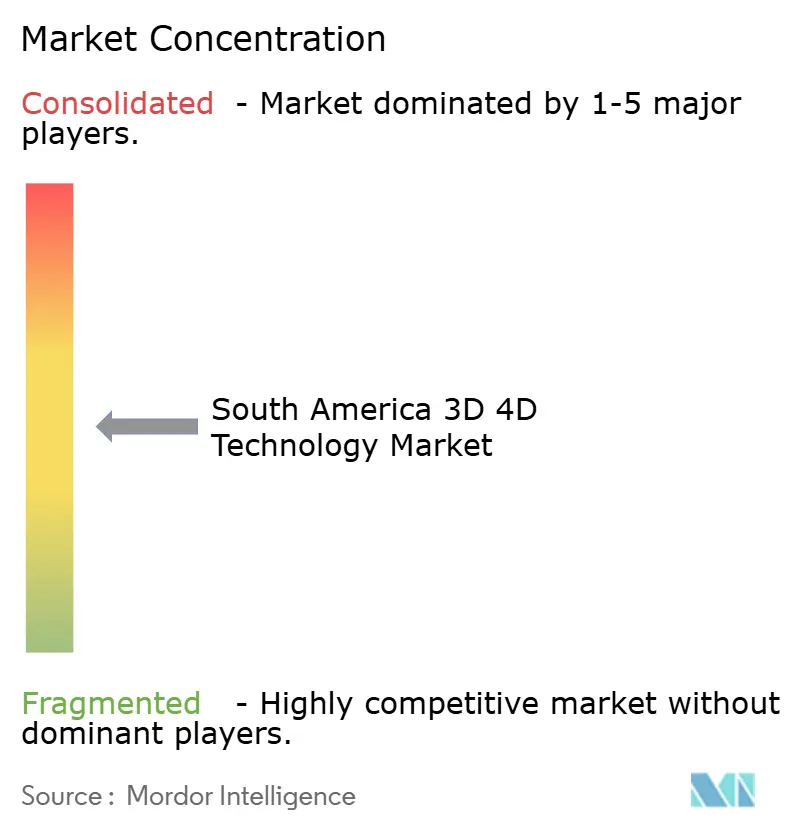
| Market Concentration | Medium |
Major Players *Disclaimer: Major Players sorted in no particular order Image © Mordor Intelligence. Reuse requires attribution under CC BY 4.0. | |
South America 3D 4D Technology Market Analysis by Mordor Intelligence
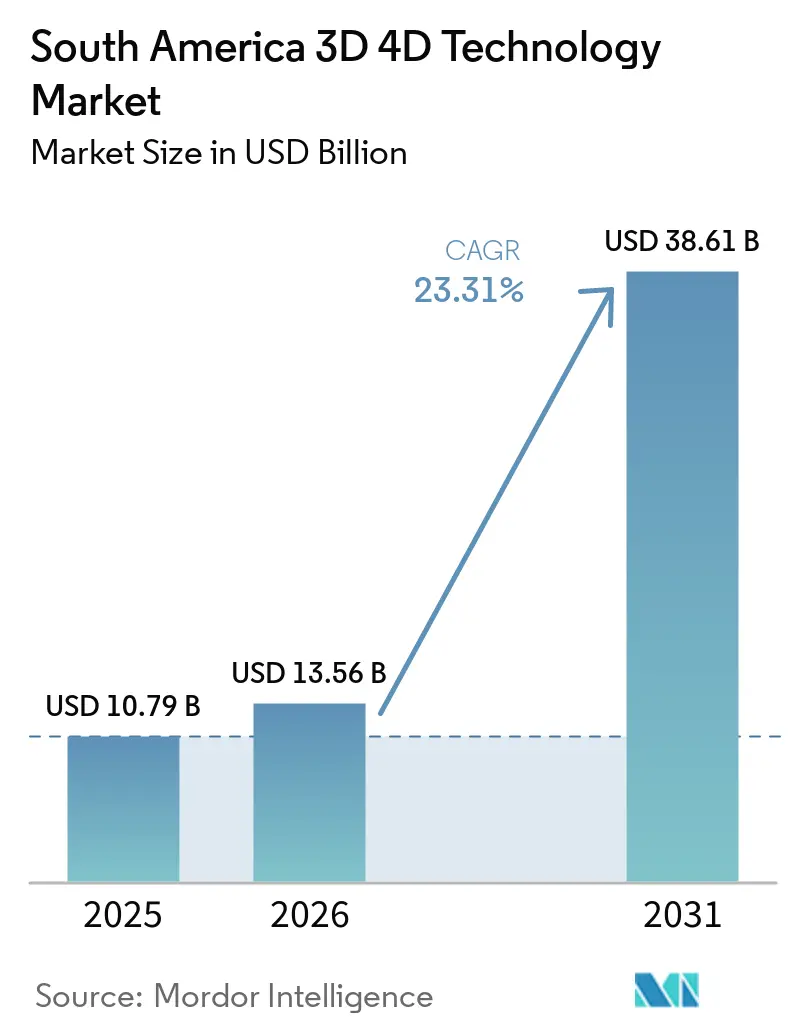
The South America 3D/4D technology market size was valued at USD 10.79 billion in 2025 and is estimated to expand from USD 13.56 billion in 2026 to reach USD 38.61 billion by 2031, at a CAGR of 23.31% during the forecast period 2026-2031. Brazil remained the regional center of demand because it combined the largest industrial base with a more developed additive manufacturing ecosystem and active applied-technology programs. Healthcare, industrial production, and infrastructure management created distinct demand paths, reducing reliance on any single use case. Suppliers increasingly combined equipment, software, technical support, and regulatory knowledge rather than selling standalone machines. This approach suited buyers who needed practical implementation support and helped local service providers compete with global original equipment manufacturers. High equipment costs, imported consumables, and a limited pool of specialized workers continued to delay wider adoption among smaller organizations.
Key Report Takeaways
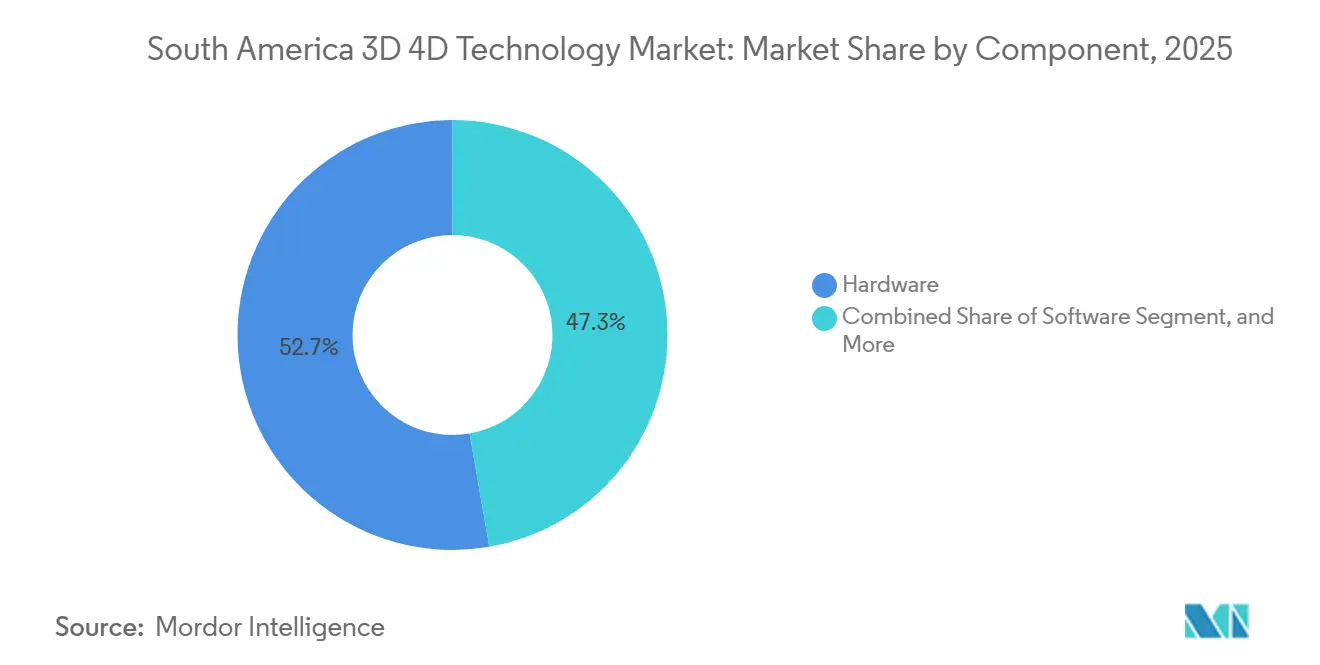
- By component, hardware accounted for 52.74% of South America's 3D/4D technology market share in 2025, while software is projected to expand at a 23.91% CAGR through 2031.
- By technology, 3D technology accounted for 79.31% of the South America 3D/4D technology market size in 2025, while 4D technology is expected to advance at a 23.69% CAGR through 2031.
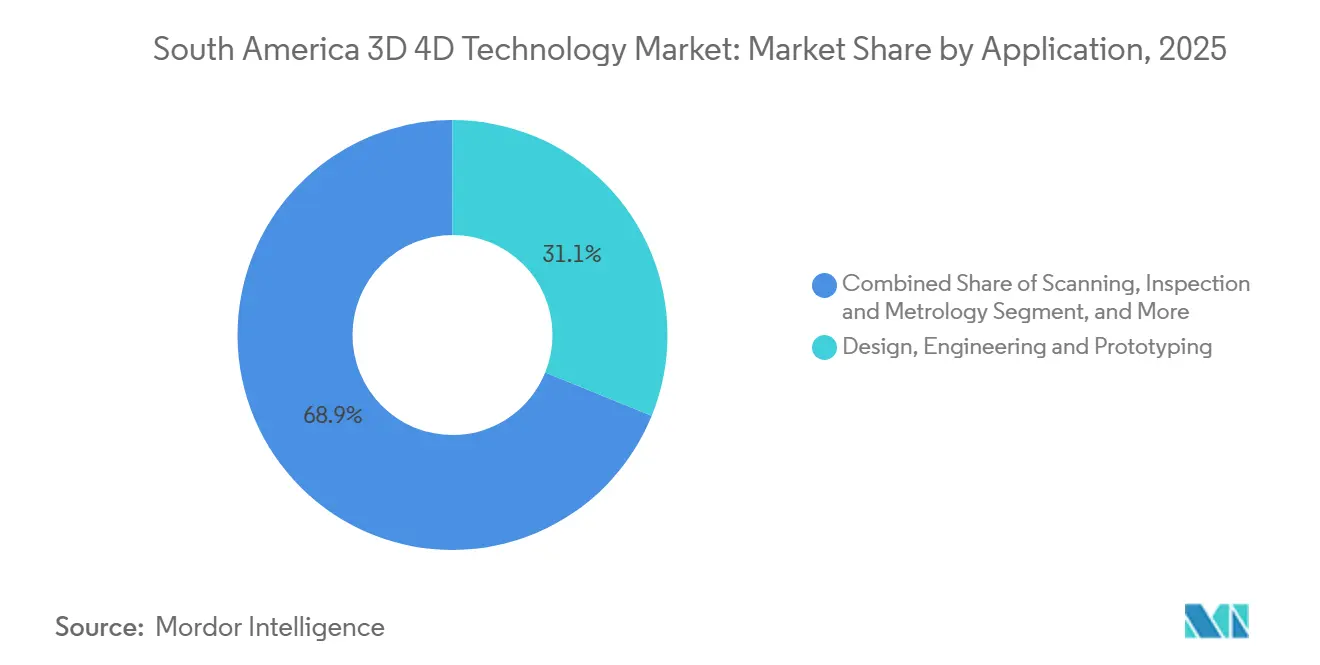
- Application, design, engineering, and prototyping represented 31.13% of revenue in 2025, while digital twins and infrastructure visualization are projected to grow at a 24.68% CAGR through 2031.
- By end-user industry, industrial manufacturing held 28.93% of revenue in 2025, while healthcare and medical is projected to expand at a 24.62% CAGR through 2031 in the South America 3D/4D technology market.
- By geography, Brazil accounted for 59.38% of regional value in 2025, while Colombia is projected to record a 24.09% CAGR through 2031.
Note: Market size and forecast figures in this report are generated using Mordor Intelligence’s proprietary estimation framework, updated with the latest available data and insights as of January 2026.
South America 3D 4D Technology Market Trends and Insights
Drivers Impact Analysis*
| Driver | (~) % Impact on CAGR Forecast | Geographic Relevance | Impact Timeline |
|---|---|---|---|
| Localized Additive Manufacturing Demand | +6.2% | Brazil, Argentina, Colombia | Medium term (2-4 years) |
| 3D Medical Imaging and Patient-Specific Devices | +4.8% | Brazil, Colombia, Argentina | Medium term (2-4 years) |
| 3D Visualization in Automotive, Aerospace, and Industrial Design | +4.1% | Brazil, Argentina | Short term (≤ 2 years) |
| Immersive Entertainment, Gaming, and 4D Cinema | +2.9% | Brazil, Colombia, Rest of South America | Short term (≤ 2 years) |
| Digital Twins for Infrastructure and Asset Management | +2.1% | Brazil, Colombia | Medium term (2-4 years) |
| Materials for Humid and Thermal-Stress Conditions | +1.0% | Brazil, Rest of South America | Long term (≥ 4 years) |
| Source: Mordor Intelligence | |||
Rising Demand for Localized Additive Manufacturing
Brazil’s effort to reduce reliance on imported industrial components supports demand across the South America 3D/4D technology market. The US International Trade Administration identified additive manufacturing as Brazil’s fastest-growing advanced manufacturing segment. It also described a national ecosystem that includes equipment, materials, software, and service providers. ABRAMAPRI3D mapped more than 249 Brazilian companies and institutions in its fifth additive manufacturing map during 2026.[1]International Trade Administration, “Brazil - Advanced Manufacturing,” U.S. Department of Commerce, trade.gov. This breadth gives industrial users more options for local technical support and service delivery. Petrobras opened LABi3D at its CENPES facility in Rio de Janeiro in February 2025 through a partnership with 3DCRIAR, Formlabs, and Siemens. The laboratory demonstrated how an energy producer can transition from outsourced prototyping to internal additive capacity. Local deployment also makes it easier to adapt designs, shorten replacement-part lead times, and develop operator knowledge around specific production assets. The South America 3D/4D technology industry, therefore, benefits when manufacturers treat printing capacity as part of a wider domestic production system rather than as a limited engineering tool.
Expansion of 3D Medical Imaging and Patient-Specific Devices
Patient-specific models, implants, and surgical planning systems are creating a practical healthcare pathway for the South America 3D/4D technology market. Hospitals can use anatomical models to support preoperative discussion and procedure preparation. Brazilian providers, including P3DMed and 3D Surgery, have focused on biomodels and surgical guides for clinical users. PolimiHealth has also described work on 3D-printed grafts, prosthetics, and medical components using biocompatible polymers. Clinical adoption depends on material performance, validated workflows, and medical-device oversight. This favors providers that can combine engineering support with local regulatory navigation. Fleury Medicina e Saúde offered 3D biomodel and surgical planning services as a standardized clinical service in Brazil during 2025. That model indicates a shift from isolated demonstrations toward more routine clinical availability. Wider use can lower dependence on imported devices, but it also raises the importance of quality controls and secure treatment of patient data.
Adoption of 3D Visualization in Automotive, Aerospace, and Industrial Design
Automotive suppliers, aerospace maintenance facilities, and industrial toolmakers use 3D visualization to test designs before committing to production. This use case supports the South America 3D/4D technology market by enabling physical prototypes, digital models, and inspection systems to work within the same workflow. The US International Trade Administration reported that Brazilian metal additive manufacturing was expected to triple in size between 2023 and 2027. Adoption remains concentrated in aerospace, oil and gas, and healthcare research and development. Firms need trained engineers and connected processes to obtain value from visualization equipment. Software for simulation and design can address this constraint by reducing manual preparation and connecting distributed machines. Materialize stated that its Magics 2025 release used nTop implicit geometries to reduce build-preparation time from days to seconds. Suppliers serving aerospace work also need to meet demanding production and traceability requirements. These needs make application knowledge and workflow support more important than equipment specifications alone.
Growth of Immersive Entertainment, Gaming, and 4D Cinema
Immersive entertainment adds a consumer-facing source of demand to the South America 3D/4D technology market. The format combines visual content with motion seating and other synchronized physical effects. Brazil’s first 9D cinema opened at Mooca Plaza Shopping in São Paulo in February 2026. The installation combined motion seats, water and wind effects, and virtual-reality projection into short experiences. These venues offer a visible use case for multisensory systems beyond industrial and medical applications. Ecuador’s Multicines operated 12 4D E-Motion auditoriums by April 2026 after adding 6 screens during 2025. This expansion demonstrates that the format can extend beyond the region’s largest economy. Entertainment operators still need steady visitor traffic and reliable maintenance to support investment returns. The category may also increase public familiarity with spatial and immersive technologies, even though its operating model differs from that of enterprise technology deployments.
Restraints Impact Analysis*
| Restraint | (~) % Impact on CAGR Forecast | Geographic Relevance | Impact Timeline |
|---|---|---|---|
| High Upfront Cost of Industrial 3D and 4D Systems | -4.2% | Global, concentrated in South America | Short term (≤ 2 years) |
| Shortage of Additive Manufacturing and Spatial Computing Skills | -2.8% | Brazil, Colombia, Argentina | Medium term (2-4 years) |
| Dependence on Imported Specialty Materials and Replacement Components | -1.9% | Global, with acute impact in South America | Medium term (2-4 years) |
| Cross-Border Design-File, Intellectual-Property, and Data-Privacy Risks | -1.1% | Global, with impact across South America | Long term (≥ 4 years) |
| Source: Mordor Intelligence | |||
High Upfront Cost of Industrial 3D and 4D Systems
Capital expenditure remains a major constraint for industrial users in the South America 3D/4D technology market. Imported equipment is exposed to exchange-rate movements, duties, taxes, and foreign-currency purchasing requirements. Formlabs launched the Fuse X1 industrial selective laser sintering system at USD 85,000 in June 2026. The price was set below that of industrial selective laser sintering systems, costing more than USD 100,000. Even this lower entry point can be difficult for smaller manufacturers that have limited capital budgets. Buyers must also account for software subscriptions, maintenance arrangements, specialty materials, and trained operators. The equipment decision becomes harder when the organization lacks the data flows and production processes needed to use the machine consistently. Service contracts and shared production facilities can ease the initial burden, but they do not remove the need for predictable demand. Cost pressure also strengthens the appeal of software upgrades that improve installed equipment instead of requiring replacement systems.
Shortage of Advanced Additive Manufacturing and Spatial Computing Skills
The shortage of specialized labor limits the speed at which organizations can deploy complex systems. Brazil’s Confederação Nacional da Indústria stated that 14 million industrial workers would need initial or refresher training by 2027. The gap includes people able to operate, maintain, design for, and validate additive manufacturing processes. It also affects scanning, digital twin, and spatial computing activities that require a mix of engineering and digital skills. Organizations cannot gain full value from equipment if teams cannot prepare files, interpret data, or manage quality assurance. Brazil’s vocational and technical education enrollment rate was 11%, compared with 33% in Chile, according to the supplied CNI-related reporting. Applied research programs supported by EMBRAPII and FINEP can help connect training with industrial needs. The time needed to produce commercially experienced specialists means the constraint is likely to remain material during the medium term. This gap gives established service providers an advantage because they can spread scarce expertise across several customers.
*Our forecasts treat driver/restraint impacts as directional, not additive. The impact forecasts reflect baseline growth, mix effects, and variable interactions.
Segment Analysis
By Component: Hardware Provides the Installed Base, While Software Improves Workflow Value
Hardware accounted for 52.74% of the South America 3D/4D technology market share in 2025. The category included industrial printers, metrology scanners, visualization rigs, and motion-capable entertainment systems. Its lead reflected the need to install physical equipment before users can build deeper digital workflows. Automotive and industrial clusters in Brazil remained important sources of demand for these systems. Mining, aerospace maintenance, hospitals, and entertainment venues also required specialized hardware. The South America 3D/4D technology market size for hardware benefited from early-stage deployments, in which buyers first needed productive assets. Hardware purchases often create follow-on demand for installation, training, maintenance, and materials. Imported systems can create cost exposure, particularly when replacement components and consumables are priced in foreign currencies. Local distributors, therefore, play an important role in technical support and after-sales service. Equipment vendors must show that systems can operate reliably in the customer’s existing production environment.
Software is projected to expand at a 23.91% CAGR through 2031, the fastest rate among component categories. The segment includes simulation, build preparation, print management, and cloud-based workflow tools. These products help organizations move beyond isolated machines and fragmented design files. Service bureaus can use them to coordinate jobs across equipment, customers, and materials. Original equipment manufacturers can use software to increase the value of their installed base. Materialize’s Magics 2025 release integrated nTop implicit geometries, reducing reported build-preparation time from days to seconds. The example showed that workflow gains can be delivered without a new hardware purchase. Software adoption also introduces data security and privacy requirements when patient scans or proprietary engineering files are transmitted through connected platforms. ISO/IEC 27001 and Brazil’s Lei Geral de Proteção de Dados are relevant considerations for users managing these files. Services remained the smallest component category, but managed contracts can help customers access capability without owning every asset directly.



By Technology: Established 3D Systems Lead, While 4D Systems Extend Material and Experience Options
3D technology accounted for 79.31% of the South America 3D 4D technology market size in 2025. The category had a broad installed base across printing, scanning, LiDAR mapping, spatial modeling, and visualization. Its position reflected years of use in prototyping, inspection, mapping, and product development. Industrial users could select technologies according to material, accuracy, volume, and post-processing requirements. Medical institutions also use 3D workflows for anatomical models and planning applications. Mining operators relied on 3D mapping to support planning and environmental work. Hexagon’s R-evolution conducted aerial imagery and LiDAR missions for Vale’s Mina de Águas Claras reclamation site during April 2026. The initiative mapped a 20 km² closed mine at 10 cm resolution for environmental reclamation work. This range of established applications explains why 3D technology retained a substantial revenue base. Continued adoption depends on integrating imaging, design, material, and operational data in usable workflows.
4D technology is projected to advance at a 23.69% CAGR through 2031. It includes stimuli-responsive materials, shape-memory composites, and multisensory entertainment systems. The segment is smaller because many uses remain at earlier stages of technical and commercial development. Its potential comes from materials that respond to temperature, humidity, or other conditions after fabrication. FAPESP supported research on smart metamaterials that combines 4D printing with programmable functionality at Brazilian universities.[2]Fundação de Amparo à Pesquisa do Estado de São Paulo, “Smart Metamaterials Through 4D Printing: A Path Towards Programmable Functionality,” FAPESP Research Grant 24/19298-4, bv.fapesp.br. This work is relevant to applications exposed to high humidity and thermal stress in parts of South America. 4D technology also includes cinema formats that pair content with synchronized physical effects. Organizations with stronger simulation and digital-twin capabilities may be better placed to assess responsive-material workflows. These relationships make knowledge of software and materials important for commercial adoption. Suppliers will need to demonstrate durability, repeatability, and practical value before 4D systems move beyond specialized projects.
By Application: Design and Prototyping Retain Scale, While Digital Twins Gain Operational Use
Design, engineering, and prototyping represented 31.13% of application revenue in 2025. The segment held the largest share of the South America 3D 4D technology market because it served established needs in product development and industrial tooling. Automotive design teams use prototypes to review form, fit, and manufacturing choices. Aerospace maintenance organizations use models and components to support repair and engineering processes. Industrial users value shorter feedback cycles when designs can be tested before full production. This application also works with a broad range of printers, scanners, and visualization technologies. Its existing user base provides distributors and service bureaus with a practical path to recurring customers. Scanning, inspection, and metrology created related demand in mining and industrial settings. Drummond Ltd. received Colombia’s first mining-sector Certificado de Operación de Sistemas Aéreos no Tripulados during March 2026. The approval enabled certified drone operations for engineering, planning, and environmental monitoring under RAC100. Medical imaging, navigation and robotics, simulation and training, and other uses added demand from specialized customer groups.
Digital twins and infrastructure visualization are projected to record a 24.68% CAGR through 2031. The application combines 3D visualization with operational information from assets, sensors, and connected systems. It is relevant to ports, oil and gas facilities, utilities, logistics assets, and infrastructure projects. Petrobras, port operators, and water infrastructure organizations have been involved in projects that use this approach in Brazil. Santos Port and PTI formalized a five-year digital-twin agreement in February 2025, with joint investments totaling nearly BRL 60 million (USD 10.5 million). The agreement focused on real-time 3D monitoring of vessel traffic and cargo. Brazil published ABNT NBR ISO/IEC 30173 in February 2026 to establish common terminology and interoperability requirements for digital twins. Public standards can help procurement teams compare systems and clarify basic expectations for implementation. The application still depends on reliable data, compatible systems, cybersecurity, and staff who can convert information into operating decisions. Navigation and robotics remain less mature but are gaining relevance in logistics and port environments.
By End-User Industry: Industrial Manufacturing Holds the Largest Base, While Healthcare Adds Faster Demand
Industrial manufacturing held 28.93% of revenue in 2025. The South America 3D 4D technology market size for this end-user group was supported by rapid tooling, jig production, complex-geometry prototyping, scanning, and asset visualization. Brazil’s automotive supply chain was a central source of demand because it included Tier 1 and Tier 2 suppliers. Mining, oil and gas, and construction also applied these technologies to operating and engineering challenges. Industrial users often have clear requirements for part performance, traceability, uptime, and cost control. These requirements can favor experienced suppliers that offer local process support. Argentina expanded construction-related additive manufacturing by deploying a COBOD BOD2 concrete printer with Techint Ingeniería y Construcción in December 2025. The installation showed that industrial adoption could extend beyond automotive and traditional machining applications. Aerospace and defense activity remained centered on Brazil’s Embraer ecosystem. Mining, energy, and utilities each presented distinct opportunities for scanning, mapping, and digital-twin systems.
Healthcare and medical is projected to expand at a 24.62% CAGR through 2031. Demand is supported by anatomical models, surgical planning, patient-specific devices, and imaging workflows. Hospitals use these tools to support planning for procedures that require detailed knowledge of individual anatomy. Biomedical developers see potential to replace some imported devices with locally produced alternatives. Regulatory clearance and documented quality processes are central to this category. Providers need to handle imaging data responsibly and maintain confidence in material suitability. Fleury’s 2025 clinical offering illustrated how a health services group could provide biomodeling and surgical planning services on a routine basis. Consumer electronics also drove demand through mixed-reality headsets and spatial computing displays. The mining, energy, and utilities group used related systems for pipeline monitoring, substation management, and environmental reclamation. Each end-user category required different procurement, compliance, and technical support capabilities.
Geography Analysis
Brazil accounted for 59.38% of the regional value in 2025, giving it the leading share of the South America 3D/4D technology market. Its position rested on the region’s largest industrial base and a comparatively mature additive manufacturing network. ABRAMAPRI3D mapped more than 249 companies and institutions in Brazil during 2026. BNDES, FINEP, and EMBRAPII supported applied technology and research activities that could connect academic work with industrial deployment. Brazil also saw demand from the automotive, aerospace, oil and gas, mining, healthcare, and port infrastructure sectors. The publication of ABNT NBR ISO/IEC 30173 during February 2026 provided a formal framework for digital-twin terminology and interoperability. Petrobras’s LABi3D opening in February 2025 showed continued interest in internal additive capabilities within the energy sector. Brazil’s large installed base gave global suppliers a reason to work through distributors while giving local providers opportunities in service and application engineering.
Colombia is projected to register a 24.09% CAGR through 2031, the fastest geographic rate in the South America 3D 4D technology market. Healthcare, construction, and mining each support this position. Hospitals and universities have developed 3D printing labs for prosthetics and surgical models. Cementos Argos and COBOD delivered 2 3D-printed social housing units in La Unión, Antioquia, during 2025. The 63 m² homes had walls printed on-site in 14 hours over 3 days. Drummond’s March 2026 certification added a compliance-based use case for drone-enabled 3D scanning in mining. The National Mining Agency began a Strategic Mining Areas bidding process in December 2025 for 14 copper, gold, and polymetallic areas.[3]International Trade Administration, “Colombia Critical Minerals Mining Opportunities,” U.S. Department of Commerce, trade.gov. These projects support demand for survey-grade mapping and geospatial modeling as new resource activity is developed.
Argentina and the rest of South America represented earlier-stage opportunities with localized signs of adoption. Argentina deployed a COBOD BOD2 large-format concrete printer in Buenos Aires during 2025 through Grondplek and Techint Ingeniería y Construcción. The equipment targeted civil engineering, urban furniture, and residential construction. Universidad Nacional de La Plata was developing a 3D concrete printer intended to construct a 60 m² structure in 50 hours. Argentina also had research activity in bioprinting and biomaterial applications through institutions such as CONICET. Ecuador’s Multicines operated 12 4D E-Motion auditoriums by April 2026. The wider region remained dependent on pilot projects in construction and healthcare. These pilots can build familiarity and local capability, but their progression depends on financing, technical support, and workforce development.
Competitive Landscape
The South America 3D/4D technology market was moderately fragmented, with global original equipment manufacturers and specialized domestic providers serving different needs. Global companies, including 3D Systems, Stratasys, Materialize, EOS GmbH, and Formlabs, relied substantially on distributors and authorized resellers in Brazil and Colombia. This route provided market coverage without requiring every supplier to build a direct local operation. Formlabs launched the Fuse X1 at USD 85,000 in June 2026 for industrial users seeking an entry point below that of higher-priced selective laser sintering systems. Domestic providers such as 3DCRIAR and P3DMed competed through application expertise, technical support, and closer customer relationships. The competitive picture varied by use case, since medical planning required different capabilities from industrial metal printing or infrastructure visualization. Local language support and familiarity with Brazilian and Colombian requirements could help service providers protect recurring work. Suppliers also needed distributor capacity for installation, maintenance, consumables, and customer training.
Stratasys announced a definitive agreement in May 2026 to acquire Markforged from Nano Dimension for USD 42.5 million in cash. The planned transaction was expected to add continuous carbon-fiber technology, metal extrusion, and the Digital Forge software platform to its portfolio. It also demonstrated the value vendors placed on connected hardware, materials, and workflow software. Renishaw and Materialize launched the NxG Build Processor in November 2025 to link Magics build preparation directly with RenAM metal systems. The integration reduced manual handling of job files and supported quality verification of laser paths. 3D Systems introduced the SLA 825 Dual and new materials at Formnext 2025 for investment casting, automotive, aerospace, and service bureau use. These moves show how product portfolios increasingly combine equipment, material options, and production software. They also increase the importance of interoperable workflows for buyers operating more than 1 system.
Market openings remained strongest where local conditions required adaptation and close service support. The region had limited local materials research and manufacturing tailored to high-humidity coastal conditions and seismic construction requirements. Domestic players could respond through application engineering, regulatory guidance, and support in Portuguese or Spanish. Medical applications required attention to ISO 13485 and other documented quality processes. Aerospace production required suppliers to meet demanding production requirements, including EN 9100, where applicable. Global vendors retained advantages in installed base, capital resources, material portfolios, and international certification experience. Domestic providers could still win specialized work when customer proximity and workflow knowledge mattered most. Competition, therefore, centered on the ability to make a technology usable in a particular customer setting rather than on machine supply alone.
South America 3D 4D Technology Industry Leaders
Maxon Computer GmbH
Side Effects Software Inc.
The Foundry Visionmongers Limited
Chaos Software EOOD
Reallusion Inc.
- *Disclaimer: Major Players sorted in no particular order

Recent Industry Developments
- August 2026: Carbon, Inc. launched DB 4000, a high-impact denture base resin for digital dentures on its M-Series printers. The material received FDA clearance and complies with ISO 20795-1, positioning Carbon for deeper penetration into South America’s growing dental laboratory market.
- June 2026: Formlabs officially launched the Fuse X1, a large-format industrial SLS 3D printer priced at USD 85,000. The system was previewed at RAPID + TCT 2026 in Boston and is available in Brazil through 3DCRIAR, with delivery expected in November 2026, designed to compete with incumbent SLS systems priced above USD 100,000.
- May 2026: Stratasys Ltd. entered into a definitive agreement to acquire Markforged, Inc. from Nano Dimension for USD 42.5 million in cash. The transaction, expected to close in the second half of 2026, adds continuous carbon-fiber FFF technology, The Digital Forge’s software platform, and Markforged’s distribution network to Stratasys’s portfolio.
- April 2026: Hexagon’s R-evolution subsidiary launched aerial 3D mapping missions with hybrid airborne imagery and LiDAR for Vale’s Mina de Águas Claras site near Belo Horizonte, Brazil. The Green Cubes Digital Reality initiative mapped the full 20 km² closed mine at 10 cm resolution to support environmental reclamation.


South America 3D 4D Technology Market Report Scope
The South America 3D/4D Technology Market encompasses the revenues generated from the sale, deployment, integration, licensing, and provision of three-dimensional (3D) and four-dimensional (4D) technologies, systems, software, and related services across South America. The market includes technologies that enable the creation, capture, processing, visualization, manipulation, analysis, and interaction with three-dimensional data, as well as 4D solutions that incorporate the time dimension or dynamic changes into 3D environments, models, objects, or visualizations.
The South America 3D/4D Technology Market Report is Segmented by Component (Hardware, Software, and Services), Technology (3D Technology, and 4D Technology), Application (Design, Engineering and Prototyping, Scanning, Inspection and Metrology, Medical Imaging and Surgical Planning, Digital Twins and Infrastructure Visualization, Navigation and Robotics, Simulation and Training, and Other Applications), End-User Industry (Healthcare and Medical, Automotive and Transportation, Aerospace and Defense, Industrial Manufacturing, Consumer Electronics, Mining, Energy and Utilities, and Other End-User Industries), and Geography (Brazil, Argentina, Colombia, and Rest of South America). The Market Forecasts are Provided in Terms of Value (USD).
By Component
| Hardware |
| Software |
| Services |
By Technology
| 3D Technology |
| 4D Technology |
By Application
| Design, Engineering and Prototyping |
| Scanning, Inspection and Metrology |
| Medical Imaging and Surgical Planning |
| Digital Twins and Infrastructure Visualization |
| Navigation and Robotics |
| Simulation and Training |
| Other Applications |
By End-User Industry
| Healthcare and Medical |
| Automotive and Transportation |
| Aerospace and Defense |
| Industrial Manufacturing |
| Consumer Electronics |
| Mining, Energy and Utilities |
| Other End-User Industries |
By Geography
| Brazil |
| Argentina |
| Colombia |
| Rest of South America |
| By Component | Hardware |
| Software | |
| Services | |
| By Technology | 3D Technology |
| 4D Technology | |
| By Application | Design, Engineering and Prototyping |
| Scanning, Inspection and Metrology | |
| Medical Imaging and Surgical Planning | |
| Digital Twins and Infrastructure Visualization | |
| Navigation and Robotics | |
| Simulation and Training | |
| Other Applications | |
| By End-User Industry | Healthcare and Medical |
| Automotive and Transportation | |
| Aerospace and Defense | |
| Industrial Manufacturing | |
| Consumer Electronics | |
| Mining, Energy and Utilities | |
| Other End-User Industries | |
| By Geography | Brazil |
| Argentina | |
| Colombia | |
| Rest of South America |


Key Questions Answered in the Report
What is the South America 3D 4D technology market size?
The South America 3D 4D technology market size is estimated at USD 13.56 billion in 2026 and is forecast to reach USD 38.61 billion by 2031, at a 23.31% CAGR.
Which component category generated the most revenue in South America in 2025?
Hardware led revenue with a 52.74% share in 2025, supported by industrial printers, scanners, visualization rigs, and immersive systems.
Which 3D and 4D technology category is forecast to expand fastest?
4D technology is projected to advance at a 23.69% CAGR through 2031, supported by responsive materials and multisensory systems.
Which applications offer the strongest commercial opportunities through 2031?
Digital twins and infrastructure visualization is projected to record a 24.68% CAGR, while design, engineering, and prototyping led applications with 31.13% of revenue in 2025.
Why is healthcare a priority opportunity for suppliers?
Healthcare and medical is projected to expand at a 24.62% CAGR through 2031 as providers use biomodels, surgical planning tools, and patient-specific devices.
Which South American country offers the fastest expansion opportunity?
Colombia is projected to record a 24.09% CAGR through 2031, supported by healthcare laboratories, 3D construction projects, and mining-related mapping.
Page last updated on:





