
Market Overview
| Study Period | 2021 - 2031 |
|---|---|
| Forecast Data Period | 2026 - 2031 |
| Historical Data Period | 2021 - 2024 |
| Growth Rate | 3.06 % |
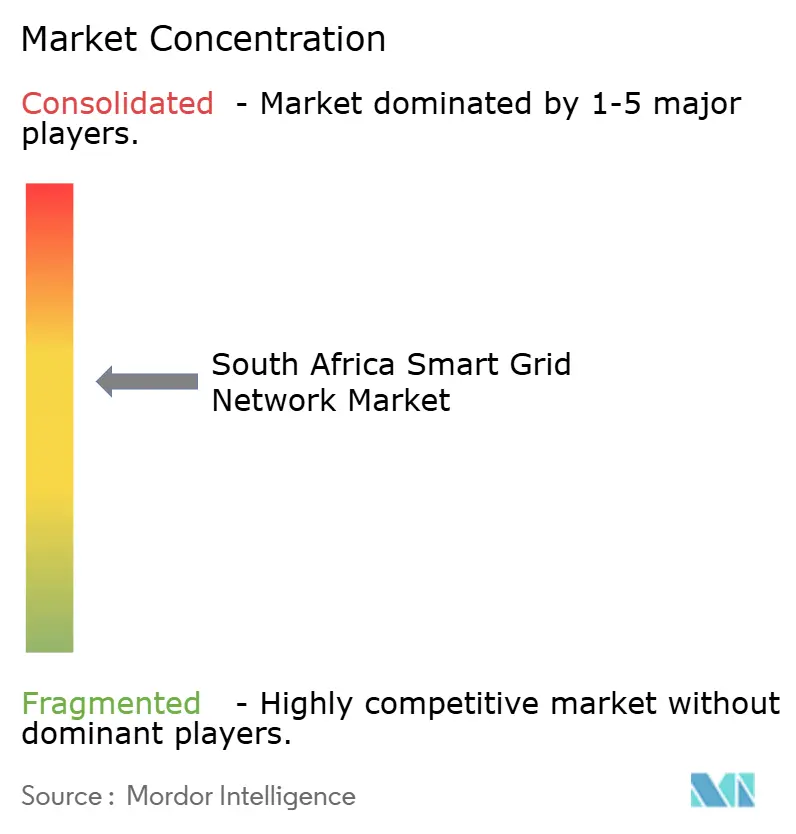
| Market Concentration | Medium |
Major Players *Disclaimer: Major Players sorted in no particular order Image © Mordor Intelligence. Reuse requires attribution under CC BY 4.0. | |
South Africa Smart Grid Network Market Analysis by Mordor Intelligence
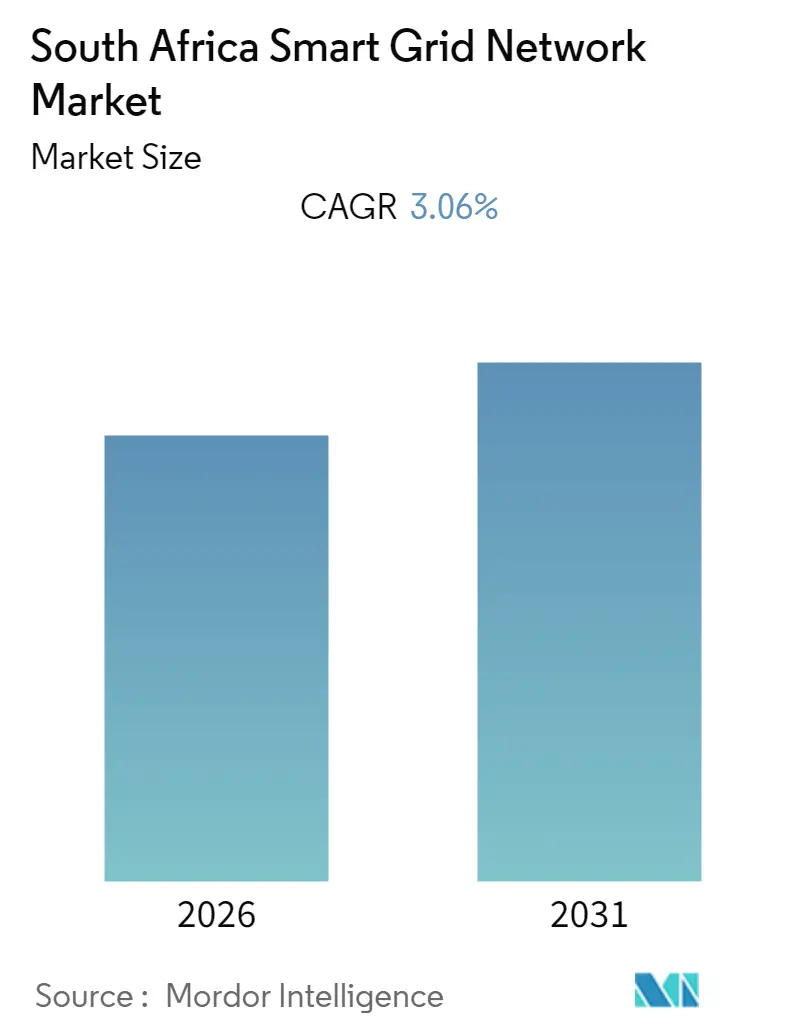
The South Africa Smart Grid Network Market size is expected to register a CAGR of 3.06% during the forecast period.
- Advanced Metering Structure is expected to drive the smart grid network significantly, providing monitoring of bi-directional flow of electricity, owing to increasing grid development.
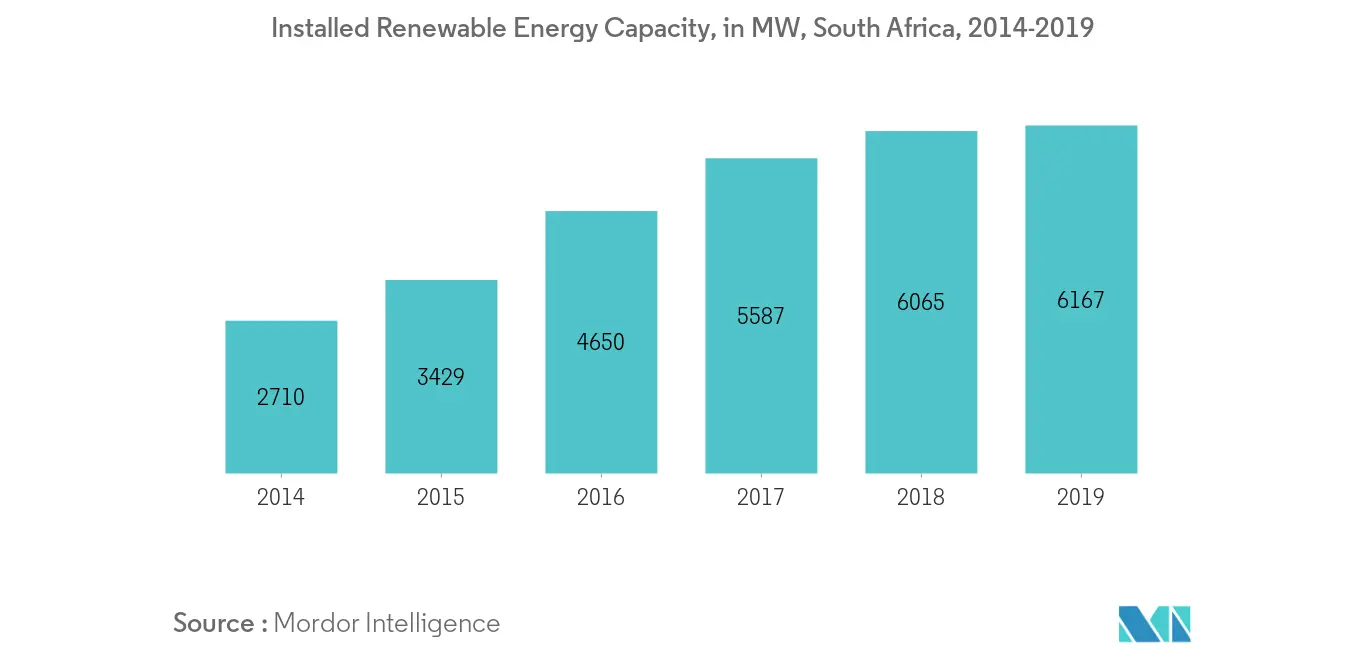
- South Africa is showing massive growth in the renewable market, reaching more than 6100 MW in 2019. This, in turn, is expected to create a significant opportunity and demand for the new T&D infrastructure and thereby creating an ample amount of opportunity for the smart grid network in the near future.
- South Africa is aiming to develop and renovate its aging grid infrastructure. To meet the growing electricity demand, The South African National Energy Development Institute (SANEDI) updated the South African Smart Grid Initiative in 2017.
Note: Market size and forecast figures in this report are generated using Mordor Intelligence’s proprietary estimation framework, updated with the latest available data and insights as of 2026.
South Africa Smart Grid Network Market Trends and Insights
Advanced Metering Infrastructure to Witness a Significant Growth
- Advanced metering infrastructure (AMI) or smart metering is an integrated system of smart meters, communications networks, and data management systems that enables two-way communication between utilities and customers.
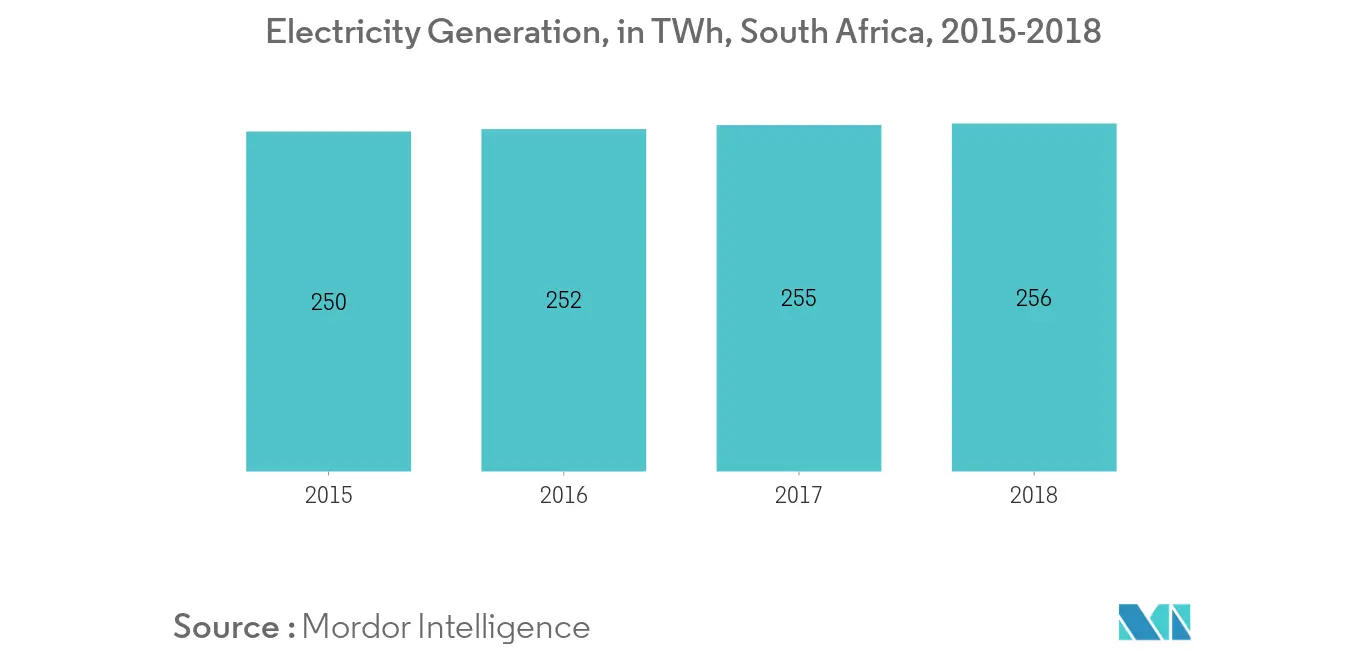
- South Africa has witnessed growth in electricity production until 2018, which is expected to grow in the forecast period. With 250 TWh in 2015 to 256 TWh in 2018, electricity production has increased the demand for smart grid and smart meters as well.
- With the increasing efforts to modernize the electricity grid and reduce transmission and distribution losses, the government across South Africa is investing in advanced metering infrastructure. This, in turn, is expected to drive the AMI market during the forecast period.
South African Smart Grid Vision and Renewable Energy to Drive the Market
- South Africa introduced a Smart grid vision to define a standard national blueprint for the smart grid before industry stakeholders and participants commit to an investment program of this magnitude and complexity.
- South African National Energy Development Institution is a separate body working with industry to provide policy inputs, address the gaps in standards, and the deployment and application of technology in smart grid deployment.
- In November 2017, South Africa and the European Union established a dialogue facility project in the review of the existing Smart Grid Vision document, consultative workshops, and a study tour to experience first-hand integrated deployments of smart grids within distribution networks.
- With the development of renewable energy sources, installed capacity of more than 2700 MW in 2014 and 6167 MW by the end of 2019, the demand for the smart grid has increased. With further renewable growth in the forecast period, the market is expected to grow significantly.
- The aim of the South African government to electrify the country entirely by 2030, and with the initiatives mentioned above, the market is expected to grow considerably.
Regulatory Landscape
South Africa's smart grid network market operates under the Electricity Regulation Act, 2006 (as amended), with the National Energy Regulator of South Africa (NERSA) issuing and enforcing rules, guidelines, and codes of practice for licensing, grid access, and market conduct. A major policy inflection came with the Electricity Regulation Amendment Act 38 of 2024, effective from January 1, 2025, which provides a statutory basis for an open market platform and competitive electricity trading. It also raises requirements for measurable system performance, data visibility, and controllability across transmission and distribution networks.
In late 2025 to 2026, regulatory instruments shifted from high-level reform toward implementation. NERSA approved Grid Capacity Allocation Rules (November 2025) to standardize access to constrained network capacity, and in April 2026 it initiated a consultation process on Market Code and Rules for wholesale market operation and participant governance. In parallel, national smart grid policy work led by SANEDI (Strategic National Smart Grid Vision for the South African Electricity Supply Industry) continues to emphasize modernization of distribution and municipal frameworks, advanced metering infrastructure (AMI), and integration of small-scale embedded generation through established technical standards (for example, NRS 097 referenced in industry practice). Together, these efforts increase compliance and interoperability requirements for metering, communications, and control systems.
Value Chain Analysis
The South Africa smart grid network value chain spans grid planning and governance (national planning frameworks such as IRP 2025 and transmission planning through NTCSA-aligned development plans), regulated network owners and operators (Eskom Transmission/Distribution and municipalities), and the enabling technology layer supplying AMI, communications, substation automation, grid monitoring, and control platforms (including global vendors active in the market such as Schneider Electric, GE, Honeywell, and Itron). Downstream, implementation is carried out through EPCs and specialist contractors for line works, substations, meter installations, systems integration, and cybersecurity. Utility operations teams and third-party service providers then manage meter data management, field services, and analytics.
A key structural change in the value chain is the introduction of Independent Transmission Projects (ITP), moving parts of grid build from a single-buyer utility model toward competitively procured private delivery. Government has advanced this with seven international-led consortia pre-qualified for an inaugural roughly USD 1 billion ITP phase (announced in December 2025), with an RFP indicated for the second half of 2026, and a Credit Guarantee Vehicle planned for July 2026 to support investment. On the distribution side, Eskom's smart meter deployment (reported at about 1.86 million units nationwide by July 2026) shows demand concentrating around loss reduction and load-reduction feeder conversion, while bottlenecks persist in field rollout, including site access and safety risks that can delay meter conversions and slow the realization of end-to-end AMI and automation benefits.
Competitive Landscape
The South Africa smart grid network market is partially consolidated. Some of the major companies include General Electric Company, Eskom Holdings SOC Ltd, Honeywell International Inc, Itron Inc, and Schneider Electric SE.
South Africa Smart Grid Network Industry Leaders
-
Honeywell International Inc
-
General Electric Company
-
Eskom Holdings SOC Ltd
-
Itron Inc
-
Schneider Electric SE
- *Disclaimer: Major Players sorted in no particular order
Market Opportunities and Future Outlook
Market opportunity is being created by the shift from policy intent to operational market design and access rules. NERSA's approval of a Market Operator licence for the National Transmission Company South Africa (NTCSA) in November 2025, alongside the Grid Capacity Allocation Rules (also approved in November 2025) and the April 2026 consultation on Market Code and Rules, increases demand for smart grid network capabilities that support transparent access, auditable data, and operational coordination across multiple participants. This is pulling deployments that connect metering, communications, and distribution automation with system and market operation processes, including improved telemetry, event visibility, and integration readiness for time-based and usage-based retail mechanisms.
Whitespace is also visible through implementation in utility and industrial programs. Eskom reported 1,861,180 smart meters deployed nationwide by early July 2026, indicating continued scale-up in AMI-centric loss reduction and feeder management, where communications networks, head-end systems, and meter data management are needed to convert installations into actionable operations. At the national industrial-policy level, the South African Renewable Energy Masterplan (June 2026) identifies smart grid technology adoption and T&D infrastructure expansion as priority opportunity areas, aligning local capability development with grid modernization. Separately, large network build programs, such as the ITP pipeline targeting 14,500 km of transmission lines and 133,000 MVA of transformer capacity by 2034, support procurement pull-through for substation automation, monitoring, protection, and digital grid management systems used to operate new assets and integrate renewable generation.
Recent Industry Developments
- July 2026: Eskom reported that 1,861,180 smart meters had been deployed nationwide, with a large share focused on load-reduction feeders and loss-reduction programs. The update underscores how AMI deployments in South Africa are being tied to operational outcomes such as feeder stabilization, theft mitigation, and improved network controllability.
- May 2026: Honeywell Process Technology was selected by Phelan Green for process technology for a sustainable aviation fuel project at Saldanha Bay, with Engineering News also noting the project context and technology selection. The project reinforces demand for reliable, digitally monitored electricity supply at new industrial loads, supporting investments in distribution automation, metering, and power quality solutions around emerging energy-intensive facilities.
- November 2025: NERSA approved the Market Operator licence for the National Transmission Company South Africa (NTCSA) and advanced the implementation pathway for market governance instruments. This step accelerates requirements for smart grid communications, data integrity, and interoperability that enable multi-party operation and verifiable settlement-ready metering and grid visibility.
Research Methodology Framework and Report Scope
Segmentation Overview
- Technology Application Area
- Transmission
- Demand Response
- Advanced Metering Infrastructure (AMI)
- Other Technology Application Areas
Key Questions Answered in the Report
What is the current South Africa Smart Grid Market size?
The South Africa Smart Grid Market is projected to register a CAGR of 3.06% during the forecast period (2026-2031)
Who are the key players in South Africa Smart Grid Market?
Honeywell International Inc, General Electric Company, Eskom Holdings SOC Ltd, Itron Inc and Schneider Electric SE are the major companies operating in the South Africa Smart Grid Market.
What years does this South Africa Smart Grid Market cover?
The report covers the South Africa Smart Grid Market historical market size for years: 2020, 2021, 2022, 2023 and 2024. The report also forecasts the South Africa Smart Grid Market size for years: 2026, 2027, 2028, 2029, 2030 and 2031.