
South Africa Office Real Estate Market Size and Share
Market Overview
| Study Period | 2021 - 2032 |
|---|---|
| Forecast Data Period | 2027 - 2032 |
| Base Year Market Size (2026) | USD 2.30 Billion |
| Market Size (2027) | USD 2.42 Billion |
| Market Size (2032) | USD 3.15 Billion |
| Growth Rate (2027 - 2032) | 5.43 % |
| Market Concentration | Medium |
Major Players *Disclaimer: Major Players sorted in no particular order Image © Mordor Intelligence. Reuse requires attribution under CC BY 4.0. | |
South Africa Office Real Estate Market Analysis by Mordor Intelligence
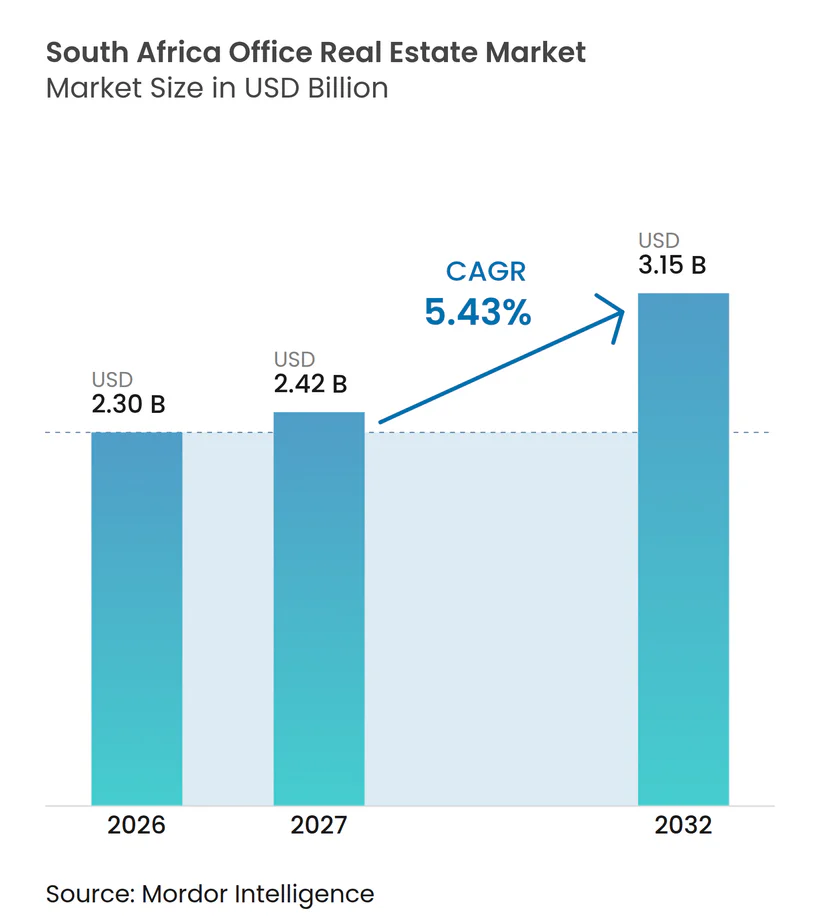
The South Africa Office Real Estate Market size is expected to grow from USD 2.30 billion in 2026 to USD 2.42 billion in 2027 and is forecast to reach USD 3.15 billion by 2032 at 5.43% CAGR over 2027-2032.
Demand is becoming increasingly selective as occupiers prioritize well-located buildings with reliable power, fiber connectivity, security, and strong environmental credentials. These preferences are improving leasing conditions for prime and Grade A properties while creating a more challenging leasing outlook for older buildings. Cape Town benefits from limited premium office supply and strong demand from the business process outsourcing industry, while Johannesburg remains the largest office hub due to its concentration of corporate headquarters. Listed property companies are responding by disposing of non-core assets, upgrading strategically located buildings, and focusing development activity in precincts with demonstrated tenant demand. Consequently, the South Africa office real estate market relies less on broad-based expansion and more on owners’ ability to adapt existing space to evolving occupier requirements.
Key Report Takeaways
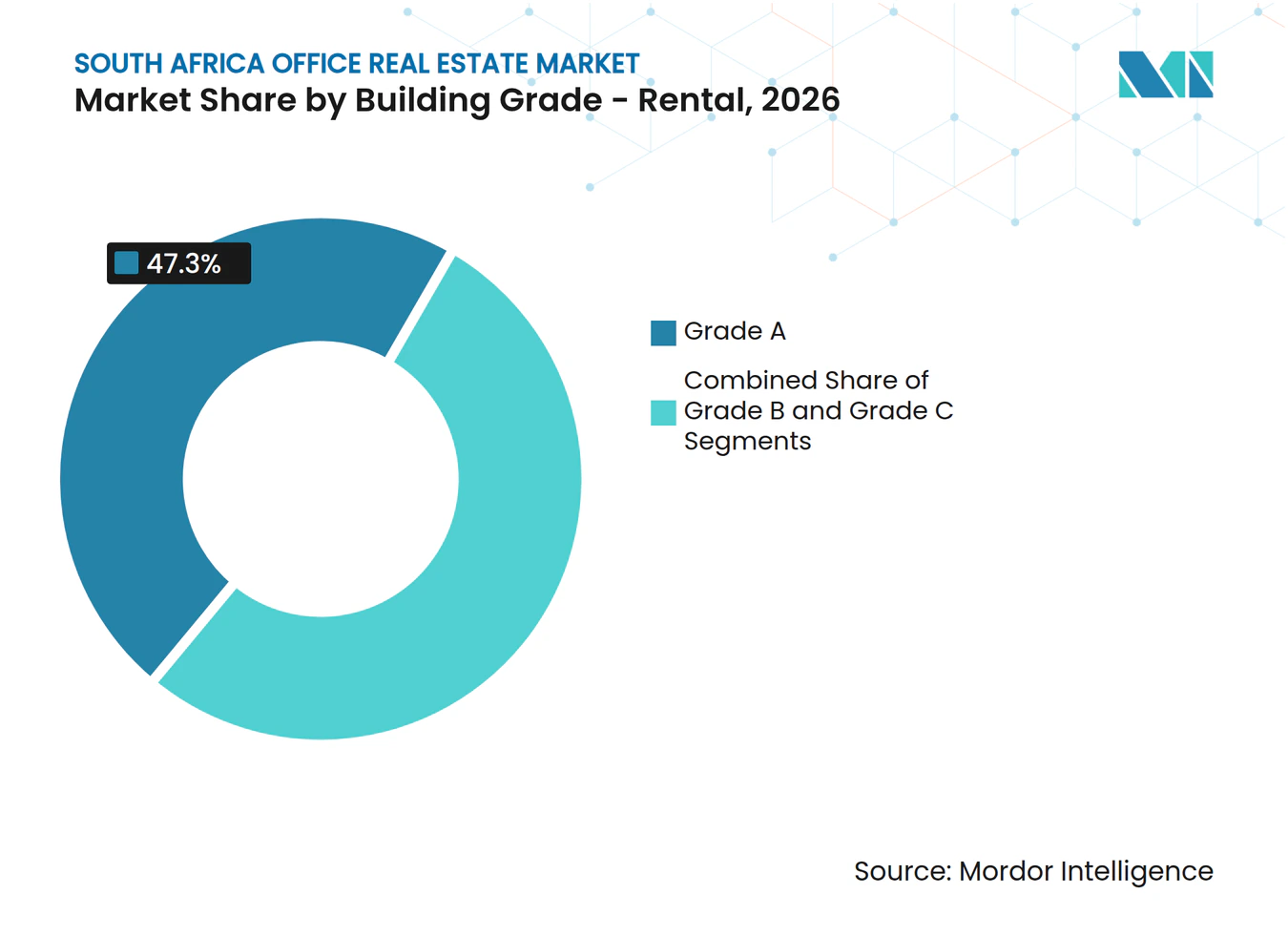
- By Building Grade - Rental: Grade A held a 47.3% share of the South Africa office real estate market in 2026, making it the largest rental segment by building grade. Grade A is forecast to grow at a CAGR of 5.97% through 2032.
- By End Use - Rental: Information Technology (IT and ITES) accounted for 28.9% of the South Africa office real estate market share in 2026, making it the largest end-use segment. Information Technology (IT and ITES) is forecast to grow at a CAGR of 6.32% through 2032.
- By Geography - Rental: Johannesburg accounted for 49.8% of the South Africa office real estate market share in 2026, making it the largest geographic segment. Cape Town is forecast to record the highest CAGR of 6.21% through 2032.
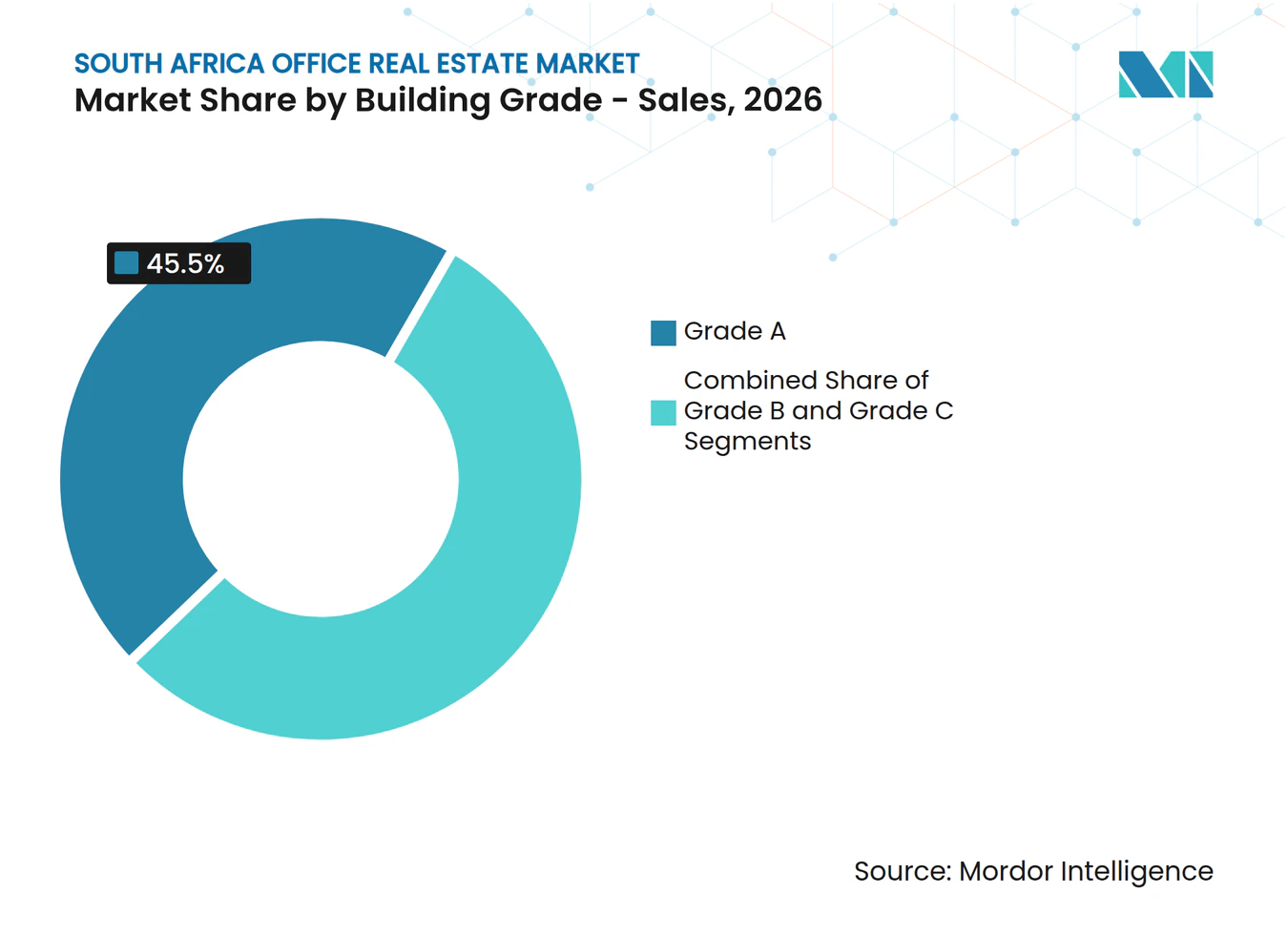
- By Building Grade - Sales: Grade A held a 45.5% share of the South Africa office real estate market in 2026, making it the largest sales segment by building grade. Grade A is projected to grow at a CAGR of 6.10% through 2032.
Note: Market numbers in this report are based on Mordor Intelligence's proprietary estimation framework, which combines nine months of actuals with Q4 projections for base year 2026.
Market Trends and Insights
Drivers Impact Analysis of South Africa Office Real Estate Market*
| Drivers | (~) % Impact on CAGR Forecast | Geographic Relevance | Impact Timeline |
|---|---|---|---|
| Corporate Flight-to-Quality Strengthening Grade A Demand | +1.4% | National, most acute in Johannesburg and Cape Town established business districts. | Short term (≤ 2 years) |
| BPO and Global Business Services Expansion Supporting Leasing | +1.2% | Cape Town, with spillover to Johannesburg, Durban, and Port Elizabeth/Gqeberha | Medium term (2-4 years) |
| Flexible and Serviced Office Adoption Increasing Adaptable Workspace Demand | +1.0% | National, concentrated in major central business districts and premium decentralized nodes. | Medium term (2-4 years) |
| Improved Electricity Supply Reliability Strengthening Occupier Confidence | +0.5% | National, strongest in Johannesburg and Cape Town prime nodes | Short term (≤ 2 years) |
| Urban Regeneration and Office Conversion Creating Repositioning Opportunities | +0.4% | Johannesburg CBD, Cape Town CBD, Pretoria, and Port Elizabeth/Gqeberha | Long term (≥ 4 years) |
| Corporate Decarbonization Supporting Green-Certified Office Demand | +0.3% | National, strongest in Western Cape and Gauteng prime nodes | Long term (≥ 4 years) |
| Source: Mordor Intelligence | |||
Corporate Flight-to-Quality Is Strengthening Demand for Modern Grade A Office Properties in Established Business Districts
Corporate tenants are shifting toward modern Grade A offices in established business districts. Prime vacancy stood at 4.7% in the third quarter of 2026, while Grade B and Grade C vacancy stood at 15.9% and 15.6%, respectively[1]. Many companies are reducing their footprint and redirecting savings toward improved building quality and location. This supports occupancy in well-serviced nodes and leaves secondary stock with a more persistent vacancy challenge. Reliable power, fiber, security, and environmental performance have become core requirements for larger occupiers.
Expansion of Business Process Outsourcing and Global Business Services Is Supporting Office Leasing Activity in Major Metropolitan Markets
Business process outsourcing and global business services are supporting office leasing in major metropolitan areas. The national sector has a target of 500,000 jobs by 2030, indicating further demand for office space[2]. Demand is strongest in Cape Town and is expanding into Johannesburg, Durban, and Port Elizabeth/Gqeberha as suitable large floorplates become harder to find. These operators require redundant fiber, backup power, dense layouts, and training space, which favors Grade A and premium buildings. AI-driven automation remains a medium-term risk, as it could reduce the labor-intensive demand that supports large-floorplate leasing.
Growing Adoption of Flexible and Serviced Offices Is Increasing Demand for Adaptable Workspace Solutions
Flexible and serviced offices are becoming an established part of South Africa's office real estate market. Corporates and fast-growing technology firms use shorter lease commitments to manage hybrid work arrangements and avoid the costs associated with conventional long-term leases. This model is gaining relevance in central business districts and premium decentralized nodes such as Sandton, Rosebank, Century City, and Umhlanga. Flexible-office operators can absorb vacant floor space through management agreements, which may support occupancy levels in Grade A and premium Grade B buildings. However, demand for managed workstations does not always translate into the same long-term leasing commitments as conventional corporate tenancies.
Improved Electricity Supply Reliability Is Strengthening Occupier Confidence in Established Commercial Locations
Improved electricity reliability is supporting confidence in established commercial locations. More stable supply allows landlords to allocate more capital toward tenant amenities, energy efficiency, and building upgrades. Grade A and prime buildings with installed solar and battery systems retain an operating-cost advantage over older properties[3]. Power reliability remains a practical site-selection requirement for occupiers, particularly those with large technology or outsourcing operations. This improvement is supporting leasing inquiries in Johannesburg and Tshwane central business districts, where generator costs previously contributed to tenant departures.
Restraints Impact Analysis of South Africa Office Real Estate Market*
| Restraints | (~) % Impact on CAGR Forecast | Geographic Relevance | Impact Timeline |
|---|---|---|---|
| Elevated Office Vacancy Limiting Rental Growth and Speculative Development | -0.8% | National, most acute in Johannesburg CBD, Port Elizabeth/Gqeberha, and secondary nodes across all metros | Long term (≥ 4 years) |
| Hybrid Working and Corporate Space Consolidation Reducing Conventional Requirements | -0.6% | National, most pronounced in knowledge-economy sectors in Johannesburg and Cape Town | Long term (≥ 4 years) |
| Rising Municipal Charges and Operating Expenses Pressuring Landlord Income | -0.4% | National, highest burden in Johannesburg CBD, Tshwane, and secondary metros | Medium term (2-4 years) |
| High Financing Costs and Cautious Bank Lending Restricting Capital | -0.3% | National, with an impact on investment appetite and development viability across major metros | Short to medium term (≤ 4 years) |
| Source: Mordor Intelligence | |||
Elevated Office Vacancy Rates in Selected Submarkets Are Limiting Rental Growth and Discouraging Speculative Development
Elevated vacancy in select submarkets remains the largest structural drag on recovery. Grade B and Grade C offices carried vacancy above 15% nationally in Q3 2026, even as the overall market improved. Many secondary buildings lack the power backup, floorplate efficiency, and environmental features required by modern tenants. More than 2.25 million square meters of surplus office space remained available nationally in Q3 2026. This overhang limits rental growth and discourages speculative development.
Hybrid Working and Corporate Space Consolidation Are Reducing Conventional Office Space Requirements
Hybrid working is reducing conventional office requirements in knowledge-intensive sectors. Many large employers are using formal work schedules that reduce the average amount of space needed per employee. At lease expiry, occupiers can return surplus space and consolidate into smaller or better-quality premises. Gross leasing activity can therefore overstate the real increase in occupied space when surrenders and sublettings offset new commitments. This restraint is especially relevant to banking, financial services, insurance, consulting, and professional services tenants.
*Our forecasts treat driver/restraint impacts as directional, not additive. The impact forecasts reflect baseline growth, mix effects, and variable interactions.
South Africa Office Real Estate Market Segment Analysis
By Building Grade, Rental:
Grade A Leads as Quality Requirements Shape LeasingGrade A is projected to account for 47.3% of rental activity in 2026 and is forecast to expand at a CAGR of 5.97% through 2032. National vacancy is expected to reach 9.5% in the third quarter of 2026. The segment offers the reliable services, flexible layouts, and operational efficiency that larger tenants seek. Variations in occupancy conditions reflect tenant preference for properties with stronger service offerings and superior locations. Prime Grade P vacancy is projected to reach 0% in Cape Town’s Northern Suburbs in the first quarter of 2026, while AAA-grade vacancy is expected to stand at 1.2%. These conditions support pre-leasing activity when new supply meets the requirements of established occupiers.
Green certification strengthens the competitive position of Grade A buildings by reducing operating costs and aligning with corporate environmental commitments. Grade B and Grade C properties continue to serve users that prioritize lower rents and higher occupancy density, particularly certain outsourcing tenants. However, these properties require significant investment to provide power reliability, connectivity, and workplace quality comparable to higher-grade assets. Growthpoint’s disposal of Grade B and non-core Grade A holdings, coupled with its investment in the Cape Town Foreshore and Sandton Summit, illustrates the ongoing shift toward higher-quality assets. Consequently, the South Africa office real estate industry is becoming increasingly segmented based on a building’s ability to meet modern tenant requirements. Rental growth is expected to remain strongest in well-managed, energy-resilient Grade A and prime properties.



By End Use, Rental:
IT and ITES Combine Scale with the Strongest GrowthIT and ITES are projected to account for 28.9% of rental activity in 2026 and register a CAGR of 6.32% through 2032. The segment includes technology service providers, business process outsourcing firms, and global business services operators. These occupiers require large floorplates, robust connectivity, backup power, and space for training and employee support. These requirements channel demand toward Grade A and premium buildings in well-serviced business nodes. Johannesburg and Cape Town remain the primary demand centers due to their large corporate occupier bases and established outsourcing ecosystems. The concentration of technology demand provides landlords in these areas with a more reliable pool of prospective occupiers.
Banking, financial services, and insurance represent the next major tier of office demand, particularly in Sandton and the Cape Town Foreshore. These organizations are consolidating branch and regional operations into fewer, larger headquarters, which may release space before they absorb new premium office space. Business consulting and professional services firms are also shifting toward amenity-rich districts, including Rosebank, Century City, and Umhlanga. Other service-sector occupiers, including legal, energy, retail, and life sciences firms, contribute to a more diversified leasing demand base. Infrastructure-intensive demand from IT and ITES reinforces the segment’s position in the South Africa office real estate market. However, the pace of automation in outsourcing could alter this demand profile over time.
By Building Grade, Sales:
Grade A Draws Institutional CapitalGrade A offices are projected to account for 45.5% of the South Africa office real estate market size, by sales value, in 2026 and are forecast to grow at a CAGR of 6.10% through 2032. Institutional buyers favor assets with stable tenants, green credentials, and resilient operating infrastructure. In May 2026, Spear REIT is expected to acquire a fully let premium office portfolio in Tygervalley comprising three buildings with 28,500 square meters of gross lettable area. The portfolio is expected to generate an initial yield of 9.67% and average annual rental escalations of 6.5%. This transaction indicates that capital remains available for well-let premium assets in supply-constrained locations. Consequently, Grade A offices retain a stronger sales outlook than buildings with uncertain leasing prospects.
Sales of Grade B and Grade C offices increasingly involve conversion or repositioning rather than conventional income-generating investments. Buyers are reassessing the future use of weaker assets where leasing income does not justify refurbishment costs. Higher financing costs and low market confidence continue to constrain overall transaction volumes. The South Africa office real estate market is gradually reducing its investable universe as owners convert obsolete space or sell it at prices that reflect redevelopment risk. This trend is expected to concentrate investment activity among a smaller group of higher-quality office assets. The sales outlook will remain strongest for assets with stable income streams or viable alternative-use potential.

Geography Analysis
Johannesburg accounted for 49.8% of rental activity in 2026, supported by its concentration of banking, mining, and professional services headquarters. The metro had an overall office vacancy rate of 14.7% in the third quarter of 2026, compared with 12.5% before the pandemic. The headline rate masks stronger conditions in Sandton and Rosebank, where prime and Grade A vacancy were 6% and 10.5%, respectively. Attacq’s Gateway East at Waterfall City covers 12,605 square meters and was 73.4% pre-leased before completion. This shows that tenant-led development can work in the right submarkets. The central business district still needs a longer period of rehabilitation before it can match decentralized nodes.
Cape Town is forecast to be the fastest-growing geography, with a 6.21% CAGR through 2032, and had the country’s tightest vacancy rate at 6.9% in the third quarter of 2026. Business process outsourcing demand and limited premium floorplate availability are supporting landlord pricing. Available large floorplates are becoming scarce, which can direct some occupiers toward other metros. The City Park redevelopment is expected to add 10,500 square meters of premium office space in the third quarter of 2026. The South Africa office real estate market in Cape Town is supported by a tighter balance of supply and demand than in other major metros.
Durban recorded a 9.3% vacancy rate in the third quarter of 2026, down 6.8 percentage points from its mid-2022 peak. Its recovery has been helped by cost-effective space in decentralized areas such as Umhlanga and the city’s base of logistics-linked activity. Gqeberha had the highest major-metro vacancy at 15.7% but is attracting interest as outsourcing expands beyond Cape Town. Smaller centers, including Bloemfontein, George, Polokwane, Mitchells Plain, and Soweto, offer possible expansion locations for delivery operations. Their prospects depend on local infrastructure and an owner’s ability to upgrade buildings to required specifications. Geographic performance across the South Africa office real estate market will remain uneven because each node faces a different combination of tenant demand, stock quality, and municipal service levels.
Competitive Landscape
Market Concentration
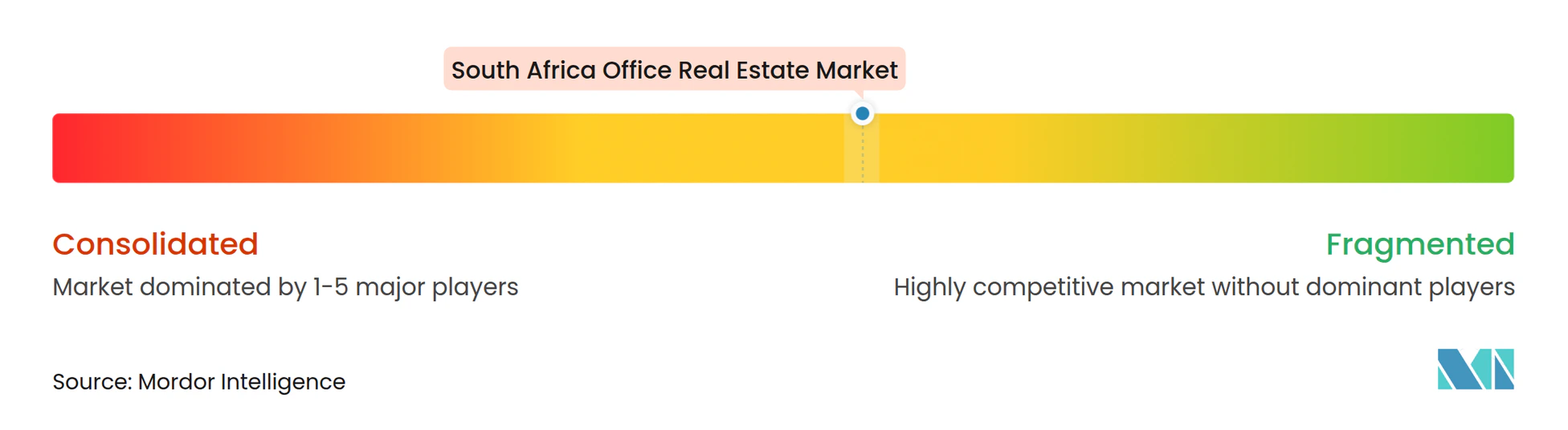
The South Africa office real estate market is moderately concentrated among listed real estate investment trusts (REITs) and institutional property companies. Growthpoint Properties, Redefine Properties, Attacq, and Spear REIT hold significant Grade A portfolios in premium nodes. Their strategies focus on disposing of lower-quality assets, improving operating performance, and concentrating development in locations with visible tenant demand. Growthpoint completed the net-zero redevelopment of 36 Hans Strijdom Avenue and secured a 15-year lease with Ninety One. This strategy directs capital toward long-term income generation and more defensible office assets.
Redefine uses its GoCity digital platform to centralize building management, monitor occupancy patterns, and support tenant safety procedures. The company reported tenant retention above 96% across its South African office portfolio. Spear REIT is expected to complete its acquisition of 1 Sportica Crescent in Tygervalley in August 2026, adding three premium office buildings in Cape Town. These developments demonstrate how large property owners prioritize technology, stable tenants, and supply-constrained precincts. Green Star standards can further strengthen this advantage, as compliance with energy and water performance requirements requires capital investment and operational expertise. Smaller owners may face greater challenges in funding these upgrades at a comparable pace.
Opportunities remain in upgrading Grade B buildings for outsourcing occupiers, developing net-zero buildings with anchor tenants, and converting non-core central business district assets into residential or mixed-use developments. Excellerate JHI and Anvil Property Smith compete through local market knowledge, brokerage capabilities, and tenant relationships rather than portfolio scale. Attacq maintains an active development pipeline at Waterfall City, including Gateway East, a conference center, and a hotel. The increasing adoption of smart building systems may also widen the operational gap between larger REITs and conventionally managed properties. Competition is therefore strongest for high-quality assets, while secondary stock is more likely to compete on rental rates or redevelopment value. The South Africa office real estate market remains a two-tier market, as modern buildings and older office space serve different tenant requirements.
South Africa Office Real Estate Industry Leaders
-
Growthpoint Properties
-
Redefine Properties
-
Fortress REIT
-
Attacq Limited
-
Liberty Two Degrees
- *Disclaimer: Major Players sorted in no particular order
South Africa Office Real Estate Market Companies Covered in this Report
- Growthpoint Properties
- Redefine Properties
- Fortress REIT
- Attacq Limited
- Liberty Two Degrees
- Investec Property Fund
- Spear REIT Limited
- Emira Property Fund
- Dipula Income Fund
- Delta Property Fund
- Vukile Property Fund
- Fairvest Limited
- SA Corporate Real Estate Limited
- Resilient REIT Limited
- Pinnacle Property Holdings
- Affordable Group
- JLL South Africa
- CBRE South Africa
- Cushman and Wakefield / BROLL
- Colliers South Africa
Recent Industry Developments in South Africa Office Real Estate Market
- October 2026: South Africa's national office vacancy rate is projected to decline to 11.8% in Q3 2026, reaching a six-year low. The market is expected to record positive net absorption of nearly 70,000 m² during the quarter, while 70.4% of the 100,500 m² development pipeline is pre-let, signaling a tenant-driven supply cycle rather than speculative development.
- August 2026: Spear REIT Limited completed the acquisition of 1 Sportica Crescent, Tygervalley, Cape Town, classified as a Category 2 transaction. The acquisition involved the transfer of three premium-grade office buildings (approximately 28,500 m² GLA) from Ingenuity Property Investments. The properties are fully let to blue-chip tenants at an estimated initial yield of 9.67%.
- June 2026: Growthpoint Properties transferred its 55% undivided share in Discovery Phase 1, Sandton, Johannesburg, to Discovery Propco and acquired 100% ownership of the adjacent Discovery Phase 2 building (19,369 m²), reducing Growthpoint's office weighting in Gauteng.
South Africa Office Real Estate Market Report Scope
Segmentation Overview
| Grade A |
| Grade B |
| Grade C |
| By Building Grade | Grade A |
| Grade B | |
| Grade C |
Key Questions Answered in the Report
What is the projected value of South Africa office real estate by 2032?
The sector is forecast to reach USD 3.15 billion by 2032, growing at a 5.43% CAGR from 2027. The outlook is shaped by a shift toward higher-quality buildings rather than broad expansion across all office stock.
Which building grade leads office rentals in South Africa?
Grade A leads rental activity with a 47.3% share in 2026 and is projected to grow at a 5.97% CAGR through 2032. Reliable utilities, efficient layouts, and tenant amenities support its stronger position.
Why is Cape Town growing faster than other South African office locations?
Cape Town is forecast to grow at a 6.21% CAGR because premium supply is limited and business process outsourcing demand remains strong. Its 6.9% vacancy rate also shows a tighter leasing balance than other major metros.
Which occupiers drive office demand in South Africa?
IT and ITES is the largest rental end-use segment, holding 28.9% in 2026, supported by technology, outsourcing, and global business services needs. These occupiers often need large floorplates, fiber, power backup, and training space.
What is holding back the recovery of older office buildings?
Grade B and Grade C assets have vacancy above 15%, and many need upgrades to provide reliable power, connectivity, and better workplace standards. Conversions to residential or mixed-use can be a practical response where office demand is not viable.
How are leading owners changing their office portfolios?
Leading owners are selling non-core assets, investing in green and energy-resilient buildings, and developing space in established premium precincts. Their actions focus on stable tenants, stronger operating performance, and longer lease commitments.