
South Africa Liquid Packaging Cartons Market Size and Share
Market Overview
| Study Period | 2021 - 2032 |
|---|---|
| Forecast Data Period | 2027 - 2032 |
| Base Year Market Size (2026) | USD 23.06 Million |
| Market Size (2027) | USD 24.17 Million |
| Market Size (2032) | USD 30.46 Million |
| Growth Rate (2027 - 2032) | 4.73 % |
| Market Concentration | Medium |
Major Players *Disclaimer: Major Players sorted in no particular order Image © Mordor Intelligence. Reuse requires attribution under CC BY 4.0. | |
South Africa Liquid Packaging Cartons Market Analysis by Mordor Intelligence
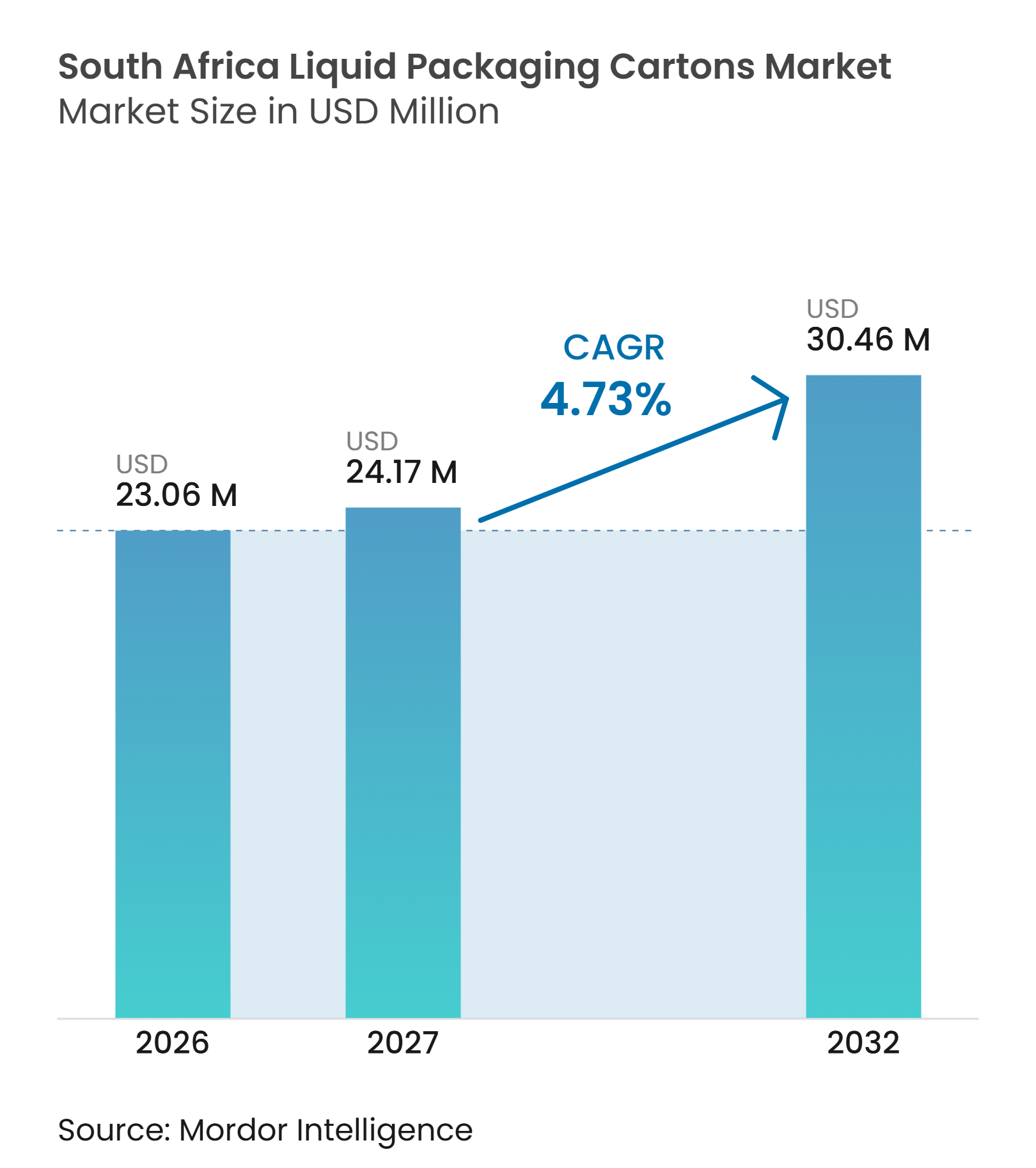
The South Africa liquid packaging cartons market size was valued at USD 23.06 million in 2026 and is estimated to grow from USD 24.17 million in 2027 to reach USD 30.46 million by 2032, at a CAGR of 4.73% during the forecast period (2027-2032). The South Africa liquid packaging cartons market benefits from demand for ambient products where refrigeration reliability remains uneven. UHT dairy remains central to usage because it supports storage and distribution without a continuous cold chain. Retailers also favor formats that can be stored efficiently and supplied through urban convenience channels. Extended Producer Responsibility requirements make collection and recycling capability more relevant to procurement decisions. Suppliers are responding by increasing local production, reducing service lead times, and investing in carton recovery infrastructure.
Key Report Takeaways
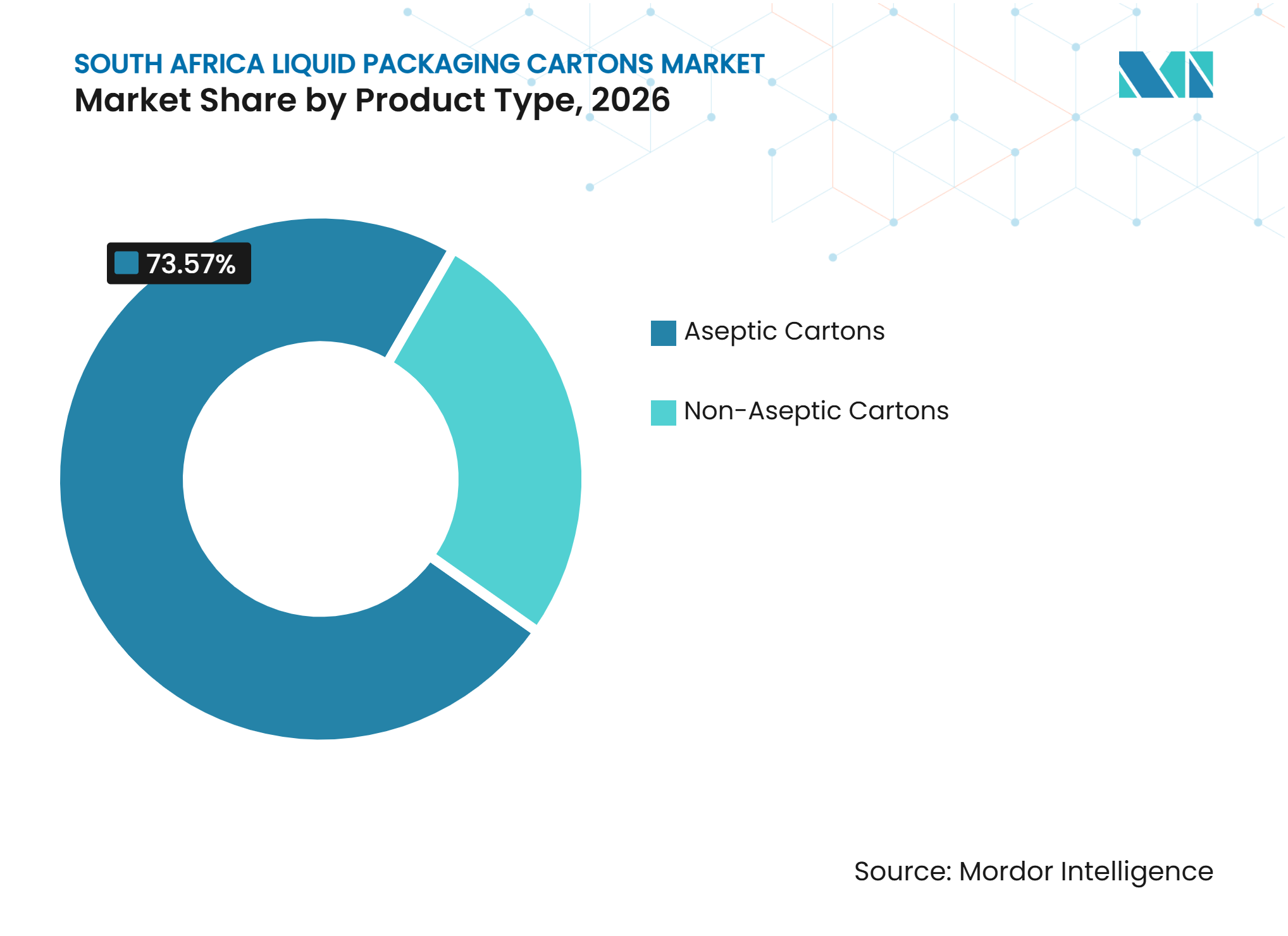
- By product type, aseptic cartons held 73.57% of the South Africa liquid packaging cartons market share in 2026 and are projected to expand at a 5.56% CAGR through 2032.
- By application, milk accounted for 46.28% of the South Africa liquid packaging cartons market size in 2026, while plant-based beverages are projected to expand at a 5.48% CAGR through 2032.
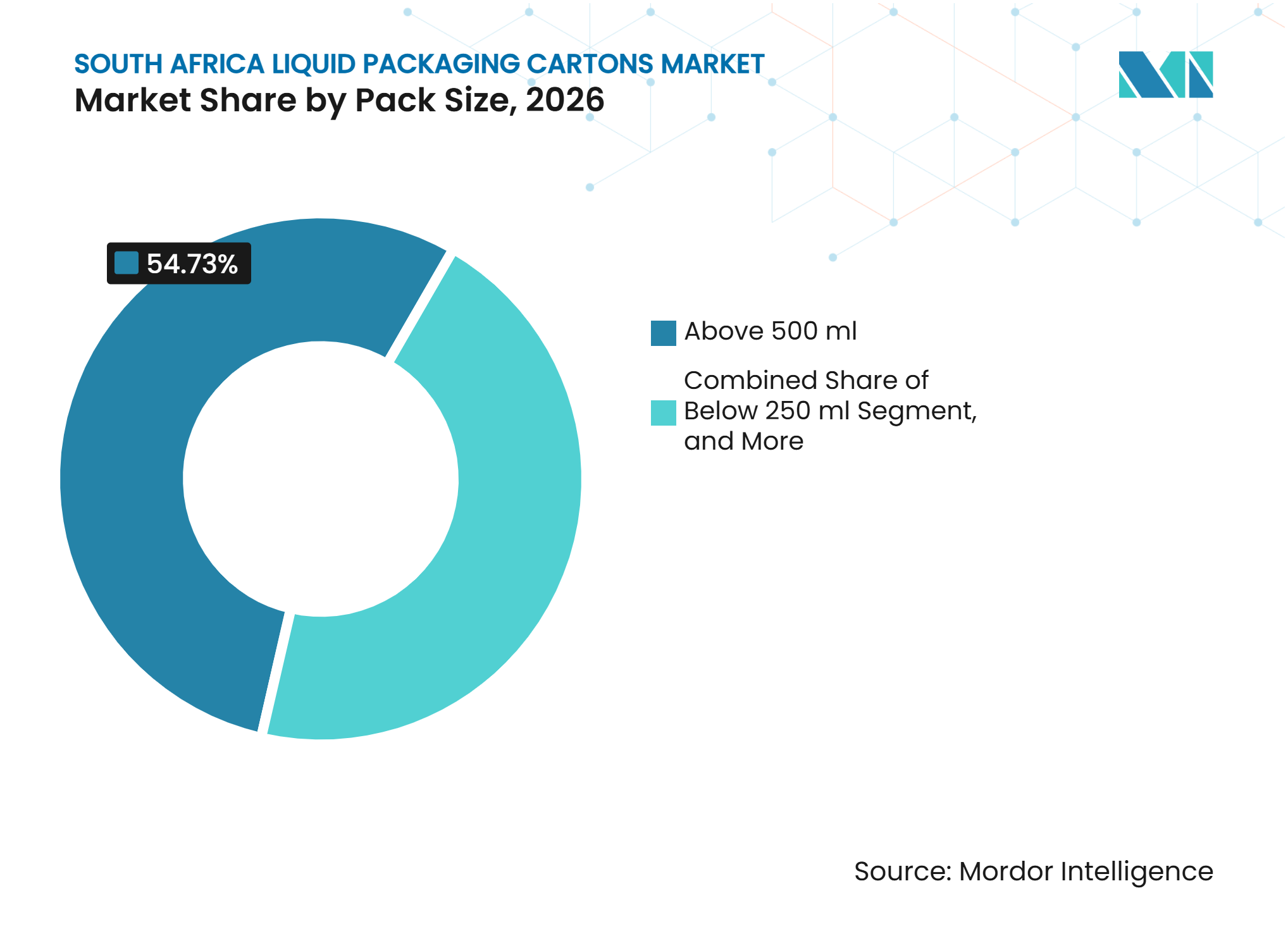
- By pack size, above 500 ml held 54.73% of the market share in 2026, while 250-500 ml is projected to expand at a 5.62% CAGR through 2032.
Note: Market numbers in this report are based on Mordor Intelligence's proprietary estimation framework, which combines nine months of actuals with Q4 projections for base year 2026.
Market Trends and Insights
Drivers Impact Analysis of South Africa Liquid Packaging Cartons Market*
| Driver | (~) % Impact on CAGR Forecast | Geographic Relevance | Impact Timeline |
|---|---|---|---|
| Growth in Ambient and UHT Dairy Consumption | +1.5% | National, strongest in Gauteng, KwaZulu-Natal, and Western Cape | Long term (≥ 4 years) |
| Convenience and Shelf-Life Demand in Urban Retail | +1.2% | National, with early gains in Johannesburg, Cape Town, and Durban | Medium term (2-4 years) |
| Expansion of Cartons in South African Wine and Traditional Beer | +0.8% | Western Cape, Gauteng, and KwaZulu-Natal | Medium term (2-4 years) |
| Mandatory EPR Investment in Liquid Board Collection and Recycling | +0.6% | National, with infrastructure gains concentrated in major metros and extending to secondary cities | Medium term (2-4 years) |
| Lightweight Transport Economics and Local Filling-Line Service | +0.4% | National, with rural supply-chain benefits in Limpopo, Mpumalanga, and Eastern Cape | Long term (≥ 4 years) |
| Growth of Recyclable Paper-Based Pack Formats | +0.3% | National, with consumer preference strongest in Western Cape and Gauteng | Medium term (2-4 years) |
| Source: Mordor Intelligence | |||
Growth in Ambient and UHT Dairy Consumption
UHT dairy is a core demand base for the South Africa liquid packaging cartons market. Earlier power interruptions made refrigerated fresh milk less dependable for households and food-service operators. That experience strengthened the role of ambient, long-life milk in regular purchasing patterns. The South African National Standard framework supports batch traceability and microbiological safety for UHT products, which supports confidence in shelf-stable dairy. Institutional buyers, including hospitals, schools, and public nutrition programs, also create recurring demand that is less exposed to changes in household spending. Tetra Pak and Woodlands Dairy introduced a High Protein range in 250 ml Tetra Brik Aseptic Edge cartons during 2025, showing how functional dairy products can extend carton demand beyond standard milk.
Convenience and Shelf-Life Demand in Urban Retail
Urban retail supports demand for packages that are compact, shelf-stable, and suitable for smaller shopping baskets. More than 68% of South Africans live in urban areas, which broadens the retail base for ambient packaged liquids. Quick-commerce services, including Checkers Sixty60 and Pick n Pay ASAP!, raise the value of formats that can move through local fulfillment networks without refrigerated display space. Small stores and forecourt retailers can stock cartons without adding refrigeration equipment. This lowers handling demands while supporting product availability in dense neighborhoods. These retail conditions support the South Africa liquid packaging cartons market in metropolitan channels. Consumer preference for recyclable paper-based packaging also supports listings for cartons in urban retail channels.
Expansion of Cartons in South African Wine and Traditional Beer
Carton use in wine and traditional beer broadens the demand base beyond dairy. Bag-in-box formats added 40 million liters to South African wine sales without reducing glass bottle volumes. Robertson Winery launched fully recyclable 3-liter bag-in-box wine packaging in April 2025, which reflected a shift toward paper-based formats among Western Cape producers. Wine producers can reduce transport weight and respond to sustainability requirements in export-facing channels. This offers the South Africa liquid packaging cartons market a wider route into alcoholic beverages. Sorghum beverages such as umqombothi are also moving toward gable-top cartons where processors need better shelf life and tamper evidence. The Diversified Liquid Packaging Group retains local capability in Pure-Pak and Conipak formats after the 2025 management buyout of Nampak Liquid Cartons
Mandatory EPR Investment in Liquid Board Collection and Recycling
Section 18 of the National Environmental Management Waste Act makes Extended Producer Responsibility a material operating requirement for carton users. Petco reported 33% collection and 31% recycling rates for liquid board packaging in 2025. The scheme supported buy-back centers in all 9 provinces, making collection more visible within the packaging value chain. This investment improves the operating position of the South Africa liquid packaging cartons market. Tetra Pak commissioned a PolyAl processing plant in Germiston in September 2026 to process polyethylene and aluminum after paper fiber recovery. The facility connects recovery activity with end uses such as outdoor furniture, roof tiles, and pipes. Converters that improve collection links and recovery partnerships can better address EPR obligations as the Department of Forestry, Fisheries and the Environment reviews scheme performance.
Restraints Impact Analysis of South Africa Liquid Packaging Cartons Market*
| Restraint | (~) % Impact on CAGR Forecast | Geographic Relevance | Impact Timeline |
|---|---|---|---|
| Volatile Liquid-Board and Polymer Input Costs | -1.5% | Global, with South Africa exposed through ZAR/USD exchange rates and long-haul shipping routes | Short term (≤ 2 years) |
| Low Collection Density Outside Major Metros | -0.8% | Widespread, most acute in Limpopo, Eastern Cape, Northern Cape, and Mpumalanga | Long term (≥ 4 years) |
| Capital Intensity of Aseptic Filling Systems | -0.6% | National, with smaller dairies in secondary cities disproportionately affected | Long term (≥ 4 years) |
| Competition from Lightweight PET and Flexible Formats | -0.5% | National, with strongest pressure in juice, energy drink, and flavored water segments | Medium term (2-4 years) |
| Source: Mordor Intelligence | |||
Volatile Liquid-Board and Polymer Input Costs
Liquid cartons rely on paperboard and poly-aluminum layers, exposing converters to pulp, polymer, fuel, and currency movements. South African operators face additional exposure because imported inputs are affected by the ZAR/USD exchange rate and long-distance shipping costs. Asian cartonboard supply placed pressure on domestic margins during 2025 and 2026. These pressures affect the South Africa liquid packaging cartons market as well as its upstream suppliers. Imports were priced 20% below the cost of production at South Africa's domestic cartonboard mill, leading Mpact to start retrenchment proceedings at Springs in February 2026. Mpact also reported that Middle East conflict affected shipping chokepoints, fuel costs, energy costs, and logistics costs.[1] These pressures limit available margin for new formats and filling-line upgrades.
Low Collection Density Outside Major Metros
Collection systems remain less developed outside Gauteng, Western Cape, and KwaZulu-Natal. These provinces had denser buy-back networks and stronger support for informal collection activity in 2025. Limpopo, Northern Cape, Mpumalanga, and rural Eastern Cape have wider gaps between collection points. Spent cartons are therefore more likely to end up in landfill in lower-density areas. This weakens an important sustainability position for the South Africa liquid packaging cartons market. This weakens the circularity proposition that is important to urban retailers and brand owners. Petco stated that feedstock and electricity costs, along with weaker demand for recycled materials, reduced incentives for collection entrepreneurs in 2026.
*Our forecasts treat driver/restraint impacts as directional, not additive. The impact forecasts reflect baseline growth, mix effects, and variable interactions.
South Africa Liquid Packaging Cartons Market Segment Analysis
By Product Type:
Aseptic Technology Supports Format LeadershipAseptic cartons held 73.57% of the South Africa liquid packaging cartons market share in 2026 and are projected to grow at a 5.56% CAGR through 2032. Their position reflects long-standing investment in aseptic filling systems at large dairy processors. The format enables ambient distribution and reduces dependence on continuous refrigeration. This feature remained important after power disruptions increased the practical value of long-life dairy. Producers can use aseptic cartons for milk, dairy drinks, plant-based beverages, and functional nutrition products.
SIG launched the Terra Alu-free + Full barrier carton in July 2025, with up to 81% paper content and no aluminum layer in the complete barrier material.[2] The product provides converters with a way to meet recyclability expectations while retaining aseptic performance. Tetra Pak's Pinetown investment reduced delivery lead times from 60 days to 14 days, improving supply responsiveness for local processors. ISO-aligned aseptic validation and FSC-certified board sourcing remain important for supplier credibility with major grocery chains. These conditions also raise entry requirements for suppliers without established equipment and service capability.


By Application:
Milk Supports Volume and Plant-Based Beverages Lead GrowthMilk held 46.28% of the South Africa liquid packaging cartons market share in 2026. UHT long-life milk supports demand across urban and rural households where cold-chain reliability varies. It is also relevant to institutional purchasing by schools, hospitals, and public nutrition programs. The category provides a stable volume base for aseptic carton suppliers. Juice is the second-largest application by value, although growth in PET bottles has increased competitive pressure.
Plant-based beverages are projected to record the fastest application CAGR at 5.48% through 2032. Soy, oat, almond, and macadamia products are moving from specialist retail toward mainstream grocery shelves. Giraf Macadamia stated that South Africa's plant-based milk category is projected to exceed USD 232 million by 2030. Small aseptic cartons are suitable for products that need ambient distribution and a clear health-oriented positioning. This application provides suppliers with another route to reduce their reliance on standard milk.
By Pack Size:
Larger Household Packs Lead Revenue and Mid-Packs Grow FasterAbove-500 ml cartons accounted for 54.73% of the South African liquid packaging carton market share in 2026. The 1-liter and 2-liter UHT milk formats remain central to household grocery purchasing. Larger packs align with bulk-buying behavior in lower-income and middle-income households. They also provide a lower cost per liter for regular dairy users. Large formats therefore remain the main revenue base for carton suppliers.
Vinimark's first-quarter 2025 review recorded the resilience of 1-liter products, reflecting continued demand for value-oriented larger packs. Growth in modern retail outside large urban areas also supports the distribution of large ambient cartons. Shoprite and Boxer are expanding into previously underserved towns, which increases availability of shelf-stable products. Large packs reduce the need for frequent replenishment where transport and refrigeration are constrained. These factors support continued relevance for household carton formats.


Geography Analysis
Gauteng: Industrial Demand and Recycling Infrastructure
Gauteng is the primary end-use geography for the South Africa liquid packaging cartons market. The province has the country's largest concentration of UHT dairy processors, FMCG manufacturers, national grocery distribution hubs, and food-service chains. Gauteng, KwaZulu-Natal, and Western Cape together accounted for 75% of South Africa's manufacturing output in 2025. The Johannesburg-Pretoria corridor concentrates carton procurement and supports frequent replenishment. Quick-commerce platforms also create demand for ambient products that can move through urban delivery networks. Tetra Pak's PolyAl facility in Germiston strengthens the local recycling chain after paper fiber is recovered at Mpact's Springs mill.[3] NEMWA Section 18 compliance factors have also made recovery performance more important in procurement decisions by nationally headquartered brand owners.
Western Cape: Wine Formats and Sustainability-Led Demand
Western Cape demand differs from Gauteng because it has a stronger mix of wine producers, premium food brands, and export-oriented processors. The province's wine sector gives carton suppliers a route beyond high-volume FMCG liquids. Robertson Winery's 2025 launch of a recyclable 3-liter bag-in-box showed continued interest in paper-based wine formats. Lower transport weight is important for formats that compete with glass. Cape Town and the Paarl-Stellenbosch corridor also have consumers who place greater emphasis on packaging recyclability. National EPR obligations and municipal recycling priorities support this direction. These conditions encourage premium dairy and plant-based brands to consider carton packaging alongside wine applications.
Inland and Coastal Markets: Supply Connectivity and Institutional Demand
KwaZulu-Natal is important for both supply and demand because the Pinetown-New Germany industrial area includes Tetra Pak's main South African converting facility. Durban's port also makes the province a key entry point for liquid board and polymer inputs. This exposes converters to freight and insurance costs, as well as lead-time pressures linked to shipping disruptions. Eastern Cape, Limpopo, Mpumalanga, and North West represent smaller demand areas where schools, hospitals, and public feeding programs purchase UHT milk. The Free State, Northern Cape, and North West offer further potential for large ambient packs as modern retailers expand into underserved towns. These regions also show the need for broader collection infrastructure if carton circularity is to develop outside major metropolitan areas.
Competitive Landscape
Market Concentration
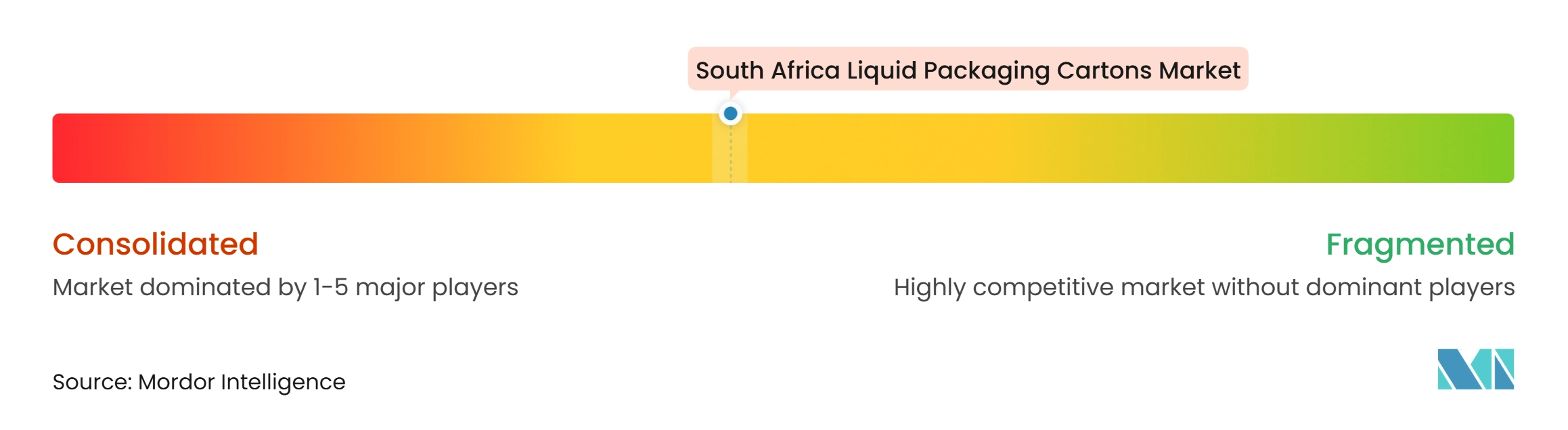
The South Africa liquid packaging cartons market is moderately concentrated. Tetra Pak International SA has a leading position through its integrated converting-and-filling-system model, local production scale, and recycling partnerships. Its Pinetown facility meets 80-90% of domestic aseptic packaging demand and has reduced delivery lead times from 60 days to 14 days after its upgrade. The company also works with Mpact Recycling on paper fiber recovery at Springs. This model combines packaging supply, technical service, and filling equipment support. It creates high switching costs for processors using aseptic technology.
Diversified Liquid Packaging Group is the principal locally based alternative in non-aseptic gable-top cartons. It was created through the January 2025 management buyout of Nampak Liquid Cartons, which retained Pure-Pak and Conipak production capabilities. The group has identified Zambia and Malawi as expansion areas, adding a regional dimension to its strategy. SIG offers a separate technology position through its aluminum-free aseptic barrier material. Smaller Chinese-origin converters, including Greatview Aseptic Packaging, Shandong Bihai, Lami Packaging, and Lamipak, compete mainly on price. Their position is constrained by logistics costs and currency exposure.
Competitive strategies focus on recycling compliance, local service, and application coverage beyond conventional dairy. Tetra Pak's Germiston PolyAl plant is an example of an investment that connects recovery requirements with local end markets for recovered material. SIG's aluminum-free barrier carton is another example of a material change designed to improve circularity credentials. The Diversified Liquid Packaging Group's regional expansion plan is a third example of a move that could extend the reach of local non-aseptic production. Board suppliers including Nippon Paper Industries, Billerud AB, and Stora Enso Oyj remain important upstream participants. FSC-certified board sourcing remains a relevant requirement for suppliers serving major grocery chains.
South Africa Liquid Packaging Cartons Industry Leaders
-
Tetra Pak International SA
-
SIG Group AG
-
Elopak ASA
-
Diversified Liquid Packaging Group (Pty) Ltd
-
Nippon Paper Industries Co., Ltd.
- *Disclaimer: Major Players sorted in no particular order
South Africa Liquid Packaging Cartons Market Companies Covered in this Report
- Tetra Pak International SA
- SIG Group AG
- Elopak ASA
- Diversified Liquid Packaging Group (Pty) Ltd
- Nippon Paper Industries Co., Ltd.
- Greatview Aseptic Packaging Company Limited
- IPI Srl
- Lami Packaging (Kunshan) Co., Ltd.
- Novolex Holdings, LLC
- Klabin S.A.
- Obeikan Investment Group
- Parksons Packaging Ltd.
- Southern Packaging Group Ltd.
- Lamipak (Suzhou) Co., Ltd.
- Xiamen Hexing Packaging Group Co., Ltd.
- Adam Pack SA
- Stora Enso Oyj
- Billerud AB
Recent Industry Developments in South Africa Liquid Packaging Cartons Market
- October 2026: Tetra Pak declared a 40% post-consumer carton recycling rate target for South Africa by 2030, up from 33% in 2025, as part of its Sub-Saharan Africa sustainability roadmap.
- September 2026: Tetra Pak commissioned its USD 1.2 million (ZAR 19 million) PolyAl processing plant in Germiston, Gauteng, in partnership with Timber Plastics and with CSIR support. The plant separates polyethylene and aluminum from spent beverage cartons after Mpact Recycling recovers paper fiber, converting the residual into outdoor furniture, roof tiles, and pipes, establishing the first domestic processing route for the poly-aluminum fraction of liquid board packaging cartons in South Africa.upport from CSIR
- March 2026: Woodlands Dairy expanded its product portfolio with the Velvet Milkshake range in ambient carton formats, including chocolate, strawberry, and vanilla SKUs.
- February 2026: Mpact Group initiated a retrenchment process at its Springs paper mill, South Africa's domestic cartonboard producer, citing competition from Asian imports priced 20% below the mill's cost of production and global cartonboard overcapacity.
South Africa Liquid Packaging Cartons Market Report Scope
The South Africa Liquid Packaging Cartons Market Report is Segmented by Product Type (Aseptic Cartons, and Non-Aseptic Cartons), Applications (Milk, Juices, Plant Based Beverages, Dairy Products Excluding Milk, Energy and Functional Drinks, Liquid Food, and Other Applications), and Pack Size (Below 250 Ml, 250-500 Ml, and Above 500 Ml). The Market Forecasts are Provided in Terms of Value (USD).
The South Africa liquid packaging cartons market includes cartons designed for packaging and preserving liquid products, such as milk, juice, beverages, and liquid food products. These cartons typically use multilayer materials, including paperboard, polyethylene, and aluminum, to provide product protection, extend shelf life, and support convenient storage and transportation.
Segmentation Overview
| Aseptic Cartons |
| Non-Aseptic Cartons |
| Milk |
| Juices |
| Plant Based Beverages |
| Dairy Products (Excluding Milk) |
| Energy and Functional Drinks |
| Liquid Food |
| Other Applications |
| Below 250 ml |
| 250-500 ml |
| Above 500 ml |
| By Product Type | Aseptic Cartons |
| Non-Aseptic Cartons | |
| By Applications | Milk |
| Juices | |
| Plant Based Beverages | |
| Dairy Products (Excluding Milk) | |
| Energy and Functional Drinks | |
| Liquid Food | |
| Other Applications | |
| By Pack Size | Below 250 ml |
| 250-500 ml | |
| Above 500 ml |
Key Questions Answered in the Report
What is the South Africa liquid packaging cartons market size?
The market is valued at USD 23.06 million in 2026 and is projected to reach USD 30.46 million by 2032, at a 4.73% CAGR from 2027 to 2032.
What is driving demand for liquid packaging cartons in South Africa?
Demand is supported by ambient UHT dairy consumption, urban convenience retail, recyclable paper-based formats, and EPR-related collection investment.
Which product type leads liquid packaging carton use in South Africa?
Aseptic cartons lead with 73.57% share in 2026 and are projected to grow at a 5.56% CAGR through 2032.
Which application is expected to grow fastest through 2032?
Plant-based beverages are projected to expand at a 5.48% CAGR as soy, oat, almond, and macadamia products gain wider retail distribution.
Which pack size is growing fastest in South Africa?
The 250-500 ml segment is projected to grow at a 5.62% CAGR through 2032, supported by convenience, nutrition, and school-use formats.