
Solid-State LiDAR For Industrial Automation Market Size and Share
Market Overview
| Study Period | 2020 - 2031 |
|---|---|
| Market Size (2026) | USD 245.61 Million |
| Market Size (2031) | USD 619.97 Million |
| Growth Rate (2026 - 2031) | 20.34 % |
| Fastest Growing Market | Middle East |
| Largest Market | Asia-Pacific |
| Market Concentration | Medium |
Major Players *Disclaimer: Major Players sorted in no particular order Image © Mordor Intelligence. Reuse requires attribution under CC BY 4.0. | |
Solid-State LiDAR For Industrial Automation Market Analysis by Mordor Intelligence
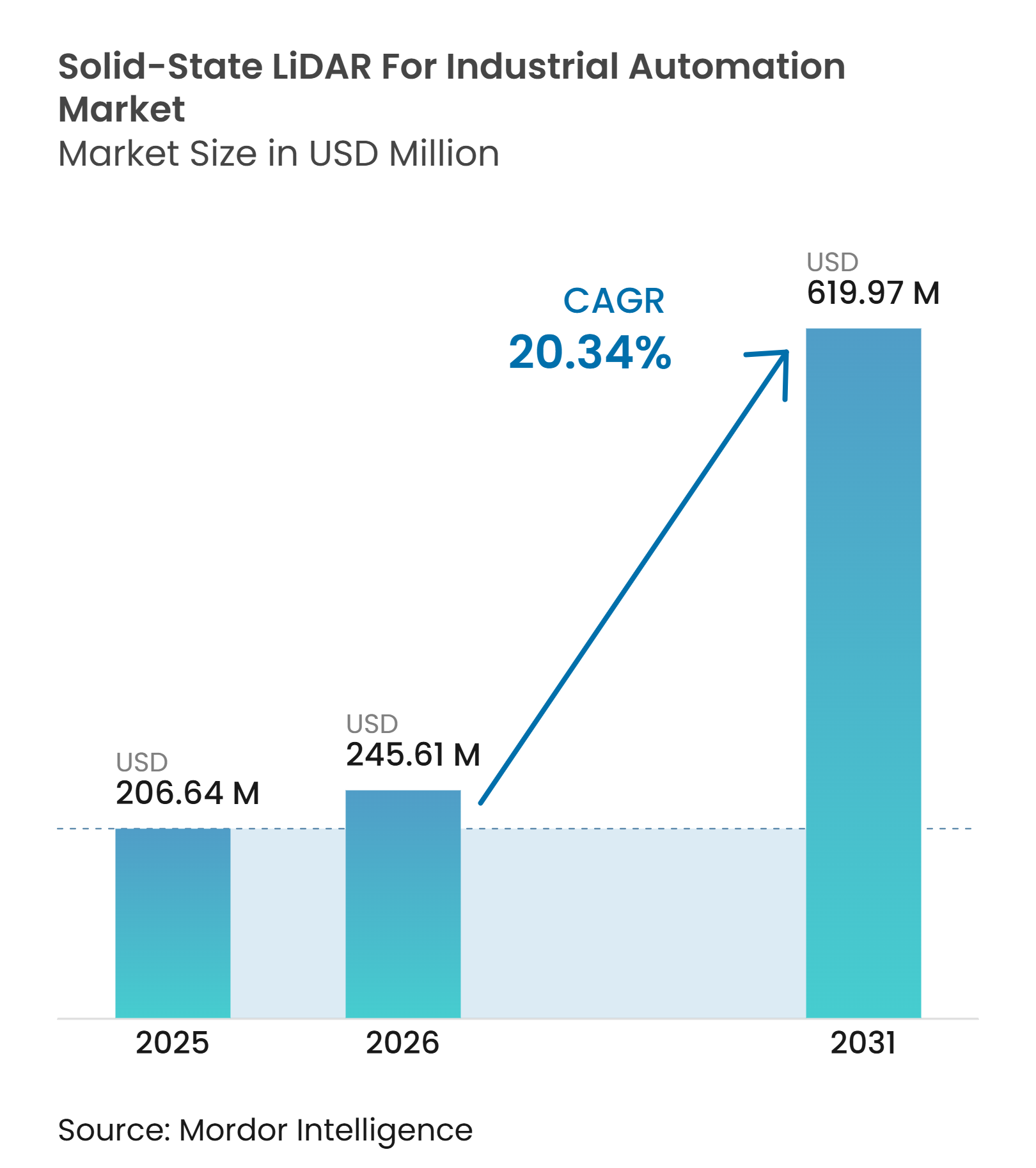
The solid-state LiDAR for industrial automation market size was valued at USD 206.64 million in 2025 and is estimated to grow from USD 245.61 million in 2026 to reach USD 619.97 million by 2031, at a CAGR of 20.34% during the forecast period (2026-2031). Demand is rising as factories, warehouses, and robotic platforms require dependable three-dimensional perception without the mechanical wear associated with spinning units. Electronic beam steering, flash illumination, and coherent photonic integration support this shift toward solid-state designs. AMRs and collaborative robots need accurate sensing for navigation, collision avoidance, and safe operation near people and equipment. Silicon photonics manufacturing is also lowering the cost and size of sensors by moving more functions onto semiconductor-compatible platforms. Suppliers are balancing high-volume production with differentiated FMCW designs that measure velocity and reduce interference in dense industrial settings.
Key Report Takeaways
- By component, Laser and Optical Source held 28.37% of solid-state LiDAR for industrial automation market share in 2025, while Signal-Processing Electronics is projected to expand at a 21.68% CAGR through 2031.
- By range, Short Range sensors held 58.42% revenue share in 2025, while Long Range sensors are projected to register a 21.91% CAGR through 2031.
- By end-user industry, Manufacturing and Industrial Facilities held 34.26% revenue share in 2025, while Robotics and Automation System Operators are projected to record a 21.83% CAGR through 2031.
- By technology architecture, MEMS-Based Solid-State LiDAR accounted for 39.58% share in 2025, while FMCW or Coherent Solid-State LiDAR is projected to grow at a 21.47% CAGR through 2031.
- By geography, Asia-Pacific held 42.73% revenue share in 2025, while the Middle East is projected to expand at a 22.76% CAGR through 2031.
Note: Market size and forecast figures in this report are generated using Mordor Intelligence’s proprietary estimation framework, updated with the latest available data and insights as of January 2026.
Market Trends and Insights
Drivers Impact Analysis of Solid-State LiDAR For Industrial Automation Market*
| Driver | (~) % Impact on CAGR Forecast | Geographic Relevance | Impact Timeline |
|---|---|---|---|
| 4D Perception Demand for Level 3 and Level 4 Autonomy | +5.2% | Global | Short term (≤ 2 years) |
| Silicon Photonics Integration Reducing Sensor Cost and Size | +4.1% | Global, with an Asia-Pacific core and spillover to North America and Europe | Medium term (2-4 years) |
| Direct Radial-Velocity Measurement Improving Collision Prediction | +3.5% | Global | Medium term (2-4 years) |
| Interference Immunity in Dense Multi-LiDAR Environments | +2.8% | Global, with Asia-Pacific manufacturing and North American and European automation hubs | Short term (≤ 2 years) |
| Productionization of FMCW LiDAR-on-Chip Platforms | +2.7% | Asia-Pacific core, with spillover to North America and Europe | Medium term (2-4 years) |
| 1550 nm Eye-Safe Power for Long-Range Perception | +2.1% | North America and Europe, with Asia-Pacific long-range applications | Long term (≥ 4 years) |
| Source: Mordor Intelligence | |||
4D Perception Demand for Level 3 and Level 4 Autonomy
The solid-state LiDAR for industrial automation market is supported by platforms moving toward Level 3 and Level 4 autonomy that need depth and velocity information for each detected object. In the solid-state LiDAR for industrial automation market, traditional time-of-flight systems measure distance but cannot provide both distance and depth measurements within a single sensing frame. RoboSense reported 282,600 robotics LiDAR shipments in the first half of 2026, which represented 510.4% year-over-year growth.[1] FMCW sensing can identify an object’s movement from the first measurement rather than by comparing its position across subsequent frames. This can shorten response time when AMRs, forklifts, and production equipment operate in the same space. RoboSense entered full-scale production of its EOCENE SPAD-SoC architecture and Peacock chipset for robotics applications in the first half of 2026.
Silicon Photonics Integration Reducing Sensor Cost and Size
The solid-state LiDAR for industrial automation market benefits when silicon photonics places laser emission, beam steering, and coherent detection on a CMOS-compatible chip. This approach uses wafer-scale manufacturing methods that can reduce sensor cost and physical size. A 2026 Nature study demonstrated a coherent 4D imaging sensor with more than 4,500 functional photonic components on one chip and centimeter-scale ranging accuracy at meter-level distances. The result shows that highly integrated coherent sensing is moving beyond small laboratory demonstrations. For the solid-state LiDAR for industrial automation market, lower-cost integration can make multi-sensor layouts more practical in factory cells where installations were previously limited by equipment budgets. MEMS sensors also benefit from batch photolithography and improved wafer yields, supporting broader use across cost-sensitive industrial sites.
Direct Radial-Velocity Measurement Improving Collision Prediction
The solid-state LiDAR for industrial automation market benefits from FMCW LiDAR, which uses the Doppler shift of returned light to measure radial velocity at each point in a scene. In the solid-state LiDAR for industrial automation market, time-of-flight systems generally need several frames to infer the same movement. A 2025 Nature Communications study found that direct velocity information can support quicker and more accurate real-time decisions in high-speed control settings. An AMR can therefore assess its own movement against a fixed rack while detecting the closing speed of an approaching forklift. Aeva introduced Eve 1V in September 2025 for manufacturing lines, using FMCW sensing to measure speed, length, and position without contact. The product demonstrates the use of direct velocity measurement in precision industrial tasks that previously relied on contact encoders and tactile devices.
Interference Immunity in Dense Multi-LiDAR Environments
The solid-state LiDAR for industrial automation market faces a deployment challenge when large AMR fleets and multi-robot cells use multiple pulsed time-of-flight sensors nearby. Such interference may create false detections and force users to separate sensor activity over time. Across the solid-state LiDAR for industrial automation market, FMCW designs use coherent detection and distinct optical frequency signatures to separate neighboring sensor signals. Voyant Photonics introduced the Helium Platform in December 2025 as a fully solid-state FMCW LiDAR platform with silicon photonics and two-dimensional on-chip beam steering. This design was developed for industrial autonomy and dense robotic environments. The approach can allow more sensors to operate in the same area without the timing constraints required by pulsed designs. That feature becomes more relevant as advanced manufacturing cells add more autonomous equipment.
Restraints Impact Analysis of Solid-State LiDAR For Industrial Automation Market*
| Restraint | (~) % Impact on CAGR Forecast | Geographic Relevance | Impact Timeline |
|---|---|---|---|
| High Coherent-Detection and Calibration Complexity | -3.2% | Global | Medium term (2-4 years) |
| Automotive Functional-Safety and Reliability Qualification Burden | -2.5% | North America and Europe | Short term (≤ 2 years) |
| Limited Volume Manufacturing of Narrow-Linewidth Lasers and PICs | -1.8% | Global, concentrated in North America and Japan | Long term (≥ 4 years) |
| Immature Ecosystem and High Sensor-System Integration Costs | -1.4% | Global, with greater relevance in the Middle East, Africa, and South America | Medium term (2-4 years) |
| Source: Mordor Intelligence | |||
High Coherent-Detection and Calibration Complexity
The solid-state LiDAR for industrial automation market faces higher production complexity because coherent FMCW systems need narrow-linewidth lasers, linear frequency chirping, and thermally stable photonic packaging. For the solid-state LiDAR for industrial automation market, these requirements remain difficult for foundries to maintain at high yield. A 2025 Nature Communications paper reported that 1% chirp nonlinearity can reduce range resolution to a degree comparable with a 5-fold increase in laser linewidth. Industrial users also need sensors that remain calibrated through vibration, thermal cycling, and dust exposure. Factory-level alignment and characterization steps add unit cost and can slow production throughput. Silicon photonics may reduce these burdens over time, but yield parity with mature MEMS manufacturing has not yet been achieved.
Automotive Functional-Safety and Reliability Qualification Burden
The solid-state LiDAR for industrial automation market requires LiDAR used in collaborative robot zones, AGV pathways, and heavy-equipment proximity sensing to meet demanding safety and reliability requirements. IEC 61508, ISO 13849, and IEC 61496-3:2025 are relevant frameworks for safety-related industrial equipment. Third-party validation in the solid-state LiDAR for industrial automation market can extend approval timelines by 12 to 18 months. This delays revenue for smaller developers, even when their technology is differentiated. Automotive qualification programs do not directly replace certification for industrial machinery, so suppliers may need parallel qualification paths. The requirement is particularly challenging for suppliers that must fund development, testing, and production readiness simultaneously.
*Our forecasts treat driver/restraint impacts as directional, not additive. The impact forecasts reflect baseline growth, mix effects, and variable interactions.
Solid-State LiDAR For Industrial Automation Market Segment Analysis
By Component:
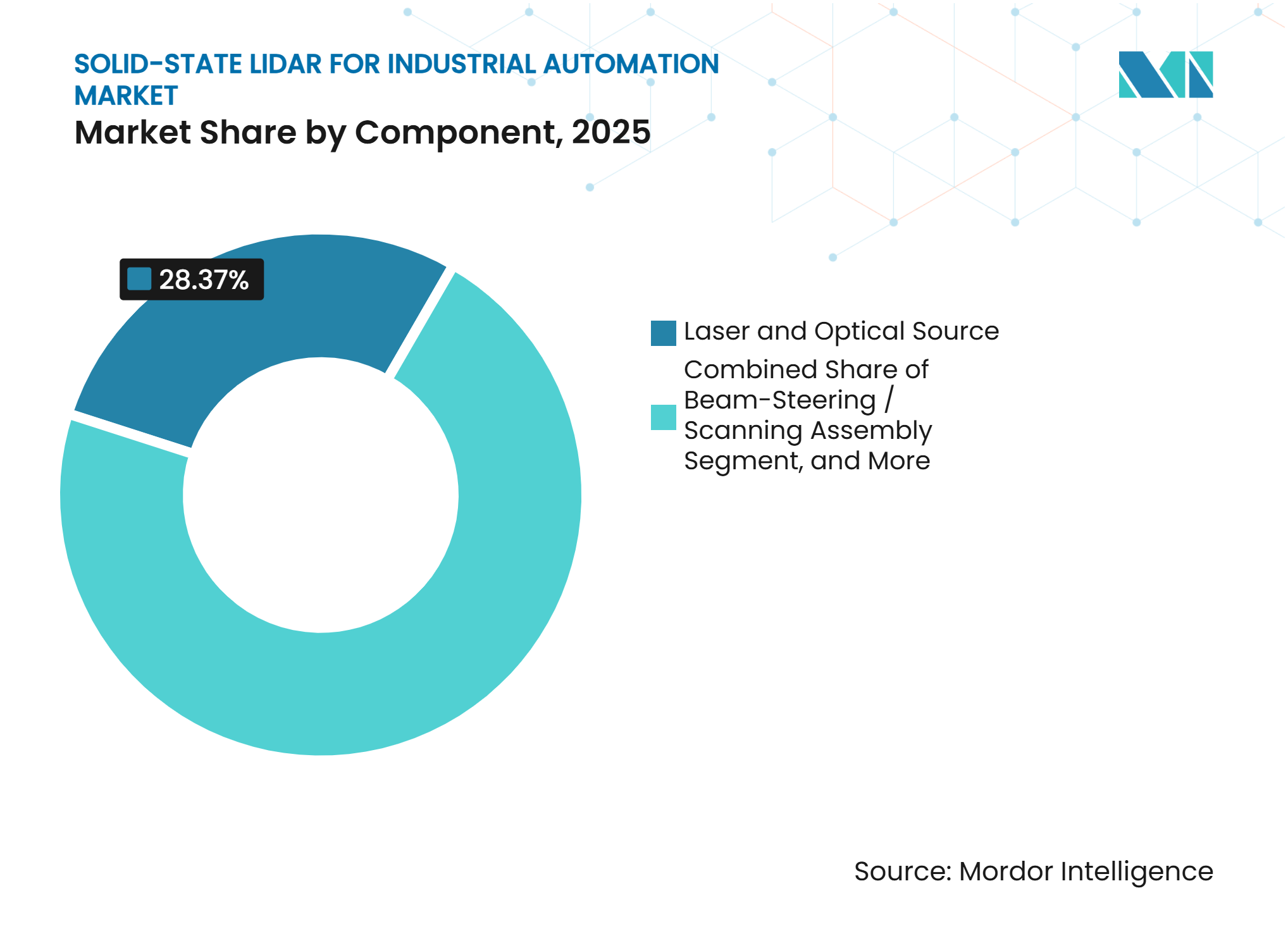
Signal-Processing Electronics Define the Next Competitive MoatLaser and Optical Source held 28.37% of the solid-state LiDAR for industrial automation market share in 2025, the largest component revenue position. The light source sets a core performance boundary for VCSEL-based MEMS designs, FMCW systems, and flash LiDAR products. Photodetector and Receiver modules provide the sensing layer, while Beam-Steering and Scanning Assembly components direct the field of view. Packaging, Optics, and Other Components complete the bill of materials and have a more standardized role. Their value depends on the durability, thermal stability, and optical performance required by each application.
Signal-Processing Electronics is projected to grow at a 21.68% CAGR from 2026 to 2031, the fastest pace among component categories. The solid-state LiDAR for industrial automation market size for this component is supported by the move from general-purpose FPGAs toward LiDAR-specific system-on-chip designs. These chips combine timing, detection, point cloud generation, and velocity extraction on a single die, reducing power consumption and data processing costs. Hesai stated that its Picasso SPAD-SoC reached mass-production readiness in 2026 and combined spatial and color perception at the ASIC level. As optical hardware becomes more standardized, proprietary processing capability can carry more sensor value.



By Range:
Short-Range Volume Anchors the Market as Long-Range ScalesThe solid-state LiDAR for industrial automation market recorded 58.42% of revenue for Short Range sensors, covering distances up to 50 m, in 2025. They support collaborative robot safety zones, AGV proximity detection, in-aisle navigation, and machine-tending safety perimeters. These uses need dense sensing and rapid updates across short distances. Medium-range products, operating above 50 m to 150 m, serve larger production bays, outdoor logistics yards, and heavy-industry applications. They balance the broader coverage required at these sites with costs lower than those of the longest-range systems.
Long-range sensors, covering distances above 150 m, are projected to grow at a 21.91% CAGR from 2026 to 2031. The solid-state LiDAR for industrial automation market size for long-range systems is tied to ports, mining sites, industrial campuses, and utilities infrastructure. Innoviz launched InnovizTwo Ultra Long-Range LiDAR in April 2026 with detection capability up to 1 kilometer.[2] These purchases follow site-infrastructure budgets rather than robot volumes, supporting higher selling prices with lower shipments. The preference for 1550 nm systems reflects their higher permissible emission power compared with 905 nm systems within laser-safety limits.
By End-User Industry:
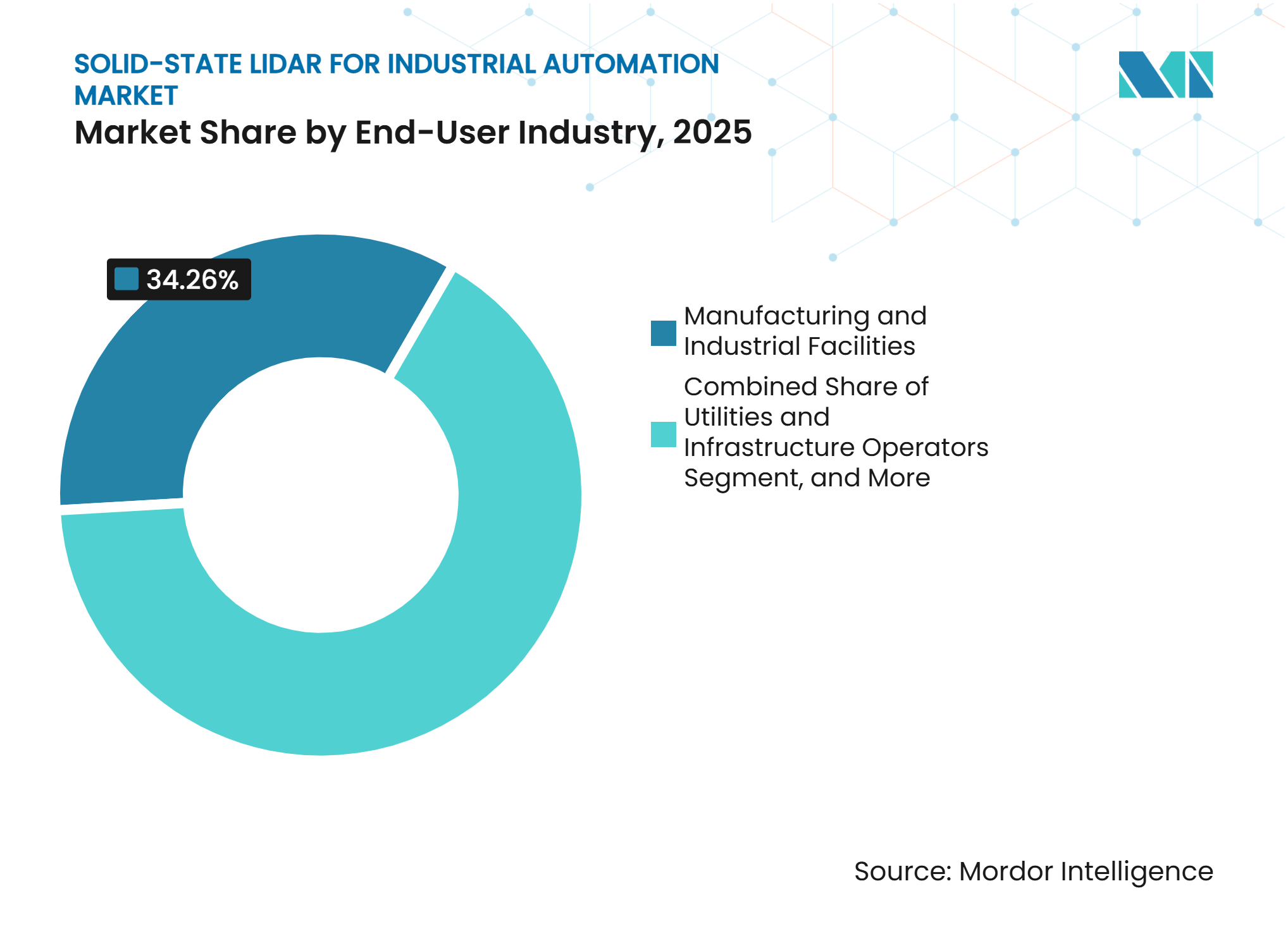
Robotics Operators Lead the Fastest Adoption PaceThe solid-state LiDAR for industrial automation market recorded a 34.26% revenue share for Manufacturing and Industrial Facilities in 2025, its largest end-user position. These facilities use LiDAR in CNC machine tending, quality inspection, assembly-line safety, and fixed material handling. Warehousing, Distribution and Logistics Facilities form another large demand base as AMR fleets expand for order picking and inventory scanning. Ouster reported USD 55 million in second-quarter 2026 revenue, up 56% year over year, and attributed the performance to warehouse automation and yard logistics customers. Process industries, utilities, infrastructure operators, research sites, and specialized industrial users add distinct demand pools.
Robotics and Automation System Operators are projected to experience the fastest end-user CAGR, at 21.83%, from 2026 to 2031. RoboSense’s 282,600 robotics LiDAR shipments in the first half of 2026 and 510.4% year-over-year increase support this adoption pace. Robotics companies increasingly specify solid-state LiDAR in platform design rather than adding it later as a retrofit. Aeva and Nikon began commercial deployment of the APDIS MV5X Laser Radar in April 2026 for robotic inspection and metrology. The deployment uses Aeva’s FMCW technology across aerospace, automotive, and energy manufacturing applications.

By Technology Architecture:
MEMS Leads Volume as FMCW Gains Functional DepthThe solid-state LiDAR for industrial automation market recorded a 39.58% revenue share for MEMS-Based Solid-State LiDAR in 2025, its largest technology revenue position. MEMS has a mature production base and works with established 905 nm VCSEL supply chains. It remains cost-effective at industrial production volumes that FMCW and OPA alternatives have not consistently reached. Flash or Non-Scanning Solid-State LiDAR is well-suited for high-speed inspection and close-range safety coverage, where frame rate matters more than range. OPA LiDAR offers angular agility and high integration potential, but insertion loss and calibration limit its current industrial use.
FMCW or Coherent Solid-State LiDAR is projected to grow at a 21.47% CAGR from 2026 to 2031. The technology benefits from chip-scale silicon photonics and its ability to measure velocity directly. Nature documented a coherent 4D imaging sensor in 2026 that used more than 4,500 integrated photonic components and achieved centimeter-scale range precision at meter-level distances. MEMS should remain important for close-range and cost-sensitive applications, while FMCW is better positioned in precision measurement and long-range monitoring. RoboSense placed its Peacock chipset into full-scale production during the first half of 2026 with a 180° × 135° field of view and VGA-level 640 × 480 resolution.
Geography Analysis
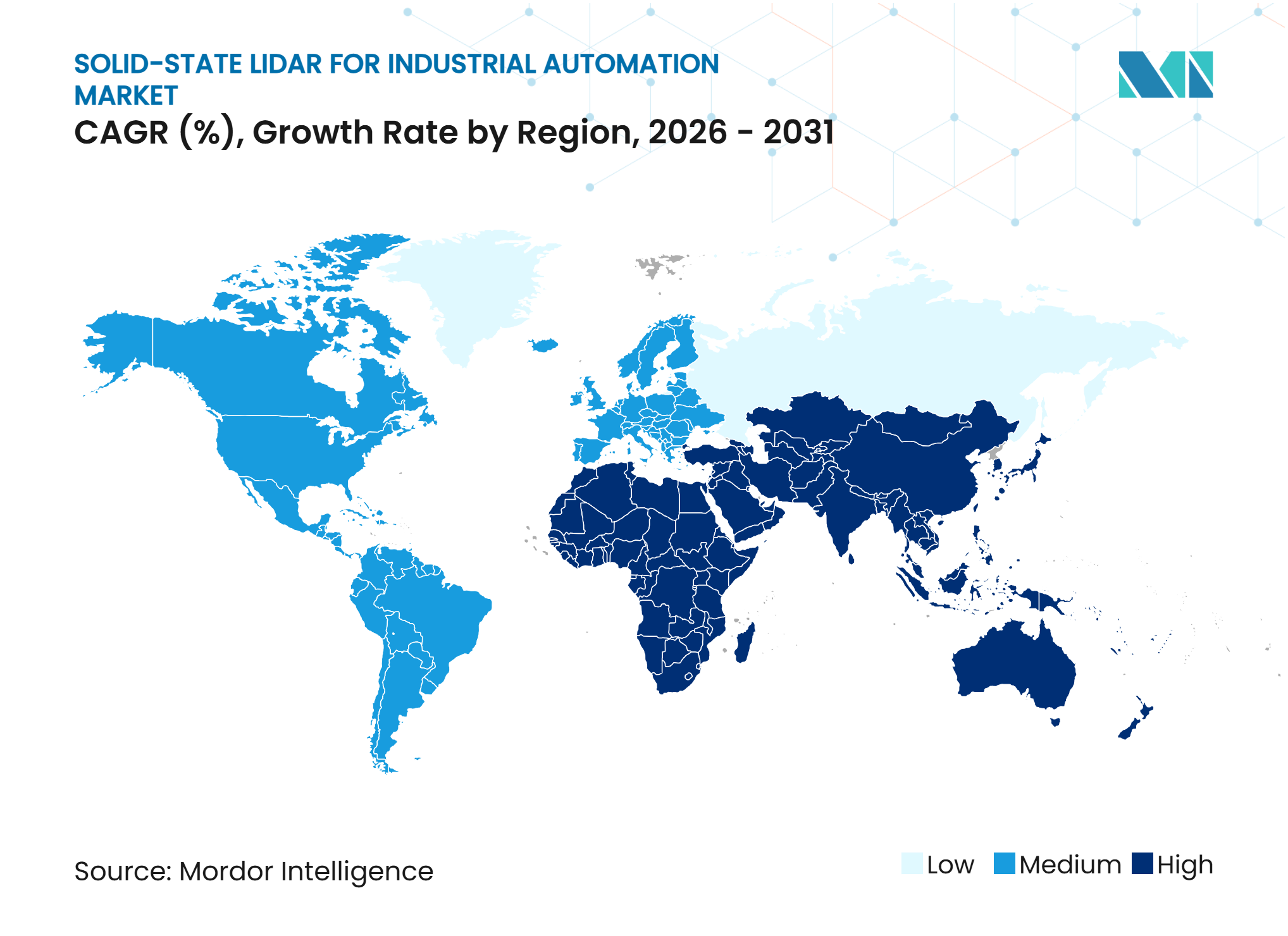
Asia-Pacific accounted for 42.73% of the solid-state LiDAR market share in the industrial automation market in 2025. China combines a large LiDAR manufacturing base with demand from automotive, industrial robotics, and warehousing applications. Japan has a strong precision-robotics and industrial-equipment base, while South Korea supports electronics-led factory automation. Hesai shipped more than 1.62 million units in fiscal year 2025 and reported RMB 3,027.6 million (USD 432.9 million) in revenue.[3] Nikon’s 2026 APDIS MV5X deployment shows the use of solid-state LiDAR in Japanese machine-level inspection products.
North America has an active base of FMCW and OPA developers, including Aeva, Voyant Photonics, and SiLC Technologies. AMR installations in fulfillment centers and automotive assembly facilities also support regional demand. Aeva planned an annual North American capacity of up to 200,000 4D LiDAR units for autonomous trucking programs. Europe has demand from German advanced manufacturing and logistics, process industry, and defense-related sensing applications, where buyers require clear safety and performance standards before large deployments. South America remains smaller, but mining automation and port logistics in Brazil and Chile create use cases for durable outdoor sensing.
The Middle East is projected to grow at a 22.76% CAGR from 2026 to 2031, the fastest geographic pace in the solid-state LiDAR for industrial automation market. Saudi Arabia’s Vision 2030 programs and UAE smart-infrastructure initiatives are creating greenfield projects that can specify solid-state sensors at inception rather than replace older equipment. Africa is at an earlier stage, with activity centered on mining fleet automation and port-terminal operations in South Africa and Egypt. Industrial diversification programs could support future demand from process industries, logistics hubs, and utilities.
Competitive Landscape
Market Concentration
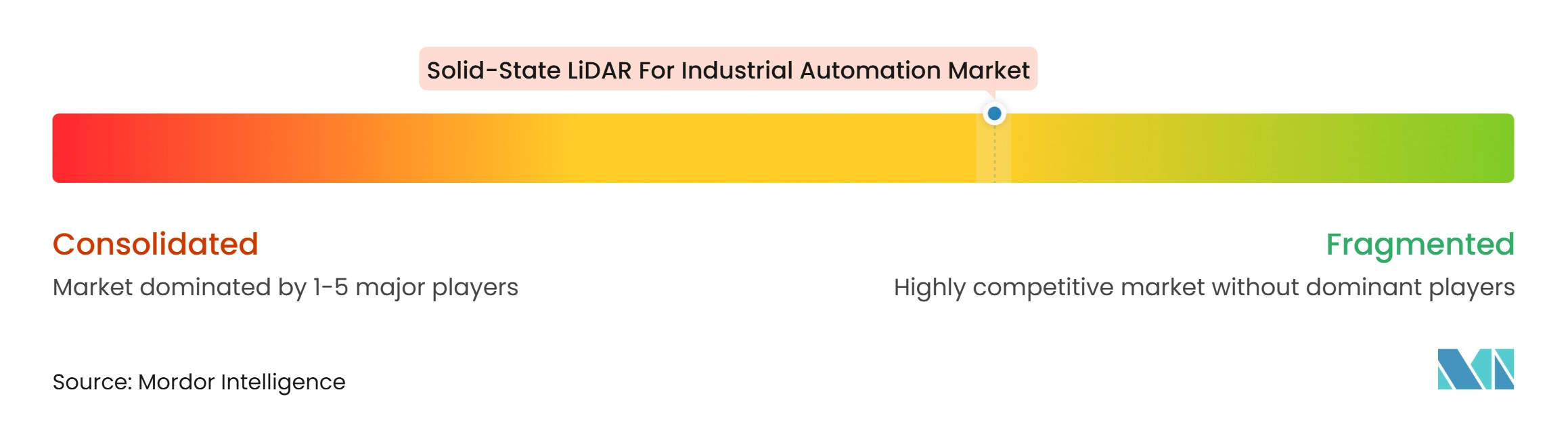
The solid-state LiDAR for industrial automation market is semi-fragmented, with no single supplier reported to hold more than 25% of total revenue. Chinese manufacturers have a production-volume advantage through vertically integrated supply chains and proprietary sensor silicon. Hesai reported its first full-year GAAP profit in 2025, generating RMB 3,027.6 million (USD 432.9 million) in annual revenue. Hesai announced plans in January 2026 to raise annual LiDAR capacity from 2 million to more than 4 million units.
Western suppliers are pursuing FMCW and silicon-photonics designs rather than competing only on shipment volume. Aeva has focused on direct velocity measurement for manufacturing, inspection, and autonomous vehicle applications. It's the April 2026 deployment with Nikon that put FMCW technology into a commercial robotic inspection and metrology system. Voyant Photonics introduced the Helium platform in December 2025 with silicon photonics and two-dimensional on-chip beam steering. These designs are suited to applications where direct velocity data, interference resistance, and compact integration take precedence over the lowest unit cost.
Patent ownership and technology partnerships also shape competition. Hesai acquired Swiss intellectual property in 2024 to support development of its solid-state FTX platform.[4] Suppliers are working toward consistent sensor data interfaces to reduce integration effort in multi-vendor installations. Voyant Photonics, SiLC Technologies, and Baraja are pursuing single-PIC architectures that aim to lower manufacturing cost at scale. Industrial safety qualification remains an important competitive requirement.
Solid-State LiDAR For Industrial Automation Industry Leaders
-
Hesai Technology Co., Ltd.
-
RoboSense Technology Co., Ltd.
-
Ouster, Inc.
-
Innoviz Technologies Ltd.
-
Aeva Technologies, Inc.
- *Disclaimer: Major Players sorted in no particular order
Solid-State LiDAR For Industrial Automation Market Companies Covered in this Report
- Hesai Technology Co., Ltd.
- RoboSense Technology Co., Ltd.
- Ouster, Inc.
- Innoviz Technologies Ltd.
- Aeva Technologies, Inc.
- Luminar Technologies, Inc.
- Cepton, Inc.
- LeddarTech Inc.
- MicroVision, Inc.
- Blickfeld GmbH
- XenomatiX N.V.
- OPSYS Tech Ltd.
- Voyant Photonics, Inc.
- SSLiDAR Inc.
- Seyond, Inc.
- Leishen Intelligent System Co., Ltd.
- Livox Technology Limited
- Benewake (Beijing) Co., Ltd.
- Baraja Pty Ltd.
- SiLC Technologies, Inc.
- TetraVue, Inc.
- Hybrid Lidar Systems
Recent Industry Developments in Solid-State LiDAR For Industrial Automation Market
- August 2026: Innoviz Technologies announced a development agreement with a top 10 global automotive OEM to build a complete LiDAR-based perception stack for a highway operational design domain, using InnovizTwo sensors on an NVIDIA-powered compute platform. The collaboration reflects the broadening of automotive-grade solid-state LiDAR into Physical AI and industrial autonomy applications.
- April 2026: Aeva Technologies and Nikon Metrology announced commercial deployment of the APDIS MV5X Laser Radar system, powered by Aeva’s Eve FMCW high-precision sensor technology, for high-volume automated robotic inspection and metrology across aerospace, automotive, and energy manufacturing applications.
- April 2026: Innoviz Technologies launched the InnovizTwo Ultra Long-Range LiDAR, with detection up to 1 kilometer, targeting large-area industrial automation, border monitoring, and wide-format infrastructure sensing. First samples were delivered to select customers at launch.
- January 2026: Hesai Technology announced plans to double annual LiDAR production capacity from 2 million to over 4 million units in 2026, driven by accelerating demand from robotics and ADAS applications, following the company’s milestone of surpassing 2 million cumulative deliveries in fiscal year 2025.
Global Solid-State LiDAR For Industrial Automation Market Report Scope
The solid-state LiDAR for industrial automation market refers to LiDAR systems that use solid-state technology rather than moving mechanical components to support automation applications across industrial environments. These systems enable accurate distance measurement, object detection, mapping, navigation, and safety monitoring for applications such as autonomous mobile robots, automated guided vehicles, robotic systems, and smart manufacturing operations.
The Solid-State LiDAR for Industrial Automation Market Report is Segmented by Component (Laser and Optical Source, Photodetector and Receiver, Beam-Steering/Scanning Assembly, Signal-Processing Electronics, and Packaging, Optics, and Other Components), Range (Up to 50 m, Above 50 m to 150 m, and Above 150 m), End-User Industry (Manufacturing and Industrial Facilities, Warehousing, Distribution and Logistics Facilities, Process Industries and Heavy Industrial Facilities, Utilities and Infrastructure Operators, Robotics and Automation System Operators, Research, Testing and Specialized Industrial Facilities, and Other End-User Industries), Technology Architecture (Flash/Non-Scanning Solid-State LiDAR, Optical Phased Array LiDAR, MEMS-Based Solid-State LiDAR, and FMCW/Coherent Solid-State LiDAR), and Geography (North America, South America, Europe, Asia-Pacific, Middle East, and Africa). The Market Forecasts are Provided in Terms of Value (USD).
Segmentation Overview
| Laser and Optical Source |
| Photodetector and Receiver |
| Beam-Steering / Scanning Assembly |
| Signal-Processing Electronics |
| Packaging, Optics and Other Components |
| Up to 50 m |
| Above 50 m to 150 m |
| Above 150 m |
| Manufacturing and Industrial Facilities |
| Warehousing, Distribution and Logistics Facilities |
| Process Industries and Heavy Industrial Facilities |
| Utilities and Infrastructure Operators |
| Robotics and Automation System Operators |
| Research, Testing and Specialized Industrial Facilities |
| Other End-User Industries |
| Flash / Non-Scanning Solid-State LiDAR |
| Optical Phased Array (OPA) LiDAR |
| MEMS-Based Solid-State LiDAR |
| FMCW / Coherent Solid-State LiDAR |
| North America | United States |
| Canada | |
| Mexico | |
| South America | Brazil |
| Argentina | |
| Chile | |
| Rest of South America | |
| Europe | Germany |
| United Kingdom | |
| France | |
| Italy | |
| Spain | |
| Rest of Europe | |
| Asia-Pacific | China |
| Japan | |
| India | |
| South Korea | |
| Australia | |
| Rest of Asia-Pacific | |
| Middle East | United Arab Emirates |
| Saudi Arabia | |
| Turkey | |
| Rest of Middle East | |
| Africa | South Africa |
| Egypt | |
| Rest of Africa |
| By Component | Laser and Optical Source | |
| Photodetector and Receiver | ||
| Beam-Steering / Scanning Assembly | ||
| Signal-Processing Electronics | ||
| Packaging, Optics and Other Components | ||
| By Range | Up to 50 m | |
| Above 50 m to 150 m | ||
| Above 150 m | ||
| By End-User Industry | Manufacturing and Industrial Facilities | |
| Warehousing, Distribution and Logistics Facilities | ||
| Process Industries and Heavy Industrial Facilities | ||
| Utilities and Infrastructure Operators | ||
| Robotics and Automation System Operators | ||
| Research, Testing and Specialized Industrial Facilities | ||
| Other End-User Industries | ||
| By Technology Architecture | Flash / Non-Scanning Solid-State LiDAR | |
| Optical Phased Array (OPA) LiDAR | ||
| MEMS-Based Solid-State LiDAR | ||
| FMCW / Coherent Solid-State LiDAR | ||
| By Geography | North America | United States |
| Canada | ||
| Mexico | ||
| South America | Brazil | |
| Argentina | ||
| Chile | ||
| Rest of South America | ||
| Europe | Germany | |
| United Kingdom | ||
| France | ||
| Italy | ||
| Spain | ||
| Rest of Europe | ||
| Asia-Pacific | China | |
| Japan | ||
| India | ||
| South Korea | ||
| Australia | ||
| Rest of Asia-Pacific | ||
| Middle East | United Arab Emirates | |
| Saudi Arabia | ||
| Turkey | ||
| Rest of Middle East | ||
| Africa | South Africa | |
| Egypt | ||
| Rest of Africa | ||
Key Questions Answered in the Report
What is the size of the solid-state LiDAR for industrial automation market?
The market is estimated at USD 245.61 million in 2026 and is forecast to reach USD 619.97 million by 2031, growing at a 20.34% CAGR.
What is driving adoption of solid-state LiDAR in industrial automation?
Demand comes from AMRs, collaborative robots, warehouse operations, inspection systems, and safety-focused industrial applications that need reliable three-dimensional sensing.
Which LiDAR range category has the largest revenue share?
Up to 50 m held 58.42% of revenue in 2025 because they support close-proximity navigation, safety, and robotic-cell applications.
Which end-user group is expected to grow fastest through 2031?
Robotics and Automation System Operators are projected to grow at a 21.83% CAGR, supported by increased platform-level use of LiDAR in autonomous equipment.
Which technology architecture leads current adoption?
MEMS-Based Solid-State LiDAR held 39.58% share in 2025, supported by established production processes and cost-effective performance for close-range applications.
Which region is expected to expand the fastest?
The Middle East is projected to grow at a 22.76% CAGR through 2031, supported by greenfield industrial modernization and smart-infrastructure programs.