
Solid State Hydrogen Storage Materials Market Size and Share
Market Overview
| Study Period | 2021 - 2031 |
|---|---|
| Market Size (2026) | USD 1.60 Billion |
| Market Size (2031) | USD 2.77 Billion |
| Growth Rate (2026 - 2031) | 11.67 % |
| Fastest Growing Market | Asia-Pacific |
| Largest Market | Asia-Pacific |
| Market Concentration | Low |
Major Players *Disclaimer: Major Players sorted in no particular order Image © Mordor Intelligence. Reuse requires attribution under CC BY 4.0. | |
Solid State Hydrogen Storage Materials Market Analysis by Mordor Intelligence
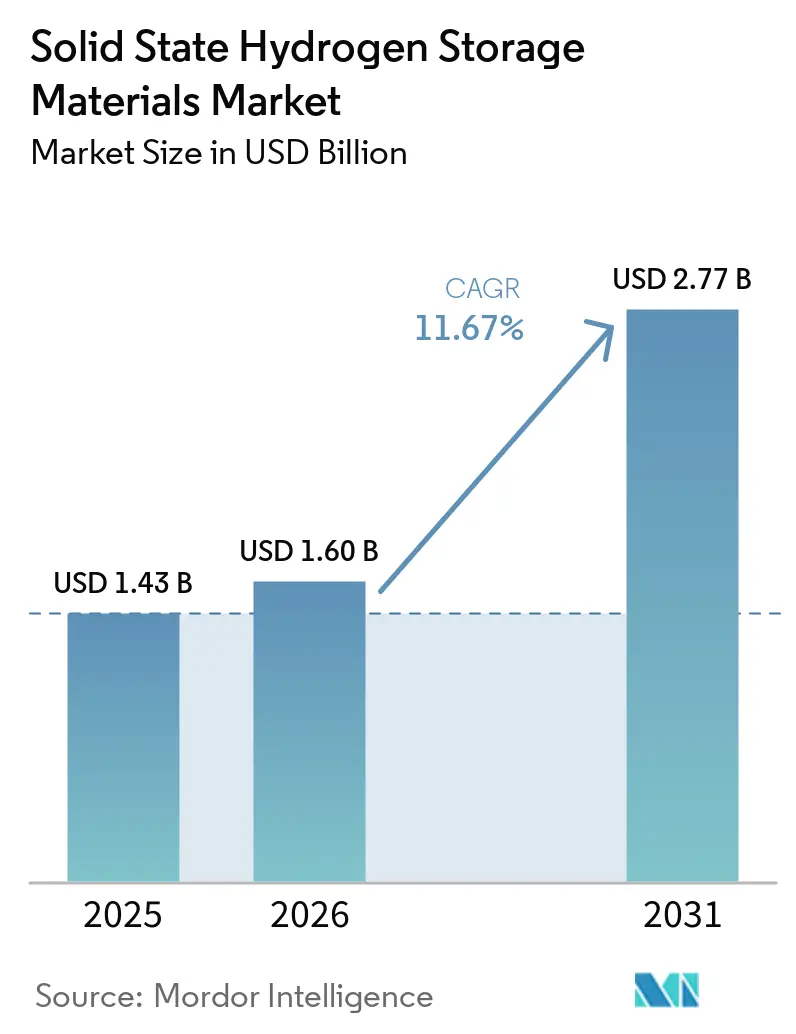
The Solid State Hydrogen Storage Materials Market size was valued at USD 1.43 billion in 2025 and is estimated to grow from USD 1.60 billion in 2026 to reach USD 2.77 billion by 2031, at a CAGR of 11.67% during the forecast period (2026-2031). The solid state hydrogen storage materials market is supported by investment in low-emissions hydrogen projects, which reached nearly USD 7 billion in 2025. Storage materials can support compact hydrogen handling at production sites, delivery nodes, and end-use facilities as these projects move toward construction. New reactive hydride composites can release hydrogen below 393 K, which brings low-grade industrial waste heat into the usable range for desorption. The solid state hydrogen storage materials market also benefits from demand in commercial trucking and stationary energy storage, which creates demand beyond passenger fuel-cell vehicles. Japan's established alloy manufacturing base and China's commercialization programs have supported the Asia-Pacific's regional leadership, while suppliers are seeking value through integrated containers and application-specific systems, and policy changes in the United States create a more uncertain project environment for suppliers with concentrated exposure to that country.
Key Report Takeaways
- By material type, metal hydrides held 38.53% of the solid state hydrogen storage materials market share in 2025 and are projected to advance at a 12.76% CAGR through 2031.
- By storage mechanism, absorption held 61.24% of the solid state hydrogen storage materials market share in 2025, while adsorption is projected to advance at a 12.23% CAGR through 2031.
- By application, automotive held 44.75% of the solid state hydrogen storage materials market share in 2025 and is projected to advance at a 13.87% CAGR through 2031.
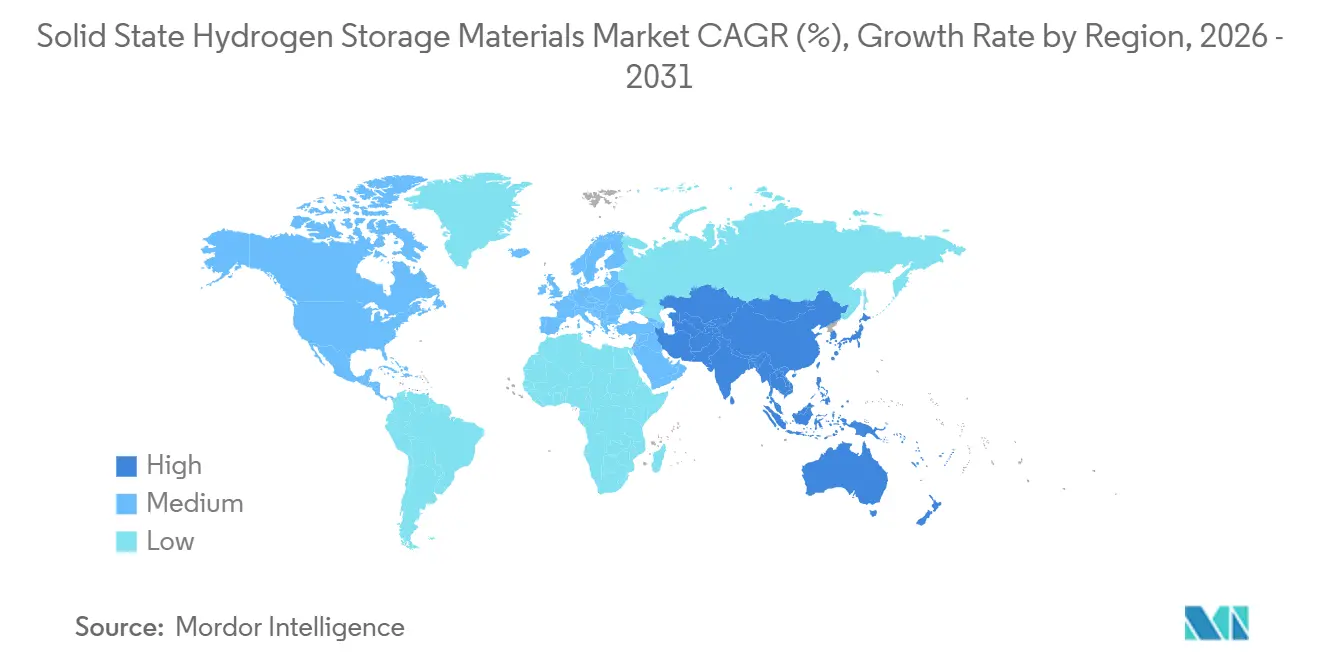
- By geography, Asia-Pacific held 32.81% of the solid state hydrogen storage materials market share in 2025 and is projected to advance at a 13.34% CAGR through 2031.
Note: Market size and forecast figures in this report are generated using Mordor Intelligence’s proprietary estimation framework, updated with the latest available data and insights as of January 2026.
Market Trends and Insights
Drivers Impact Analysis of Solid State Hydrogen Storage Materials Market*
| Driver | (~) % Impact on CAGR Forecast | Geographic Relevance | Impact Timeline |
|---|---|---|---|
| Hydrogen Infrastructure Investment | +3.2% | Global, with China, the EU, and GCC | Medium term (2-4 years) |
| Fuel-Cell Vehicle and Heavy-Duty Mobility Deployment | +2.8% | Asia-Pacific core, spillover to EU and North America | Medium term (2-4 years) |
| Long-Duration Renewable-Energy Storage Demand | +2.1% | Global, with early concentrated deployments in the EU, Japan, and South Korea | Long term (≥ 4 years) |
| Government Hydrogen Incentives and Decarbonization Mandates | +1.7% | North America, EU, Japan, South Korea, Middle-East | Short term (≤ 2 years) |
| Waste-Heat Integration in Metal-Hydride Systems | +1.0% | Japan, EU, South Korea | Long term (≥ 4 years) |
| Source: Mordor Intelligence | |||
Hydrogen Infrastructure Investment
Capital spending on low-emissions hydrogen projects reached nearly USD 7 billion in 2025. Electrolysis accounted for nearly 70% of this 2026 investment, and it overtook carbon-capture-based hydrogen investment for the first time. More than 85% of investment in 2026 targets existing hydrogen demand in industry and refineries, which supports near-term demand for stationary metal hydride units and creates a defined initial customer base at sites where hydrogen is already used as an industrial feedstock. The U.S. Department of Energy found that metal hydride systems can require up to 65% less land than 170-bar compressed-gas storage, which can aid integration at delivery nodes and constrained industrial sites[1]. The solid state hydrogen storage materials market can gain from direct storage procurement and from operators’ need to reduce the footprint of hydrogen infrastructure.
Fuel-Cell Vehicle and Heavy-Duty Mobility Deployment
Commercial trucking expands the addressable demand base beyond light-duty vehicles within the solid state hydrogen storage materials market. Switzerland reported 1,600 fuel-cell trucks in operation by 2025, and the H2Accelerate TRUCKS program deployed 125 heavy-duty fuel-cell trucks across 6 European Union member states. A next-generation station in that program targets hydrogen dispensing capacity above 1,000 kg per day. Compressed-gas tanks need 200-300 kg of carbon-fiber reinforcement per vehicle, which can reduce payload capacity. Vanadium-titanium alloys achieved more than 2 weight percent (wt%) reversible hydrogen capacity at near-ambient temperatures and pressures, supporting their suitability for onboard storage. Japan and South Korea remain important fuel-cell electric vehicle markets, while European freight operators are shaping requirements for higher-throughput systems.
Long-Duration Renewable-Energy Storage Demand
Long-duration renewable-energy storage provides a demand path that is not dependent on automotive programs. The U.S. Department of Energy found that TiFe-based metal hydride configurations delivered storage costs of USD 0.45/kWh, while complex metal hydride systems reached USD 0.38/kWh. These systems were cost-competitive with 350-bar compressed-gas storage in the analysis and used less physical space in suitable configurations. Longer charging durations and more operating cycles can reduce the levelized cost of metal hydride systems, particularly where asset use can be spread across many cycles. Carbon-based adsorption materials are complementary candidates for seasonal storage because they can support near-ambient-temperature operation. The solid state hydrogen storage materials market can, therefore, serve grid applications with multi-hour discharge needs that differ from vehicle duty cycles.
Government Hydrogen Incentives and Decarbonization Mandates
Government frameworks in Asia, Europe, and the Gulf Cooperation Council support demand for hydrogen storage technologies. Japan’s Hydrogen Basic Strategy identifies solid-state hydrogen storage materials as a priority technology for the 2050 carbon-neutrality target. In June 2025, Ontario’s Order in Council 1022/2025 directed the Independent Electricity System Operator to develop a program for low-carbon hydrogen technologies across electricity supply, capacity, and storage. This direction can support stationary storage procurement from 2026 through 2028. ISO 14687 hydrogen fuel-quality standards and emerging alloy-performance specifications can favor producers with established certification capabilities. The U.S. construction deadline of December 31, 2027, for the revised Section 45V credit supports near-term activity but adds risk to longer-horizon supply commitments.
Restraints Impact Analysis of Solid State Hydrogen Storage Materials Market*
| Restraint | (~) % Impact on CAGR Forecast | Geographic Relevance | Impact Timeline |
|---|---|---|---|
| High Material and System-Integration Costs | -2.4% | Global; most acute in North America and Europe | Medium term (2-4 years) |
| Slow Absorption and Desorption Kinetics | -1.8% | Global | Long term (≥ 4 years) |
| Thermal-Management and Heat-Rejection Complexity | -1.3% | Global; most acute in Middle-East, South Asia, and Southeast Asia | Long term (≥ 4 years) |
| Source: Mordor Intelligence | |||
High Material and System-Integration Costs
High material and system-integration costs remain a commercialization barrier for the solid state hydrogen storage materials market. Rare-earth elements in AB5 alloys, particularly lanthanum, face supply-concentration risk because China has substantial processing capacity. The U.S. Department of Energy identified USD 10/kg as the metal hydride production-cost threshold for broad commercial competitiveness. Heat exchangers, pressure-regulation hardware, safety enclosures, and thermal-management assemblies can cost more than raw materials in small and medium installations, which limits distributed deployments and makes the purchase decision sensitive to local system requirements. In May 2025, the Korea Institute of Materials Science developed a magnesium-nickel-tin alloy intended to reduce manufacturing costs and energy use. New alloy compositions usually need 3-5 years of process scale-up before they can reach commercial cost parity.
Slow Absorption and Desorption Kinetics
Slow hydrogen uptake and release remain a technical barrier in high-throughput uses. Traditional AB5-type alloys have comparatively good kinetics but limited gravimetric capacity. Magnesium-based materials provide higher capacity but release hydrogen too slowly under near-ambient conditions for many mobility uses. This limitation also affects fast-response grid balancing and portable power systems with changing discharge profiles, reducing the use cases available to the solid state hydrogen storage materials market. In July 2025, RIKEN reported that mechanochemical hydrogen insertion into perovskite lattice structures at room temperature improved kinetics without high-temperature or high-pressure processing. Broad commercial resolution across operating temperatures and discharge rates is unlikely before 2028-2030.
*Our forecasts treat driver/restraint impacts as directional, not additive. The impact forecasts reflect baseline growth, mix effects, and variable interactions.
Solid State Hydrogen Storage Materials Market Segment Analysis
By Material Type:
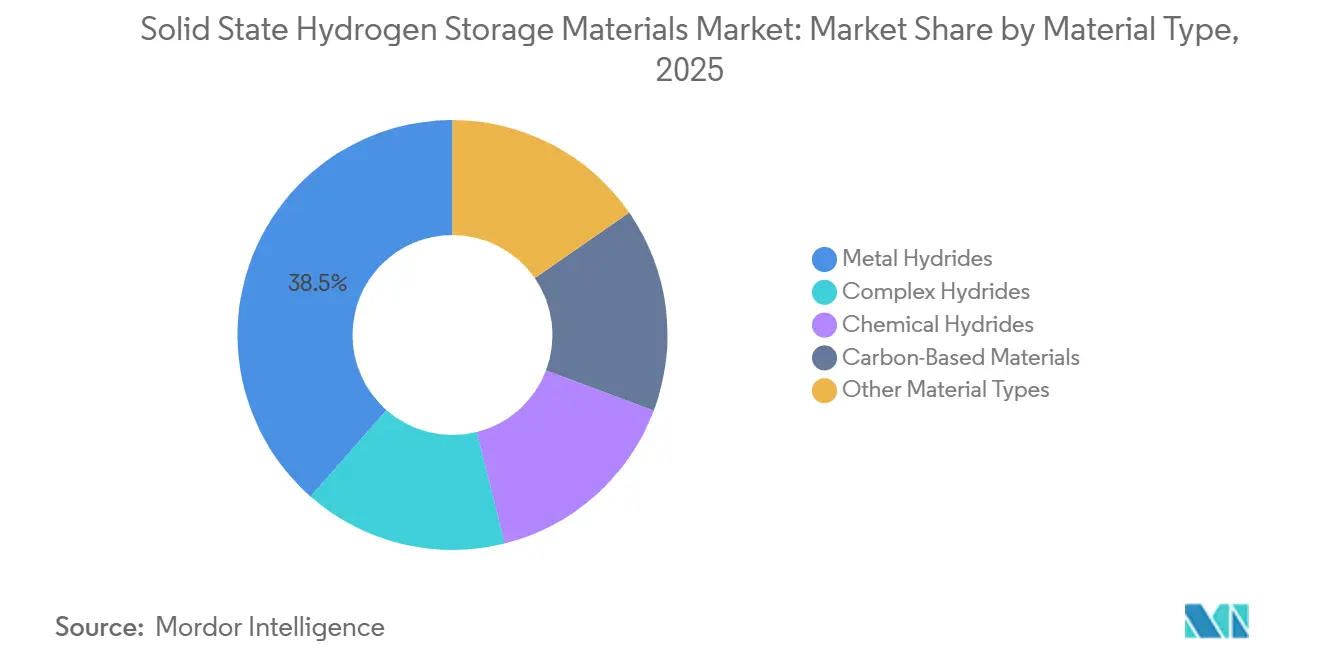
Metal Hydrides Lead Through Established System CompatibilityMetal hydrides held 38.53% of the solid state hydrogen storage materials market in 2025 and are projected to advance at a 12.76% CAGR through 2031. Their position reflected high volumetric energy density and compatibility with fuel-cell systems in automotive, stationary power, and maritime uses. In July 2025, FDK developed a high-capacity AB2-type hydrogen-absorbing alloy with 20% higher gravimetric capacity than incumbent AB5-type materials. FDK began sample supply to selected customers in July 2025 and planned mass-production shipments from October 2025. Higher capacity reduces the alloy mass required per storage unit, which matters in weight-sensitive automotive and aerospace installations.
Complex hydrides can provide reversible hydrogen release below 393 K, enabling operation with fuel-cell waste heat. Chemical hydrides serve specialized systems where regeneration is possible, including military and aerospace uses. Carbon-based materials are gaining traction in adsorption applications, with graphene composites and activated-carbon systems reaching 7-10 weight percent (wt%) storage capacity under controlled conditions. H2MOF applies reticular materials to unmanned aerial vehicle hydrogen storage. The solid state hydrogen storage materials market is moving toward material selection based on temperature range, discharge rate, and total cost of ownership.

By Storage Mechanism:
Absorption Leads Current Deployments While Adsorption ExpandsAbsorption held 61.24% of the solid state hydrogen storage materials market in 2025. The mechanism is established in safety-critical uses, including hospital backup power, maritime transport, and fuel-cell fleets. Reversible hydrogen bonding within a metal lattice moderates pressure and can reduce explosion risk compared with compressed storage. In February 2026, Hydrexia completed a regional maritime shipment using magnesium-based MHX absorption containers across Asian seaports. Complex hydride absorption systems are also moving toward stationary grid applications, where high volumetric density and hydrogen retention are useful to the solid state hydrogen storage materials market.
Adsorption is projected to advance at a 12.23% CAGR through 2031. Porous materials, including activated carbons, metal-organic frameworks, and zeolites, use weak physical interactions to retain hydrogen. This approach can support faster charge-discharge cycling and lower-energy activation than absorption-based systems. Aerospace and uncrewed aerial vehicle uses value the lower weight that can result from eliminating thermal-management hardware. H2MOF is deploying nanoengineered reticular-material storage systems for unmanned aerial vehicle platforms. Other storage mechanisms, which include chemical carrier-based approaches, remain pre-commercial within the solid state hydrogen storage materials market.
By Application:
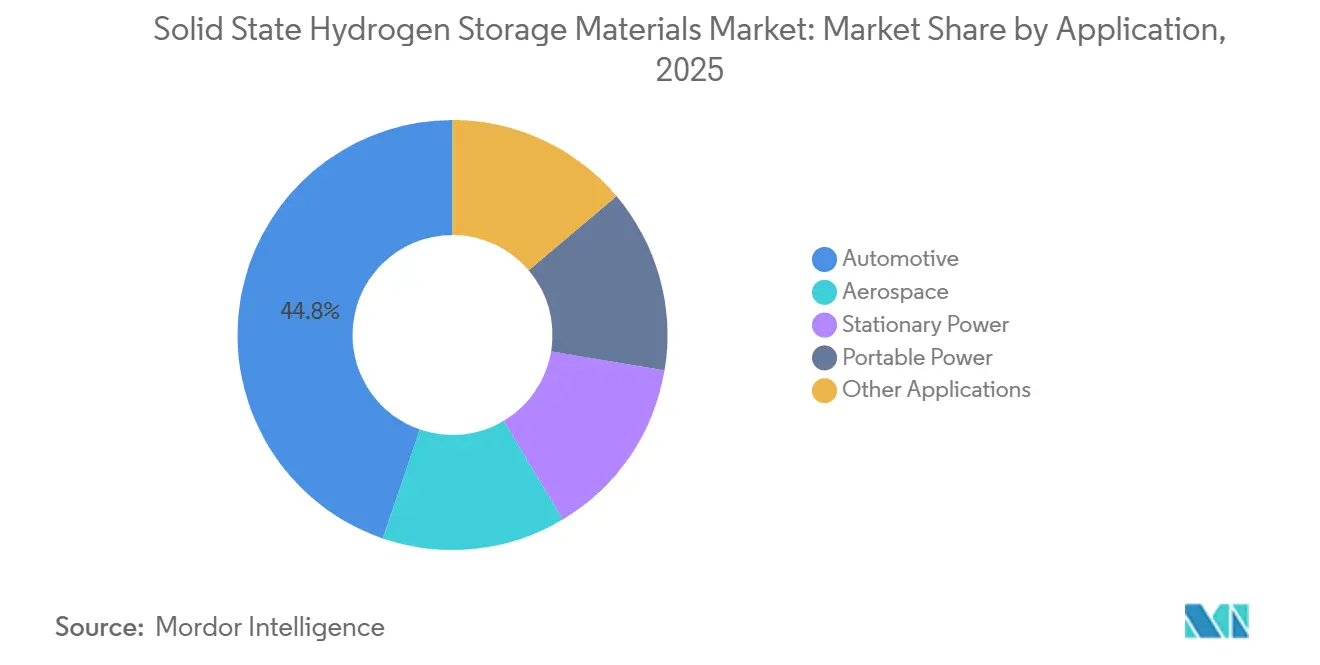
Automotive Leads Both Market Share and GrowthAutomotive held 44.75% of the solid state hydrogen storage materials market in 2025 and is projected to advance at a 13.87% CAGR through 2031. Demand is concentrated in Japan, South Korea, and China, which account for much of the global fuel-cell electric vehicle fleet. Passenger fuel-cell electric vehicle programs require metal hydride alloys, while commercial trucks can benefit from high-density solid-state storage. A 2026 review examined storage developments in Toyota Mirai, Hyundai NEXO, BMW iX5 Hydrogen, and Honda CR-V e:Fuel Cell Electric Vehicle (FCEV) platforms. The review showed continuing work on vanadium-based alloys for onboard storage.
Stationary power can receive greater procurement attention after 2027 as long-duration energy-storage tenders include hydrogen options. The U.S. Department of Energy assessment of metal hydride systems at USD 0.38-0.45/kWh provides an economic reference for procurement decisions. LAVO has demonstrated a metal hydride off-grid energy-storage system in Australia and is expanding into Japan and Southeast Asian island communities that rely on diesel generators. Aerospace demand also includes solid-state storage for unmanned aerial vehicles and regional aviation. In June 2025, StellarJet unveiled a metal hydride hydrogen-storage unit developed from space applications, illustrating the broader application range available to the solid state hydrogen storage materials market.
Geography Analysis
APAC Solid State Hydrogen Storage Materials Market
Asia-Pacific held 32.81% of the solid state hydrogen storage materials market share in 2025 and is projected to advance at a 13.34% CAGR through 2031. State-backed programs support downstream storage commercialization in China. Japan contributes to alloy manufacturing and system research through companies including FDK, SANTOKU CORPORATION, and Mitsui Kinzoku Co., Ltd. In May 2025, the Korea Institute of Materials Science (KIMS) developed a magnesium-nickel-tin alloy intended for safe hydrogen storage and transport without high-pressure vessels or cryogenic equipment, reinforcing the region’s role in materials development.
Europe and North America Solid State Hydrogen Storage Materials Market
India is at an early stage and can create downstream storage demand as hydrogen infrastructure matures, with its National Green Hydrogen Mission targeting 5 million metric tons of green hydrogen production per year by 2030[2]. Europe’s role centers on pipeline infrastructure and circular materials sourcing. The REMEDHYS project began in January 2025 to develop solid-state storage from recycled European metals and validate the materials with a 2 MW proton exchange membrane electrolyzer. North America has more policy uncertainty, but California allocated USD 15 million for hydrogen refueling infrastructure in August 2026 within a USD 95.2 million Clean Transportation Program.
MEA and South America Solid State Hydrogen Storage Materials Market
South America, and Middle-East and Africa markets are smaller but relevant to suppliers focused on distributed and off-grid uses. LAVO has operations in Saudi Arabia and South Africa for data-center and telecom-tower decarbonization. Saudi Arabia’s green-hydrogen export plans can create future demand for storage as transport infrastructure develops. Brazil and Argentina have renewable-energy integration plans that include hydrogen storage, although commercial procurement is expected to remain modest through 2028. High ambient temperatures in the Middle-East create thermal-management challenges for absorption materials, making adsorption systems and thermally stabilized complex hydrides more suitable for some regional uses. The geographic profile of the solid state hydrogen storage materials market, therefore, combines high-volume Asian manufacturing with more specialized opportunities in other regions.
Competitive Landscape
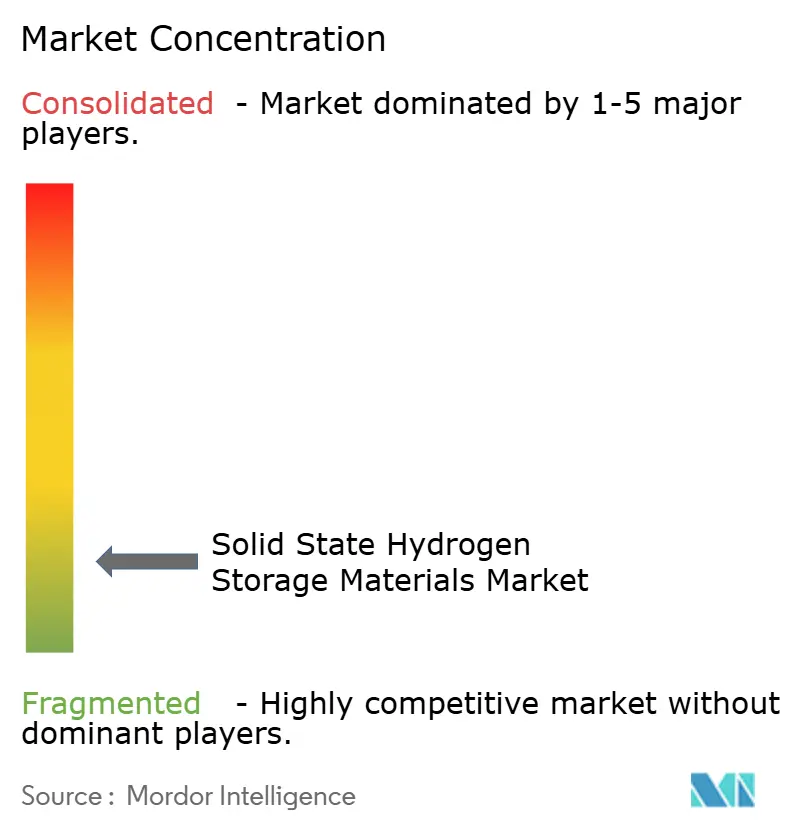
The solid state hydrogen storage materials market is highly fragmented, with the top five players including Langley Holdings plc, GRZ Technologies, H2MOF, Hydrexia, and Japan Metals & Chemicals Co., Ltd. SANTOKU CORPORATION has pursued alloy compositions designed to improve hydrogen absorption and desorption behavior. Japanese incumbents can use their materials knowledge and supply relationships to defend against lower-cost alloy substitution. NIPPON DENKO CO., LTD. also serves nickel-metal hydride battery applications, which supports its specialty-alloy capability.
System-oriented companies are seeking application-layer positions through integrated storage products in the solid state hydrogen storage materials market, especially where customers require equipment, logistics, and operating support from a single supplier. Hydrexia completed a regional maritime shipment in February 2026, entered Vietnam through a commercial agreement in April 2026, and secured a hospital backup-power project in Washington State in March 2026. These moves show how container, distribution, and end-use integration can support customer retention. Suppliers that integrate materials and operating systems can reduce adoption barriers for customers with limited hydrogen-handling experience.
Recycled-alloy storage materials are an emerging area for competitive differentiation. REMEDHYS is developing a technical case for hydrogen storage based on recycled European metals, which aligns with European critical-raw-material priorities. GRZ Technologies, H2MOF, H2GO Power Limited, and Hydrexia compete through application-specific systems rather than raw-material supply alone. Ergenics Corp., Mincatec Energy, and Safe Hydrogen LLC serve specialized niches in the United States, Europe, and North America. The competitive balance will depend on cost reduction, materials performance, certification, and the ability to integrate storage into operating systems, while the solid state hydrogen storage materials market offers space for specialized suppliers because customer requirements differ across mobility, grid, maritime, and backup-power uses.
Solid State Hydrogen Storage Materials Industry Leaders
-
Langley Holdings plc
-
GRZ Technologies
-
H2MOF
-
Hydrexia
-
Japan Metals & Chemicals Co., Ltd.
- *Disclaimer: Major Players sorted in no particular order
Solid State Hydrogen Storage Materials Market Companies Covered in this Report
- Ergenics Corp.
- GRZ Technologies
- H2GO Power Limited
- H2MOF
- Hydrexia
- Hystorsys
- Japan Metals & Chemicals Co., Ltd.
- Langley Holdings plc
- LAVO
- Mincatec Energy
- Mitsui Kinzoku Co., Ltd.
- NIPPON DENKO CO., LTD.
- Plasma Kinetics
- Safe Hydrogen LLC
- SANTOKU CORPORATION
Recent Industry Developments in Solid State Hydrogen Storage Materials Market
- April 2026: Hydrexia’s agreement with KPT Chemical Group to supply magnesium-based solid-state MHX containers and mobile hydrogen refueling stations marks the commercial deployment of metal hydride hydrogen storage technology in Southeast Asia. The use of magnesium-based storage materials directly supports demand for solid-state hydrogen storage materials and related storage systems.
- June 2025: StellarJet unveiled a metal hydride-based solid-state hydrogen storage unit for aerospace, unmanned aerial vehicle (UAV), satellite, and submarine applications at the Paris Air Show 2025. The development expands the application base for metal hydride storage materials into mobility and aerospace systems, supporting adoption of compact solid-state hydrogen storage technologies.
Global Solid State Hydrogen Storage Materials Market Report Scope
Solid-state hydrogen storage materials are advanced materials designed to store hydrogen within a solid medium, offering an alternative to conventional compressed or liquid hydrogen storage approaches. They can enable higher storage safety and improved volumetric efficiency while supporting controlled hydrogen release for various energy and mobility applications.
The Solid State Hydrogen Storage Materials Market is segmented by material type, storage mechanism, application, and geography. By material type, the market is segmented into metal hydrides, complex hydrides, chemical hydrides, carbon-based materials, and other material types. By storage mechanism, the market is segmented into absorption, adsorption, and other storage mechanisms. By application, the market is segmented into automotive, stationary power, portable power, aerospace, and other applications. The report also covers the market size and forecasts for solid state hydrogen storage materials in 15 countries across major regions. For each segment, the market sizing and forecasts have been done on the basis of value (USD).
Segmentation Overview
| Metal Hydrides |
| Complex Hydrides |
| Chemical Hydrides |
| Carbon-Based Materials |
| Other Material Types |
| Absorption |
| Adsorption |
| Other Storage Mechanisms |
| Automotive |
| Stationary Power |
| Portable Power |
| Aerospace |
| Other Applications |
| Asia-Pacific | China |
| India | |
| Japan | |
| South Korea | |
| Rest of Asia-Pacific | |
| North America | United States |
| Canada | |
| Mexico | |
| Europe | Germany |
| United Kingdom | |
| France | |
| Italy | |
| Rest of Europe | |
| South America | Brazil |
| Argentina | |
| Rest of South America | |
| Middle-East and Africa | Saudi Arabia |
| South Africa | |
| Rest of Middle-East and Africa |
| By Material Type | Metal Hydrides | |
| Complex Hydrides | ||
| Chemical Hydrides | ||
| Carbon-Based Materials | ||
| Other Material Types | ||
| By Storage Mechanism | Absorption | |
| Adsorption | ||
| Other Storage Mechanisms | ||
| By Application | Automotive | |
| Stationary Power | ||
| Portable Power | ||
| Aerospace | ||
| Other Applications | ||
| By Geography | Asia-Pacific | China |
| India | ||
| Japan | ||
| South Korea | ||
| Rest of Asia-Pacific | ||
| North America | United States | |
| Canada | ||
| Mexico | ||
| Europe | Germany | |
| United Kingdom | ||
| France | ||
| Italy | ||
| Rest of Europe | ||
| South America | Brazil | |
| Argentina | ||
| Rest of South America | ||
| Middle-East and Africa | Saudi Arabia | |
| South Africa | ||
| Rest of Middle-East and Africa | ||
Key Questions Answered in the Report
What is the size of the solid state hydrogen storage materials market?
The solid state hydrogen storage materials market stands at USD 1.60 billion in 2026 and is projected to reach USD 2.77 billion by 2031.
What is driving demand for solid state hydrogen storage materials?
Hydrogen infrastructure investment, heavy-duty fuel-cell deployment, long-duration renewable-energy storage, public incentives, and waste-heat integration support demand.
Which material type led demand in 2025?
Metal hydrides held 38.53% of demand in 2025 because of their volumetric density and compatibility with fuel-cell systems.
Which storage mechanism is expected to grow fastest through 2031?
Adsorption is projected to advance at a 12.23% CAGR through 2031, supported by near-ambient operation and faster cycling potential.