
Solar Thermal Collector Market Size and Share
Market Overview
| Study Period | 2022 - 2032 |
|---|---|
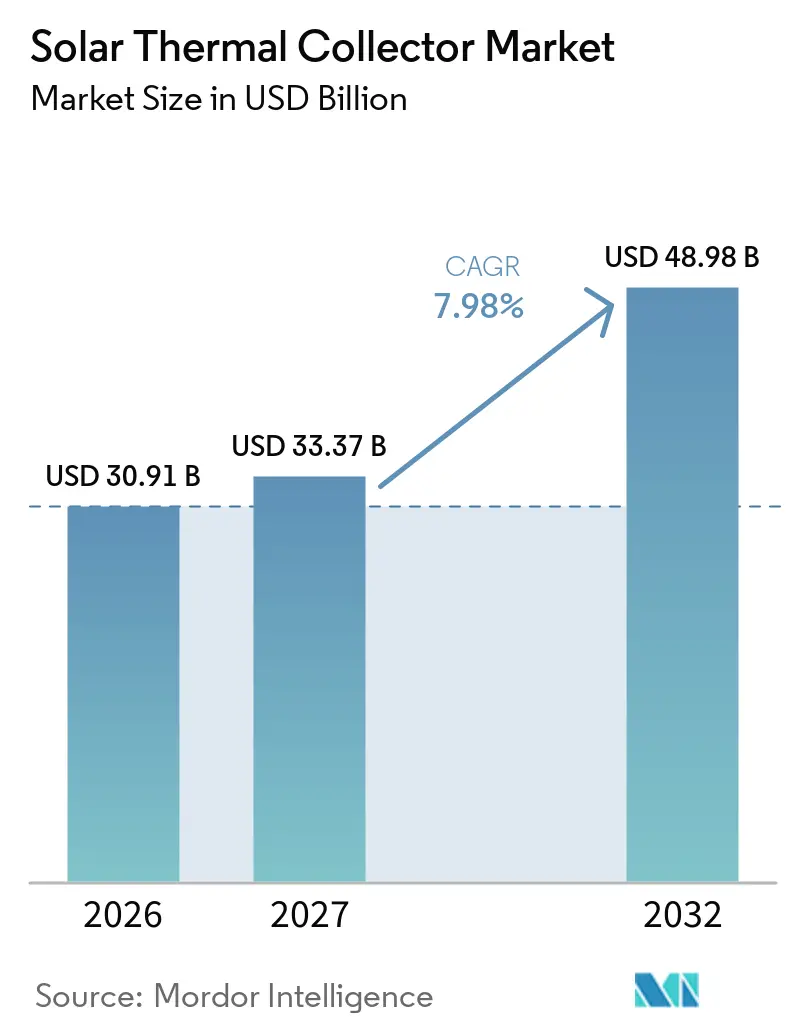
| Market Size (2027) | USD 33.37 Billion |
| Market Size (2032) | USD 48.98 Billion |
| Growth Rate (2027 - 2032) | 7.98 % |
| Fastest Growing Market | Middle East and Africa |
| Largest Market | Asia-Pacific |
| Market Concentration | Low |
Major Players *Disclaimer: Major Players sorted in no particular order Image © Mordor Intelligence. Reuse requires attribution under CC BY 4.0. | |
Solar Thermal Collector Market Analysis by Mordor Intelligence
The Solar Thermal Collector Market size is projected to expand from USD 30.91 billion in 2026 and USD 33.37 billion in 2027 to USD 48.98 billion by 2032, at a CAGR of 7.98% between 2027 and 2032. The global solar thermal collector market is moving beyond its traditional dependence on residential hot-water systems toward larger applications in district heating, commercial buildings, and industrial facilities. Regulatory targets for renewable heat are strengthening the case for solar thermal systems, where electricity networks face pressure from heating electrification. Large projects increasingly combine collectors with thermal storage and heat pumps, which broadens their operating role beyond daytime heat supply. The global solar thermal collector market also faces persistent competition from photovoltaic systems and air-source heat pumps, especially in residential installations. Suppliers are responding through larger collector formats, hybrid PV-T products, and service models that sell useful heat rather than equipment.
Key Report Takeaways
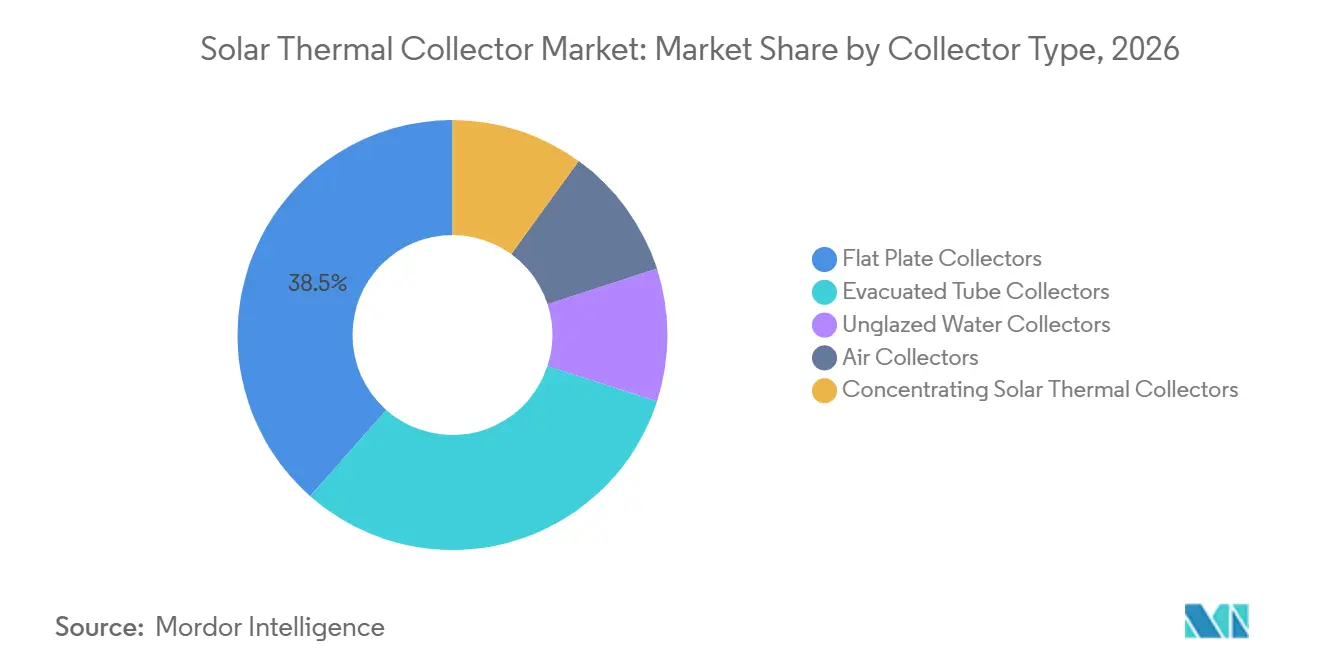
- By collector type, flat plate collectors led with 38.5% revenue share in 2026, while concentrating solar thermal collectors are forecast to grow at a 9.9% CAGR through 2032.
- By collector configuration, stationary collectors held 91.1% revenue share in 2026, while dual-axis tracking collectors are forecast to grow at a 10.4% CAGR through 2032.
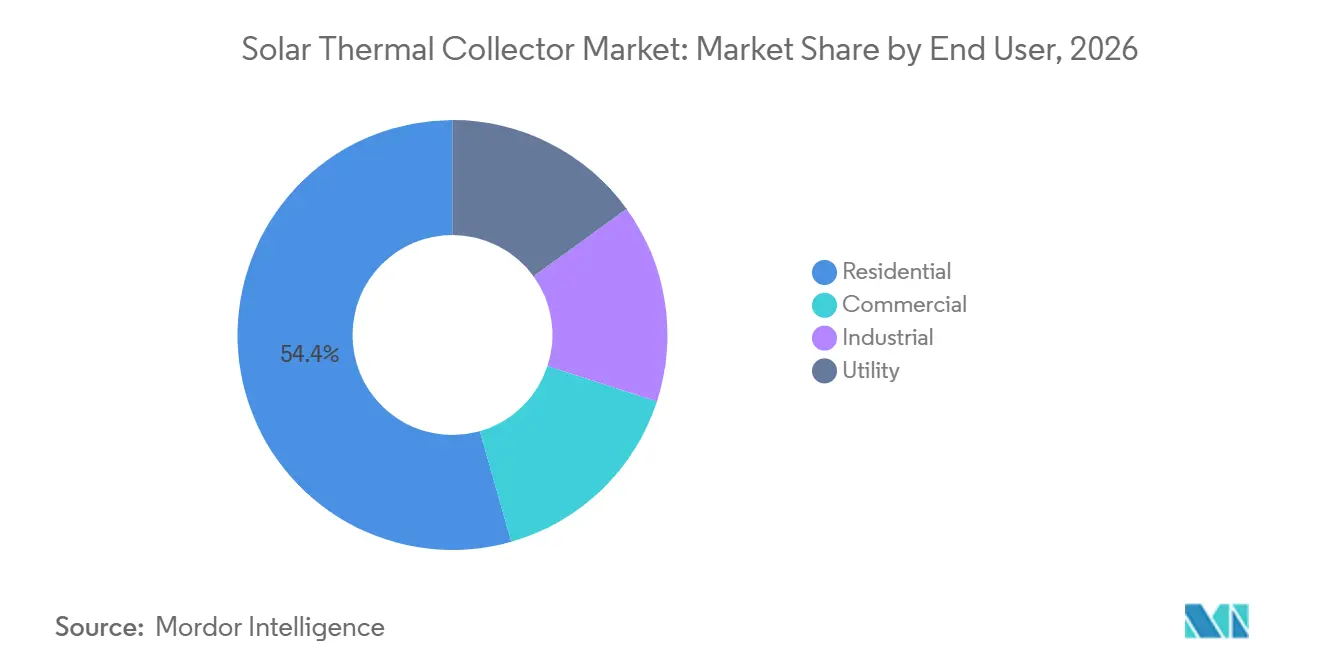
- By end user, residential systems accounted for 54.4% revenue share in 2026, while industrial applications are forecast to grow at a 10.5% CAGR through 2032.
- By installation, rooftop-mounted systems accounted for 55.2% revenue share in 2026, while ground-mounted systems are forecast to grow at an 8.9% CAGR through 2032.
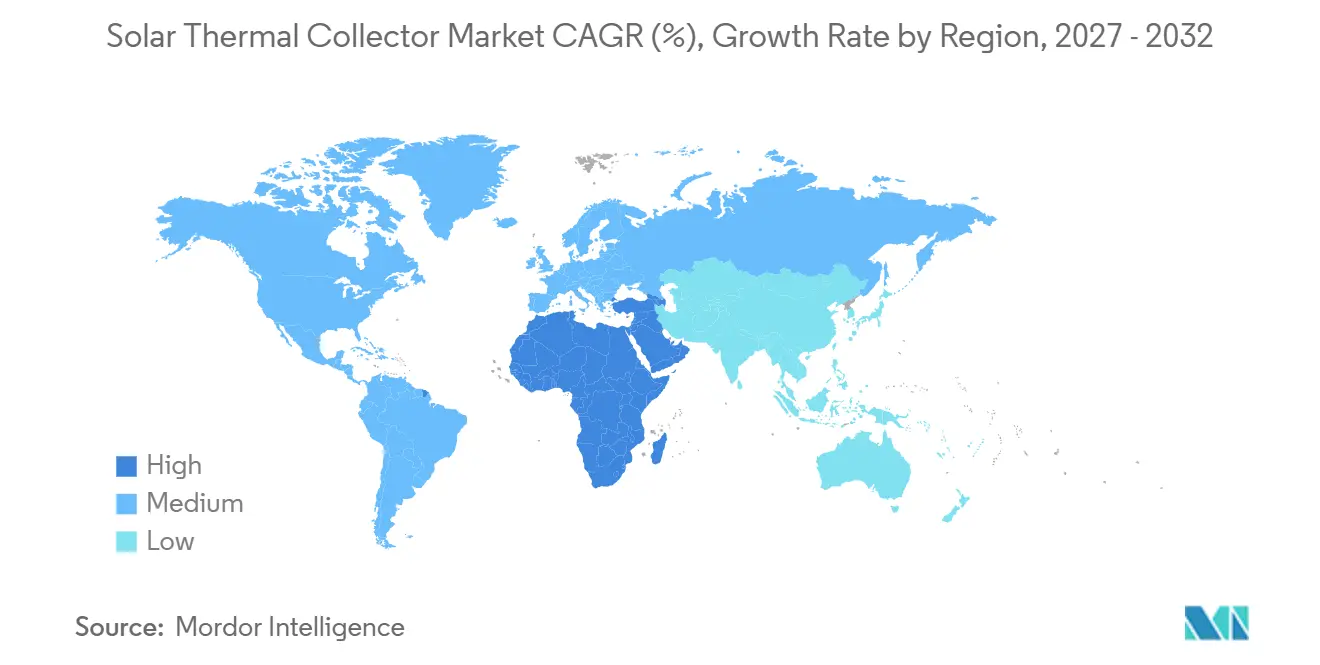
- By geography, Asia-Pacific held 48.4% revenue share in 2026, while Middle East and Africa is forecast to grow at a 10.2% CAGR through 2032.
Note: Market numbers in this report are based on Mordor Intelligence's proprietary estimation framework, which combines nine months of actuals with Q4 projections for base year 2026.
Market Trends and Insights
Drivers Impact Analysis of Solar Thermal Collector Market*
| Driver | (~) % Impact on CAGR Forecast | Geographic Relevance | Impact Timeline |
|---|---|---|---|
| Building And District-Heating Decarbonization | +2.1% | Europe, Asia-Pacific, North America | Medium term (2-4 years) |
| Industrial Process-Heat Decarbonization | +1.8% | Global, with early activity in Chile, Europe, and the Middle East | Long term (≥ 4 years) |
| Government Renewable-Heat Mandates And Incentives | +1.5% | European Union, Saudi Arabia, United Arab Emirates, India, and China | Short term (≤ 2 years) |
| Solar Thermal Integration With Heat Pumps, Storage, And PV-T | +0.9% | Europe, Asia-Pacific, and North America | Medium term (2-4 years) |
| Industrial Fuel-Price And Carbon-Cost Exposure | +0.8% | Global, especially emissions-trading and carbon-priced markets | Long term (≥ 4 years) |
| Supplier-Led Standardized Large-Scale Systems | +0.7% | Europe, Asia-Pacific, and South America | Long term (≥ 4 years) |
| Source: Mordor Intelligence | |||
Building And District-Heating Decarbonization
Municipal heat networks offer a practical route for deploying larger solar collector fields. RED III requires European Union member states to raise the renewable share of heating and cooling by at least 1.1 percentage points each year through 2030. It also sets a 2.2% annual increase requirement for renewable energy in district heating and cooling, which gives network operators a continuing compliance objective. The global solar thermal collector market can benefit when collectors are paired with seasonal thermal storage near established pipe networks. Solar Heat Europe reported that 6 solar thermal district-heating systems entered service in the European Union during 2025, including the 37 MW Dorkwerd project in Groningen. The project uses 24,000 vacuum collectors to provide heat for 10,000 households, showing why land close to heat infrastructure has become important for development.[1]
Industrial Process-Heat Decarbonization
Industrial process heat remains a large fossil-fuel demand area and creates an opportunity for solar heat where operating temperatures match collector capability. The global solar thermal collector market is therefore gaining attention from food, beverage, mining, and chemical producers with direct fuel-emissions obligations. Fraunhofer ISE reports that Germany’s relevant incentive programs can enable solar process heat costs below EUR 0.03/kWh, with payback periods of 3-4 years under suitable conditions. This supports adoption in processes such as pasteurization, drying, brewing, and sterilization, where heat demand is recurring and temperature requirements are manageable. Concentrating designs have a separate role when users need higher temperatures than flat-plate and evacuated-tube systems can supply efficiently. The global solar thermal collector market has room for both approaches because industrial sites differ in temperature, land, and production schedules.[2]
Government Renewable-Heat Mandates And Incentives
Policy is shifting from optional support toward building and heat-sector obligations in several important countries. The recast Energy Performance of Buildings Directive took effect on 29 May 2026 and requires new building permits to optimize solar energy generation potential. Solar installation requirements apply to new business buildings from January 2027, public buildings above 2,000 m² from January 2028, and new residential buildings from December 2029. Ireland transposed RED III renewable-heating amendments into national law through Statutory Instrument No. 36 of 2026. These measures provide greater planning certainty for the global solar thermal collector market, particularly for building owners and district-heating operators. They also favor technologies that can be integrated into an overall building-energy design instead of being added after construction.
Solar Thermal Integration With Heat Pumps, Storage, And PV-T
Integration with heat pumps and thermal storage is changing the operating profile of collector systems. A 2025 study in Energy Conversion and Management found that a parabolic-trough system combined with a 400 kW high-temperature heat pump and 1,950 kWh of latent heat storage could deliver process heat up to 210° C. The study reported an average operating-emissions reduction of 48% while maintaining competitiveness with fossil-fired equipment. GREENoneTEC launched its PV-T product range at Intersolar Europe 2026, combining electric and thermal output in a single module. These configurations can reduce grid demand at times when building heat loads would otherwise require more electricity. The global solar thermal collector market is consequently becoming more connected with broader renewable-heat system design.
Restraints Impact Analysis of Solar Thermal Collector Market*
| Restraint | (~) % Impact on CAGR Forecast | Geographic Relevance | Impact Timelin |
|---|---|---|---|
| Competition From PV And Air-Source Heat Pumps | -2.4% | Europe, especially Germany, and North America | Short term (≤ 2 years) |
| Policy Stop-Go And Incentive Uncertainty | -1.8% | Germany, Greece, and the broader European Union residential segment | Short term (≤ 2 years) |
| Long Project Development And Payback Periods | -1.0% | Global, especially solar industrial process heat and large district-heating projects | Long term (≥ 4 years) |
| Quality, Installation, And Performance-Verification Gaps | -0.7% | Emerging markets in Asia-Pacific, Middle East and Africa, and South America | Medium term (2-4 years) |
| Source: Mordor Intelligence | |||
Competition From PV And Air-Source Heat Pumps
Photovoltaic and heat-pump combinations are a durable, competitive challenge for solar thermal systems. Their appeal is strongest in new buildings where a single electrical system can serve several loads and where technology-neutral regulations apply. A 2025 scientific study found that photovoltaic-driven heat pumps outperformed conventional solar water heating across annual cycles in low-to-moderate solar-irradiance conditions. Solar thermal retained advantages in periods with strong summer irradiation, but that does not resolve the full-year comparison for every building. Germany installed fewer than 20,000 solar thermal systems in 2025, with a new capacity of 98.6 MW thermal, according to BSW-Solar. The global solar thermal collector market can respond by presenting collectors as a complement to heat pumps, especially where thermal storage can reduce peak electrical demand.
Policy Stop-Go And Incentive Uncertainty
Incentive changes can quickly weaken demand for smaller systems because households and installers make decisions on short investment horizons. Solar Heat Europe reported that new collector installations in Europe fell 6.5% in 2025 to 1.18 million m². Germany declined 30% during the same year, while Greece stalled after a national subsidy program was paused until mid-2025. The effect was not uniform across the sector because large district-heating projects often have long-term contracts and utility counterparties. Small residential purchases remained more exposed to changing subsidy conditions and installer confidence. The global solar thermal collector market will depend on steadier rules if it is to restore residential demand while large projects continue to advance.
*Our forecasts treat driver/restraint impacts as directional, not additive. The impact forecasts reflect baseline growth, mix effects, and variable interactions.
Solar Thermal Collector Market Segment Analysis
By Collector Type:
Concentrating Collectors Support Higher-Temperature Industrial HeatFlat-plate collectors held 38.5% of the global solar thermal collector market share in 2026. Their position reflects established use in domestic hot water, low-temperature space heating, commercial systems, and large district-heating arrays. The technology is familiar to installers and offers a simple design with a broad supplier base. GREENoneTEC has annual flat-plate production capacity above 1.6 million m² and is extending this format into larger renewable-heat projects. Its scale illustrates how established product lines can remain relevant as project size rises. Evacuated-tube collectors remain important where cold-weather performance and higher output temperatures support their added complexity.
Concentrating solar thermal collectors are forecast to grow at a 9.9% CAGR through 2032. They are suited to sites that require process heat above 150°C, including selected food-processing, mining, and chemical applications. A 2026 IOP Science study reported that concentrating solar thermal with molten-salt storage could supply more than 50% of industrial heat demand cost-competitively in solar-rich locations below 45° latitude, compared with natural gas at USD 50/MWh. The finding emphasizes the role of solar resource, storage, and industrial load profiles in project economics. Unglazed water collectors continue to address seasonal pool-heating demand, while air collectors serve narrower applications such as agricultural drying. The global solar thermal collector market therefore contains distinct product niches rather than a single replacement path.

By Collector Configuration:
Tracking Systems Serve Utility And Industrial ProjectsStationary collectors commanded 91.1% of the global solar thermal collector market share in 2026. Fixed systems dominate because they have no moving parts, require limited maintenance, and fit the needs of most rooftop projects. They are widely used in residential systems, smaller commercial installations, and many district-heating applications. Their lower initial cost remains important for projects that value simplicity over maximum hourly output. Single-axis configurations provide an intermediate option for some ground-mounted arrays and agricultural applications. The global solar thermal collector market continues to rely on fixed collectors because the installed base and practical use cases remain much larger than the tracking segment.
Dual-axis tracking collectors are forecast to expand at a 10.4% CAGR through 2032. Their higher yield can improve economics for concentrating systems where land, direct sunlight, and thermal demand justify more complex equipment. Tracking is most relevant to utility-scale and industrial projects that use collector fields rather than building rooftops. It is less suitable for standard residential systems because maintenance requirements and capital costs are higher. The segment also benefits when customers procure heat through long-term service agreements instead of buying the entire solar field. The global solar thermal collector market can use these contracts to lower the ownership barrier for large industrial installations.
By End User:
Industrial Demand Builds On Process-Heat RequirementsResidential systems accounted for 54.4% of 2026 revenue in the global solar thermal collector market. Rooftop hot-water and combi-system installations in China, India, and Southern Europe continue to support this large installed base. Residential demand remains sensitive to incentives, installer availability, and competition from heat pumps. Commercial users in hospitality, health care, and education can benefit from consistent hot-water loads and larger roof areas. Utility-scale plants have a higher value per project because one district-heating field can serve a substantial number of buildings. The global solar thermal collector market retains this residential foundation even as new investment shifts toward larger projects.
Industrial applications are forecast to grow at a 10.5% CAGR through 2032. They are gaining support from direct-emissions reduction requirements and from the need to manage fuel and carbon costs. Food and beverage plants are well-suited to applications such as pasteurization, brewing, and drying because their heat requirements can align with solar thermal temperature ranges. In June 2026, Absolicon signed a final agreement with Athenian Brewery in Greece to supply a concentrating solar thermal installation for malt drying. The company stated that this made Heineken the third of the 3 largest brewing groups to adopt its technology, after Carlsberg and Asahi. The global solar thermal collector market is becoming more relevant to industrial buyers that need proven heat supply rather than only energy equipment.
By Installation:
Ground-Mounted Fields Expand With District Heating And Industrial ProjectsRooftop-mounted systems accounted for 55.2% of 2026 installation revenue in the global solar thermal collector market. They remain the main format for residential and commercial systems because roofs offer a direct location for on-site heat production. The revised European buildings directive will strengthen the need to assess solar potential when new buildings are designed. Building-integrated and building-attached collectors are smaller categories that link heat generation with the building envelope. Their use can be attractive in dense areas where available land is limited, and planners value multifunctional surfaces. Rooftop systems will remain central even as larger ground fields increase their share.
Ground-mounted systems are forecast to grow at an 8.9% CAGR through 2032. They are used where solar district-heating plants and industrial heat projects need substantial collector areas close to a network or facility. In June 2026, Stadtwerke Leipzig and Ritter XL Solar inaugurated a 45.6 MW vacuum-tube collector field in Leipzig-Lausen. The project represented an investment of EUR 40 million and is expected to deliver 29 GWh each year. It demonstrates the scale that becomes possible when collectors are deployed on open land rather than across individual roofs. The global solar thermal collector market can gain from similar projects where land access, storage, and heat networks are available.
Geography Analysis
Asia-Pacific held 48.4% of the global solar thermal collector market revenue in 2026. China underpins the regional position with an installed base of 294 GW thermal across 4.2 billion m² of collector area, representing 54% of the global total. China’s market is strongly associated with evacuated-tube systems, while the region also includes growing industrial demand. India remains an active market for solar water heating in applicable commercial buildings. Vietnam, Thailand, and Indonesia have relevant conditions in urban growth, food processing, and textiles. The regional opportunity increasingly includes industrial and agricultural thermal demand alongside residential replacement systems.
Europe is the second-largest regional revenue area, but its 2026 performance varied sharply by application. European collector installations fell 6.5%, while large district-heating projects continued to provide a different source of demand. Germany’s installed solar thermal capacity reached 14.1 GW thermal at the end of 2025 and generated 9.5 TWh of heat. BSW-Solar stated that this output avoided 2.5 million tonnes of carbon dioxide equivalents. The global solar thermal collector market in Europe will be shaped by the EPBD and RED III, which combine building-design obligations with renewable-heating targets.
Middle East and Africa is forecast to grow at a 10.2% CAGR through 2032. High direct normal irradiance and large industrial sites support the case for concentrating solar heat. In January 2026, GlassPoint closed a USD 20 million funding round to advance its 1.5 GW parabolic-trough project with Ma’aden in Saudi Arabia and a 750 MW project with Searles Valley Minerals in California. Saudi Arabia’s Vision 2030 target includes 2.7 GW of concentrating solar power capacity. South America also has a role through Chilean mining projects, while North American incentives support commercial and industrial project development. The global solar thermal collector market has its strongest utility-scale growth conditions where solar resource, industrial load, and land availability coincide.
Competitive Landscape
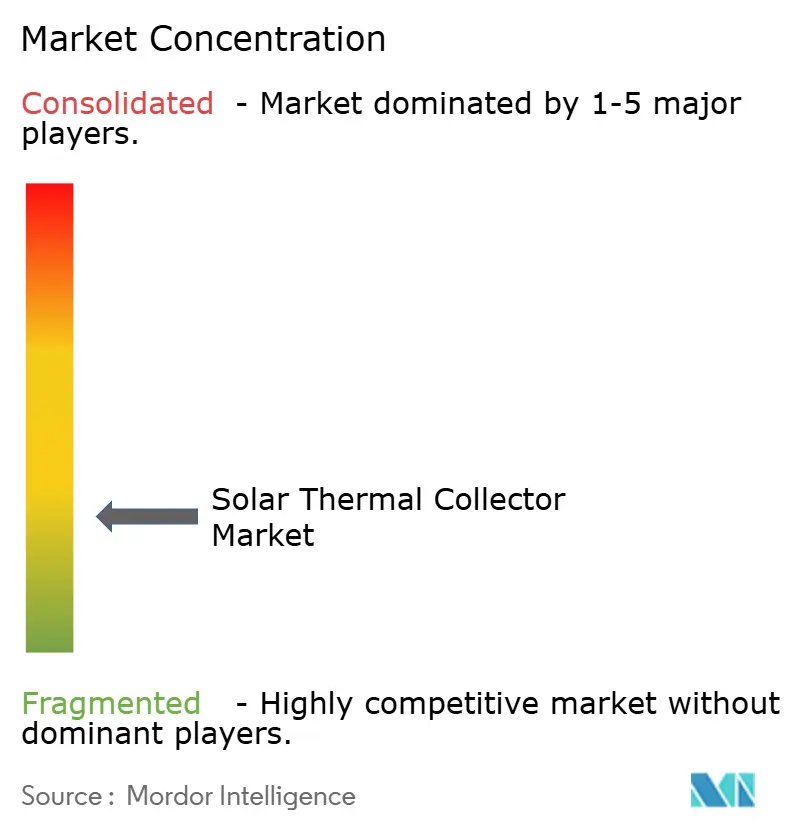
The global solar thermal collector market is fragmented. Chinese suppliers hold a strong production position in standard evacuated-tube and flat-plate systems, while European specialists focus more on certified, large-format, and integrated solutions. GREENoneTEC competes through flat-plate manufacturing scale and its new PV-T offering. TVP Solar has focused on vacuum flat-plate technology for district-heating applications that need performance in cold conditions. The commercial difference increasingly lies in system design, site development, storage integration, and heat-delivery contracts. The global solar thermal collector market is therefore not defined only by collector efficiency.
Absolicon acquired SavoSolar’s solar thermal business from Summa Energy Oy in June 2026 for EUR 393,000, comprising EUR 175,000 in cash and 355,723 new shares. The transaction gave Absolicon access to SavoSolar’s brand, references, and customer relationship management resources in Germany, France, and Denmark. In February 2026, Viessmann Climate Solutions welcomed the planned reform of Germany’s Buildings Energy Act, which moves away from a rigid 65% heat-pump rule toward technology openness. This policy direction supports hybrid solar-thermal and heat-pump configurations when they are appropriate for the building. GREENoneTEC also introduced PV-T products in 2026, showing suppliers’ interest in combined electrical and thermal offerings. These moves show how the global solar thermal collector market is responding through consolidation, hybrid products, and broader project capability.
Service-based procurement is another important competitive approach. Heat-as-a-service arrangements allow customers to buy delivered heat under contract rather than carry the capital cost of a collector field. This model can be useful for industrial and commercial users who prioritize operational certainty over ownership. It also puts more emphasis on the supplier’s ability to finance, construct, operate, and guarantee a project. Companies that combine collectors with storage, controls, and engineering can address a broader customer need than equipment suppliers alone. The global solar thermal collector market will reward credible delivery capability as project size increases. Market concentration score: 3 out of 10, because no top player's combined market share figure establishes dominance, and production remains distributed among several regional suppliers.
Solar Thermal Collector Industry Leaders
-
Solareast Holdings Co., Ltd.
-
GREENoneTEC Solarindustrie GmbH
-
Sunrain Group Co., Ltd.
-
Linuo Ritter International Co., Ltd.
-
Photon Energy Systems Limited
- *Disclaimer: Major Players sorted in no particular order
Solar Thermal Collector Market Companies Covered in this Report
- Aalborg CSP A/S
- Absolicon Solar Collector AB
- Alternate Energy Technologies LLC
- Ariston Holding N.V.
- Bosch Thermotechnology Corp.
- GREENoneTEC Solarindustrie GmbH
- Heliodyne, Inc.
- HTP Comfort Solutions LLC
- Kingspan Group plc
- Linuo Ritter International Co., Ltd.
- Ouraset
- Photon Energy Systems Limited
- Rheem Manufacturing Company
- Savosolar Oyj
- Solareast Holdings Co., Ltd.
- Solimpeks Renewable Heating
- SunEarth, Inc.
- SUNERG Solar Energy S.R.L.
- SunMaxx Solar, Inc.
- Sunrain Group Co., Ltd.
- TVP Solar
- Viessmann Climate Solutions Berlin GmbH
Recent Industry Developments in Solar Thermal Collector Market
- June 2026: Absolicon Solar Collector AB signed a final delivery agreement with Athenian Brewery, Heineken’s Greek operation, to supply a concentrating solar thermal installation for malt drying in Thessaloniki. The project is the third major brewery group, after Carlsberg and Asahi, to adopt Absolicon’s technology, targeting delivery in autumn 2026.
- February 2026: Viessmann Climate Solutions publicly welcomed the German government’s agreement on the revised Buildings Energy Act. The reform moves away from the rigid 65% heat-pump rule toward technological openness and is expected to support hybrid solar-thermal-plus-heat-pump systems.
- January 2026: GlassPoint closed a USD 20 million funding round led by N.I.S. New Investment Solutions, with participation from MIG Capital. The funding supports its 1.5 GW parabolic-trough project with Ma’aden and its 750 MW project with Searles Valley Minerals.
Global Solar Thermal Collector Market Report Scope
A solar thermal collector absorbs incoming solar radiation and converts it into thermal energy. It transfers the heat to a circulating fluid, such as water, air, or oil.
The global solar thermal collector market is segmented by collector type, collector configuration, end user, installation, and geography. By collector type, the market is segmented into flat plate collectors, evacuated tube collectors, unglazed water collectors, air collectors, and concentrating solar thermal collectors. By collector configuration, the market is segmented into stationary collectors, single-axis tracking collectors, and dual-axis tracking collectors. By end-user, the market is segmented into residential, commercial, industrial, and utility. By installation, the market is segmented into rooftop-mounted systems, ground-mounted systems, building-integrated systems, and building-attached systems. The report also covers the market size and forecasts for the global solar thermal collector market across 26 countries in the key regions. For each segment, market sizing and forecasts are provided in terms of value (USD).
Segmentation Overview
| Flat Plate Collectors |
| Evacuated Tube Collectors |
| Unglazed Water Collectors |
| Air Collectors |
| Concentrating Solar Thermal Collectors |
| Stationary Collectors |
| Single-Axis Tracking Collectors |
| Dual-Axis Tracking Collectors |
| Residential |
| Commercial |
| Industrial |
| Utility |
| Rooftop-Mounted Systems |
| Ground-Mounted Systems |
| Building-Integrated Systems |
| Building-Attached Systems |
| North America | United States |
| Canada | |
| Mexico | |
| Europe | Germany |
| France | |
| Italy | |
| Spain | |
| United Kingdom | |
| Poland | |
| Russia | |
| Rest of Europe | |
| Asia-Pacific | China |
| India | |
| Japan | |
| South Korea | |
| Australia | |
| Indonesia | |
| Vietnam | |
| Thailand | |
| Rest of Asia-Pacific | |
| South America | Brazil |
| Argentina | |
| Chile | |
| Rest of South America | |
| Middle East and Africa | Saudi Arabia |
| United Arab Emirates | |
| Egypt | |
| South Africa | |
| Morocco | |
| Rest of Middle East and Africa |
| By Collector Type | Flat Plate Collectors | |
| Evacuated Tube Collectors | ||
| Unglazed Water Collectors | ||
| Air Collectors | ||
| Concentrating Solar Thermal Collectors | ||
| By Collector Configuration | Stationary Collectors | |
| Single-Axis Tracking Collectors | ||
| Dual-Axis Tracking Collectors | ||
| By End User | Residential | |
| Commercial | ||
| Industrial | ||
| Utility | ||
| By Installation | Rooftop-Mounted Systems | |
| Ground-Mounted Systems | ||
| Building-Integrated Systems | ||
| Building-Attached Systems | ||
| By Geography | North America | United States |
| Canada | ||
| Mexico | ||
| Europe | Germany | |
| France | ||
| Italy | ||
| Spain | ||
| United Kingdom | ||
| Poland | ||
| Russia | ||
| Rest of Europe | ||
| Asia-Pacific | China | |
| India | ||
| Japan | ||
| South Korea | ||
| Australia | ||
| Indonesia | ||
| Vietnam | ||
| Thailand | ||
| Rest of Asia-Pacific | ||
| South America | Brazil | |
| Argentina | ||
| Chile | ||
| Rest of South America | ||
| Middle East and Africa | Saudi Arabia | |
| United Arab Emirates | ||
| Egypt | ||
| South Africa | ||
| Morocco | ||
| Rest of Middle East and Africa | ||
Key Questions Answered in the Report
What is the forecast for the global solar thermal collector market?
The Solar Thermal Collector Market size is projected to expand from USD 30.91 billion in 2026 and USD 33.37 billion in 2027 to USD 48.98 billion by 2032, registering a CAGR of 7.98% between 2027 and 2032.
Which solar thermal collector type is growing fastest?
Concentrating solar thermal collectors are forecast to expand at a 9.9% CAGR through 2032 because they can serve higher-temperature industrial heat needs.
Why are industrial buyers adopting solar thermal systems?
Industrial applications are forecast to grow at a 10.5% CAGR, supported by process-heat demand, fuel-cost exposure, and direct-emissions reduction needs.
Which region leads solar thermal collector revenue?
Asia-Pacific held 48.4% of global revenue in 2026, supported primarily by China's large collector base.
What is constraining residential solar thermal adoption?
Competition from photovoltaic and heat-pump systems, together with unstable incentives, has weakened smaller residential installations in several European countries.
How are suppliers differentiating their offerings?
Suppliers are expanding into PV-T products, thermal storage integration, large system delivery, and heat-as-a-service arrangements.