
SME Insurance Market Size and Share
Market Overview
| Study Period | 2021 - 2032 |
|---|---|
| Market Size (2027) | USD 431.90 Billion |
| Market Size (2032) | USD 559.10 Billion |
| Growth Rate (2027 - 2032) | 5.30 % |
| Fastest Growing Market | Asia-Pacific |
| Largest Market | North America |
| Market Concentration | Low |
Major Players *Disclaimer: Major Players sorted in no particular order Image © Mordor Intelligence. Reuse requires attribution under CC BY 4.0. | |
SME Insurance Market Analysis by Mordor Intelligence
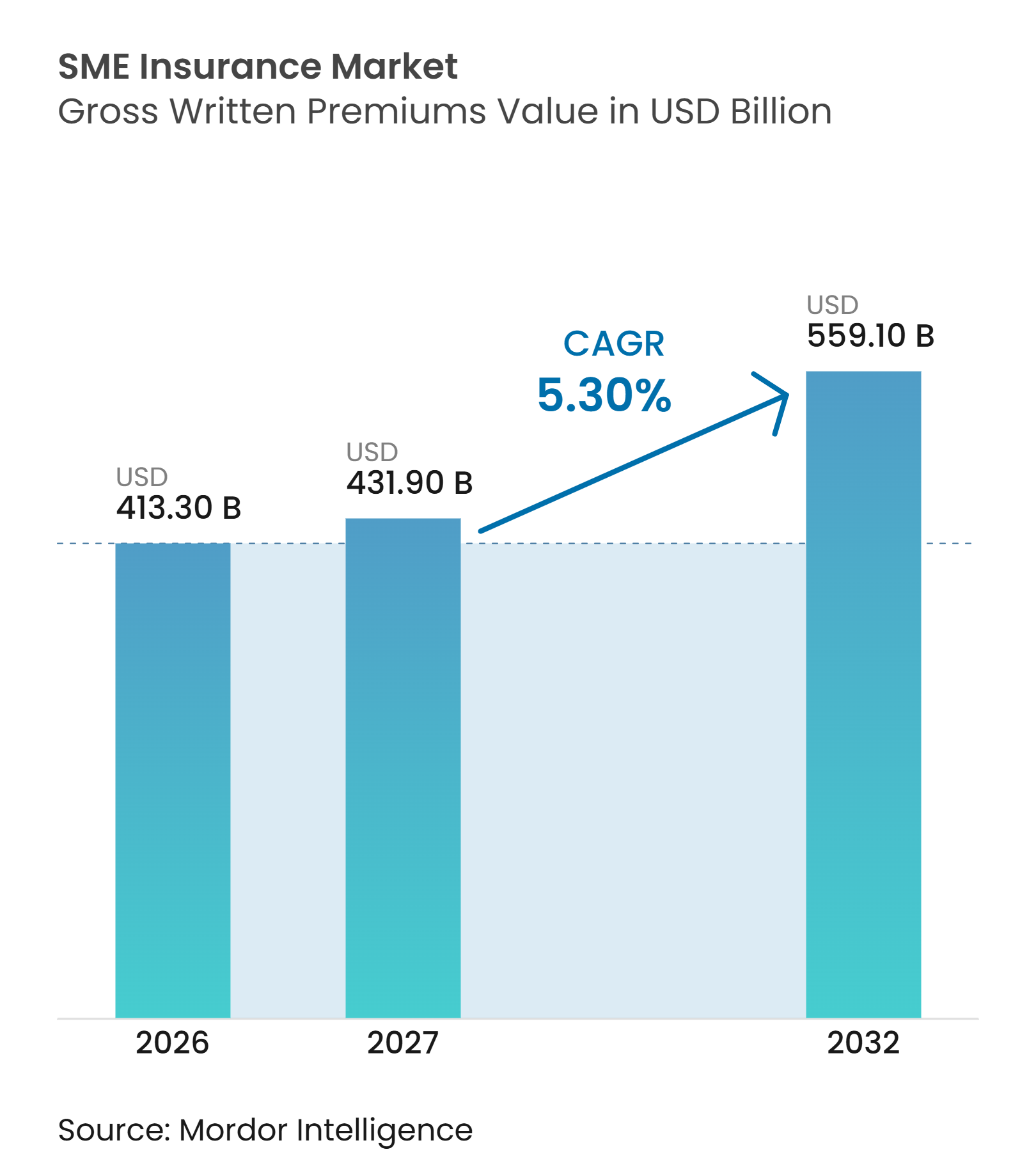
The SME Insurance Market size in terms of gross written premiums value is projected to be USD 413.30 billion in 2026, USD 431.90 billion in 2027, and reach USD 559.10 billion by 2032, growing at a CAGR of 5.30% from 2027 to 2032.
The SME insurance market is expanding as more businesses formalize their operations and need protection for property, liability, employees, and digital activity. Small and medium-sized enterprises account for 50% of business-sector jobs across Organisation for Economic Co-operation and Development member countries, while they created 16 jobs for every 10 created by large firms between 2014 and 2020, indicating the scale of the business base that can require commercial coverage. Cyber risk, contract requirements, and digital distribution are changing how insurers reach smaller firms. Automation is also allowing carriers to process lower-premium accounts with less manual work, which supports competition for previously underserved customers. The SME insurance market therefore faces an opportunity to improve access while maintaining underwriting discipline as property and cyber risks change.
Key Report Takeaways
- By insurance product, property and business interruption captured 33.7% of the SME insurance market share in 2026, while cyber insurance is projected to grow at a 14.1% CAGR through 2032.
- By enterprise size, medium enterprises captured 42.3% of the SME insurance market share in 2026, while micro enterprises are projected to grow at a 6.8% CAGR through 2032.
- By industry vertical, manufacturing captured 18.1% of the SME insurance market share in 2026, while professional, scientific, and technical services are projected to grow at a 6.1% CAGR through 2032.
- By distribution channel, insurance brokers captured 61.5% of the SME insurance market share in 2026, while direct insurer sales are projected to grow at an 8.1% CAGR through 2032.
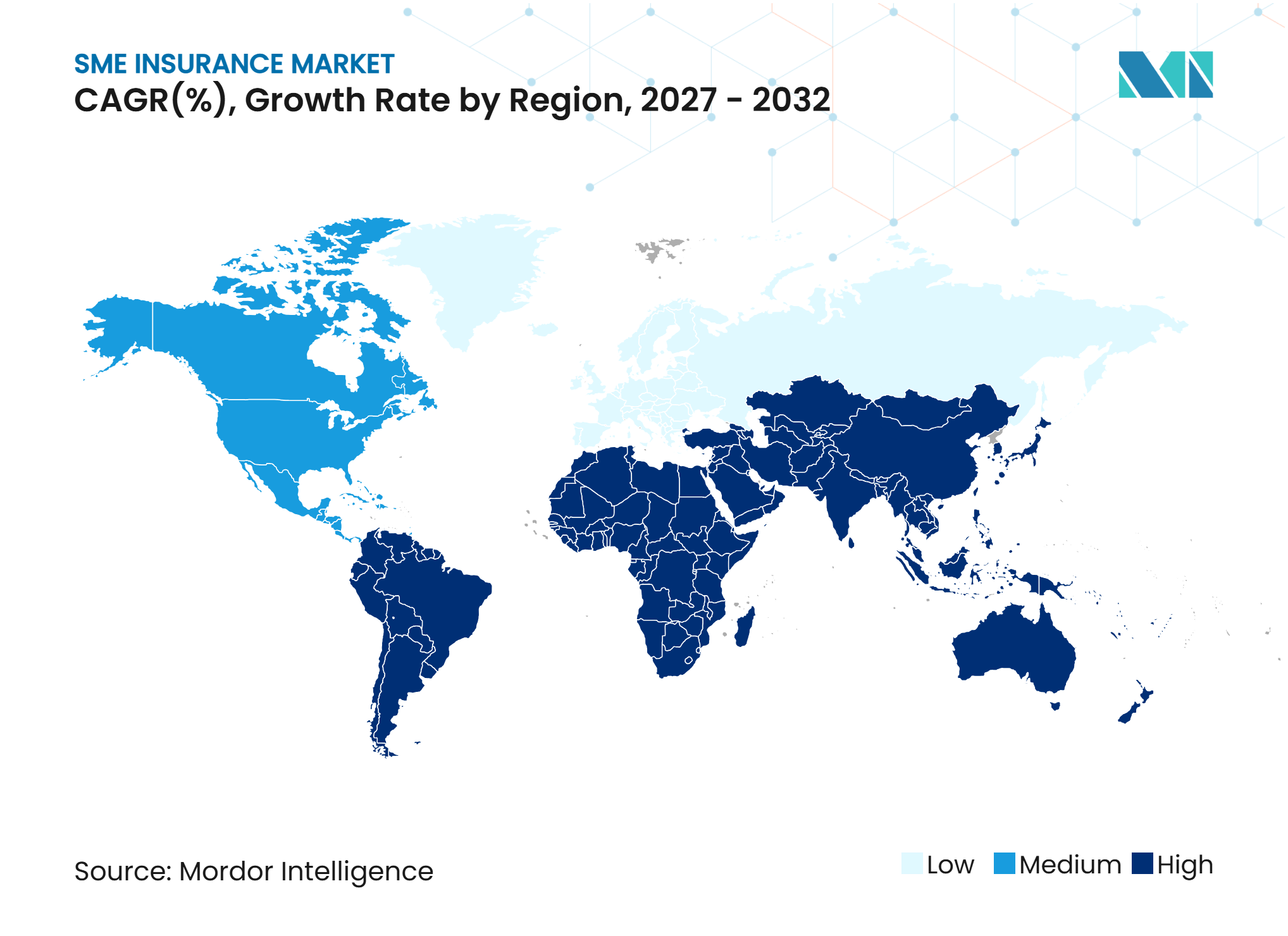
- By geography, North America captured 40.2% of the SME insurance market share in 2026, while Asia-Pacific is projected to grow at a 7.5% CAGR through 2032.
Note: Market numbers in this report are based on Mordor Intelligence's proprietary estimation framework, which combines nine months of actuals with Q4 projections for base year 2026.
Market Trends and Insights
Drivers Impact Analysis of SME Insurance Market*
| Driver | (~) % Impact on CAGR Forecast | Geographic Relevance | Impact Timeline |
|---|---|---|---|
| SME Formation, Business Formalization, and Commercial Risk Protection | +1.0% | Global, with early gains in South and Southeast Asia, Sub-Saharan Africa, and Latin America | Medium term (2-4 years) |
| Cyberattacks, Ransomware, and Digital Business Interruption Exposure | +1.4% | Global, strongest in North America and Europe, and accelerating in Asia-Pacific | Short term (≤ 2 years) |
| Mandatory Insurance, Client Contracts, and Supply-Chain Compliance Requirements | +0.7% | North America, European Union, United Kingdom, Australia, and growing in Gulf Cooperation Council countries | Medium term (2-4 years) |
| Embedded Commercial Insurance Through SME Software, Banking, and Payments Platforms | +0.6% | Global, with activity in the United States, United Kingdom, India, Malaysia, and East Africa | Short term (≤ 2 years) |
| Digital Underwriting Using Payroll, Accounting, Transaction, and Firmographic Information | +0.5% | North America and European Union core markets, with expansion to Asia-Pacific and the Middle East and Africa | Medium term (2-4 years) |
| Sector-Specific Coverage for Professional Services, Retail, Construction, and Logistics | +0.6% | Global, with professional services advancing in developed economies and construction and logistics in emerging economies | Long term (≥ 4 years) |
| Source: Mordor Intelligence | |||
Cyberattacks, Ransomware, and Digital Business Interruption Exposure
Cyber risk has become a material operational concern for smaller enterprises and is driving demand for specialized coverage. Hiscox surveyed 5,750 businesses across 7 countries in 2025 and found that 59% of small and medium-sized enterprises had experienced a cyberattack in the preceding 12 months[1]. Among businesses affected by ransomware, 80% paid a ransom, and 60% recovered all or part of their information, which shows the operational pressure created by a serious incident. Hiscox also reported that 33% of businesses experiencing a breach faced a substantial fine that affected their financial health. The SME insurance market benefits as cyber policies address incident response, liability, business interruption, and recovery costs in a single offering. The European Union’s NIS2 Directive and Digital Operational Resilience Act rules are also increasing attention to cyber and operational resilience across supply chains.
SME Formation, Business Formalization, and Growing Demand for Commercial Risk Protection
A wider formal business base is increasing the number of enterprises that may need commercial insurance. The Organisation for Economic Co-operation and Development found that 16% to 27% of small and medium-sized enterprises in tracked economies were scalers that grew at least 10% annually[2]. As these firms add employees, assets, contracts, and customer commitments, they generally face more need for liability, property, worker, and professional protection. The SME insurance market can benefit when coverage is introduced as part of business formation, lending, supplier onboarding, or payroll administration. In India, the micro, small, and medium enterprise sector contributes 30% of gross domestic product and employs more than 110 million people, showing the potential scale of a formalizing customer base. Digital insurance adoption is also becoming more important as formal businesses seek faster and simpler policy access.
Mandatory Insurance, Client Contracts, and Supply-Chain Compliance Requirements
Commercial requirements can make insurance a condition of winning work or continuing a supplier relationship. Customers, lenders, landlords, and public bodies may request evidence of liability, property, workers’ compensation, professional indemnity, or cyber coverage. These requirements can bring first-time buyers into the SME insurance market and can encourage existing policyholders to review their limits. The European Union’s NIS2 Directive and Digital Operational Resilience Act place added focus on cyber resilience in affected supply chains. Small firms need policy terms that match the requirements written into their contracts. Clear proof of coverage and straightforward renewal processes can therefore be important parts of the customer experience.
Embedded Commercial Insurance Through SME Software, Banking, and Payments Platforms
Embedded insurance is shortening the path from identifying a need to obtaining a policy. Bluevine and Coverdash announced in October 2026 that commercial insurance would be integrated into Bluevine’s small-business banking platform, allowing customers to quote, purchase, and manage selected policies within the same environment[3]. The offering includes general liability, business owner policies, workers’ compensation, cyber, and commercial auto coverages from more than 40 carriers. In the United Kingdom, Tide launched embedded business insurance for small and medium-sized businesses in 2025 with Admiral Business, using existing customer details to prepopulate forms. The SME insurance market can use these channels to reduce application effort and reach firms that may not otherwise approach a broker. These models can also give carriers access to business information that supports more tailored offers and policy servicing.
Restraints Impact Analysis of SME Insurance Market*
| Restraint | (~) % Impact on CAGR Forecast | Geographic Relevance | Impact Timeline |
|---|---|---|---|
| Premium Affordability, Coverage Gaps, and Persistent SME Underinsurance | -0.9% | Global, most acute in South Asia, Sub-Saharan Africa, and Latin America | Long-term (≥ 4 years) |
| Limited Claims Histories and Inconsistent Risk Information for Micro and Newly Established Businesses | -0.5% | Global, with the sharpest constraints in emerging economies and the Middle East and Africa | Medium term (2-4 years) |
| High Acquisition, Distribution, and Policy-Servicing Costs Relative to Small Premiums | -0.6% | Global, particularly in markets reliant on offline broker intermediation | Medium term (2-4 years) |
| Catastrophe Loss Volatility, Cyber Accumulation, and Uncertainty Over Policy Coverage | -0.7% | North America and Asia-Pacific for catastrophe risk, and global for cyber accumulation | Short term (≤ 2 years) |
| Source: Mordor Intelligence | |||
Premium Affordability, Coverage Gaps, and Persistent SME Underinsurance
Underinsurance remains a barrier because many smaller firms do not understand what their existing policies cover. Hiscox found in 2025 that 74% of small-business owners in the United States could not accurately describe general liability coverage, 83% could not correctly describe professional liability, and 77% did not understand a business owner policy. The same research found that 77% of United States small businesses remained underinsured. This makes affordability a product-design and communication issue as well as a pricing issue. If coverage is unclear, businesses may buy inadequate limits or postpone updating policies as their operations change. The SME insurance market needs simpler explanations and practical policy reviews to close this protection gap.
Limited Claims Histories and Inconsistent Risk Information for Micro and Newly Established Businesses
Insurers often find it difficult to assess new and micro enterprises because these businesses may have limited claims, payroll, revenue, and operating histories. As a result, insurers may struggle to set policy terms and coverage limits with confidence, particularly when reliable business records are unavailable. This challenge is more pronounced in emerging economies, where informal business activity may restrict access to standard documentation. Digital information sources can help address this gap, provided the data is accurate, relevant, and used transparently. The SME insurance market can mitigate this challenge by using proportionate underwriting questions and obtaining clear data permissions. A consistent approach is essential, as overly complex application processes may discourage first-time buyers.
*Our forecasts treat driver/restraint impacts as directional, not additive. The impact forecasts reflect baseline growth, mix effects, and variable interactions.
SME Insurance Market Segment Analysis
By Insurance Product:
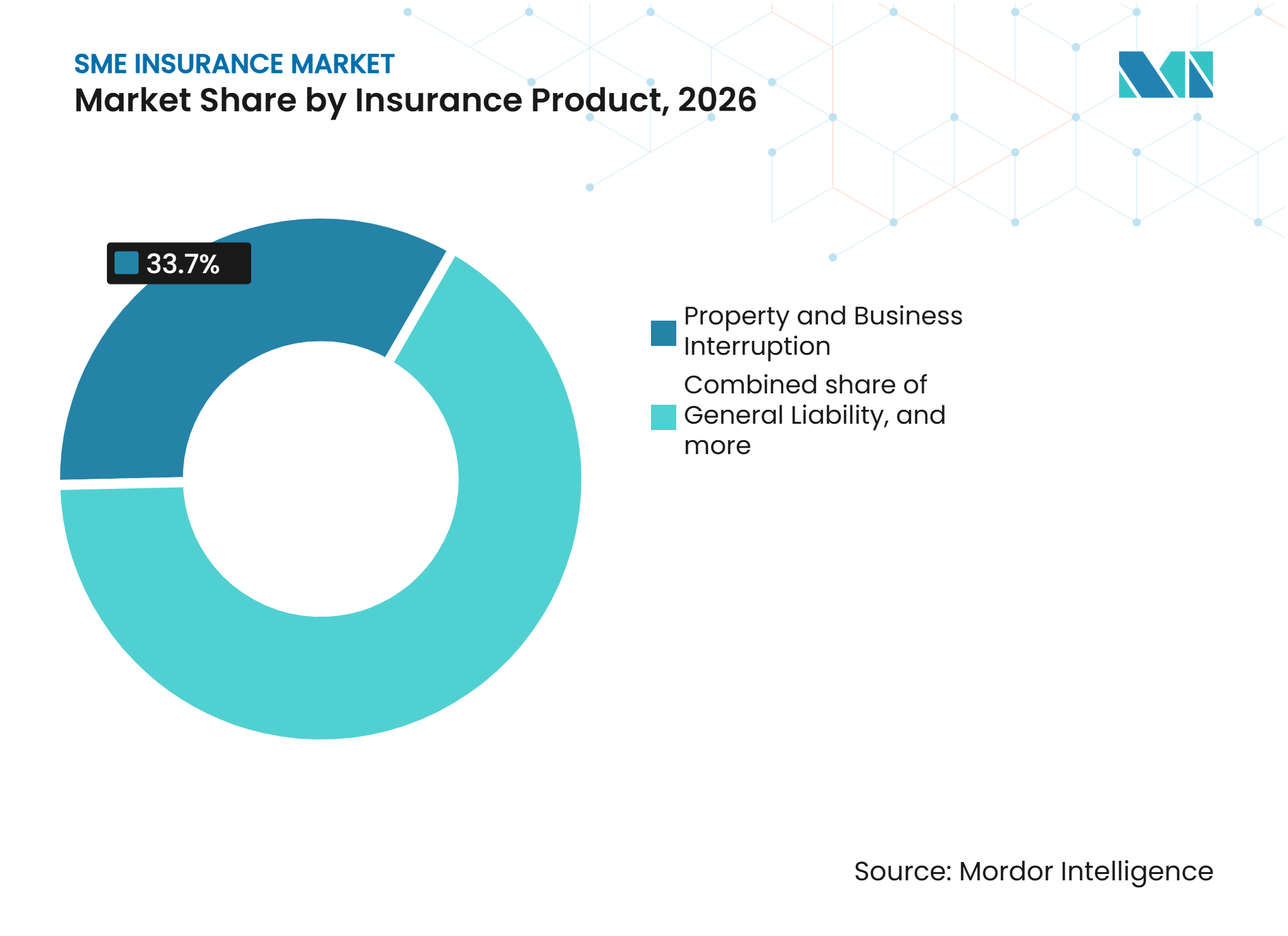
Physical Risk Anchors Scale While Cyber Leads GrowthProperty and business interruption held a 33.7% share in 2026. The segment remains central because smaller firms need protection for buildings, inventory, equipment, and income that can be interrupted after a covered event. Replacement-cost pressure has also made accurate insured values more important for many businesses. General liability, professional indemnity and errors and omissions, workers’ compensation and employers’ liability, commercial motor, and goods in transit remain core forms of protection. Together, these policies address the exposures that customers, regulators, lenders, and commercial partners often expect businesses to manage.
Cyber insurance is the fastest-growing product line, with the SME insurance market size for cyber insurance projected to expand at a 14.1% CAGR between 2027 and 2032. NEXT Insurance reported that cyber liability adoption among small businesses rose to 27% in 2025. Insureon also reported in 2026 that cyber insurance purchases among its customers had risen 59% from 2023 to 2025, although the earlier baseline is not used elsewhere in this rewrite. Cyber demand is supported by the operational impact of attacks, contractual requirements, and regulatory expectations. Specialty residual coverage also includes crime and fidelity, directors and officers liability, management liability, and surety and bonds. The SME insurance industry is increasingly treating cyber protection as a standard element in packages for digital and professional businesses.


By Enterprise Size:
Medium Enterprises Hold Scale While Micro Enterprises Grow FasterMedium enterprises held a 42.3% share in 2026. Their larger asset base and more complex operations often require multiple policies and higher limits than micro or small enterprises. They are also more likely to have formal purchasing processes and professional advice. These features support higher average premiums and greater insurance penetration. Medium businesses remain important for carriers that combine specialist underwriting with the ability to serve complex multi-line accounts.
Micro enterprises are projected to grow at a 6.8% CAGR from 2027 to 2032. Digital underwriting is improving the ability to serve small accounts where manual processing was once difficult to justify. J.D. Power found that the strongest year-over-year customer-satisfaction gains in its 2026 United States small commercial study came from micro businesses with fewer than 5 employees. Improvements in digital capability were a stated factor in this performance. As these customers develop, they can expand into small and medium enterprises and increase their coverage needs. The SME insurance industry can use this progression to build long-term customer relationships.
By Industry Vertical:
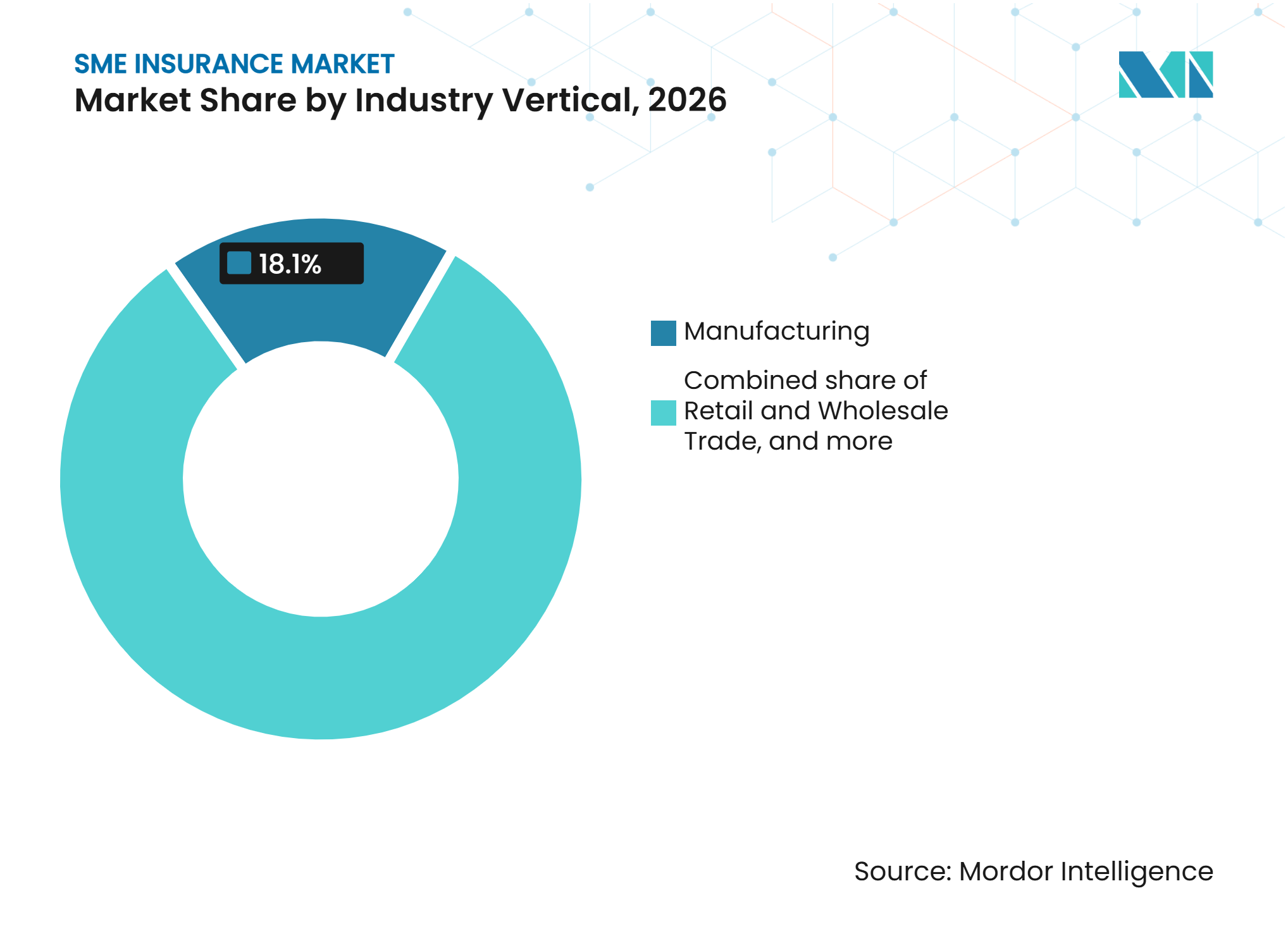
Manufacturing Holds the Largest Position While Professional Services ExpandManufacturing captured an 18.1% share in 2026. Manufacturers often require protection across property, product liability, machinery breakdown, commercial motor, goods in transit, and workers’ compensation. This multi-line risk profile can result in higher average premiums than in many service-based sectors. Government manufacturing programs and supply-chain investment can enlarge the base of smaller manufacturers in emerging economies. Retail and wholesale trade, construction, healthcare and social work, transportation and storage, accommodation and food service, agriculture, and other services complete the wider vertical landscape.
Professional, scientific, and technical services are projected to grow at a 6.1% CAGR from 2027 to 2032. CFC identified expanding service scopes, artificial intelligence-related professional liability, and packaged coverage as important themes for professional liability in 2026. These businesses may need errors and omissions, cyber, general liability, management liability, and technology coverage in one coordinated solution. The European Union Artificial Intelligence Act and professional licensing expectations can strengthen the need for more specific policy wording. The SME insurance market benefits when brokers and insurers make these risks understandable for firms that may not have dedicated risk managers.

By Distribution Channel:
Brokers Lead While Direct Sales Grow FasterInsurance brokers captured a 61.5% share in 2026. Brokers remain important for firms that need to compare policy terms, arrange several policies, or meet the requirements of a contract. Their role is especially relevant for medium enterprises and customers with complex property, liability, or specialty exposures. In the United Kingdom, small firms increasingly begin their search online but may still use a broker for purchase when the risk is more complex. The SME insurance market continues to rely on brokers for advice where digital self-service does not address the full coverage need.
Direct insurer sales are projected to grow at an 8.1% CAGR from 2027 to 2032. Carriers are investing in digital quote and bind systems that enable micro and small businesses to obtain straightforward coverage quickly. Bancassurance and embedded channels are also placing insurance offers within banking, payment, and accounting activities. These routes can improve convenience for firms that want simple policies and rapid proof of insurance. The SME insurance market will likely use a mix of direct, broker, and embedded approaches because customer needs differ by risk complexity. Distribution performance will depend on whether policy terms remain clear and service remains available when customers need it.
Geography Analysis
North America captured a 40.2% share in 2026. The region has a large commercial insurance base, with the United States providing a mature environment for brokers, carriers, managing general agents, and digital platforms. J.D. Power reported in 2026 that only one-third of United States small businesses saw a rate increase, which reflects active competition for suitable accounts. Canada also has a meaningful protection gap, which creates an opportunity for commercial lines digitization and improved small-business access to coverage. Mexico can benefit from manufacturing investment and the associated need for property, liability, and cargo protection among smaller suppliers.
Asia-Pacific is projected to grow at a 7.5% CAGR from 2027 to 2032. Allianz reported 9.3% insurance premium growth for Asia excluding Japan in 2024 and projected that India would sustain 10.5% annual growth over the following decade. India’s micro, small, and medium enterprise sector contributes 30% of gross domestic product and employs more than 110 million people, offering a large base for commercial coverage. China’s National Financial Regulatory Administration issued 2025 guidance for insurers to expand small-enterprise product portfolios, improve digital services, and simplify underwriting. Shanghai’s inclusive micro-enterprise program had provided CNY 11.3 billion (USD 1.6 billion) in protection to nearly 10,000 small businesses by May 2025. Asia-Pacific represents a key opportunity because digital business activity is growing while protection gaps remain substantial.
Europe remains important because cyber, operational resilience, and professional liability requirements are becoming more relevant for small firms and their supply-chain partners. Commercial insurance demand in Europe is supported by frameworks such as NIS2 and the Digital Operational Resilience Act, which raise attention to cyber and operational resilience. Allianz launched UnternehmensSchutz in Germany and Austria in January 2026 as a modular commercial product with 3 configurable packages covering fire, storm, theft, business interruption, and liability. The product targets Austria’s small and medium-sized enterprise base, which represents 99.7% of enterprises. South America and the Middle East and Africa remain less mature in aggregate, but embedded insurance and broader digital adoption create potential for first-time buyers. Mastercard and Hillcroft, also known as mTek, partnered in 2025 to bring embedded insurance to small and medium-sized enterprises across East Africa.
Competitive Landscape
Market Concentration
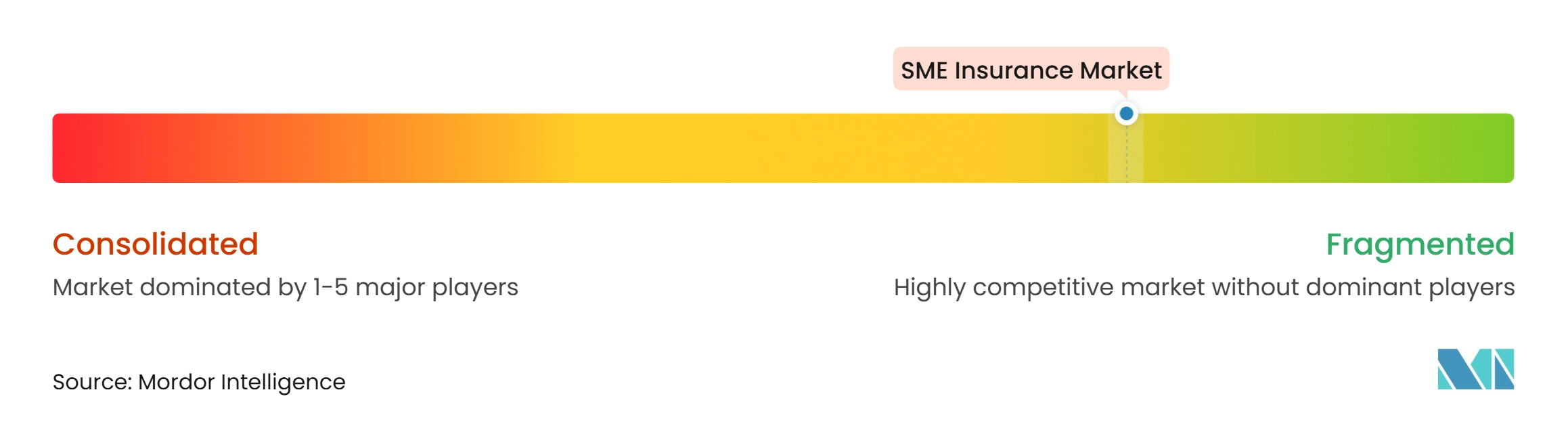
The SME insurance market is fragmented at local and regional levels, while scale is more concentrated among large carriers, reinsurers, and technology providers. Allianz, AXA, Chubb, Zurich, The Hartford, and Aviva compete through their established commercial insurance positions and growing digital capabilities. Hiscox, CNA Financial, AmTrust, Markel, and W. R. Berkley compete through specialized underwriting, sector experience, and claims capabilities. Competition increasingly depends on whether insurers can process straightforward risks efficiently while providing advice for complex medium-enterprise accounts. Munich Re’s primary insurance business completed the acquisition of NEXT Insurance in July 2025 for USD 2.6 billion, adding a fully digital carrier that serves more than 600,000 small business customers across more than 1,000 professions. This transaction shows interest in digital distribution and automated underwriting within the SME insurance market.
Leading companies are using partnerships and product changes to address distribution and coverage gaps. Allianz X made a strategic equity investment in Coterie Insurance in September 2025 and expanded the reinsurance relationship through Allianz Re. The Hartford added CyberChoice First Response to its ICON digital quoting and binding platform in September 2025, allowing agents to bind cyber coverage alongside its Spectrum business owner policy. Zurich Kotak General Insurance launched Business Secure Plus in India in 2025 as a digital modular proposition that combines several business covers on one platform. These examples show how insurers are combining technology, product design, and distribution relationships to reduce purchase friction. The SME insurance market is also seeing managing general agents and embedded platforms compete for micro and small enterprises that need simple, rapid coverage.
The remaining opportunity is concentrated among first-time buyers, digital businesses seeking non-damage business interruption protection, and professional or technology firms with evolving liability exposures. Insurers need to balance automation with policy explanations, data transparency, and reliable claims support. Regulatory requirements related to data protection, cyber reporting, and artificial intelligence can influence product wording and the information used in underwriting. The SME insurance market can remain competitive when carriers build distinct capabilities in either high-volume digital processing or specialist advisory support. No qualifying combined market-share figure for the leading insurers is available, so a concentration score cannot be assigned using the required methodology. The competitive structure should therefore be described as fragmented in local markets, with increasing strategic activity among global insurers and technology-focused participants.
SME Insurance Industry Leaders
-
Allianz SE
-
AXA S.A.
-
American International Group Inc.
-
Zurich Insurance Group Ltd.
-
The Travelers Companies Inc.
- *Disclaimer: Major Players sorted in no particular order
SME Insurance Market Companies Covered in this Report
- Allianz SE
- AXA S.A.
- American International Group, Inc.
- Zurich Insurance Group Ltd.
- The Travelers Companies, Inc.
- Chubb Limited
- CNA Financial Corporation
- The Hartford Financial Services Group, Inc.
- Liberty Mutual Insurance
- Nationwide Mutual Insurance Company
- The Progressive Corporation
- State Farm Mutual Automobile Insurance Company
- Berkshire Hathaway Inc.
- AmTrust Financial Services, Inc.
- ERGO NEXT Insurance
- Aviva plc
- MAPFRE S.A.
- Hiscox Ltd.
- QBE Insurance Group Limited
- Tokio Marine Holdings, Inc.
Recent Industry Developments in SME Insurance Market
- October 2026: Bluevine, the largest United States small business banking platform, partnered with Coverdash to embed commercial insurance directly into the Bluevine platform. Customers can quote, purchase, manage policies, and generate Certificates of Insurance across general liability, business owner policies, workers’ compensation, cyber, and commercial auto without leaving their banking environment, integrating coverage from over 40 commercial carriers.
- September 2026: Mosaic Insurance launched HALO, an artificial intelligence-enabled digital underwriting system for SME specialty lines, beginning with a Cyber Tech Errors and Omissions product accessible through North American wholesale broker partners. HALO receives submissions through email, application programming interfaces, or a portal, structures and enriches information, quotes eligible risks in minutes, and allows appetite and pricing recalibration within 24-48 hours.
- September 2025: The Hartford added CyberChoice First Response to its ICON digital quoting and binding platform, making cyber insurance available nationwide for small businesses alongside Spectrum business owner policies.
- September 2025: Allianz X made a strategic equity investment in Coterie Insurance and expanded its reinsurance relationship through Allianz Re. The deal supports Allianz’s position in the United States small- and medium-sized enterprise distribution ecosystem.
Global SME Insurance Market Report Scope
Segmentation Overview
| Property and Business Interruption |
| General Liability |
| Professional Indemnity / Errors & Omissions |
| Workers’ Compensation and Employers’ Liability |
| Commercial Motor and Goods in Transit |
| Specialty Residual (Cyber, Crime/Fidelity, SME D&O/Management Liability, Surety/Bonds, etc.) |
| Micro Enterprises |
| Small Enterprises |
| Medium Enterprises |
| Retail and Wholesale Trade |
| Manufacturing |
| Construction |
| Professional, Scientific and Technical Services |
| Healthcare and Social Work |
| Transportation and Storage |
| Accommodation and Food Service |
| Agriculture, Forestry and Fishing |
| Other Services and Residual |
| Insurance Brokers |
| Insurance Agents |
| Direct Insurer Sales |
| Bancassurance |
| Embedded, Affinity and Other Partnerships |
| North America | United States |
| Canada | |
| Mexico | |
| South America | Brazil |
| Argentina | |
| Rest of South America | |
| Europe | United Kingdom |
| Germany | |
| France | |
| Italy | |
| Spain | |
| Rest of Europe | |
| Asia-Pacific | China |
| India | |
| Japan | |
| Australia | |
| Rest of Asia-Pacific | |
| Middle East & Africa | United Arab Emirates |
| Saudi Arabia | |
| South Africa | |
| Rest of Middle East & Africa |
| By Insurance Product | Property and Business Interruption | |
| General Liability | ||
| Professional Indemnity / Errors & Omissions | ||
| Workers’ Compensation and Employers’ Liability | ||
| Commercial Motor and Goods in Transit | ||
| Specialty Residual (Cyber, Crime/Fidelity, SME D&O/Management Liability, Surety/Bonds, etc.) | ||
| By Enterprise Size | Micro Enterprises | |
| Small Enterprises | ||
| Medium Enterprises | ||
| By Industry Vertical | Retail and Wholesale Trade | |
| Manufacturing | ||
| Construction | ||
| Professional, Scientific and Technical Services | ||
| Healthcare and Social Work | ||
| Transportation and Storage | ||
| Accommodation and Food Service | ||
| Agriculture, Forestry and Fishing | ||
| Other Services and Residual | ||
| By Distribution Channel | Insurance Brokers | |
| Insurance Agents | ||
| Direct Insurer Sales | ||
| Bancassurance | ||
| Embedded, Affinity and Other Partnerships | ||
| By Geography | North America | United States |
| Canada | ||
| Mexico | ||
| South America | Brazil | |
| Argentina | ||
| Rest of South America | ||
| Europe | United Kingdom | |
| Germany | ||
| France | ||
| Italy | ||
| Spain | ||
| Rest of Europe | ||
| Asia-Pacific | China | |
| India | ||
| Japan | ||
| Australia | ||
| Rest of Asia-Pacific | ||
| Middle East & Africa | United Arab Emirates | |
| Saudi Arabia | ||
| South Africa | ||
| Rest of Middle East & Africa | ||
Key Questions Answered in the Report
What is the projected growth rate for SME insurance through 2032?
The SME insurance market is projected to grow at a 5.3% CAGR from 2027 to 2032 and reach USD 559.1 billion by 2032.
Which insurance product is growing fastest for small and medium-sized enterprises?
Cyber insurance is the fastest-growing product line, with a projected CAGR of 14.1% through 2032.
Why do smaller businesses need cyber insurance?
Hiscox found that 59% of surveyed SMEs experienced a cyberattack in the preceding 12 months in 2025, while cyber coverage can address response, liability, and interruption costs.
Which enterprise size has the largest share of SME insurance demand?
Medium enterprises held the largest share at 42.3% in 2026, reflecting their higher average premiums and more complex multi-line coverage needs.
Which region is growing fastest for SME coverage?
Asia-Pacific is projected to grow at a 7.5% CAGR through 2032, supported by business formalization, digital distribution, and a large protection gap.
How are insurers making coverage easier to purchase?
Insurers are using digital underwriting, broker platforms, banking partnerships, and payment integrations to simplify quotes, policy issuance, and servicing.