
Smart Factory Vision Systems Market Size and Share
Market Overview
| Study Period | 2020 - 2031 |
|---|---|
| Market Size (2026) | USD 21.13 Billion |
| Market Size (2031) | USD 34.33 Billion |
| Growth Rate (2026 - 2031) | 10.19 % |
| Fastest Growing Market | Asia-Pacific |
| Largest Market | Asia-Pacific |
| Market Concentration | Low |
Major Players *Disclaimer: Major Players sorted in no particular order Image © Mordor Intelligence. Reuse requires attribution under CC BY 4.0. | |
Smart Factory Vision Systems Market Analysis by Mordor Intelligence
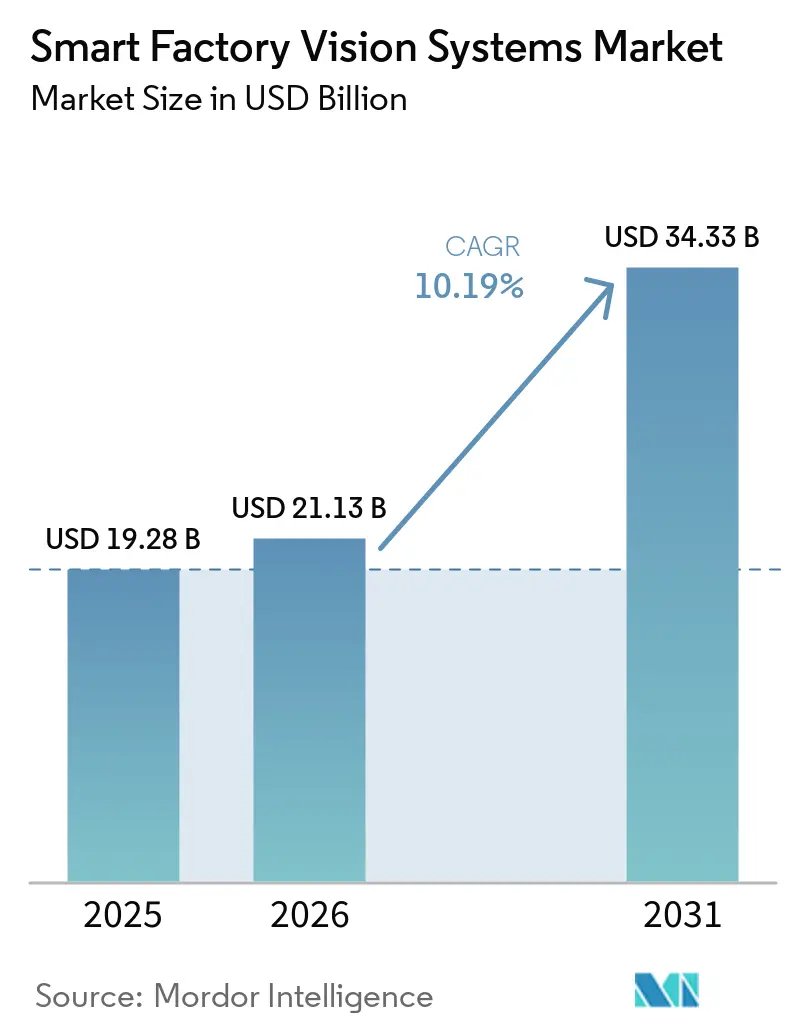
The Smart Factory Vision Systems Market size was valued at USD 19.28 billion in 2025 and estimated to grow from USD 21.13 billion in 2026 to reach USD 34.33 billion by 2031, at a CAGR of 10.19% during the forecast period (2026-2031). The Smart Factory Vision Systems Market is moving from stand-alone inspection equipment toward connected tools that support quality control, traceability, and robot guidance on production lines. Improved deep learning methods are expanding the range of defects that automated inspection can identify, including difficult surface and semiconductor defects. New electric vehicle battery plants and semiconductor fabs require more inspection points and higher precision, which supports demand for advanced systems. Vendors are responding by combining cameras, edge computing, software, and deployment support into integrated offerings. The Smart Factory Vision Systems Market also faces higher cybersecurity and integration requirements as connected systems join operational technology networks and use industrial communication standards.
Key Report Takeaways
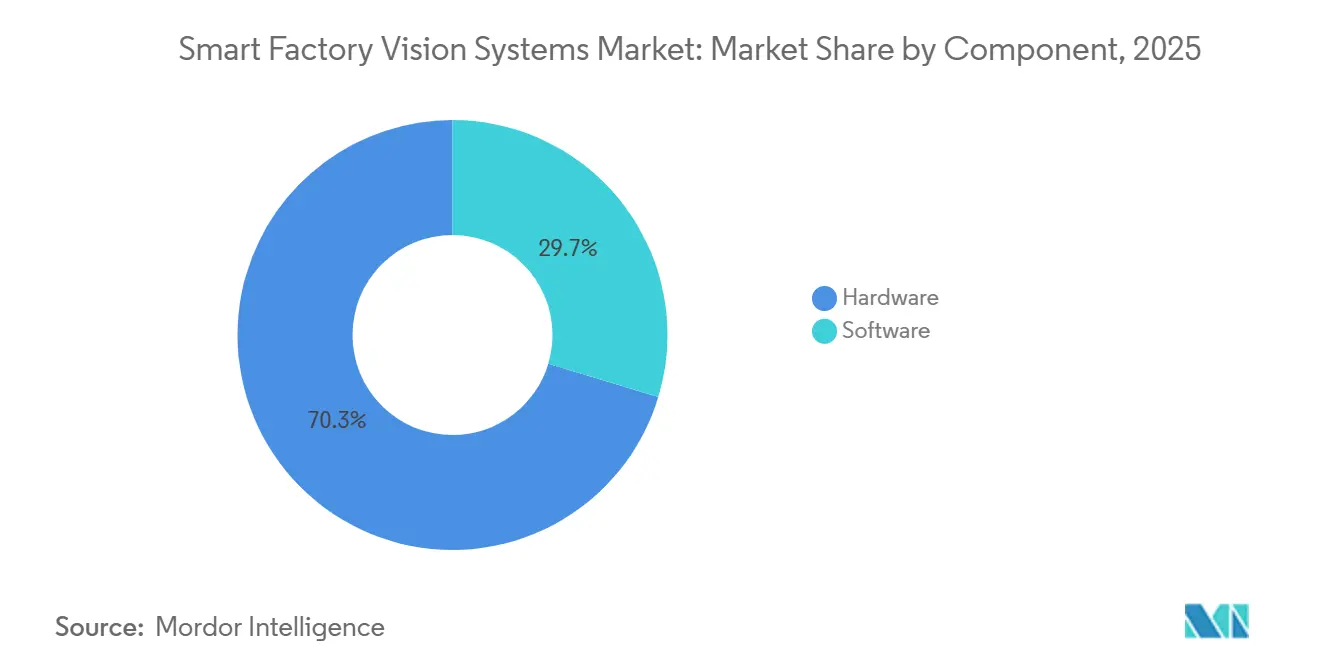
- By component, hardware held 70.34% of the Smart Factory Vision Systems Market share in 2025, while software is forecast to grow at an 11.45% CAGR through 2031.
- By vision system type, 2D vision systems held 63.78% of the Smart Factory Vision Systems Market share in 2025, while 3D vision systems are forecast to grow at an 11.91% CAGR through 2031.
- By deployment mode, edge-based deployment held 34.21% of the Smart Factory Vision Systems Market share in 2025 and is forecast to grow at an 11.23% CAGR through 2031.
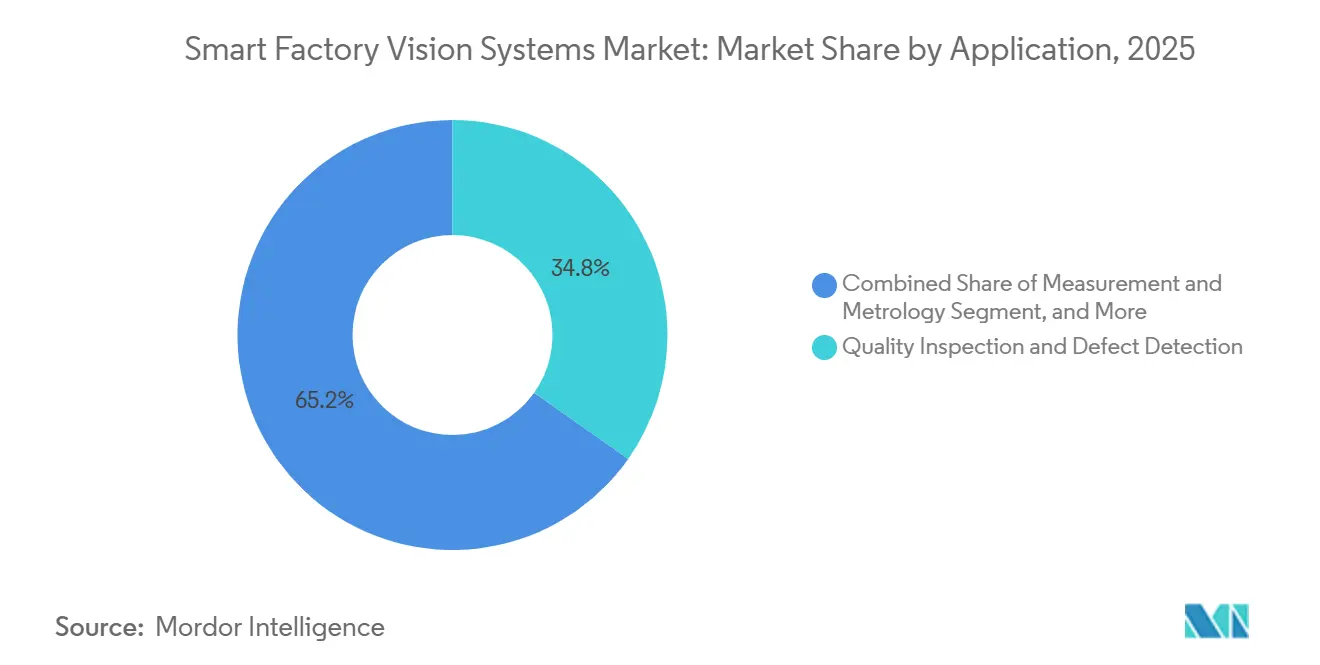
- By application, quality inspection and defect detection held 34.78% of the Smart Factory Vision Systems Market share in 2025, while positioning, guidance, and robotics are forecast to grow at an 11.76% CAGR through 2031.
- By end-user industry, automotive and automotive components held 24.19% of the Smart Factory Vision Systems Market share in 2025, while electronics and semiconductors are forecast to grow at an 11.87% CAGR through 2031.
- By geography, Asia-Pacific held 34.21% of the Smart Factory Vision Systems Market share in 2025 and is forecast to grow at an 11.56% CAGR through 2031.
Note: Market size and forecast figures in this report are generated using Mordor Intelligence’s proprietary estimation framework, updated with the latest available data and insights as of January 2026.
Market Trends and Insights
Drivers Impact Analysis of Smart Factory Vision Systems Market*
| Driver | (~) % Impact on CAGR Forecast | Geographic Relevance | Impact Timeline |
|---|---|---|---|
| Deep Learning Accuracy in Defect Detection | +2.4% | Global, with concentration in East Asia and Germany | Short term (≤ 2 years) |
| Expansion of EV Battery and Semiconductor Manufacturing | +1.8% | Asia-Pacific core, North America and Europe spillover | Medium term (2-4 years) |
| Declining Edge AI Hardware Costs | +1.5% | Global, with strongest adoption in ASEAN and India | Short term (≤ 2 years) |
| Labor Shortages in Quality Inspection Roles | +1.1% | North America, Europe, Japan, and South Korea | Medium term (2-4 years) |
| Vision-Guided Robotics Adoption | +0.7% | Global, with early concentration in automotive corridors | Medium term (2-4 years) |
| Traceability Requirements in Food, Pharmaceutical, and Medical Manufacturing | +0.5% | European Union and North America | Long term (≥ 4 years) |
| Source: Mordor Intelligence | |||
Deep Learning Accuracy in Defect Detection
Deep learning has become more suitable for factory inspection, where defect patterns vary by shape, surface, or product design. Hybrid CNN-transformer models performed better than pure CNN models by 2.8 to 12.6 percentage points in complex defect tasks in a 2026 review. The findings covered defects such as irregular cracks, semiconductor failures, and electrode pinholes.[1]Springer Nature. “A Systematic Review of Deep Learning Based Machine Vision for Quality Control in Industry 4.0.” Discover Mechanical Engineering, July 29, 2026. link.springer.com This capability gives manufacturers a stronger reason to use the Smart Factory Vision Systems Market for tasks that rule-based inspection cannot handle consistently. Human review remains important for unclear cases, supporting hybrid inspection cells rather than complete labor replacement. Suppliers that offer model training and continuous improvement tools are better placed to support these operating models.
Expansion of EV Battery and Semiconductor Manufacturing
Electric vehicle battery and semiconductor facilities need more inspection steps than many conventional production lines. The International Federation of Robotics reported 590,000 industrial robot installations worldwide in 2024, and Asia accounted for 70% of new installations. Robot cells often need vision guidance for picking, placement, and assembly checks.[2]International Federation of Robotics. “Record 3 Million Robots Work in Factories Around the Globe.” 2024. ifr.org Semiconductor manufacturing also requires close inspection of wafers, coatings, and packaging. The European Chips Act has directed EUR 43 billion of public and private policy support toward European semiconductor capacity. These investments broaden the Smart Factory Vision Systems Market opportunity for suppliers capable of meeting semiconductor qualification and repeatability requirements.[3]European Commission. “European Chips Act.” 2024. commission.europa.eu
Declining Edge AI Hardware Costs
Lower-cost edge processors are making it easier to run image analysis close to the production line. Cognex launched the In-Sight 3900 on May 5, 2026, with Qualcomm Dragonwing processing, up to 25-megapixel imaging, and processing speeds up to 4 times faster than its predecessor. The system does not require an external PC, which can reduce equipment, validation, and maintenance needs. Advantech also introduced edge AI platforms that support input from 16 cameras and deliver 100 TOPS of inference throughput.[4]Advantech. “Advantech Unveils Edge AI Solutions Accelerated by NVIDIA Jetson Thor for Robotics, Medical AI, and Data Intelligence.” 2026. advantech.com As routine classification moves to camera-level or local processing, demand shifts toward software that manages models and connects systems. This change gives the Smart Factory Vision Systems Market a stronger recurring software opportunity.
Labor Shortages in Quality Inspection Roles
Manufacturers are using automated inspection to reduce reliance on manual visual checks. This need is especially relevant in North America, Europe, Japan, and South Korea, where production teams face pressure to maintain output with limited skilled labor. Mitsubishi Electric and Sony Semiconductor Solutions agreed on July 22, 2026, to establish Advanced Vision Solutions Co., Ltd. in Yokohama. Mitsubishi Electric holds 60%, and Sony Semiconductor Solutions holds 40% in the planned venture. Operations are planned to begin in October 2026, with a focus on AI-equipped vision sensors for labor-saving and unmanned manufacturing. The Smart Factory Vision Systems Market benefits when suppliers can offer systems that work without specialized optical or AI expertise.
Restraints Impact Analysis of Smart Factory Vision Systems Market*
| Restraint | (~) % Impact on CAGR Forecast | Geographic Relevance | Impact Timeline |
|---|---|---|---|
| High Implementation and Integration Costs | -0.9% | Global, most acute in South America, Middle East, and Africa | Medium term (2-4 years) |
| Shortage of Skilled Vision-System Integrators | -0.6% | North America, Europe, India, and ASEAN | Long term (≥ 4 years) |
| Cybersecurity Risks in Connected Vision Systems | -0.3% | Global, with stronger compliance pressure in the European Union and U.S. federal markets | Medium term (2-4 years) |
| Training-Data, Model-Validation, and Model-Drift Burden | -0.2% | Global, concentrated in high-mix and low-volume manufacturing | Long term (≥ 4 years) |
| Source: Mordor Intelligence | |||
High Implementation and Integration Costs
A production-grade vision installation requires more than cameras and software. Costs can include lighting design, lens selection, fixtures, communications mapping, and validation for existing PLC and manufacturing execution systems. Food, beverage, and pharmaceutical sites may require additional design work due to hygiene, ingress protection, and product changeover requirements. Safety and recordkeeping requirements can also add documentation and extend installation periods. These costs are difficult for smaller manufacturers that do not employ dedicated machine vision teams. Simpler platforms such as Cognex In-Sight SnAPP sensors and SICK Inspector83x systems are therefore relevant to the Smart Factory Vision Systems Market because they reduce setup complexity.
Shortage of Skilled Vision-System Integrators
Qualified integrators are needed to match optics, lighting, camera settings, and algorithms with a manufacturer’s defect requirements. The available pool has not grown as quickly as demand from automotive electrification, semiconductor capacity projects, and food safety compliance. This shortage can extend project schedules and raise labor costs. It also makes deployment risk more difficult for manufacturers with limited in-house engineering resources. Vertically integrated suppliers can reduce this issue by combining hardware with trained models, setup tools, and remote deployment workflows. The Smart Factory Vision Systems Market, therefore, favors providers that absorb more technical work within their products and services.
*Our forecasts treat driver/restraint impacts as directional, not additive. The impact forecasts reflect baseline growth, mix effects, and variable interactions.
Smart Factory Vision Systems Market Segment Analysis
By Component:
Software Expands Value CreationHardware held 70.34% of the Smart Factory Vision Systems Market share in 2025. The category includes cameras, optics, frame grabbers, processors, and edge AI accelerators. Cameras remained the largest hardware subcategory because every system requires image capture. Processors and edge accelerators are growing in popularity as manufacturers add inference capabilities to installed camera platforms. Software is projected to grow at an 11.45% CAGR from 2026 to 2031, faster than the overall Smart Factory Vision Systems Market. This growth reflects increasing demand for image processing, deep learning tools, and integration middleware.
Cognex made OneVision generally available in 2025 after a beta launch in June 2025. More than 100 customers used the platform during its beta period for centralized model training and cross-site edge deployment. Software can help manufacturers update inspection models across multiple plants without replacing all camera hardware. Traditional image processing continues to compete on predictable output and license cost. AI tools command attention, but users also need annotation, model version control, synthetic data, and deployment management. Integration software is also gaining importance because camera output must connect with PLC, MES, and SCADA systems. The Smart Factory Vision Systems industry is therefore shifting part of its value toward software support that extends beyond the initial hardware sale.


By Vision System Type:
3D Use Broadens Beyond Automotive2D vision systems held 63.78% of the Smart Factory Vision Systems Market share in 2025. They remain widely used for flat-surface inspection, barcode reading, and label verification. Their installed base, broad application range, and cost profile support their continuing lead. 3D vision systems are forecast to grow at an 11.91% CAGR through 2031. Battery cell inspection needs depth data for electrode alignment that conventional 2D images cannot resolve. Robotic bin-picking also uses 3D point clouds to identify the position and orientation of parts.
LMI Technologies acquired Liberty Robotics in August 2024 to combine 3D vision with robot guidance capabilities for automotive, packaging, and logistics applications. Multispectral and hyperspectral systems are used for selected applications in pharmaceutical coating checks, semiconductor thin-film mapping, and food foreign-body detection. Thermal and infrared systems focus on temperature-related inspection, including soldering defects, bearing overheating, and cold-chain verification. Teledyne FLIR IIS launched its Forge 1GigE SWIR camera series in August 2024 for industrial inspection, environmental monitoring, and recycling classification. These systems can distinguish materials that look similar in visible light. The Smart Factory Vision Systems Market is consequently expanding into applications that require depth, thermal, or spectral information alongside standard images.
By Deployment Mode:
Edge Architecture Gains PriorityEdge-based deployment held 34.21% of the Smart Factory Vision Systems Market share in 2025. It is also the fastest-growing deployment mode, with an 11.23% CAGR projected through 2031. Edge systems analyze images near the equipment, enabling rapid inspection decisions and reducing reliance on a central server. Smaller processors and smart cameras have made this approach more practical for a larger range of manufacturers. This combination of adoption and growth shows that local inference is becoming a common architecture choice. The Smart Factory Vision Systems Market continues to use other deployment models where their technical requirements are stronger.
On-premises systems remain useful when users train models on large proprietary datasets or synchronize many high-resolution cameras. Cloud-connected systems support model management, cross-site analysis, and broader anomaly review rather than real-time inspection decisions. Hybrid systems combine local inference with centralized model governance and over-the-air updates. Cognex OneVision follows this approach by combining edge execution with centralized training and site deployment. Connected designs also expand cybersecurity responsibilities at the operational technology-information technology boundary. Suppliers must therefore make security, documentation, and system compatibility part of their Smart Factory Vision Systems industry offering.
By Application:
Robotics Supports Guidance DemandQuality inspection and defect detection held 34.78% of the Smart Factory Vision Systems Market share in 2025. The application is used across automotive, electronics, food, and pharmaceutical production. A single line can include many inspection cameras that examine different defect types at separate stages. Positioning, guidance, and robotics are forecast to grow at an 11.76% CAGR through 2031. This use case benefits from increased robot installations and the need to verify component placement. Vision-guided robotic systems also require the coordinated integration of motion, camera, and control systems.
Measurement and metrology systems can supplement coordinate measuring machines in high-throughput settings. Identification, optical character recognition, and code reading support pharmaceutical serialization, food lot coding, and automotive part tracking. KEYENCE partnered with Extensiv in October 2024 to provide mobile scanning solutions for third-party logistics operators. This shows how identification capabilities can move beyond fixed production stations. Process monitoring and control use continuous imaging to detect drift before the production of a defective finished product. The Smart Factory Vision Systems Market gains value when systems are supplied as coordinated hardware-and-software packages that reduce multivendor commissioning effort.

By End-User Industry:
Electronics and Semiconductors Lead GrowthAutomotive and automotive components held 24.19% of the Smart Factory Vision Systems Market share in 2025. The sector has long used automated inspection, robot guidance, and vehicle identification systems. Electric vehicle production adds battery cell, module assembly, and high-voltage connector checks. These new requirements create both retrofit and new-plant demand for vision systems. Electronics and semiconductors are forecast to grow at an 11.87% CAGR through 2031. Advanced chip production requires high-resolution and hyperspectral systems for wafer and packaging inspection.
Food and beverage manufacturers use vision systems for foreign-body detection, fill-level checks, label compliance, and date-code reading. Pharmaceutical and life sciences facilities use AI-supported serialization, blister-pack inspection, and injectable vial inspection. Consumer goods, industrial machinery, and equipment represent volume demand for cost-sensitive 2D systems. Metals and manufacturing users are adopting in-process 3D metrology to identify dimensional issues before scrap accumulates. The European Chips Act has supported additional investment in semiconductor capacity, with implications for demand for inspection equipment. The Smart Factory Vision Systems industry serves both high-volume standard inspection and specialized applications that require more precise measurement.
Geography Analysis
APAC Smart Factory Vision Systems Market
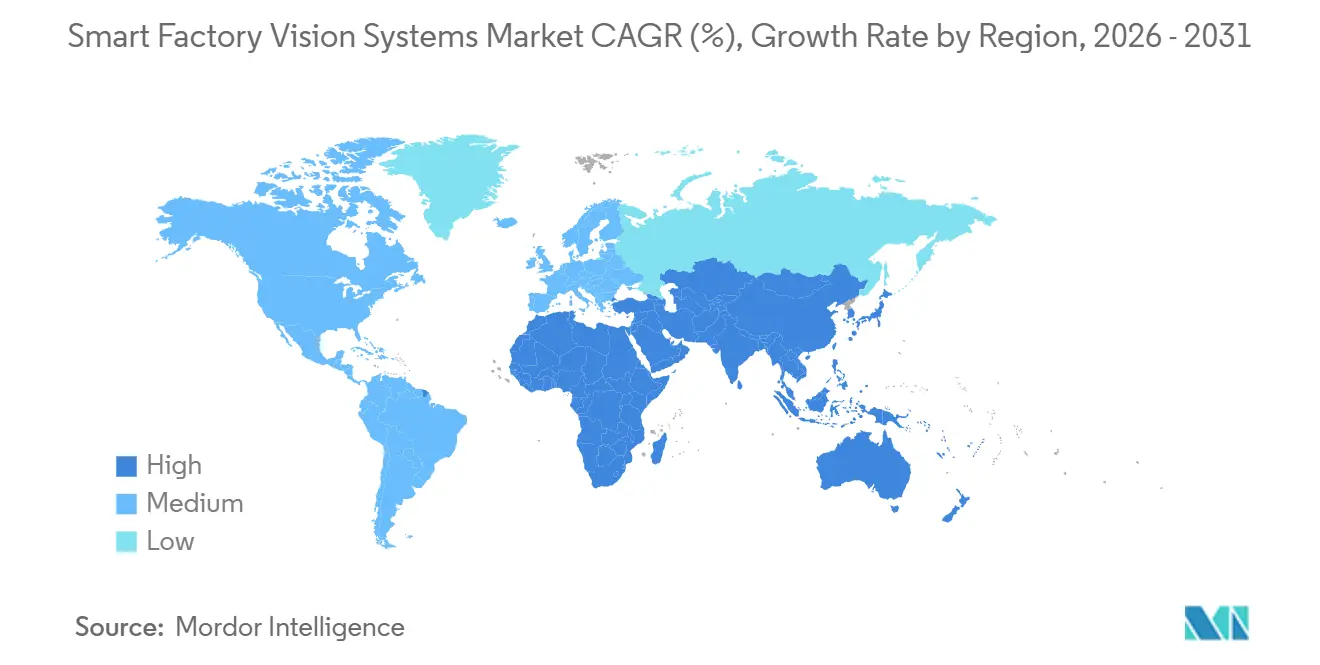
Asia-Pacific held 34.21% of the Smart Factory Vision Systems Market share in 2025 and is forecast to grow at an 11.56% CAGR through 2031. China is the largest national market in the region, supported by domestic suppliers of edge cameras and image processing software. Japanese and South Korean manufacturers retain importance in high-precision optics and imaging sensors. Mitsubishi Electric and Sony Semiconductor Solutions agreed in July 2026 to establish Advanced Vision Solutions in Japan, bringing together expertise in factory automation control, image sensors, and edge AI technology. India’s Production Linked Incentive program is supporting new electronics manufacturing capacity, which creates greenfield opportunities for vision deployment. These conditions reinforce Asia-Pacific’s role in the Smart Factory Vision Systems Market.
North America Smart Factory Vision Systems Market
North America is supported by automotive assembly, semiconductor inspection, and logistics automation. The U.S. CHIPS and Science Act has encouraged investment in facilities where 2D and 3D vision systems can be specified at the design stage. Cognex reported USD 268 million in first-quarter 2026 revenue, a 24% year-over-year increase, and cited strength in consumer electronics and automotive end markets. Canada and Mexico are linked to the region’s automotive supply chain and follow original equipment manufacturer capacity decisions. Demand often centers on high-specification systems for wafer, vehicle, and warehouse applications. The Smart Factory Vision Systems Market in North America is, therefore, closely tied to capital investment cycles in these sectors.
EMEA and South America Smart Factory Vision Systems Market
Europe is shaped by advanced industrial automation and stricter documentation requirements. Germany is the leading European market and is home to Basler, IDS Imaging Development Systems, and MVTec Software. The European Union’s AI rules add emphasis on training data, validation, and software documentation for certain regulated applications. These requirements can favor suppliers that provide consistent records across cameras, software, and connected equipment. South America, the Middle East, and Africa remain earlier-stage areas where adoption is concentrated in food processing, mining, logistics, and investment-led industrial projects. Brazil’s São Paulo automotive cluster and Abu Dhabi's industrial programs offer established demand corridors.

Competitive Landscape
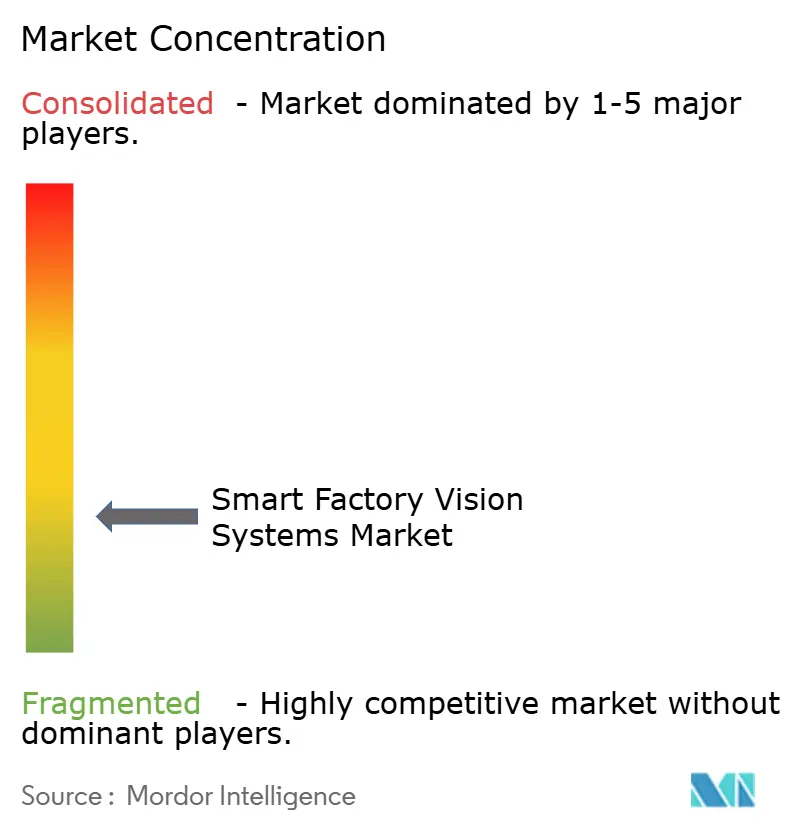
The Smart Factory Vision Systems Market has fragmentation at the platform level. Cognex and KEYENCE have strong positions through their software, product ecosystems, and application experience. European and Asian camera suppliers compete through sensor performance, interfaces, and vertical specialization. Cognex launched two AI compute architectures in 2026, including the NVIDIA-powered In-Sight 6900 and the Qualcomm Dragonwing-powered In-Sight 3900. The two products serve advanced and cost-sensitive embedded AI requirements. This product approach shows how suppliers are tailoring compute capability to different inspection tasks.
Basler acquired a 25.1% stake in 3D specialist Roboception to expand its position in vision software and robotic integration. The move reflects pressure on camera vendors to build services and applications around their hardware. TKH Group coordinates Allied Vision, Chromasens, and Euresys across cameras, software, and frame grabbers as a broader systems offering. Zivid and Photoneo, now part of Zebra Technologies, compete in 3D robot guidance with systems designed for robot integration. Zebra announced its intent to acquire Photoneo in December 2024 to expand its 3D machine vision portfolio. The Smart Factory Vision Systems Market rewards suppliers that reduce the technical burden of deploying 3D systems.
Opportunities remain among smaller manufacturers that cannot take on high integration costs. Suppliers also have room to develop certified modules that combine 2D, 3D, and thermal imaging. AI model governance is becoming more relevant as users manage more product variants and changing production conditions. SICK partnered with Aicadium in May 2024 to develop AI computer vision offerings for Singapore and Southeast Asia. Security compliance is another point of competition for connected controllers. The Smart Factory Vision Systems industry is likely to favor companies that combine reliable hardware, practical software tools, and documented cybersecurity processes.
Smart Factory Vision Systems Industry Leaders
Cognex Corporation
KEYENCE CORPORATION
Basler AG
Teledyne Technologies Incorporated
SICK AG
- *Disclaimer: Major Players sorted in no particular order
Smart Factory Vision Systems Market Companies Covered in this Report
- Cognex Corporation
- KEYENCE CORPORATION
- Basler AG
- Teledyne Technologies Incorporated
- SICK AG
- Allied Vision Technologies GmbH
- IDS Imaging Development Systems GmbH
- JAI A/S
- LMI Technologies Inc.
- Datalogic S.p.A.
- Baumer Holding AG
- Euresys S.A.
- Photonfocus AG
- Chromasens GmbH
- Vieworks Co., Ltd.
- Zivid AS
- Photoneo s.r.o.
- SPECIM Spectral Imaging Ltd.
- Vision Components GmbH
- Emergent Vision Technologies Inc.
- Adimec Electronic Imaging B.V.
- Imperx, Inc.
- LUCID Vision Labs Inc.
- FLIR Systems, Inc.

Recent Industry Developments in Smart Factory Vision Systems Market
- July 2026: Mitsubishi Electric Corp. and Sony Semiconductor Solutions Corp. signed a strategic cooperation agreement on July 22, 2026, to establish Advanced Vision Solutions Co., Ltd. in Yokohama, Japan. Mitsubishi Electric holds a 60% equity stake and Sony Semiconductor Solutions holds 40%. The joint venture combines Mitsubishi Electric's factory automation control expertise with Sony's image-sensor and edge AI technology to develop AI-equipped vision sensor solutions for labor-saving and unmanned manufacturing operations. Business operations are planned to commence in October 2026.
- May 2026: Cognex Corporation launched the In-Sight 3900 Vision System on May 5, 2026, its highest-performance embedded AI vision system powered by Qualcomm Dragonwing platforms. The system delivers up to 4 times faster processing than its predecessor, supports imaging resolutions up to 25 megapixels, and operates without an external PC.
- May 2026: Cognex Corporation reported Q1 2026 revenue of USD 268 million, a 24% year-over-year increase. Operating income rose 131% to USD 60 million and adjusted EBITDA margin expanded to 26.9%. The company also introduced the NVIDIA-powered In-Sight 6900 for advanced inspection applications.
- May 2026: The world's first IEC 62443-4-2:2026-certified industrial vision controller received its certificate from TÜV Rheinland on May 4, 2026, entering mass production on the same date. The certification covers 17 cybersecurity development-lifecycle activities including threat modeling, secure coding, and post-deployment vulnerability management, and is functioning as a de facto market-access prerequisite for smart cameras and embedded vision processing units in German, French, and Italian industrial markets.


Global Smart Factory Vision Systems Market Report Scope
The Smart Factory Vision Systems Market refers to advanced imaging and processing technologies used to automate visual inspection, measurement, and guidance in manufacturing environments. These systems integrate cameras, optics, and AI-powered software deployed via edge, cloud, or on-premises models to perform tasks like defect detection, code reading, and robotic guidance. They are essential for industries such as automotive, electronics, and pharmaceuticals to enhance production quality, reduce human error, and enable real-time process control.
The Smart Factory Vision Systems Market Report is Segmented by Component (Hardware (Cameras, Optics and Lenses, Frame Grabbers, Processors and Edge AI Accelerators, and Other Hardware) and Software (Image Processing Software, Deep Learning and Artificial Intelligence Software, Vision System Integration Software, and Other Software)), Vision System Type (2D Vision Systems, 3D Vision Systems, Multispectral / Hyperspectral Vision Systems, Thermal / Infrared Vision Systems, and Other Vision Systems), Deployment Mode (Edge-Based, On-Premises, Cloud-Connected, and Hybrid), Application (Quality Inspection and Defect Detection, Measurement and Metrology, Identification, OCR, and Code Reading, Positioning, Guidance, and Robotics, Process Monitoring and Control, and Other Applications), End-User Industry (Automotive and Automotive Components, Electronics and Semiconductors, Food and Beverage, Pharmaceuticals and Life Sciences, Consumer Goods, Industrial Machinery and Equipment, Metals and Manufacturing, and Other End-User Industries), and Geography (North America, South America, Europe, Asia-Pacific, and Middle East and Africa). The Market Forecasts are Provided in Terms of Value (USD).
| Hardware | Cameras |
| Optics and Lenses | |
| Frame Grabbers | |
| Processors and Edge AI Accelerators | |
| Other Hardware | |
| Software | Image Processing Software |
| Deep Learning and Artificial Intelligence Software | |
| Vision System Integration Software | |
| Other Software |
| 2D Vision Systems |
| 3D Vision Systems |
| Multispectral / Hyperspectral Vision Systems |
| Thermal / Infrared Vision Systems |
| Other Vision Systems |
| Edge-Based |
| On-Premises |
| Cloud-Connected |
| Hybrid |
| Quality Inspection and Defect Detection |
| Measurement and Metrology |
| Identification, OCR, and Code Reading |
| Positioning, Guidance, and Robotics |
| Process Monitoring and Control |
| Other Applications |
| Automotive and Automotive Components |
| Electronics and Semiconductors |
| Food and Beverage |
| Pharmaceuticals and Life Sciences |
| Consumer Goods |
| Industrial Machinery and Equipment |
| Metals and Manufacturing |
| Other End-User Industries |
| North America | United States | |
| Canada | ||
| Mexico | ||
| South America | Brazil | |
| Argentina | ||
| Rest of South America | ||
| Europe | Germany | |
| United Kingdom | ||
| France | ||
| Italy | ||
| Spain | ||
| Rest of Europe | ||
| Asia-Pacific | China | |
| Japan | ||
| India | ||
| South Korea | ||
| Rest of Asia-Pacific | ||
| Middle East and Africa | Middle East | Saudi Arabia |
| United Arab Emirates | ||
| Rest of the Middle East | ||
| Africa | South Africa | |
| Rest of Africa | ||
| By Component | Hardware | Cameras | |
| Optics and Lenses | |||
| Frame Grabbers | |||
| Processors and Edge AI Accelerators | |||
| Other Hardware | |||
| Software | Image Processing Software | ||
| Deep Learning and Artificial Intelligence Software | |||
| Vision System Integration Software | |||
| Other Software | |||
| By Vision System Type | 2D Vision Systems | ||
| 3D Vision Systems | |||
| Multispectral / Hyperspectral Vision Systems | |||
| Thermal / Infrared Vision Systems | |||
| Other Vision Systems | |||
| By Deployment Mode | Edge-Based | ||
| On-Premises | |||
| Cloud-Connected | |||
| Hybrid | |||
| By Application | Quality Inspection and Defect Detection | ||
| Measurement and Metrology | |||
| Identification, OCR, and Code Reading | |||
| Positioning, Guidance, and Robotics | |||
| Process Monitoring and Control | |||
| Other Applications | |||
| By End-User Industry | Automotive and Automotive Components | ||
| Electronics and Semiconductors | |||
| Food and Beverage | |||
| Pharmaceuticals and Life Sciences | |||
| Consumer Goods | |||
| Industrial Machinery and Equipment | |||
| Metals and Manufacturing | |||
| Other End-User Industries | |||
| By Geography | North America | United States | |
| Canada | |||
| Mexico | |||
| South America | Brazil | ||
| Argentina | |||
| Rest of South America | |||
| Europe | Germany | ||
| United Kingdom | |||
| France | |||
| Italy | |||
| Spain | |||
| Rest of Europe | |||
| Asia-Pacific | China | ||
| Japan | |||
| India | |||
| South Korea | |||
| Rest of Asia-Pacific | |||
| Middle East and Africa | Middle East | Saudi Arabia | |
| United Arab Emirates | |||
| Rest of the Middle East | |||
| Africa | South Africa | ||
| Rest of Africa | |||


Key Questions Answered in the Report
What is the Smart Factory Vision Systems Market size?
The Smart Factory Vision Systems Market is estimated at USD 21.13 billion in 2026 and is forecast to reach USD 34.33 billion by 2031, at a 10.19% CAGR.
What is driving demand for smart factory vision systems?
Deep learning accuracy, expansion of battery and semiconductor production, lower edge AI hardware costs, and labor shortages are supporting adoption.
Which component is growing fastest in smart factory vision systems?
Software is forecast to grow at an 11.45% CAGR through 2031 as manufacturers invest in model training, management, and cross-site deployment.
Which vision system type is growing fastest?
3D vision systems are forecast to grow at an 11.91% CAGR through 2031, supported by battery inspection and robotic bin-picking needs.
Which region leads smart factory vision systems?
Asia-Pacific held 34.21% share in 2025 and is forecast to grow at an 11.56% CAGR through 2031.
Why are edge-based systems gaining adoption?
Edge-based systems process images close to the production line, supporting rapid decisions while reducing dependence on external PCs and central servers.
Page last updated on:





