
Small Drone Market Size and Share
Market Overview
| Study Period | 2021 - 2031 |
|---|---|
| Market Size (2026) | USD 10.28 Billion |
| Market Size (2031) | USD 18.11 Billion |
| Growth Rate (2026 - 2031) | 11.98 % |
| Fastest Growing Market | Asia-Pacific |
| Largest Market | North America |
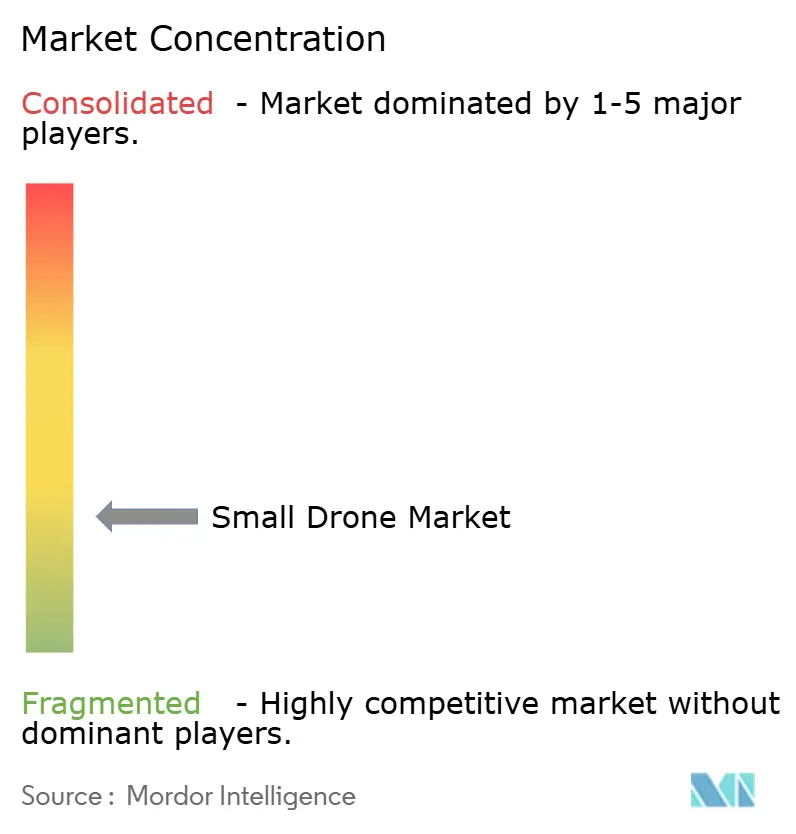
| Market Concentration | Low |
Major Players *Disclaimer: Major Players sorted in no particular order Image © Mordor Intelligence. Reuse requires attribution under CC BY 4.0. | |
Small Drone Market Analysis by Mordor Intelligence
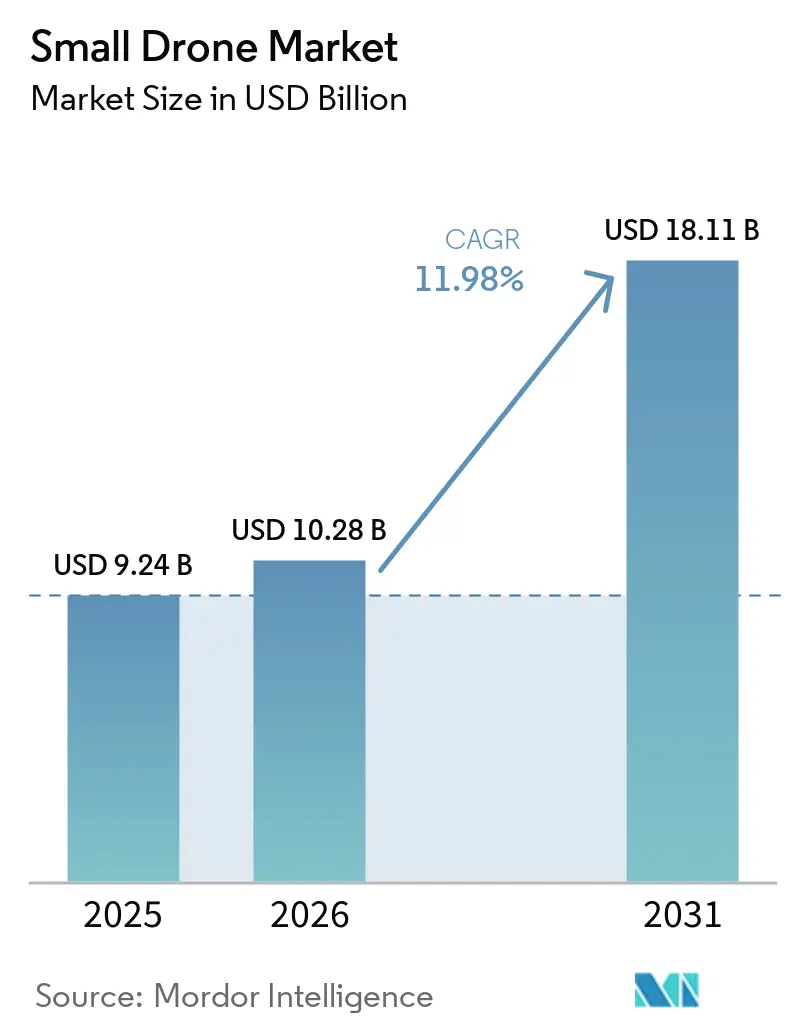
The Small Drone Market size was valued at USD 9.24 billion in 2025 and estimated to grow from USD 10.28 billion in 2026 to reach USD 18.11 billion by 2031, at a CAGR of 11.98% during the forecast period (2026-2031). Defense procurement and commercial use in logistics, agriculture, and infrastructure inspection are supporting demand for small unmanned systems. Buyers are placing greater value on reliable platforms for operational missions, which raises the importance of payload integration, autonomy, and secure communications. Dual-use airframes can serve civil and defense requirements, allowing suppliers to apply product development across more than 1 customer group. The small drone market is also shifting toward software, replaceable payloads, and data services, rather than sales of a single airframe alone. Regulatory progress for beyond visual line of sight operations and local production policies will shape where deployment can scale.
Key Report Takeaways
- By application, ISR held 65.5% of the Small Drone Market share in 2025, while Combat is projected to grow at a 12.8% CAGR through 2031.
- By platform, Civil and Commercial held 60.3% of the Small Drone Market share in 2025 and is forecast to expand at a 12.6% CAGR through 2031.
- By type, Fixed Wing VTOL accounted for 53.7% of the Small Drone Market size in 2025, while Hybrid is forecast to grow at a 13.2% CAGR through 2031.
- By geography, North America held 46.9% of revenue in 2025, while Asia-Pacific is forecast to grow at a 12.4% CAGR through 2031.
Note: Market size and forecast figures in this report are generated using Mordor Intelligence’s proprietary estimation framework, updated with the latest available data and insights as of January 2026.
Global Small Drone Market Trends and Insights
Drivers Impact Analysis*
| Driver | (~) % Impact on CAGR Forecast | Geographic Relevance | Impact Timeline |
|---|---|---|---|
| Commercial and Industrial Drone Adoption | +3.20% | Global, with concentration in North America, APAC, and Western Europe | Medium term (2–4 years) |
| Defense Demand for Tactical ISR Platforms | +2.50% | North America, Europe (NATO), APAC core (India, South Korea, Australia) | Short to medium term (≤ 4 years) |
| BVLOS and Remote-Identification Regulatory Enablement | +1.80% | North America, EU, UK, APAC with early gains in Japan, South Korea, Singapore | Medium term (2–4 years) |
| Advances in AI, Batteries and Miniaturized Sensors | +1.40% | Global, with R&D concentration in USA, China, Germany, Israel | Long term (≥ 4 years) |
| GPS-Denied Autonomy in Contested Operating Environments | +0.90% | NATO members, Indo-Pacific, Eastern European frontline states | Short to medium term (≤ 4 years) |
| Sovereign Production and Rapid Attrition Replacement | +1.10% | USA, EU member states (SAFE regulation), Taiwan, India, South Korea | Medium to long term (2–5 years) |
| Source: Mordor Intelligence | |||
Commercial And Industrial Drone Adoption Scaling Enterprise Use Cases
Commercial use is extending beyond pilot projects into agricultural protection, geospatial surveying, and public safety monitoring. China’s commercial drone sector reached CNY 121.5 billion in 2024, with these activities among its 3 largest areas[1]National Center for Science and Technology Information, “Commercial Drone Market Insights, 2025 Zhongguancun Forum,” National Center for Science and Technology Information, ncsti.gov.cn. Fleet operators are moving more spending toward software subscriptions and upgraded payloads. The change favors suppliers that can support a platform after the initial aircraft purchase. This supports recurring revenue opportunities for suppliers serving the Small Drone Market. It also places more importance on payload compatibility and dependable data handling. India had more than 6,500 DGCA-approved drone startups and operators under Digital Sky by 2025. This created a user base for domestic manufacturers and foreign original equipment manufacturers. Agricultural spraying and infrastructure inspection are also building use cases in Indonesia, Vietnam, and Thailand. Hybrid and multi-rotor aircraft are suited to many of these short-range, task-specific operations.
Defense Demand For Tactical ISR Platforms Anchors Revenue
ISR represented 65.5% of application revenue in 2025, supporting platform volumes in defense and public safety. Persistent ISR data can support targeting, battle-damage assessment, and guidance decisions during small-unit operations. It has therefore become a core requirement rather than an occasional surveillance capability. AeroVironment received a USD 117.3 million U.S. Army contract in July 2026 for 82 P550 electric VTOL reconnaissance drones. The award was the system’s first full-rate production contract. It showed continuing demand for battery-powered reconnaissance systems within formal acquisition programs. India’s DFPDS-2026 framework gives field commanders procurement authority along the 3,488 km Line of Actual Control. This reduces reliance on annual procurement cycles for operational drone needs. Military demand for EO/IR and SIGINT payloads can also raise capability standards for commercial inspection systems.
BVLOS And Remote Identification Regulatory Enablement Opens Scale
BVLOS rules remain important for commercial operations that need to travel beyond the pilot’s direct view. This capability is necessary for delivery corridors, large-area inspection, and many public safety missions. The FAA published a Part 108 notice of proposed rulemaking on August 7, 2025 for routine low-altitude BVLOS operations. The proposal moves toward a standards-based approach for logistics, inspection, and public safety. It would replace a model based mainly on individual waivers. Executive Order 14307 directed the FAA to finalize drone rules within 240 days and streamlined export authorizations for U.S.-made UAVs. Europe adopted the SORA methodology in April 2025 for BVLOS-specific risk assessment. Remote ID requirements may also create flight datasets for planning and operational software. Those datasets can support more informed flight planning as operators build their commercial networks.
AI, Battery, And Sensor Advances Reshape Platform Economics
Edge computing, battery research, and smaller sensors are enabling compact systems to perform more demanding missions. These changes reduce the weight and cost of mission-capable configurations. Commercial drones can now exceed 60 minutes of endurance with sensor payloads, compared with 20 to 30 minutes 3 years earlier[2]International Journal of Engineering Research and Technology, “Advancements in Drone and Anti-Drone Systems, A Technical Overview,” International Journal of Engineering Research and Technology, ijert.org. Onboard analysis reduces dependence on a constant data link in remote or contested settings. It can also reduce satellite bandwidth needs during remote inspection work. Platforms below 250 grams can now carry EO/IR, multispectral, and limited radar payloads. This creates some overlap between nano-UAVs and larger small-UAS systems. Procurement teams may therefore assess whether lighter systems can meet a mission at lower cost. This comparison is changing how buyers define requirements for Group 1 systems.
Restraints Impact Analysis*
| Restraint | (~) % Impact on CAGR Forecast | Geographic Relevance | Impact Timeline |
|---|---|---|---|
| Fragmented Airspace Certification and Operating Rules | −3.0% | Global, most acute in South America, MEA, Southeast Asia | Medium to long term (2–5 years) |
| Battery Endurance and Payload Trade-Offs | −2.2% | Global | Long term (≥ 4 years) |
| Counter-UAS and Spectrum-Congestion Exposure | −1.5% | Active conflict zones, NATO frontline states, contested airspace globally | Short term (≤ 2 years) |
| Weather Windows and Ruggedization Costs | −1.2% | High-latitude markets (Northern Europe, Canada), tropical-monsoon markets (SE Asia, South Asia) | Medium term (2–4 years) |
| Source: Mordor Intelligence | |||
Fragmented Airspace Certification Constrains Commercial Scalability
The lack of a common BVLOS framework limits commercial scaling across borders. More than 80 jurisdictions in South America, Africa, and Southeast Asia use ministerial permits for drone operations. These processes can take weeks and restrict the route-network model needed for delivery and inspection. A network cannot be operated consistently when permissions and operating conditions differ from one jurisdiction to another. Defense users can usually operate under military airspace authority, so the constraint falls more heavily on civil operators. ICAO’s UTM concept and the European Union’s U-space framework provide reference models for convergence. National interfaces and implementation capacity remain uneven. This limits cross-border operations and constrains the Small Drone Market in emerging operating environments.
Battery Endurance And Payload Trade-Offs Limit Mission Profiles
Battery energy density remains a physical limit for small aircraft. A heavier sensor payload reduces flight time when the airframe and battery capacity remain fixed. Operators must often choose between longer time over a target and more complete sensing capability. Solid-state cells could improve energy density by 2 to 3 times, but commercial manufacturing and aviation certification remain limited. Hydrogen fuel-cell systems are being evaluated for fixed-wing platforms between 5 kg and 25 kg. Such systems may extend range beyond 600 km, but broad commercial availability is still distant. Multi-rotor logistics and public safety systems also need charging infrastructure before operators can expand missions at scale. This infrastructure cost can be difficult for operators to justify before route economics are proven.
*Our forecasts treat driver/restraint impacts as directional, not additive. The impact forecasts reflect baseline growth, mix effects, and variable interactions.
Segment Analysis
By Application: ISR Leads Revenue While Combat Records The Fastest Growth
ISR accounted for 65.5% of the Small Drone Market size in 2025. The segment supports surveillance, targeting data, battle-damage assessment, and coordination during operations. Its scale reflects the move from occasional aerial observation to persistent data collection. This data can be used across several phases of a mission. Combat is forecast to grow at a 12.8% CAGR through 2031. One-way attack drones are supporting this growth because they can carry out precision-strike roles in environments that present high risk for crewed aircraft. Their use is changing the cost comparison between small unmanned systems and more expensive munitions.
AeroVironment’s Switchblade 600 Block 2 had been fielded across more than 20 U.S. Army brigade combat teams since 2025[3]AeroVironment, “AV Receives USD 51 Million U.S. Army Order for Switchblade 600 Loitering Munitions,” AeroVironment, avinc.com. This development places the product within a formal Army procurement setting. ISR and combat missions are becoming more connected when reconnaissance data guides attack systems. This link increases the value of platforms that can share mission data securely. Inspection and Maintenance remains the largest commercial application by platform count. Surveying and Mapping benefits from improved photogrammetry and Building Information Modeling workflows. Agriculture supports demand for spraying and crop monitoring, while Delivery and Logistics remains tied to BVLOS rulemaking. Search and Rescue remains smaller by revenue but benefits from thermal imaging and rapid post-disaster deployment.
By Platform: Civil And Commercial Platforms Combine Scale With Growth
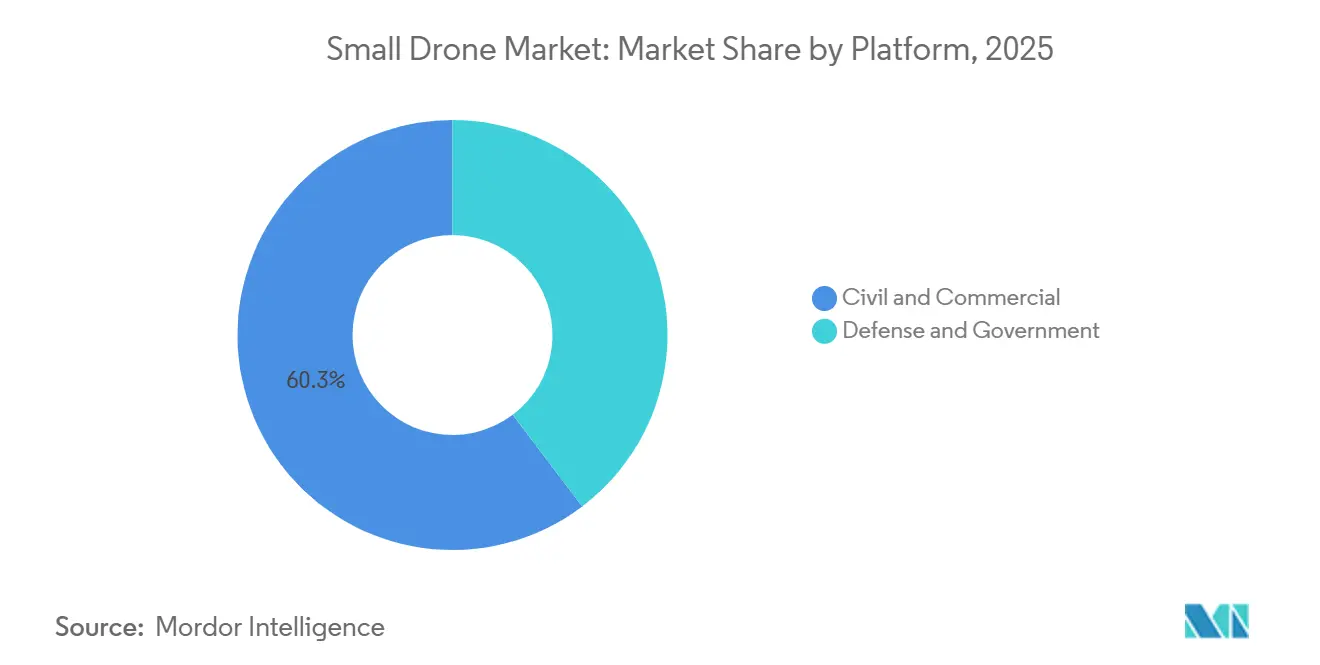
Civil and Commercial platforms held 60.3% of the Small Drone Market share in 2025. The segment is projected to expand at a 12.6% CAGR through 2031. Buyers are shifting toward systems with replaceable payloads that can support inspection, mapping, and delivery. These systems may reduce the need to acquire a separate airframe for each task. This can increase revenue per unit and reduce the need for separate single-purpose aircraft. European sourcing rules can also encourage localization of electronics and motor supply. The policy environment is becoming a more important factor in supplier selection.
DJI held 70% of civilian volume in 2025, down from 74% in 2024, according to the Special Competitive Studies Project. This share provides a price reference for commercial platforms, while regulatory exclusions create risk for users reliant on Chinese supply. Defense and Government systems represented the remaining 39.7% of revenue in 2025. They are associated with many high-value contracts and requirements for adaptable mission systems. The U.S. Department of Defense requested more than USD 70 billion for drone and counter-drone systems across services in FY2027. Defense buyers are increasingly seeking open architectures that permit payload and autonomy upgrades without replacing the entire platform. This approach shifts spending toward mission systems and software. It can also extend the useful life of an airframe and support aftermarket revenue.


By Type: Fixed Wing VTOL Holds The Largest Share While Hybrid Systems Expand
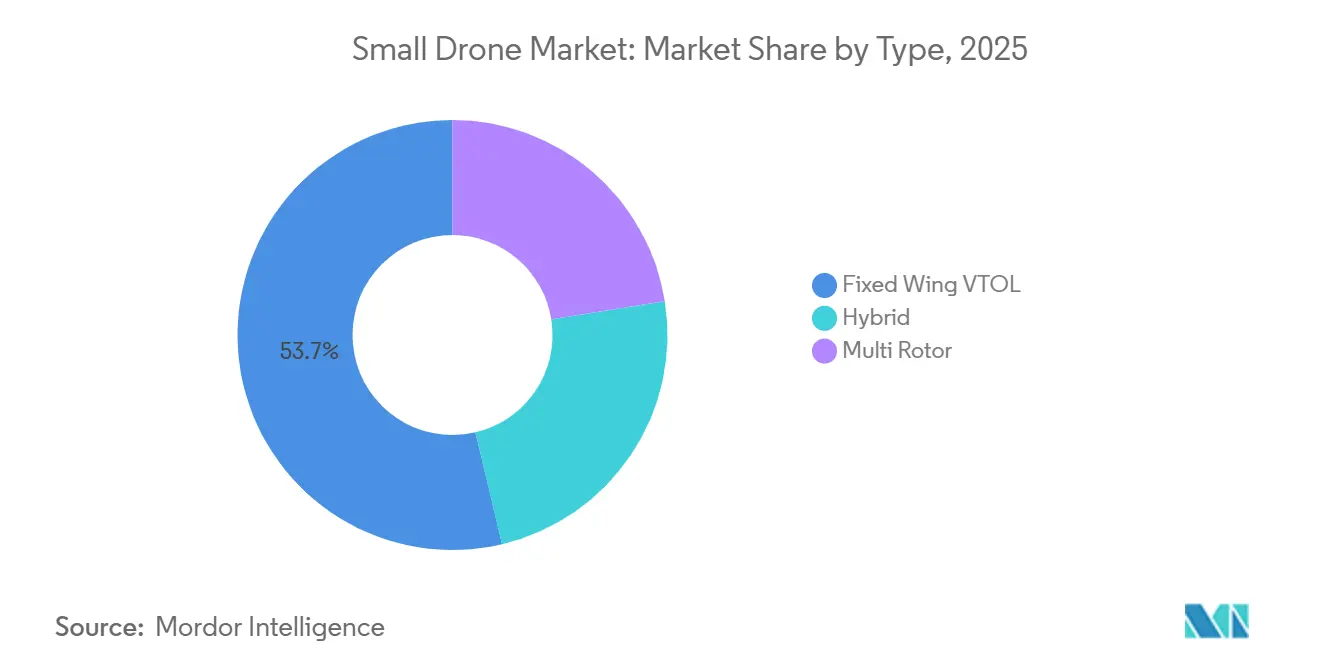
Fixed Wing VTOL accounted for 53.7% of the Small Drone Market size in 2025. These systems combine vertical takeoff with the range and endurance of fixed-wing flight. Their operating profile suits ISR, mapping, and long-range patrol. They can operate without a runway while maintaining more efficient forward flight. Commercial users can also use them to survey large areas between battery changes. This combination supports demand from both defense and commercial operators. The configuration remains useful where takeoff space is limited but broad-area coverage is required.
Hybrid systems are forecast to grow at a 13.2% CAGR through 2031. They can hover for close inspection, payload delivery, or coordination tasks while retaining efficient fixed-wing travel. A single hybrid platform can therefore cover missions that previously required 2 platform types. This can improve asset use and simplify management of mixed-mission fleets. Multi-Rotor systems lead in unit volume because they generally cost less and have a broad payload ecosystem. Their shorter endurance limits some missions, but better batteries and urban charging facilities are expanding practical use. The Small Drone Market continues to support several aircraft architectures because operators match platforms to different mission profiles. This produces parallel demand rather than a single winner across all use cases.
Geography Analysis
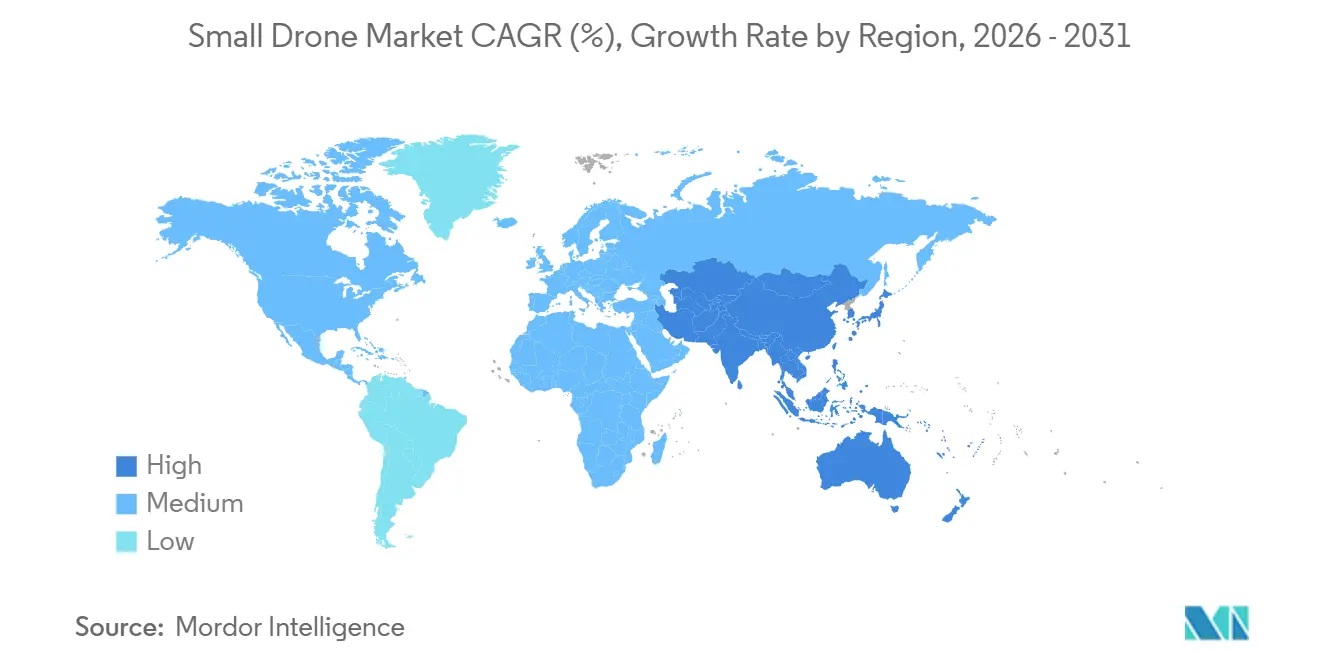
North America held 46.9% of Small Drone Market share in 2025. Defense appropriations and commercial regulatory activity support regional demand. The U.S. Department of Defense requested more than USD 70 billion for drone and counter-drone systems in FY2027. This demand supports both platforms and the systems used to detect or defeat them. The FAA’s Part 108 framework is intended to support routine commercial BVLOS authorization. A standards-based system could make planning easier for commercial operators than a waiver process. The USD 1.1 billion Drone Dominance Program targets 200,000 domestically produced lethal small UAS by 2027. Performance Drone Works received a conditional USD 820 million loan commitment in July 2026 to increase propulsion and power-control manufacturing in Alabama. Section 232 tariffs announced in August 2026 apply 100% tariffs to UAVs above 25 kg and 25% tariffs to smaller systems. These measures encourage domestic sourcing by defense and commercial operators.
Asia-Pacific is forecast to grow at a 12.4% CAGR through 2031. China accounted for more than 70% of global commercial drone production capacity in 2025. Its drone exports are projected to reach 6.89 million units valued at USD 4.25 billion in 2026. Production is shifting from consumer photography toward industrial and service-integrated solutions. India is the region’s fastest-growing national market because defense procurement authority is becoming more direct. The DFPDS-2026 framework allows field commanders to procure drones along the Line of Actual Control. This creates a demand route that does not depend only on annual budget decisions. South Korea’s BVLOS demonstration zones can shorten authorization cycles. Japan’s agricultural labor constraints and Australia’s maritime requirements support demand for high-endurance platforms.
Europe is changing quickly as defense requirements increase and procurement standards evolve. NATO’s 2026 drone-ready initiative commits member countries to more than USD 40 billion in counter-drone investment over 5 years[4]North Atlantic Treaty Organization, “Counter-UAS and Drone Investment Initiative Announcement,” NATO, nato.int. The United Kingdom’s Defense Investment Plan committed GBP 5 billion, USD 6.74 billion, to drone transformation through 2029. Germany procured 50,000 drones through a EUR 90 million Auterion-Skyfall order in July 2026. The procurement included Auterion’s autonomous operating system. European buyers are also placing greater weight on local content and compliant supply chains. South America focuses on border surveillance, counter-narcotics, and environmental monitoring. Brazil and Mexico anchor much of this procurement activity. Middle East and Africa demand includes oil and gas inspection, infrastructure monitoring, agriculture, and localized UAV production. Saudi Arabia and the United Arab Emirates lead regional procurement, while North African activity includes commercial inspection and agricultural applications.

Competitive Landscape
The Small Drone Market is fragmented in commercial applications and more concentrated in defense procurement. Commercial suppliers face pricing pressure from Chinese production scale and growing regulatory constraints in the United States and Europe. Chinese suppliers account for more than 70% of global civilian volume. Defense suppliers are competing through autonomy, secure data links, payload integration, and manufacturing capacity. Software is becoming more important because it can connect sensors and effectors across hardware from different suppliers. This creates an additional revenue path alongside airframe sales. The resulting competition makes system integration as important as aircraft performance for many buyers.
Anduril raised USD 5 billion in a Series H round in May 2026 at a USD 61 billion valuation. The company reported USD 2.2 billion in 2025 revenue. It also secured a USD 20 billion, 10-year Army counter-UAS enterprise contract in March 2026 using its Lattice command-and-control system. The arrangement consolidated more than 120 previously separate procurement actions into 1 ordering framework. AeroVironment announced a USD 100 million investment in a Southern California campus to expand autonomous-system and loitering-munition capacity. This investment reflects the need to expand output in high-attrition applications. Skydio raised USD 110 million in a Series F round in April 2026 for expansion of its Hayward, California facility. Its planned capacity increase supports U.S. Army X10D reconnaissance commitments.
Opportunities remain for systems that can navigate in GPS-denied environments and meet domestic-content requirements. Quantum Systems and ideaForge have benefited from local sourcing preferences in Germany and India. These preferences can narrow access for suppliers using Chinese-origin components. Research on combined LiDAR, radar, vision, and inertial sensing supports positioning where satellite signals are unavailable. Commercial hardware based on similar sensing combinations is already in field testing. Suppliers also need the production capacity to serve high-attrition defense demand. Commercial operators may require compliance tools that support BVLOS operating plans across several jurisdictions. The competitive position of each supplier will depend on its ability to pair compliant hardware with reliable autonomy software. It will also depend on whether suppliers can support payload upgrades without a full platform replacement.
Small Drone Industry Leaders
DJI
AeroVironment, Inc.
Parrot Drone SAS
Israel Aerospace Industries Ltd.
Lockheed Martin Corporation
- *Disclaimer: Major Players sorted in no particular order

Recent Industry Developments
- August 2026: AeroVironment received a USD 51 million U.S. Army delivery order for Switchblade 600 Block 2 loitering munitions under a USD 990 million IDIQ for Lethal Unmanned Systems, with the award also covering a Foreign Military Sale to a key U.S. ally.
- August 2026: AeroVironment announced a USD 100 million investment in a unified Southern California campus to expand manufacturing and engineering capacity for autonomous systems and loitering munitions.
- July 2026: AeroVironment received a 3-year, USD 500 million sole-source IDIQ for counter-UAS capabilities supporting JIATF-401’s Domestic Shield Program.
- June 2026: The White House Drone Dominance Program’s Gauntlet II attracted 49 companies and 79 drone designs, and 19 designs advanced under the USD 1.1 billion initiative.


Global Small Drone Market Report Scope
Small drones are unmanned aerial vehicles (UAVs) that are compact, lightweight, and typically designed for short-range operations with limited payload capacity and flight endurance. They can be remotely piloted or operate autonomously using onboard sensors, navigation systems, and software. Small drones are widely used for surveillance and reconnaissance, agriculture, inspection and maintenance, surveying and mapping, delivery and logistics, search and rescue, photography, and defense applications. Depending on the regulatory framework, the classification of a "small" drone is generally based on maximum takeoff weight, size, operating altitude, and range.
The global small drone market is segmented by application, platform, type, and geography. By application, the market is segmented into combat, intelligence, surveillance and reconnaissance (ISR), inspection and maintenance, surveying and mapping, agriculture, delivery and logistics, search and rescue, and other applications. By platform, the market is segmented into civil and commercial, and defense and government. By type, the market is segmented into fixed-wing VTOL, multi-rotor, and hybrid drones. The report also covers the market size and forecasts for the global small drone market across 26 countries in key regions. For each segment, the market sizing and forecasts have been provided on the basis of value (USD).
| Combat |
| Intelligence, Surveillance and Reconnaissance |
| Inspection and Maintenance |
| Surveying and Mapping |
| Agriculture |
| Delivery and Logistics |
| Search & Rescue |
| Others |
| Civil and Commercial |
| Defense and Government |
| Fixed Wing VTOL |
| Multi Rotor |
| Hybrid |
| North America | United States |
| Canada | |
| Mexico | |
| Europe | Germany |
| France | |
| Italy | |
| Spain | |
| United Kingdom | |
| Poland | |
| Russia | |
| Rest of Europe | |
| Asia-Pacific | China |
| India | |
| Japan | |
| South Korea | |
| Australia | |
| Indonesia | |
| Vietnam | |
| Thailand | |
| Rest of Asia-Pacific | |
| South America | Brazil |
| Argentina | |
| Chile | |
| Rest of South America | |
| Middle East and Africa | Saudi Arabia |
| United Arab Emirates | |
| Egypt | |
| South Africa | |
| Morocco | |
| Rest of Middle East and Africa |
| By Application | Combat | |
| Intelligence, Surveillance and Reconnaissance | ||
| Inspection and Maintenance | ||
| Surveying and Mapping | ||
| Agriculture | ||
| Delivery and Logistics | ||
| Search & Rescue | ||
| Others | ||
| By Platform | Civil and Commercial | |
| Defense and Government | ||
| By Type | Fixed Wing VTOL | |
| Multi Rotor | ||
| Hybrid | ||
| By Geography | North America | United States |
| Canada | ||
| Mexico | ||
| Europe | Germany | |
| France | ||
| Italy | ||
| Spain | ||
| United Kingdom | ||
| Poland | ||
| Russia | ||
| Rest of Europe | ||
| Asia-Pacific | China | |
| India | ||
| Japan | ||
| South Korea | ||
| Australia | ||
| Indonesia | ||
| Vietnam | ||
| Thailand | ||
| Rest of Asia-Pacific | ||
| South America | Brazil | |
| Argentina | ||
| Chile | ||
| Rest of South America | ||
| Middle East and Africa | Saudi Arabia | |
| United Arab Emirates | ||
| Egypt | ||
| South Africa | ||
| Morocco | ||
| Rest of Middle East and Africa | ||


Key Questions Answered in the Report
What is the projected value of small drones by 2031?
The sector is forecast to reach USD 18.11 billion by 2031, growing at a 11.98% CAGR from 2026.
Which application generated the largest revenue in 2025?
ISR led applications with 65.5% of revenue in 2025, supported by defense and public safety uses.
Which platform category is growing fastest?
Civil and Commercial platforms held 60.3% in 2025 and are forecast to grow at a 12.6% CAGR through 2031.
Which aircraft type is expected to grow fastest?
Hybrid systems are forecast to grow at a 13.2% CAGR through 2031 because they combine hovering capability with efficient forward flight.
Which region has the largest demand for small drones?
North America held 46.9% of revenue in 2025, supported by defense procurement and BVLOS regulatory activity.
What limits commercial deployment of small drones?
Fragmented airspace rules, endurance limits, charging needs, and counter-UAS exposure can slow scalable commercial operations.
Page last updated on:





