
Singapore Tokenized Deposit Market Size and Share
Market Overview
| Study Period | 2021 - 2032 |
|---|---|
| Forecast Data Period | 2027 - 2032 |
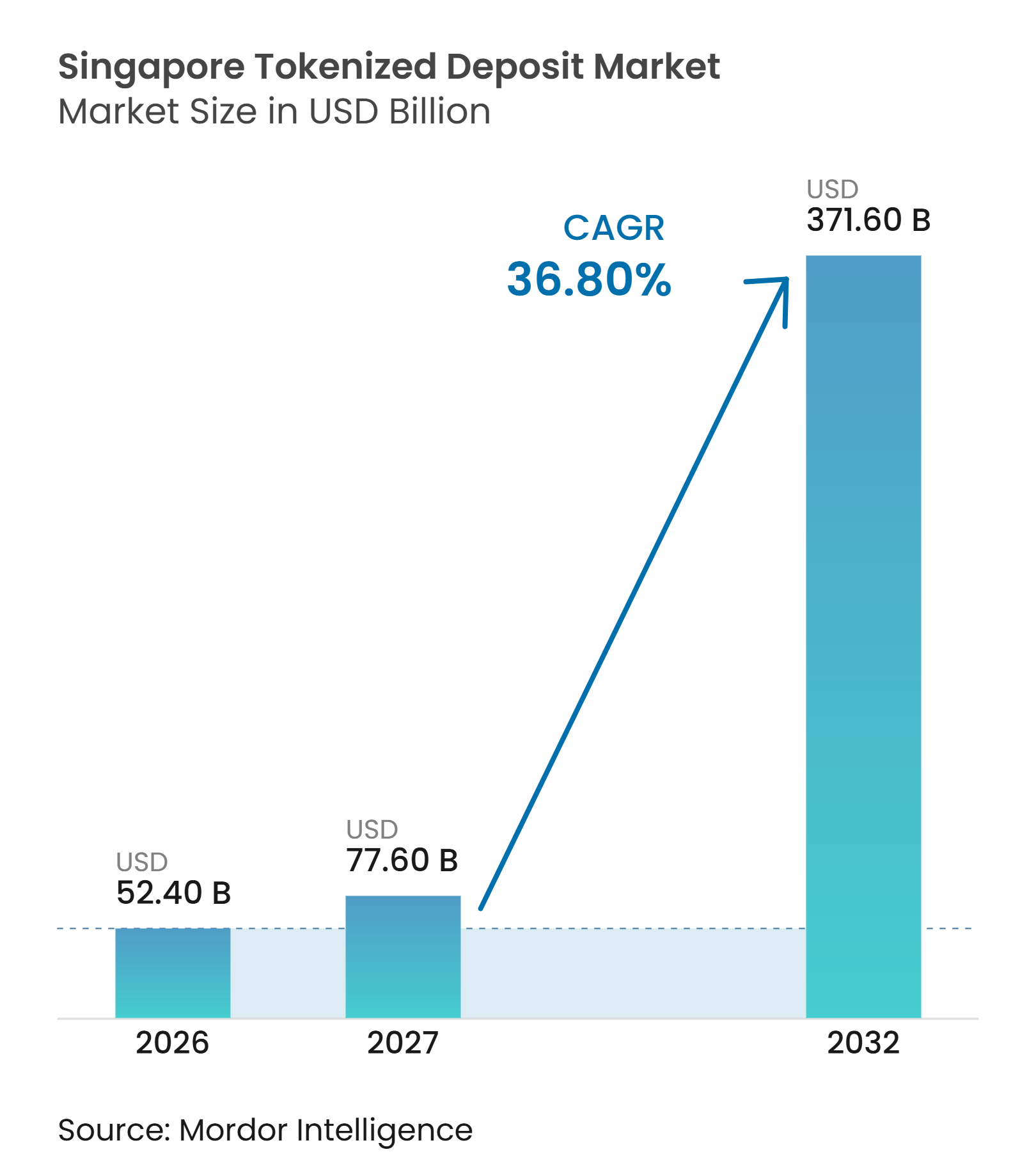
| Base Year Market Size (2026) | USD 52.40 Billion |
| Market Size (2027) | USD 77.60 Billion |
| Market Size (2032) | USD 371.60 Billion |
| Growth Rate (2027 - 2032) | 36.80 % |
| Market Concentration | Medium |
Major Players *Disclaimer: Major Players sorted in no particular order Image © Mordor Intelligence. Reuse requires attribution under CC BY 4.0. | |
Singapore Tokenized Deposit Market Analysis by Mordor Intelligence
The Singapore Tokenized Deposit Market size is expected to increase from USD 52.40 billion in 2026 to USD 77.60 billion in 2027 and reach USD 371.60 billion by 2032, growing at a CAGR of 36.80% over 2027-2032.
Growth reflects the move from technical trials toward bank services that support treasury activity, payments, and settlement on distributed ledgers. The Monetary Authority of Singapore (MAS) is providing a structured setting for commercialization through BLOOM, while established banks are testing live interbank processes. DBS, OCBC, and UOB completed live Singapore dollar (SGD) interbank tokenized deposit transactions on Swift’s ledger in September 2026, showing that domestic activity is moving beyond isolated pilots. The Singapore tokenized deposit market also depends on workable links between banks, networks, and jurisdictions because broader participation can increase the value of each participating network. Regulatory coordination, resilient liquidity processes, and secure custody arrangements will determine how rapidly commercial deployments can extend across cross-border corridors.
Key Report Takeaways
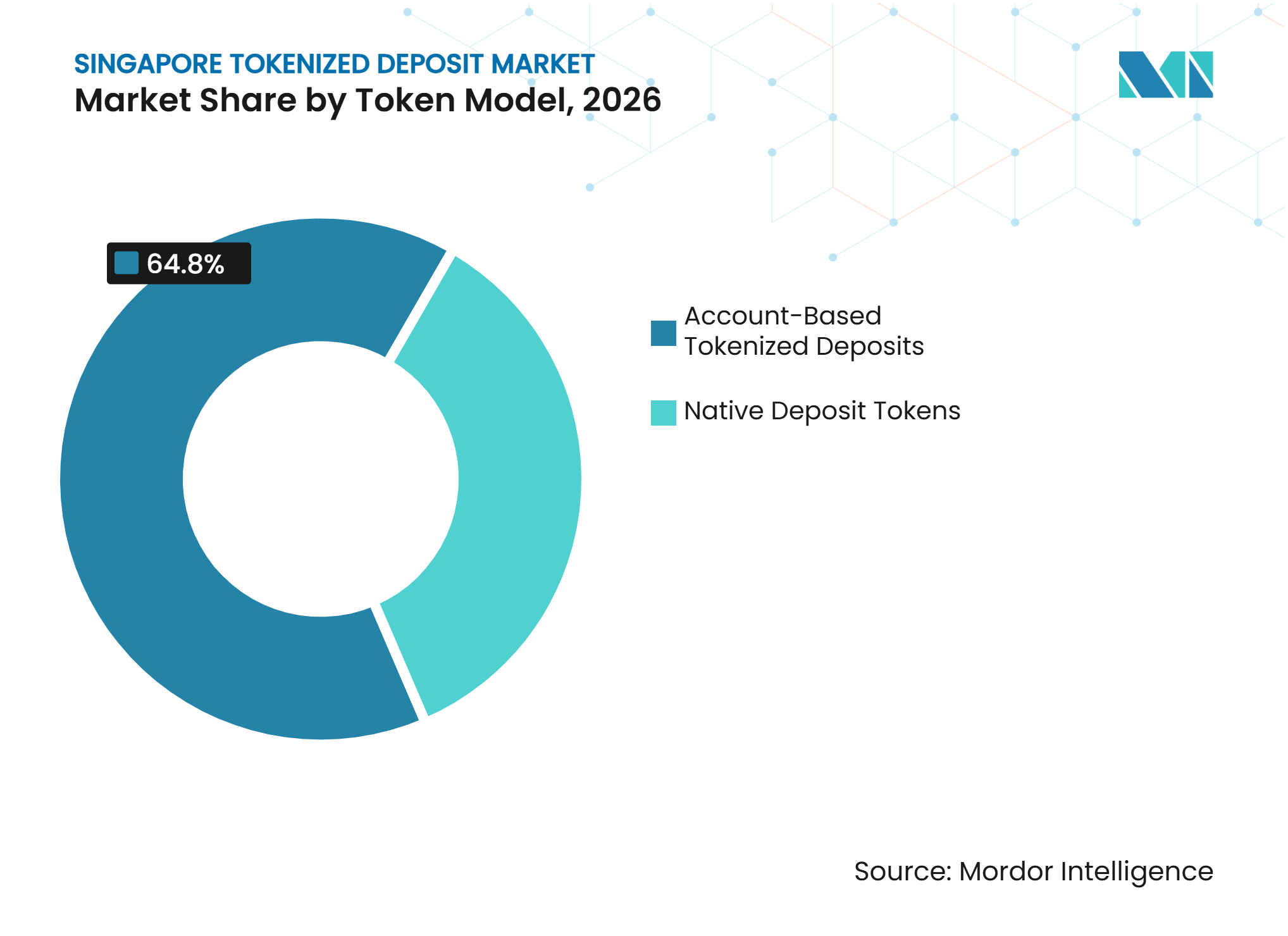
- By token model, account-based tokenized deposits captured 64.8% of the Singapore tokenized deposit market share in 2026, while native deposit tokens are projected to grow at a 43.5% CAGR through 2032.
- By network model, single-bank networks captured 44.6% of the Singapore tokenized deposit market share in 2026, while interbank shared multi-bank networks are projected to grow at a 45.6% CAGR through 2032.
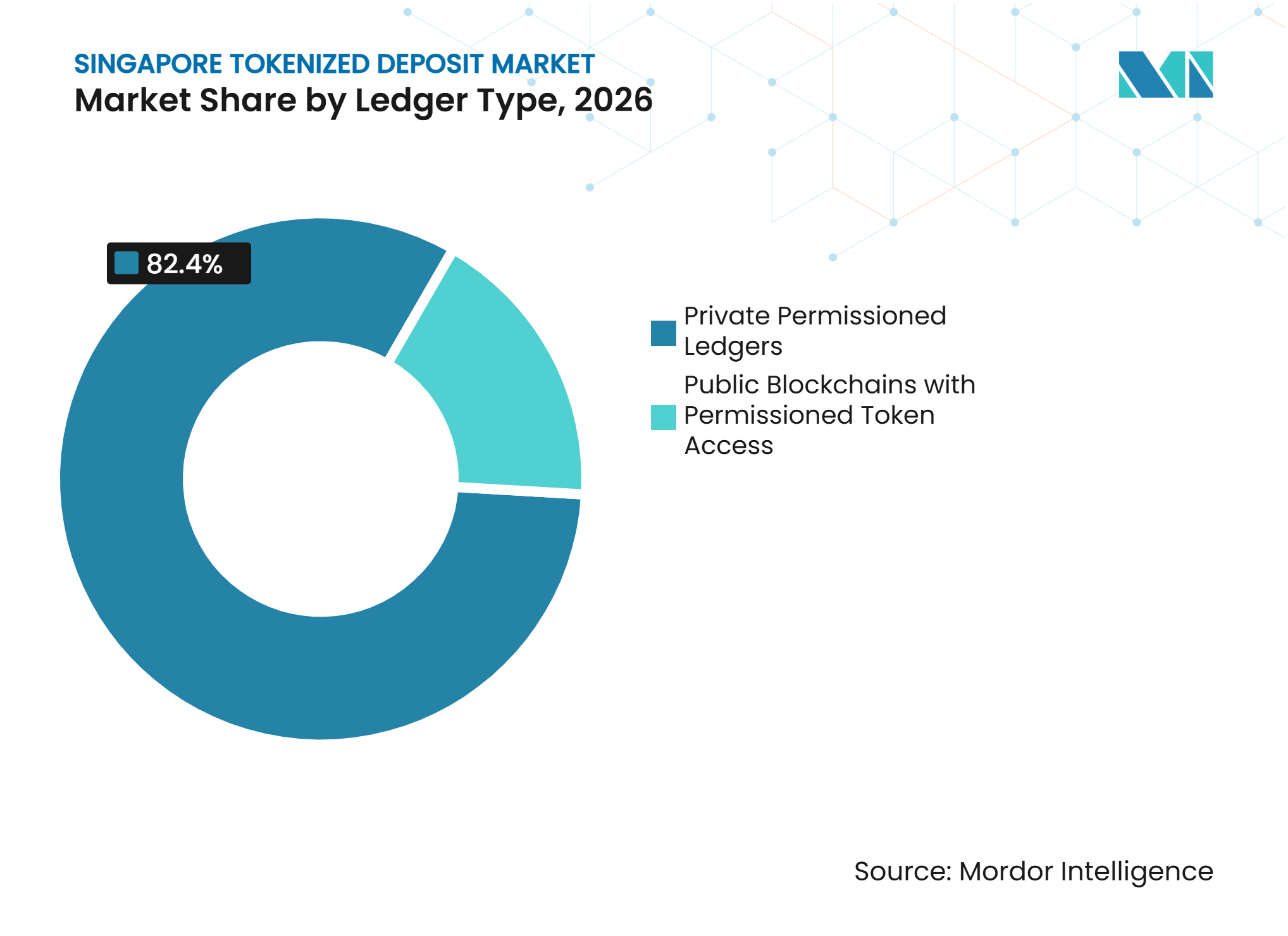
- By ledger type, private permissioned ledgers captured 82.4% of the Singapore tokenized deposit market share in 2026, while public blockchains with permissioned token access are projected to grow at a 43.7% CAGR through 2032.
- By use case, intra-group treasury and liquidity management captured 29.7% of the Singapore tokenized deposit market share in 2026, while securities and digital-asset settlement and collateral management are projected to grow at a 44.6% CAGR through 2032.
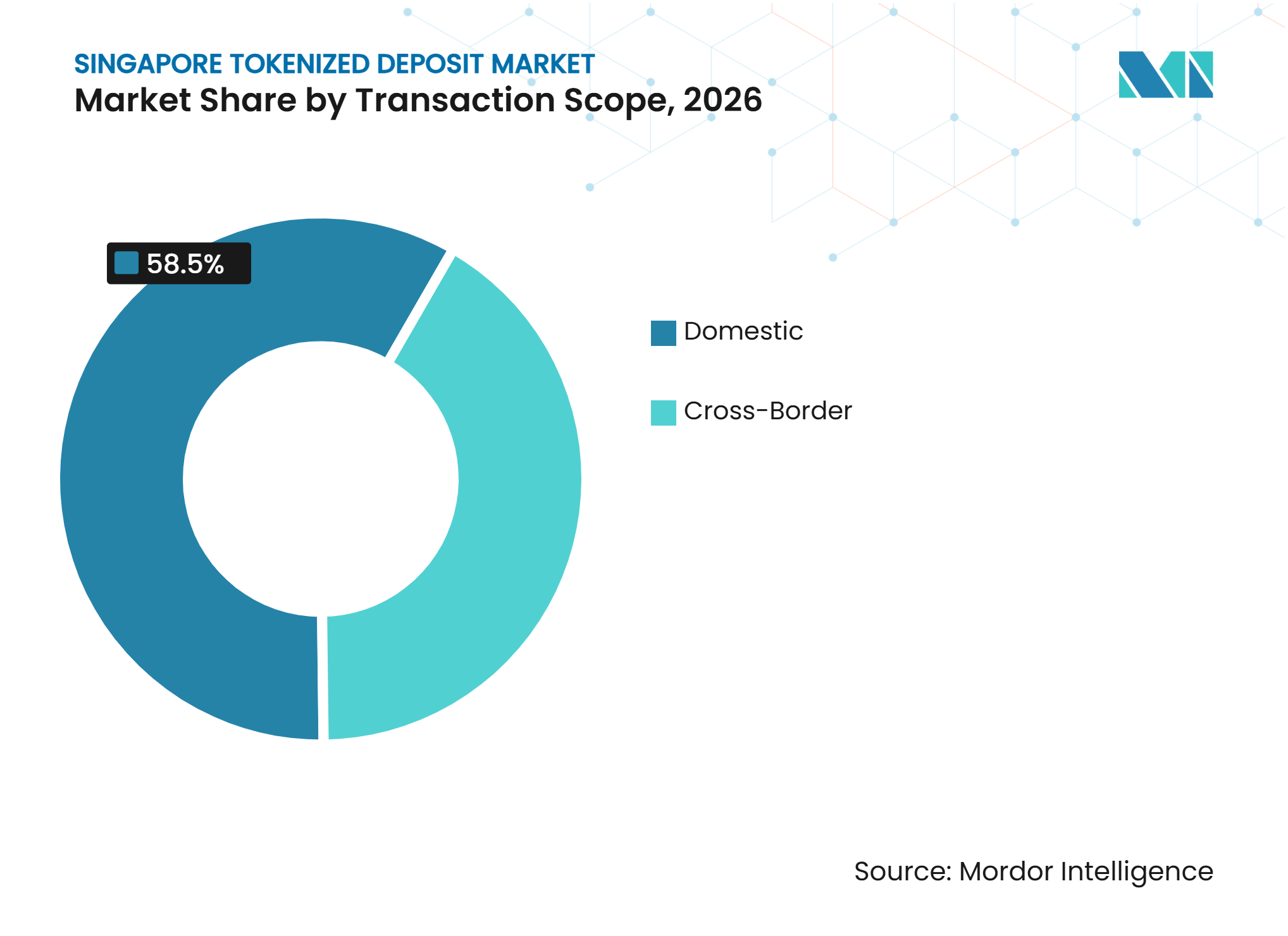
- By transaction scope, domestic transactions captured 58.5% of the Singapore tokenized deposit market share in 2026, while cross-border transactions are projected to grow at a 42.5% CAGR through 2032.
- By end user, banks and other deposit-taking institutions captured 40.3% of the Singapore tokenized deposit market share in 2026, while payments, fintech, and digital-asset firms are projected to grow at a 44.5% CAGR through 2032.
Note: Market numbers in this report are based on Mordor Intelligence's proprietary estimation framework, which combines nine months of actuals with Q4 projections for base year 2026.
Market Trends and Insights
Drivers Impact Analysis of Singapore Tokenized Deposit Market*
| Driver | (~) % Impact on CAGR Forecast | Geographic Relevance | Impact Timeline |
|---|---|---|---|
| 24/7 Corporate Treasury and Intraday Liquidity Management | +8.5% | Global, with greatest intensity in Singapore’s Asia-Pacific treasury hub corridors | Short term (≤ 2 years) |
| MAS-Led Commercialization of Tokenized Bank Deposits | +7.2% | Singapore domestic, with spillover to ASEAN through BLOOM | Short term (≤ 2 years) |
| Cross-Border Corporate Payments and Settlement Efficiency | +5.8% | Singapore, ASEAN, Hong Kong, and global corridors | Medium term (2-4 years) |
| Interoperable Multi-Currency Settlement for Regional Treasury Operations | +4.5% | ASEAN, with spillover to Japan and the Middle East and Africa | Medium term (2-4 years) |
| Programmable Payments and Automated Corporate Cash Management | +4.2% | Global, led by Singapore and Hong Kong nodes | Medium term (2-4 years) |
| Tokenized-Asset Settlement Using Regulated Bank Money | +3.1% | Singapore and global capital-market centers | Long term (≥ 4 years) |
| Source: Mordor Intelligence | |||
24/7 Corporate Treasury and Intraday Liquidity Management
The Singapore tokenized deposit market has a clear commercial case in corporate treasury, where continuous transfers can remove payment cut-off constraints. HSBC launched its Tokenised Deposit Service in Singapore in October 2025, enabling real-time Singapore dollar and United States dollar (USD) transfers between entity wallets at all hours[1]. This service can reduce overnight funding gaps for corporate groups operating across time zones. Standard Chartered launched tokenized Singapore dollar and United States dollar account balances for Ant International in December 2025, allowing intragroup fund deployment to move closer to a continuous process. Better use of intraday balances can reduce idle funds across multinational entities. This creates demand that is linked to treasury operations rather than only to interest-rate conditions.
MAS-Led Commercialization of Tokenized Bank Deposits
MAS launched BLOOM on October 16, 2025, moving beyond a sandbox approach toward commercial work on digital money settlement, interoperability, and programmable controls[2]. The initiative covers G10 and Asian currencies, domestic and cross-border settlement, corporate treasury, and agentic payments. In October 2026, Bank Negara Malaysia and the Bank of Thailand joined as policymaker members, extending coordination across 3 ASEAN economies. MAS completed a live trial in November 2025 in which interbank overnight lending was settled with wholesale central bank digital currency on the Singapore dollar Testnet. DBS, OCBC, and UOB recorded the first live issuance of wholesale central bank digital currency in their official books during that trial. Existing MAS requirements for payments, anti-money-laundering, and countering the financing of terrorism shape tokenized bank liabilities without requiring separate reserve backing.
Cross-Border Corporate Payments and Settlement Efficiency
Cross-border correspondent banking costs and settlement delays are central problems addressed by the Singapore tokenized deposit market. The ISDA and Ant International report under MAS Project Guardian estimated that a common tokenized bank-liability framework for foreign-exchange settlement could lower cross-border transaction costs by 12.5% and produce savings above USD 50 billion by 2030[3]. Partior connected with OSTTRA and Baton in June 2025 to support payment-versus-payment settlement using United States dollar, euro, and Singapore dollar tokenized commercial bank funds on a 24/7 basis. Payment-versus-payment processing helps prevent one currency leg from settling before the other. The resulting process can reduce the need for large pre-funded nostro balances. Internationally active banks can therefore use the model to review how capital is allocated across foreign-exchange settlement activity.
Interoperable Multi-Currency Settlement for Regional Treasury Operations
Singapore-based networks are moving from bank-specific rails toward linked settlement arrangements that can serve regional treasury operations. DBS and Kinexys by J.P. Morgan announced an interoperability framework in November 2025 for transfers between DBS Token Services and Kinexys Digital Payments[4]. The framework connects a permissioned blockchain with the Base public blockchain and allows clients of the 2 banks to make real-time on-chain payments. OCBC launched a solution with Ant International in October 2026 that supports 24/7 Singapore dollar and United States dollar liquidity movement between Singapore and Malaysia through WhaleRTP. BLOOM focuses on cross-jurisdiction acceptance and settlement, interoperability across digital money arrangements, and programmable controls. These elements create a common institutional direction for a regional settlement layer rather than a series of unrelated bilateral links.
Restraints Impact Analysis of Singapore Tokenized Deposit Market*
| Restraint | (~) % Impact on CAGR Forecast | Geographic Relevance | Impact Timeline |
|---|---|---|---|
| Limited Interoperability Across Bank-Issued Tokens and Settlement Networks | -4.2% | Global, most acute across Singapore bank and network corridors | Short term (≤ 2 years) |
| Cross-Jurisdictional Regulatory and Legal Coordination Challenges | -3.5% | ASEAN, Singapore, Hong Kong, and global corridors | Medium term (2-4 years) |
| Bank Liquidity, Funding, and Balance-Sheet Management Constraints | -2.8% | Singapore domestic and correspondent banking relationships | Medium term (2-4 years) |
| Cybersecurity, Digital-Key Management, and Settlement Operational Risks | -2.4% | Global, with shared-ledger infrastructure concentrated in Singapore | Long term (≥ 4 years) |
| Source: Mordor Intelligence | |||
Limited Interoperability Across Bank-Issued Tokens and Settlement Networks
Fragmentation among bank platforms remains an immediate limitation for the Singapore tokenized deposit market. Each bank can operate its own ledger, wallet design, and settlement logic, requiring new bilateral connections as networks expand. The September 2026 Swift transaction among DBS, OCBC, and UOB used an orchestration layer rather than a single unified ledger. This approach preserves institutional autonomy, but it does not create native interoperability across all bank-issued tokens. A common exchange and redemption standard similar in function to ISO 20022 would reduce integration costs and governance effort. Until that standard is established, network expansion is likely to remain more operationally demanding than conventional domestic payments integration.
Cybersecurity, Digital-Key Management, and Settlement Operational Risks
Moving deposit liabilities onto distributed-ledger infrastructure introduces risks that differ from conventional core banking processes. IOSCO identified tokenization-specific vulnerabilities that include smart-contract defects, risks in transparent-ledger designs, and attacks affecting permissionless networks. The ITU technical report on digital wallet security also identified key theft and malicious smart-contract code as material concerns for institutional digital wallets. Private-key loss can be irreversible, making strong custody and recovery procedures essential. Multi-party computation custody and off-chain backup requirements can increase the cost of safe participation. These controls can place smaller deposit-taking institutions at a disadvantage and reinforce the position of well-capitalized incumbents.
*Our forecasts treat driver/restraint impacts as directional, not additive. The impact forecasts reflect baseline growth, mix effects, and variable interactions.
Singapore Tokenized Deposit Market Segment Analysis
By Token Model:
Account-Based Models Lead Current DeploymentAccount-based tokenized deposits held 64.8% of the Singapore tokenized deposit market share in 2026. They represent claims on existing deposit balances and can allow banks to integrate tokenization with core banking systems in stages. HSBC’s Tokenised Deposit Service operates across 6 markets and 7 currencies, while Standard Chartered provides a Singapore dollar and United States dollar solution for Ant International. These examples show why banks favor an approach that uses familiar account structures. The model can reduce initial implementation risk for supervised institutions. It also supports a measured transition from existing banking operations to ledger-enabled payment activity.
Native deposit tokens are projected to expand at a 43.5% CAGR through 2032. Their appeal comes from functions such as atomic delivery-versus-payment, programmable cash flows, and connection with on-chain securities and collateral platforms. The UOB and OCBC pilot showed how tokenized securities and wholesale central bank digital currency can be exchanged simultaneously for intraday repo and collateral management. That functionality can be harder to replicate efficiently through account-based structures. The Singapore tokenized deposit industry can therefore support both models as banks match architecture to specific operating needs. Account-based deposits are likely to remain important even as native tokens gain use in more complex settlement workflows.


By Network Model:
Shared Networks Extend the Addressable BaseSingle-bank networks held 44.6% of the market in 2026. Banks built many of these proprietary platforms before common interoperability arrangements became available. Such networks can serve large multinational clients within a bank’s own relationship base. Their reach is nevertheless limited by the client perimeter of the issuing bank. This makes them useful for immediate treasury deployments but less suited to broad multi-bank activity. The Singapore tokenized deposit market continues to use these networks as a foundation for early commercial services.
Interbank shared multi-bank networks are forecast to grow at a 45.6% CAGR through 2032. They can create greater utility because participants can settle across institutions rather than only within one bank. The first live Swift-led Singapore dollar transactions among DBS, OCBC, and UOB in September 2026 showed a practical path toward this model. Interbank bilateral and cross-network links provide a transitional option while common standards develop. Partior and LSEG Digital Settlement House are planning a Multi-Settlement Bank solution for production launch and commercial onboarding from the first quarter of 2027. This structure points to a role for network-level clearing and liquidity provision alongside bank-issued deposits.
By Ledger Type:
Permissioned Infrastructure Leads Institutional UsePrivate permissioned ledgers accounted for 82.4% of the market in 2026. Controlled access supports the integration of anti-money-laundering and countering the financing of terrorism requirements within banking operations. The model also fits the governance expectations of supervised deposit-taking institutions. Permissioned systems give banks clearer control over participant access and operating rules. They are therefore the baseline architecture for current institutional deployment. This does not prevent banks from considering other designs where controls can be applied effectively.
Public blockchains with permissioned token access are projected to grow at a 43.7% CAGR through 2032. JPMorgan’s JPMD deposit tokens on the Base Ethereum Layer 2 network, with Mastercard and B2C2 among early trial participants, show how a controlled institutional product can operate through public-chain infrastructure. MAS evaluates tokenized instruments based on economic substance rather than ledger type. This position allows banks to test different technical approaches. Institutional custody standards and reliable key-management practices remain necessary before public-chain use can widen. The Singapore tokenized deposit market can consequently develop through a mix of private and hybrid-access networks.

By Use Case:
Treasury Leads While Securities Settlement Gains PaceIntra-group treasury and liquidity management represented 29.7% of the Singapore tokenized deposit market size in 2026. Standard Chartered, HSBC, DBS, and OCBC have used 24/7 liquidity deployment with large corporate clients to support this use case. Treasury activity benefits from more frequent visibility into balances and faster movement between legal entities. The use case can fit existing corporate cash-management processes without requiring immediate changes to wider capital-market infrastructure. It also gives banks an early route to commercialization with established clients. This explains its position as the largest use case in the current Singapore tokenized deposit market.
Securities and digital-asset settlement and collateral management are forecast to expand at a 44.6% CAGR through 2032. The segment uses tokenized bank money as the cash leg in delivery-versus-payment transactions. Project Guardian recorded live tokenized fund work by DBS, UBS Group, and Ant Group. Foreign exchange and payment-versus-payment settlement are also advancing through Partior’s connection with OSTTRA and Baton. Third-party institutional payments and retail activity remain less developed because identity and wallet arrangements require further work. MAS’s Purpose Bound Money framework is developing conditions for more controlled digital-money applications.
By Transaction Scope:
Domestic Systems Support Cross-Border ExpansionDomestic transactions accounted for 58.5% of the market in 2026. This position is supported by Singapore dollar infrastructure developed through Project Orchid, the November 2025 wholesale central bank digital currency trial, and the September 2026 live interbank transaction. Domestic operating experience can give banks and regulators confidence before they enter multi-jurisdictional deployments. It also provides the local liquidity base needed for wider settlement links. The Singapore tokenized deposit market therefore relies on domestic execution as an important practical foundation. This activity is not isolated from cross-border plans because it creates the processes used in regional corridors.
Cross-border transactions are forecast to grow at a 42.5% CAGR through 2032. Singapore’s role as an Asia-Pacific treasury and financial center makes international corporate settlement a central use case. OCBC’s October 2026 link with Ant International created a production arrangement for 24/7 liquidity movement between Singapore and Malaysia. BLOOM’s expansion to include the Malaysian and Thai central banks adds a policy channel for related ASEAN work. Cross-border deployment will need compatible legal, regulatory, and operational frameworks across each corridor. The pace of expansion will therefore depend on coordination as much as on the underlying ledger technology.
By End User:
Banks Lead Adoption and Fintechs Drive GrowthBanks and other deposit-taking institutions captured 40.3% of the market in 2026. They act as both issuers of tokenized deposits and primary users of interbank settlement arrangements. Capital-markets and investment firms also participate through Project Guardian work on settlement for tokenized bonds and fund units. Banks have the licenses, customer relationships, and balance-sheet functions needed to issue regulated bank money. These characteristics place them at the center of present deployment. Their role will remain material as networks extend to more corporate and financial participants.
Payments, fintech, and digital-asset firms are projected to grow at a 44.5% CAGR through 2032. Ant International processes more than 1-third of its transactions on-chain, showing the higher utilization potential of fintech platforms compared with traditional corporate banking users. Large corporations and multinationals are early users for treasury optimization, while small and medium-sized enterprises remain an underserved group in MAS’s assessment. Public-sector entities and individuals are still emerging participant categories. DBS’s programmable grant disbursement pilot with Enterprise Singapore provides an early government-to-business example. The Singapore tokenized deposit market can broaden through these users as wallet, identity, and compliance systems become more mature.
Geography Analysis
Singapore
Singapore is the primary base of the Singapore tokenized deposit market and supports production activity at institutional scale. MAS created BLOOM with more than 16 founding participants from banks, fintechs, and payment networks, providing a shared setting for clearing, compliance, and programmable payment work. DBS, OCBC, and UOB completed live Singapore dollar interbank tokenized deposit transactions through Swift’s ledger in September 2026. Swift confirmed in July 2026 that the ledger was ready for initial use with 17 banks across 6 continents. The November 2025 Singapore dollar testnet trial also demonstrated wholesale central bank digital currency-settled interbank overnight lending. MAS applies existing capital, liquidity, and anti-money-laundering requirements to tokenized bank liabilities, which keeps deployment within a familiar supervisory framework.
ASEAN Regional Connectivity
ASEAN links are becoming a practical extension of Singapore’s domestic settlement base. Bank Negara Malaysia and the Bank of Thailand joined BLOOM as policymaker members in October 2026, connecting 3 ASEAN central bank jurisdictions in work on digital-money settlement. This coordination supports work on Singapore dollar, Malaysian ringgit, and Thai baht corridors without stating a separate regional market share or market size. OCBC and Ant International introduced a platform in October 2026 for 24/7 Singapore dollar and United States dollar movement between Singapore and Malaysia. SBI Shinsei Bank, Partior, and DeCurret DCP signed a memorandum of understanding in September 2025 to study multi-currency clearing using tokenized deposits. These developments show that regional expansion depends on both commercial corridors and policy coordination.
Global Interconnections
Global connections position Singapore as a multi-network node linking ASEAN activity with the United Kingdom, United States, Japan, Hong Kong, and Europe. HSBC’s Tokenised Deposit Service is available across 6 markets and 7 currencies, illustrating the reach of a service introduced in Singapore. Deutsche Bank completed its first euro-denominated payment through Partior in September 2025, with DBS as beneficiary bank. The transaction shows that Singapore is participating in intercontinental tokenized settlement rather than only regional routing. The DBS and Kinexys framework also links a Singapore bank platform with a United States public-chain payment platform. MAS supports Swift’s Global Layer One work with the Bank of England, Banque de France, and European Central Bank, which is intended to develop interoperability tools for global networks. This approach can reduce the need for separate bilateral arrangements as international connections expand.
Competitive Landscape
Market Concentration
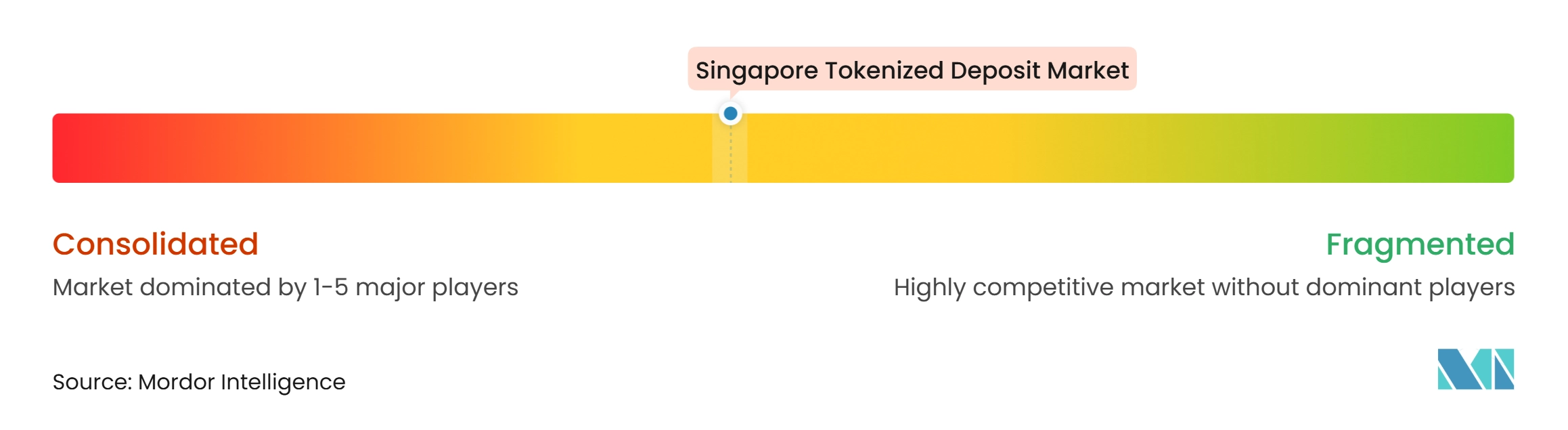
The Singapore tokenized deposit market is moderately concentrated in infrastructure and more actively contested in product delivery. DBS, OCBC, and UOB have structural advantages as Singapore dollar primary clearing banks and as the banks that completed live interbank Singapore dollar transactions on Swift’s ledger. HSBC competes through a Tokenised Deposit Service that spans 6 markets and 7 currencies. Standard Chartered offers a Singapore dollar and United States dollar tokenized deposit solution for Ant International in Singapore. These products give multinational corporate clients access to multi-currency treasury services through established bank relationships. Singapore banks are responding through interoperability arrangements that expand network reach without depending only on their own internal platforms.
JPMorgan’s Kinexys Digital Payments broadens competition toward digital-asset and payments-fintech activity. Its JPMD deposit-token work on the Base network included early trial participants such as Mastercard and B2C2. DBS and Kinexys announced their interbank transfer framework in November 2025, providing a specific example of competing networks working toward compatible settlement. Ant International has a separate position because it is both a commercial partner and a major user of on-chain payment processes. The company processes more than 1-third of its transactions on-chain, which can speed the development of enterprise use cases. Competition is therefore shaped by infrastructure capability, currency coverage, corporate connectivity, and the ability to meet regulated operating requirements.
Partior occupies a distinct role as a neutral blockchain clearing network rather than a tokenized deposit issuer. Its value proposition centers on network membership, currency coverage, and clearing arrangements. Partior and LSEG Digital Settlement House announced a Multi-Settlement Bank solution in September 2026, with production launch and onboarding of further settlement banks planned from the first quarter of 2027. MAS identified opportunities in small and medium-sized enterprise treasury access, programmable trade-finance disbursements, and agentic payment workflows. BIS Project Agorá brings together 7 central banks and more than 40 regulated financial institutions to study tokenized deposits and reserves for cross-border payments. These initiatives keep the competitive field open to banks, neutral settlement networks, and technology partners.
Singapore Tokenized Deposit Industry Leaders
-
DBS
-
Standard Chartered PLC
-
HSBC Holdings plc
-
Partior Pte. Ltd.
-
J.P. Morgan Chase & Co.
- *Disclaimer: Major Players sorted in no particular order
Singapore Tokenized Deposit Market Companies Covered in this Report
- DBS Bank Ltd.
- Oversea-Chinese Banking Corporation Limited (OCBC)
- United Overseas Bank Limited (UOB)
- HSBC Holdings plc
- Standard Chartered PLC
- JPMorgan Chase & Co.
- Citigroup Inc.
- Partior Pte. Ltd.
- SWIFT
- Ant International
- Bank of America Corporation
- BNP Paribas
- Société Générale
- MUFG Bank, Ltd.
- Sumitomo Mitsui Banking Corporation (SMBC)
- Deutsche Bank AG
- UBS Group AG
- BNY Mellon
- Barclays PLC
- Wells Fargo & Company
Recent Industry Developments in Singapore Tokenized Deposit Market
- October 2026: MAS announced that Bank Negara Malaysia and Bank of Thailand joined BLOOM as policymaker members, with new participants including Airwallex, Mastercard, Maybank, Nium, Ripple, ShopeePay, Visa, and the World Bank Group. The expanded initiative covers cross-border digital money acceptance, settlement, interoperability, and programmable controls across 3 ASEAN central bank jurisdictions.
- October 2026: OCBC launched a tokenized deposit solution with Ant International enabling 24/7 treasury management and liquidity movement between Singapore and Malaysia entities via the WhaleRTP blockchain settlement platform. It is the first production cross-border tokenized deposit corridor connecting Singapore to mainland ASEAN.
- September 2026: DBS, OCBC, and UOB completed the first live Singapore dollar interbank tokenized deposit transactions on Swift’s blockchain-based ledger, demonstrating 24/7 programmable Singapore dollar and United States dollar payments. The milestone followed Swift’s July 2026 confirmation that its ledger was ready for initial use with 17 banks across 6 continents.
- September 2026: Partior and LSEG Digital Settlement House announced a strategic collaboration to deliver always-on settlement bank liquidity through a Multi-Settlement Bank solution. Production launch and commercial onboarding of additional settlement banks are planned from the first quarter of 2027.
Singapore Tokenized Deposit Market Report Scope
Segmentation Overview
| Account-Based Tokenized Deposits |
| Native Deposit Tokens |
| Single-Bank (Intra-Bank) Networks |
| Interbank – Shared Multi-Bank Networks |
| Interbank – Bilateral and Cross-Network Links |
| Private Permissioned Ledgers |
| Public Blockchains with Permissioned Token Access |
| Securities and Digital-Asset Settlement and Collateral Management |
| FX and PvP Settlement |
| Intra-Group Treasury and Liquidity Management |
| Third-Party Commercial and Institutional Payments |
| Retail and Other Payments |
| Domestic |
| Cross-Border |
| Banks and Other Deposit-Taking Institutions | |
| Capital-Markets and Investment Firms | |
| Payments, Fintech and Digital-Asset Firms | |
| Nonfinancial Corporates | Large Corporates and Multinationals |
| SMEs | |
| Public Sector and Government Entities | |
| Individuals |
| By Token Model | Account-Based Tokenized Deposits | |
| Native Deposit Tokens | ||
| By Network Model | Single-Bank (Intra-Bank) Networks | |
| Interbank – Shared Multi-Bank Networks | ||
| Interbank – Bilateral and Cross-Network Links | ||
| By Ledger Type | Private Permissioned Ledgers | |
| Public Blockchains with Permissioned Token Access | ||
| By Use Case | Securities and Digital-Asset Settlement and Collateral Management | |
| FX and PvP Settlement | ||
| Intra-Group Treasury and Liquidity Management | ||
| Third-Party Commercial and Institutional Payments | ||
| Retail and Other Payments | ||
| By Transaction Scope | Domestic | |
| Cross-Border | ||
| By End User | Banks and Other Deposit-Taking Institutions | |
| Capital-Markets and Investment Firms | ||
| Payments, Fintech and Digital-Asset Firms | ||
| Nonfinancial Corporates | Large Corporates and Multinationals | |
| SMEs | ||
| Public Sector and Government Entities | ||
| Individuals | ||
Key Questions Answered in the Report
What is the Singapore tokenized deposit market size?
The Singapore tokenized deposit market size is estimated at USD 71.7 billion in 2027 and is forecast to reach USD 371.6 billion by 2032.
What is driving tokenized deposit adoption in Singapore?
Continuous corporate treasury transfers, MAS-led commercialization, and cross-border settlement efficiency are driving adoption.
Which token model leads current deployment?
Account-based tokenized deposits lead with a 64.8% share in 2026, while native deposit tokens are forecast to grow at a 43.5% CAGR through 2032.
Which network model is growing fastest?
Interbank shared multi-bank networks are forecast to grow at a 45.6% CAGR through 2032.
Which use case has the strongest projected growth?
Securities and digital-asset settlement and collateral management are projected to grow at a 44.6% CAGR through 2032.
What limits wider tokenized deposit deployment?
Interoperability gaps, cross-jurisdiction coordination needs, balance-sheet pressures, and cybersecurity risks remain important constraints.