
Singapore Professional Indemnity Insurance Market Size and Share
Market Overview
| Study Period | 2020 - 2031 |
|---|---|
| Forecast Data Period | 2026 - 2031 |
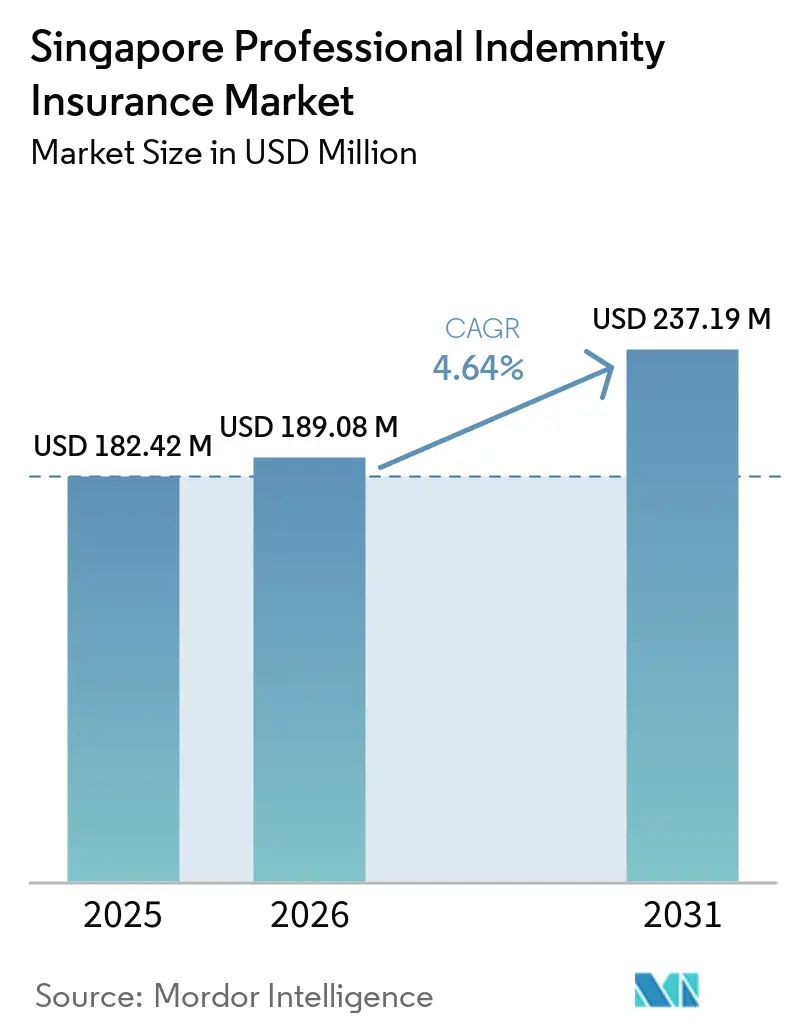
| Base Year Market Size (2025) | USD 182.42 Million |
| Market Size (2026) | USD 189.08 Million |
| Market Size (2031) | USD 237.19 Million |
| Growth Rate (2026 - 2031) | 4.64 % |
| Market Concentration | Low |
Major Players *Disclaimer: Major Players sorted in no particular order Image © Mordor Intelligence. Reuse requires attribution under CC BY 4.0. | |
Singapore Professional Indemnity Insurance Market Analysis by Mordor Intelligence
The Singapore professional indemnity insurance market size was valued at USD 182.4 million in 2025 and estimated to grow from USD 189.1 million in 2026 to reach USD 237.2 million by 2031, at a CAGR of 4.6% during the forecast period (2026-2031). Singapore’s domestic general insurance business generated SGD 6.09 billion (USD 4.8 billion) in gross written premiums during 2025, while the Singapore professional indemnity insurance market operates within this expanding specialty insurance setting. Mandatory coverage for several licensed professions supports recurring demand and makes policy renewal less dependent on discretionary purchasing. Technology suppliers, professional advisers, and built-environment consultants are facing broader liability exposures as digital delivery and major infrastructure work continue. Carriers are responding through specialty capacity, combined technology liability products, and digital access for smaller professional firms.
Key Report Takeaways
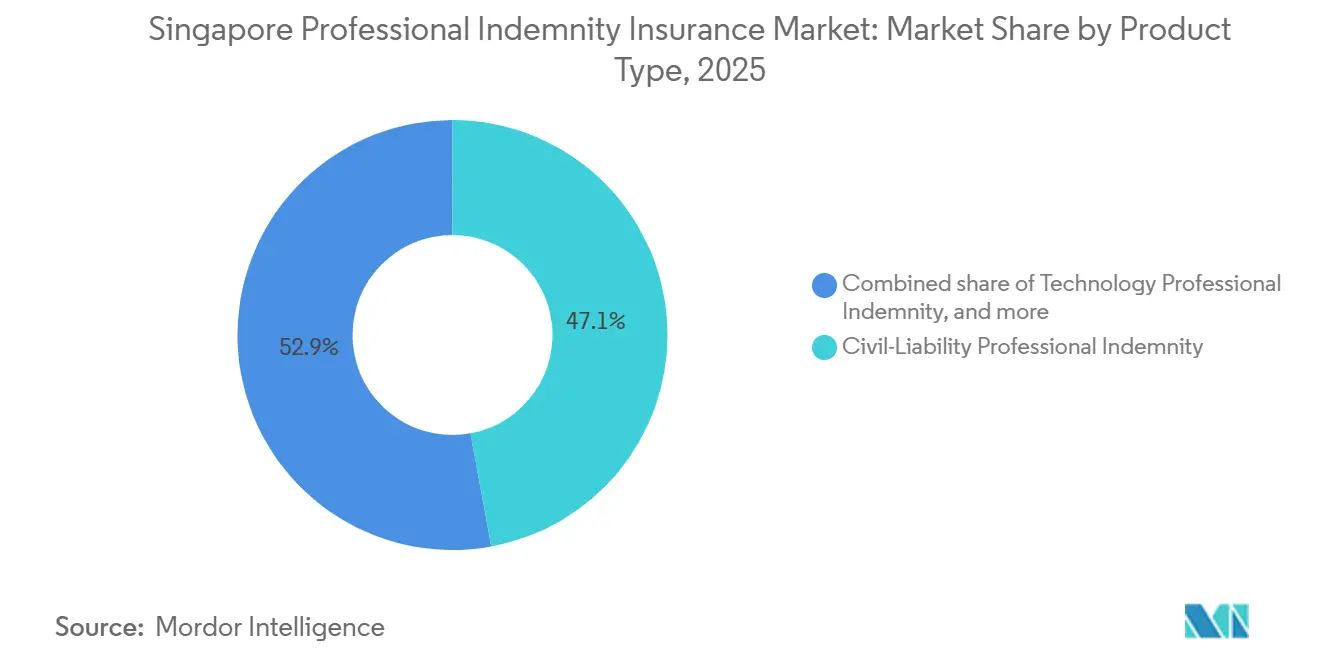
- By product type, civil-liability professional indemnity captured 47.12% of the Singapore professional indemnity insurance market share in 2025, while technology professional indemnity is projected to grow at 8.68% CAGR through 2031.
- By profession of the insured, legal services captured 22.08%of the Singapore professional indemnity insurance market share in 2025, while information technology, software, SaaS, and managed services are projected to grow at 8.84% CAGR through 2031.
- By end user and business size, large firms captured 45.89% of the Singapore professional indemnity insurance market share in 2025, while SMEs are projected to grow at 5.96% CAGR through 2031.
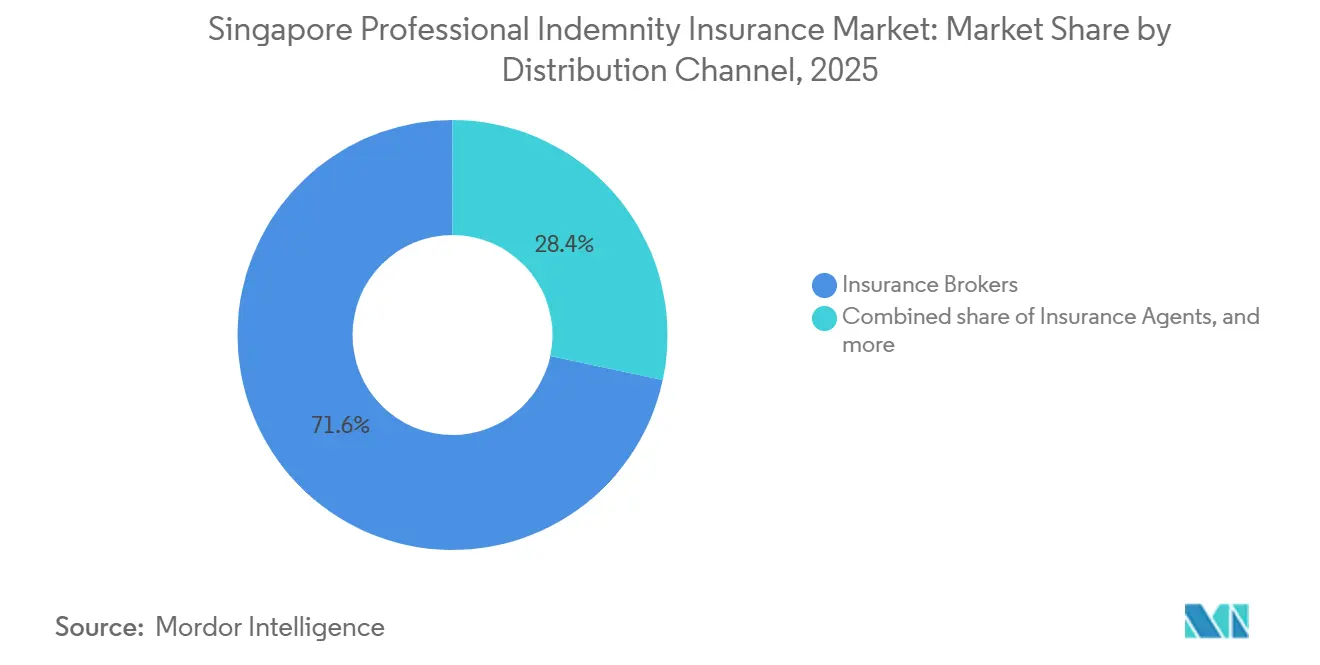
- By distribution channel, insurance brokers captured 71.64% of the Singapore professional indemnity insurance market share in 2025, while direct insurer channels are projected to grow at 7.62% CAGR through 2031.
- By policy structure, annual practice claims-made policies captured 89.82% of the Singapore professional indemnity insurance market share in 2025, while project-specific professional indemnity is projected to grow at 7.24% CAGR through 2031.
Note: Market size and forecast figures in this report are generated using Mordor Intelligence’s proprietary estimation framework, updated with the latest available data and insights as of January 2026.
Singapore Professional Indemnity Insurance Market Trends and Insights
Drivers Impact Analysis*
| Driver | (~) % Impact on CAGR Forecast | Geographic Relevance | Impact Timeline |
|---|---|---|---|
| Mandatory Professional Indemnity Requirements | +1.2% | Singapore-wide across financial, legal, engineering, and accountancy professions | Short term (≤ 2 years) |
| Professional Services Expansion and Liability Exposure | +1.0% | Singapore-wide, concentrated in financial, legal, and advisory centers | Medium term (2-4 years) |
| Construction and Infrastructure Consultant Demand | +0.8% | Singapore-wide, centered on government infrastructure and mixed-use contracts | Short term (≤ 2 years) |
| Digitalization of Professional Services | +0.9% | Singapore and Asia-Pacific | Medium term (2-4 years) |
| Regional Professional Services Hub Role | +0.6% | Asia-Pacific, supported by Singapore-based cross-border service firms | Long term (≥ 4 years) |
| Cross-Border Multinational Service Requirements | +0.4% | Global, with Singapore as a regional contracting hub | Long term (≥ 4 years) |
| Source: Mordor Intelligence | |||
Mandatory Professional Indemnity Requirements Drive Structurally Inelastic Demand
The Singapore professional indemnity insurance market has a recurring premium base because licensed firms must maintain coverage to meet regulatory requirements. Financial advisers must carry professional indemnity cover that ranges from SGD 500,000 (USD 0.4 million) to SGD 10 million (USD 7.8 million), based on gross revenue. The Monetary Authority of Singapore requires registered insurance brokers to maintain cover and to replace a policy within 1 month when a qualifying claim reaches the stated notification threshold. Legal practices, architects, and professional engineers also face professional indemnity obligations under their respective rules and statutes[1]. These requirements make the Singapore professional indemnity insurance market less exposed to short-term changes in voluntary insurance spending. Annual policy cycles that align with licensing requirements also support more consistent renewal behavior among regulated buyers.
Expansion of Professional Services Activity Deepens the Insured Population
Professional services activity increases the number of firms and individuals with advice-based liability exposure. Singapore’s financial sector grew 4.3% in 2025, and employment in the sector added an average of 4,200 net jobs each year from 2021 through 2025[2]. Assets under management reached SGD 6.7 trillion (USD 5.2 trillion) by the end of 2025 across 1,320 licensed fund management companies. Fund managers and advisers need cover that reflects their revenue, client mandates, and potential professional liability. The Singapore professional indemnity insurance market therefore benefits when advisory, fund management, legal, and consulting activity expands. Larger mandates can also raise coverage limits even when the number of insured firms changes slowly.
Construction and Infrastructure Demand Creates Project-Specific Coverage Opportunity
Large construction programs create demand for architects, engineers, planners, and other consultants who need professional indemnity coverage. The Land Transport Authority awarded a SGD 757 million (USD 591.7 million) contract in May 2026 for road network works supporting Changi Airport Terminal 5[3]. The work involves design and supervision functions that can create professional liability exposure across a project’s life. Statutory coverage obligations for architects and professional engineers provide an established basis for consultant demand. Government liability-cap provisions for built-environment consultancy contracts took effect in December 2025 and reduced a key barrier to obtaining proportionate coverage. This setting supports the Singapore professional indemnity insurance market, particularly for project-specific placements on multi-year engagements.
Digitalization and Technology Integration Reshape Technology Coverage Demand
Technology service providers face a broader set of contract and service-delivery risks when they supply regulated organizations. The Monetary Authority of Singapore’s technology risk management requirements establish obligations for regulated financial institutions on system availability and incident reporting. These requirements can flow into vendor selection and insurance expectations for software, SaaS, managed services, and AI-enabled providers. Singapore had approximately 1,900 fintech firms in 2026, creating a sizeable technology professional cohort with liability exposures. Chubb offers PremierTech, which combines technology professional liability and cyber coverage in a single form[4]. The Singapore professional indemnity insurance market is seeing technology cover develop as a response to the overlap between professional error claims and cyber-related events.
Restraints Impact Analysis*
| Restraint | (~) % Impact on CAGR Forecast | Geographic Relevance | Impact Timeline |
|---|---|---|---|
| Rising Claims Severity and Défense Costs | -0.3% | Global, with pressure on legal, financial advisory, and engineering accounts in Singapore | Short term (≤ 2 years) |
| Selective Underwriting of Complex Exposures | -0.2% | Asia-Pacific, particularly AI-adjacent and technology-hybrid services | Medium term (2-4 years) |
| Uncertainty Between Professional Liability and Cyber Events | -0.1% | Asia-Pacific, connected to policy wording development | Medium term (2-4 years) |
| Limited Risk Data for Emerging Services | -0.1% | Singapore, particularly AI-enabled advisory firms, SaaS platforms, and managed service providers | Long term (≥ 4 years) |
| Source: Mordor Intelligence | |||
Rising Claims Severity and Defense Costs Compress Underwriting Margins
Professional liability disputes can involve high legal costs, technical evidence, and long resolution periods. This pressure is particularly relevant in financial advisory, fund management, legal, and engineering claims, where regulatory reviews may run alongside civil disputes. Chubb has noted increased client interest in coverage that lasts for the full term of professional contracts rather than relying only on annual renewal continuity. Under policies where defense costs sit within the limit, those costs reduce the amount available for damages or settlement. Rising claims costs can make underwriters more cautious on limits, deductibles, and pricing. The Singapore professional indemnity insurance market can grow while carriers still face pressure to preserve adequate underwriting margins.
Selective Underwriting Constrains Capacity for Emerging Professional Classes
Established legal, architectural, engineering, and financial advisory risks have clearer historical experience than emerging technology exposures. Underwriters can be more selective where AI integration, SaaS delivery, and managed service arrangements make liability triggers harder to identify. QBE’s Asia operations product appetite document states a USD 50 million capacity ceiling for professional indemnity in Singapore and includes project-specific coverage capability. However, a standard professional indemnity wording may not clearly fit a firm whose main deliverable is technology that performs functions for clients. Standalone cyber policies may also leave gaps when a loss involves both technical failure and professional judgment. This uncertainty can slow premium expansion in the fastest-growing parts of the Singapore professional indemnity insurance market.
*Our forecasts treat driver/restraint impacts as directional, not additive. The impact forecasts reflect baseline growth, mix effects, and variable interactions.
Segment Analysis
By Product Type: Civil Liability Anchors Coverage While Technology PI Accelerates
Civil liability professional indemnity accounted for 47.12% of the Singapore professional indemnity insurance market share in 2025. Its leading position reflects mandatory coverage among lawyers, architects, engineers, and financial advisers, which creates a recurring annual premium base. Medical malpractice and clinical professional liability form a stable specialist area for licensed practitioners and hospital groups. Directors’ and officers’ liability and financial institutions' errors and omissions cover higher-value but lower-volume exposures among regulated organizations. Civil liability cover remains important because statutory minimums and established practice standards give buyers and insurers a familiar framework.
Technology professional indemnity is projected to grow at 8.68% CAGR from 2026 to 2031, faster than the overall Singapore professional indemnity insurance market. The Monetary Authority of Singapore’s technology risk requirements can increase contractual insurance expectations for vendors that serve financial institutions. Technology firms also need clearer protection when faulty services cause financial harm, data events, or service interruptions. Chubb’s combined technology liability and cyber policy illustrates how insurers are addressing this overlap. The product mix is therefore moving gradually toward technology-related cover while civil liability remains the largest category.
By Profession of the Insured: Legal Services Lead While Technology Services Expand
Legal services held 22.08% of the premium in 2025 and led the profession mix in Singapore. The Legal Profession rules require cover for sole practitioners, partnerships, law corporations, and limited liability law partnerships. This requirement gives legal practices a structured annual purchasing cycle and a relatively stable insurance need. Architecture, engineering, and surveying also retain a firm position because their work is subject to statutory professional indemnity requirements. Financial advisory, fund management, insurance broking, real estate, valuation, management consulting, healthcare, media, and advertising contribute to steady demand across the remaining profession groups.
Information technology, software, SaaS, and managed services are forecast to grow at 8.84% CAGR through 2031. Singapore’s fintech population of approximately 1,900 firms represents a visible part of the wider technology services base. Vendor requirements from regulated clients are making professional liability coverage more relevant for firms that deliver systems, advice, or outsourced operations. AI-supported client work adds another area where service quality, reliance, and accountability need clear contractual and insurance treatment. The Singapore professional indemnity insurance industry is therefore seeing technology services take a larger role in the profession mix.
By End User and Business Size: Large Firms Anchor Premium Volume While SMEs Grow Faster
Large firms accounted for 45.89% of end-user value in 2025. Global professional services networks, major financial institutions, and multinational engineering and law firms often buy higher limits than the statutory minimum. Their programs can use multiple insurers in layers, which increases premiums per client despite lower policy counts than smaller firms. Sole practitioners are important in number, especially in legal and accountancy work, but their minimum-limit policies generate less premium per policy. The large-firm segment remains central to specialty underwriting because it needs structured coverage, broker support, and claims expertise.
SMEs are projected to grow at 5.96% CAGR from 2026 to 2031. Mandatory coverage proposals for accounting sole proprietorships and partnerships could add 408 firms to the compulsory insurance population. Government construction contracts also create a practical link between smaller consultants and project-related professional indemnity needs. Digital quotation tools and modular policies can make standard cover easier to purchase for small professional firms. The Singapore professional indemnity insurance market may gain policy count as smaller businesses move from minimum compliance cover toward limits that better reflect litigation and contract risks.
By Distribution Channel: Brokers Lead While Direct Insurers Gain Ground
Insurance brokers accounted for 71.64% of premium distribution in 2025 and held the largest share of the Singapore professional indemnity insurance market. Complex professional indemnity placements require limit benchmarking, policy structure, insurer negotiations, and support during claims. Marsh administers the Law Society of Singapore’s professional indemnity program, demonstrating the role of specialist intermediaries in compulsory schemes. Registered brokers also operate within a regulatory framework that requires their own professional indemnity protection. This channel is likely to remain important for high-limit and bespoke accounts.
Direct insurer channels are forecast to grow at 7.62% CAGR through 2031. Digital tools can reduce the time required to quote and bind standard-form coverage for sole practitioners and smaller firms. Agents also provide access to simpler policies, while banks and other channels remain less central because professional indemnity needs often require specialized advice. Direct access is most relevant where the risk is familiar, and the buyer can use a modular policy without extensive negotiation. The Singapore professional indemnity insurance market is therefore likely to keep a broker-led structure while direct channels build a larger role in smaller accounts.
By Policy Structure: Claims-Made Policies Dominate While Project-Specific PI Grows
Annual practice claims-made policies captured 89.82% of premium in 2025. This structure lets insurers reassess risk and pricing at each renewal rather than estimate the full loss exposure when the work begins. It also aligns with annual licensing and compliance cycles for regulated professionals. Run-off and extended reporting cover serve practitioners who retire or dissolve a partnership but remain exposed to claims from earlier work. The claims-made format continues to dominate because it fits long-tail professional liability risks and recurring regulatory insurance obligations.
Project-specific professional indemnity is projected to grow at 7.24% CAGR through 2031. AIG and QBE offer project-specific coverage in Singapore with limits up to USD 50 million. This cover can attach from project inception to completion and reduce continuity concerns in multi-year construction work. The December 2025 liability-cap requirement for government consultancy agreements improved the ability to define the outer boundary of consultant liability. Project activity, therefore, offers a focused growth path for the Singapore professional indemnity insurance market.
Geography Analysis
Singapore represented 100% of the report scope in 2025 because the report covers a single jurisdiction. Domestic general insurance premiums reached SGD 6.09 billion (USD 4.8 billion) during 2025, and underwriting profit increased 32% to SGD 289 million (USD 225.9 million). Professional indemnity benefits from a broad statutory framework that covers financial advisers, brokers, legal practices, architects, and engineers. This regulatory base makes the market more mature than several smaller Association of Southeast Asian Nations jurisdictions. It also supports the presence of global specialty carriers that require sufficient premium depth, regulatory clarity, and complex risk demand.
Singapore’s assets under management totaled SGD 6.7 trillion (USD 5.2 trillion) at the end of 2025 across 1,320 licensed fund management companies. Singapore-based professionals can be liable to clients across Asia-Pacific, Europe, and the Middle East through cross-border mandates. International arbitration, cross-border mergers and acquisitions advice, and regional infrastructure consulting can require higher limits and multinational coverage structures. Allied World Re’s Singapore-based operations provide financial and professional lines treaty capacity across Asia-Pacific. This gives the Singapore professional indemnity insurance market a regional underwriting role as well as a domestic premium base.
The geographic role of Singapore is also shaped by its data protection and technology risk obligations. The Personal Data Protection Commission requires organizations to notify affected individuals when a data breach is likely to result in significant harm. Technology and advisory firms that process regional client data may face liabilities that are domestic in policy issuance but cross-border in effect. Financial institutions must comply with the Monetary Authority of Singapore’s technology risk management requirements, which can influence vendor controls and procurement conditions. These factors reinforce Singapore’s role as an Asia-Pacific location for sophisticated technology and professional liability placements.
Competitive Landscape
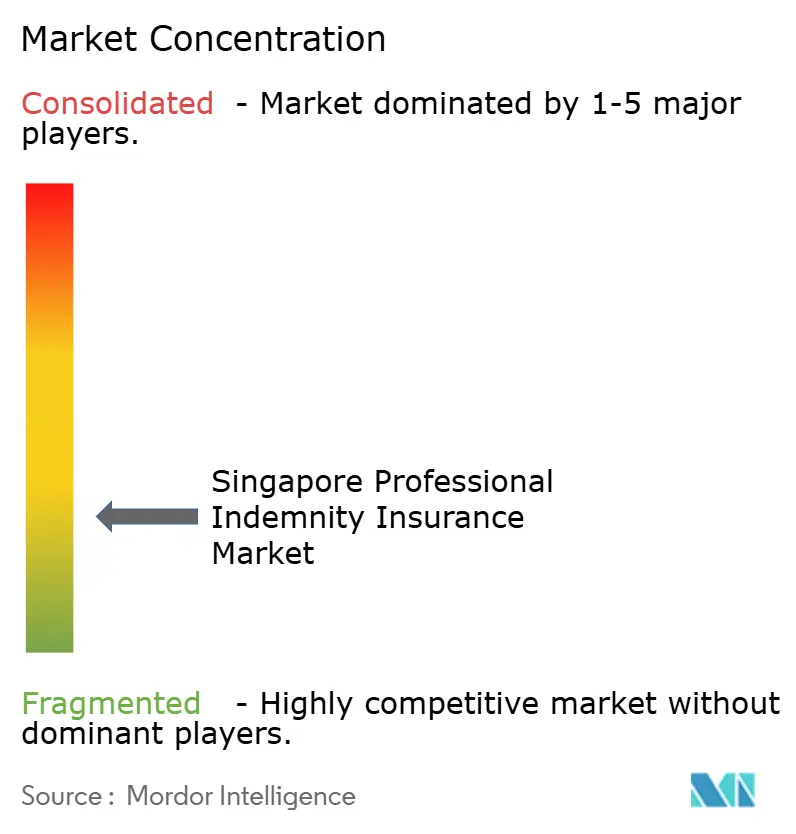
The Singapore professional indemnity insurance market is fragmented among global specialty insurers that serve high-limit and complex professional risks. AIG Asia Pacific, Chubb Insurance Singapore, QBE Insurance Singapore, Allied World, AXA XL, Zurich, AXIS Specialty, Allianz Global Corporate and Specialty, Berkshire Hathaway Specialty Insurance, and Markel International participate in professional lines for financial institutions, law firms, and engineering consultancies. MSIG, Sompo, Tokio Marine Kiln, and Canopius Asia also compete in standard and SME-oriented placements. QBE states that it can provide professional indemnity capacity of up to USD 50 million in Singapore, including project-specific professional indemnity capability. This mix gives buyers access to broad specialty capacity, although complex programs still depend on specialist broker relationships and layered underwriting.
Product design is a key competitive tool in the Singapore professional indemnity insurance market. Chubb’s PremierTech combines technology professional liability and cyber insurance to address claims that may involve both exposures. AIG offers single-project professional indemnity solutions for construction and infrastructure-related professional services. In February 2026, AIG completed a 35% equity investment in Convex and entered into a whole-account quota share arrangement effective January 1, 2026. The transaction expanded AIG’s specialty underwriting capacity through a partnership model. Such moves show that competitive positions depend on capacity, product scope, and the ability to serve changing professional risks.
Berkshire Hathaway Specialty Insurance promoted Edwin Sim to lead Executive and Professional Lines in Singapore in September 2025. The appointment indicates continued carrier investment in specialist leadership for professional and financial lines. Competitive opportunities are strongest in AI-exposed professional services, coordinated professional liability and cyber cover, and modular products for smaller accounting and technology firms. Insurers also need to meet governance, technology risk, outsourcing, and enterprise risk expectations that apply to Singapore-licensed carriers. The Singapore professional indemnity insurance market remains competitive, but the absence of disclosed combined shares for leading carriers prevents a precise assessment of concentration by premium.
Singapore Professional Indemnity Insurance Industry Leaders
-
AXA Insurance Singapore Pte. Ltd
-
Chubb Insurance Singapore Limited
-
MSIG Insurance (Singapore) Pte. Ltd
-
NTUC Income Insurance Ltd
-
AIG Asia Pacific Insurance Pte. Ltd
- *Disclaimer: Major Players sorted in no particular order
Recent Industry Developments
- May 2026: The Land Transport Authority awarded a SGD 757 million (USD 591.7 million) civil contract to the CES_SDC and KTC Civil Engineering and Construction joint venture for Changi Airport Terminal 5 road network enhancements along Xilin Avenue, the ECP, and Tanah Merah Coast Road, with works commencing Q3 2026 and a second package planned for Q4 2026. The scale of supervisory and design engagement across these packages requires PI coverage from the consultancy firms involved.
- April 2026: Allied World Re published its updated Asia-Pacific Financial and Professional Lines product appetite, confirming continued Singapore-based proportional and non-proportional treaty capacity for D&O, E&O, and professional indemnity across the Asia-Pacific region via Allied World Assurance Company Singapore Branch and Lloyd’s Syndicate 2232.
- February 2026: AIG completed its acquisition of a 35% equity stake in Convex, a specialty insurer, and entered a whole-account quota share agreement effective January 1, 2026, expanding its professional and specialty lines underwriting capacity, including in Singapore, where Convex already has a presence.
- February 2026: MAS revised its Compliance Toolkit for Direct Insurers and Reinsurers, reinforcing requirements for technology risk management, fraud risk management, enterprise risk management, and outsourcing. These standards govern how Singapore-licensed PI carriers manage their operational and compliance exposures.
Singapore Professional Indemnity Insurance Market Report Scope
| Civil-Liability Professional Indemnity |
| Medical Malpractice/Clinical Professional Liability |
| Technology Professional Indemnity |
| Financial-Institutions And Investment-Manager E&O |
| Directors’ and Officers’ Liability |
| Legal Services |
| Architecture, Engineering and Surveying |
| Accountancy and Corporate Secretarial Services |
| Financial Advisory, Fund Management and Insurance Broking |
| Management, Strategy and Human-Resources Consulting |
| Information Technology, Software, SaaS and Managed Services |
| Real Estate, Property Management and Valuation |
| Media, Advertising, Public Relations and Events |
| Education, Training and Teaching Organisations |
| Healthcare and Allied Medical Services |
| Travel, Recruitment and Employment Services |
| Other Professional Services |
| Sole Practitioners |
| Small and Medium-Sized Enterprises |
| Large Firms |
| Insurance Brokers |
| Insurance Agents |
| Direct Insurer Distribution |
| Bank and Other Channels |
| Annual Practice Claims-Made Policies |
| Project-Specific Professional Indemnity |
| Run-Off and Extended Reporting Period |
| By Product Type | Civil-Liability Professional Indemnity |
| Medical Malpractice/Clinical Professional Liability | |
| Technology Professional Indemnity | |
| Financial-Institutions And Investment-Manager E&O | |
| Directors’ and Officers’ Liability | |
| By Profession of the Insured | Legal Services |
| Architecture, Engineering and Surveying | |
| Accountancy and Corporate Secretarial Services | |
| Financial Advisory, Fund Management and Insurance Broking | |
| Management, Strategy and Human-Resources Consulting | |
| Information Technology, Software, SaaS and Managed Services | |
| Real Estate, Property Management and Valuation | |
| Media, Advertising, Public Relations and Events | |
| Education, Training and Teaching Organisations | |
| Healthcare and Allied Medical Services | |
| Travel, Recruitment and Employment Services | |
| Other Professional Services | |
| By End User and Business Size | Sole Practitioners |
| Small and Medium-Sized Enterprises | |
| Large Firms | |
| By Distribution Channel | Insurance Brokers |
| Insurance Agents | |
| Direct Insurer Distribution | |
| Bank and Other Channels | |
| By Policy Structure | Annual Practice Claims-Made Policies |
| Project-Specific Professional Indemnity | |
| Run-Off and Extended Reporting Period |
Key Questions Answered in the Report
What is driving demand for professional indemnity insurance in Singapore?
Mandatory cover for licensed professions, expanding professional services activity, technology vendor requirements, and infrastructure consulting work support demand.
How large is the Singapore professional indemnity insurance market?
Singapore professional indemnity insurance premiums total USD 189.1 million in 2026 and are forecast to reach USD 237.2 million by 2031, at a 4.6% CAGR.
Which product category leads professional indemnity cover in Singapore?
Civil-liability professional indemnity led with a 47.12% share in 2025, supported by coverage obligations across established regulated professions.
Which insured profession is growing fastest in Singapore?
Information technology, software, SaaS, and managed services are forecast to grow at an 8.84% CAGR through 2031.
Why do insurance brokers remain important for professional indemnity policies?
Brokers handled 71.64% of premium in 2025 because complex placements require specialist policy design, insurer access, and claims support.
What is the fastest-growing policy structure for Singapore professional indemnity coverage?
Project-specific professional indemnity is forecast to grow at a 7.24% CAGR through 2031, supported by construction and infrastructure engagements.