
Singapore Employers' Liability Insurance Market Size and Share
Market Overview
| Study Period | 2020 - 2031 |
|---|---|
| Forecast Data Period | 2026 - 2031 |
| Base Year Market Size (2025) | USD 382.76 Million |
| Market Size (2026) | USD 396.15 Million |
| Market Size (2031) | USD 500.80 Million |
| Growth Rate (2026 - 2031) | 4.80 % |
| Market Concentration | Low |
Major Players *Disclaimer: Major Players sorted in no particular order Image © Mordor Intelligence. Reuse requires attribution under CC BY 4.0. | |
Singapore Employers' Liability Insurance Market Analysis by Mordor Intelligence
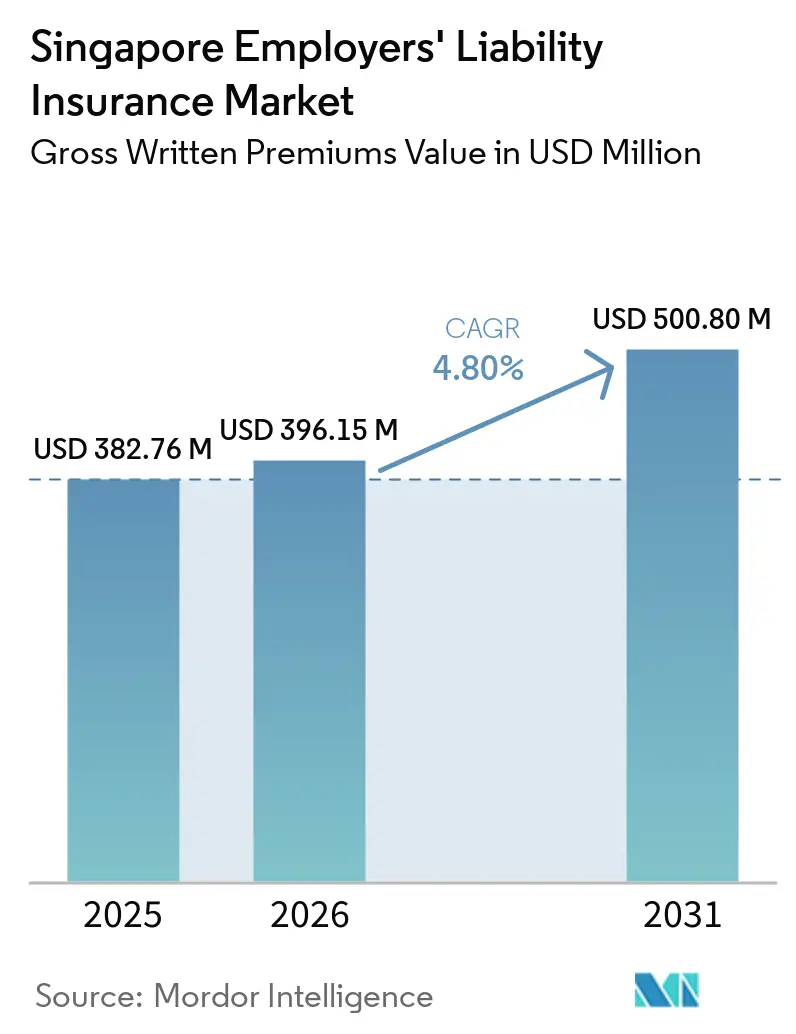
The Singapore Employers Liability Insurance Market size in terms of gross written premiums value is projected to expand from USD 382.76 million in 2025 and USD 396.15 million in 2026 to USD 500.80 million by 2031, registering a CAGR of 4.80% between 2026 and 2031.
The Singapore employers' liability insurance market is shaped by the Work Injury Compensation Act 2019, which requires coverage for manual employees and non-manual employees earning up to SGD 2,600 (USD 1,924) per month. The January 2025 inclusion of platform workers broadened the compulsory pool and placed new demand on designated insurers. Higher compensation limits from November 2025 also increased the maximum exposure that insurers must consider when renewing policies. Improving safety results supported underwriting performance, but lower claims frequency may reduce renewal pressure for employers with strong safety records. The market remains Singapore-specific, rather than a United Kingdom, United States, or Asia-Pacific regional total.
Key Report Takeaways
- By coverage type, statutory WICA benefits captured 75.82% of the Singapore employers' liability insurance market share in 2025, while in-class optional extensions are projected to grow at 7.02% CAGR through 2031.
- By insurance obligation, compulsory lives captured 83.56% of the Singapore employers' liability insurance market share in 2025 and is projected to grow at 5.19% CAGR through 2031.
- By worker category, manual employees captured 67.91% of the Singapore employers' liability insurance market share in 2025, while platform workers are projected to grow at 7.82% CAGR through 2031.
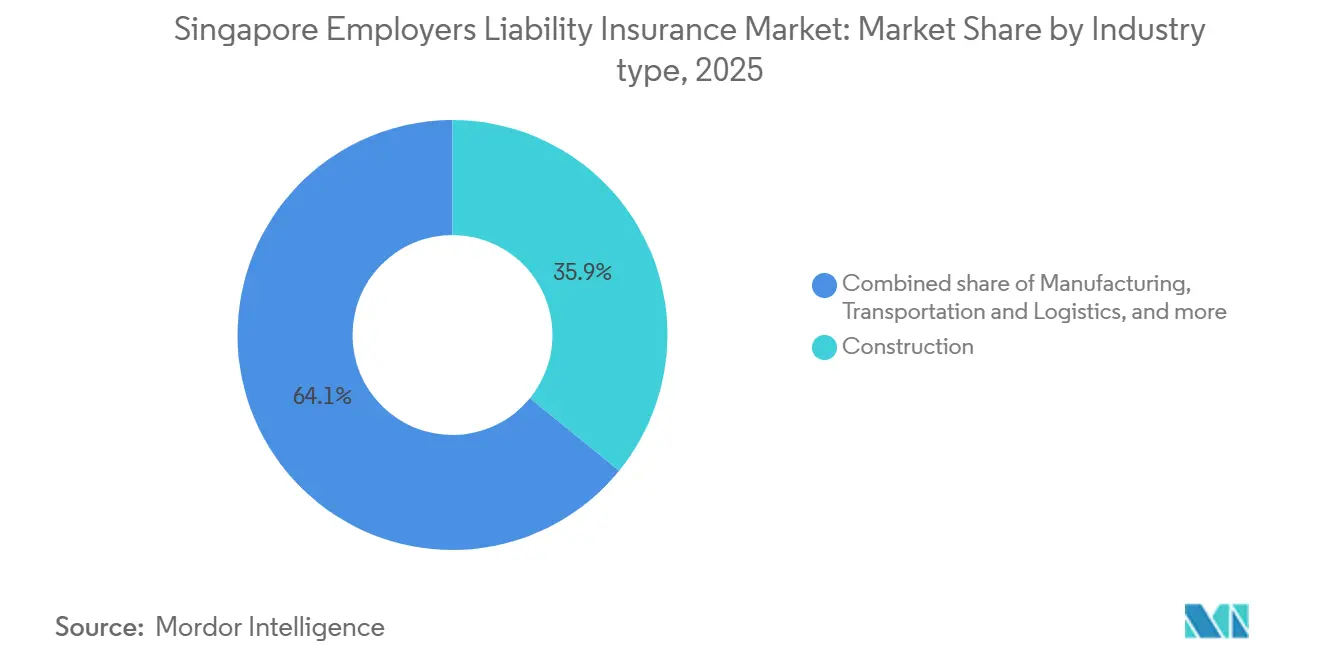
- By industry type, construction captured 35.88% of the Singapore employers' liability insurance market share in 2025, while healthcare and social services are projected to grow at 6.45% CAGR through 2031.
- By customer size, SMEs captured 61.74% of the Singapore employers' liability insurance market share in 2025, while large corporates are projected to grow at 5.46% CAGR through 2031.
- By geography, the west region captured 32.12% of the Singapore employers' liability insurance market share in 2025 and is projected to grow at 5.69% CAGR through 2031.
Note: Market size and forecast figures in this report are generated using Mordor Intelligence’s proprietary estimation framework, updated with the latest available data and insights as of January 2026.
Singapore Employers' Liability Insurance Market Trends and Insights
Drivers Impact Analysis*
| Driver | (~) % Impact on CAGR Forecast | Geographic Relevance | Impact Timeline |
|---|---|---|---|
| Mandatory Work Injury Coverage for Platform Workers | +1.2% | National, with the highest density in Central and West Regions, where platform operators are concentrated in food delivery and ride-hailing hubs | Short term (≤ 2 years) |
| Higher Statutory Compensation Limits | +1.0% | National, applying to all designated-insurer WIC policies at renewal | Short term (≤ 2 years) |
| Stronger Employer Compliance and Work Injury Requirements | +0.8% | National, with enforcement focused on Construction, Manufacturing, and Transportation | Medium term (2-4 years) |
| Broader Occupational Disease Coverage | +0.6% | National, with a greater effect on Manufacturing, Healthcare, and Social Services, and chemical-exposure sectors | Medium term (2-4 years) |
| Recurring Mandatory Coverage for Manual and Lower-Wage Employees | +0.7% | National, with the highest density in Construction, Logistics, Food and Beverage, and Retail | Long term (≥ 4 years) |
| Broader Protection for Local, Foreign, and Non-Traditional Workers | +0.5% | National, with spillover to West Region industrial zones and North Region logistics corridors | Long term (≥ 4 years) |
| Source: Mordor Intelligence | |||
Expansion of Mandatory Work Injury Coverage to Platform Workers
The inclusion of platform workers under the Work Injury Compensation Act (WICA) from January 2025 expanded the compulsory insurance base, bringing around 99,200 platform workers into mandatory coverage. Designated platform operators must obtain approved WIC policies through designated insurers, creating a formal and recurring insurance channel for delivery riders and private-hire drivers. Platform workers recorded 2 fatalities and 74 major injuries in 2025, with a fatal and major injury rate of 84.6 per 100,000 workers, substantially above the national workplace average of 17.7[1]Ministry of Manpower, Singapore, “Workplace Safety and Health National Statistics Report 2025,” Ministry of Manpower, mom.gov.sg.. The higher-risk profile increases the need for differentiated underwriting and claims management for this newly insured workforce. Overall, the regulatory expansion increases the addressable premium pool while introducing a distinct risk class for Singapore employers' liability insurers.
Higher Statutory Compensation Limits Increasing Employer Liability Exposure
The increase in WICA compensation limits from November 2025 is raising the maximum severity exposure for employers' liability insurers, with the permanent incapacity limit increasing 19% to SGD 346,000 (USD 256,000), the death benefit rising 19% to SGD 269,000 (USD 199,000), and the medical expense cap increasing 17% to SGD 53,000 (USD 39,000) per accident[2]Ministry of Manpower, Singapore, “0802 Higher Compensation Limits Under the Work Injury Compensation Act,” Ministry of Manpower, mom.gov.sg.. Although total work injury compensation payouts declined 2% to SGD 135.5 million (USD 100.3 million) in 2025, lower claim frequency does not eliminate the impact of higher potential claim severity. Insurers must therefore recalibrate pricing, reserving, and risk selection to reflect higher maximum liabilities. The change creates a stronger premium and underwriting opportunity for insurers with robust claims analytics and reserve discipline. Periodic statutory revisions also create the potential for future repricing as compensation limits are reviewed again.
Strengthening Employer Compliance and Work Injury Insurance Requirements
Singapore's strengthened WIC compliance framework is supporting demand for compulsory employers' liability coverage by making insurance and payroll information more transparent to regulators. The EmPOWER-WIC data exchange platform enables comparisons between employer payroll declarations and insurer policy information, making potential coverage gaps easier to identify. Employers that fail to meet insurance requirements can face fines of up to SGD 10,000 (USD 7,500) and imprisonment of up to 12 months, reinforcing compliance-driven demand. Increased safety enforcement, particularly in construction, further encourages employers and subcontractors to maintain compliant coverage. This environment benefits insurers through higher policy retention and opportunities to differentiate through administration, compliance support, and claims servicing.
Expanded Occupational Disease Coverage Broadening Insurable Risks
The harmonization of occupational disease schedules under the Workplace Safety and Health Act (WSHA) and WICA from December 2025 expanded the range of conditions that can generate compensation exposure, with the revised schedule recognizing 38 conditions[3] Ministry of Manpower, Singapore, “Updated Coverage of Reportable and Compensable Occupational Diseases Under WSHA and WICA,” Ministry of Manpower, mom.gov.sg.. The inclusion of broader musculoskeletal, biological, and chemical exposure conditions extends potential employers' liability exposure beyond traditional high-risk sectors such as construction and manufacturing. Healthcare, laboratory, and social-service employers can consequently become more important underwriting segments for insurers. Because occupational diseases can have long latency periods between workplace exposure and diagnosis, the financial impact of the reform may emerge gradually through claims development and reserves. This creates demand for stronger occupational-disease underwriting, exposure monitoring, and long-tail claims management capabilities.
Restraints Impact Analysis*
| Restraint | (~) % Impact on CAGR Forecast | Geographic Relevance | Impact Timeline |
|---|---|---|---|
| High Penetration in Traditional Employee Segments | -0.9% | National, most acute in Central and East Regions where higher-salary non-manual employment is dominant | Long term (≥ 4 years) |
| Designated-Insurer Rules Limiting Entry and Product Flexibility | -0.7% | National | Medium term (2-4 years) |
| Complex Occupational Disease Assessment and Claims Management | -0.5% | National, with a greater effect on Manufacturing, Healthcare, and chemical-exposure sectors | Long term (≥ 4 years) |
| Limited Compulsory Coverage for Higher-Income Non-Manual Employees | -0.6% | National, concentrated in the Central Region's financial, professional, and technology services districts | Long term (≥ 4 years) |
| Source: Mordor Intelligence | |||
High Market Penetration Limiting Growth from Traditional Employee Segments
The high penetration of statutory WICA coverage limits incremental growth from Singapore's traditional employee base, with insurers accounting for 94% of WICA claim payouts in 2025. The number of major workplace injuries remained broadly stable at 586 cases, providing limited scope for claims-volume-driven expansion. As most eligible employees are already covered, premium growth is increasingly dependent on employment and wage growth rather than new policy penetration. Insurers, therefore, have limited opportunity to expand through the statutory base alone. Further growth must come from voluntary liability extensions, higher limits, and emerging categories such as platform workers. This makes the market more dependent on value-added coverage and risk-based pricing than on expansion of the traditional compulsory employee pool.
Regulated Designated-Insurer Framework Constraining Market Entry and Product Flexibility
Singapore's requirement that only MOM-designated insurers issue WICA-compliant policies creates a significant barrier to entry and limits competitive expansion. Designated insurers must meet licensing, system-integration, and regulatory requirements, including participation in the EmPOWER-WIC data exchange platform. The framework also involves an annual designation fee, including SGD 36,000 (USD 26,700) for insurers with gross WIC premiums above SGD 10 million. These requirements favor established insurers with the necessary regulatory infrastructure and scale. Standardized statutory benefits further restrict differentiation in the core WICA product. Insurers therefore have greater scope to compete through voluntary extensions, digital administration, broker relationships, and claims services rather than through fundamental changes to compulsory coverage.
*Our forecasts treat driver/restraint impacts as directional, not additive. The impact forecasts reflect baseline growth, mix effects, and variable interactions.
Segment Analysis
By Coverage Type: Optional Extensions Lead Growth on a Mature WICA Base
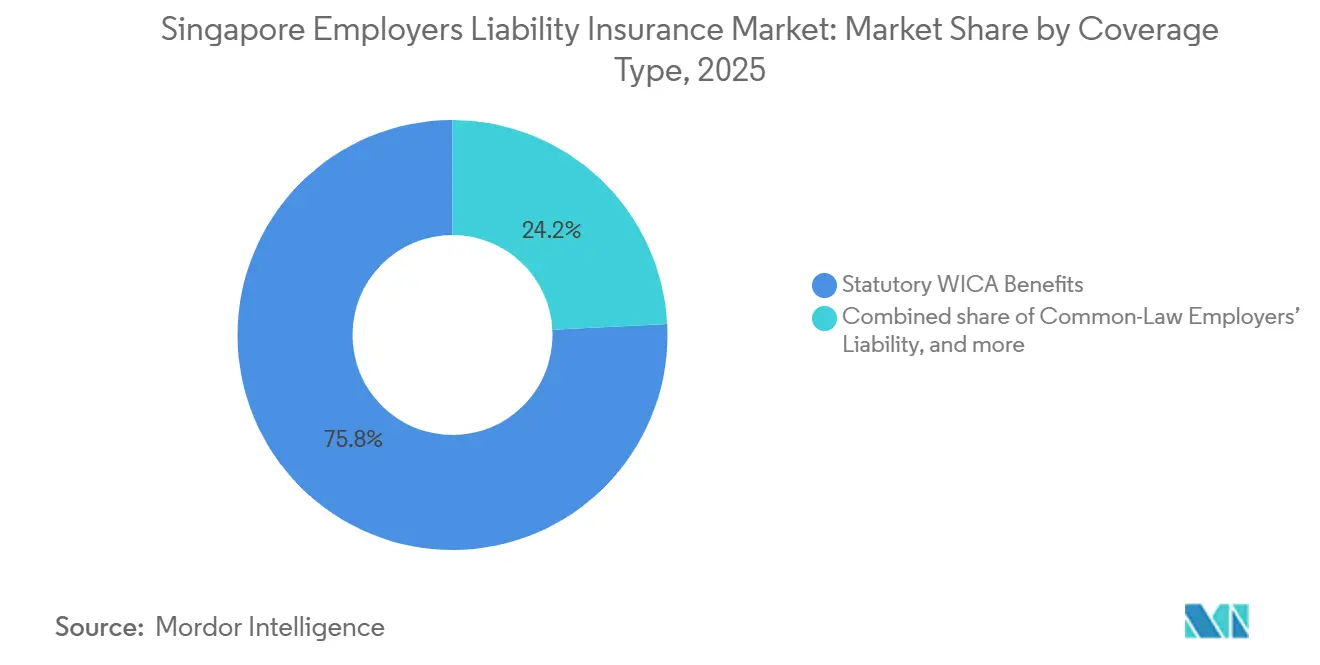
Statutory WICA benefits accounted for 75.82% of coverage-type volume in 2025. This dominant position reflects Singapore's no-fault compensation framework and its compulsory coverage requirements. Statutory WICA benefits held the largest Singapore employers' liability insurance market share, as the Ministry of Manpower prescribes the basic terms of coverage. Competition in this segment centers on price, claims efficiency, and digital onboarding rather than major differences in the required statutory benefits. The large statutory base provides recurring demand from employers within the mandatory coverage perimeter, as manual employees and eligible lower-wage non-manual employees remain subject to clearly defined compulsory insurance requirements across Singapore's employment base.
In-class optional extensions are forecast to grow at a 7.02% CAGR from 2026 to 2031. The Singapore employers' liability insurance market size for optional extensions is growing faster than the overall market, at a 7.02% CAGR versus 4.8%, as employers add protection beyond the statutory floor. Construction, healthcare, and logistics employers may add enhanced medical expense cover, occupational disease extensions, and higher common-law indemnity limits. Common-law employers' liability applies when an injured employee pursues a civil negligence claim instead of a WICA claim. Such claims are generally associated with catastrophic injuries where statutory caps may be insufficient, which is why employers in sectors with serious injury or occupational disease exposure consider higher protection alongside prescribed WICA benefits. A standard Singapore WIC policy typically includes a common-law employers' liability limit of SGD 10 million (USD 7.5 million) per claim.


By Insurance Obligation: Compulsory Lives Drive Both Share and Growth
Compulsory lives held 83.56% of the Singapore employers' liability insurance market share in 2025. The category is forecast to grow at a 5.19% CAGR from 2026 to 2031, making it both the largest insurance-obligation category and the main growth engine. Growth is driven by policy requirements rather than an increase in workplace injuries, allowing the category to expand when coverage obligations change, even as the national safety record improves and reported injury frequency declines. The January 2025 inclusion of platform workers expanded the compulsory pool. Any future increase in the SGD 2,600 (USD 1,924) monthly salary threshold for non-manual employees would further broaden the category.
Voluntary lives and self-insured residual together represented the remaining 16.44% in 2025. Voluntary lives depend on employers' risk appetite and demand for coverage beyond statutory requirements. The self-insured residual category is concentrated among public-sector entities that opt out of commercial insurance. Better workplace safety does not necessarily reduce the size of compulsory lives. Instead, safety improvements can support loss ratios while policy requirements remain in place, allowing insurers to retain a compulsory premium base while managing claims costs. This makes the compulsory base attractive for designated insurers that can manage distribution costs efficiently. The Singapore employers' liability insurance market size can therefore continue to expand with changes in coverage obligations, even when workplace injury frequency declines.
By Worker Category: Platform Workers Change the Manual-Heavy Pattern
Manual Employees accounted for 67.91% of worker-category volume in 2025. The category is large because WICA covers all manual employees regardless of salary. Construction, manufacturing, logistics, and food services make up a substantial part of this insured workforce. Non-Manual Employees are the second-largest worker category. Mandatory coverage for non-manual employees applies only when the monthly gross salary is at or below SGD 2,600 (USD 1,920). This salary threshold leaves a share of professional employment outside the compulsory perimeter, particularly in office-based roles where monthly earnings commonly exceed the applicable level for mandatory non-manual employee coverage.
Platform Workers are forecast to grow at 7.82% CAGR from 2026 to 2031. The Singapore employers' liability insurance market size for platform workers is expanding as operators complete a first full cycle of injury and occupational disease claims after the Platform Workers Act 2024. The group recorded an injury rate of 84.6 per 100,000 workers in 2025. This rate is above the national average and indicates higher claims costs per insured life. Insurers must price this category using their own risk profile rather than applying standard manual employee loss ratios, since the work commonly involves road travel, delivery activity, and operating conditions that differ from many conventional workplace settings. Platform operators must obtain Ministry of Manpower approved policies through the designated insurer list for platform workers.
By Industry Type: Construction Leads Volume and Healthcare Drives Growth
Manual employees accounted for 67.91% of worker-category volume in 2025. The category is large because WICA covers all manual employees regardless of salary. Construction, manufacturing, logistics, and food services make up a substantial part of this insured workforce. Non-manual employees were the second-largest worker category. Mandatory coverage for non-manual employees applies only when the monthly gross salary is at or below SGD 2,600 (USD 1,920). This salary threshold leaves a share of professional employment outside the compulsory perimeter, particularly in office-based roles where monthly earnings commonly exceed the applicable threshold.
Platform workers are forecast to grow at a 7.82% CAGR from 2026 to 2031. The Singapore employers' liability insurance market size for platform workers is expanding as operators complete a first full cycle of injury and occupational disease claims following the Platform Workers Act 2024. The group recorded an injury rate of 84.6 per 100,000 workers in 2025. This rate is above the national average and indicates higher claims costs per insured life. Insurers must price this category based on its own risk profile rather than applying standard manual employee loss ratios, as the work commonly involves road travel, delivery activity, and operating conditions that differ from many conventional workplace settings. Platform operators must obtain Ministry of Manpower-approved policies through the designated insurer list for platform workers. Growth in this segment is expected to support the Singapore employers' liability insurance market share of platform-worker coverage through 2031.
By Customer Size: SMEs Provide Volume While Large Corporates Gain Momentum
SMEs represented 61.74% of customer-size volume in 2025. This share reflects Singapore's enterprise composition and the large number of smaller employers with mandatory WIC obligations. The SME category held the largest Singapore employers' liability insurance market share among customer sizes. QBE Insurance found that 66% of SME decision-makers reported full awareness of WIC requirements in 2025, down from 70% in 2024. The remaining awareness gap creates a role for simplified onboarding and digital distribution, particularly where smaller employers need clearer guidance on insurance requirements and easier administration of policy renewals. Insurers serving SMEs can compete on clarity, speed, and accessible policy administration.
Large corporates are forecast to grow at a 5.46% CAGR from 2026 to 2031. Larger employers often seek integrated WIC and employers' liability programs rather than basic statutory cover alone. These programs can include common-law extensions, occupational health management, workforce data analytics, managed care networks, and return-to-work support. Large corporations commonly work through brokers to negotiate program terms. The November 2025 increase in statutory compensation limits adds relevance to higher-limit and occupational disease extensions. The Singapore employers' liability insurance market size can benefit from demand for these higher-value service layers, as larger employers often seek coordinated support across claims, occupational health, and return-to-work needs.
Geography Analysis
The West Region held 32.12% of the Singapore employers' liability insurance market share in 2025 and is forecast to grow at a 5.69% CAGR from 2026 to 2031. This combination of the largest regional share and highest regional growth rate is linked to the Jurong-Tuas industrial belt, which includes manufacturing, chemical and petrochemical plants, port logistics, and marine engineering operations. These activities have larger manual workforces and higher injury exposure than office-based employment. The Urban Redevelopment Authority released the 3.7-hectare Jurong Lake District Town Hall Link white site in March 2026 under the H1 2026 Government Land Sales reserve list. The site is intended to support 100,000 new jobs in the West by the 2040s, with construction activity creating demand from 2026 onward and later operational employment adding to the region's existing concentration of insurable industrial work.
Small-scale construction and alteration works accounted for more than 60% of fatal and major construction injuries nationally in 2025. Renovation work across West Region industrial parks and mixed-use sites can therefore sustain claims frequency even as overall safety performance improves. The Central Region has a different risk profile because it includes the financial district, Orchard Road, and a large professional services corridor. Many employees in these roles earn above the SGD 2,600 (USD 1,924) monthly threshold for compulsory non-manual coverage. This limits statutory premium volume in parts of the Central Region, although employers may still choose voluntary extensions or common-law protection beyond the statutory minimum for employees outside the compulsory threshold. The East Region is linked to Changi Airport cargo, aviation maintenance, and ground handling employment, where transportation and storage injury exposure remains relevant.
The North Region includes Woodlands, Yishun, and Sembawang industrial parks. The North-East Region includes Sengkang, Punggol, and biomedical manufacturing clusters. Together, these areas have growing employer bases supported by plans to develop advanced manufacturing and biomedical capacity away from the Central corridor. Smaller employers in these areas may face stronger safety enforcement as the bizSAFE framework review progresses. Renovation and light manufacturing businesses can respond through policy upgrades over the medium term as safety compliance expectations become more visible for smaller employers carrying manual work and site-based operating risks. The Singapore employers' liability insurance market size is therefore closely tied to the location of manual work, industrial activity, and higher-paid non-manual employment.
Competitive Landscape
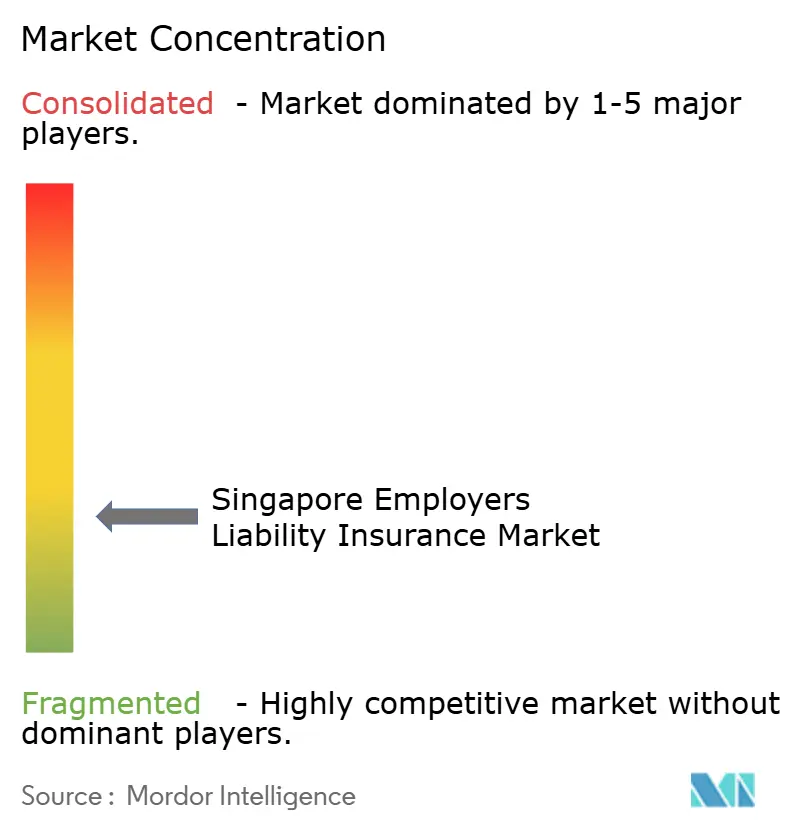
The Singapore employers’ liability insurance market is fragmented, with approximately 20 Ministry of Manpower designated insurers competing across the regulated WICA market. The participant base includes international insurers, regional Asian carriers, and Singapore-based insurers, creating a diverse competitive landscape rather than dominance by a small group of providers. Mandatory WICA requirements standardize core coverage, limiting differentiation through policy structure. Competition is therefore driven primarily by premium pricing, broker relationships, claims handling, digital onboarding, policy administration, and service quality. The relatively broad insurer base provides employers with multiple options while regulatory designation requirements continue to restrict entry by new participants.
MSIG Insurance Singapore was named Digital Insurer of the Year at The Asset Triple A Digital Finance Awards 2026. Its use of Generative AI and robotic process automation saved more than 31,000 operational hours each year. MSIG also stated that 1-fifth of travel claims were auto-approved and paid within 48 hours. In February 2026, MSIG Asia named Peak3 as its strategic digital insurance platform partner. The arrangement supports modular embedded WIC product distribution through digital commerce channels in Southeast Asia. MSIG also published a standalone claims transparency report in August 2025 that disclosed SGD 132.4 million (USD 98.0 million) in total claims paid and a 94% settlement ratio, putting greater emphasis on service accountability in a class where core statutory policy terms are closely regulated.
Berkshire Hathaway Specialty Insurance launched WICare+ in July 2025 through Steadfast's 37-broker Singapore network. The WICA-compliant enhanced product targeted SMEs seeking above-statutory benefits and faster claims payments. The Monetary Authority of Singapore issued a consultation paper on AI Risk Management Guidelines for Financial Institutions in November 2025. The guidelines address the use of AI in underwriting, automated claims adjudication, and fraud detection. Higher technology governance requirements can increase compliance costs for smaller designated insurers. Larger insurers with established governance systems may therefore have an advantage as digital claims and underwriting tools become more important, since the same firms can combine technology investment with the controls expected under the emerging regulatory framework.
Singapore Employers' Liability Insurance Industry Leaders
Income Insurance Ltd
Chubb Insurance Singapore Limited
MSIG Insurance (Singapore) Pte Ltd
Allianz Insurance Singapore Pte. Ltd
Liberty Insurance Pte Ltd
- *Disclaimer: Major Players sorted in no particular order

Recent Industry Developments
- June 2026: Singapore's Ministry of Health confirmed that the healthcare workforce is projected to grow 20% by 2030, while salary revisions for 23,000 community care workers are being introduced by the end of 2026. The Healthcare and Social Services workforce is expanding, and higher salary levels increase premium volume and maximum WICA compensation liability within this fastest-growing industry segment.
- February 2026: MSIG Singapore was named Digital Insurer of the Year at The Asset Triple A Digital Finance Awards 2026. The recognition covered the use of Generative AI and robotic process automation across underwriting, claims processing, and customer service. These tools saved more than 31,000 operational hours annually.
- December 2025: The Ministry of Manpower expanded Singapore's recognized occupational disease list to 38 conditions and harmonized the WSHA and WICA Second Schedules effective December 1, 2025. The revised list broadened compensable disease exposure in healthcare, laboratory, and chemical-sector work. The change created policy repricing requirements for designated insurers active in these sectors.
- November 2025: WICA compensation ceilings increased 19% for death, with a new maximum of SGD 269,000 (USD 199,000), and permanent incapacity, with a new maximum of SGD 346,000 (USD 256,000). The medical expense limit increased 17% to SGD 53,000 (USD 39,000). All WIC policies renewing in 2026 reflect this repricing trigger.


Singapore Employers' Liability Insurance Market Report Scope
| Statutory WICA Benefits |
| Common-Law Employers’ Liability |
| In-Class Optional Extensions |
| Compulsory Lives |
| Voluntary Lives |
| Self-Insured Residual |
| Manual Employees |
| Non-Manual Employees |
| Platform Workers |
| Construction |
| Manufacturing |
| Transportation and Logistics |
| Healthcare and Social Services |
| Wholesale and Retail Trade |
| Professional, Scientific and Technical Services |
| Information and Communications |
| Administrative and Support Services |
| Education |
| Financial and Insurance Services |
| Real Estate, Utilities and Other Industries |
| SMEs |
| Large Corporates |
| Central Region |
| East Region |
| North Region |
| North-East Region |
| West Region |
| By Coverage Type | Statutory WICA Benefits |
| Common-Law Employers’ Liability | |
| In-Class Optional Extensions | |
| By Insurance Obligation | Compulsory Lives |
| Voluntary Lives | |
| Self-Insured Residual | |
| By Worker Category | Manual Employees |
| Non-Manual Employees | |
| Platform Workers | |
| By Industry Type | Construction |
| Manufacturing | |
| Transportation and Logistics | |
| Healthcare and Social Services | |
| Wholesale and Retail Trade | |
| Professional, Scientific and Technical Services | |
| Information and Communications | |
| Administrative and Support Services | |
| Education | |
| Financial and Insurance Services | |
| Real Estate, Utilities and Other Industries | |
| By Customer Size | SMEs |
| Large Corporates | |
| By Geography | Central Region |
| East Region | |
| North Region | |
| North-East Region | |
| West Region |


Key Questions Answered in the Report
What is driving demand for employers' liability insurance in Singapore?
Mandatory WICA coverage, the inclusion of more than 99,200 platform workers in 2025, and higher compensation limits from November 2025 are supporting demand.
How large is Singapore's employers' liability insurance market?
It stands at USD 396.15 million in 2026 and is forecast to reach USD 500.80 million by 2031 at a 4.8% CAGR.
Which coverage type has the largest share in Singapore?
Statutory WICA Benefits accounted for 75.82% of coverage-type volume in 2025, while Optional Extensions are forecast to grow at 7.02% CAGR.
Which worker group is growing fastest in Singapore employers' liability insurance?
Platform Workers are forecast to grow at 7.82% CAGR from 2026 to 2031 after mandatory WIC coverage was introduced.
Which Singapore region has the strongest growth outlook?
The West Region held 32.12% share in 2025 and is forecast to grow at 5.69% CAGR through 2031.
How do designated insurer rules affect insurers in Singapore?
Only Ministry of Manpower designated insurers can issue WICA-compliant policies, so service, claims handling, and digital delivery are key competitive factors.
Page last updated on:





