
Singapore Credit Insurance Market Size and Share
Market Overview
| Study Period | 2020 - 2031 |
|---|---|
| Forecast Data Period | 2026 - 2031 |
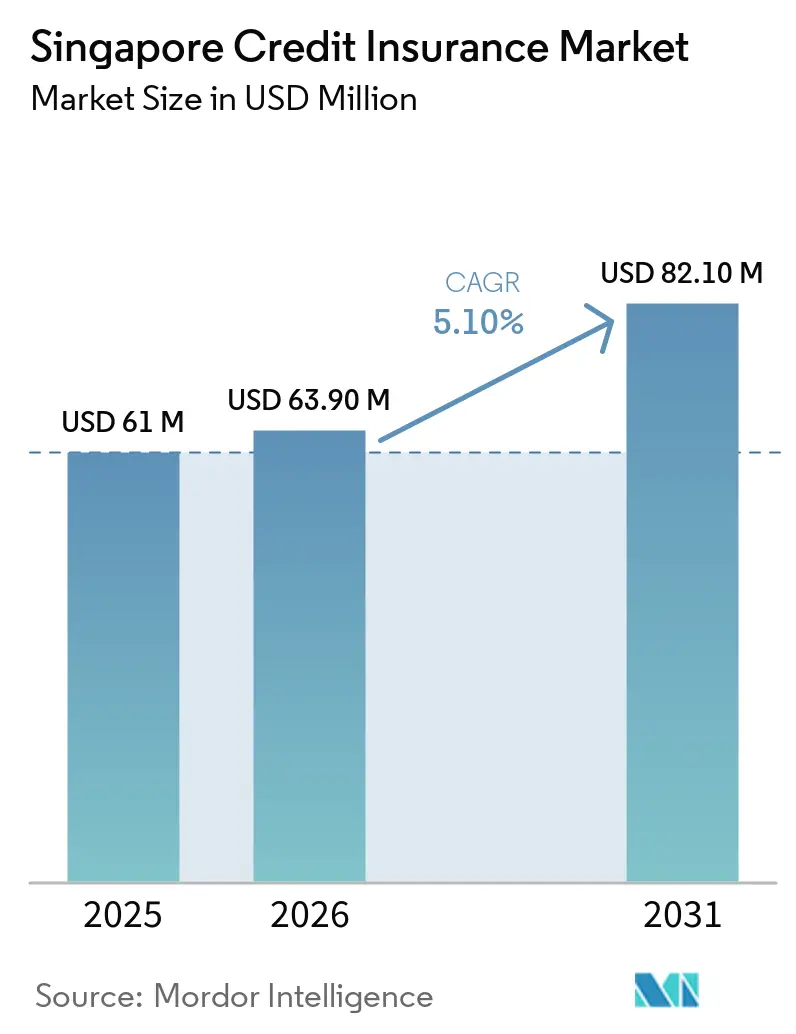
| Base Year Market Size (2025) | USD 61 Million |
| Market Size (2026) | USD 63.90 Million |
| Market Size (2031) | USD 82.10 Million |
| Growth Rate (2026 - 2031) | 5.10 % |
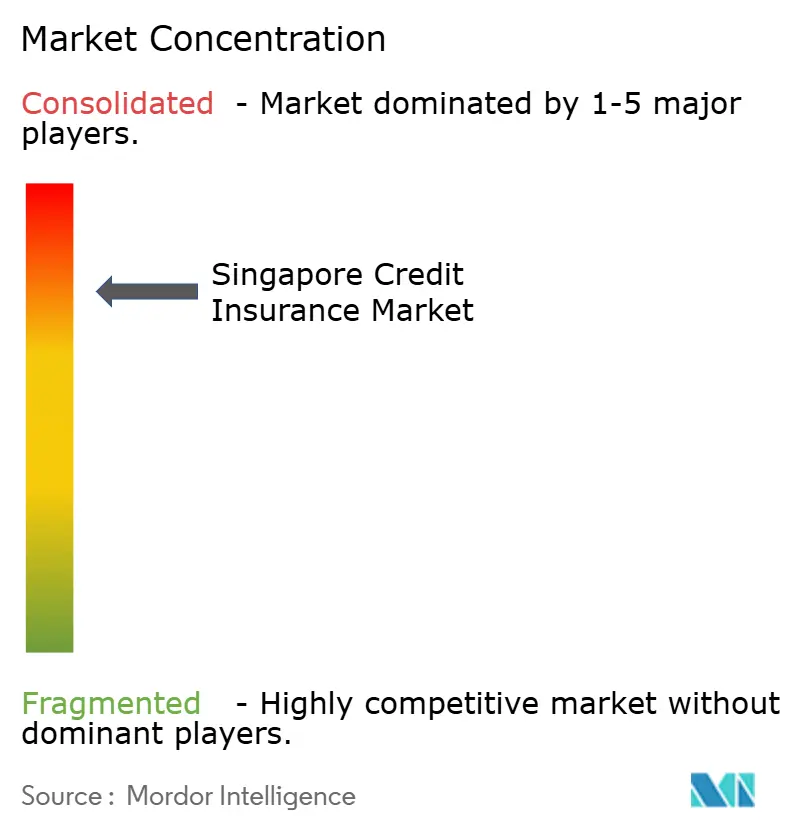
| Market Concentration | High |
Major Players *Disclaimer: Major Players sorted in no particular order Image © Mordor Intelligence. Reuse requires attribution under CC BY 4.0. | |
Singapore Credit Insurance Market Analysis by Mordor Intelligence
The Singapore credit insurance market size was valued at USD 61.0 million in 2025 and estimated to grow from USD 63.9 million in 2026 to reach USD 82.1 million by 2031, at a CAGR of 5.1% during the forecast period from 2026 to 2031. Credit sales account for 51% of business-to-business sales in Singapore, the highest proportion in Asia, compared with 43% across Asia-Pacific, which keeps receivables exposure central to corporate risk decisions. Customer default experience is also elevated, as 57% of Singapore companies reported at least 1 default in the 12 months to mid-2026, against 45% across Asia-Pacific. Compulsory winding-up applications rose to 492 in 2025 from 399 in 2024, strengthening the case for insurance that protects receivables before losses become material. The Singapore credit insurance market is also being shaped by wider use of receivables finance, closer involvement by banks, and demand for political-risk protection among companies trading across Association of Southeast Asian Nations, China, and the Middle East. Digital buyer monitoring is becoming more important because insurers can use faster solvency information to manage limits and help policyholders respond to signs of payment stress.
Key Report Takeaways
- By product line, trade credit and political-risk insurance captured 89.7% of the Singapore credit insurance market share in 2025 and is projected to grow at a 5.4% CAGR through 2031.
- By enterprise size, large enterprises accounted for 70.1% of the Singapore credit insurance market share in 2025, while small and medium-sized enterprises are projected to grow at a 7.2% CAGR through 2031.
- By distribution channel, insurance agents and brokers held 62.3% of the Singapore credit insurance market share in 2025, while banks are projected to grow at a 6.8% CAGR through 2031.
- By insured industry, wholesale trade, commodities, and distribution captured 36.4% of the Singapore credit insurance market share in 2025, while manufacturing is projected to grow at a 6.5% CAGR through 2031.
Note: Market size and forecast figures in this report are generated using Mordor Intelligence’s proprietary estimation framework, updated with the latest available data and insights as of January 2026.
Singapore Credit Insurance Market Trends and Insights
Drivers Impact Analysis*
| Driver | (~) % Impact on CAGR Forecast | Geographic Relevance | Impact Timeline |
|---|---|---|---|
| Growing Corporate Buyer Default and Non-Payment Risk | +1.3% | National, with spillover in Association of Southeast Asian Nations export corridors | Short term (≤ 2 years) |
| Expansion of Cross-Border and Open-Account Trade | +1.0% | Association of Southeast Asian Nations core, Singapore-China-Middle East trade lanes | Medium term (2-4 years) |
| Growing Small and Medium-Sized Enterprise Demand for Receivables Protection and Formal Credit-Risk Management | +0.7% | National, with early gains in export-oriented small and medium-sized enterprise clusters | Medium term (2-4 years) |
| Digitalization of Credit Intelligence and Credit-Limit Monitoring | +0.6% | Global platforms deployed domestically, with near-term Singapore benefit | Long term (≥ 4 years) |
| Integration of Trade Credit Insurance with Receivables and Working-Capital Financing | +0.5% | National, anchored in Singapore's trade finance ecosystem | Medium term (2-4 years) |
| Increasing Demand for Political-Risk and Cross-Border Trade-Disruption Protection | +0.4% | Association of Southeast Asian Nations, Middle East, and South Asia, with spillover to Singapore-domiciled multinationals | Short term (≤ 2 years) |
| Source: Mordor Intelligence | |||
Growing Corporate Buyer Default and Non-Payment Risk
Singapore's corporate payment environment weakened through 2025 and into 2026. The Coface Asia-Pacific Payment Survey 2026 included 152 Singapore respondents within a survey of 2,800 finance professionals across 10 Asia-Pacific markets during March and April 2026. It found that 57% of Singapore companies had experienced at least 1 customer default in the preceding 12 months, exceeding the Asia-Pacific result of 45%[1]. Among affected firms, 31% said defaults had eliminated more than 10% of their total receivables. Singapore businesses often respond after exposure has already accumulated, with 65% waiting until delays exceed 60 days before tightening credit terms, compared with 47% across Asia-Pacific. This timing leaves a practical gap for the Singapore credit insurance market because earlier limit management and insurance protection can reduce the effect of a buyer default before a counterparty's financial weakness becomes a receivables loss.
Expansion of Cross-Border and Open-Account Trade
Open-account transactions remain a defining feature of Singapore's cross-border trade. Singapore conducts 51% of business-to-business sales on credit, leading Asia and exceeding the regional average of 43%[2]. The share of credit-based transactions has continued to rise across the region, increasing the value of careful buyer selection and credit-limit monitoring. From April 2026, the Enterprise Financing Scheme Trade Loan removed per-borrower caps while retaining an overall borrower group ceiling of SGD 50 million (USD 37 million), enabling larger cross-border trade facilities. Longer payment cycles and buyer requests for extended terms raise receivables exposure for exporters serving the Association of Southeast Asian Nations and Middle Eastern markets. The Singapore credit insurance market benefits companies that need formal support for risks that internal credit controls cannot fully absorb.
Digitalization of Credit Intelligence and Credit-Limit Monitoring
Real-time monitoring is changing the operational role of trade credit insurance in Singapore. Allianz Trade reports that its infrastructure tracks solvency changes across more than 80 million corporate entities daily, with application programming interface tools for buyer-grade monitoring and claims declaration[3]. This gives policyholders a faster route to assess changes in buyer conditions and manage approved credit limits. The Singapore Commercial Credit Bureau reported in July 2025 that slow payments reached a near four-year high in the second quarter of 2025, with manufacturing and construction showing the sharpest deterioration. Coface research published in July 2026 found that 30% of Singapore organizations treat risk teams as strategic growth partners, while 70% expect predictive analytics from external partners within 3 to 5 years. These requirements favor the Singapore credit insurance market, where insurers combine indemnity cover with buyer information that allows policyholders to revise terms or reduce a credit limit before losses arise.
Integration of Trade Credit Insurance with Receivables and Working-Capital Financing
Credit insurance is increasingly being used within receivables finance rather than purchased only as a separate risk product. DBS Bank's Accounts Receivable Purchase facility includes up to 100% buyer-default protection within a receivables financing arrangement[4]. This approach can make protection part of the facility structure and reduce the need for a separate procurement process. Atradius states that financial institutions generate 60% of credit insurance enquiries, reflecting demand linked to capital relief and balance-sheet protection. The April 2026 Trade Loan changes support larger receivables-backed facilities, while the September 2026 increase in government risk sharing for qualifying small and medium-sized enterprise working-capital loans reduces banks' residual exposure. These changes support bank-led distribution and broaden the role of the Singapore credit insurance market in working-capital infrastructure, where lenders and policyholders benefit from a defined response to buyer nonpayment.
Restraints Impact Analysis*
| Restraint | (~) % Impact on CAGR Forecast | Geographic Relevance | Impact Timeline |
|---|---|---|---|
| Cost Sensitivity and Premium Affordability Among Small and Medium-Sized Enterprises | -1.0% | National, concentrated in domestic-only small and medium-sized enterprises outside the Market Readiness Assistance grant eligibility | Short term (≤ 2 years) |
| Policy Conditions, Exclusions, and Administrative Complexity | -0.7% | National, with a larger effect on first-time buyers in wholesale trade and distribution | Medium term (2-4 years) |
| Uneven Availability of Reliable Cross-Border Buyer Credit Information | -0.5% | Association of Southeast Asian Nations and South Asia corridors with limited credit bureau coverage | Long term (≥ 4 years) |
| Concentration and Accumulation Risk in Credit Insurance Underwriting | -0.4% | National, especially construction, commodities, and electronics buyer clusters | Medium term (2-4 years) |
| Source: Mordor Intelligence | |||
Cost Sensitivity and Premium Affordability Among Small and Medium-Sized Enterprises
Premium affordability remains a significant constraint on participation by smaller companies. Trade credit insurance premiums are calculated as a share of insured turnover, so businesses with narrow margins must compare that cost with internal provisions for nonpayment risk. Atradius found in 2025 that 50% of Singapore companies did not plan to extend trade credit to business-to-business customers, showing the caution surrounding receivables exposure. The Market Readiness Assistance grant covers up to 70% of eligible premiums for qualifying small and medium-sized enterprises entering new export markets from April 2026. The support does not cover all domestic credit risks, leaving some smaller firms exposed to the full policy cost. Premium declarations, credit-limit applications, and broker support can create additional administrative expense, which can reduce the appeal of smaller policies in the Singapore credit insurance market.
Policy Conditions, Exclusions, and Administrative Complexity
Policy administration can discourage first-time buyers, particularly where firms have many customers and limited credit-management resources. Policyholders must observe buyer credit limits, report overdue accounts within stated periods, and manage protracted-default waiting periods that can range from 90 to 180 days. These requirements can be demanding for wholesale trade and distribution businesses that process large volumes of buyer transactions. Small and medium-sized enterprises without specialist staff can find that compliance responsibilities exceed their internal capacity. Exclusions for commercial disputes, nonconforming goods, and political events can also make coverage feel less certain before a claim occurs. The Singapore credit insurance market therefore depends on clear policy communication and practical support, particularly for buyers unfamiliar with deadlines and documentary requirements when an account becomes overdue.
*Our forecasts treat driver/restraint impacts as directional, not additive. The impact forecasts reflect baseline growth, mix effects, and variable interactions.
Segment Analysis
By Product Line: Trade Credit Anchors a Concentrated but Broadening Market
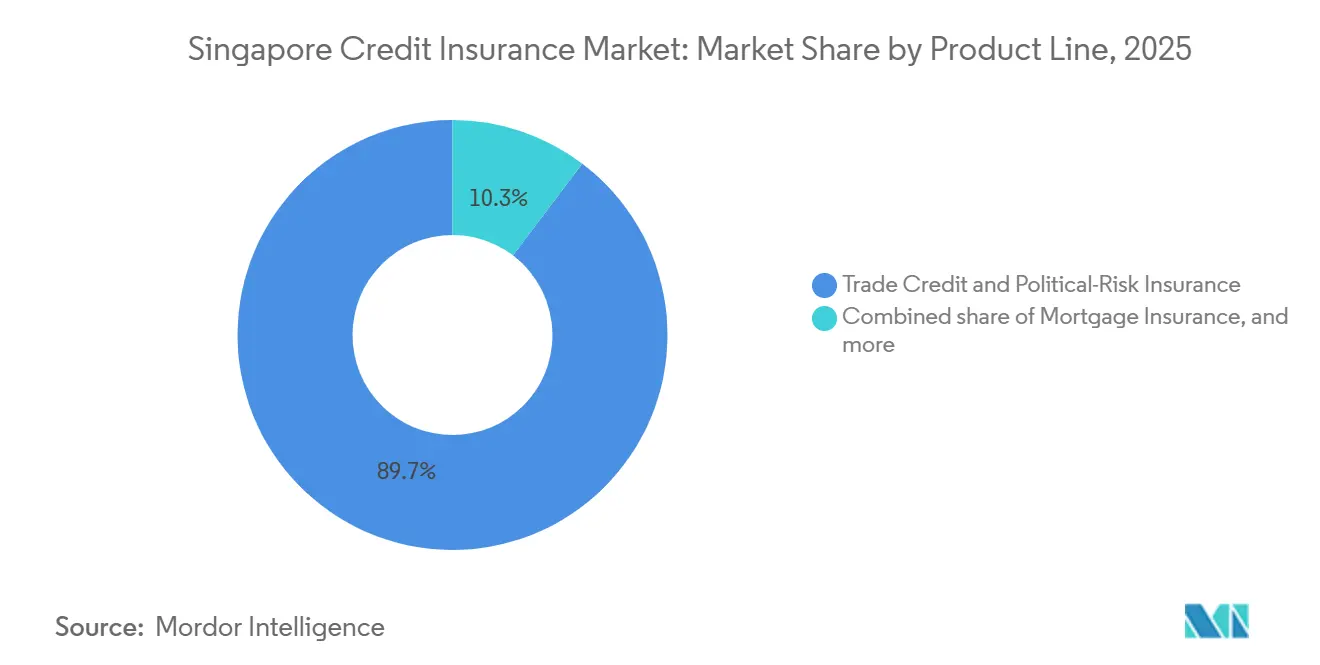
Trade credit and political-risk insurance accounted for 89.7% of the Singapore credit insurance market share in 2025 and is forecast to grow at a 5.4% CAGR through 2031. The product aligns with Singapore's trade-intensive economy and protects receivables against buyer nonpayment. Trade flows represented more than 3.5 times the size of Singapore's economy, which makes external buyer conditions material for local companies. Whole-turnover and key-buyer policies can address recurring exposures across a portfolio of customers. Political-risk protection is increasingly attached to standard cover for businesses with buyers in geopolitically exposed markets, helping preserve the product line's leading position within the Singapore credit insurance market.
Mortgage insurance and financial guarantee insurance made up the remaining 10.3% of premiums in 2025. Mortgage insurance serves residential lenders, while financial guarantee insurance supports structured finance and other credit obligations. These lines involve different risk characteristics from trade receivables and therefore require separate underwriting decisions. The Monetary Authority of Singapore Notice 133 amendment took effect on March 31, 2026, updating risk-based capital requirements for licensed insurers. The rules influence capital allocation and pricing, while bank integration with trade finance facilities can expand the reach of cover without a separate insurance purchase.
By Enterprise Size: Large Enterprises Anchor, but the Small and Medium-Sized Enterprise Segment Accelerates
Large enterprises held 70.1% of the Singapore credit insurance market share in 2025. Their position reflects larger buyer portfolios, higher credit limits, and wider use of insurance as support for receivables financing. These companies often maintain whole-turnover programs across the Association of Southeast Asian Nations and global markets. Broker teams can manage buyer limits, declarations, and claims activity for these more complex programs. Their established risk-management frameworks help them meet policy requirements and preserve their role as the main premium base for the Singapore credit insurance market.
Small and medium-sized enterprises represented 29.9% of premiums in 2025 and are projected to expand at a 7.2% CAGR through 2031. Budget 2026 increased the Market Readiness Assistance grant subsidy from 50% to 70% from April 2026 and expanded support to businesses deepening existing overseas relationships. This reduces an entry barrier for qualifying export-focused companies. Automated onboarding, policy administration, and adaptive coverage tied to trading behavior can better serve firms with changing buyer portfolios. These developments create a clearer route for deeper small and medium-sized enterprise participation in the Singapore credit insurance market.
By Distribution Channel: Brokers Lead While Bank-Embedded Models Accelerate
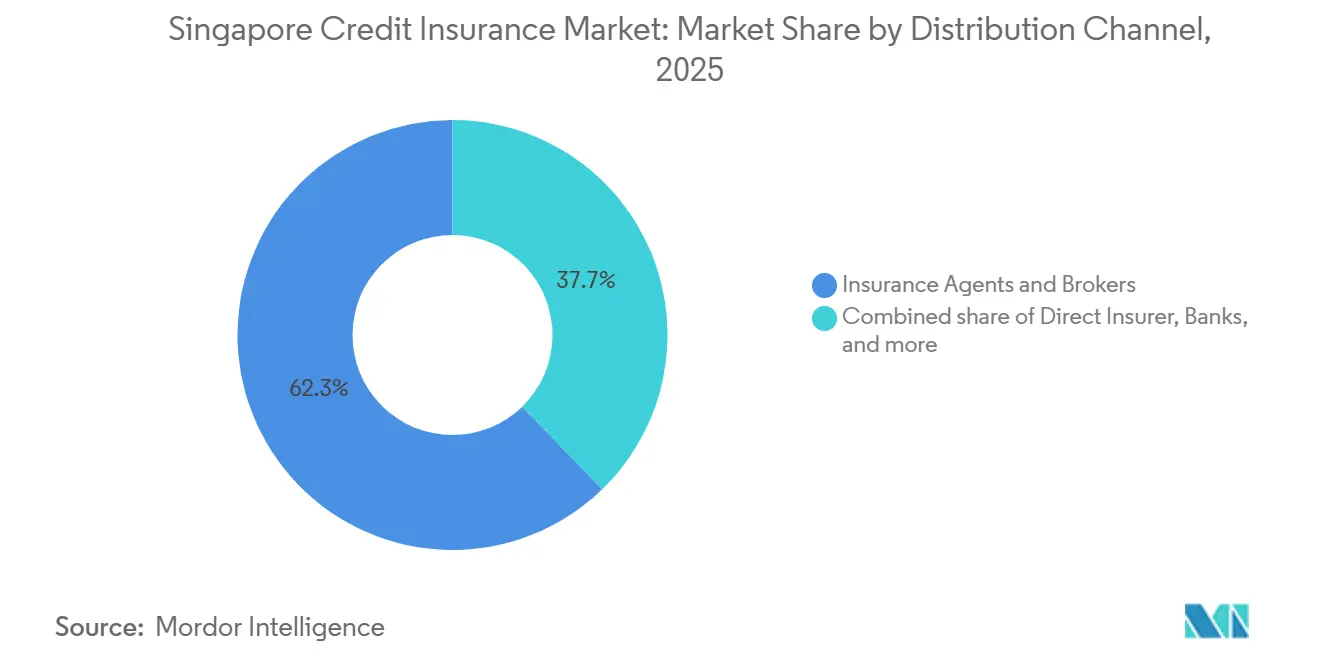
Insurance agents and brokers held 62.3% of the Singapore credit insurance market share in 2025. Their role is supported by access to more than 50 global credit underwriting markets and by experience in whole-turnover, key-buyer, and political-risk programs. Brokers manage ongoing policy work, including limits, declarations, and claims, which is valuable where corporate structures and buyer portfolios are complex. Howden Singapore offers up to USD 4 billion of political-risk capacity and USD 2.8 billion of private nonpayment capacity through its specialist team. Direct insurer channels serve businesses with simpler requirements and a preference for a single-underwriter relationship.
Banks are projected to grow at a 6.8% CAGR through 2031, making them the fastest-growing distribution channel. Their growth is linked to receivables finance and supply-chain finance facilities that include credit protection. DBS provides an example through its Accounts Receivable Purchase facility, which includes up to 100% buyer-default protection. The arrangement embeds protection in financing and can make the insurance component less visible to the end user. Digital platforms and financial technology-supported onboarding remain early-stage but are gaining attention as insurers seek scalable access to small and medium-sized enterprises through embedded models.
By Insured Industry: Wholesale Trade Anchors as Manufacturing and Construction Show Diverging Trajectories
Wholesale trade, commodities, and distribution captured 36.4% of the Singapore credit insurance market share in 2025. Singapore's role in commodity trading, re-exports, and distribution supports the segment's large insured exposure. Slow payments in wholesale trade reached 40.4% in the second quarter of 2025, compared with 40.3% in the second quarter of 2024. Persistent delayed payment and buyer concentration across cross-border trade lanes keep receivables protection relevant for suppliers and trading houses. These conditions sustain the importance of wholesale trade within the Singapore credit insurance market.
Manufacturing is forecast to grow at a 6.5% CAGR through 2031, the fastest rate among insured industries. The Economic Development Board reported in April 2026 that a net weighted 17% of manufacturers had a positive outlook for April to September 2026. Electronics and precision engineering support activity, although feedstock disruptions and tariff uncertainty affect some order pipelines. Construction recorded average payment delays of 85.8 days, compared with Singapore's national average of 66.3 days. The Building and Construction Authority forecast 2026 construction demand of SGD 47 billion (USD 35.3 billion) to SGD 53 billion (USD 39.8 billion), while marine, information and communications technology, healthcare, and professional services diversify the insured portfolio.
Geography Analysis
Singapore is the entire geographic base for the Singapore credit insurance market, yet its policyholders manage buyer exposures across Southeast Asia, Northeast Asia, the Middle East, and South Asia. Credit insurers serving Singapore cover buyers in up to 164 countries through their international networks. Singapore's average payment delay was 66.3 days in 2026, below the Asia-Pacific average of 68.1 days, but 57% of local firms had experienced a customer default in the prior 12 months, above the regional figure of 45%. The Singapore credit insurance market, therefore, serves domestic firms with geographically dispersed receivables.
Cross-border buyer concentration is central to Singapore's risk profile because trade volumes exceeded 3.5 times gross domestic product, increasing exposure to changes in the United States, China, and the Association of Southeast Asian Nations economies. The 2026 disruption around the Strait of Hormuz led to greater credit-limit activity related to Oman-routed shipments. Howden's Singapore team provides USD 4 billion of political-risk capacity and USD 2.8 billion of private nonpayment capacity for clients with concentrated positions. Across Asia, cash-flow problems are the most common cause of delayed payment, and overdue invoices make up nearly 1 third of business-to-business receivables. The Singapore credit insurance market helps companies manage the result of those external risks on local balance sheets.
Domestic insolvency conditions also affect suppliers that sell to Singapore-based buyers. Compulsory winding-up applications reached 492 in 2025, a 15-year high and a 23% increase from 399 in 2024. Business closures rose 12.8% in the first 7 months of 2026 to 38,146, with construction closures increasing 47% year over year. These conditions create direct receivables risk for subcontractors, material suppliers, and wholesale businesses. The Singapore credit insurance market continues to address the resulting domestic exposure as suppliers formalize how they manage buyer credit risk.
Competitive Landscape
The Singapore credit insurance market is oligopolistic at the underwriting level, with Allianz Trade, Atradius, and Coface holding the dominant share of trade credit premiums. ECICS Limited is the only Singapore-domiciled underwriter in the group and was founded in 1975 as the government-backed Export Credit Insurance Corporation. Its long local operating history gives it a distinct position, alongside QBE Insurance, Zurich Insurance, AXA XL, Tokio Marine HCC, Sompo International, Allied World Assurance, Chubb Insurance Singapore, AIG Asia Pacific, and Berkshire Hathaway Specialty Insurance. These insurers compete across financial guarantee, political risk, and specialty credit lines, where risk appetite can vary by transaction. The Singapore credit insurance market also depends on the ability of underwriters to monitor cumulative exposure by buyer, sector, and country.
Allianz Trade differentiates through a developer platform that monitors solvency signals across more than 80 million global entities each day. Its application programming interface tools support buyer monitoring and claims workflows, while Coface combines trade credit insurance with business information and buyer monitoring across more than 200 markets. Atradius has emphasized collections infrastructure and data-led underwriting as part of a broader approach to credit-cycle management. These examples show competition centered on information, collections, and financing relevance rather than premium alone. The Singapore credit insurance market rewards providers that can link policy cover with practical risk-management support.
The small and medium-sized enterprise segment remains important for competitive expansion because it is forecast to grow at 7.2% CAGR through 2031. Insurers are seeking automated formats that can serve lower-value policies without excessive manual underwriting. Policies designed for buyers with changing trade patterns can improve access, while Marsh, Aon, WTW, Gallagher, Lockton, Howden, and NCI Brokers compete through market access, structuring expertise, and claims advocacy. Howden and WTW have differentiated capabilities in credit, political risk, and surety placements, which are relevant where geopolitical exposure is rising. Capacity is therefore concentrated among a small group of major trade credit underwriters, while specialist carriers compete selectively on transaction-specific requirements.
Singapore Credit Insurance Industry Leaders
-
Allianz Trade
-
Atradius N.V.
-
Coface
-
American International Group, Inc.
-
Chubb Limited
- *Disclaimer: Major Players sorted in no particular order
Recent Industry Developments
- August 2026: Atradius published the 2026 Asia Payment Practices Barometer, confirming that Singapore holds Asia's highest share of credit-based business-to-business sales at 51%, compared with the 43% regional average. The data gives underwriters and brokers current portfolio benchmarks for positioning and credit-limit calibration.
- June 2026: Atradius hosted a Credit Solutions Conference co-facilitated by Aon in Singapore. Atradius's Chief Marketing Officer discussed the effect of artificial intelligence and bank-led capital-relief demand on credit insurance, reflecting the convergence of credit insurance and structured finance.
- April 2026: Singapore's Budget 2026 implementation removed per-borrower loan caps under the Enterprise Financing Scheme Trade Loan, while maintaining an overall borrower group ceiling of SGD 50 million (USD 37.5 million). The change enables banks to structure larger receivables-backed trade finance facilities, increasing the transaction sizes available for credit insurance as a credit enhancement mechanism.
- March 2026: MAS Notice 133 Amendment 2026 took effect on March 31, 2026, revising the risk-based capital framework applicable to all Singapore-licensed insurers, including credit insurance underwriters. The amendment updates requirements for the calculation of total risk requirements and financial resources, affecting capital allocation against credit and political-risk portfolios.
Singapore Credit Insurance Market Report Scope
| Trade Credit and Political-Risk Insurance |
| Mortgage Insurance |
| Financial Guarantee Insurance |
| Large Enterprises |
| SMEs |
| Direct Insurer |
| Insurance Agents and Brokers |
| Banks |
| Other Channels |
| Wholesale Trade, Commodities and Distribution |
| Manufacturing |
| Construction, Infrastructure and Engineering Contractors |
| Marine, Offshore and Related Services |
| Information And Communications |
| Healthcare And Pharmaceuticals |
| Professional, Financial and Other Business Services |
| Other Industries |
| By Product Line | Trade Credit and Political-Risk Insurance |
| Mortgage Insurance | |
| Financial Guarantee Insurance | |
| By Enterprise Size of the Insured | Large Enterprises |
| SMEs | |
| By Distribution Channel | Direct Insurer |
| Insurance Agents and Brokers | |
| Banks | |
| Other Channels | |
| By Insured Industry | Wholesale Trade, Commodities and Distribution |
| Manufacturing | |
| Construction, Infrastructure and Engineering Contractors | |
| Marine, Offshore and Related Services | |
| Information And Communications | |
| Healthcare And Pharmaceuticals | |
| Professional, Financial and Other Business Services | |
| Other Industries |
Key Questions Answered in the Report
What is the projected value of Singapore credit insurance in 2031?
The Singapore credit insurance market is forecast to reach USD 82.1 million by 2031, rising from USD 63.9 million in 2026 at a 5.1% CAGR.
Which product line leads credit insurance in Singapore?
Trade credit and political-risk insurance led with 89.7% share in 2025 and is forecast to grow at a 5.4% CAGR through 2031.
Why do Singapore companies need receivables protection?
In 2026, 57% of Singapore firms had experienced at least 1 customer default during the preceding 12 months, compared with 45% across Asia-Pacific.
Which customer group has the fastest projected expansion?
Small and medium-sized enterprises are the fastest-growing enterprise group, with a forecast CAGR of 7.2% through 2031.
How are banks involved in Singapore credit insurance?
Banks are forecast to grow at a 6.8% CAGR as they include credit protection in receivables and supply-chain financing facilities.
Which insured industry is growing fastest in Singapore?
Manufacturing is projected to grow at a 6.5% CAGR through 2031, supported by its exposure to global electronics and precision engineering supply chains.