
Shell and Tube Heat Exchanger Market Size and Share
Market Overview
| Study Period | 2022 - 2032 |
|---|---|
| Market Size (2027) | USD 7.17 Billion |
| Market Size (2032) | USD 9.67 Billion |
| Growth Rate (2027 - 2032) | 6.16 % |
| Fastest Growing Market | Asia-Pacific |
| Largest Market | Asia-Pacific |
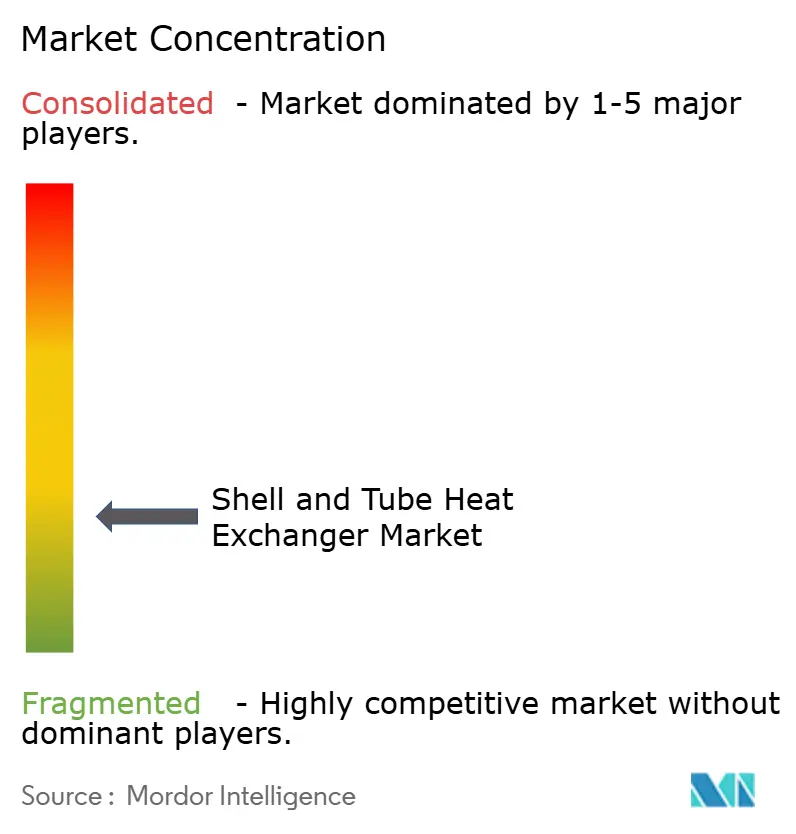
| Market Concentration | Low |
Major Players *Disclaimer: Major Players sorted in no particular order Image © Mordor Intelligence. Reuse requires attribution under CC BY 4.0. | |
Shell and Tube Heat Exchanger Market Analysis by Mordor Intelligence
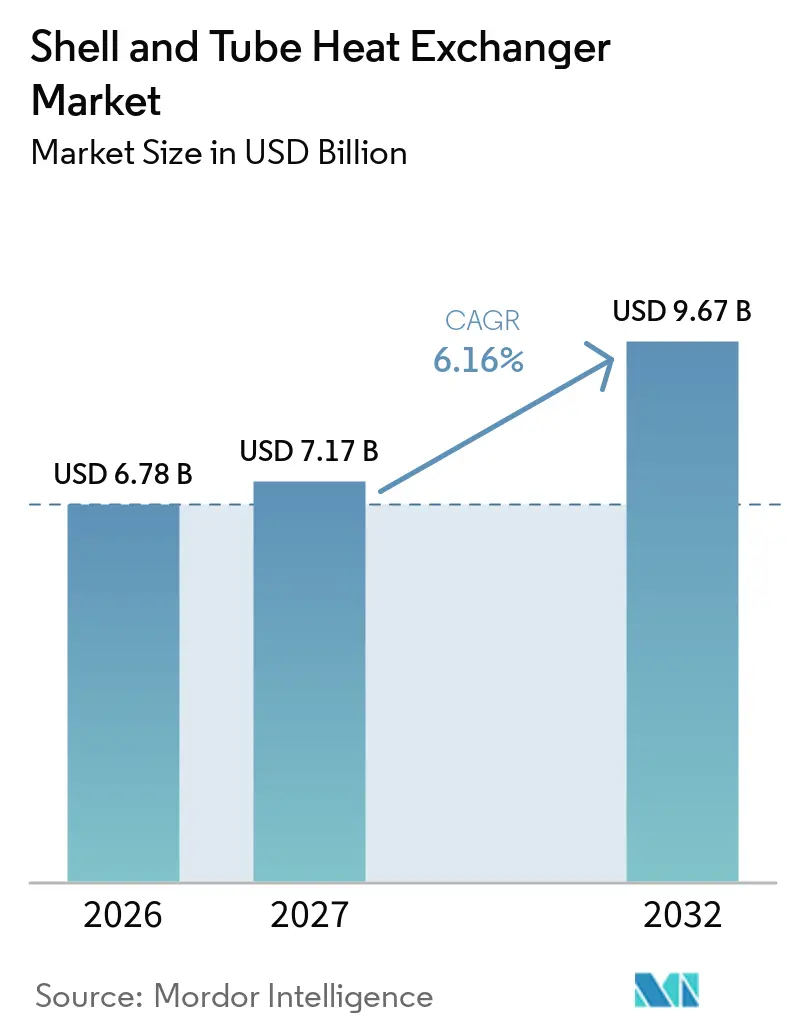
The Shell And Tube Heat Exchanger Market size is expected to increase from USD 6.78 billion in 2026 to USD 7.17 billion in 2027 and reach USD 9.67 billion by 2032, growing at a CAGR of 6.16% over 2027-2032. The shell and tube heat exchanger market benefits from its established role in high-pressure and high-temperature process duties. American Society of Mechanical Engineers (ASME)-related certification requirements continue to support its use in refinery and petrochemical operations. The shell and tube heat exchanger market also gains from industrial energy-efficiency projects, waste-heat recovery, and digital maintenance programs. New process capacity in Asia and the Middle East supports equipment orders, while retrofit work can sustain demand when greenfield spending slows and operators prioritize reliability, energy savings, and incremental improvement at existing industrial facilities and integrated process plants globally. Suppliers widen their service offer with monitoring and maintenance support, which can increase recurring revenue, make supplier changes harder for customers, and give operators more information when they plan cleaning, inspection, or replacement work.
Key Report Takeaways
- By type, Fixed Tube Sheet Heat Exchangers held 34.6% of the shell and tube heat exchanger market share in 2026, while Floating Head Heat Exchangers are forecast to expand at a 6.5% CAGR through 2032.
- By design, Multi-Pass Heat Exchangers held 53.2% of the shell and tube heat exchanger market share in 2026 and are forecast to grow at a 6.6% CAGR through 2032.
- By material, Carbon Steel held 32.6% of global demand in 2026, while Nickel Alloys are forecast to expand at a 7.2% CAGR through 2032.
- By end-use industry, Chemical and Petrochemical held 23.7% of global demand in 2026 and are forecast to grow at a 6.9% CAGR through 2032.
- By geography, Asia-Pacific held 34.9% of global demand in 2026 and is forecast to expand at a 6.8% CAGR through 2032.
Note: Market numbers in this report are based on Mordor Intelligence's proprietary estimation framework, which combines nine months of actuals with Q4 projections for base year 2026.
Market Trends and Insights
Drivers Impact Analysis of Shell and Tube Heat Exchanger Market*
| Driver | (~) % Impact on CAGR Forecast | Geographic Relevance | Impact Timeline |
|---|---|---|---|
| Industrial Energy Efficiency and Waste-Heat Recovery | +1.5% | Global, with core gains in Europe, North America, and East Asia | Medium term (2-4 years) |
| Refinery and Petrochemical Capacity Expansion | +1.8% | Asia-Pacific, with spillover to the Middle East and Africa | Medium term (2-4 years) |
| Chemical-Process Intensification and High-Pressure Duties | +0.7% | Europe and North America, with early uptake in South Korea | Long term (≥ 4 years) |
| Industrial Decarbonization and Heat-Recovery Retrofits | +0.8% | Europe and North America, with early adoption in Japan | Medium term (2-4 years) |
| Hydrogen, LNG, and Carbon-Capture Infrastructure | +1.2% | North America, the Middle East, and selected Asia-Pacific LNG corridors | Medium term (2-4 years) |
| Digital Fouling Prediction and Predictive Maintenance | +0.9% | Global, concentrated in large refinery and petrochemical clusters | Short term (≤ 2 years) |
| Source: Mordor Intelligence | |||
Industrial Energy-Efficiency and Waste-Heat Recovery
Industrial waste heat recovery is increasing the value placed on shell-and-tube equipment beyond new plants, because project owners can link energy losses to operating costs, emissions, fuel use, and the performance of related equipment across an operating site. The California Energy Commission reported that low-level heat below 149°C accounts for 25 of every 100 quadrillion BTUs consumed in the United States. It placed the associated lost value at more than USD 200 billion each year, which shows the scale of energy that industrial sites could recover.[1] A 2025 process simulation for hydrogen-based direct reduced iron production found that an integrated waste-heat recovery system can lower energy use and plant carbon intensity within the same production system.[2] These projects favor robust equipment that can operate under demanding process conditions and integrate into established plant layouts. Retrofit and revamp projects can also provide suppliers with work that is less dependent on large greenfield investment cycles, while customers can pursue measured upgrades without redesigning an entire process line.
Refinery and Petrochemical Capacity Expansion
The shell and tube heat exchanger market is supported by refinery and petrochemical projects that require large process equipment packages and often have lengthy engineering schedules, detailed procurement reviews, and equipment integration across several process units. Bharat Petroleum’s Bina Refinery expansion, which includes an integrated ethylene cracker and targets 12 Million Metric Tons Per Annum (MMTPA) throughput, reached Engineering, Procurement, and Construction (EPC) bidding in May 2025. Binh Son Refining awarded an EPC contract for the Dung Quat refinery expansion covering 22 new and upgraded licensed process units. Execution is scheduled to run to February 2029.[3] These projects need exchangers across distillation, hydrocracking, and reforming duties, where reliability and material selection can influence overall plant availability. Their multiyear schedules improve order visibility for qualified fabricators and support follow-on maintenance demand after start-up, especially when facilities commission new units in stages.
Hydrogen, Liquefied Natural Gas (LNG), and Carbon-Capture Infrastructure
Hydrogen, Liquefied Natural Gas (LNG), and carbon-capture projects are creating new duties that often require higher-grade materials and closely documented equipment performance, particularly where process safety, corrosion resistance, and continuous operation are important. Chart Industries was selected in October 2025 to supply air-cooled heat exchangers, brazed aluminum heat exchangers, and cold boxes for Port Arthur Liquefied Natural Gas (LNG) Phase 2 in Texas.[4] Tranter was selected in November 2025 to supply 40 large heat exchangers for the Net Zero Teesside Power project. The project is designed to capture up to 2 million tonnes of carbon dioxide each year. Hydrogen and carbon-capture work can require specialty alloys and demanding certifications, which raises the value of established technical records. This requirement favors suppliers with tested fabrication, inspection, and documentation capabilities, while also narrowing the field for the most demanding applications.
Digital Fouling Prediction and Predictive Maintenance
Digital fouling monitoring is changing how operators assess exchanger performance and maintenance needs by making early performance changes more visible, helping maintenance teams compare measured operating conditions with expected thermal performance. A 2025 refinery study found that one undetected fouled shell-and-tube unit led to 175 tonnes of excess carbon dioxide emissions and EUR 12,000 in losses over 2 months. The researchers validated Long Short-Term Memory (LSTM) and Extreme Gradient Boosting models using standard five-minute sensor data. Their validation R² values exceeded 0.98, without a need for dedicated fouling instrumentation. Refinery preheat trains often contain many exchangers, so degradation in one unit can affect the wider train and create cumulative energy losses. Service providers that combine equipment knowledge with monitoring support can build longer customer relationships and identify maintenance needs before they become a larger process interruption.
Restraints Impact Analysis of Shell and Tube Heat Exchanger Market*
| Restraint | (~) % Impact on CAGR Forecast | Geographic Relevance | Impact Timeline |
|---|---|---|---|
| Fouling, Corrosion, and Unplanned Downtime | -0.8% | Global, with the highest exposure in crude oil refining and offshore Asia-Pacific operations | Short term (≤ 2 years) |
| High Installed Cost and Engineered-to-Order Complexity | -0.6% | Emerging economies in South America and the Middle East and Africa | Medium term (2-4 years) |
| Nickel, Titanium, and Specialty-Alloy Price Volatility | -0.5% | Global, concentrated in hydrogen, LNG, and offshore projects | Medium term (2-4 years) |
| Long Qualification Cycles and EPC Lead-Time Constraints | -0.4% | Global, with high exposure in nuclear and green hydrogen projects | Long term (≥ 4 years) |
| Source: Mordor Intelligence | |||
Fouling, Corrosion, and Unplanned Downtime
Fouling remains a continuing operating issue for the shell and tube heat exchanger market because it gradually lowers heat-transfer performance between scheduled cleaning events, particularly when deposits reduce the effective heat-transfer surface over time. It reduces thermal efficiency before it reaches the point of scheduled cleaning, so operators can carry higher fuel use without an immediate mechanical failure. The 2025 refinery study showed that missed fouling can increase fuel use, emissions, and operating costs. Corrosion failures can require tube-bundle replacement and a shutdown of the affected process train, which can make the cost of a failure far greater than the cost of a planned inspection. Tubular Exchanger Manufacturers Association (TEMA) mechanical standards and ISO 13706 establish important fabrication requirements, but they do not manage fouling during service. Operators therefore face a balance between higher initial material costs and the risk of unplanned downtime, while modular tube-bundle design only partly reduces the operating challenge.
Nickel, Titanium, and Specialty-Alloy Price Volatility
Specialty-alloy price changes can make fixed-price project work difficult for smaller fabricators, particularly when one order requires both nickel-based materials and titanium, because equipment pricing is often set before fabrication and delivery are complete. The International Nickel Study Group expected a 198,000-tonne global nickel surplus in 2025, based on production of 3.735 million tons and consumption of 3.537 million tons. Nickel prices nonetheless remained volatile during the year, which affected the cost base of alloy-intensive equipment even when the headline supply balance appeared loose. Titanium supply conditions also faced weak demand through mid-2025, adding uncertainty for buyers that use both materials. Engineered-to-order equipment, lengthy qualification steps, and EPC lead-time constraints further limit how quickly suppliers can pass costs through to project owners. This can delay decisions for smaller projects and narrow margins for suppliers with limited purchasing power or limited ability to manage material exposure.
*Our forecasts treat driver/restraint impacts as directional, not additive. The impact forecasts reflect baseline growth, mix effects, and variable interactions.
Shell and Tube Heat Exchanger Market Segment Analysis
By Type:
Floating Head Demand Rises with Heavy Crude ProcessingFixed Tube Sheet Heat Exchangers held 34.6% of global demand in 2026. Their simple construction and lower cost support use in clean-service chemical and power applications. In the shell and tube heat exchanger market, this type remains a practical choice where routine cleaning needs are limited. U-Tube Heat Exchangers serve duties with high thermal cycling and large temperature differences. Their tube bundle can accommodate expansion without the same mechanical stress.
Floating Head Heat Exchangers are projected to grow at a 6.5% CAGR through 2032. In the shell and tube heat exchanger market, their removable bundle addresses cleaning needs in services that see heavier deposits. They allow bundle withdrawal for cleaning, which matters where heavier feedstocks increase deposits on tube surfaces. Kettle Reboilers retain a specialized role in column-bottom applications. Research published in 2025 found that triply periodic minimal surface cores achieved a tenfold increase in volumetric power density at 900°C and 25 MPa, showing a potential long-term challenge to conventional designs.
By Design:
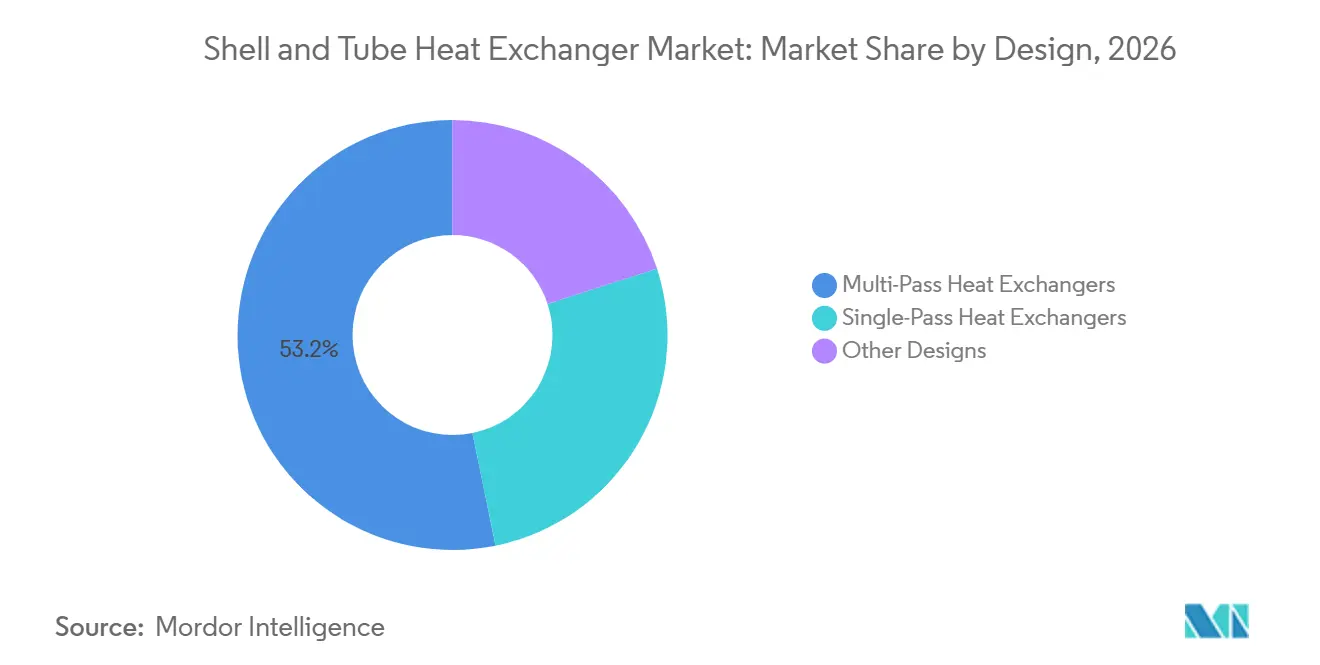
Multi-Pass Efficiency Lock-in Creates a Durable LeadMulti-Pass Heat Exchangers accounted for 53.2% of the shell and tube heat exchanger market size in 2026. They also lead design-level growth with a 6.6% CAGR through 2032. In the shell and tube heat exchanger market, this combination indicates that operators value the design in both established and expanding applications. The arrangement directs tube-side fluid through multiple passes in one shell. This can provide closer temperature approaches within a limited footprint.
Single-Pass Heat Exchangers remain suitable where pressure-drop limits are tight or one pass provides enough temperature change. They are used in condensers and selected reboiler duties. Their simpler flow path can meet requirements where a multi-pass arrangement would not add sufficient value. Research published in 2025 examined the optimization of tubular heat-exchanger reactors for process intensification. Multi-pass geometry can require more complex inspection at tube-sheet junctions, supporting established TEMA-certified suppliers.
By Material:
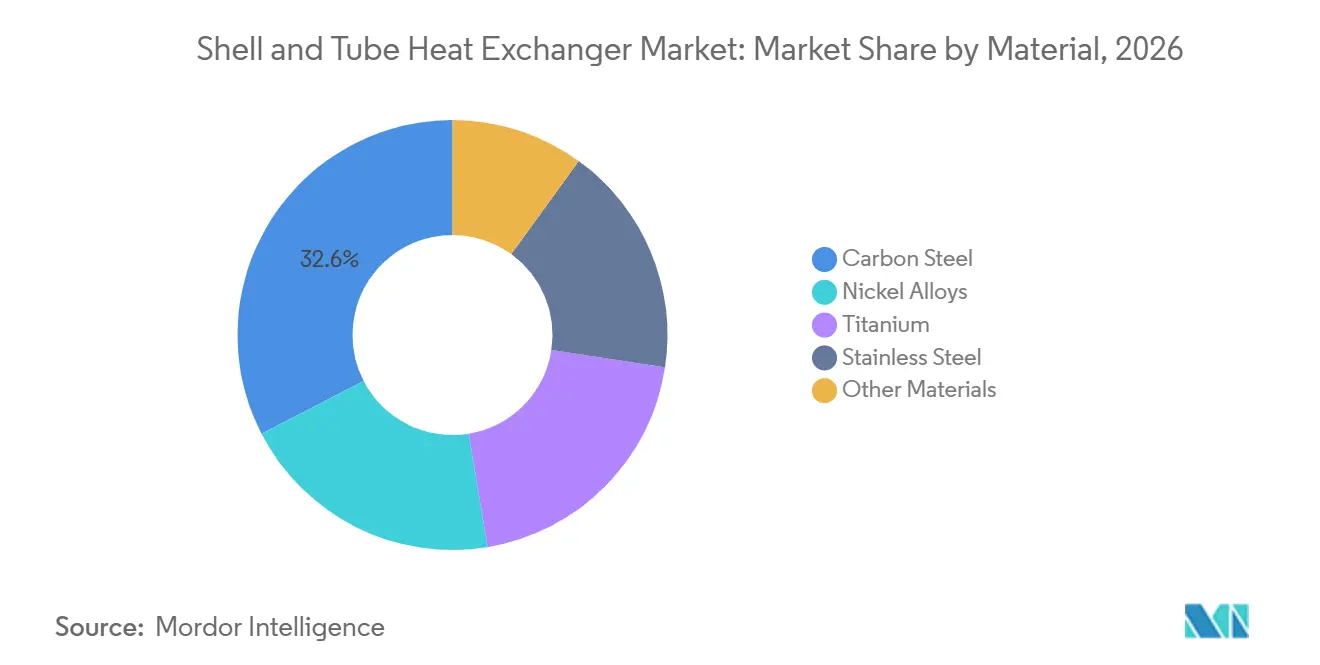
Nickel Alloys Claim the Growth Premium at Both EndsCarbon Steel accounted for 32.6% of the shell and tube heat exchanger market size in 2026. Its broad availability and lower cost make it suitable for many petrochemical and power-generation streams. In the shell and tube heat exchanger market, its position reflects the continued importance of applications with manageable corrosion exposure. Stainless Steel is used where hygiene process and moderate corrosion resistance are required. Food, beverage, and pharmaceutical applications often require these material properties.
Nickel Alloys are projected to expand to a 7.2% CAGR through 2032. In the shell and tube heat exchanger market, this growth reflects demand from service conditions where material failure has serious operational consequences. Hydrogen, LNG, and carbon-capture work supports demand where temperatures are high, or corrosion risk is severe. Titanium remains important in offshore seawater cooling, chlorine production, and certain pharmaceutical duties. The shell and tube heat exchanger industry therefore faces a wider material mix as new energy projects require performance beyond carbon steel.
By End-Use Industry:
Chemicals Lead, Energy Transition Broadens the BaseChemical and Petrochemical accounted for 23.7% of the shell and tube heat exchanger market size in 2026. It is also forecast to record the highest end-use CAGR at 6.9% through 2032. In the shell and tube heat exchanger market, this leading position links equipment demands to both capacity additions and ongoing process reliability needs. Refinery process trains and chemical plants use exchangers for heating, cooling, condensation, and energy recovery. Project activity at Bina and Dung Quat illustrates the continuing need for process equipment in new and expanded facilities.
Oil and Gas remains a major application across refinery, offshore, and pipeline services. Power Generation uses the equipment in steam condensers, feedwater heaters, and heat-recovery systems. These applications also generate aftermarket work as operators maintain installed equipment throughout their service life. Food and Beverage and Pharmaceuticals require materials that meet hygiene and corrosion requirements. Heating, Ventilation, and Air Conditioning (HVAC) and Refrigeration demand can also benefit from larger industrial heat pumps and contaminated-water duties that require equipment that can be cleaned.
Geography Analysis
APAC Shell and Tube Heat Exchanger Market
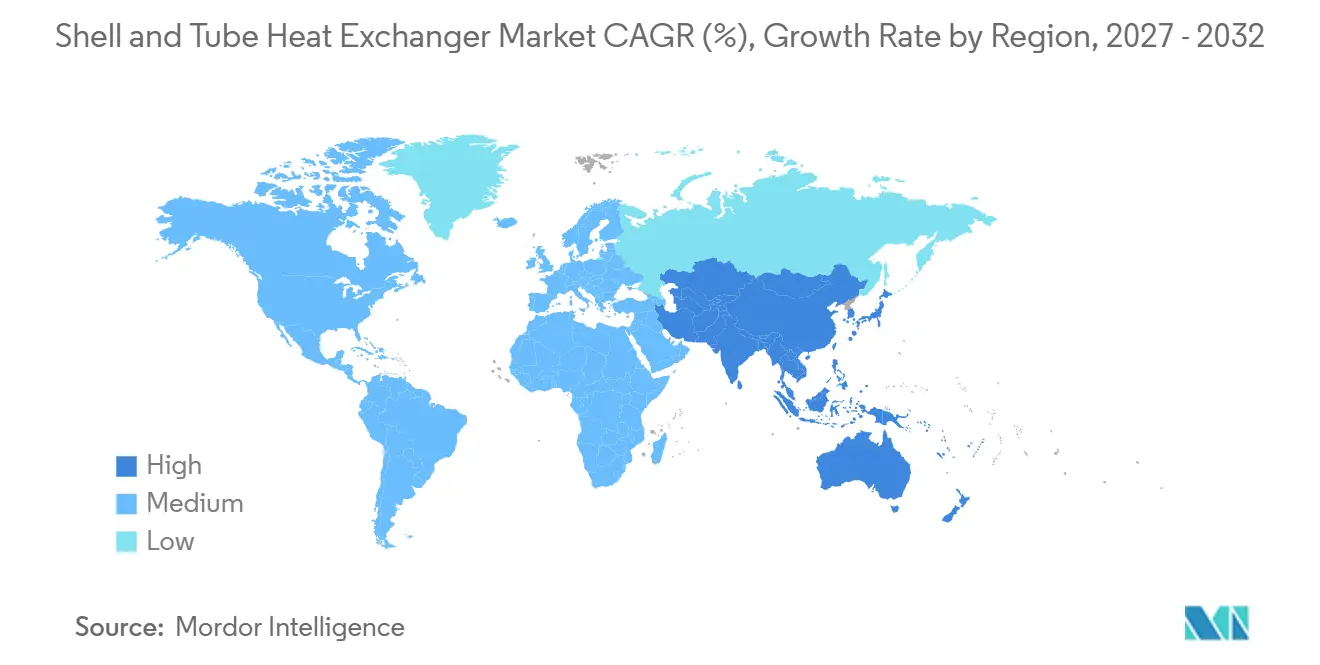
Asia-Pacific accounted for 34.9% of global demand in 2026, and the region is forecast to record a 6.8% CAGR through 2032. China, India, and Indonesia remain important because of refining, chemical, power, and industrial investment, which gives the shell and tube heat exchanger market several demand centers rather than a single source of regional activity. Bina Refinery’s planned expansion in India reflects continuing process capacity development in the region. Dung Quat’s expansion in Vietnam further supports a multiyear equipment demand pipeline.
North America and Europe Shell and Tube Heat Exchanger Market
North America supports demand for certified, high-specification equipment, where suppliers must meet established technical and documentation expectations. Chart Industries’ Port Arthur LNG Phase 2 award demonstrates ongoing investment in major LNG equipment packages. Europe remains an important location for energy-efficiency and carbon-capture projects. Tranter’s selection for Net Zero Teesside shows demand for large equipment in post-combustion carbon-capture service. These regions also have established quality and certification requirements that can favor experienced suppliers and extend qualification periods for new entrants.
MEA and South America Shell and Tube Heat Exchanger Market
South America and the Middle East and Africa are smaller regional markets but can produce significant project orders. Process industries,LNG, refining, water, and power projects create demand in concentrated investment cycles, with project timing often more important than annual spending patterns. The shell and tube heat exchanger market has opportunities where local capacity is limited and international fabricators can meet required technical specifications. Competitive success depends on material expertise, lead times, and the ability to support customers after installation. Regional fabricators remain important where local service, delivery speed, and knowledge of operating conditions influence purchasing.
Competitive Landscape
The shell and tube heat exchanger market is fragmented. Competition often centers on delivery schedules, material knowledge, certification, application engineering, and the ability to adapt a design to a customer’s operating conditions without delaying the wider project. Large suppliers have an advantage in projects that require detailed quality systems, international references, and the capacity to manage complex engineered-to-order work.
Alfa Laval launched its TS45 semi-welded plate heat exchanger in May 2026 for industrial heat pumps, energy storage, carbon capture, and heavy industrial duties. The launch shows that plate technologies are competing for some duties traditionally served by shell-and-tube equipment, especially where space use, energy efficiency, or a new process configuration changes the preferred equipment choice. L&T Heavy Engineering signed an agreement with Holtec International’s Asia unit in November 2025 to develop heat-transfer solutions for nuclear power plants. These moves show how suppliers are seeking positions in energy-transition and nuclear applications. Qualification barriers can slow entry into premium applications, particularly where nuclear or hydrogen standards apply.
The US Department of Energy reported in 2025 that topology-optimized exchanger cores achieved a 115% improvement in heat-transfer area and a 27.6% increase in gravimetric power density over conventional designs. This work signals a longer-term technology challenge rather than an immediate replacement of established designs, since industrial customers still require proven fabrication, predictable maintenance, and compliance with established project specifications. Suppliers that combine retrofit engineering, specialty-alloy fabrication, and digital monitoring have a broader service position in the shell and tube heat exchanger market. Pure equipment suppliers may face greater pressure where customers seek performance guarantees and maintenance support.
Shell and Tube Heat Exchanger Industry Leaders
-
Alfa Laval AB
-
Xylem Inc.
-
Mersen
-
Kelvion Holding GmbH
-
GEA Group Aktiengesellschaft
- *Disclaimer: Major Players sorted in no particular order
Shell and Tube Heat Exchanger Market Companies Covered in this Report
- Alfa Laval AB
- API Heat Transfer, Inc.
- BORSIG GmbH
- Doosan Corporation
- E.J. Bowman (Birmingham) Limited
- Enerquip, LLC
- FUNKE Wärmeaustauscher Apparatebau GmbH
- GEA Group Aktiengesellschaft
- Hisaka Works, Ltd.
- HRS Heat Exchangers Ltd.
- Hughes Anderson Heat Exchangers, Inc.
- IHI Corporation
- Kelvion Holding GmbH
- Koch Heat Transfer Company, LP
- Larsen & Toubro Limited
- Mersen
- Southern Heat Exchanger Corporation
- SPX FLOW, Inc.
- Thermax Limited
- Xylem Inc.
Recent Industry Developments in Shell and Tube Heat Exchanger Market
- May 2026: Alfa Laval launched the TS45, its largest semi-welded plate heat exchanger, targeting duties historically served by shell-and-tube technology, including industrial heat pumps, energy storage, and carbon capture. The product became available in Q2 2026.
- November 2025: Tranter was awarded the heat exchanger supply contract for the Net Zero Teesside Power project, set to become the world's first commercial-scale gas-fired CCS power plant in the UK. The scope covers 40 large heat exchangers for the post-combustion carbon capture process designed to capture up to 2 million tons of CO₂ annually.
- November 2025: L&T Heavy Engineering signed an MoU with Holtec International's Asia arm to develop heat transfer solutions for nuclear power plants, combining L&T's manufacturing capability with Holtec's SMR-300 design expertise and an existing US Department of Energy 810 Authorization.
- October 2025: L&T Heavy Engineering won significant orders valued between INR 1,000–2,500 crore, including a 4-unit heat exchanger package for a 3 Million Metric Tons Per Annum (MMTPA) PTA7 project at Dahej, Gujarat, heat exchangers for Brazil's replacement market, and a Saudi Arabia HOFCC reactor and regenerator revamp contract.
Global Shell and Tube Heat Exchanger Market Report Scope
A shell-and-tube heat exchanger is an indirect-contact device that transfers heat between two fluids using a bundle of parallel tubes enclosed within a cylindrical pressure vessel (the shell). One fluid flows through the inside of the tubes, while the second fluid flows around the outside of the tubes within the shell, allowing thermal energy to transfer through the tube walls without the fluids mixing.
The global shell and tube heat exchanger market is segmented by type, design, material, end-use industry, and geography. By type, the market is segmented into fixed tube sheet heat exchangers, U-tube heat exchangers, floating head heat exchangers, kettle reboilers, and other types. By design, the market is segmented into single-pass heat exchangers, multi-pass heat exchangers, and other designs. By material, the market is segmented into carbon steel, stainless steel, nickel alloys, titanium, and other materials. By end-use industry, the market is segmented into oil and gas, chemical and petrochemical, power generation, food and beverage, pharmaceuticals, HVAC and refrigeration, pulp and paper, marine, metals and mining, and other industries. The report also covers the market size and forecasts for the global shell and tube heat exchanger market across 29 countries in key regions. For each segment, the market sizing and forecasts have been provided on the basis of value (USD).
Segmentation Overview
| Fixed Tube Sheet Heat Exchangers |
| U-Tube Heat Exchangers |
| Floating Head Heat Exchangers |
| Kettle Reboilers |
| Other Types |
| Single-Pass Heat Exchangers |
| Multi-Pass Heat Exchangers |
| Other Designs |
| Carbon Steel |
| Stainless Steel |
| Nickel Alloys |
| Titanium |
| Other Materials |
| Oil and Gas |
| Chemical and Petrochemical |
| Power Generation |
| Food and Beverage |
| Pharmaceuticals |
| HVAC and Refrigeration |
| Pulp and Paper |
| Marine |
| Metals and Mining |
| Other Industries |
| North America | United States |
| Canada | |
| Mexico | |
| Europe | Germany |
| France | |
| Italy | |
| Spain | |
| United Kingdom | |
| Poland | |
| Netherlands | |
| Russia | |
| Rest of Europe | |
| Asia-Pacific | China |
| India | |
| Japan | |
| South Korea | |
| Australia | |
| Indonesia | |
| Malaysia | |
| Thailand | |
| Philippines | |
| Rest of Asia-Pacific | |
| South America | Brazil |
| Argentina | |
| Colombia | |
| Rest of South America | |
| Middle East and Africa | Saudi Arabia |
| United Arab Emirates | |
| South Africa | |
| Kenya | |
| Egypt | |
| Nigeria | |
| Rest of Middle East and Africa |
| By Type | Fixed Tube Sheet Heat Exchangers | |
| U-Tube Heat Exchangers | ||
| Floating Head Heat Exchangers | ||
| Kettle Reboilers | ||
| Other Types | ||
| By Design | Single-Pass Heat Exchangers | |
| Multi-Pass Heat Exchangers | ||
| Other Designs | ||
| By Material | Carbon Steel | |
| Stainless Steel | ||
| Nickel Alloys | ||
| Titanium | ||
| Other Materials | ||
| By End-Use Industry | Oil and Gas | |
| Chemical and Petrochemical | ||
| Power Generation | ||
| Food and Beverage | ||
| Pharmaceuticals | ||
| HVAC and Refrigeration | ||
| Pulp and Paper | ||
| Marine | ||
| Metals and Mining | ||
| Other Industries | ||
| By Geography | North America | United States |
| Canada | ||
| Mexico | ||
| Europe | Germany | |
| France | ||
| Italy | ||
| Spain | ||
| United Kingdom | ||
| Poland | ||
| Netherlands | ||
| Russia | ||
| Rest of Europe | ||
| Asia-Pacific | China | |
| India | ||
| Japan | ||
| South Korea | ||
| Australia | ||
| Indonesia | ||
| Malaysia | ||
| Thailand | ||
| Philippines | ||
| Rest of Asia-Pacific | ||
| South America | Brazil | |
| Argentina | ||
| Colombia | ||
| Rest of South America | ||
| Middle East and Africa | Saudi Arabia | |
| United Arab Emirates | ||
| South Africa | ||
| Kenya | ||
| Egypt | ||
| Nigeria | ||
| Rest of Middle East and Africa | ||
Key Questions Answered in the Report
What is the expected value of the global shell and tube heat exchanger market by 2032?
The global shell and tube heat exchanger market is forecast to reach USD 9.67 billion by 2032, from USD 6.78 billion in 2026, at a 6.16% CAGR. The shell and tube heat exchanger market is supported by waste-heat recovery, process investment, and maintenance service needs across industrial sites.
Which shell and tube heat exchanger type is growing fastest?
Floating Head Heat Exchangers are forecast to grow at a 6.5% CAGR through 2032 because their bundles can be removed for cleaning in demanding duties. This feature is relevant where heavier feedstocks increase fouling risk, and it can reduce the disruption associated with tube-side mechanical cleaning.
Which design holds the largest share of shell and tube heat exchanger demand?
Multi-Pass Heat Exchangers held 53.2% of design demand in 2026 and are forecast to grow at a 6.6% CAGR through 2032. They can provide closer temperature approaches within a constrained plant footprint, which supports their use where operators seek more thermal duty from existing space.
Why are nickel alloys important for heat exchanger projects?
Nickel Alloys are projected to grow at a 7.2% CAGR through 2032 because hydrogen, LNG, and carbon-capture duties can require stronger corrosion and temperature resistance. Their use expands where carbon steel cannot meet service requirements, although exposure to material price changes can complicate fixed-price equipment contracts.
Which end-use sector leads demand for shell and tube heat exchangers?
Chemical and Petrochemical held 23.7% of demand in 2026 and is forecast to grow at a 6.9% CAGR through 2032. Plants use exchangers across heating, cooling, condensation, and energy-recovery duties, while multiyear expansion projects can also support follow-on maintenance and replacement orders.
Which region leads shell and tube heat exchanger demand?
Asia-Pacific held 34.9% of demand in 2026 and is forecast to expand at a 6.8% CAGR through 2032. Refining, chemicals, power, and industrial investment support regional equipment demand, while projects in India and Vietnam demonstrate the regions continuing process-capacity activity.