
Semiconductor Demand In Data Center Market Size and Share
Market Overview
| Study Period | 2021 - 2032 |
|---|---|
| Market Size (2027) | USD 1.02 Trillion |
| Market Size (2032) | USD 1.49 Trillion |
| Growth Rate (2027 - 2032) | 7.87 % |
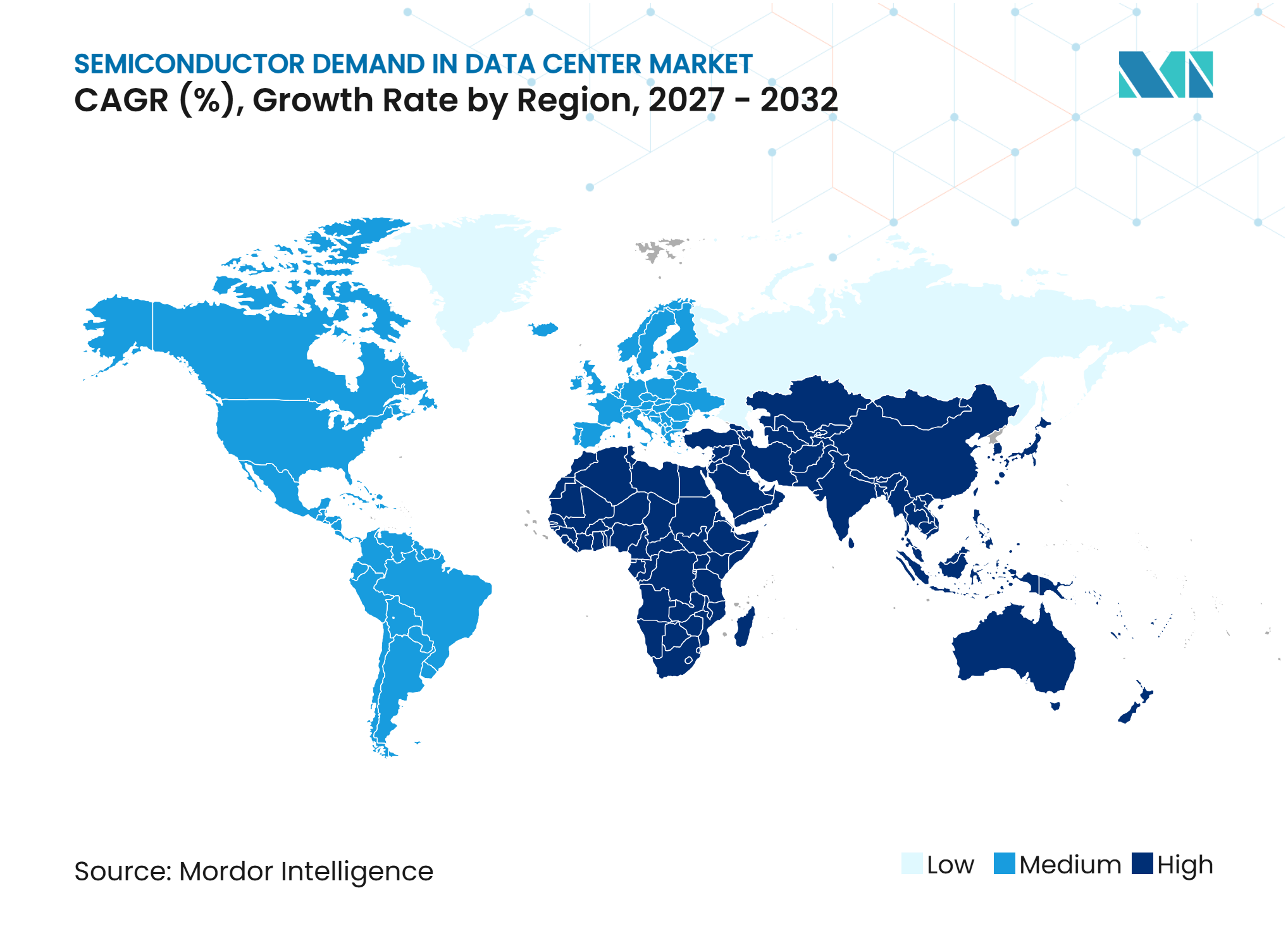
| Fastest Growing Market | Asia-Pacific |
| Largest Market | North America |
| Market Concentration | Medium |
Major Players *Disclaimer: Major Players sorted in no particular order Image © Mordor Intelligence. Reuse requires attribution under CC BY 4.0. | |
Semiconductor Demand In Data Center Market Analysis by Mordor Intelligence
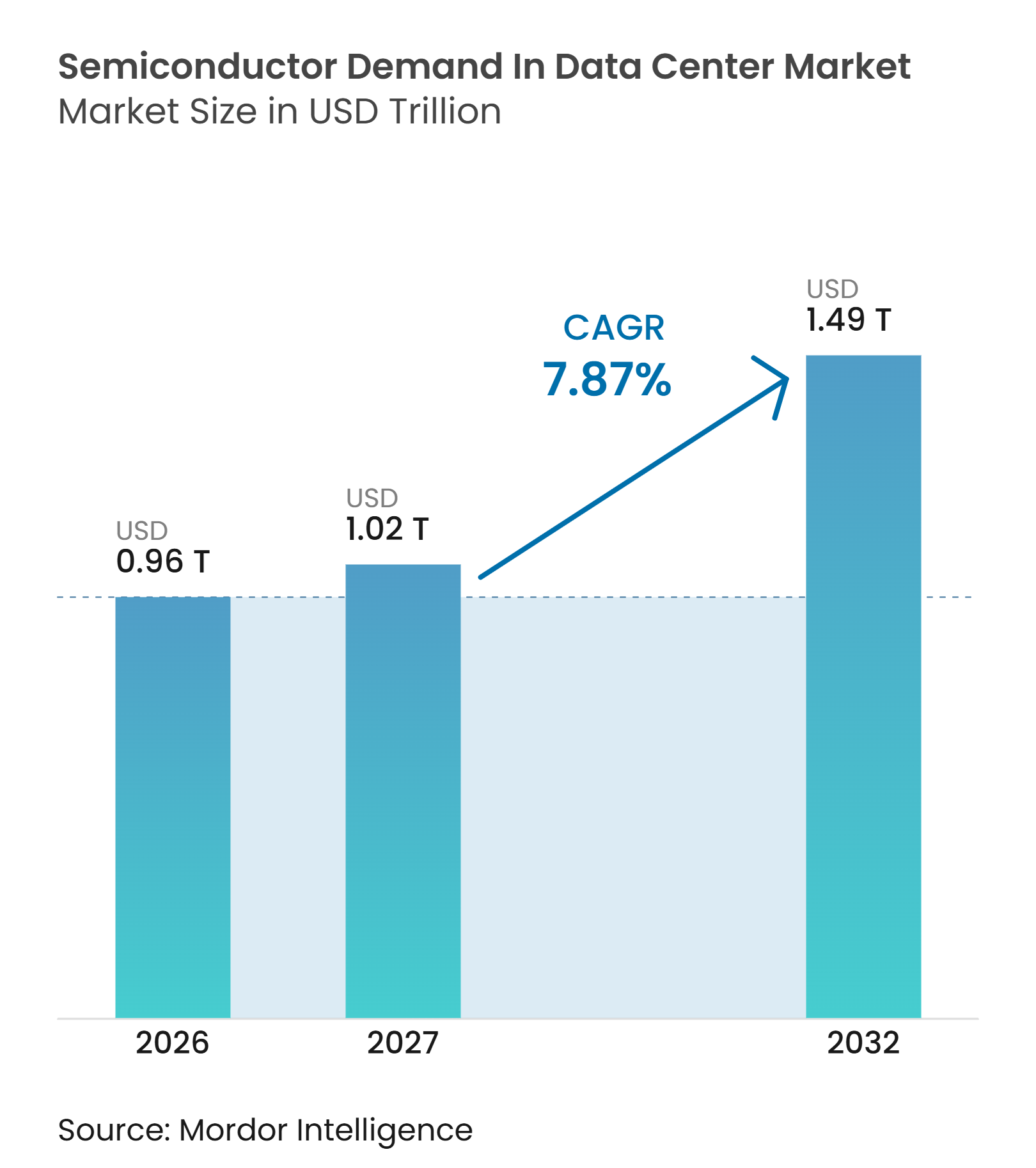
The Semiconductor Demand In Data Center Market size is projected to expand from USD 0.96 trillion in 2026 and USD 1.02 trillion in 2027 to USD 1.49 trillion by 2032, registering a CAGR of 7.87% between 2027 and 2032. The Semiconductor Demand in Data Center Market is being shaped by sustained investment in AI compute infrastructure, which is raising demand across processors, memory, networking, power management, and sensing devices rather than only graphics processors. AI racks also require more power conversion, cooling, and monitoring hardware as rack densities rise, which broadens semiconductor demand across the physical data center. Large cloud operators remain central to procurement, but private AI deployments and edge installations are widening the addressable customer base. Supply availability for advanced packaging and high-bandwidth memory continues to influence procurement schedules, pricing, and vendor selection. The Semiconductor Demand in Data Center Market therefore depends on both continued infrastructure investment and the ability of buyers to translate AI capacity into measurable operating value.
Key Report Takeaways
- By product type, processors held 41.67% of semiconductor demand in data center market share in 2026, while memory type is projected to expand at a 8.52% CAGR through 2032.
- By application, IT equipment accounted for 71.36% of the Semiconductor Demand in Data Center Market size in 2026, while server and rack power systems are projected to grow at a 8.36% CAGR through 2032.
- By data center type, hyperscale data centers held 58.94% of the Semiconductor Demand in Data Center Market share in 2026, while enterprise and edge data centers are expected to expand at a 8.41% CAGR through 2032.
- By geography, North America held 42.83% of revenue in 2026, while Asia-Pacific is projected to grow a 8.76% CAGR through 2032.
Note: Market numbers in this report are based on Mordor Intelligence's proprietary estimation framework, which combines nine months of actuals with Q4 projections for base year 2026.
Market Trends and Insights
Drivers Impact Analysis of Semiconductor Demand In Data Center Market*
| Driver | (~) % Impact on CAGR Forecast | Geographic Relevance | Impact Timeline |
|---|---|---|---|
| Generative AI and Large-Scale Model Training | +2.4% | Global, led by North America and Asia-Pacific | Medium term (2-4 years) |
| Hyperscale Data Center Expansion | +1.9% | Global, concentrated in North America, Asia-Pacific, and Western Europe | Medium term (2-4 years) |
| High-Bandwidth Memory and Advanced Memory Demand | +1.3% | Global, with production concentrated in South Korea within Asia-Pacific | Short term (≤ 2 years) |
| Cloud Migration and Data-Intensive Enterprise Workloads | +0.9% | Global, with strongest adoption in North America and Europe | Medium term (2-4 years) |
| Inference and Agentic AI Increasing General-Purpose Compute Demand | +0.7% | Global, led by North America with spillover to Asia-Pacific and Europe | Long term (≥ 4 years) |
| Power-Density Growth Driving Silicon Refresh Cycles | +0.5% | Global, with early adoption in North America and Asia-Pacific data center clusters | Short term (≤ 2 years) |
| Source: Mordor Intelligence | |||
Generative AI and Large-Scale Model Training
Generative AI and foundation model training are shifting a periodic server upgrade cycle into an ongoing procurement cycle for high-performance computing infrastructure. The Semiconductor Demand in the Data Center Market benefits because training clusters require large volumes of accelerators, memory, networking devices, and power components in every deployment. The Semiconductor Industry Association reported that an AI server rack can contain more than 4,500 packaged chips across nearly 20,000 dies, demonstrating how demand extends well beyond a single compute processor.[1] This component intensity makes rack deployment a broad semiconductor demand event, including advanced logic, high-bandwidth memory, analog devices, optoelectronics, and sensors. The Semiconductor Demand in Data Center Market also gains support as model builders continue to train larger models and refresh installed systems to support newer architectures.
Hyperscale Data Center Expansion
Hyperscalers are expanding AI capacity at a pace that keeps server platforms and supporting infrastructure in active refresh cycles. Their purchasing concentrates demand for graphics processors, custom accelerators, HBM stacks, networking ASICs, and advanced power semiconductors within large deployment programs. The Semiconductor Industry Association identified data center investment as a major driver of AI infrastructure growth and noted that semiconductor content accounts for more than 95% of the value of a leading AI server rack. That relationship means each increase in data center capacity can raise demand for both compute chips and the devices that regulate, distribute, and monitor electricity. The Semiconductor Demand in Data Center Market is therefore supported by the scale of cloud capacity additions, even as individual platform designs change across generations.
High-Bandwidth Memory and Advanced Memory Demand
High-bandwidth memory has become a major requirement for AI servers because system performance increasingly depends on moving data rapidly between memory and compute. The Semiconductor Demand in Data Center Market is affected by this shift because HBM and advanced packaging determine how quickly complete accelerator systems can be delivered. SK Hynix stated that AI memory demand is expected to grow strongly through 2030, while its HBM output was already committed under long-term arrangements. The move toward HBM4 introduces custom base dies produced on advanced foundry processes, making the memory element more closely tied to a customer's wider system design. Long lead times and limited supply can therefore delay deployments for buyers without secure allocation, while strengthening the position of suppliers with qualified capacity.
Cloud Migration and Data-Intensive Enterprise Workloads
Cloud migration supports semiconductor demand because modern enterprise workloads require persistent processing, storage, networking, and low-latency data access. The Semiconductor Demand in Data Center Market expands when enterprise software and data are moved into hyperscale or colocation facilities that need more server and networking capacity. AI workloads add another layer of demand because they require high-bandwidth memory, efficient inference processors, and upgraded power systems alongside general-purpose infrastructure. This effect also creates demand for analog integrated circuits, sensors, and power modules that receive less attention than accelerators but are necessary for operating higher-density facilities. The resulting demand is spread across cloud providers, colocation operators, and enterprises that retain private infrastructure for selected workloads.
Restraints Impact Analysis of Semiconductor Demand In Data Center Market*
| Restraint | (~) % Impact on CAGR Forecast | Geographic Relevance | Impact Timeline |
|---|---|---|---|
| High Capital and Operating Costs of AI Infrastructure | -1.8% | Global, most pronounced in North America and Europe | Medium term (2-4 years) |
| Advanced-Node, Packaging, and Memory Supply Constraints | -1.4% | Global, with concentrated impact in Asia-Pacific manufacturing hubs | Short term (≤ 2 years) |
| Thermal Envelope Limits in High-Density AI Racks | -0.9% | North America and Asia-Pacific, which are early hyperscale adopters | Medium term (2-4 years) |
| Recurring Server Overcapacity and Procurement Correction Cycles | -0.6% | North America and Europe, across enterprise and colocation segments | Long term (≥ 4 years) |
| Source: Mordor Intelligence | |||
High Capital and Operating Costs of AI Infrastructure
AI infrastructure requires significant upfront investment in servers, accelerators, networking equipment, power systems, cooling, and facility construction. The Semiconductor Demand in Data Center Market can slow when enterprise buyers cannot establish a clear return from expensive deployments or cannot obtain sufficient electricity for planned capacity. The EU AI Act and the National Institute of Standards and Technology AI Risk Management Framework can support governance and planning for enterprises deploying AI systems. These factors can extend procurement timing, especially for organizations without the scale or balance sheets of large cloud operators. Higher equipment and operating costs are consequently more restrictive for mid-tier enterprises and colocation customers than for the largest hyperscalers.
Advanced-Node, Packaging, and Memory Supply Constraints
Leading-edge chip supply depends on a narrow group of foundries, packaging providers, and memory manufacturers. The Semiconductor Demand in Data Center Market can face schedule risk when capacity for advanced nodes, CoWoS packaging, or HBM is committed to major accelerator programs. TSMC has continued to invest in advanced manufacturing and packaging capacity, including its expanded Arizona program, to meet demand for leading-edge semiconductor production. However, capacity additions take time to qualify and must support multiple AI chip generations simultaneously. Limited allocation can delay systems for secondary buyers and can keep prices elevated when demand rises faster than output.
*Our forecasts treat driver/restraint impacts as directional, not additive. The impact forecasts reflect baseline growth, mix effects, and variable interactions.
Semiconductor Demand In Data Center Market Segment Analysis
By Product Type:
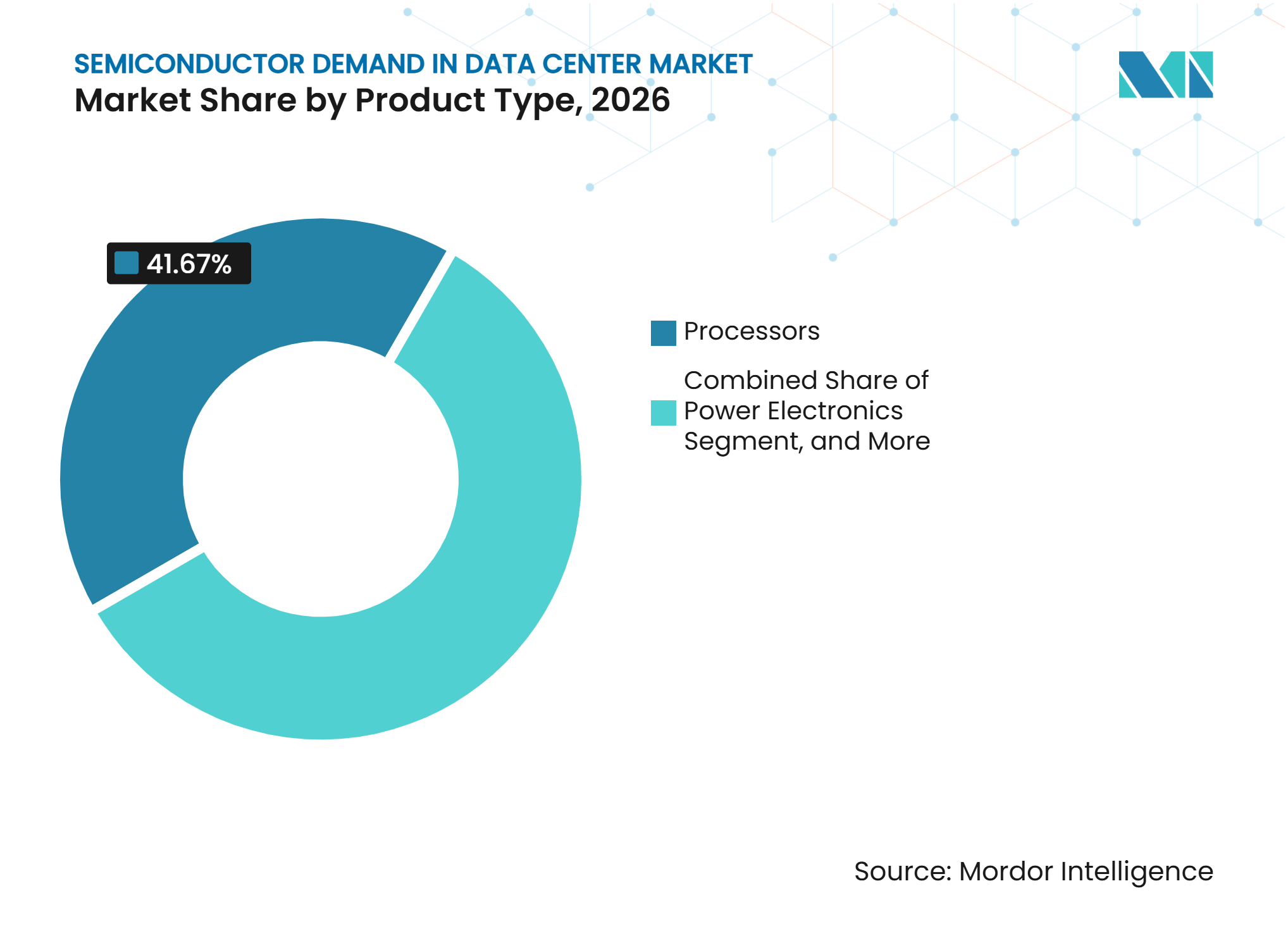
Memory Semiconductors Lead Growth as Processors Retain ScaleProcessors held 41.67% of market revenue in 2026, reflecting the high value of graphics processors and AI accelerators in large training and inference systems. Graphics processors have retained the strongest revenue per unit across the stack because they perform the parallel computing that supports many AI workloads. Processor demand is also reinforced by central processing units, data processing units, field-programmable gate arrays, and SmartNICs that coordinate data movement across a server cluster. Processor demand remains tied to hyperscaler spending because the largest cloud operators buy high volumes of the most advanced platforms.
Memory type is expected to grow at an 8.52% CAGR from 2027 to 2032, the fastest pace among product categories. High-bandwidth memory is important because bandwidth, rather than only processor throughput, can limit system-level performance in AI training and inference. The transition to HBM4 uses custom base dies and advanced foundry processes, making memory more closely integrated with customer-specific silicon designs. NAND flash also supports retrieval-augmented generation workloads that access large stores of cold data, while DRAM remains essential to server operation. SK Hynix reported that its HBM production was committed through 2027 under long-term supply arrangements, supporting continued visibility into demand for advanced memory suppliers.



By Application:
IT Equipment Holds the Largest Position While Power Systems AccelerateIT equipment accounted for 71.36% of the Semiconductor Demand in Data Center Market size in 2026, as servers, memory, and networking equipment dominate spending within a data center. The IT equipment share reflects the cost and component density of AI racks, where accelerator and memory configurations account for much of the installed value. The Semiconductor Industry Association reported that semiconductor content exceeds 95% of the value of an AI server rack, which it placed at USD 1.5 million to USD 4 million. IT equipment will remain the main source of revenue because compute and network silicon are required before workloads can be deployed.
Server and rack power systems are projected to grow at an 8.36% CAGR from 2027 to 2032, driven by higher rack densities that necessitate replacement cycles for power conversion and distribution equipment. The shift from 54V architectures to 800VDC designs is driving demand for power integrated circuits, isolated DC-DC converters, gate drivers, hot-swap controllers, silicon carbide switches, and gallium nitride devices. Infineon demonstrated 800 VDC hot-swap technology intended to support increasingly dense AI server environments, including racks moving from 120 kW to higher power levels.[2] Battery backup systems, facility power equipment, cooling systems, and monitoring arrays also require discrete components, sensors, and control devices. This wider application base reduces the extent to which growth relies only on accelerator shipments.
By Data Center Type:
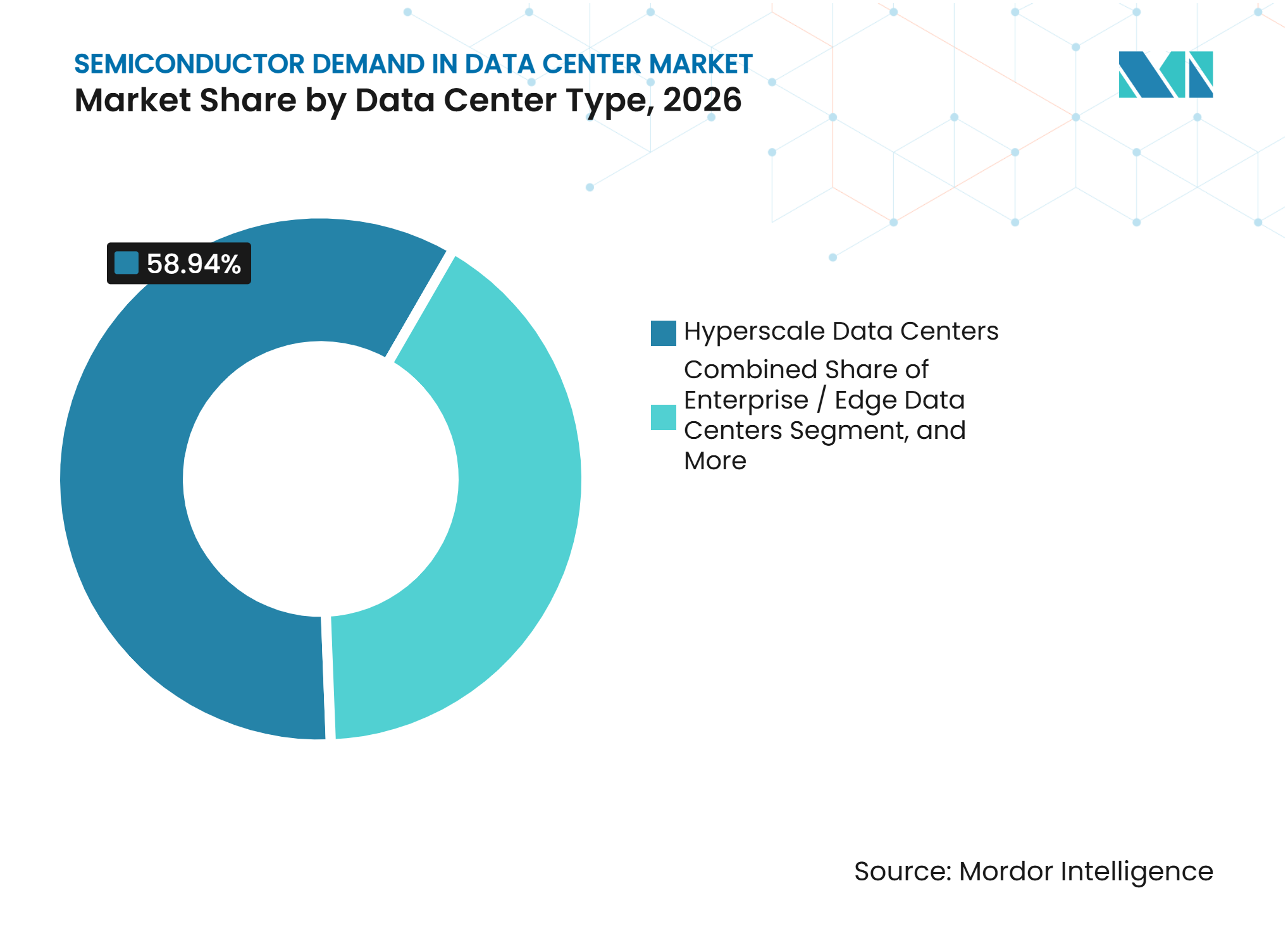
Hyperscale Leads Spending While Enterprise and Edge Deployments ExpandHyperscale data centers held 58.94% of market revenue in 2026 because a small group of cloud providers purchases the largest volumes of accelerators, HBM stacks, and networking ASICs. Their scale supports the rollout of large training clusters and broad inference services, which require standardized rack designs and continuous hardware refreshes. Hyperscale operators also influence supply allocation because their orders are large enough to secure advanced packaging and memory capacity. Colocation facilities provide another route to deployment for organizations that need AI capacity but do not build their own facilities. Their demand is focused on GPU density upgrades and on placing inference nodes alongside more traditional computing workloads.
Enterprise and edge data centers are expected to grow at an 8.41% CAGR from 2027 to 2032, making them the fastest-growing data center type. Data sovereignty requirements, latency-sensitive applications, and the availability of mid-scale AI racks support private deployments near users and controlled datasets. The EU AI Act is a key compliance factor for organizations that need to manage AI-related governance and data-handling requirements in their deployment choices. Financial services, health care, and public administration can favor private infrastructure when data governance or response-time requirements limit the feasibility of a fully centralized cloud model.

Geography Analysis
North America
North America held 42.83% of market revenue in 2026, supported by its concentration of hyperscaler headquarters, AI training clusters, and semiconductor design companies. Large cloud operators in the region continue to set the pace for accelerator, advanced memory, and networking deployments. The Semiconductor Industry Association reported more than USD 770 billion in semiconductor ecosystem commitments across 160 US projects, which supports a broader domestic supply base for the equipment used by data center operators. TSMC’s planned Arizona expansion includes fabrication and advanced packaging facilities that can bring a portion of leading-edge supply closer to North American system builders
Asia-Pacific
Asia-Pacific is projected to grow at an 8.76% CAGR from 2027 to 2032, making it the fastest-growing regional segment of the Semiconductor Demand in Data Center Market. The region combines expanding AI data center demand with manufacturing capabilities in foundry services, advanced packaging, HBM, equipment, materials, and specialty chemicals. Taiwan remains important to foundry and packaging supply, South Korea is a key source of high-bandwidth memory, and Japan provides materials and equipment that support the broader supply chain.[3] SK Hynix described its HBM integration work with TSMC’s 3DFabric technologies for 2026, highlighting the close link between memory suppliers and the region's advanced packaging ecosystem.
Europe and Emerging Markets
Europe is adding AI-related data center capacity through enterprise digital transformation, cloud expansion, and sovereign AI programs in France, Germany, and the Netherlands. Energy-efficiency requirements drive demand for power-efficient semiconductor designs in cooling, power management, and monitoring systems. The EU AI Act exerts regulatory influence over how organizations govern AI deployments and can favor infrastructure choices that offer stronger control over data and operations. Saudi Arabia and the UAE are pursuing large AI data center campuses supported by government priorities, energy availability, and partnerships with global cloud providers. Brazil is still at an earlier stage but is attracting infrastructure investment as data localization policy strengthens the case for in-country AI server deployments, diversifying the Semiconductor Demand in Data Center Market beyond North American hyperscalers and Asia-Pacific manufacturing centers.
Competitive Landscape
Market Concentration
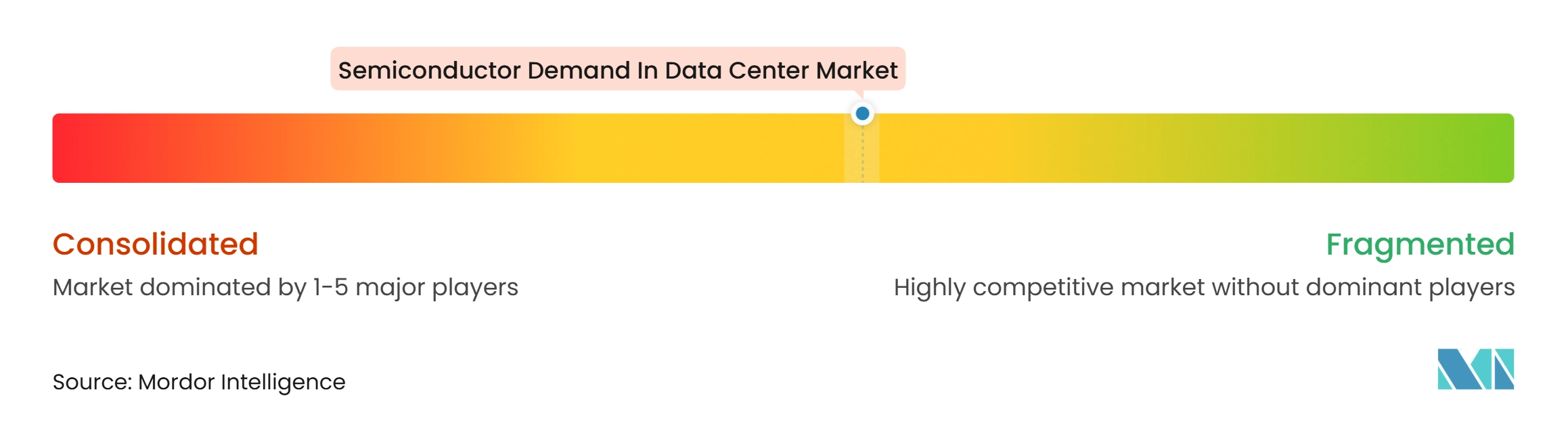
The Semiconductor Demand in Data Center Market is moderately consolidated in accelerators and advanced memory, while it is more fragmented across power electronics, analog devices, optoelectronics, and sensors. NVIDIA held an estimated major share of the AI semiconductor sub-segment in 2025, which reflects the company’s central position in accelerator platforms. Its competitive position is reinforced by control over rack-scale architectures, software compatibility, and relationships with major memory and manufacturing partners.
NVIDIA contributed MGX 1.2 rack designs to the Open Compute Project in October 2026, extending its approach to scalable, high-power AI data center configurations.[4]Broadcom is a key competitive challenge due to its custom ASIC platform, which allows hyperscalers to design accelerators tailored to their own requirements. Broadcom reported AI semiconductor revenue of USD 16.7 billion in fiscal Q3 2026, up 221% from the prior year, demonstrating the rise of customer-designed processing platforms. AMD is also expanding its data center position through its Instinct GPU roadmap and the Helion rack reference design, which can support equipment from Cisco, Dell Technologies, HPE, Lenovo, and Supermicro.
Memory suppliers play an increasingly strategic role because HBM availability and technical integration can determine when accelerator systems reach volume deployment. Micron confirmed joint work with NVIDIA on a custom NVHBM, targeting higher bandwidth and lower power than standard HBM4E, for planned 2027 volume production. Samsung, SK Hynix, and Micron are expanding capacity through long-term supply arrangements, which strengthens the link between memory supply planning and accelerator roadmaps. Smaller companies, including Cerebras Systems, Ampere Computing, SambaNova Systems, and Tenstorrent, are positioning around inference processors and alternative compute architectures.
Semiconductor Demand In Data Center Industry Leaders
-
NVIDIA Corporation
-
Advanced Micro Devices, Inc.
-
Intel Corporation
-
Taiwan Semiconductor Manufacturing Company Limited
-
SK hynix Inc.
- *Disclaimer: Major Players sorted in no particular order
Semiconductor Demand In Data Center Market Companies Covered in this Report
- NVIDIA Corporation
- Advanced Micro Devices, Inc.
- Intel Corporation
- Taiwan Semiconductor Manufacturing Company Limited
- SK hynix Inc.
- Micron Technology, Inc.
- Broadcom Inc.
- Samsung Electronics Co., Ltd.
- Marvell Technology, Inc.
- GlobalFoundries Inc.
- United Microelectronics Corporation
- Arm Holdings plc
- Qualcomm Incorporated
- MediaTek Inc.
- Huawei Technologies Co., Ltd.
- International Business Machines Corporation
- Ampere Computing LLC
- Cerebras Systems, Inc.
- SambaNova Systems, Inc.
- Tenstorrent Inc.
Recent Industry Developments in Semiconductor Demand In Data Center Market
- November 2026: Samsung, SK Hynix, and Micron announced accelerated HBM capacity expansions backed by long-term supply agreements. Samsung secured contracts for 60%-70% of its HBM production through 2030 with 10 customers. SK Hynix sold out production through agreements with 14 customers. Micron committed USD 25 billion in capital investment in the first half of fiscal year 2027.
- October 2026: AMD announced agreements to acquire Taalas, a low-latency inference-silicon company, and World Labs, a spatial-intelligence company. Both transactions were expected to close by the end of 2026, extending AMD’s data center AI portfolio into inference-optimized silicon and embodied AI.
- October 2026: Micron confirmed joint development of custom NVHBM with NVIDIA, targeting 30% more bandwidth and 15% lower power than standard HBM4E, with volume production expected in 2027. Samsung and SK Hynix are co-participants, with base dies manufactured on TSMC’s 3nm process.
- May 2026: TSMC raised its total planned US investment to USD 265 billion, encompassing 6 fabrication plants, 2 advanced packaging facilities, and an R&D center in Arizona. This represented a near fivefold increase from the original USD 65 billion commitment.
Global Semiconductor Demand In Data Center Market Report Scope
Semiconductor demand in the data center market refers to the need for integrated circuits and related components that enable data processing, storage, networking, and power management within data center infrastructure. These semiconductors include processors, memory chips, graphics processing units, networking chips, and power management integrated circuits used in servers, storage systems, and networking equipment.
The Semiconductor Demand in Data Center Market Report is Segmented by Product Type (Processors [Central Processing Units (CPUs), Graphics Processing Units (GPUs), Microcontrollers (MCUs), and Digital Signal Processors (DSPs)], Logic ICs [Field Programmable Gate Arrays (FPGAs), DPUs/IPUs/SmartNICs, Network Switches and Server Rack Connectivity, Controller ICs, and Other Logic ICs], Memory Type [DRAM, High-Bandwidth Memory (HBM), NAND Flash, NOR Flash, and Other Memory Types], Power Electronics [Discrete Components {Rectifiers, Bipolar Transistors, MOSFETs, IGBTs, and Other Discrete Components}, Power Modules {Thyristor Modules, IGBT Modules, MOSFET Modules, and Intelligent Power Modules (IPMs)}, and Power ICs {PMICs (Multichannel), Switching Regulators (AC/DC and DC/DC, Isolated/Non-Isolated), Linear Regulators, Battery Management ICs, Gate Driver ICs, and Other Power ICs}], Analog ICs [Interface and Signal-Conditioning ICs, Signal-Conversion ICs, Application-Specific Analog ICs], Optoelectronics [Laser Transmitters, Photodetectors and Photodiodes, Optocouplers and Optical Isolators, Optical Switches, and Infrared Emitters and Detectors], and Sensors [Temperature Sensors, Pressure Sensors, Magnetic-Field and Hall-Effect Sensors, Current Sensors, Humidity Sensors, and Gas and Smoke Sensors]), Application (IT Equipment, Server and Rack Power Systems, Battery Backup and Energy Storage Systems, Facility Power Infrastructure, Cooling and Thermal Management Infrastructure, Data Center Monitoring and Automation, and Safety and Security Infrastructure), Data Center Type (Hyperscale Data Centers, Colocation Data Centers, and Enterprise/Edge Data Centers), and Geography (North America, Europe, Asia-Pacific, and Rest of the World). The Market Forecasts are Provided in Terms of Value (USD).
Segmentation Overview
| Processors | Central Processing Units (CPUs) | |
| Graphics Processing Units (GPUs) | ||
| Microcontrollers (MCUs) | ||
| Digital Signal Processors (DSPs) | ||
| Logic ICs | Field Programmable Gate Arrays (FPGAs) | |
| DPUs / IPUs / SmartNICs | ||
| Network Switches and Server Rack Connectivity | ||
| Controller ICs | ||
| Other Logic ICs | ||
| Memory Type | DRAM | |
| High-Bandwidth Memory (HBM) | ||
| NAND Flash | ||
| NOR Flash | ||
| Other Memory Types | ||
| Power Electronics | Discrete Components | Rectifiers |
| Bipolar Transistors | ||
| MOSFETs | ||
| IGBTs | ||
| Other Discrete Components | ||
| Power Modules | Thyristor Modules | |
| IGBT Modules | ||
| MOSFET Modules | ||
| Intelligent Power Modules (IPMs) | ||
| Power ICs | PMICs (Multichannel) | |
| Switching Regulators (AC/DC, DC/DC, Isolated/Non-Isolated) | ||
| Linear Regulators | ||
| Battery Management ICs | ||
| Gate Driver ICs | ||
| Other Power ICs | ||
| Analog ICs | Interface and Signal-Conditioning ICs | |
| Signal-Conversion ICs | ||
| Application-Specific Analog ICs | ||
| Optoelectronics | Laser Transmitters | |
| Photodetectors and Photodiodes | ||
| Optocouplers and Optical Isolators | ||
| Optical Switches | ||
| Infrared Emitters and Detectors | ||
| Sensors | Temperature Sensors | |
| Pressure Sensors | ||
| Magnetic-Field and Hall-Effect Sensors | ||
| Current Sensors | ||
| Humidity Sensors | ||
| Gas and Smoke Sensors | ||
| IT Equipment |
| Server and Rack Power Systems |
| Battery Backup and Energy Storage Systems |
| Facility Power Infrastructure |
| Cooling and Thermal Management Infrastructure |
| Data Center Monitoring and Automation |
| Safety and Security Infrastructure |
| Hyperscale Data Centers |
| Colocation Data Centers |
| Enterprise / Edge Data Centers |
| North America | United States |
| Canada | |
| Mexico | |
| Europe | Germany |
| United Kingdom | |
| France | |
| Italy | |
| Rest of Europe | |
| Asia-Pacific | China |
| Japan | |
| South Korea | |
| Taiwan | |
| India | |
| Rest of Asia-Pacific | |
| Rest of the World |
| By Product Type | Processors | Central Processing Units (CPUs) | |
| Graphics Processing Units (GPUs) | |||
| Microcontrollers (MCUs) | |||
| Digital Signal Processors (DSPs) | |||
| Logic ICs | Field Programmable Gate Arrays (FPGAs) | ||
| DPUs / IPUs / SmartNICs | |||
| Network Switches and Server Rack Connectivity | |||
| Controller ICs | |||
| Other Logic ICs | |||
| Memory Type | DRAM | ||
| High-Bandwidth Memory (HBM) | |||
| NAND Flash | |||
| NOR Flash | |||
| Other Memory Types | |||
| Power Electronics | Discrete Components | Rectifiers | |
| Bipolar Transistors | |||
| MOSFETs | |||
| IGBTs | |||
| Other Discrete Components | |||
| Power Modules | Thyristor Modules | ||
| IGBT Modules | |||
| MOSFET Modules | |||
| Intelligent Power Modules (IPMs) | |||
| Power ICs | PMICs (Multichannel) | ||
| Switching Regulators (AC/DC, DC/DC, Isolated/Non-Isolated) | |||
| Linear Regulators | |||
| Battery Management ICs | |||
| Gate Driver ICs | |||
| Other Power ICs | |||
| Analog ICs | Interface and Signal-Conditioning ICs | ||
| Signal-Conversion ICs | |||
| Application-Specific Analog ICs | |||
| Optoelectronics | Laser Transmitters | ||
| Photodetectors and Photodiodes | |||
| Optocouplers and Optical Isolators | |||
| Optical Switches | |||
| Infrared Emitters and Detectors | |||
| Sensors | Temperature Sensors | ||
| Pressure Sensors | |||
| Magnetic-Field and Hall-Effect Sensors | |||
| Current Sensors | |||
| Humidity Sensors | |||
| Gas and Smoke Sensors | |||
| By Application | IT Equipment | ||
| Server and Rack Power Systems | |||
| Battery Backup and Energy Storage Systems | |||
| Facility Power Infrastructure | |||
| Cooling and Thermal Management Infrastructure | |||
| Data Center Monitoring and Automation | |||
| Safety and Security Infrastructure | |||
| By Data Center Type | Hyperscale Data Centers | ||
| Colocation Data Centers | |||
| Enterprise / Edge Data Centers | |||
| By Geography | North America | United States | |
| Canada | |||
| Mexico | |||
| Europe | Germany | ||
| United Kingdom | |||
| France | |||
| Italy | |||
| Rest of Europe | |||
| Asia-Pacific | China | ||
| Japan | |||
| South Korea | |||
| Taiwan | |||
| India | |||
| Rest of Asia-Pacific | |||
| Rest of the World | |||
Key Questions Answered in the Report
What is the current value and forecasts for Semiconductor Demand in Data Center Market?
The Semiconductor Demand In Data Center Market size is projected to expand from USD 0.96 trillion in 2026 and USD 1.02 trillion in 2027 to USD 1.49 trillion by 2032, registering a CAGR of 7.87% between 2027 and 2032.
What is driving demand for data center semiconductors?
AI training and inference are increasing demand for accelerators, HBM, networking chips, power devices, sensors, and advanced packaging. The Semiconductor Demand in Data Center Market benefits because every AI rack combines these component groups in a single system deployment, while larger cloud installations require continuous hardware refreshes.
Which product category is growing fastest?
Memory type is projected to expand at a 8.52% CAGR through 2032, supported by demand for high-bandwidth memory in AI systems. HBM availability and advanced packaging capacity will continue to influence which accelerator platforms reach data centers on schedule, especially for buyers without secure allocation.
Which application is growing fastest?
Server and rack power systems are projected to grow at an 8.36% CAGR through 2032 as higher-density racks require new power conversion and distribution equipment. This supports demand for power integrated circuits, controllers, switches, sensors, and thermal control devices as operators transition from earlier 54V architectures.
Which data center type is growing fastest?
Enterprise and edge data centers are expected to grow at an 8.41% CAGR through 2032 as organizations prioritize data control and low-latency AI workloads. The Semiconductor Demand in Data Center Market also gains from these deployments because they require local servers, memory, power equipment, and networking systems close to controlled data.