
Self-Service Password Management Market Size and Share
Market Overview
| Study Period | 2021 - 2032 |
|---|---|
| Market Size (2027) | USD 1.21 Billion |
| Market Size (2032) | USD 1.91 Billion |
| Growth Rate (2027 - 2032) | 9.67 % |
| Fastest Growing Market | Asia-Pacific |
| Largest Market | North America |
| Market Concentration | Low |
Major Players *Disclaimer: Major Players sorted in no particular order Image © Mordor Intelligence. Reuse requires attribution under CC BY 4.0. | |
Self-Service Password Management Market Analysis by Mordor Intelligence
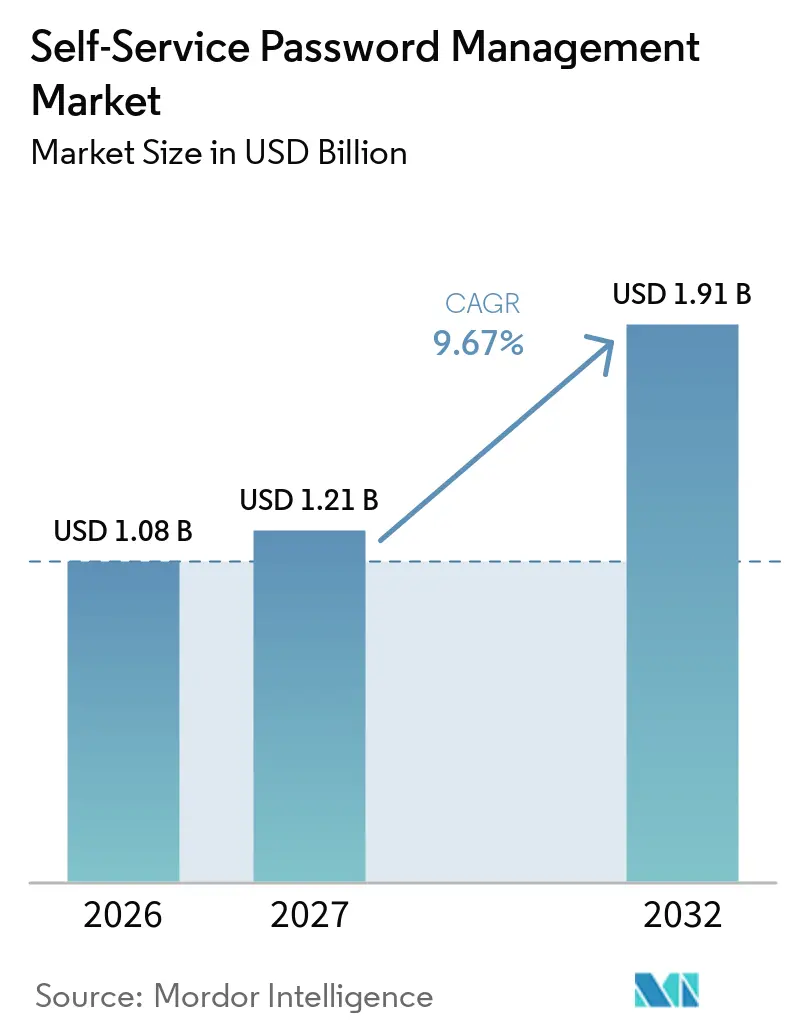
The self-service password management market size was valued at USD 1.08 billion in 2026 and estimated to expand from USD 1.21 billion in 2027 to reach USD 1.91 billion by 2032, at a CAGR of 9.67% during the forecast period 2027-2032. Credential theft, phishing, and account takeover are making password recovery a security control rather than a simple service desk function. Enterprises are also seeking lower reset volumes, faster employee recovery, and audit records that show how authentication events were handled. Cloud adoption is increasing the need to manage credentials across directories, software applications, and contractor accounts without relying on a single on-premises environment. Passkey adoption changes the role of the self-service password management market, as many organizations will operate both password and passwordless methods simultaneously during the transition. Vendors are responding by combining reset workflows with stronger identity checks, passkey enrollment support, directory synchronization, and reporting functions.
Key Report Takeaways
- By solution type, Password Reset Tools held 37.84% of the self-service password management market share in 2026, while Multi-Factor Authentication Integration is projected to expand at a 10.67% CAGR through 2032.
- By deployment mode, Cloud-Based deployment accounted for 59.49% of revenue in 2026 and is projected to expand at a 10.26% CAGR through 2032.
- By organization size, Large Enterprises held 69.31% of revenue in 2026, while Small and Medium Enterprises are projected to expand at a 10.08% CAGR through 2032.
- By application, Employee Password Reset accounted for 68.42% of revenue in 2026, while Customer and Consumer Password Recovery is projected to expand at a 10.66% CAGR through 2032.
- By end-user vertical, BFSI held 22.14% of revenue in 2026, while IT and Telecom are projected to expand at an 11.03% CAGR through 2032.
- By geography, North America held 41.03% of revenue in 2026, while Asia-Pacific is projected to expand at a 10.09% CAGR through 2032.
Note: Market numbers in this report are based on Mordor Intelligence's proprietary estimation framework, which combines nine months of actuals with Q4 projections for base year 2026.
Market Trends and Insights
Drivers Impact Analysis of Self-Service Password Management Market*
| Driver | (~) % Impact on CAGR Forecast | Geographic Relevance | Impact Timeline |
|---|---|---|---|
| Rising Credential Theft, Phishing, and Account-Takeover Risk | +3.2% | Global | Short term (≤ 2 years) |
| Help-Desk Cost Reduction and Faster User Recovery | +2.4% | Global | Short term (≤ 2 years) |
| Expansion of Cloud Applications and Hybrid Workforces | +1.8% | Asia-Pacific core, spill-over to Middle East and Africa | Medium term (2-4 years) |
| Regulatory Pressure for Auditable Identity Controls | +1.2% | North America and Europe | Medium term (2-4 years) |
| Help-Desk Social-Engineering Defense | +0.6% | North America and Europe | Short term (≤ 2 years) |
| Directory Sprawl and Machine-Identity Convergence | +0.4% | Global, with early gains in North America | Long term (≥ 4 years) |
| Source: Mordor Intelligence | |||
Rising Credential Theft, Phishing, and Account-Takeover Risk
Credential attacks remain a central reason for investment in the self-service password management market. SpyCloud reported 5.3 billion credential pairs in criminal circulation in 2026 and a 65% password reuse rate among consumer accounts.[1] Password reuse allows an event in one system to pose a risk to unrelated enterprise services. Kaspersky reported a 59% increase in infostealer detections on PCs from 2024 to 2025, with more than 1 million banking accounts at the 100 largest banks compromised. These conditions place greater value on reset processes that check credentials against known exposures and require strong verification. The self-service password management market, therefore, favors platforms that treat a reset request as a potential fraud event rather than solely as a user support request.
Help-Desk Cost Reduction and Faster User Recovery
Password resets continue to create avoidable workload for service desks, especially in organizations with large employee populations. A Canadian energy provider reported an 85% reduction in password-related service desk calls after adopting self-service tools and automation. This result makes faster user recovery relevant to productivity, not only to information technology costs. It also shows why buyers assess whether a recovery system can reduce routine requests without weakening authentication controls. The self-service password management market benefits when buyers pair cost reduction with policy enforcement, audit trails, and safer identity validation.
Expansion of Cloud Applications and Hybrid Workforces
Cloud software and hybrid working have expanded the number of identity stores that an organization must manage. Employees may use Active Directory, Microsoft Entra ID, software-as-a-service directories, and contractor systems within the same workday. This environment makes synchronized credential recovery a practical requirement for many buyers in the self-service password management market. HENNGE launched HENNGE Password Manager in October 2026 to address credentials used for software applications and internal systems that do not support native single sign-on. The offering reflects a continuing gap between federated applications and older systems that retain separate credentials. As the number of connected applications increases, providers that support both cloud and local directories can address a wider range of operational environments.
Regulatory Pressure for Auditable Identity Controls
Identity rules increasingly emphasize reliable authentication, password management, and documented access controls. NIST published SP 800-63B-4 in July 2025, updating its guidance on authentication and authenticator management. The guidance supports the use of password managers and recognizes self-service reset processes within an authentication lifecycle. This direction matters to public-sector buyers and private organizations that align their policies with NIST guidance. It also raises demand for tools that record verification steps, policy decisions, and administrative actions. The self-service password management market is therefore shaped by platforms that can demonstrate how recovery was completed and whether the process met the organization’s stated controls.
Restraints Impact Analysis of Self-Service Password Management Market*
| Restraint | (~) % Impact on CAGR Forecast | Geographic Relevance | Impact Timeline |
|---|---|---|---|
| Weak Identity-Proofing Can Create Reset Attack Paths | -1.8% | Global | Short term (≤ 2 years) |
| Legacy Directory and Application Integration Complexity | -1.4% | North America and Europe | Medium term (2-4 years) |
| Passkey Adoption Reducing Long-Term Password-Centric Demand | -1.0% | Global, early impact in North America and Europe | Long term (≥ 4 years) |
| Data-Residency, Trust, and Migration Concerns in Cloud Delivery | -0.6% | Europe and Asia-Pacific core | Medium term ( |
| Source: Mordor Intelligence | |||
Weak Identity-Proofing Can Create Reset Attack Paths
A self-service reset flow can create risk when identity checks are weak or easily bypassed. Static knowledge questions are vulnerable because answers may be obtained from prior data exposures or through social engineering. Modern identity proofing needs stronger signals, such as device information, registered authenticators, or document and liveness checks where suitable. Imprivata stated that it is developing government identification liveness verification for self-service password reset workflows.[2] The change shows why buyers increasingly assess the quality of identity validation before they assess reset convenience. The self-service password management market faces a constraint, such as weak deployments can erode trust in the broader category and create additional security review work.
Legacy Directory and Application Integration Complexity
Many large organizations operate identity systems that were implemented before cloud-based identity tools became common. These environments may include mainframes, custom LDAP directories, enterprise resource planning applications, operational technology systems, and specialized authentication stores. Standard connectors do not always cover these systems without configuration and testing. The result is slower deployment and a higher chance that some users remain outside the automated recovery process. Complexity also increases when service accounts, application credentials, and bot identities are subject to related governance processes. Buyers may delay a wider rollout until directory synchronization, policy mapping, and audit requirements have been tested. This limits the speed of near-term deployment in the self-service password management market, particularly for regulated organizations with lengthy certification processes.
*Our forecasts treat driver/restraint impacts as directional, not additive. The impact forecasts reflect baseline growth, mix effects, and variable interactions.
Self-Service Password Management Market Segment Analysis
By Solution Type:
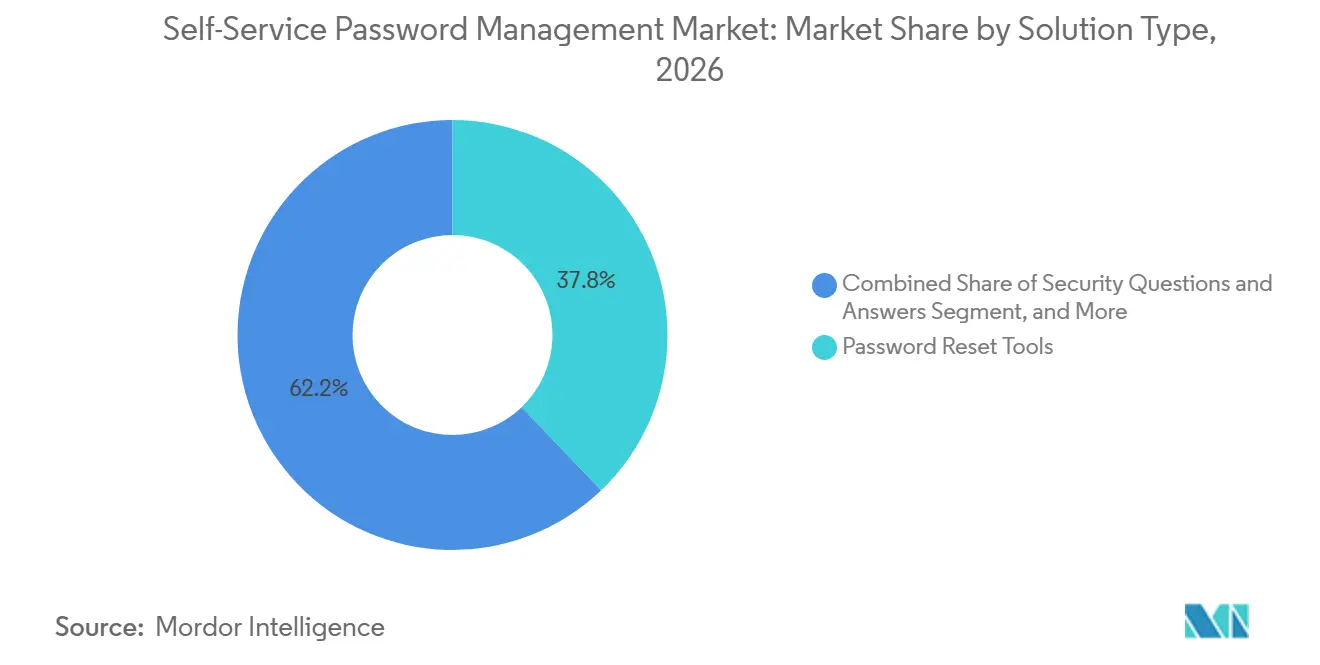
MFA Integration Redefines the SSPR Value PropositionPassword Reset Tools accounted for 37.84% of solution revenue in 2026, reflecting their early adoption and established use in enterprise support operations. The self-service password management market size for Password Reset Tools is supported by installed deployments and recurring renewal activity. Organizations continue to use these tools as a direct means of reducing service desk involvement with standard credential issues. Self-Service Password Recovery Solutions extend this role by combining recovery workflows with identity verification and policy controls. Security Questions and Answers are becoming less suitable for high-risk environments because static personal information is easier to obtain or manipulate. Mobile Password Management Applications serve employees who need recovery capabilities away from managed workstations. These options remain relevant where shift workers, traveling staff, and distributed teams cannot rely on a fixed office device. The self-service password management industry is moving toward solutions that combine recovery with higher assurance rather than separate basic reset functions from security controls, because a single weak recovery path can undermine otherwise strong authentication rules applied during normal sign-in activity.
Multi-Factor Authentication Integration is projected to expand at a 10.67% CAGR through 2032, making it the fastest-growing solution category. Buyers increasingly expect a reset event to include a second verification step rather than relying on a personal question or a single email. FIDO Alliance reported in October 2026 that more than 1 in 3 enterprise sign-ins used a passkey, compared with 26% in 2025. This shift requires recovery systems that can support passkey enrollment, authenticator replacement, and account restoration without returning to weaker methods. Specops stated that it screens more than 5.5 billion known compromised credentials during password creation and reset processes. MFA Integration therefore gains importance because it connects recovery to the broader authentication policy. Mature platforms will need to support both password-based and passwordless methods while organizations maintain mixed user populations, particularly when users have different device access, work locations, recovery options, and enrollment histories that require policy decisions to remain consistent across connected applications, through service desk handoffs when automated proofing does not meet a required standard, and through administrator oversight that preserves a clear audit record of every recovery decision throughout the full account lifecycle and across every supported authentication channel.



By Deployment Mode:
Cloud Dominance Is Shaped by SaaS-First ArchitecturesCloud-Based deployment accounted for 59.49% of revenue in 2026 and is projected to expand at a 10.26% CAGR through 2032. The self-service password management market share held by cloud deployment reflects buyer demand for centralized administration across distributed workforces. Cloud delivery can reduce reliance on local infrastructure and can support policy changes across multiple locations. It also fits organizations that already use software-as-a-service applications and cloud directories for daily operations. Hybrid deployment remains important for buyers who maintain local directories, specialized applications, or local processing requirements. On-Premises deployment continues to serve organizations that need close control over data location and network access. These models show that deployment choices depend as much on existing identity architecture as on a preference for a particular delivery format, especially where a recovery failure could disrupt operational systems, customer support, or daily workforce access.
Cloud adoption does not remove every implementation challenge. Organizations still need to align directory objects, authentication policies, recovery methods, and audit records across their systems. Microsoft retired legacy MFA and SSPR management blades in September 2025 and consolidated governance within the Entra ID Authentication Methods Policy. This type of product change encourages customers to revisit older configurations and evaluate whether their current workflows align with their broader identity architecture. Specops expanded its uReset solution in 2025 for Entra ID-only environments, targeting customers who had completed their migration from on-premises Active Directory. Cloud providers can gain an advantage by simplifying these transitions, but buyers will still assess data residency, integration depth, and operational control. The self-service password management market will continue to support cloud, local, and hybrid environments because migration paths differ across sectors and countries, and because operational continuity often requires an enterprise to keep some identity systems or business applications outside a fully cloud-based administration model.
By Organization Size:
SMEs Become the Next Growth AreaLarge Enterprises held 69.31% of revenue in 2026 because they manage extensive identity populations, multiple directories, and complex compliance obligations. Their global workforces and high number of applications create frequent credential recovery needs. Large organizations also tend to have formal access control teams and established service desk processes. These conditions make the value of automation easier to measure. They may require support for contractors, privileged users, and specialized systems in addition to employee accounts. Large Enterprise deployments often prioritize reporting, directory integration, and policy consistency across business units. This customer group remains important to the self-service password management market because its requirements shape product capabilities and enterprise buying criteria, including the ability to enforce different verification methods for high-risk users, external partners, and workforce accounts without creating separate manual processes.
Small and Medium Enterprises are projected to expand at a 10.08% CAGR through 2032. Lower entry costs for cloud tools make formal password management more accessible to organizations without large identity teams. HENNGE and Passpack announced a strategic business alliance in November 2025 to expand credential management offerings for small and medium enterprises in Japan and other markets. Smaller organizations increasingly operate several cloud applications despite having limited internal security staff. Remote and hybrid work also exposes them to the same password reuse and recovery challenges that larger enterprises face. Simple deployment, predictable pricing, and manageable policy settings are especially important in this segment. The self-service password management industry can reach this group when providers make stronger authentication and controlled recovery practical without requiring a dedicated identity administration team, while presenting configuration choices in a form that business administrators can manage and employees can follow without repeated support requests, prolonged account lockouts, complex connector projects, or a need to choose between security controls and routine operating efficiency.
By Application:
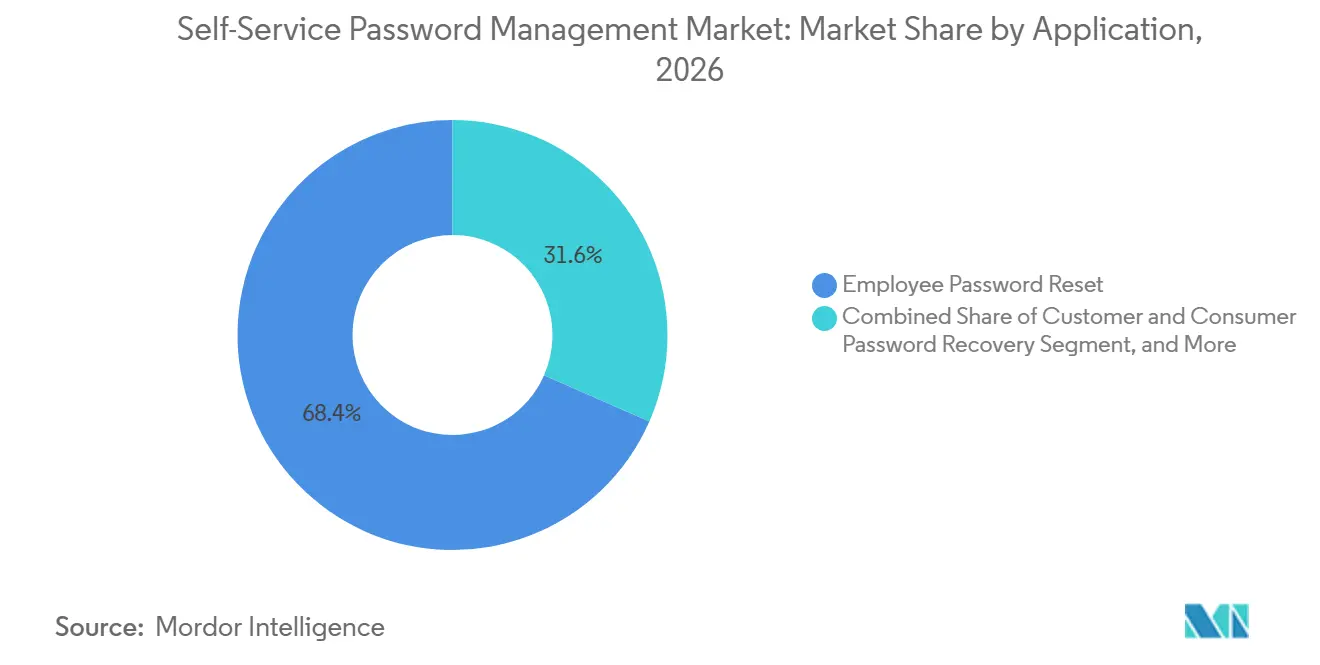
Consumer Recovery Approaches Enterprise Recovery RequirementsEmployee Password Reset accounted for 68.42% of application revenue in 2026, making it the primary use case for deployed solutions. Employee accounts typically include directory records, registered devices, and established authentication methods that support a controlled recovery process. Reset demand is also visible to service desk managers through ticket volumes and response times. This makes the employee use case a common starting point for adoption. Organizations can apply policy rules consistently because they know the user population and can link recovery to workforce access requirements. Self-service systems reduce disruption when employees are unable to sign in to collaboration, business, or security applications. The self-service password management market remains anchored by this workload because employees need access recovery throughout the workday, and organizations can connect recovery outcomes to established onboarding, access review, device, and incident response practices.
Customer and Consumer Password Recovery is projected to expand at a 10.66% CAGR through 2032. Consumer recovery is harder to secure because organizations may have less information about the user and fewer trusted devices or enrolled authenticators. NIST guidance on identity assurance helps organizations consider the required strength of remote authentication and recovery methods. Document checks, liveness detection, and secure authenticator replacement can become important where an account provides access to sensitive services. Contractor and Partner Account Recovery also remains less mature because external identities may not be managed in the same directory or policy framework. Organizations are beginning to apply stronger controls to third-party access as zero-trust approaches extend beyond internal employees. The self-service password management market can address this opportunity by enabling platforms to manage recovery for different identity populations without applying the same verification process to every user, allowing organizations to distinguish routine recovery activity from requests that require an additional proofing step or an assisted escalation process.

By End-User Vertical:
IT and Telecom Leads on Growth While BFSI Anchors DemandBFSI accounted for 22.14% of revenue in 2026, supported by long-standing investments in authentication, customer protection, and access governance. The BFSI revenue position reflects the sector’s requirement for controlled recovery and records of authentication activity. Financial institutions handle privileged employee access, consumer accounts, and third-party connections, each of which creates distinct recovery risks. They also operate in regulatory environments that require clear information security policies. Auditable recovery processes can help reduce manual intervention while preserving a record of the approval or verification path. This sector may continue to use hybrid deployment because older platforms and local requirements remain common. Providers serving BFSI need to demonstrate strong identity checks, reliable integration, and support for large and varied user groups, including teams that must restore access quickly while avoiding an inconsistent exception process for sensitive systems and customer-facing services.
IT and Telecom is projected to expand at an 11.03% CAGR through 2032. This sector has complex identity environments that can include contractors, distributed technical teams, cloud applications, and privileged administration accounts. Its buyers are often early users of cloud identity systems and passkey technologies, which creates demand for recovery methods that cover multiple authentication models. Healthcare and Life Sciences also provide a meaningful opportunity during the transition to passwordless access. Imprivata reported in January 2026 that 85% of United States healthcare information technology leaders considered passwordless authentication very important or mission-critical, while only 7% had fully implemented it. Government and Public Sector, Manufacturing, Retail, and E-Commerce each require secure access recovery for their own workforce and customer systems. The self-service password management market, therefore serves verticals with different risk profiles but a common need to restore access without compromising identity assurance, whether the affected account belongs to an employee, a customer, a supplier, a contractor, or a highly privileged technical administrator, and whether the user needs recovery during normal operating hours, a remote shift, a security incident, or a time-sensitive service interruption.
Geography Analysis
North America Self-Service Password Management Market
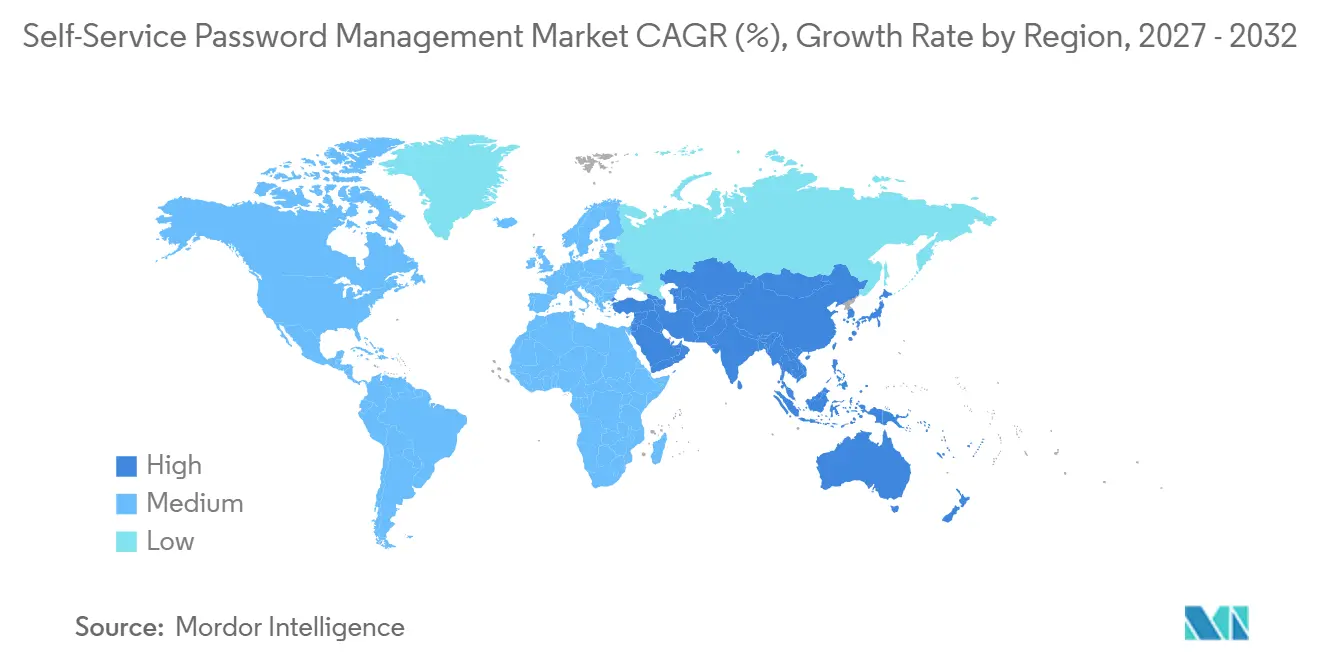
North America held 41.03% of revenue in 2026, giving it the leading position in the self-service password management market. The region has a large installed base of enterprise identity systems, a high concentration of recovery and access management vendors, and complex workforce, customer, and government access environments. Keeper Security received FedRAMP High Authorization for its Government Cloud platform in February 2026, enabling it to meet United States federal procurement requirements for high-impact unclassified systems. This competitive environment encourages providers to add stronger identity proofing, passkey support, and wider integration options.
APAC Self-Service Password Management Market
Asia-Pacific is projected to expand at a 10.09% CAGR through 2032, the highest regional rate in the self-service password management market. Adoption is supported by cloud expansion, the development of digital service ecosystems, and a growing focus on identity controls among financial institutions and enterprises. Japan is a visible center for locally designed products that address software-as-a-service accounts and legacy systems, while HENNGE introduced HENNGE Password Manager in October 2026 for applications without native single sign-on. India, South Korea, and Australia also add demand as enterprises formalize security controls and update their cybersecurity practices. Regional suppliers can compete by supporting local language, deployment, compliance, and integration needs.
EMEA and South America Self-Service Password Management Market
Europe holds a significant revenue position because its organizations operate under overlapping data protection, cybersecurity, and sector requirements. Germany and France are important country markets, and Germany’s preference for local processing supports continued demand for on-premises and hybrid deployment. Specops expanded its cloud offering for Entra ID-only environments in 2025, addressing organizations that completed their cloud migration.[3] South America, the Middle East, and Africa remain earlier-stage regions where digital services, financial sector modernization, data residency, and local implementation needs determine the pace of adoption. Brazil, Saudi Arabia, and South Africa are important country-level adoption centers.
Competitive Landscape
Market Concentration
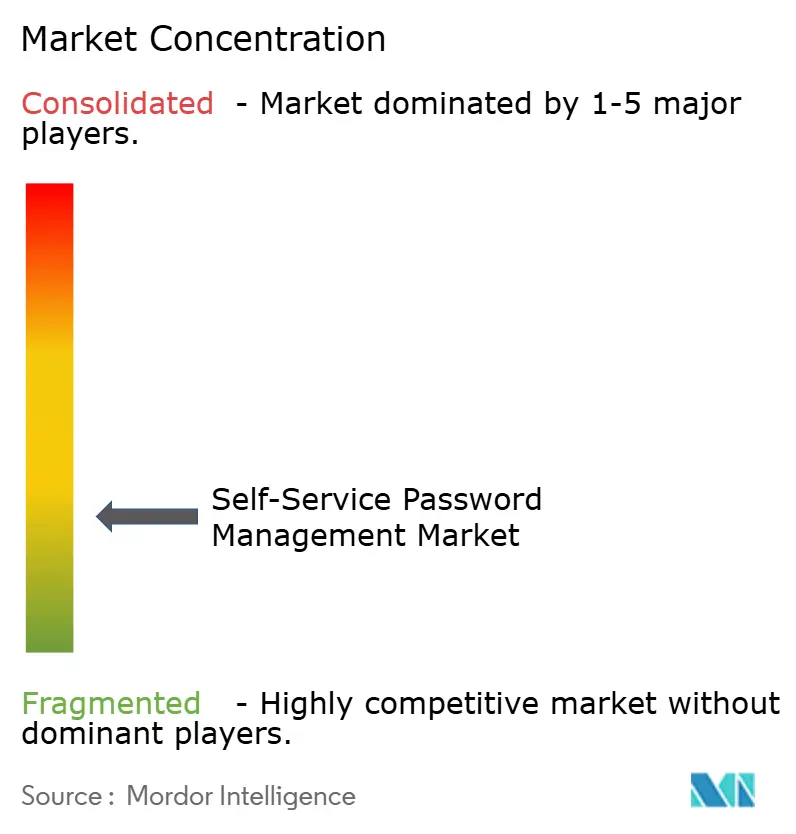
The self-service password management market is fragmented, with specialist providers competing against broader identity, privileged access, and identity governance platforms. Buyers compare directory integration, identity proofing, recovery reliability, password and passkey support, and suitability for shared workstations and varied identity populations. Established vendors can bundle recovery into broader identity portfolios, while specialist providers can compete by offering deep reset controls, rapid implementation, and complex directory support. Keeper Security reported more than 100,000 enterprise customers and more than USD 240 million in annual recurring revenue in October 2026, illustrating the advantage of platform expansion. This pressure makes a basic password reset offering less competitive.
Competitive strategies now include passwordless transition services and stronger controls at the identity recovery event. Specops expanded uReset for Entra ID-only environments in 2025, and Avatier has described behavioral anomaly detection that identifies potentially suspicious recovery requests. HID Global’s agreement to acquire IDmelon offers another example of expansion into FIDO2 passkey capabilities. These moves treat recovery, authentication, and access governance as connected parts of identity security. They also make price-only competition less effective.
White-space demand remains in behavioral analysis, deviceless FIDO2 recovery for frontline staff, and self-service rotation for machine identities. QuickLaunch launched an AI-powered Insights Agent in October 2026 to analyze password reset volumes, MFA enrollment, and account provisioning events. Such reporting can make a platform a source of identity governance information rather than only a transactional tool.
Self-Service Password Management Industry Leaders
-
Avatier Corporation
-
Hitachi ID Systems, Inc.
-
Specops Software AB
-
Tools4ever B.V.
-
FastPassCorp A/S
- *Disclaimer: Major Players sorted in no particular order
Self-Service Password Management Market Companies Covered in this Report
- Avatier Corporation
- Hitachi ID Systems, Inc.
- Specops Software AB
- Tools4ever B.V.
- FastPassCorp A/S
- nFront Security, Inc.
- Enzoic, Inc.
- CionSystems, Inc.
- JiJi Technologies Pvt. Ltd.
- Anixis, Inc.
- StealthINTERCEPT, LLC
- safepass.me Ltd.
- OmniSharp, Inc.
- Ilantus Technologies Private Limited
- Securden, Inc.
- EmpowerID, Inc.
- QuickLaunch, Inc.
- ReACT Software Corporation
- Password Reset Pro, LLC
- Core Security SDI Corporation
- GateKeeper Enterprise, Inc.
- Siber Systems, Inc.
- AgileBits Inc.
- Keeper Security, Inc.
- Password Boss, Inc.
Recent Industry Developments in Self-Service Password Management Market
- October 2026: Keeper Security surpassed 100,000 enterprise customers globally and exceeded USD 240 million in annual recurring revenue, driven by KeeperAI, real-time privileged session monitoring reducing threat detection time by 99%, and the expansion of KeeperPAM into agentic AI governance with Model Context Protocol server certification, positioning the company as a unified identity security platform beyond standalone password management.
- October 2026: HENNGE K.K. launched HENNGE Password Manager on October 1, 2026, within its HENNGE One platform, enabling individual-level secure management of shared credentials across SaaS applications and internal systems without native SSO support, specifically targeting the structural gap in Japan's enterprise credential management market for non-federatable applications.
- October 2026: QuickLaunch launched its AI-powered Insights Agent, enabling higher-education IAM administrators to query password reset volumes, MFA enrollment, and account provisioning events through conversational analytics, expanding the platform's governance reporting capability beyond transactional authentication workflows.
- February 2026: Keeper Security's Government Cloud platform achieved FedRAMP High Authorization, opening access to US federal civilian agency procurement for high-impact unclassified systems and marking the most stringent federal cybersecurity qualification for a password and PAM platform.
Global Self-Service Password Management Market Report Scope
The Self-Service Password Management Market refers to the global market for software solutions and applications that enable users to independently reset, recover, and manage their passwords without requiring direct assistance from IT support teams or customer service representatives. These solutions include password reset tools, self-service password recovery platforms, multi-factor authentication integration, security questions and answers, and mobile password management applications designed to simplify credential management while maintaining security and access control. The market encompasses cloud-based, on-premises, and hybrid deployment models that support employee password resets, customer and consumer password recovery, and contractor and partner account recovery. These solutions help organizations reduce help desk workloads, minimize password-related support costs, improve user productivity, strengthen authentication security, and maintain business continuity.
The Self-Service Password Management Market Report is Segmented by Solution Type (Password Reset Tools, Self-Service Password Recovery Solutions, Multi-Factor Authentication Integration, Security Questions and Answers, and Mobile Password Management Applications), Deployment Mode (Cloud-Based, On-Premises, and Hybrid), Organization Size (Large Enterprises and Small and Medium Enterprises), Application (Employee Password Reset, Customer and Consumer Password Recovery, and Contractor and Partner Account Recovery), End-User Vertical (BFSI, Healthcare and Life Sciences, IT and Telecom, Government and Public Sector, Manufacturing, Retail and E-Commerce, and Other End-User Verticals), and Geography (North America, South America, Europe, Asia-Pacific, Middle East, and Africa). The Market Forecasts are Provided in Terms of Value (USD).
Segmentation Overview
| Password Reset Tools |
| Self-Service Password Recovery Solutions |
| Multi-Factor Authentication Integration |
| Security Questions and Answers |
| Mobile Password Management Applications |
| Cloud-Based |
| On-Premises |
| Hybrid |
| Large Enterprises |
| Small and Medium Enterprises |
| Employee Password Reset |
| Customer and Consumer Password Recovery |
| Contractor and Partner Account Recovery |
| BFSI |
| Healthcare and Life Sciences |
| IT and Telecom |
| Government and Public Sector |
| Manufacturing |
| Retail and E-Commerce |
| Other End-User Verticals |
| North America | United States |
| Canada | |
| Mexico | |
| South America | Brazil |
| Argentina | |
| Rest of South America | |
| Europe | Germany |
| United Kingdom | |
| France | |
| Italy | |
| Spain | |
| Rest of Europe | |
| Asia-Pacific | China |
| Japan | |
| South Korea | |
| India | |
| Australia | |
| New Zealand | |
| Rest of Asia-Pacific | |
| Middle East | Saudi Arabia |
| United Arab Emirates | |
| Turkey | |
| Rest of Middle East | |
| Africa | South Africa |
| Nigeria | |
| Kenya | |
| Rest of Africa |
| By Solution Type | Password Reset Tools | |
| Self-Service Password Recovery Solutions | ||
| Multi-Factor Authentication Integration | ||
| Security Questions and Answers | ||
| Mobile Password Management Applications | ||
| By Deployment Mode | Cloud-Based | |
| On-Premises | ||
| Hybrid | ||
| By Organization Size | Large Enterprises | |
| Small and Medium Enterprises | ||
| By Application | Employee Password Reset | |
| Customer and Consumer Password Recovery | ||
| Contractor and Partner Account Recovery | ||
| By End-User Vertical | BFSI | |
| Healthcare and Life Sciences | ||
| IT and Telecom | ||
| Government and Public Sector | ||
| Manufacturing | ||
| Retail and E-Commerce | ||
| Other End-User Verticals | ||
| By Geography | North America | United States |
| Canada | ||
| Mexico | ||
| South America | Brazil | |
| Argentina | ||
| Rest of South America | ||
| Europe | Germany | |
| United Kingdom | ||
| France | ||
| Italy | ||
| Spain | ||
| Rest of Europe | ||
| Asia-Pacific | China | |
| Japan | ||
| South Korea | ||
| India | ||
| Australia | ||
| New Zealand | ||
| Rest of Asia-Pacific | ||
| Middle East | Saudi Arabia | |
| United Arab Emirates | ||
| Turkey | ||
| Rest of Middle East | ||
| Africa | South Africa | |
| Nigeria | ||
| Kenya | ||
| Rest of Africa | ||
Key Questions Answered in the Report
What is the self-service password management market size?
The market was valued at USD 1.08 billion in 2026, is estimated at USD 1.21 billion in 2027, and is projected to reach USD 1.91 billion by 2032 at a 9.67% CAGR.
What is driving demand for self-service password management?
Credential theft, phishing risk, service desk cost reduction, cloud application expansion, and requirements for auditable authentication controls are key demand factors.
Which self-service password management solution is expanding fastest?
Multi-Factor Authentication Integration is projected to expand at a 10.67% CAGR through 2032 as buyers seek stronger verification during credential recovery.
Why is cloud deployment important for password recovery tools?
Cloud-based tools support centralized administration across distributed teams, software-as-a-service applications, and multiple identity directories.
Which end-user vertical has the highest projected CAGR?
IT and Telecom is projected to expand at an 11.03% CAGR through 2032 because of its distributed workforces, contractor use, cloud environments, and privileged access needs.
How do passkeys affect self-service password management?
Passkeys reduce reliance on passwords, but organizations still need recovery processes for mixed authentication environments, lost devices, shared workstations, and enrollment changes.