
Self-Adhesive Tear Tapes Market Size and Share
Market Overview
| Study Period | 2022 - 2032 |
|---|---|
| Market Size (2027) | USD 241.58 Million |
| Market Size (2032) | USD 316.79 Million |
| Growth Rate (2027 - 2032) | 5.57 % |
| Fastest Growing Market | Asia-Pacific |
| Largest Market | Asia-Pacific |
| Market Concentration | Medium |
Major Players *Disclaimer: Major Players sorted in no particular order Image © Mordor Intelligence. Reuse requires attribution under CC BY 4.0. | |
Self-Adhesive Tear Tapes Market Analysis by Mordor Intelligence
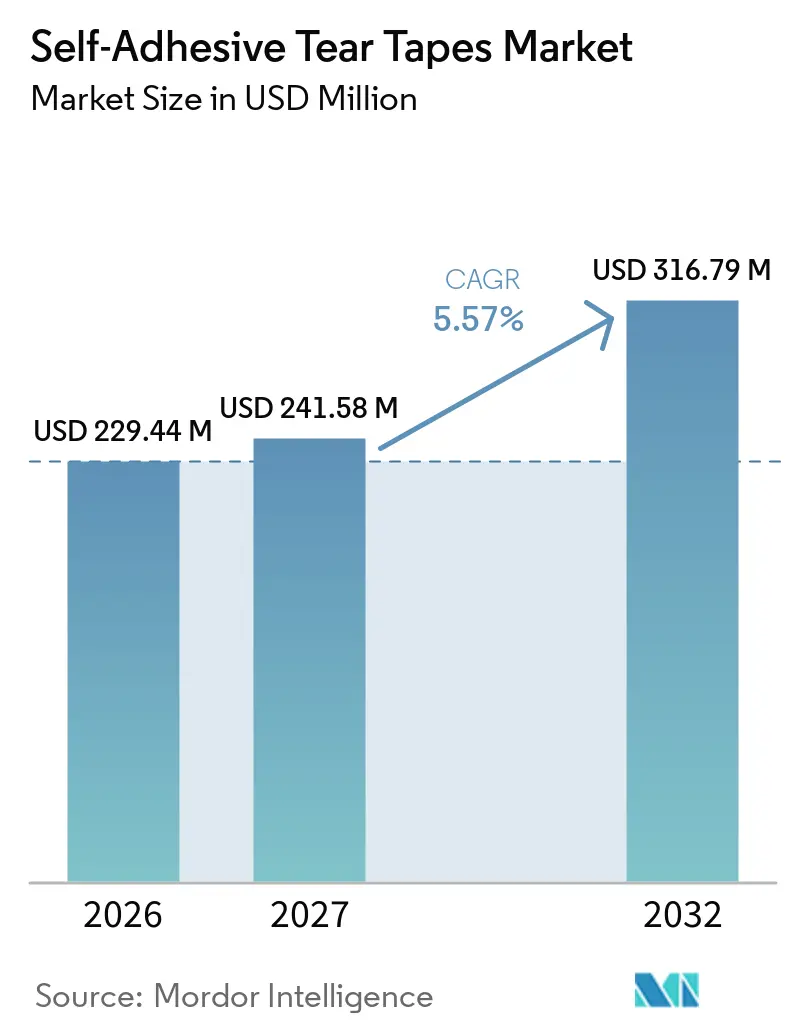
The self-adhesive tear tapes market size was valued at USD 229.44 million in 2026 and is estimated to grow from USD 241.58 million in 2027 to USD 316.79 million by 2032, at a CAGR of 5.57% during the forecast period (2027-2032). The self-adhesive tear tapes market is driven by demand for easy-open and tamper-evident packaging across consumer goods, pharmaceuticals, and retail shipments. Suppliers are moving beyond plain opening strips by offering security printing, holographic elements, VOID adhesives, and authentication features, increasing the role of tear tapes in packaging performance and brand protection. Paper-based constructions and recycled-content products are gaining attention as packaging buyers respond to recyclability requirements. The self-adhesive tear tapes market reflects steady packaging demand alongside a shift toward higher-value product specifications.
Key Report Takeaways
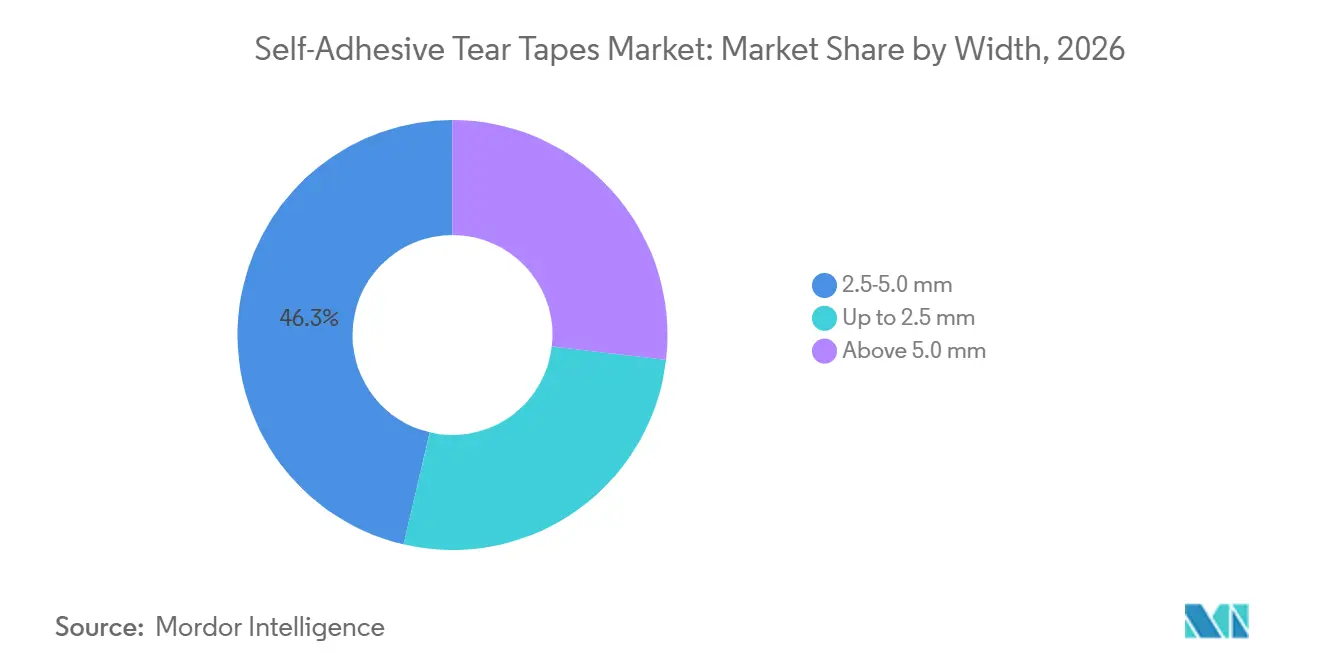
- By width, 2.5-5.0 mm accounted for 46.34% of the self-adhesive tear tape market share in 2026, while widths above 5.0 mm are projected to grow at a CAGR of 5.94% through 2032.
- By material type, polypropylene accounted for 54.12% market share in 2026, while paper-based tapes are projected to grow at a CAGR of 6.18% through 2032.
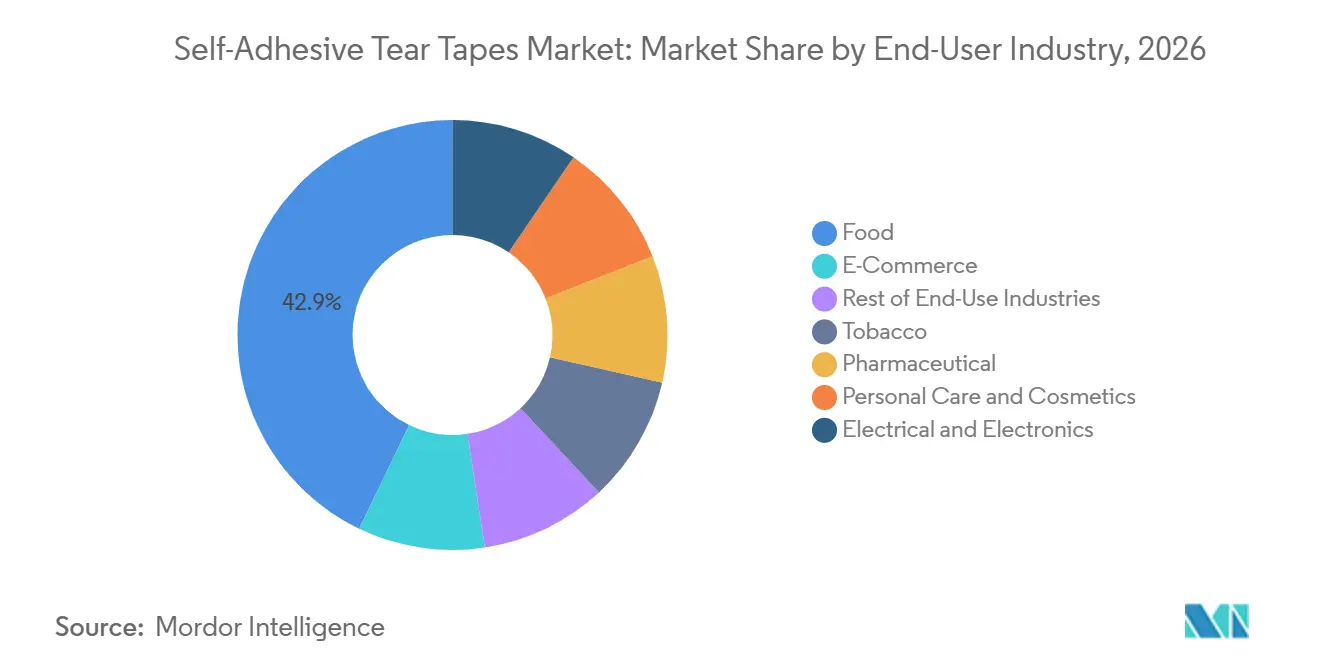
- By end-user industry, food held 42.86% market share in 2026, while pharmaceuticals are forecast to expand at a CAGR of 6.51% through 2032.
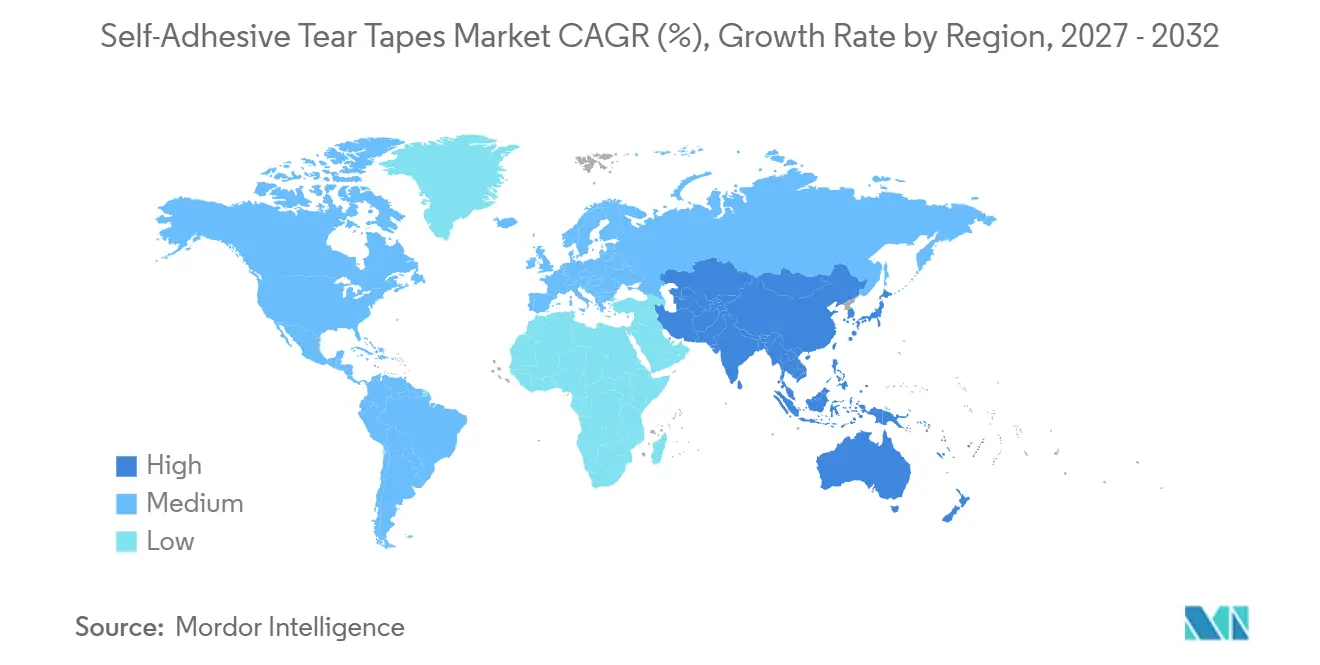
- By geography, Asia-Pacific accounted for 40.47% market share in 2026 and is expected to grow at a CAGR of 6.35% through 2032.
Note: Market numbers in this report are based on Mordor Intelligence's proprietary estimation framework, which combines nine months of actuals with Q4 projections for base year 2026.
Market Trends and Insights
Drivers Impact Analysis of Self-Adhesive Tear Tapes Market*
| Drivers | (~) % Impact on CAGR Forecast | Geographic Relevance | Impact Timeline |
|---|---|---|---|
| Convenient and Tamper-Evident Packaging | +1.2% | Global, strongest in North America and the EU | Medium term (2-4 years) |
| E-Commerce Parcel and Mailer Growth | +1.4% | Global, particularly Asia-Pacific and North America | Short term (≤ 2 years) |
| Recyclable and Paper-Based Packaging | +1.1% | EU core, with spillover to North America and Asia-Pacific | Medium term (2-4 years) |
| Automation-Compatible High-Speed Packaging Lines | +0.9% | Global, strongest in Asia-Pacific and Europe | Long term (≥ 4 years) |
| Brand Authentication and Premium Unboxing | +0.7% | North America and the EU, plus premium Asia-Pacific segments | Short term (≤ 2 years) |
| Source: Mordor Intelligence | |||
Demand for Convenient and Tamper-Evident Packaging
The self-adhesive tear tapes market benefits from packaging regulations that require visible evidence of opening. The EU Falsified Medicines Directive requires an anti-tampering device on the outer packaging of prescription medicines in Europe. The US Drug Supply Chain Security Act reinforces the need for secure and traceable pharmaceutical packaging systems. These requirements give converters a reason to use tapes with VOID adhesives, serialized QR codes, Near Field Communication (NFC) authentication, or security printing, particularly when pack components must protect the product throughout distribution and provide a simple way to detect tampering. Such specifications raise the value of a tape compared with a plain food-packaging strip, as the tape contributes to compliance, authentication, and the consumer's ability to determine whether a package has been opened. Pharmaceutical packaging demand supports the self-adhesive tear tapes market because opening performance and evidence of tampering must work together across multiple pack designs and sales regions.
E-Commerce Parcel and Mailer Growth
The self-adhesive tear tapes market is supported by parcel formats that require clean opening without the need for a separate cutting tool. Tear tapes can improve the opening experience in sealed corrugated mailers where package strength matters during storage, transport, delivery, and return handling. Automated fulfillment operations also require materials that run consistently on packaging equipment, and tapes must maintain a secure seal without causing interruptions as order quantities move through fast packing lines. This requirement makes line performance more important than tape price alone, since a tape that jams or opens poorly can disrupt fulfillment activity and undermine the customer experience. Printed tear strips can add a branded element to direct-to-consumer shipments and make the opening point easier to identify. The self-adhesive tear tapes market benefits when packaging teams choose corrugated mailers that combine secure transit performance, a simple opening method, and an opening strip that supports brand presentation.
Shift Toward Recyclable and Paper-Based Packaging
The self-adhesive tear tapes market is being shaped by the EU Packaging and Packaging Waste Regulation. Regulation 2025/40 entered into force on February 11, 2025, and applies from August 12, 2026. The regulation sets a direction toward recyclable packaging and minimum recycled content requirements for plastic packaging from 2030, giving packaging buyers a clearer reason to assess the tape within the recycling path of the whole pack. For a tear tape placed within cartonboard or corrugated packaging, compatibility with the host material's recycling route is an important product requirement rather than a secondary material preference. Paper-based tapes with repulpability and recyclability validation provide packaging buyers with documentation to support material selection, internal approval processes, and discussions with converter customers. Once a converter has qualified a tape for recycling performance, changing the construction can require further testing, re-certification, and approval, which can make a validated paper solution more durable in the specification.
Automation-Compatible High-Speed Packaging Lines
The self-adhesive tear tapes market is supported by packaging lines that require uninterrupted tape application. Large tape rolls, including formats designed for extended running lengths, help reduce changeovers where manual application is unsuitable and continuous output is important. Manufacturers are responding with products designed for fast equipment settings and secure seals, as the tape must be applied correctly at the line speed used by a packaging converter or fulfillment operation. H.B. Fuller introduced Close Sesame double-sided tape in April 2025 for secure packaging and compatibility with high-speed lines[1]. Packaging buyers seek documented performance data for specific equipment conditions rather than selecting tape based solely on the quoted cost per roll. This gives an advantage to suppliers that can demonstrate consistent runnability, sealing performance, and practical use in the equipment settings their customers operate.
Restraints Impact Analysis of Self-Adhesive Tear Tapes Market*
| Restraints | (~) % Impact on CAGR Forecast | Geographic Relevance | Impact Timeline |
|---|---|---|---|
| Adhesive Performance Variability Across Substrates and Climates | -0.4% | Global, most acute in South America, the Middle East, and Africa | Medium term (2-4 years) |
| Volatility in Polypropylene and Specialty Adhesive Costs | -0.3% | Global, sharpest in North America and Asia-Pacific | Short term (≤ 2 years) |
| Competition From Perforations, Tear-Open Pouches, and Alternative Seals | -0.3% | Global, particularly Asia-Pacific and Europe | Medium term (2-4 years) |
| Source: Mordor Intelligence | |||
Adhesive Performance Variability Across Substrates and Climates
The self-adhesive tear tapes market faces technical limitations when a single specification must perform across multiple packaging surfaces. Tape may be applied on polypropylene overwrap, coated cartonboard, and treated corrugated board, and each surface can affect how the adhesive bonds and releases during opening. Temperature and humidity can affect bond strength during storage and distribution, particularly when the same pack moves through different climates before reaching the end user. Cold-chain pharmaceutical products may require reliable performance at -2°C to 8°C, while humid transport routes may impose different stresses on the carrier and adhesive. A 2025 study in Resources, Conservation and Recycling identified performance trade-offs between paper and film tape carriers under varying environmental conditions[2]. Product qualification remains necessary because no adhesive-carrier combination is equally suitable for every substrate, climate, distribution route, and intended opening experience.
Volatility in Polypropylene and Specialty Adhesive Costs
Polypropylene is the dominant material in the self-adhesive tear tape market, making it a key cost variable. Film and adhesive costs can compress converter margins when selling prices cannot adjust at the same pace, particularly in supply arrangements where tape prices are set before input costs are known. Specialty grades use hot-melt, acrylic, or solvent-borne adhesive systems that have their own supply and cost conditions, which can differ from changes in film costs. Smaller producers may be more exposed due to limited purchasing power and fewer long-term supply arrangements compared to larger companies with broader sourcing options. This dynamic can favor larger suppliers and may lead customers to prefer suppliers that offer stable specifications and continuity of supply. Cost uncertainty also makes it harder for smaller converters to invest in premium security and sustainable tape constructions, even as customer interest in those products grows.
*Our forecasts treat driver/restraint impacts as directional, not additive. The impact forecasts reflect baseline growth, mix effects, and variable interactions.
Self-Adhesive Tear Tapes Market Segment Analysis
By Width:
Mid-Range Widths Dominate While Wider Formats Gain ShareThe 2.5-5.0 mm category accounted for 46.34% of the self-adhesive tear tapes market in 2026, reflecting its compatibility with established automated overwrap applications in cigarette packs, biscuit cartons, food trays, and corrugated mailers. Many FMCG lines are already configured for these widths, and moving outside this range may require equipment changes that buyers tend to avoid when existing settings still meet production needs. Polypropylene, PET, and paper-based tapes are commercially available in this range, giving converters material flexibility without requiring changes to applicators. This category benefits from installed equipment and a wide range of proven tape constructions, and its position is supported by standardized packaging formats that require reliable opening performance.
The above-5.0 mm category is projected to grow at a CAGR of 5.94% through 2032, as premium corrugated packaging for appliances, electronics, and business-to-business logistics requires wider strips to distribute opening force across heavier board grades. Wider tapes also support controlled opening on secondary packaging where the pack must remain secure during transport but be easy to open at delivery. The up-to-2.5 mm category serves pharmaceutical blister cartons and luxury goods packaging where a limited visual footprint is important. Australian tobacco packaging requirements, effective from July 2025, specify that tear strips on cigarette pack wrappers be no wider than 3 mm. This requirement clearly defines the use case for precision narrow-width tape and provides suppliers with a specific application in which dimensional control, consistent placement, and compliance with stated pack requirements are essential.

By Material Type:
Polypropylene Leads, While Paper Changes Product SelectionPolypropylene accounted for 54.12% of the self-adhesive tear tapes market in 2026, supported by long-established processing infrastructure, cost competitiveness, and reliable adhesion on coated packaging surfaces. Polyethylene serves flexible and soft-film packaging, while PET provides optical clarity and thermal stability for pharmaceutical secondary packs and premium food cartons. PVC faces increasing pressure from European packaging regulations and broader PVC-restriction frameworks, which affect the relative appeal of other carrier materials. Material selection is moving beyond a simple price-and-performance comparison, as customers place greater weight on recyclability and documented sustainability attributes. This makes the material decision more consequential for converters serving multiple pack formats and regulatory markets, since a carrier selected for one product must still meet the customer's equipment, presentation, recycling, and tamper-evidence requirements.
Paper-based tapes are forecast to grow at a CAGR of 6.18% through 2032, supported by recyclable packaging requirements and buyer interest in Forest Stewardship Council (FSC) certification and evidence of repulpability. In January 2025, Tesa introduced a solvent-free paper-based tesaFilm product that the company stated was repulpable under the INGEDE 12 method. Tesa also introduced packaging tapes with 55% and 60% total recycled content, made from separately recycled PET products. These launches indicate that paper-based, biobased, and recycled-content constructions are moving from development into commercial packaging portfolios. The self-adhesive tear tapes industry is responding to requests for performance evidence to support recycling and recycled-content objectives, while converters assess whether the chosen tape can meet established equipment conditions and the intended pack recycling route.
By End-User Industry:
Pharmaceuticals Record Fastest Growth, While Food Supports Overall OutputFood accounted for 42.86% of the self-adhesive tear tapes market in 2026, driven by widespread use in ready-to-eat products, confectionery overwraps, snack cartons, and other packaged food formats. These applications require a convenient opening method suited for mobile, immediate consumption, and food packaging offers a broad range of repeat-use formats for tape converters. The category remains relevant even as other end uses adopt more advanced security features, as its scale supports stable tape output. Food buyers are also considering paper-compatible tapes as recyclable packaging requirements become more relevant to pack design. This combination of high use frequency and changing material requirements keeps food central to demand, with suppliers needing to meet established packaging output needs while responding to growing customer interest in recyclability and convenient opening.
Pharmaceuticals are projected to grow at a CAGR of 6.51% through 2032 as product manufacturers respond to stronger requirements for tamper-evidence and packaging authentication. VOID adhesives, security printing, and Near Field Communication (NFC) features can help suppliers address these needs, particularly when a package must provide both visible evidence of opening and product identification. A 2025 review in AAPS PharmSciTech described the broad set of frameworks relevant to pharmaceutical packaging, including FDA 21 CFR 211.132 and ISO 10993. Tobacco remains a meaningful application because plain-packaging rules standardize tear-strip requirements rather than remove the need for tear strips, while personal care and cosmetics support higher-value printed and holographic tape options. The electrical and electronics sectors use tapes mainly on secondary cartons, and e-commerce demand follows product movement through retail shipments, broadening the self-adhesive tear tapes market beyond its established food, tobacco, and pharmaceutical applications.
Geography Analysis
APAC Self-Adhesive Tear Tapes Market
Asia-Pacific accounted for 40.47% of the self-adhesive tear tapes market share in 2026 and is forecast to grow at a CAGR of 6.35% through 2032, supported by large food, consumer goods, pharmaceutical, and packaging manufacturing bases. India supports demand through food packaging and pharmaceutical manufacturing, and its 2025 approval of recycled plastic for food-grade applications generated interest in new material options. The self-adhesive tear tapes market in Asia-Pacific also benefits from suppliers placing technical support and manufacturing operations close to converters. Tesa opened a Customer Solution Center in Chennai in September 2025, its first center in India and fourth in Asia-Pacific, to provide adhesive evaluation, teardown studies, and co-development support for packaging customers. The region combines demand scale with a growing need for local technical support.
The Americas, Europe and APAC Self-Adhesive Tear Tapes Market
North America has mature fulfillment systems and pharmaceutical compliance requirements that support higher tape specifications. Europe is adjusting to Packaging and Packaging Waste Regulation (PPWR) requirements ahead of the regulation's August 2026 application date, driving demand for tapes compatible with recyclable cartonboard and corrugated structures. Nordic markets are early adopters of Forest Stewardship Council (FSC)-certified and repulpability-validated paper tape specifications, serving as a reference point for other European converters. South America is developing from a lower base, with Brazil supporting demand through food and personal care packaging. Bagla Group opened a manufacturing facility in Altamira, Mexico, in August 2026, adding to its production presence across India, Indonesia, Paraguay, and Mexico.
The Americas and MEA Self-Adhesive Tear Tapes Market
The Altamira facility supports supply to customers in Latin America and North America. The Middle East and Africa remain the smallest region in absolute terms, with Saudi Arabia serving as a focal point for pharmaceutical and tobacco packaging. South Africa supports demand in personal care and pharmaceutical applications through its organized retail sector. The broader African opportunity depends on the continued development of organized retail and packaging infrastructure. Tobacco packaging continues to require consistent tear-strip output in applications where pack specifications remain standardized.
Competitive Landscape
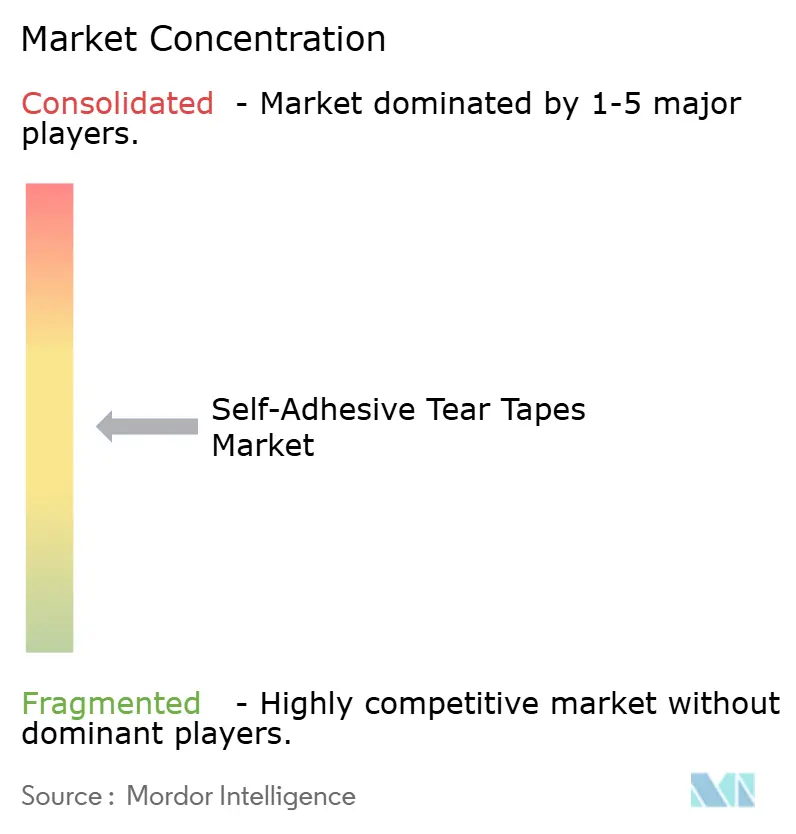
The self-adhesive tear tapes market is moderately fragmented. Competition centers on equipment runnability, material sustainability credentials, and security capabilities such as VOID adhesives, holographic foils, and NFC integration. Suppliers with demonstrated compliance with INGEDE, FSC, and recyclability requirements are better positioned for specification-led projects. Standard tape formats remain price-sensitive due to the broad presence of regional manufacturers, creating a clear distinction between premium applications and high-volume commodity supply.
Tesa's product development reflects a focus on material and technology differentiation. In January 2025, the company launched a paper-based adhesive tape described as solvent-free and repulpable in accordance with INGEDE 12 testing. Tesa also received the 2025 MMK Award of Excellence in Sustainable Engineering for its Debonding on Demand technology. H.B. Fuller's April 2025 Close Sesame launch emphasized secure sealing and compatibility with high-speed packaging lines. These developments illustrate competition based on tape performance, sustainability, and packaging-line requirements.
Geographic expansion enables suppliers to reduce delivery times and strengthen local customer support. Bagla Group's Altamira facility demonstrates this approach in the Americas, while its broader production footprint spans India, Indonesia, Paraguay, and Mexico. An opportunity exists for paper-carrier tapes that combine repulpability validation with pharmaceutical-grade authentication features, addressing both recycling compatibility and product security needs. The market favors suppliers that can balance proven running performance with material and security requirements.
Self-Adhesive Tear Tapes Industry Leaders
-
H.B. Fuller Company
-
tesa SE
-
Bagla Group
-
3M
-
Supertape
- *Disclaimer: Major Players sorted in no particular order
Self-Adhesive Tear Tapes Market Companies Covered in this Report
- 3M
- Advance Tapes International
- Bagla Group
- DS Smith
- Duraco Inc.
- Essentra plc
- H.B. Fuller Company
- Marotech Inc.
- NADCO Tapes & Labels, Inc.
- NOWOFOL Kunststoffprodukte GmbH & Co. KG
- Supertape
- Suzhou Image Technology
- Tamper Technologies Ltd.
- TANN GROUP
- tesa SE
Recent Industry Developments in Self-Adhesive Tear Tapes Market
- August 2026: Bagla Group inaugurated a new tape manufacturing facility in Altamira, Mexico, expanding its production footprint to 8 facilities across India, Indonesia, Paraguay, and Mexico. This move reinforces its supply strategy for tear tape customers in Latin America and North America.
- September 2025: Tesa SE opened a Customer Solution Center (CSC) in Chennai, India, its first in India and fourth in Asia-Pacific. The center provides adhesive tape evaluation, teardown studies, and co-development support for automotive, electronics, and packaging customers, as part of its "Local for Local" expansion strategy.
Global Self-Adhesive Tear Tapes Market Report Scope
Self-adhesive tear tapes are pressure-sensitive, narrow-opening strips applied to the inside of packaging (such as cigarette boxes, FMCG cartons, and e-commerce boxes) to allow clean, tool-free access without damaging the contents.
The self-adhesive tear tapes market is segmented by width, material type, end-user industry, and geography. By width, the market is segmented into up to 2.5 mm, 2.5-5.0 mm, and above 5.0 mm. By material type, the market is segmented into polypropylene, polyethylene, polyvinyl chloride (PVC), polyethylene terephthalate (PET), paper-based, and the rest of material types. By end-user industry, the market is segmented into food, tobacco, pharmaceutical, personal care and cosmetics, electrical and electronics, e-commerce, and the rest of the end-use industries. The report also covers market sizes and forecasts for self-adhesive tear tapes across 15 countries in major regions. The market sizes and forecasts are provided in terms of value (USD).
Segmentation Overview
| Up to 2.5 mm |
| 2.5-5.0 mm |
| Above 5.0 mm |
| Polypropylene |
| Polyethylene |
| Polyvinyl Chloride (PVC) |
| Polyethylene Terephthalate (PET) |
| Paper-Based |
| Rest of Material Types |
| Food |
| Tobacco |
| Pharmaceutical |
| Personal Care and Cosmetics |
| Electrical and Electronics |
| E-Commerce |
| Rest of End-Use Industries |
| Asia-Pacific | China |
| India | |
| Japan | |
| South Korea | |
| ASEAN Countries | |
| Rest of Asia-Pacific | |
| North America | United States |
| Canada | |
| Mexico | |
| Europe | Germany |
| United Kingdom | |
| France | |
| Italy | |
| NORDIC Countries | |
| Rest of Europe | |
| South America | Brazil |
| Argentina | |
| Rest of South America | |
| Middle East and Africa | Saudi Arabia |
| South Africa | |
| Rest of Middle East and Africa |
| By Width | Up to 2.5 mm | |
| 2.5-5.0 mm | ||
| Above 5.0 mm | ||
| By Material Type | Polypropylene | |
| Polyethylene | ||
| Polyvinyl Chloride (PVC) | ||
| Polyethylene Terephthalate (PET) | ||
| Paper-Based | ||
| Rest of Material Types | ||
| By End-User Industry | Food | |
| Tobacco | ||
| Pharmaceutical | ||
| Personal Care and Cosmetics | ||
| Electrical and Electronics | ||
| E-Commerce | ||
| Rest of End-Use Industries | ||
| By Geography | Asia-Pacific | China |
| India | ||
| Japan | ||
| South Korea | ||
| ASEAN Countries | ||
| Rest of Asia-Pacific | ||
| North America | United States | |
| Canada | ||
| Mexico | ||
| Europe | Germany | |
| United Kingdom | ||
| France | ||
| Italy | ||
| NORDIC Countries | ||
| Rest of Europe | ||
| South America | Brazil | |
| Argentina | ||
| Rest of South America | ||
| Middle East and Africa | Saudi Arabia | |
| South Africa | ||
| Rest of Middle East and Africa | ||
Key Questions Answered in the Report
What is current market size of Self-Adhesive Tear Tapes Market?
The self-adhesive tear tapes market size was valued at USD 229.44 million in 2026 and is estimated to grow from USD 241.58 million in 2027 to USD 316.79 million by 2032, at a CAGR of 5.57% during the forecast period (2027-2032).
Which material is growing fastest?
Paper-based tapes are forecast to grow at a CAGR of 6.18% from 2027 to 2032. Recyclability requirements, evidence of repulpability, and packaging buyers’ interest in sustainable material choices support their inclusion in new converter specifications.
Which end-user application is growing fastest?
Pharmaceutical applications are forecast to expand at a CAGR of 6.51% through 2032. The segment requires tamper-evident and authentication features, including VOID adhesives, security printing, and Near Field Communication (NFC)-based identification.
Which region leads demand and growth?
Asia-Pacific held a 40.47% share in 2026 and is forecast to grow at a CAGR of 6.35% through 2032. Its regional position reflects the scale of food, consumer goods, pharmaceutical, and packaging manufacturing activity.