
Security Questionnaire Automation Market Size and Share
Market Overview
| Study Period | 2020 - 2031 |
|---|---|
| Market Size (2026) | USD 0.42 Billion |
| Market Size (2031) | USD 1.20 Billion |
| Growth Rate (2026 - 2031) | 23.30 % |
| Fastest Growing Market | Asia-Pacific |
| Largest Market | North America |
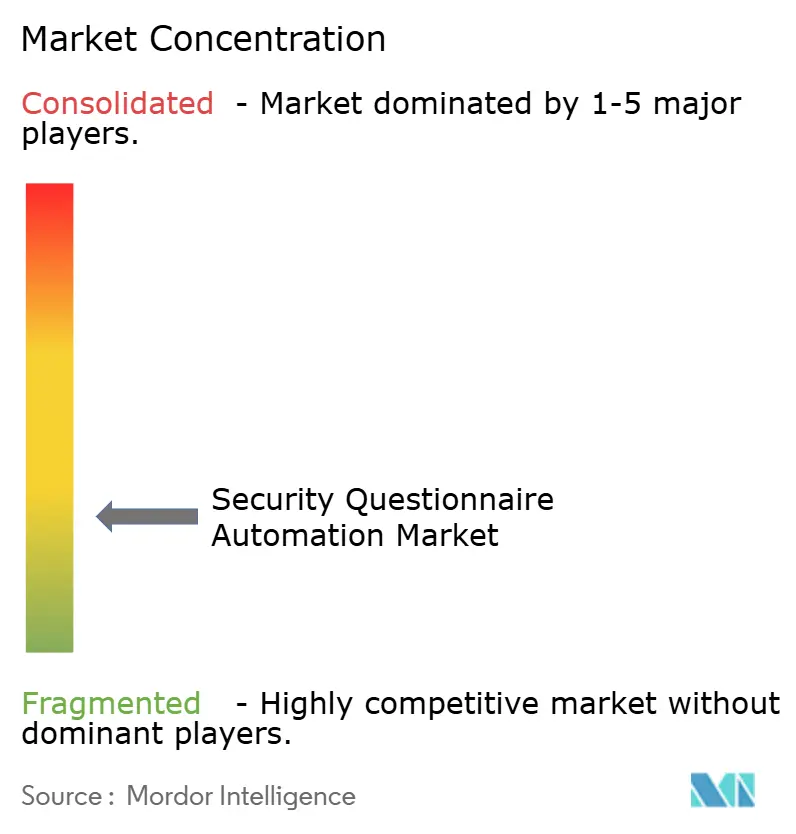
| Market Concentration | Low |
Major Players *Disclaimer: Major Players sorted in no particular order Image © Mordor Intelligence. Reuse requires attribution under CC BY 4.0. | |
Security Questionnaire Automation Market Analysis by Mordor Intelligence
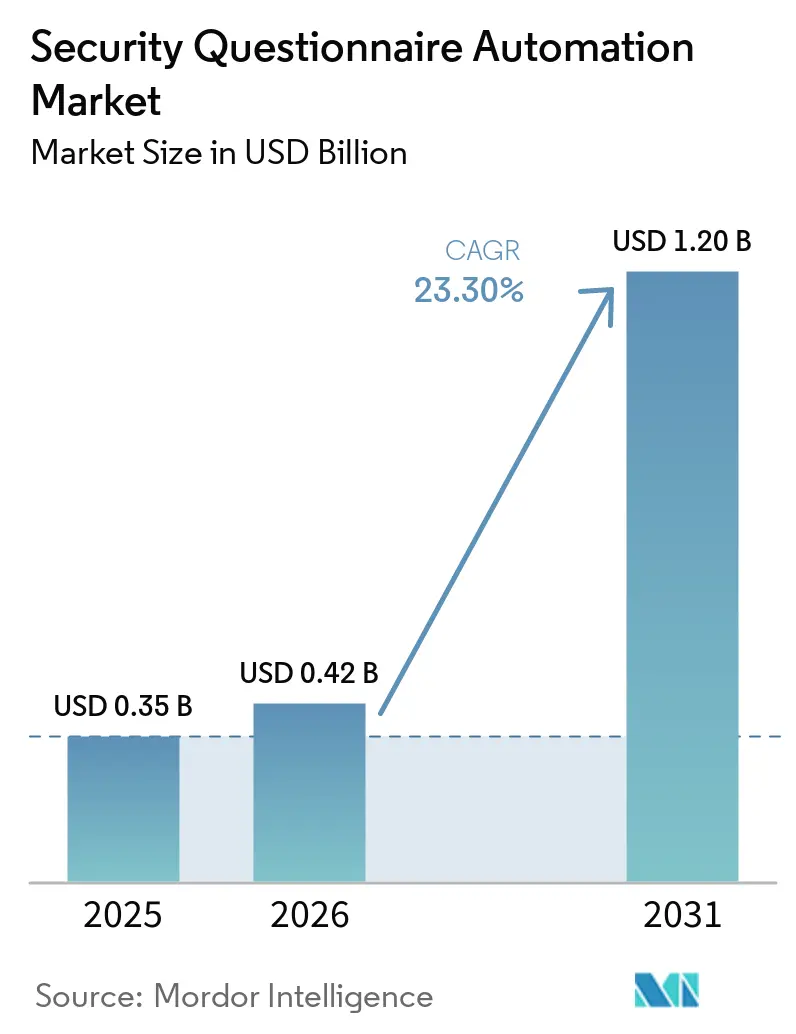
The Security questionnaire automation market size was valued at USD 0.35 billion in 2025 and estimated to grow from USD 0.42 billion in 2026 to reach USD 1.20 billion by 2031, at a CAGR of 23.30% during the forecast period (2026-2031). Regulatory requirements are making vendor reviews a documented compliance task, particularly where financial services firms must assess information and communications technology providers. Growth in cloud and SaaS use is increasing the number of vendors requiring review, adding to the workload for security teams. Production use of large language model tools is also making automated responses more practical when they are supported by verified evidence and approval records. The Security questionnaire automation market is therefore moving beyond a simple response library toward tools that maintain current evidence, route reviews, and support recurring assurance work. Providers that can support traceable responses, secure integrations, and buyer-facing trust centers are likely to be better placed with regulated customers, particularly when evidence must be refreshed across multiple departments.
Key Report Takeaways
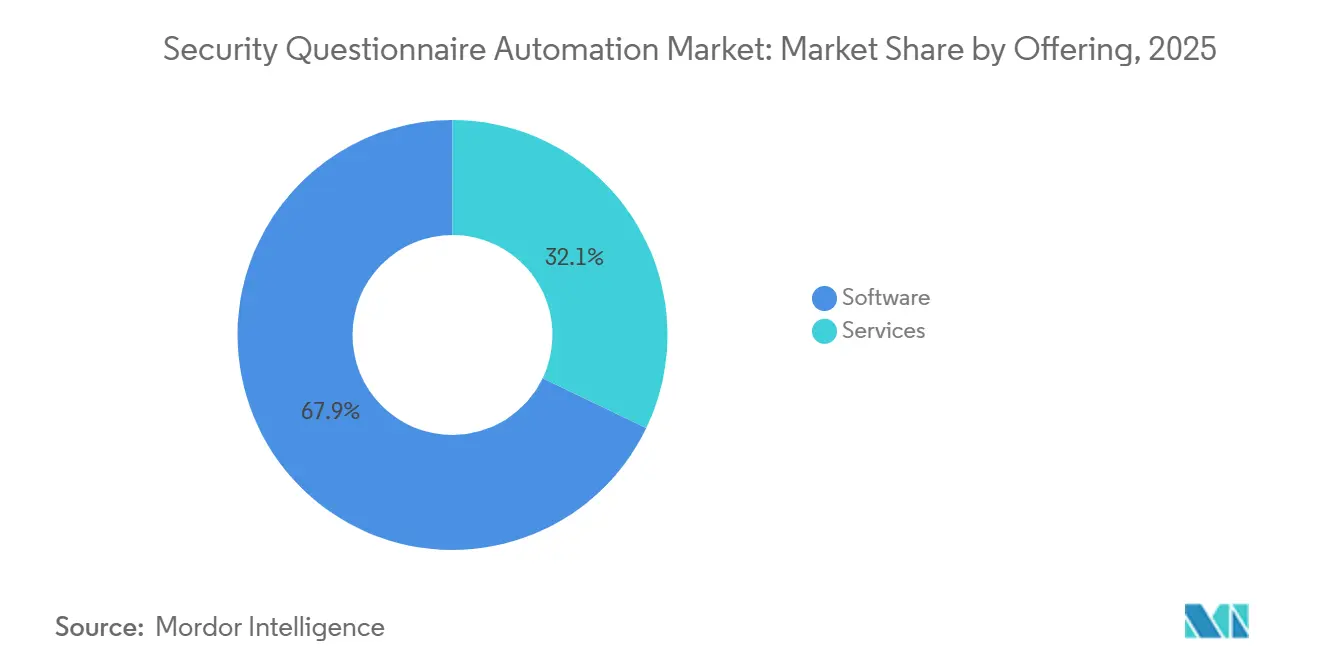
- By offering, software held 67.88% of the Security questionnaire automation market share in 2025, while services are projected to expand at a CAGR of 24.75% through 2031.
- By deployment mode, cloud accounted for 68.15% of the Security questionnaire automation market share in 2025 and is projected to grow at a CAGR of 24.38% through 2031.
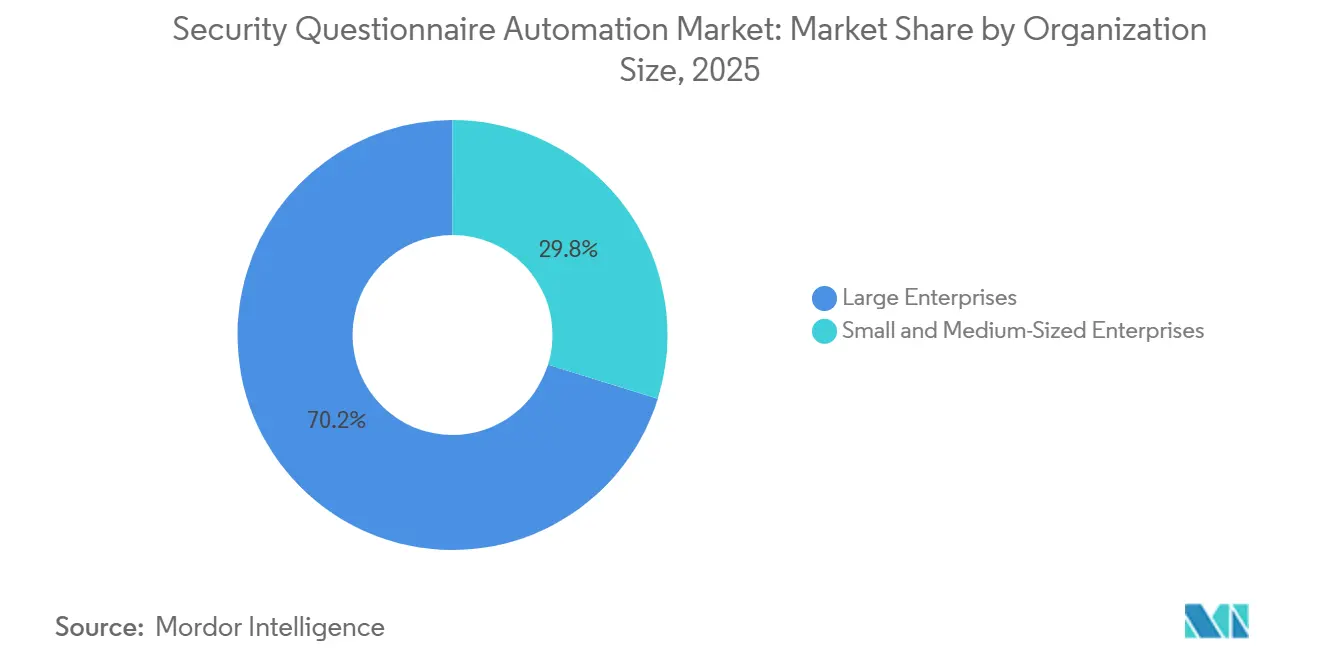
- By organization size, large enterprises held 70.21% of the Security questionnaire automation market revenue in 2025, while SMEs are projected to expand at a CAGR of 25.09% through 2031.
- By end-user industry, BFSI accounted for 31.29% of the Security questionnaire automation market revenue in 2025, while healthcare and life sciences are projected to expand at a CAGR of 23.72% through 2031.
- By geography, North America held 38.44% of revenue in 2025, while Asia-Pacific is projected to expand at a CAGR of 24.10% through 2031.
Note: Market size and forecast figures in this report are generated using Mordor Intelligence’s proprietary estimation framework, updated with the latest available data and insights as of January 2026.
Global Security Questionnaire Automation Market Trends and Insights
Drivers Impact Analysis*
| Driver | (~) % Impact on CAGR Forecast | Geographic Relevance | Impact Timeline |
|---|---|---|---|
| Rising Third-Party Cybersecurity and Privacy Obligations | +5.2% | Global, concentrated in North America and Europe | Short term (≤ 2 years) |
| Expansion of Cloud and SaaS Vendor Ecosystems | +4.8% | Global, with spill-over to Asia-Pacific and Middle East | Medium term (2-4 years) |
| Shift From Periodic Reviews to Continuous Vendor Assurance | +3.5% | North America and Europe, early adoption in Asia-Pacific | Medium term (2-4 years) |
| Increasing Volume and Complexity of Security Questionnaires | +3.2% | Global | Short term (≤ 2 years) |
| Growing Demand for Faster and More Consistent Questionnaire Responses | +2.1% | North America and Europe | Short term (≤ 2 years) |
| Questionnaire Deflection Through Buyer-Facing Trust Centers | +1.4% | North America, with early gains in Europe | Medium term (2-4 years) |
| Source: Mordor Intelligence | |||
Rising Third-Party Cybersecurity and Privacy Obligations
The Security questionnaire automation market benefits from rules requiring organizations to document how they assess third parties. The Digital Operational Resilience Act has applied directly to European Union financial entities since January 2025 and requires documented oversight of information and communications technology third parties. The European Banking Authority published final guidance in September 2026 that also covers non-information and communications technology third-party services, widening the set of vendor relationships that banks must assess. In the United States, federal banking agencies proposed guidance in 2026 that moved expectations away from basic checklist reviews and toward more complete third-party risk management. These requirements add framework-specific questions on contracts, security safeguards, data handling, and audit rights. Platforms with evidence links can reduce repeated manual work while helping teams show how an answer was supported.
Expansion of Cloud and SaaS Vendor Ecosystems
The expanding cloud software base is increasing the volume of vendor assessments that organizations must complete. As companies add applications, security and procurement teams must review more providers and more sub-processors before approving a purchase. This pressure is strongest where applications process customer data or support critical operations. The Security questionnaire automation market can address this workload by reusing approved evidence across requests while keeping ownership with the teams responsible for the control. Cloud delivery also makes it easier to connect a response workflow with procurement, customer relationship management, and governance tools. The commercial case becomes stronger when the same platform can support incoming buyer questionnaires and outgoing assessments of the organization's own vendors.
Shift From Periodic Reviews to Continuous Vendor Assurance
The Security questionnaire automation market is also supported by a shift from periodic review cycles to more continuous vendor assurance. A 2026 industry report found that 38% of organizations operated with a standardized, continuous approach to third-party risk management, while 46% still relied on periodic assessments or annual audits. FINRA listed vendor risk management as an examination priority in its 2026 regulatory oversight report. Its January 2025 request for updated third-party engagement information also reinforced the need for firms to maintain current records. Continuous assurance requires a knowledge base capable of identifying stale evidence and requesting renewed validation. This favors providers that link answers to underlying controls rather than generating stand-alone text.
Increasing Volume and Complexity of Security Questionnaires
Security questionnaires now cover a wider mix of topics, including artificial intelligence governance, environmental and social clauses, and data residency requirements. Drata reported in June 2026 that questions about artificial intelligence governance increased by 30% over 9 months across 2.1 million processed questions. The same disclosure stated that 89% of vendors left these questions unanswered. Japan's Financial Services Agency reported in April 2026 that financial institutions face duplicate work because firms use their own questionnaire formats rather than common ones.[1] That duplication increases the value of structured content, approved answer libraries, and format-specific response tools. It also allows the Security questionnaire automation market to reduce avoidable work without weakening the review process.
Restraints Impact Analysis*
| Restraint | (~) % Impact on CAGR Forecast | Geographic Relevance | Impact Timeline |
|---|---|---|---|
| Integration Complexity and Total Cost of Ownership | -2.8% | Global | Medium term (2-4 years) |
| Privacy and Cross-Border Evidence-Sharing Constraints | -1.9% | Europe, Asia-Pacific, and North America | Long term (≥ 4 years) |
| Hallucination, Provenance, and Liability Risk in AI-Generated Answers | -1.5% | Global | Medium term (2-4 years) |
| Fragmented Ownership of Security, Privacy, Legal, and Sales Content | -1.2% | Global | Short term (≤ 2 years) |
| Source: Mordor Intelligence | |||
Integration Complexity and Total Cost of Ownership
Integration complexity can slow adoption in the Security questionnaire automation market, especially for large organizations with separate governance, customer relationship management, collaboration, and identity systems. Buyers often operate a patchwork of tools rather than a unified third-party risk management environment. The cost also includes content cleanup, knowledge-base maintenance, model configuration, and human review of generated responses. These costs can be difficult for buyers to assess during the initial procurement process. Mid-sized firms may have the greatest need to reduce manual work but may have fewer technical resources to deploy. Providers that offer prebuilt connectors and managed onboarding can reduce this barrier and shorten the path to active use.
Hallucination, Provenance, and Liability Risk in AI-Generated Answers
An inaccurate response can create compliance and contract risks when submitted to a regulated customer. The Cloud Security Alliance stated in June 2026 that the European Union Product Liability Directive extends strict liability to artificial intelligence software and requires implementation by December 2026. The directive also creates an evidentiary presumption in cases where technical complexity makes it difficult for a claimant to prove a defect. Buyers in BFSI and healthcare are therefore seeking outputs that cite source documents and show the approval history. These requirements can extend sales cycles, but they also distinguish systems that use verified customer evidence from general-purpose text generation. Strong provenance controls can help providers address the concern without removing the productivity benefit of automation.
*Our forecasts treat driver/restraint impacts as directional, not additive. The impact forecasts reflect baseline growth, mix effects, and variable interactions.
Segment Analysis
By Offering: Software Leads While Services Expand With Implementation Needs
Software captured 67.88% of the Security questionnaire automation market size in 2025. This position reflects the demand for response engines that combine structured knowledge bases, trust-center publishing, questionnaire intake, and evidence reuse into a single workflow. Each completed response can strengthen the library that supports later requests, provided that content owners keep it current, approved, and linked to the relevant control. Software platforms can also provide security, legal, privacy, and sales teams with a single controlled workflow instead of separate spreadsheets and email handoffs. The result is more consistent language across customer reviews and a clearer record of who approved each response.
Services are projected to grow at a CAGR of 24.75% from 2026 to 2031. Implementation, integration, managed response, and advisory work are important in the Security questionnaire automation market, where a buyer lacks the people or processes to operate a platform at scale. Managed response services can help organizations that receive a high volume of questionnaires but lack a dedicated program team or an established response process. Advisory services also support the shift from informal cross-functional handoffs to defined owners, service-level commitments, approval routes, and a practical process for keeping evidence up to date. Large organizations often need additional implementation effort because legacy systems increase the complexity of linking governance, customer, and collaboration environments.
By Deployment Mode: Cloud Supports Current Scale and Continuing Adoption
Cloud accounted for 68.15% of the Security questionnaire automation market size in 2025. Its lead reflects the need for frequent knowledge-base updates, application programming interface connections, online trust-center publishing, and access for teams operating across locations. Cloud tools can also support questionnaires submitted through buyer portals, where an analyst might otherwise need to manually copy information into a separate form. That capability matters because file-upload workflows alone cannot address many portal-based assessments. Centralized cloud delivery also helps distributed teams access the same approved content and approval history.
Cloud is projected to grow at a CAGR of 24.38% from 2026 to 2031, retaining the strongest position among deployment modes in the Security questionnaire automation market. Organizations continue to prefer systems that can integrate with governance, customer relationship management, and collaboration tools without requiring them to maintain their own hosting environment. On-premises deployment remains relevant for government, defense, critical infrastructure, and sovereign artificial intelligence settings with strict data residency requirements. These buyers may prioritize direct control of where evidence is stored and processed, including material used to support supplier and customer reviews. Their needs keep an on-premises option relevant even as cloud security practices improve and more customers move their workflow online.
By Organization Size: Large Enterprises Lead While SMEs Gain Momentum
Large enterprises held 70.21% of revenue in 2025. Major technology vendors and financial services providers can receive hundreds of questionnaires each quarter, making manual completion a material operating burden. Larger firms also need to coordinate a wider group of product, security, legal, and sales stakeholders. Automation allows them to route questions to the right content owner while applying consistent evidence and approval standards. These characteristics make the investment easier to justify when questionnaire volume is high.
SMEs are projected to grow at a CAGR of 25.09% from 2026 to 2031. Larger customers are applying stricter vendor qualification requirements to smaller suppliers, which increases the need for those suppliers to respond promptly and consistently. Cloud-native platforms and usage-based pricing can lower the initial cost for smaller organizations while allowing them to build their response process over time. Regulatory expectations are also reaching SMEs through customer contracts before direct enforcement becomes a practical concern. The Security questionnaire automation market can therefore help smaller vendors protect sales opportunities by making repeatable assurance responses easier to manage.
By End-User Industry: BFSI Provides Scale While Healthcare and Life Sciences Advance
BFSI accounted for 31.29% of revenue in 2025, making it a core use case for the Security questionnaire automation market. Financial institutions both send vendor assessments and receive assessments from their own customers, which creates a dual workload. The Digital Operational Resilience Act requires financial entities to document their management of third-party risk in information and communications technology.[2] Contractual requirements concerning service descriptions, data protection, audit rights, and exit arrangements require organizations to maintain supporting evidence.
Healthcare and life sciences are projected to grow at a CAGR of 23.72% from 2026 to 2031. HIPAA Business Associate Agreement verification requires a review of how service providers protect health information. The U.S. Department of Health and Human Services proposed an update to the HIPAA Security Rule in January 2025 that would require covered entities to obtain annual written verification from business associates that required technical safeguards are in place. Common frameworks such as HITRUST can make it valuable to map a single response across HIPAA, NIST guidance, and SOC 2 requirements. This reduces repeated content work for teams that must assess a large number of vendors.
Geography Analysis
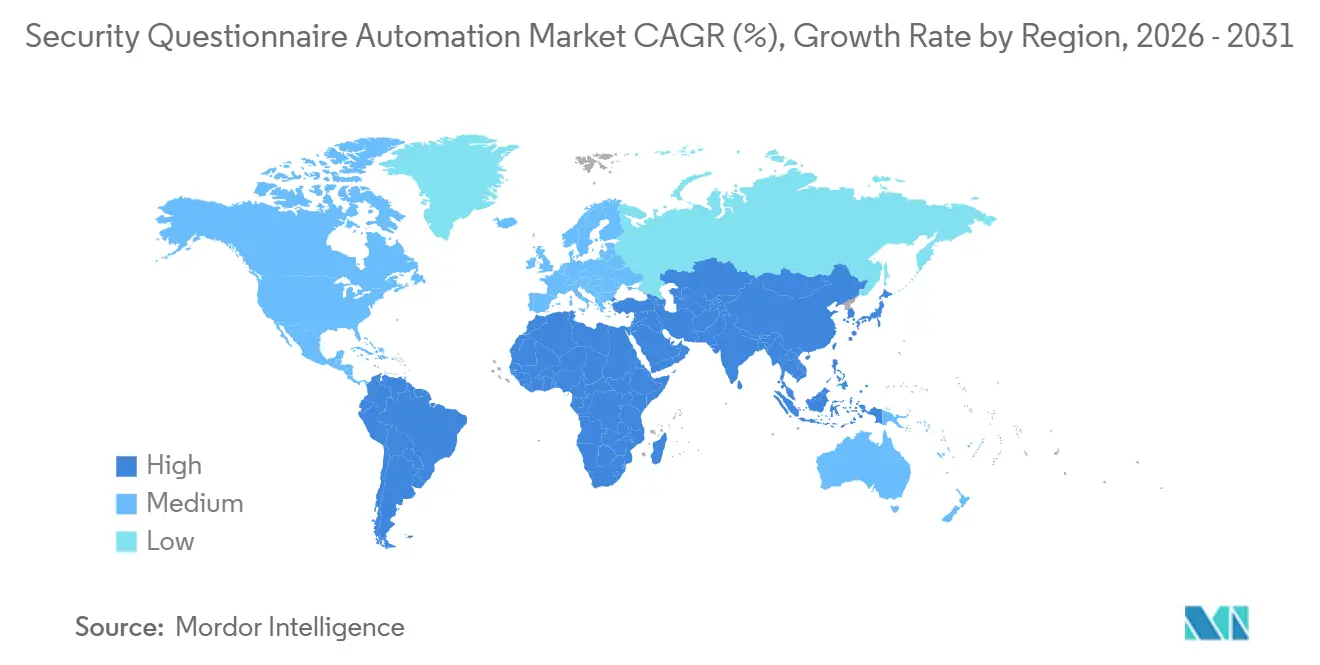
North America held 38.44% of revenue in 2025, supported by technology suppliers facing substantial incoming customer reviews and financial institutions operating under overlapping third-party risk expectations. New York State's Department of Financial Services issued guidance in October 2025 on managing third-party service provider risk for covered entities. FINRA also reinforced vendor risk management as an examination priority in 2026. The United States combines high SaaS use, established third-party risk management programs, and buyers that expect evidence-level traceability for assisted responses. This combination keeps North America central to the Security questionnaire automation market.
Europe is the second-largest regional market for security questionnaire automation. DORA and the NIS2 supply-chain security requirements create a strong compliance basis for vendor due diligence and encourage firms to document their assessments. The European Commission proposed a trusted information and communications technology supply chain framework in 2026 to enable coordinated security risk assessments across critical sectors.[3] The European Banking Authority's September 2026 guidance extends assessment requirements to non-information and communications technology services at banks. Germany, the United Kingdom, and France generate significant demand, while cross-border transfer rules and national data residency requirements favor localized data handling and multilingual processing.
Asia-Pacific is projected to expand at a CAGR of 24.10% from 2026 to 2031. Singapore's technology risk management expectations, Japan's cybersecurity management guidance, India's data protection requirements, and South Korea's evolving data protection rules are increasing attention to vendor assurance. Zeroboard added cybersecurity survey items to its Dataseed SAQ platform in March 2026 using Japan's Cybersecurity Management Guidelines Ver. 3.0. China's cybersecurity localization requirements and smart-city supply-chain assessments also create demand for data residency controls and multilingual response capabilities. South America, the Middle East, and Africa remain earlier-stage regions where demand for the Security questionnaire automation market centers on multinational subsidiaries, BFSI institutions, and technology vendors seeking to qualify for enterprise contracts.
Competitive Landscape
The Security questionnaire automation market includes dedicated response platforms, trust-management platforms with embedded response automation, and artificial-intelligence-native knowledge-automation providers. Dedicated providers include Conveyor, Whistic, Vendict, and Skypher, while trust-management providers include Vanta, Drata through SafeBase, TrustCloud, Secureframe, Scrut Automation, and Sprinto. Artificial intelligence-native providers include Arphie, 1up AI, and Inventive AI. No provider has a dominant position across both SMEs and large enterprises, which keeps pricing and product competition active.
Competition in the Security questionnaire automation market centers on whether a provider treats the questionnaire as an isolated task or as part of a continuous compliance and vendor risk workflow. Buyers in BFSI and healthcare place increasing weight on source-linked outputs and tamper-evident approval records. Vanta launched its Customer Trust Agent in March 2026, featuring a self-improving knowledge base, automated question routing, and a reported 87% deflection rate for inbound trust reviews. Drata launched AI Agent Governance in June 2026 to help enterprises inventory, monitor, and govern artificial intelligence agents. These actions show a move toward ongoing evidence management rather than one-time answer generation.
Drata acquired SafeBase for USD 250 million in February 2025, combining a compliance automation platform with trust-center capabilities and buyer-side network reach.[4] Sprinto launched its Autonomous Trust Platform in March 2026 with agents for vendor due diligence, evidence refresh, and control-gap resolution across more than 200 standards. Conveyor raised USD 20 million in a Series B round in June 2025 to expand artificial intelligence capabilities for security reviews and requests for proposals. Open space remains in multilingual response automation, buyer-portal completion, and governance tools for mid-sized customers. Providers that can prove response accuracy, integration reliability, and evidence currency are likely to have an advantage as the Security questionnaire automation market faces tighter buyer review requirements.
Security Questionnaire Automation Industry Leaders
-
Vanta Inc.
-
Drata, Inc.
-
Secureframe, Inc.
-
Sprinto Technologies Private Limited
-
SecurityPal, Inc.
- *Disclaimer: Major Players sorted in no particular order
Recent Industry Developments
- October 2026: Optro, formerly AuditBoard, Inc., partnered with Carahsoft to bring its agentic GRC Intelligence Platform to the US public sector, expanding questionnaire automation and connected risk capabilities for federal agencies and defense contractors subject to mandatory third-party cybersecurity assessment obligations.
- September 2026: The European Banking Authority published final guidelines on the sound management of third-party risk for non-ICT services, extending DORA-aligned vendor assessment obligations beyond ICT providers for EU financial institutions and materially expanding the volume of questionnaires addressable by automation platforms.
- June 2026: Drata, Inc. launched AI Agent Governance, extending its trust management platform to inventory, monitor, and govern enterprise AI agents. This addresses the fastest-growing security question category in procurement, with AI-governance questions rising 30% in frequency across 2.1 million processed questions, and 89% of vendors leaving them unanswered.
- May 2026: Optro acquired Midship, an AI-native autonomous controls-testing startup, creating what it described as the first agentic GRC system capable of automating up to 87% of controls management, directly strengthening continuous questionnaire evidence generation and maintenance.
Global Security Questionnaire Automation Market Report Scope
The Security Questionnaire Automation Market comprises software platforms and related services that automate the completion, management, analysis, and response of security, compliance, vendor risk, and due diligence questionnaires. These solutions leverage artificial intelligence, knowledge management, workflow automation, compliance repositories, and collaboration tools to reduce manual effort associated with responding to Requests for Information (RFIs), Requests for Proposal (RFPs), security assessments, and third-party risk management questionnaires. The market serves organizations seeking to accelerate sales cycles, improve compliance accuracy, streamline vendor assessments, and enhance security assurance processes.
The Security Questionnaire Automation Market Report is Segmented by Offering (Software, and Services [Implementation and Integration Services, Managed Questionnaire Response Services, and Consulting and Advisory Services]), Deployment Mode (Cloud, and On-Premises), Organization Size (Large Enterprises, and Small and Medium-Sized Enterprises), End-User Industry (Banking, Financial Services, and Insurance [BFSI], IT and Telecommunications, Government and Defense, Healthcare and Life Sciences, Retail and E-Commerce, Energy and Utilities, and Other End-User Industries), and Geography (North America, South America, Europe, Asia-Pacific, Middle East, and Africa). The Market Forecasts are Provided in Terms of Value (USD).
| Software | |
| Services | Implementation and Integration Services |
| Managed Questionnaire Response Services | |
| Consulting and Advisory Services |
| Cloud |
| On-Premises |
| Large Enterprises |
| Small and Medium-Sized Enterprises |
| Banking, Financial Services, and Insurance (BFSI) |
| IT and Telecommunications |
| Government and Defense |
| Healthcare and Life Sciences |
| Retail and E-Commerce |
| Energy and Utilities |
| Other End-User Industries |
| North America | United States |
| Canada | |
| South America | Brazil |
| Argentina | |
| Mexico | |
| Rest of South America | |
| Europe | United Kingdom |
| Germany | |
| France | |
| Italy | |
| Spain | |
| Rest of Europe | |
| Asia-Pacific | China |
| Japan | |
| India | |
| South Korea | |
| Australia | |
| Singapore | |
| Rest of Asia-Pacific | |
| Middle East | United Arab Emirates |
| Saudi Arabia | |
| Turkey | |
| Israel | |
| Rest of Middle East | |
| Africa | South Africa |
| Nigeria | |
| Egypt | |
| Rest of Africa |
| By Offering | Software | |
| Services | Implementation and Integration Services | |
| Managed Questionnaire Response Services | ||
| Consulting and Advisory Services | ||
| By Deployment Mode | Cloud | |
| On-Premises | ||
| By Organization Size | Large Enterprises | |
| Small and Medium-Sized Enterprises | ||
| By End-User Industry | Banking, Financial Services, and Insurance (BFSI) | |
| IT and Telecommunications | ||
| Government and Defense | ||
| Healthcare and Life Sciences | ||
| Retail and E-Commerce | ||
| Energy and Utilities | ||
| Other End-User Industries | ||
| By Geography | North America | United States |
| Canada | ||
| South America | Brazil | |
| Argentina | ||
| Mexico | ||
| Rest of South America | ||
| Europe | United Kingdom | |
| Germany | ||
| France | ||
| Italy | ||
| Spain | ||
| Rest of Europe | ||
| Asia-Pacific | China | |
| Japan | ||
| India | ||
| South Korea | ||
| Australia | ||
| Singapore | ||
| Rest of Asia-Pacific | ||
| Middle East | United Arab Emirates | |
| Saudi Arabia | ||
| Turkey | ||
| Israel | ||
| Rest of Middle East | ||
| Africa | South Africa | |
| Nigeria | ||
| Egypt | ||
| Rest of Africa | ||
Key Questions Answered in the Report
What is the size of the Security questionnaire automation market?
The Security questionnaire automation market was valued at USD 0.35 billion in 2025 and is estimated at USD 0.42 billion in 2026. It is projected to reach USD 1.20 billion by 2031 at a CAGR of 23.30%.
What is driving demand for security questionnaire automation?
Third-party risk rules, larger cloud vendor portfolios, continuous assurance requirements, and more complex artificial intelligence governance questions are increasing the burden on security teams.
Which offering leads security questionnaire automation adoption?
Software led with 67.88% of revenue in 2025. Services are projected to grow faster at a CAGR of 24.75% through 2031 as buyers seek implementation and managed response support.
Which deployment mode is most widely used for these platforms?
Cloud held 68.15% of revenue in 2025 and is projected to grow at a CAGR of 24.38% through 2031. It supports frequent updates, integrations, and buyer-facing trust centers.
Which end-user sector has the largest demand?
BFSI accounted for 31.29% of revenue in 2025 because financial institutions both send and receive extensive vendor security assessments.
Which region is growing fastest for questionnaire automation?
Asia-Pacific is projected to grow at a CAGR of 24.10% through 2031, supported by regional data protection and technology risk management requirements.