
Secret Detection and Scanning Tools Market Size and Share
Market Overview
| Study Period | 2021 - 2032 |
|---|---|
| Market Size (2027) | USD 3.17 Billion |
| Market Size (2032) | USD 7.68 Billion |
| Growth Rate (2027 - 2032) | 19.36 % |
| Fastest Growing Market | Asia-Pacific |
| Largest Market | North America |
| Market Concentration | Medium |
Major Players *Disclaimer: Major Players sorted in no particular order Image © Mordor Intelligence. Reuse requires attribution under CC BY 4.0. | |
Secret Detection and Scanning Tools Market Analysis by Mordor Intelligence
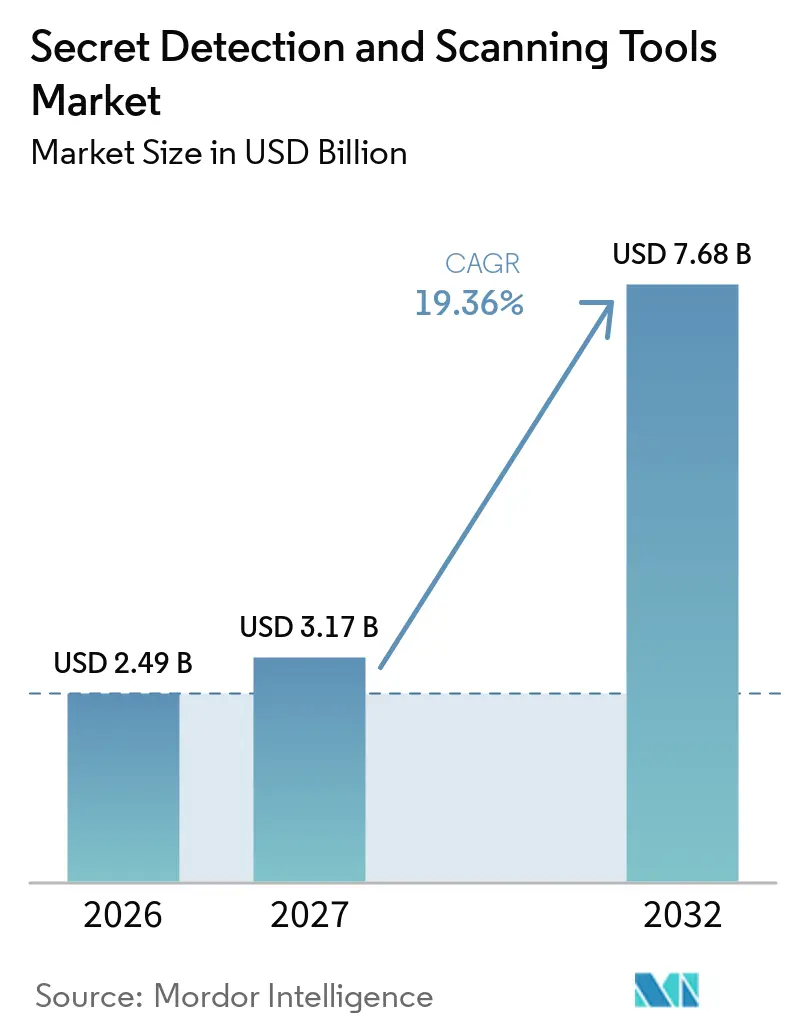
The secret detection and scanning tools market size is expected to increase from USD 2.49 billion in 2026 to USD 3.17 billion in 2027 and reach USD 7.68 billion by 2032, growing at a CAGR of 19.36% over 2027-2032. The Secret detection and scanning tools market is expanding as exposed credentials appear across source repositories, CI/CD configurations, container images, and collaboration tools. DevSecOps practices make early detection more important because credentials that enter version history are difficult to remove and rotate. The increase in non-human identities also broadens the number of service accounts, certificates, and tokens that need monitoring. Wider platform coverage is becoming a competitive requirement for the Secret detection and scanning tools market, particularly across cloud vaults, artifacts, and developer workflows. AI-assisted coding creates a further need for fast detection because credentials can be generated and committed faster than periodic scans can identify them.
Key Report Takeaways
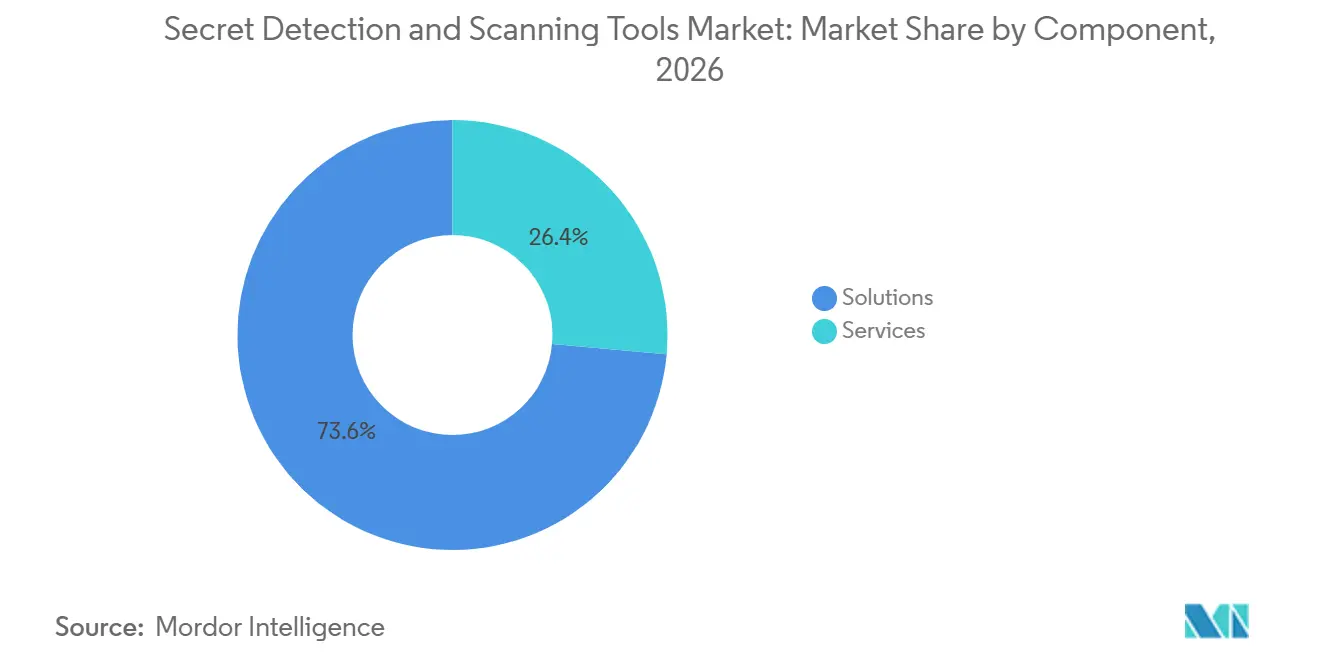
- By component, solutions held 73.58% of the secret detection and scanning tools market in 2026, while services are projected to expand at a 21.76% CAGR through 2032.
- By deployment model, cloud-based deployment accounted for 67.58% of the market in 2026 and is projected to grow at a 22.81% CAGR through 2032.
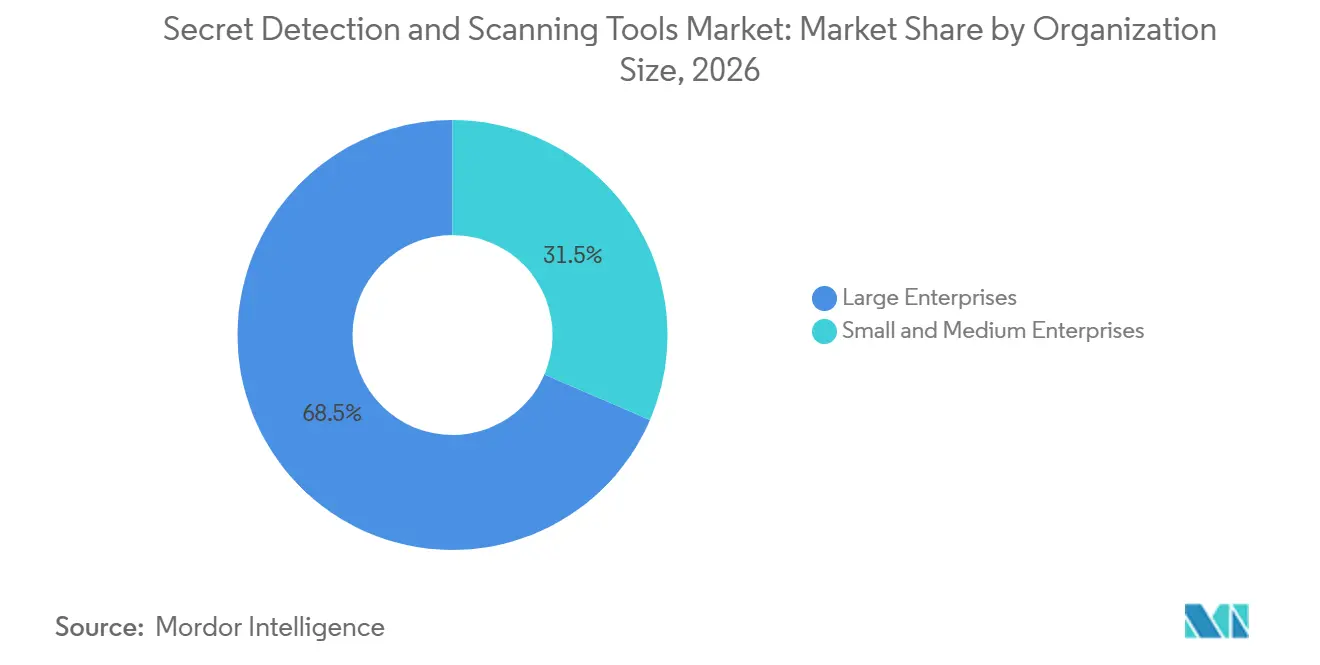
- By organization size, large enterprises accounted for 68.54% of the secret detection and scanning tools market in 2026, while SMEs are projected to expand at a 21.72% CAGR through 2032.
- By application, source code scanning held 24.81% of the market in 2026, while software supply-chain protection is projected to expand at a 23.72% CAGR through 2032.
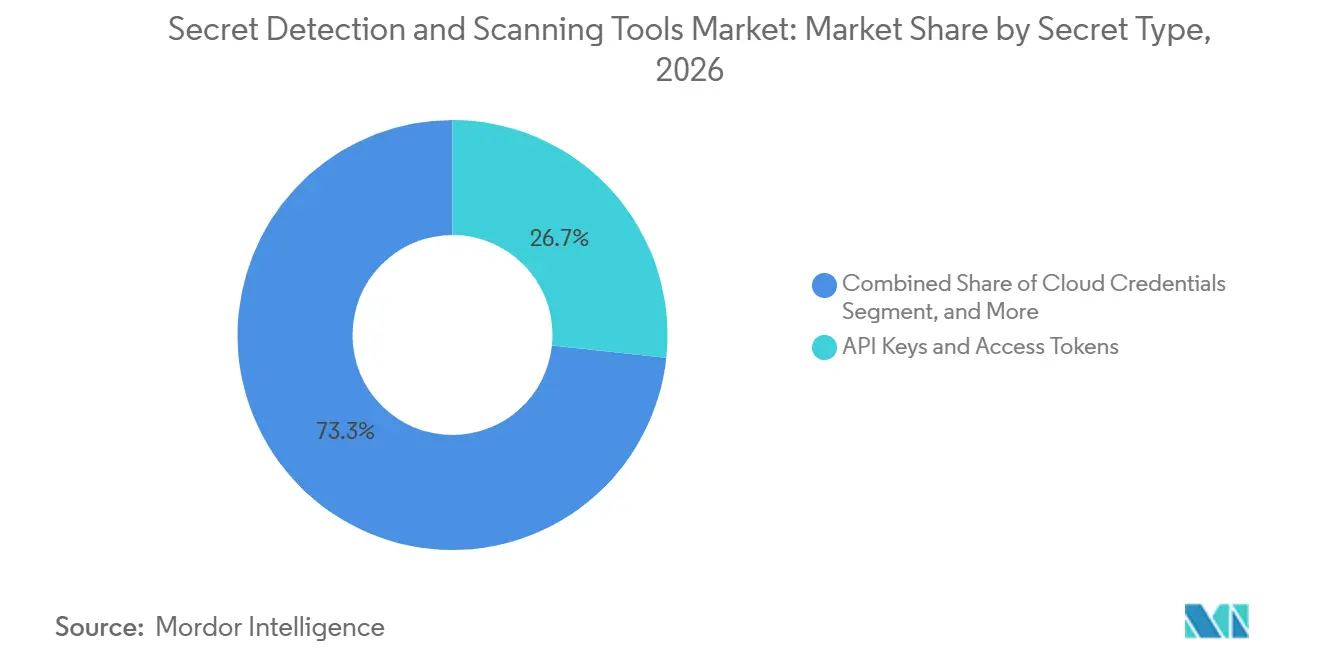
- By secret type, API keys and access tokens held 26.69% of the market in 2026, while AI and machine-learning API keys are projected to expand at a 24.42% CAGR through 2032.
- By end-user industry, BFSI held 27.69% of the market in 2026, while government and public administration are projected to expand at a 21.22% CAGR through 2032.
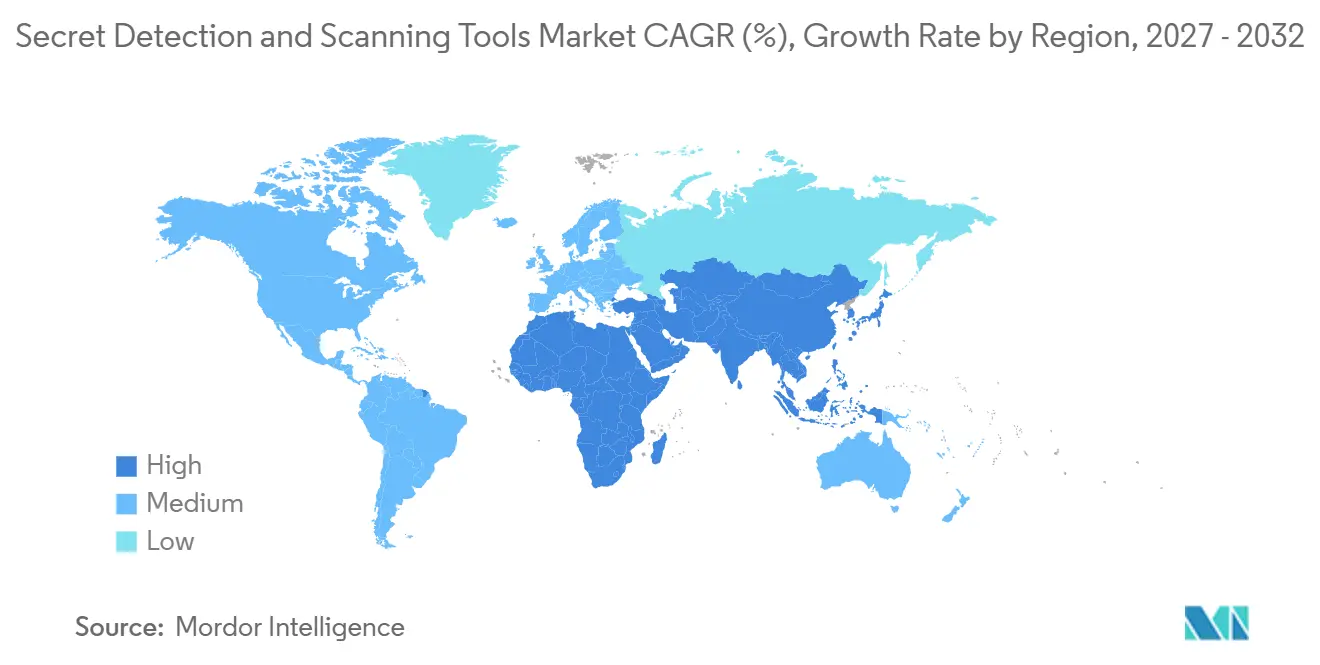
- By geography, North America held 38.64% of the secret detection and scanning tools market in 2026, while Asia-Pacific is projected to expand at a 23.93% CAGR through 2032.
Note: Market numbers in this report are based on Mordor Intelligence's proprietary estimation framework, which combines nine months of actuals with Q4 projections for base year 2026.
Market Trends and Insights
Drivers Impact Analysis of Secret Detection and Scanning Tools Market*
| DRIVER | (~) % IMPACT ON CAGR FORECAST | GEOGRAPHIC RELEVANCE | IMPACT TIMELINE |
|---|---|---|---|
| DevSecOps and CI/CD Pipeline Expansion | +5.2% | Global, concentrated in North America and Western Europe | Short term (≤ 2 years) |
| Multi-Cloud Secrets Sprawl | +4.1% | Global, most acute in North America, Europe, and Asia-Pacific | Short term (≤ 2 years) |
| Regulatory Pressure for Credential Governance | +3.5% | Europe and North America primary, cascading to Asia-Pacific and Middle East | Medium term (2-4 years) |
| Explosion of Machine Identities and API Workloads | +3.2% | Global, highest intensity in cloud-native enterprise markets | Long term (≥ 4 years) |
| AI-Assisted Coding and Autonomous Software Agents | +2.8% | North America, Europe, East Asia, and South Asia | Short term (≤ 2 years) |
| Secret Exposure Across Non-Code Collaboration Surfaces | +2.1% | Global, with early gains in North America and Japan | Medium term (2-4 years) |
| Source: Mordor Intelligence | |||
DevSecOps and CI/CD Pipeline Expansion Drives Automated Credential Governance
DevSecOps adoption is moving secrets scanning from periodic audits to each push, pull request, and deployment workflow. Pre-commit controls can stop credentials before they enter version history, where rotation becomes difficult, and the exposure record remains. HashiCorp identifies CI/CD pipelines as high-value targets because they bring cloud credentials, registry tokens, and deployment keys into one execution environment.[1] The Cloud Security Alliance reported in September 2025 that static, long-lived pipeline secrets can expose a broader software stack when a runner is compromised. As repository counts rise, the secret detection and scanning tools market benefits from automated scanning because manual code review cannot maintain the same coverage. Vendors that combine prevention, detection, and remediation can be more relevant to teams seeking fewer separate workflow controls.
Multi-Cloud Secrets Sprawl Creates Demand for Cross-Vault Detection
Enterprises using several cloud providers create secrets in different native formats and store them across vaults, environment variables, and configuration files. AWS IAM keys, Google Cloud service account JSON files, and Azure client secrets require controls that can interpret different contexts. IBM describes secret scanning as a way to identify credentials exposed in repositories and other development locations. The secret detection and scanning tools market, therefore, favors platforms that bring cloud vaults and third-party stores into one inventory layer. Teams that add services and AI integrations faster than governance controls can create wider coverage gaps. A consolidated view can help security teams identify where credentials are stored, prioritize remediation, and reduce reliance on isolated cloud-specific tools.
Regulatory Pressure for Credential Governance Creates Structured Enterprise Demand
Credential governance is increasingly tied to documented controls and audit evidence. The Digital Operational Resilience Act and the NIS2 Directive place stronger security and resilience expectations on regulated European entities.[2] PCI DSS v4.0 also prohibits hard-coded passwords in system components under requirement 8.6.2. These requirements can shift secret detection and scanning tools market purchasing from a discretionary security project toward an operational compliance need. The secret detection and scanning tools market is supported when buyers need evidence of credential-management controls and remediation activity. Compliance requirements also increase the value of reporting features that link detection results to policy and audit processes.
Explosion of Machine Identities and API Workloads Expands the Detectable Surface
Service accounts, workload certificates, API keys, and pipeline credentials are now essential to cloud-based applications. GitGuardian reported in April 2025 that non-human identities can outnumber human identities at very high ratios in large cloud environments. Traditional employee-centered identity practices do not provide sufficient context for the wider secret detection and scanning tools market identity surface. Palo Alto Networks noted that long-lived static credentials in machine-to-machine communication can create persistent high-privilege paths. The secret detection and scanning tools market can address current exposure while organizations move toward workload identity models. Research on SPIFFE-based authentication also shows that some architectures can eliminate static secret injection in CI/CD pipelines, increasing the importance of products that work alongside newer identity frameworks.
Restraints Impact Analysis of Secret Detection and Scanning Tools Market*
| RESTRAINT | (~) % IMPACT ON CAGR FORECAST | GEOGRAPHIC RELEVANCE | IMPACT TIMELINE |
|---|---|---|---|
| Integration Complexity in Legacy and Hybrid Environments | -0.9% | Global, most acute in Europe and North America with large legacy estates | Long term (≥ 4 years) |
| False Positives and Developer Workflow Friction | -0.7% | Global | Short term (≤ 2 years) |
| Bundled Scanning and Open-Source Price Pressure | -0.6% | North America and Europe, mature open-source and bundled suite ecosystems | Medium term (2-4 years) |
| Shortage of Secrets-Governance Skills | -0.4% | Global, most acute in emerging markets | Long term (≥ 4 years) |
| Source: Mordor Intelligence | |||
Integration Complexity in Legacy and Hybrid Environments Slows Deployment Velocity
Organizations with mainframes, legacy version-control systems, and hybrid CI/CD environments can face difficult deployments. Some older environments store credentials in proprietary files or repositories that commercial scanners do not support directly. Custom connectors can add implementation work and increase the cost of a broader rollout. IBM launched Vault Dedicated in September 2026 for regulated cloud workloads that need managed secrets management and data-residency options. Even so, secret detection and scanning tools market deployments in hybrid environments require tools to work across different access rules and credential-rotation schedules. These constraints can slow procurement in the secret detection and scanning tools market, even where compliance requirements are clear.
False Positives and Developer Workflow Friction Limit Adoption Depth
False positives can leave security teams with large remediation queues and reduce developer trust in pre-commit controls. Pattern matching and entropy-based methods can flag placeholders, documentation, and test data as active credentials. GitHub reported in October 2026 that its ModernBERT classifier improved precision by 13%, recall by 19%, and median scan execution time by 86%. These results show why detection quality is becoming a core product requirement rather than a secondary feature. Developers are more likely to use secret detection and scanning tools that market controls that are fast and provide results they can act on. The secret detection and scanning tools market faces adoption limits until improved classification is broadly available across tools.
*Our forecasts treat driver/restraint impacts as directional, not additive. The impact forecasts reflect baseline growth, mix effects, and variable interactions.
Secret Detection and Scanning Tools Market Segment Analysis
By Component:
Platform Solutions Lead While Services Support ImplementationSolutions accounted for 73.58% of the secret detection and scanning tools market share in 2026. This position reflects enterprise demand for platforms that combine detection, remediation, and compliance reporting in subscription contracts. Buyers often prefer a single product that can scan repositories, containers, artifacts, and collaboration environments. The solutions category is separating AI-enabled detection products from older tools that rely mainly on fixed patterns. Multi-year agreements can also simplify ownership across security, engineering, and compliance teams.
Services are projected to expand at a 21.76% CAGR through 2032. Organizations need support to configure scanners, connect data sources, tune findings, and establish remediation processes. This need is more evident when coverage expands beyond source code to include artifact repositories and SaaS collaboration tools. Snyk made its Secrets Scanner generally available in August 2026 with machine-learning detection for human-written and AI-generated code.[3] Service providers and platform vendors can use this complexity to support implementation, managed detection, and governance design. They can also help teams set ownership rules for triage and credential rotation.
By Deployment Model:
Cloud Delivery Sets the Standard While Hybrid Meets Edge CasesCloud-based deployment held 67.58% of the secret detection and scanning tools market share in 2026. Code repositories, CI/CD pipelines, and collaboration applications are commonly cloud-hosted, making SaaS delivery a direct fit for many buyers. Cloud delivery also lets vendors update rule sets and machine-learning models continuously. Shared telemetry can improve detection quality when it is used within appropriate security and privacy controls. Centralized delivery can reduce the effort required to distribute new detection logic across development groups.
Cloud-based deployment is projected to expand at a 22.81% CAGR through 2032. The category leads both current adoption and forecast expansion, indicating that demand has not yet reached maturity. On-premises tools remain relevant for data-residency requirements and air-gapped systems. Hybrid deployments combine centralized cloud repository scanning with agents for sensitive systems. HashiCorp recommends dynamic credentials for secure systems, and this posture requires coherent controls across deployment environments. Hybrid-capable products can therefore serve enterprises with uneven cloud adoption.
By Organization Size:
Large Enterprises Lead While SMEs Expand AccessLarge enterprises held 68.54% of the market in 2026. Their multi-cloud environments, regulated workloads, and large developer groups create more opportunities for credentials to spread. These buyers often seek broad contracts that cover several repository types and secret categories. They also value integrations with vaults, identity platforms, and enterprise reporting systems. Procurement can favor vendors that can support several internal teams under one control framework.
SMEs are projected to expand at a 21.72% CAGR through 2032. Open-source command-line tools, freemium SaaS offerings, and straightforward per-seat pricing can reduce procurement barriers for smaller development teams seeking Secret detection and scanning tools. CyberArk expanded its machine identity security portfolio in October 2025 with cross-vault discovery, a risk dashboard, and HashiCorp Vault integration. Infisical raised USD 16 million in June 2025 and stated that its platform secured more than 500 million secrets daily at that time. Such a product and funding activity illustrate continuing interest in accessible tools for organizations with limited security resources. Smaller teams can adopt these tools without building large dedicated security operations groups.
By Application:
Source Code Scanning Leads While Supply-Chain Protection AcceleratesSource code scanning accounted for 24.81% of the market in 2026. It has the largest application share because detection rules are well established, and developers are familiar with pre-commit and post-push workflows. Source code remains an important initial control point for credentials. However, code repositories cover a declining portion of the wider exposure surface when secrets move into packages, images, and artifacts. This makes code scanning necessary but insufficient for a complete control program.
Software supply-chain protection is projected to expand at a 23.72% CAGR through 2032. Credentials in dependency layers and CI/CD artifacts can create lateral movement paths when an attacker compromises the build process. GitGuardian extended detection to 12 package ecosystems through its March 2026 JFrog Artifactory integration.[4] DevOps and CI/CD security, compliance, and audit readiness, and data loss prevention remain relevant applications. Their demand is tied to maturing DevSecOps programs, regulatory controls, and wider use of SaaS tools. Broader secret detection and scanning tools market artifact coverage can help teams identify secrets outside their main repositories.
By Secret Type:
API Keys Define Current Exposure While AI Keys AccelerateAPI keys and access tokens held 26.69% of the market in 2026. Nearly every service-to-service interaction uses a key or token, creating a broad and recurring exposure surface. Cloud credentials, passwords, database credentials, private keys, certificates, OAuth tokens, and webhook tokens each have different detection requirements. Purpose-trained classifiers can add context to generic secret detection, particularly where fixed rules are insufficient. Category-specific detection is important because the remediation process differs by credential type.
AI and machine-learning API keys are projected to expand at a 24.42% CAGR through 2032. Wiz reported in 2025 that 65% of companies in the Forbes AI 50 had verified leaked secrets on GitHub. AI-enabled development can create credentials at a faster pace, increasing the value of controls that detect secrets before code is committed. GitGuardian launched its MCP Server in July 2025 to bring real-time secrets security into developer workflows and agile coding environments. Detection models also need to understand the context of AI services without blocking valid development activity. This requirement increases the value of systems that can distinguish active keys from test material.

By End-User Industry:
BFSI Leads Spending While Government Adoption AcceleratesBFSI accounted for 27.69% of the market in 2026. Financial institutions handle regulated data, large application estates, and sensitive transaction systems. These conditions create a strong need for evidence that credentials are controlled and remediated. AI-enhanced detection can be relevant where security teams must prioritize a large volume of findings. Financial buyers may also seek controls that fit established audit and risk-management processes.
The government and public administration industry is projected to expand at a 21.22% CAGR through 2032. Cloud migration of legacy systems and API-based citizen services adds new credentials faster than some inherited governance programs can manage. The FDIC Office of Inspector General identified protecting cloud secrets as a material control issue in a 2025 audit of a cloud platform and application. Defense, intelligence, and civilian agencies can require tools that support air-gapped and data-sovereignty conditions. Healthcare, life sciences, retail, e-commerce, telecommunications, media, travel, and hospitality also create demand as their cloud footprints and machine identities increase. Government procurement can reward vendors that support specialized security and deployment requirements.
Geography Analysis
North America Secret Detection and Scanning Tools Market
North America held 38.64% of the regional market in 2026. The region has a high concentration of technology companies, financial institutions, and federal agencies with large multi-cloud environments. The United States is supported by credential-control expectations in federal security practices and state-level cybersecurity requirements, while Canada adds demand through financial-sector DevSecOps activity and data-residency needs. Competition is particularly active because pure-play scanners, application-security suites, and identity vendors are targeting the same enterprise budgets.
Europe Secret Detection and Scanning Tools Market
Europe has a demand profile shaped by DORA and NIS2 requirements. These rules support stronger credential governance and documented evidence for many regulated organizations. Germany, the United Kingdom, and France lead demand through large industrial and financial organizations. Germany creates demand for hybrid and on-premises tools that align with data-sovereignty requirements, while Scandinavian markets have mature DevSecOps practices. The secret detection and scanning tools market in Europe benefits when buyers need continuous compliance controls rather than periodic reviews.
APAC, South America and Middle East Secret Detection and Scanning Tools Market
Asia-Pacific is projected to expand at a 23.93% CAGR through 2032. The region combines cloud migration, AI development, and public digital transformation, which expand credential exposure across organizations. Netskope reported in 2026 that MCP activity in Asia rose 398% over 14 months and that passwords and API keys appeared in 5% of AI-related data-policy violations. India, South Korea, Japan, Australia, and Singapore are distinct demand centers with different regulatory and technology conditions. Australia and Singapore add compliance demand through privacy and data-protection requirements, while South America and the Middle East remain earlier-stage markets where financial services and telecommunications digitization support adoption.
Competitive Landscape
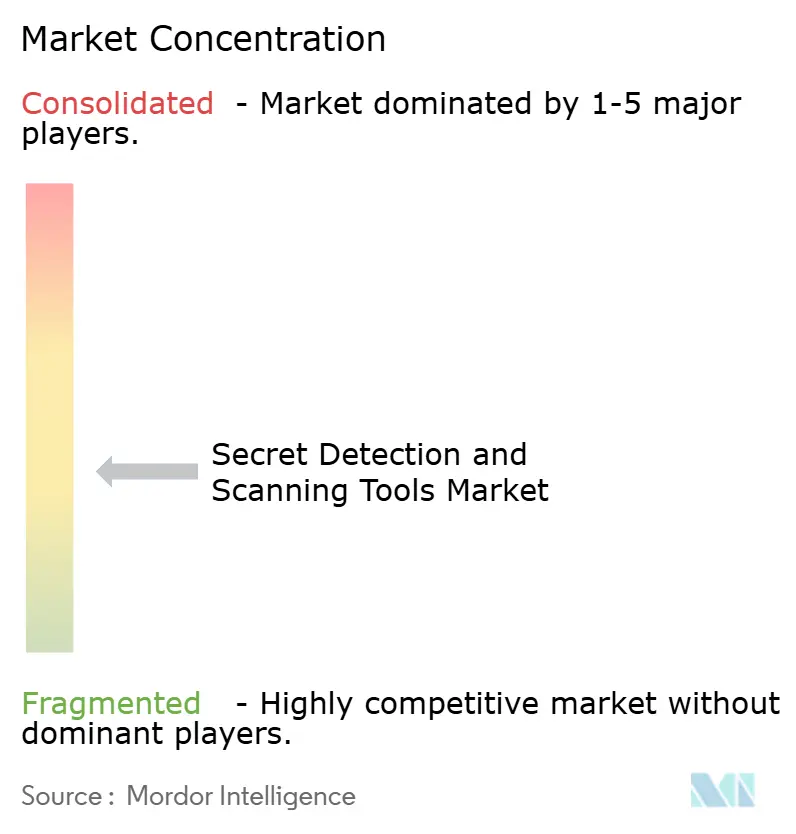
The secret detection and scanning tools market is moderately fragmented, with approximately 30 profiled vendors across pure-play scanners, developer platform tools, application-security suites, and identity vendors. GitGuardian, Truffle Security, and Nightfall AI represent focused scanning and data-security providers. GitHub Advanced Security and GitLab provide native capabilities within developer platforms. Snyk, Checkmarx, JFrog, Synopsys, and SonarSource offer application-security coverage that can include secrets detection. CyberArk, HashiCorp, IBM, and Akeyless extend identity and secrets-management capabilities toward detection.
The secret detection and scanning tools market competition increasingly depends on surface breadth and detection quality. Vendors are extending coverage from source code to CI/CD logs, containers, artifact registries, SaaS applications, and endpoints. Checkmarx acquired Tromzo in December 2025 to add deep-reasoning AI agents and end-to-end agentic triage to its platform. GitHub published ModernBERT detection results in October 2026, setting a higher performance standard for precision, recall, and scan speed. CyberArk also expanded machine identity capabilities in 2026, including features for human, AI, and machine identities.
Developer endpoint protection, AI agent security, MCP server security, and cross-language artifact scanning remain open areas. Akeyless introduced SecretlessAI in July 2025 to use intent-aware, runtime-issued credentials for AI agents and MCP servers. Google released Veles in July 2025 as an open-source credential scanner for deps.dev, raising the baseline available to developers. Open-source tools and bundled platform capabilities can pressure vendors that offer narrow pattern-based scanning. Vendors that pair useful developer workflows with broad coverage and lower false-positive rates are better positioned to retain enterprise accounts.
Secret Detection and Scanning Tools Industry Leaders
-
GitHub, Inc.
-
Microsoft Corporation
-
GitGuardian SAS
-
Snyk Limited
-
GitLab Inc.
- *Disclaimer: Major Players sorted in no particular order
Secret Detection and Scanning Tools Market Companies Covered in this Report
- GitHub, Inc.
- Microsoft Corporation
- GitGuardian SAS
- Snyk Limited
- Check Point Software Technologies Ltd.
- GitLab Inc.
- Truffle Security Co.
- SonarSource SA
- Aqua Security Software Ltd.
- Cycode, Inc.
- Veracode, Inc.
- Checkmarx Ltd.
- Synopsys, Inc.
- JFrog Ltd.
- Nightfall AI, Inc.
- Aikido Security BV
- Infisical, Inc.
- HashiCorp, Inc., an IBM Company
- CyberArk Software Ltd.
- BeyondTrust Corporation
- Delinea Inc.
- Akeyless Security Ltd.
- Keeper Security, Inc.
- Doppler Technologies, Inc.
- Amazon Web Services, Inc.
- Google LLC
- Atlassian Corporation Plc
- Rapid7, Inc.
- Teleport, Inc.
- StrongDM, Inc.
Recent Industry Developments in Secret Detection and Scanning Tools Market
- September 2026: IBM launched Vault Dedicated, a fully managed, single-tenant deployment of HashiCorp Vault Enterprise on IBM Cloud in beta in Frankfurt and Dallas. The offering delivered dynamic credentials, policy-based access controls, and enterprise secrets management to IBM Cloud workloads targeting regulated industries with data-residency requirements.
- September 2026: Nightfall AI expanded its integration with Anthropic's Claude Compliance API, bringing AI-native data loss prevention and real-time secrets detection to Claude Enterprise for agentic AI workflows.
- December 2025: Checkmarx acquired Tromzo to integrate deep-reasoning AI agents into the Checkmarx One platform. The acquisition added Safe Refactor capabilities and end-to-end agentic triage across pre-commit, post-commit, and runtime software development lifecycle phases.
- July 2025: GitGuardian launched its MCP Server on July 15, 2025. The release embedded AI-driven secrets security into developer IDEs and agentic coding environments.
Global Secret Detection and Scanning Tools Market Report Scope
The secret detection and scanning tools market encompasses tools and services for identifying, classifying, triaging, remediating, and preventing exposed secrets across source code, repositories, CI/CD pipelines, developer environments, containers, cloud configurations, and collaboration platforms. It includes secret scanning, false-positive reduction, exposure monitoring, and automated revocation or remediation workflows.
The Secret Detection and Scanning Tools Market Report is Segmented by Component (Solutions, and Services), Deployment Mode (Cloud-Based, On-Premises, and Hybrid), Organization Size (Large Enterprises, and Small and Medium Enterprises), Application (Source Code Scanning, DevOps and CI/CD Security, Compliance and Audit Readiness, Data Loss Prevention and Insider-Risk Reduction, Software Supply-Chain Protection, and Other Applications), Secret Type (API Keys and Access Tokens, Cloud Credentials, Passwords and Database Credentials, Private Keys and Certificates, OAuth, Webhook, and Service Tokens, AI and Machine-Learning API Keys, and Proprietary and Generic Secrets), End-User Industry (Banking, Financial Services, and Insurance (BFSI), Government and Public Administration, Healthcare and Life Sciences, Retail and E-Commerce, Telecommunications and Media, Travel and Hospitality, and End-User Industries), and Geography (North America, South America, Europe, Asia-Pacific, Middle East, and Africa). The Market Forecasts are Provided in Terms of Value (USD).
Segmentation Overview
| Solutions |
| Services |
| Cloud-Based |
| On-Premises |
| Hybrid |
| Small and Medium Enterprises |
| Large Enterprises |
| Source Code Scanning |
| DevOps and CI/CD Security |
| Compliance and Audit Readiness |
| Data Loss Prevention and Insider-Risk Reduction |
| Software Supply-Chain Protection |
| Other Applications |
| API Keys and Access Tokens |
| Cloud Credentials |
| Passwords and Database Credentials |
| Private Keys and Certificates |
| OAuth, Webhook, and Service Tokens |
| AI and Machine-Learning API Keys |
| Proprietary and Generic Secrets |
| Banking, Financial Services, and Insurance (BFSI) |
| Government and Public Administration |
| Healthcare and Life Sciences |
| Retail and E-Commerce |
| Telecommunications and Media |
| Travel and Hospitality |
| Other End User Industries |
| North America | United States |
| Canada | |
| Mexico | |
| South America | Brazil |
| Argentina | |
| Chile | |
| Rest of South America | |
| Europe | Germany |
| United Kingdom | |
| France | |
| Italy | |
| Rest of Europe | |
| Asia-Pacific | China |
| Japan | |
| India | |
| South Korea | |
| Australia | |
| Rest of Asia-Pacific | |
| Middle East | Saudi Arabia |
| United Arab Emirates | |
| Rest of Middle East | |
| Africa | South Africa |
| Nigeria | |
| Rest of Africa |
| By Component | Solutions | |
| Services | ||
| By Deployment Model | Cloud-Based | |
| On-Premises | ||
| Hybrid | ||
| By Organization Size | Small and Medium Enterprises | |
| Large Enterprises | ||
| By Application | Source Code Scanning | |
| DevOps and CI/CD Security | ||
| Compliance and Audit Readiness | ||
| Data Loss Prevention and Insider-Risk Reduction | ||
| Software Supply-Chain Protection | ||
| Other Applications | ||
| By Secret Type | API Keys and Access Tokens | |
| Cloud Credentials | ||
| Passwords and Database Credentials | ||
| Private Keys and Certificates | ||
| OAuth, Webhook, and Service Tokens | ||
| AI and Machine-Learning API Keys | ||
| Proprietary and Generic Secrets | ||
| By End-Use Industry | Banking, Financial Services, and Insurance (BFSI) | |
| Government and Public Administration | ||
| Healthcare and Life Sciences | ||
| Retail and E-Commerce | ||
| Telecommunications and Media | ||
| Travel and Hospitality | ||
| Other End User Industries | ||
| By Geography | North America | United States |
| Canada | ||
| Mexico | ||
| South America | Brazil | |
| Argentina | ||
| Chile | ||
| Rest of South America | ||
| Europe | Germany | |
| United Kingdom | ||
| France | ||
| Italy | ||
| Rest of Europe | ||
| Asia-Pacific | China | |
| Japan | ||
| India | ||
| South Korea | ||
| Australia | ||
| Rest of Asia-Pacific | ||
| Middle East | Saudi Arabia | |
| United Arab Emirates | ||
| Rest of Middle East | ||
| Africa | South Africa | |
| Nigeria | ||
| Rest of Africa | ||
Key Questions Answered in the Report
What is the 2026 size of the secret detection and scanning tools market?
The secret detection and scanning tools market size is expected to increase from USD 2.49 billion in 2026 to USD 3.17 billion in 2027 and reach USD 7.68 billion by 2032, growing at a CAGR of 19.36% over 2027-2032.
What is driving demand for secret detection and scanning tools?
DevSecOps adoption, multi-cloud credential sprawl, compliance requirements, and a growing number of machine identities are key demand factors. These conditions expand the number of systems where credentials require early detection.
Which deployment model leads adoption?
Cloud-based deployment held 67.58% in 2026 and is projected to expand at a 22.81% CAGR through 2032. Its position reflects the increasing use of cloud-hosted repositories, pipelines, and collaboration applications.
Which application is expanding fastest?
Software supply-chain protection is projected to expand at a 23.72% CAGR through 2032. It addresses credentials that can move through package ecosystems and CI/CD artifacts beyond the source repository.
Which region is expanding fastest?
Asia-Pacific is projected to expand at a 23.93% CAGR through 2032. Regional cloud migration, AI development, and digital transformation programs are broadening the exposure surface.
Why do AI development workflows increase secrets risk?
AI-assisted coding can create API keys and other credentials at a pace that requires early and continuous detection controls. Context-aware detection is important because valid test material should not be treated as an active credential.