
Scandinavia Prefabricated Product Logistics Market Size and Share
Market Overview
| Study Period | 2020 - 2031 |
|---|---|
| Forecast Data Period | 2026 - 2031 |
| Base Year Market Size (2025) | USD 1.06 Billion |
| Market Size (2026) | USD 1.09 Billion |
| Market Size (2031) | USD 1.40 Billion |
| Growth Rate (2026 - 2031) | 5.10 % |
| Market Concentration | Medium |
Major Players *Disclaimer: Major Players sorted in no particular order Image © Mordor Intelligence. Reuse requires attribution under CC BY 4.0. | |
Scandinavia Prefabricated Product Logistics Market Analysis by Mordor Intelligence
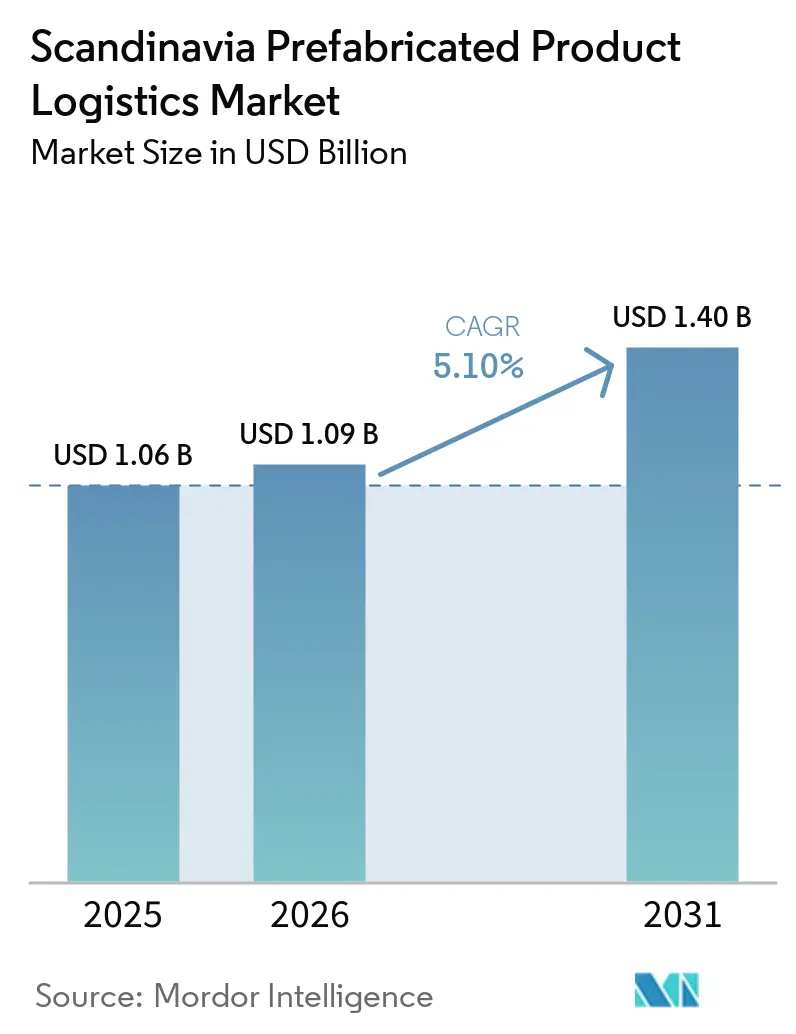
The Scandinavia prefabricated product logistics market size was valued at USD 1.06 billion in 2025 and estimated to grow from USD 1.09 billion in 2026 to reach USD 1.40 billion by 2031, at a CAGR of 5.10% during the forecast period (2026-2031).
Factory-built construction supported demand because it reduced dependence on constrained on-site labor and helped developers manage shorter delivery schedules. Sweden remained the regional anchor through its established house-factory base and transport links for large-format cargo. Norway offered the strongest country growth as zero-emission construction requirements and labor shortages made factory-built methods more attractive. Providers that combined specialist haulage with delivery sequencing, crane coordination, and reliable emissions reporting were better placed to win complex projects. Different oversized-load rules, persistent freight costs, and difficult winter delivery conditions continued to limit cross-border operating efficiency.
Key Report Takeaways
- By service, transportation commanded 65.25% of the Scandinavia prefabricated product logistics market share in 2025, while value-added services recorded the highest projected CAGR at 6.71% through 2031.
- By product type, modular buildings held 45.15% of the Scandinavia prefabricated product logistics market size in 2025, while panelized and componentized systems recorded the highest projected CAGR at 6.45% through 2031.
- By application, residential buildings represented 49.20% of the Scandinavia prefabricated product logistics market share in 2025, while commercial buildings recorded the highest projected CAGR at 5.95% through 2031.
- By country, Sweden held 41.70% of the Scandinavia prefabricated product logistics market size in 2025, while Norway recorded the highest projected CAGR at 6.15% through 2031.
Note: Market size and forecast figures in this report are generated using Mordor Intelligence’s proprietary estimation framework, updated with the latest available data and insights as of January 2026.
Scandinavia Prefabricated Product Logistics Market Trends and Insights
Drivers Impact Analysis*
| Driver | (~) % Impact on CAGR Forecast | Geographic Relevance | Impact Timeline |
|---|---|---|---|
| Growth in Volumetric Modular Construction | +1.4% | Nordic-wide, most acute in Norway and Sweden | Medium term (2-4 years) |
| Demand for Faster Construction-Site Delivery | +0.9% | Sweden and Norway metropolitan corridors | Short term (≤ 2 years) |
| Expansion of Remote and Energy-Project Modular Facilities | +0.7% | Northern Norway, Swedish Boden-Lulea corridor | Long term (≥ 4 years) |
| Sustainability and Embodied-Carbon Requirements | +0.6% | Nordic-wide, EU Green Deal cross-border influence | Medium term (2-4 years) |
| Digital Visibility and Real-Time Delivery Coordination | +0.5% | Global, early adoption in Sweden and Denmark | Short term (≤ 2 years) |
| Cross-Border Prefab Trade Across the Baltic and North Seas | +0.6% | Baltic and North Sea littoral, Sweden, Denmark, Germany, and Poland | Medium term (2-4 years) |
| Source: Mordor Intelligence | |||
Growth in Volumetric Modular Construction
The Scandinavia prefab product logistics market benefited when modular factories increased output in Norway and Sweden. Moelven Byggmodul reported a record order backlog in August 2026 and recruited 35 additional workers. The company also ran double shifts on both Moelv production lines at the same time for the first time. Each group of three-dimensional timber modules required specialist low-loader transport, coordinated permits, and pre-booked crane crews at the destination. This placed pressure on the available fleet of dedicated equipment and favored providers with contracted lowbed capacity. Construction preparations for Stockholm Wood City began in October 2024, creating multi-year demand in a tightly regulated urban transport area.
The added factory output changed how carriers planned capacity across the Scandinavia prefab product logistics market. A factory can release modules faster than a site can, particularly when crane access or local permits are delayed. Operators, therefore, needed to align production releases with night transport windows and site installation sequences.[1]“Carbon Limits for Construction Study,” Nordic Council of Ministers, norden.org The work rewarded carriers that held repeat-route knowledge instead of relying on a shipment-by-shipment approach. It also increased the value of staging locations where modules could wait without disrupting factory flow. These conditions made transport availability and coordination capabilities as important as basic distance traveled.
Demand for Faster Construction-Site Delivery
The Scandinavia prefab product logistics market gained support from developers seeking faster site delivery. Construction investment in Sweden is forecast to rise 4% by the end of 2026 after a contraction in 2025. New dwelling starts were projected to approach 33,700 units as purchasing power recovered. Developers with tighter project schedules relied less on buffer storage and more on just-in-time arrival windows. This transferred the schedule risk from the construction site to the logistics provider. It also increased demand for providers that could coordinate transport, site access, and crane timing within a single delivery plan.
Sweden’s High Capacity Transport regulation TSFS 2025:17 gave approved longer-combination vehicles access to selected corridors. The rule reduced trip frequency for qualifying movements, yet it raised the coordination needed for each wider-load shipment.[2]“Construction and Housing Statistics, 2026,” Statistics Sweden, scb.se Routes required individual clearance where vehicle dimensions and local conditions did not match standard movements. Providers that maintained approved-route records could give developers more dependable delivery windows. The regulation also reinforced the importance of familiar domestic corridors connecting factories to urban construction sites. This operating model supported recurring work rather than one-time transport assignments.
Expansion of Remote and Energy-Project Modular Facilities
The Scandinavia prefab product logistics market also drew demand from remote facilities linked to offshore wind and onshore hydro activity. Northern and western Norway need factory-built accommodation and operating facilities that can reach locations beyond standard road access. These movements require planning for escorts, permits, ferries, and restricted road conditions. The resulting delivery pattern carries higher costs than many urban routes. That cost reflects the work required to make each route practical rather than simply the number of modules moved. Remote projects, therefore, contributed revenue beyond their share of total prefab volume.
The Boden-Lulea corridor created another concentration point for the Scandinavia prefab product logistics market. Industrial construction tied to green steel and battery manufacturing increased the need for worker facilities and support buildings before plant operations began. The corridor brought maritime access into the planning of factory-built facilities and other project cargo. Providers needed to link port handling with onward road movements and site schedules. This made the route a relevant opportunity for companies with combined project logistics and coastal transport capability.
Sustainability and Embodied-Carbon Requirements
The Scandinavia prefab product logistics market faced stronger pressure to show transport emissions within building life-cycle assessments. The Nordic Council of Ministers modeled construction carbon limits that included logistics emissions rather than treating transport as an external cost. Developers, therefore, had a reason to request verified shipment-level carbon information during procurement. This requirement placed emissions measurement alongside price and delivery reliability. Providers with data collection systems could respond more clearly to project documentation needs. The change also connected logistics decisions more closely with design, procurement, and building certification processes.
European Commission research stated that optimized off-site construction might reduce material waste by up to 90% compared with site-built methods. Danish and Swedish municipal housing tenders increasingly referenced this value, where construction logistics were managed effectively. The Corporate Sustainability Reporting Directive added a further reason to provide verified emissions data within service contracts. Fleet investment became relevant because port calls and local movements could affect a project’s reported footprint. The Scandinavia prefab product logistics market consequently favored suppliers that could pair specialized delivery with documented environmental performance. This did not remove the importance of cost, but it increased the value of transparent operating data.
Restraints Impact Analysis*
| Restraint | (~) % Impact on CAGR Forecast | Geographic Relevance | Impact Timeline |
|---|---|---|---|
| Oversized-Load Permitting and Route Constraints | -0.8% | Norway, Sweden remote corridors, cross-border Baltic | Medium term (2-4 years) |
| High Road and Sea Freight Costs | -0.5% | Nordic-wide, elevated on Norway and Denmark island routes | Short term (≤ 2 years) |
| Winter Weather and Remote-Site Delivery Volatility | -0.4% | Northern Sweden, northern and coastal Norway | Short term (≤ 2 years) |
| Limited Standardization of Interfaces and Delivery Documentation | -0.3% | Cross-border Baltic and North Sea routes | Long term (≥ 4 years) |
| Source: Mordor Intelligence | |||
Oversized-Load Permitting and Route Constraints
The Scandinavia prefab product logistics market remained exposed to different national rules for oversized movements. Norway revised its normal and special transport regulations in February 2026, narrowing operating windows and tightening load dimension thresholds for some load classes. The changes added lead time to delivery planning in the Western Fjord region. A volumetric module wider than 4 meters in Norway typically requires a police escort, a survey of bridges and underpasses, and a route-specific permit for a 48-hour window. A factory delay can restart the permit process. These conditions made delivery timing difficult to change once a route was approved.
Sweden’s TSFS 2025:17 High Capacity Transport rules provided some relief on approved domestic routes. Cross-border consistency remained limited because Sweden, Norway, and Denmark retained separate permit frameworks. A carrier planning a multi-country move, therefore, handled different application steps, dimensions, and operating restrictions. The European Commission’s FIT for 55 package did not harmonize these permit rules across the Nordic region.[3]“BUILD UP Research Note on Offsite Construction,” European Commission, build-up.ec.europa.eu Route feasibility continued to depend on national transport authorities and local conditions. However, this constraint favored established operators with permit records and local route knowledge.
High Road and Sea Freight Costs
The Scandinavia prefab product logistics market continued to face high road and sea freight costs. Fuel surcharge pass-through remained relevant across ferry and road corridors. These arrangements protected larger integrators more effectively than subcontracted specialist carriers operating fixed-price delivery contracts. Danish island and Norwegian coastal projects also carried ferry-crossing costs that did not depend on diesel prices. The additional cost created a persistent price floor on these routes. Project budgets, therefore, had to account for transport constraints early rather than treating logistics as a final-stage purchase.
Cost pressure also affected how carriers presented low-emission equipment. Battery and hybrid assets can reduce fuel-linked exposure during port activity or other defined operating stages. Such investments do not remove the cost of heavy haulage, escorts, or ferries. They can, however, support a more predictable service offer for frequent maritime movements. Providers still need enough route density to justify the capital commitment. The Scandinavia prefab product logistics market thus remained shaped by a balance between freight pricing, equipment use, and delivery reliability.[4]“TSFS 2025:17 Regulations on High Capacity Transport,” Swedish Transport Agency, transportstyrelsen.se
*Our forecasts treat driver/restraint impacts as directional, not additive. The impact forecasts reflect baseline growth, mix effects, and variable interactions.
Segment Analysis
By Service: Road and Sea Haulage Anchors Volume, Value-Added Logistics Gains Margin Share
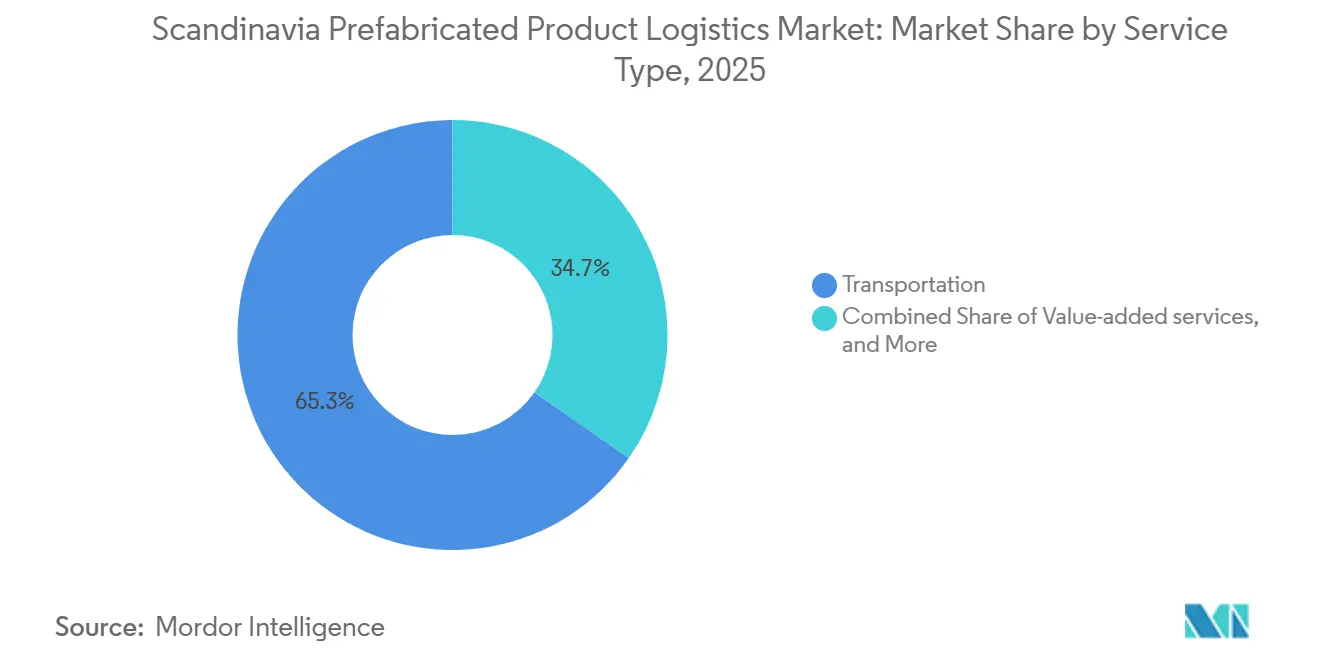
Transportation retained 65.25% of the Scandinavia prefabricated product logistics market share in 2025. Three-dimensional modules and large-panel systems required specialized road haulage for most domestic movements. Short-sea and RoRo ferry services handled crossings among Scandinavian and Baltic locations. Rail held a narrower role for flat panels on approved Swedish intermodal corridors. The Swedish Transport Agency’s High-Capacity Transport framework supported longer-combination vehicles on designated routes. Transportation, therefore, remained the essential physical link between factory output and site installation.
Value-added services were forecast to grow at 6.71% annually through 2031. Warehousing and storage provided staging capacity at regional consolidation points. This service helped producers separate factory release schedules from construction-site readiness. It became more useful when Sweden’s 2025 construction downturn created timing gaps between module production and site access. Developers outsourced crane-slot sequencing, installation-order planning, track-and-trace, and construction-platform coordination to providers that could manage delivery risk. Scandinavian Express transported a precast element exceeding 30 meters in a single movement in April 2026, demonstrating the precision required for complex heavy-load assignments. The service category gained importance because site constraints raised the cost of an incorrectly timed delivery.



By Product Type: Volumetric Modules Command Premium, Panelized Systems Grow on Speed
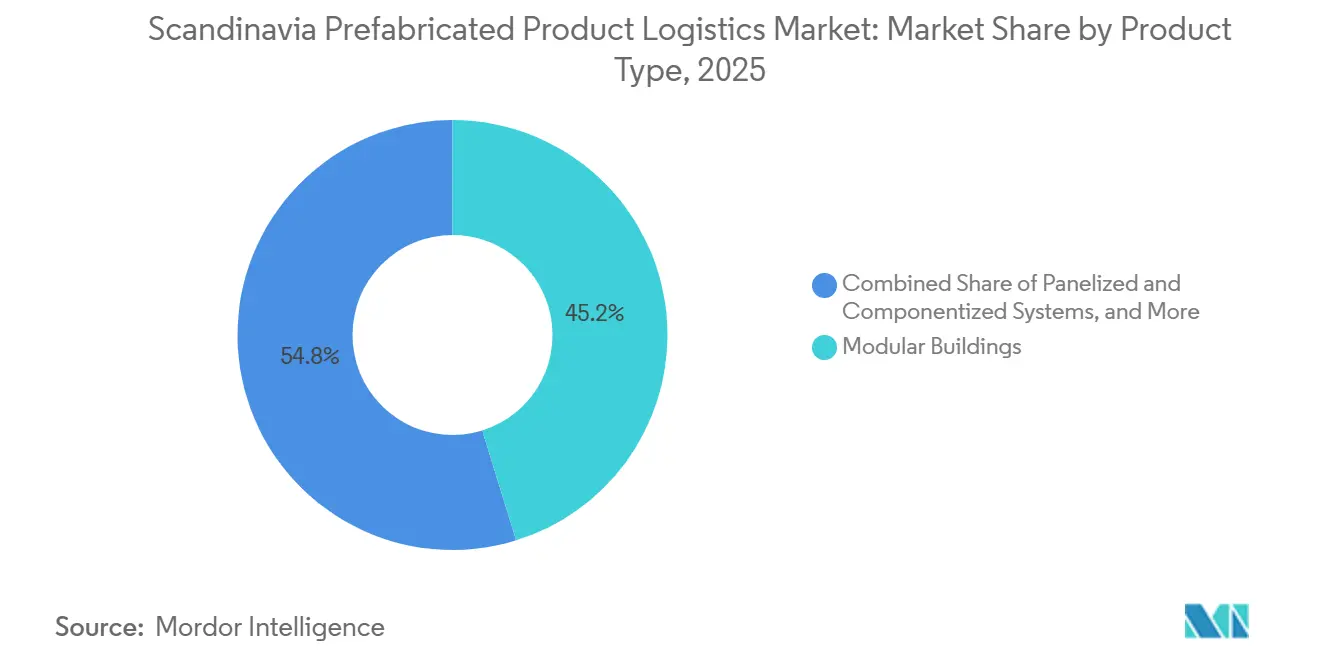
Modular buildings held a 45.15% share of the Scandinavia prefabricated product logistics market size in 2025. Norway and Sweden used three-dimensional timber modules in residential, education, and hospitality construction. These movements required equipment suited to height, width, and weight limits. The segment created a higher logistics premium because carriers needed permits, escorts, and planned crane activity. Large modules also left less room to alter delivery timing after production. This made dependable route planning central to the segment’s economics.
Panelized and componentized systems were forecast to grow at 6.45% annually through 2031. Their flatpack geometry avoided some width and height triggers that required police escorts on standard roads. Realdania By & Byg’s MiniCO2 Etagehus PREFAB project in Fredericia was assembled on site in 2 days from factory-built panels, while the five-story building was completed in 6 months. Panel movements can be planned in concentrated and sequenced deliveries for dense urban sites. Digital fabrication also links cutting lists with route planning and crane scheduling. Denmark’s BR18 technical requirements were more straightforward to document for factory-certified panel systems, reinforcing their fit with fixed public procurement schedules.
By Application: Residential Provides Volume, Commercial Accelerates on Program Compression
Residential buildings accounted for 49.20% of the Scandinavia prefabricated product logistics market share in 2025. Sweden’s single-family house-factory model and multifamily programs supported this demand across the region. The segment relied on recurring factory-to-site corridors where providers could build route-specific knowledge. Sweden’s house-building supply base also allowed repeat delivery patterns and pre-approved permit libraries. Statistics Norway recorded residential permits in Q2 2026 at 10.1% below the equivalent quarter in 2025. For approved projects, this reinforced the value of faster and more predictable delivery.
Commercial buildings were forecast to grow at 5.95% annually through 2031. Office, hospitality, and logistics hub projects placed a higher value on short build programs and planned site access. CREE Buildings delivered prefab wall elements to the Osterbrogade 190 project in Copenhagen, where the site had no on-site storage and required just-in-time deliveries of elements up to 3.35 meters high. The Others segment included welfare facilities, temporary health care units, and redeployable education buildings. ISO 668 container dimensions broadened the carrier pool for relevant units and reduced per-unit logistics costs compared with bespoke projects. Commercial and other projects offered stronger margins when schedule sensitivity and site complexity supported pricing.
Geography Analysis
Sweden held 41.70% of the Scandinavia prefabricated product logistics market share in 2025. Its position reflected coordinated investment in factory-based construction and intermodal transport capacity. Construction investment recovered in 2026 after a 2025 contraction, and dwelling starts approached 33,700 units. Gothenburg supported movements of prefabricated components to Germany, Denmark, and the United Kingdom. The Boden-Lulea corridor also emerged as a logistics node tied to green steel and battery manufacturing. High-Capacity Transport routes under TSFS 2025:17 improved efficiency for approved longer-combination vehicles. These routes helped domestic residential and commercial modular deliveries.
Norway recorded the fastest country CAGR at 6.15% through 2031. The country’s labor, regulatory, and geographic conditions favored investment in factory-built delivery models. Residential permits in Q2 2026 were 10.1% below the equivalent quarter in 2025. This concentrated demand around approved projects where speed carried greater value. Fjord terrain and island geography added ferry, escort, and seasonal road constraints. The February 2026 transport regulation revisions increased planning requirements for some oversized loads. The country remained both a destination and a source of specialized prefab movements.
Denmark’s logistics demand centered on dense city environments and social housing programs. Housing starts rebounded substantially in Q2 2026, especially in apartment development. Copenhagen, Aarhus, and Odense shaped the resulting delivery requirements. Summer conditions in the Baltic Sea supported cross-border shipments from Swedish and Polish suppliers. Winter North Sea conditions required planning buffers for western and island deliveries. The MiniCO2 Etagehus PREFAB program showed a batch-delivered, crane-sequenced, just-in-time model in Fredericia. Its project structure reduced cumulative site operating needs relative to traditional staged deliveries.
Competitive Landscape
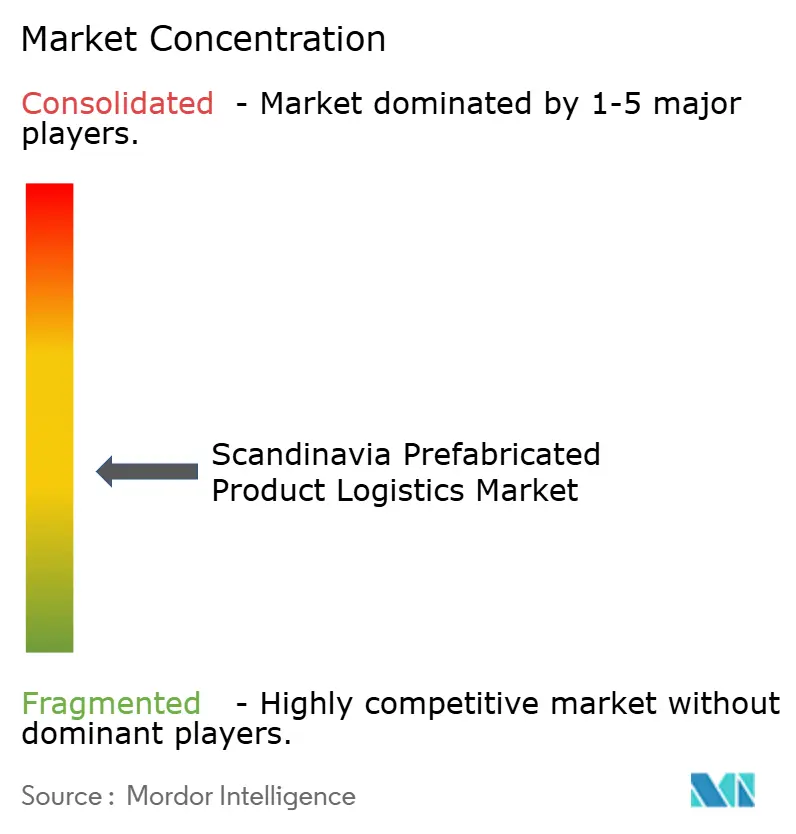
The Scandinavia prefabricated product logistics market was moderately fragmented across integrators, specialist heavy-haulage operators, and project logistics providers. No single operator held a pan-regional dominant position. PostNord reported plans for a modern parcel and logistics terminal in Timra, Northern Sweden, for operation in 2028. These companies competed through network coverage and established freight capacity. Specialized carriers competed through oversized-load permits, equipment availability, and detailed knowledge of local routes.
The Scandinavia prefabricated product logistics market also had room for providers that joined physical transport with construction planning. BIM-linked delivery sequencing, real-time load tracking, and crane-crew coordination were increasingly relevant on high-specification projects. CREE Buildings’ Copenhagen work showed the operational importance of timed delivery where a site had no storage area. Scandinavian Express demonstrated heavy-load capability by moving a precast element longer than 30 meters in 1 operation in April 2026. These assignments required planning capacity beyond general freight forwarding. They also gave established niche operators an advantage where a project involved unusually large or time-sensitive components.
Sustainability became another basis for competition in the Scandinavia prefab product logistics market. Frode Laursen published its 2025 sustainability report in June 2026 and disclosed approval of its near-term science-based emissions targets in May 2026. The company had also reported 7% revenue growth in 2025, driven by new grocery and industrial clients. Providers that could report shipment emissions supported developers preparing life-cycle assessment and sustainability documentation. This gave verified operational data a role in procurement. Competition therefore remained fragmented, while service depth and documented performance influenced project selection.
Scandinavia Prefabricated Product Logistics Industry Leaders
Scandinavian Express
PostNord AB
DFDS A/S
Frode Laursen A/S
Flexilast Ekonomisk Forening
- *Disclaimer: Major Players sorted in no particular order

Recent Industry Developments
- September 2026: ESL Shipping completed its 12-vessel Green Coaster program with the handover of Luxomar on September 8, 2026. The 5,400 DWT plug-in hybrid general cargo vessel carries Ice Class 1A certification, a 1 MWh battery pack, and shore-power connectivity, targeting nearly 50% lower CO₂ emissions per cargo unit than the previous fleet generation. The completion of the program significantly strengthened ESL Shipping's low-emission short-sea capacity on Baltic and Norwegian coastal routes relevant to prefab product logistics.
- August 2026: Frode Laursen A/S announced that it would deploy solar panels on 150 trucks and refrigerated trailers following a seven-month pilot program in which no battery breakdowns occurred. The fleet-wide rollout reduces reliance on conventional power during vehicle rest stops and supports the company's SBTi-approved decarbonization targets.
- June 2026: Tschudi Logistics AS announced investment in a multimodal terminal in northwest Ukraine through Tschudi Logistics Poland and participated in the UkraineRecovery Conference in Gdansk, presenting its partnership with Aries Industrial Group and expanding its project logistics footprint in eastern European reconstruction corridors.
- June 2025: Tschudi Logistics AS executed the delivery of prefabricated hotel modules from Norway to Iceland, confirming the commercial viability of the sub-Arctic North Atlantic prefab logistics corridor and establishing a routing precedent for volumetric cargo on that lane.


Scandinavia Prefabricated Product Logistics Market Report Scope
| Transportation | Road |
| Rail | |
| Air | |
| Sea and Inland Waterways | |
| Warehousing and Storage | |
| Value-Added Services |
| Modular Buildings |
| Panelized and Componentized Systems |
| Other Prefab Types |
| Residential Buildings |
| Commercial Buildings |
| Others |
| Denmark |
| Norway |
| Sweden |
| By Service | Transportation | Road |
| Rail | ||
| Air | ||
| Sea and Inland Waterways | ||
| Warehousing and Storage | ||
| Value-Added Services | ||
| By Product Type | Modular Buildings | |
| Panelized and Componentized Systems | ||
| Other Prefab Types | ||
| By Application | Residential Buildings | |
| Commercial Buildings | ||
| Others | ||
| By Country | Denmark | |
| Norway | ||
| Sweden |


Key Questions Answered in the Report
What was the value of Scandinavia prefab product logistics in 2026?
The sector was estimated at USD 1.09 billion in 2026 and was forecast to reach USD 1.40 billion by 2031.
What growth rate was projected through 2031?
The forecast CAGR is 5.10% from 2026 to 2031.
Which service accounted for the largest revenue share?
Transportation commanded 65.25% revenue share in 2025 because road and short-sea movements remained essential for large prefab units.
Which product category grew fastest through 2031?
Panelized and componentized systems recorded the highest projected CAGR at 6.45%, supported by flatpack transport geometry and urban delivery needs.
Which country led regional demand?
Sweden held 41.70% revenue share in 2025, supported by industrialized construction, established freight corridors, and export links.
Why did providers need delivery coordination capabilities?
Timed deliveries, permit planning, crane scheduling, and site restrictions increased the value of coordinated logistics services.
Page last updated on:





