
Scaffolding Market Size and Share
Market Overview
| Study Period | 2021 - 2032 |
|---|---|
| Market Size (2027) | USD 62.34 Billion |
| Market Size (2032) | USD 77.72 Billion |
| Growth Rate (2027 - 2032) | 4.51 % |
| Fastest Growing Market | Asia-Pacific |
| Largest Market | Asia-Pacific |
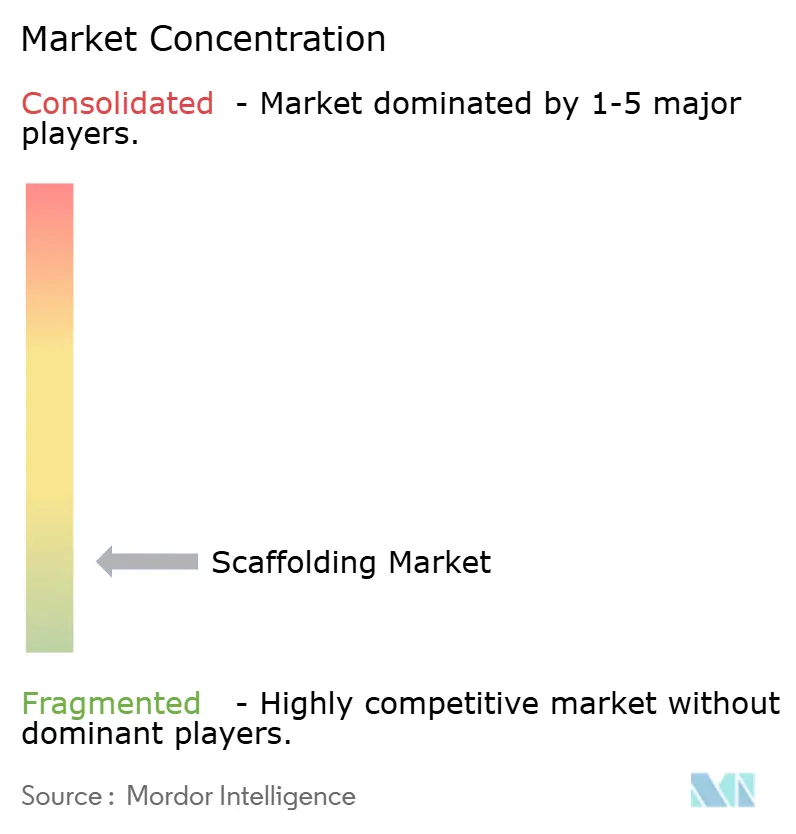
| Market Concentration | Low |
Major Players *Disclaimer: Major Players sorted in no particular order Image © Mordor Intelligence. Reuse requires attribution under CC BY 4.0. | |
Scaffolding Market Analysis by Mordor Intelligence
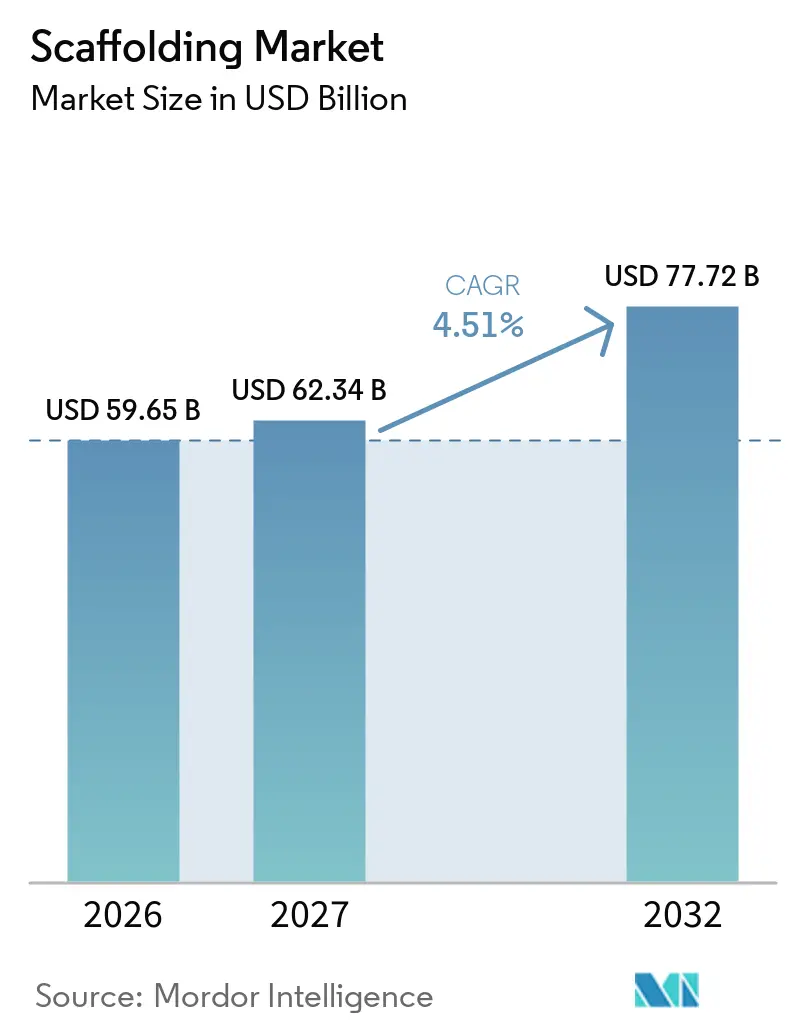
The Scaffolding Market size was valued at USD 59.65 billion in 2026 and is estimated to grow from USD 62.34 billion in 2027 to reach USD 77.72 billion by 2032, at a CAGR of 4.51% during the forecast period (2027-2032).
Public spending on transport, utilities, and urban construction gives the Scaffolding market a broad base of project demand across several asset classes. In contrast, long project schedules create equipment needs during structural work, finishing, testing, inspection, and later repair work. Renovation activity also supports equipment use in established cities because existing buildings require access during repair and energy upgrades, often with more constrained site conditions than new construction. Certified systems are becoming more important as contractors face higher documentation and safety requirements, and suppliers are responding with modular equipment, engineering support, delivery services, inspection support, and rental services that reduce work on site. This changes procurement decisions because buyers increasingly consider installation speed, labor needs, documented compliance, equipment availability, logistics, and the capacity to modify access arrangements as the project develops, rather than evaluating the initial equipment price alone. Material costs and shortages of trained workers remain important limits on margins and installation capacity because fixed-price contracts may not allow providers to recover higher fleet replacement, transport, storage, and specialist labor costs quickly.
Key Report Takeaways
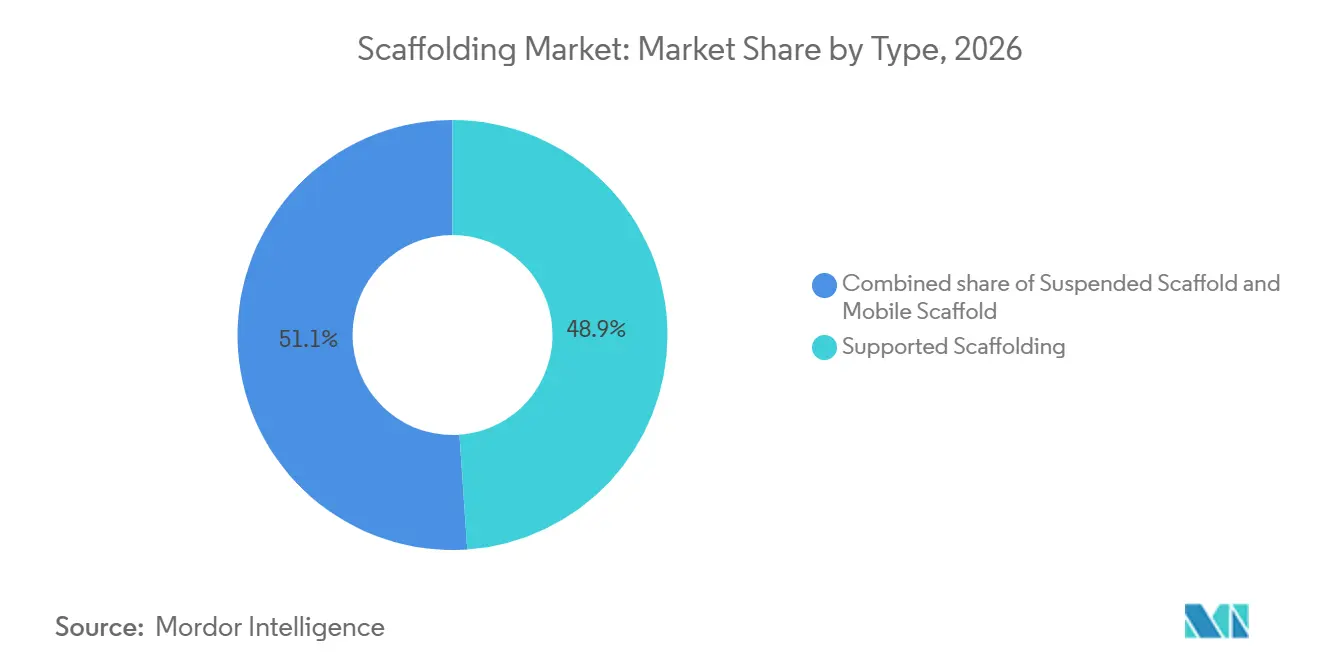
- By type, supported scaffolding held 48.9% of the Scaffolding market share in 2026, while the same segment is projected to grow at a 5.21% CAGR through 2032.
- By system, tube and coupler accounted for 35.7% of the scaffolding market size in 2026, while modular / ringlock systems are projected to grow at a 5.33% CAGR through 2032.
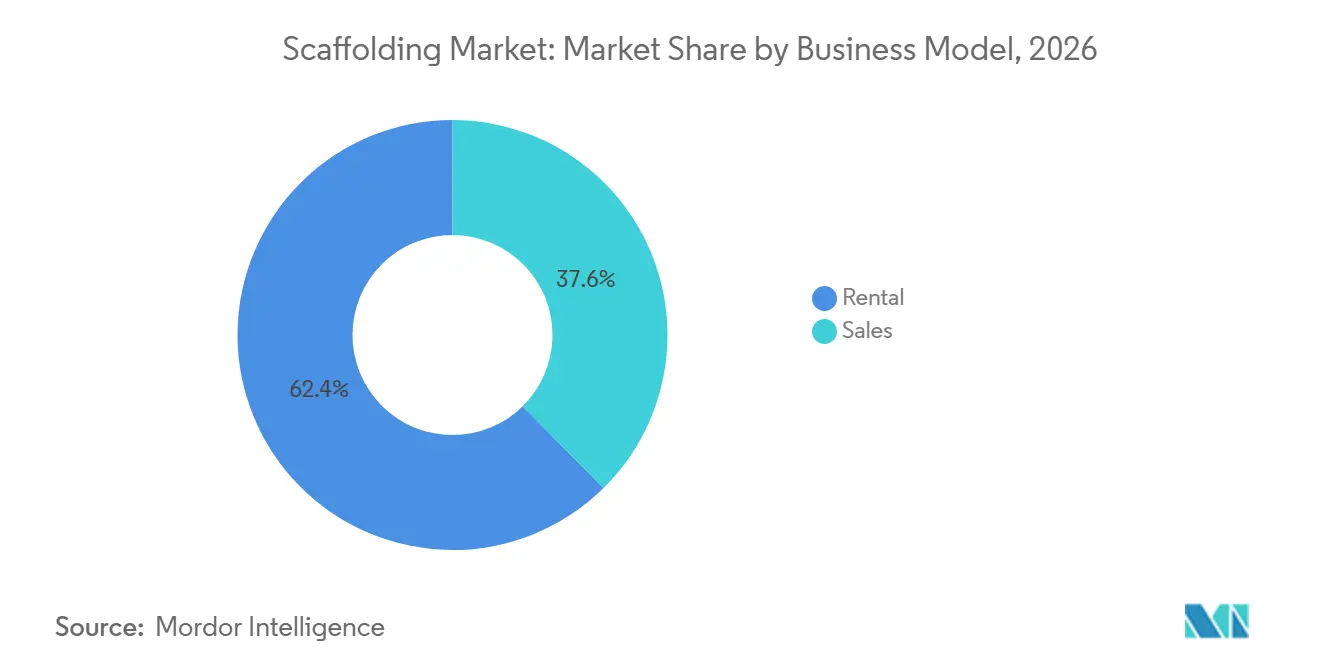
- By business model, rental held 62.4% of the market in 2026, while sales are projected to grow at a 5.15% CAGR through 2032.
- By material type, steel held 52.5% of the market in 2026, while aluminum is projected to grow at a 5.65% CAGR through 2032.
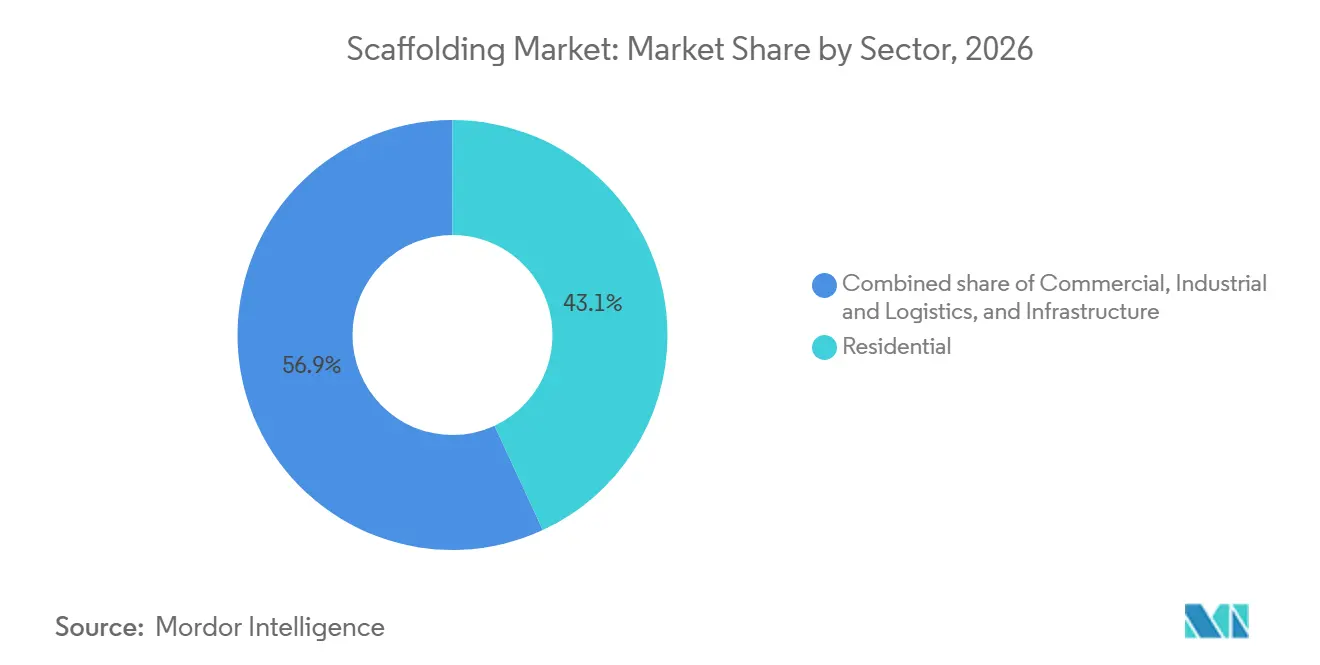
- By sector, residential held 43.1% of the market in 2026, while the same residential segment is projected to grow at a 5.51% CAGR through 2032.
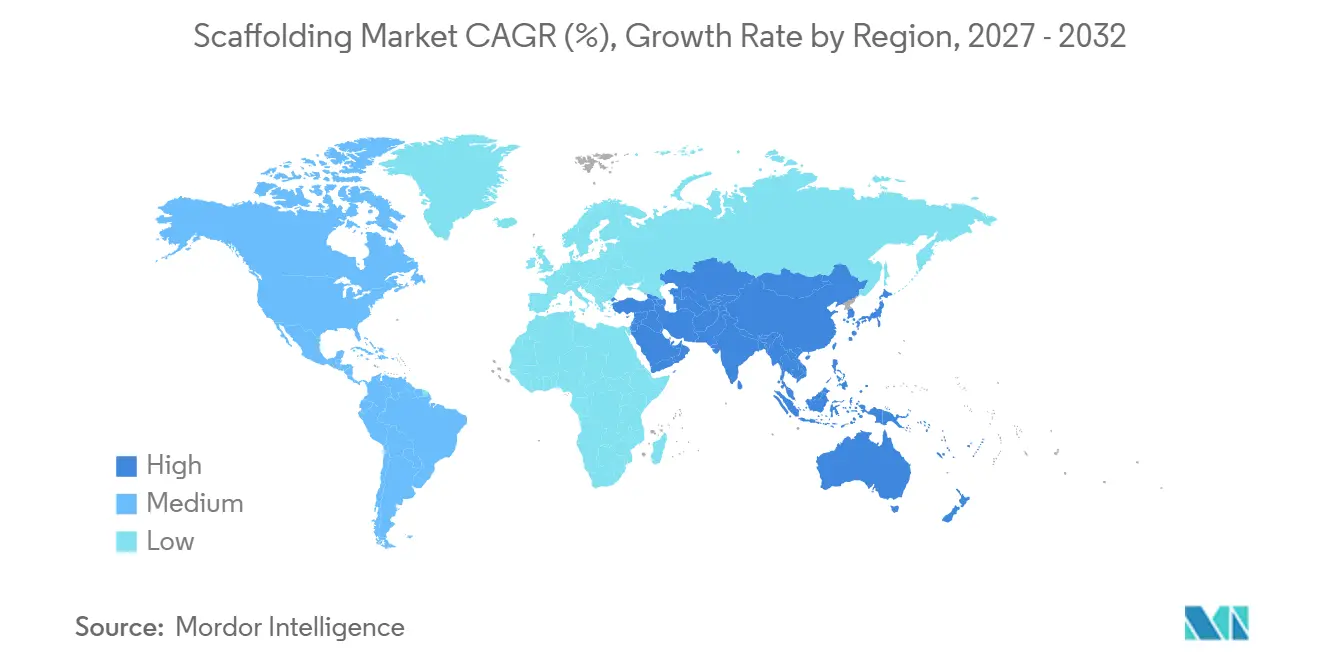
- By geography, Asia-Pacific held 37.1% of the market in 2026, while Asia-Pacific is projected to grow at a 5.89% CAGR through 2032.
Note: Market numbers in this report are based on Mordor Intelligence's proprietary estimation framework, which combines nine months of actuals with Q4 projections for base year 2026.
Market Trends and Insights
Drivers Impact Analysis of Scaffolding Market*
| Drivers | (~) % Impact on CAGR Forecast | Geographic Relevance | Impact Timeline |
|---|---|---|---|
| Government Investment in Transportation Infrastructure | +1.2% | Global, with greatest intensity in Asia-Pacific, the Middle East, and North America | Long term (≥ 4 years) |
| Growth in High-Rise Residential and Commercial Construction | +0.9% | Asia-Pacific, with spillover to the Middle East and Africa | Long term (≥ 4 years) |
| Renovation and Restoration of Aging Buildings | +0.7% | North America, Europe, Japan, and Australia | Medium term (2-4 years) |
| Stricter Construction Safety Regulations | +0.6% | Global, with high compliance intensity in Europe, North America, and Australia | Medium term (2-4 years) |
| Industrial Maintenance and Turnaround Activity | +0.5% | Middle East, North America, South Korea, and Japan | Long term (≥ 4 years) |
| Shipbuilding and Offshore Energy Expansion | +0.4% | South Korea, Japan, Vietnam, the Middle East, and the North Sea | Long term (≥ 4 years) |
| Source: Mordor Intelligence | |||
Government Investment in Transportation Infrastructure
Government transport programs provide a durable source of work because they create repeated access needs across construction, finishing, and inspection stages. Unlike a single procurement event, these programs can require access equipment as structures move from foundations to elevated work, finishing, and later maintenance. India allocated USD 133.1 billion to public capital expenditure for fiscal year 2026 to 2027. Roads and railways received significant support within this program, alongside planned high-speed rail corridors and national highway construction. Project owners may divide this activity into several packages, which means access providers can support more than one contractor or work phase within the same wider program. These projects require access equipment over several years rather than for a single short installation. Suppliers can plan fleet deployment with greater confidence when work is tied to a funded pipeline rather than a short private construction cycle. The work can also create demand for design changes as sites move from structural access to finishing and inspection. This structure supports rentals, engineered design services, and recurring equipment demand in the Scaffolding market. It also allows contractors to develop familiarity with a system across several project packages, which can simplify training and site coordination[1].
Growth in High-Rise Residential and Commercial Construction
High-rise construction increases the need for safe façade access across several floors at the same time. The work can involve structural completion, external cladding, glazing, painting, repair, and inspection, often while other activities continue inside the building and while ground space is shared with deliveries, workers, and neighboring properties. Supported systems remain relevant where ground-based load transfer is practical, and project conditions permit it. Suspended and modular configurations are used where building height or restricted ground space makes those designs more suitable. Faster floor-by-floor installation can reduce time spent repositioning equipment and help contractors manage labor availability. This matters when several trades need scheduled access to the same façade without disrupting the overall work sequence, which can otherwise create delays between subcontractors. Completed towers also create ongoing maintenance work that extends demand beyond the initial construction period. The Scaffolding market therefore benefits from both new urban construction and later façade maintenance[2].
Renovation and Restoration of Aging Buildings
Renovation work supports access demand because repairs must often proceed around occupied spaces and existing structural features. Unlike greenfield construction, refurbishment crews may need to protect surrounding surfaces, maintain entrances, keep parts of a building open, and work around services that cannot be interrupted while repairs are completed. Building codes, energy-efficiency requirements, and physical deterioration can sustain these projects when new construction slows. Existing buildings may require more complex layouts than new sites because workers must protect residents and keep essential areas accessible. This can increase the value of engineered designs and trained installation crews that can adapt to limited access points, occupied floors, and sensitive surfaces. Maintenance and seismic reinforcement also provide repeated work in mature economies, including Japan. Renovation can help suppliers keep equipment deployed between larger new-build projects. The Scaffolding market has a more stable source of demand when renovation programs complement new construction[3].
Stricter Construction Safety Regulations
Safety requirements are raising demand for equipment that has defined load, stability, and assembly documentation. Project teams increasingly need to show how temporary access structures will be used, inspected, and modified as site conditions change. Modular systems can provide standardized components and engineering records that are easier to review on complex sites. These requirements can make informal installations less competitive when projects require formal approval. Contractors also place more value on suppliers that can provide training, design support, and compliance records. Clear documentation can reduce uncertainty for site managers, insurers, and project owners who need evidence that equipment has been selected and assembled correctly. The same requirements can influence how contractors choose suppliers because they need reliable information before a project begins and responsive technical advice when a layout changes. Equipment providers that understand local rules can also help customers avoid delays caused by incomplete plans or missing inspection records. A certified system does not eliminate the need for proper installation, but it gives crews a more consistent basis for planning and checking the work. This shift favors suppliers with established quality processes and broad service capacity. It also makes safety documentation a meaningful purchasing factor in the Scaffolding market.
Restraints Impact Analysis of Scaffolding Market*
| Restraints | (~) % Impact on CAGR Forecast | Geographic Relevance | Impact Timeline |
|---|---|---|---|
| Steel and Aluminum Price Volatility | -0.8% | Global, especially North America and Asia-Pacific procurement markets | Medium term (2-4 years) |
| Shortages of Certified Scaffold Erectors and Inspectors | -0.5% | United Kingdom, Australia, North America, and selected Asian markets | Long term (≥ 4 years) |
| High Transportation and Storage Costs | -0.3% | Global, particularly Africa, South America, and Oceania | Medium term (2-4 years) |
| Differences in Certification and Safety Standards | -0.2% | Global, with higher cross-border friction in ASEAN, the Middle East, and Europe | Long term (≥ 4 years) |
| Source: Mordor Intelligence | |||
Steel and Aluminum Price Volatility
Material costs affect manufacturers, rental providers, and contractors because steel and aluminum form the base of many equipment fleets. A change in input pricing can affect the cost of replacement stock, repair parts, and new system capacity at the same time. The producer price index for aluminum mill shapes increased 30.5% between December 2024 and December 2025. Steel mill product prices increased 17% over the same period. Higher replacement costs can cause rental providers to postpone fleet upgrades or extend the use of existing assets. Project-specific rental rates may not always rise quickly enough to recover those costs when contracts are competitively tendered. Providers can face added pressure when a project requires specialized components that cannot be replaced with standard fleet equipment. Purchasing decisions may then depend on expected utilization, available storage, and whether a longer contract offers sufficient certainty to justify replacement. This may narrow the ability of smaller operators to refresh fleets while continuing to meet customer expectations during periods of strong ongoing demand. Price pressure can also limit the appeal of aluminum systems for cost-sensitive operators despite their handling advantages.
Shortages of Certified Scaffold Erectors and Inspectors
A shortage of trained workers limits the number of projects that contractors can install and supervise safely. The effect extends beyond direct labor because fewer qualified workers can slow inspections, changes to access layouts, and the release of equipment for the next project. Training takes time, which makes this constraint difficult to resolve quickly during periods of strong construction activity. Contractors may focus skilled crews on complex infrastructure and industrial work where returns are higher. Smaller contracts can become harder to staff, particularly when work requires certified inspection. Labor constraints can raise the value of systems that are faster to assemble and easier to document. Better planning can help allocate available crews, but it cannot fully replace site experience on difficult access work. Firms may also need to manage travel, supervision, and training commitments when teams work across several locations. This can affect both the number of contracts accepted and the time needed to complete each installation. The Scaffolding industry must expand training capacity if equipment availability is to translate fully into installed project volume.
*Our forecasts treat driver/restraint impacts as directional, not additive. The impact forecasts reflect baseline growth, mix effects, and variable interactions.
Scaffolding Market Segment Analysis
By Type:
Supported Scaffolding Leads Broad Construction AccessSupported scaffolding accounted for 48.9% of the Scaffolding market size in 2026. Its position reflects its use across bridges, highways, exterior access, and multi-story buildings where the ground can carry the system load. Contractors can configure supported structures for varied elevations, work areas, and building shapes without changing the basic principle of ground-supported access. This flexibility makes the category suitable for public infrastructure and residential construction. It can be used on long infrastructure assets as well as urban projects where façades need sustained access. The system is familiar to many installers and can be adapted to different site layouts through planning and component selection. It also supports maintenance work when façades, structures, or industrial assets require long-duration access. These broad uses explain why the category leads the type classification even though more specialized access methods remain important.
Supported scaffolding is also the fastest-growing type, with a projected 5.21% CAGR through 2032. Large transport programs and urban building projects support this outlook because they require repeated work platforms during several project phases and across different parts of the same site. A bridge project may require access while foundations, piers, deck sections, finishing work, and inspections are completed. A residential project can use the same broad category for structural work, exterior finishing, and maintenance access after handover. Prefabricated modules can improve planning and reduce assembly time when designs are prepared in advance, and material deliveries follow the construction schedule. Building information modeling, often called BIM, can help project teams coordinate those modules with other site activities, including formwork, material movement, and safety planning. These planning tools do not remove the need for trained crews, but they can reduce uncertainty before installation begins. Suspended scaffolding remains important for high-rise façades and bridge soffits where ground support is not feasible. Mobile equipment serves interior work and maintenance that require frequent repositioning. The Scaffolding market therefore retains demand for several access designs even though supported systems lead the type classification.

By System:
Tube and Coupler Systems Lead While Modular / Ringlock Systems Grow FastestTube and coupler systems held 35.7% of the Scaffolding market size in 2026. Their continued use reflects the ability to adapt to irregular structures, dense industrial sites, and local repair needs. Contractors can alter the arrangement to work around pipes, plant equipment, and nonstandard building forms, which is often essential where a standard layout will not fit. This flexibility remains useful in mature industrial locations where conditions change frequently during maintenance or turnaround work. Traditional systems also benefit from broad familiarity among local crews and established suppliers. Repairs can often be completed with available components when equipment is used repeatedly across local projects. These practical advantages preserve demand even as modular systems gain ground on projects that require standardized documentation.
Modular / ringlock systems are forecast to expand at a 5.33% CAGR through 2032. Their components can support quicker assembly, consistent connection methods, and clearer load documentation than many site-built arrangements. These traits are valuable in projects that require engineering review, defined work sequences, and formal safety records before crews begin installation. Standard components can also make it easier for contractors to repeat a proven layout across similar floors, building elevations, or work zones. The benefit is especially relevant when a project has limited space for staging equipment or must coordinate several subcontractors. China has moved toward ringlock equipment as infrastructure-heavy work has increased the value of rapid deployment and standardized records. For suppliers, the opportunity is not limited to selling components because customers may also need design support, technical training, and project coordination. AT-PAC introduced modular ringlock lines at Bauma 2025 and expanded its European presence through new German operations. The Scaffolding market is consequently seeing system competition move beyond the cost of individual tubes and fittings.
By Business Model:
Rental Leads While Sales Grow FastestRental accounted for 62.4% of the market in 2026. Contractors often select rental because it avoids a large upfront equipment purchase and gives access to technical support. The model can also include delivery, engineering documentation, inspection, and on-site service. These features help contractors meet project requirements without maintaining large internal fleets. Rental is especially useful when project schedules or regulations change during delivery. An equipment provider can adjust the mix of components as the job develops, which is useful when access designs must be revised for site conditions. The customer can therefore focus more of its capital and management effort on construction delivery rather than asset ownership. These operating benefits support rental’s leading position in the Scaffolding market.
Sales are projected to expand at a 5.15% CAGR through 2032 as major contractors and industrial operators build owned inventories. Ownership can provide security when local supply is tight, a site requires frequent equipment use, or a contractor expects a predictable long-term volume of work. It can also help long-term industrial operators manage shutdown and maintenance work across repeated cycles without waiting for outside availability. The decision still requires buyers to manage storage, maintenance, inspection, replacement, and transport responsibilities. Rental providers carry replacement costs over the life of their fleets, which can moderate the contractor’s immediate exposure to material prices and reduce the administrative burden of maintaining compliant equipment. This difference explains why rental remains the larger category even while sales are forecast to grow faster. Sunbelt Rentals completed its acquisition of Superior Scaffold Services in February 2026, demonstrating interest in established regional access capacity. In the Scaffolding market, full-service rental platforms can compete by combining equipment availability with local logistics and technical support.
By Material Type:
Steel Maintains Its Lead While Aluminum Gains TractionSteel held 52.5% of the market in 2026 and remains central to heavy civil and industrial applications. Its load capacity, availability, and compatibility with established designs make it suitable for demanding sites. Existing fleet composition also makes steel practical for many rental providers because replacement components and trained crews are widely available. Contractors familiar with steel systems can use existing procedures, tools, and workforce skills. These factors maintain steel’s importance where long spans, high loads, and repeated deployment are required. Steel’s established position also reduces the operational disruption that can arise when a provider changes a large fleet from one material system to another. The material remains a practical choice where durability and system compatibility matter more than reduced component weight.
Aluminum is forecast to grow at a 5.65% CAGR through 2032. Its lower weight can help crews move equipment more quickly on façades, suspended platforms, and marine sites, where repeated lifting and repositioning can extend installation time. Corrosion resistance also supports use in coastal, offshore, and shipbuilding environments that expose equipment to moisture and salt. Faster assembly can offset part of the higher material cost when labor is scarce, installation time is limited, or access conditions make heavy components harder to handle. The balance between initial cost and total installed cost differs by project, which limits a simple substitution of aluminum for steel. The 2025 increase in aluminum prices temporarily complicated fleet decisions for rental providers, particularly where customers focused on short-term equipment rates. Even so, applications that value reduced weight and corrosion resistance can sustain adoption. The Scaffolding market is likely to see continued aluminum use where these performance benefits are material to project execution. Timber and plywood remain in selected local applications but face pressure from tighter safety requirements and the preference for documented systems.
By Sector:
Residential Held the Largest Share and Is Projected to Grow FastestResidential construction held 43.1% of the Scaffolding market size in 2026. Government-backed housing targets and multi-storey development support this result in Asia-Pacific, South Asia, and the Middle East. Residential projects require exterior access during structural work, cladding, finishes, and later maintenance. Dense urban construction can also favor systems that use space efficiently and support staged delivery, especially where neighboring buildings limit ground space. Suppliers can serve this demand through equipment that is readily available in repeatable configurations for several building types. Rental and service support can be useful for contractors working across multiple housing sites with different schedules. This broad activity keeps residential work important for suppliers and rental providers.
Residential construction is also forecast to grow at a 5.51% CAGR through 2032. Commercial work contributes through office renovation, data center fit-out, and hospitality projects, each of which can require internal or external temporary access during construction and refurbishment. Plant maintenance, liquefied natural gas terminals, and chemical capacity additions support industrial and logistics demand. Major processing facilities commonly require periodic turnaround work that calls for specialized access equipment, careful sequencing, and crews familiar with operating sites. Infrastructure remains smaller by sector share but can produce high equipment value per project because access needs persist across multiple phases and are often spread across a wide area. Contractors serving several sectors can reduce their dependence on any individual building cycle and keep fleets active throughout the year. This mix gives the Scaffolding market exposure to construction, refurbishment, and industrial maintenance cycles. It also raises the value of suppliers that can serve different site conditions without requiring customers to manage multiple equipment partners.
Geography Analysis
Asia-Pacific held 37.1% of global demand in 2026 and is forecast to grow at a 5.89% CAGR through 2032. China’s infrastructure investment increased 8.9% year over year in the first quarter of 2026, supporting work in civil aviation, waterways, power grids, and urban pipelines. India’s capital program supports road, railway, and urban development at the same time, creating overlapping work streams for construction access providers. Australia adds demand through transport, utility, and renewable transmission projects that often require complex staging across long distances. Japan’s maintenance and resilience programs support access needs for aging infrastructure, where repair work can repeat across existing assets. South Korea and Vietnam also offer marine and offshore opportunities tied to shipbuilding and energy projects. The Scaffolding market in the region therefore draws demand from both new assets and maintenance of established infrastructure.
North America and Europe form a large and stable base for the Scaffolding market. Infrastructure renewal and formal safety rules support continuing demand even when private commercial construction is less active. In the United States, public construction spending reached USD 511.6 billion in May 2025, according to the supplied draft, providing a base for access work across public facilities and transport assets. The United Kingdom is supported by planned investment in water, electricity, roads, and railways. European suppliers also face higher expectations for system documentation, engineered design, inspection records, and trained installation. These requirements can increase the value of established technical support because contractors need equipment that can be approved and deployed without avoidable delay. Certified providers with broad service coverage are therefore well positioned across the region.
The Middle East benefits from Saudi Arabia’s Vision 2030 program, stadium construction, and refinery maintenance in Gulf countries. South America has targeted opportunities in ports, offshore energy, and social housing programs in Brazil, Argentina, and Chile. Africa remains concentrated in infrastructure work, mining maintenance in South Africa, and urban construction in Nigeria and Egypt. Projects in these regions can have complex logistics because equipment must be delivered, stored, maintained, and moved in conditions that differ from dense urban markets. This can favor providers that understand local access requirements and can organize service support near the customer. The regional mix reduces dependence on a single construction cycle because demand comes from infrastructure, renovation, industrial maintenance, and urban development. This geographic diversity supports the Scaffolding market when activity in one region slows. It also increases the importance of adaptable fleets, local service networks, and equipment that can be configured for varied site conditions.
Competitive Landscape
The Scaffolding market is fragmented at the project-delivery level. BrandSafway, Layher, PERI, ULMA, HAKI Safety, and Altrad compete with many regional and national suppliers. Larger providers seek wider service portfolios and broader geographic coverage because customers may need equipment, engineering, delivery, inspection, and labor support through one contract. BrandSafway operates through 340 locations in 25 countries and employs 40,000 people. Regional firms remain important because installation, logistics, and site knowledge are often locally delivered. Their proximity to customer sites can be a practical advantage when projects need rapid delivery or changes to an access layout.
Acquisitions are a major route to scale in the Scaffolding market. Altrad merged Generation Hire and Sales with TRAD UK into Altrad Hire and Sales in September 2026. The combined operation brings scaffolding, temporary works, fencing, and safety equipment under one commercial platform across the United Kingdom and Ireland. Alimak Group acquired Pro-Bel in July 2026 for USD 142 million, expanding its suspended access and fall-protection offering in North America. Alimak stated that Pro-Bel joins its Facade Access division under its New Heights strategy. These moves show how larger companies are adding local capacity and specialized access capabilities rather than relying only on organic branch expansion.
Technology and compliance shape competitive position as strongly as equipment price. AT-PAC combines ringlock systems with BIM-compatible planning and integrated engineering support in Europe. This approach moves competition toward project coordination, documented design, and labor efficiency, which can matter more than a lower component price on regulated sites. Muehlhan Industrial Services acquired Steigerbouw van der Panne in October 2025, adding scaffolding capability for industrial, offshore, infrastructure, and construction work in Belgium and the Netherlands. White-space opportunities remain in marine and offshore work, petrochemical turnaround access, and emerging regions where infrastructure activity has grown faster than local rental fleets. These applications can require equipment that resists corrosion, operates in confined areas, or supports complex inspection and maintenance routines. Suppliers that pair specialized equipment with planning and compliance support may have stronger access to these projects. The Scaffolding market can therefore reward firms that combine physical equipment with technical services and responsive local delivery.
Scaffolding Industry Leaders
-
PERI India Pvt. Ltd.
-
Doka India Private Limited
-
Layher Scaffolding Systems Pvt Ltd
-
ULMA Formwork Systems India Pvt. Ltd
-
RMD Kwikform India Private Limited
- *Disclaimer: Major Players sorted in no particular order
Scaffolding Market Companies Covered in this Report
- PERI India Pvt. Ltd.
- Doka India Private Limited
- Layher Scaffolding Systems Pvt Ltd
- ULMA Formwork Systems India Pvt. Ltd
- RMD Kwikform India Private Limited
- Technocraft Industries, India Ltd.
- JRS Scaffoldings
- Finomax Scaffolding (I) Pvt. Ltd.
- Expee Engineering Private Limited
- Iron Ridge Scaffolding and Engineering (I) Pvt. Ltd.
- AMCO Exports
- Wheels Scaffolding (India) Ltd.
- Winntus Formwork Private Limited
- Ananta Formwork Private Limited
- Nexrise India Infra Pvt. Ltd.
- Hindustan Scaffolding and Formwork Pvt. Ltd.
- Safeway Scaffolding and Formwork Pvt. Ltd.
- BSL Scaffolding Ltd
- Bharat Scaffolding Co.
- Shreeji Scaffolding Pvt. Ltd.
- BrandSafway India / SGB BrandSafway
- K-nest Manufacturers Private Limited
- MSafe Group
- MTandT Rentals Limited
- Translite Scaffolding Ltd.
Recent Industry Developments in Scaffolding Market
- September 2026: Altrad merged Generation Hire & Sales and TRAD UK into Altrad Hire & Sales, effective 1 September 2026, combining two of the United Kingdom’s prominent scaffolding and construction hire brands under one commercial platform. The merged entity serves customers across the United Kingdom and Ireland through a consolidated branch network offering scaffolding, temporary works, fencing, and safety equipment.
- September 2026: Acrow Limited completed its acquisition of AusGroup Industrial Services following Australian Competition and Consumer Commission Phase 1 clearance in August 2026. AusGroup provides scaffolding, insulation, and surface protection to resources and energy customers in Queensland, strengthening Acrow's industrial access platform in North Queensland's mining and infrastructure markets.
- July 2026: Alimak Group closed its acquisition of Pro-Bel Group Ltd., a Toronto-area provider of suspended access and fall protection solutions, for USD 142 million. Pro-Bel generated USD 49 million in revenue in the 12 months to April 2026 and was consolidated into Alimak’s Facade Access division, expanding the group’s coverage of low- and mid-rise building maintenance across North America.
Global Scaffolding Market Report Scope
Segmentation Overview
| Supported Scaffold |
| Suspended Scaffold |
| Mobile Scaffold |
| Tube and Coupler |
| Cuplock |
| Modular / Ringlock |
| Frame / H-Frame |
| Sales |
| Rental |
| Timber / Plywood |
| Steel |
| Aluminum |
| Plastic / Fiberglass |
| Other Material Types |
| Residential |
| Commercial |
| Industrial and Logistics |
| Infrastructure |
| North America | United States |
| Canada | |
| Mexico | |
| South America | Brazil |
| Argentina | |
| Chile | |
| Rest of South America | |
| Europe | Germany |
| United Kingdom | |
| France | |
| Italy | |
| Spain | |
| Russia | |
| Rest of Europe | |
| Asia-Pacific | China |
| India | |
| Japan | |
| South Korea | |
| Australia | |
| Rest of Asia-Pacific | |
| Middle East | United Arab Emirates |
| Saudi Arabia | |
| Turkey | |
| Rest of Middle East | |
| Africa | South Africa |
| Nigeria | |
| Egypt | |
| Rest of Africa |
| By Type | Supported Scaffold | |
| Suspended Scaffold | ||
| Mobile Scaffold | ||
| By System | Tube and Coupler | |
| Cuplock | ||
| Modular / Ringlock | ||
| Frame / H-Frame | ||
| By Business Model | Sales | |
| Rental | ||
| By Material Type | Timber / Plywood | |
| Steel | ||
| Aluminum | ||
| Plastic / Fiberglass | ||
| Other Material Types | ||
| By Sector | Residential | |
| Commercial | ||
| Industrial and Logistics | ||
| Infrastructure | ||
| By Geography | North America | United States |
| Canada | ||
| Mexico | ||
| South America | Brazil | |
| Argentina | ||
| Chile | ||
| Rest of South America | ||
| Europe | Germany | |
| United Kingdom | ||
| France | ||
| Italy | ||
| Spain | ||
| Russia | ||
| Rest of Europe | ||
| Asia-Pacific | China | |
| India | ||
| Japan | ||
| South Korea | ||
| Australia | ||
| Rest of Asia-Pacific | ||
| Middle East | United Arab Emirates | |
| Saudi Arabia | ||
| Turkey | ||
| Rest of Middle East | ||
| Africa | South Africa | |
| Nigeria | ||
| Egypt | ||
| Rest of Africa | ||
Key Questions Answered in the Report
What is the forecast value of the scaffolding market in 2032?
The scaffolding market is forecast to reach USD 77.72 billion by 2032, growing at a 4.51% CAGR from 2027.
Which scaffolding type has the largest share?
Supported scaffolding leads by type with a 48.9% share in 2026 and is projected to grow at a 5.21% CAGR through 2032.
Why are modular / ringlock systems gaining adoption?
Faster assembly, consistent connections, and stronger documentation support their projected 5.33% CAGR through 2032.
Which material is expanding fastest for access systems?
Aluminum is the fastest-growing material, with a projected 5.65% CAGR through 2032, supported by its lower weight and corrosion resistance.
Which region is expected to grow fastest?
Asia-Pacific is forecast to grow at a 5.89% CAGR through 2032 and held 37.1% of global demand in 2026.
What limits scaffolding demand and supplier margins?
Steel and aluminum price volatility, shortages of certified workers, logistics costs, and differing national standards can constrain equipment supply and installation capacity.