
Saudi Arabia Takaful Market Size and Share
Market Overview
| Study Period | 2021 - 2032 |
|---|---|
| Forecast Data Period | 2027 - 2032 |
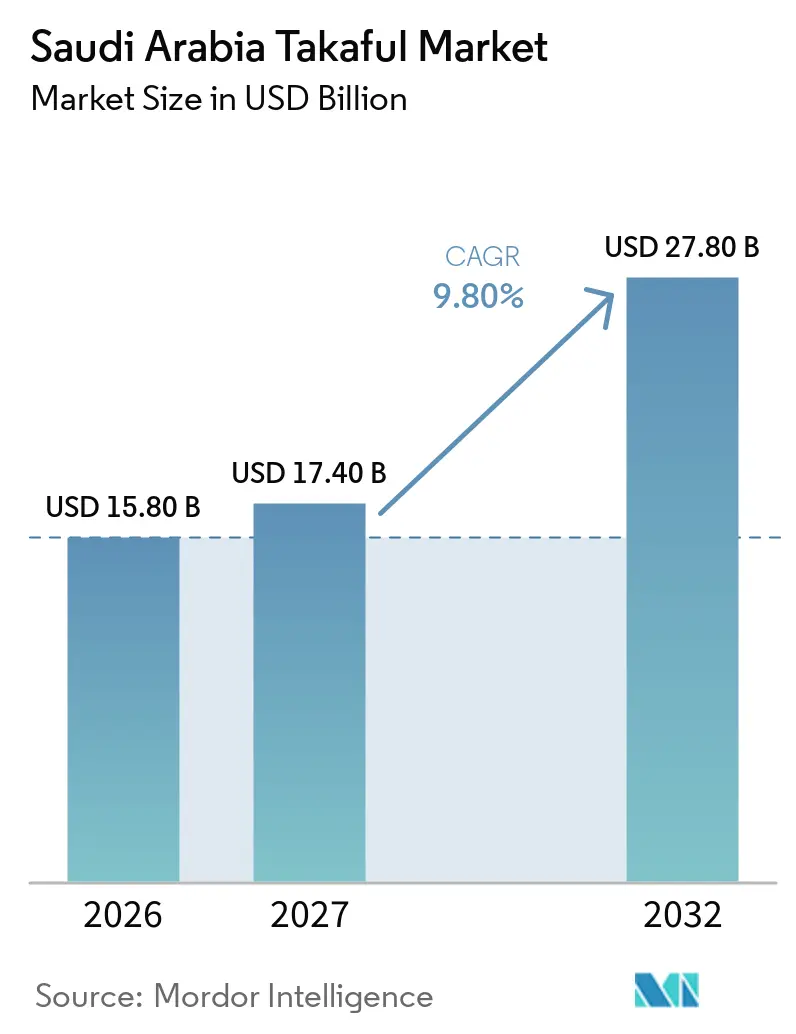
| Base Year Market Size (2026) | USD 15.80 Billion |
| Market Size (2027) | USD 17.40 Billion |
| Market Size (2032) | USD 27.80 Billion |
| Growth Rate (2027 - 2032) | 9.80 % |
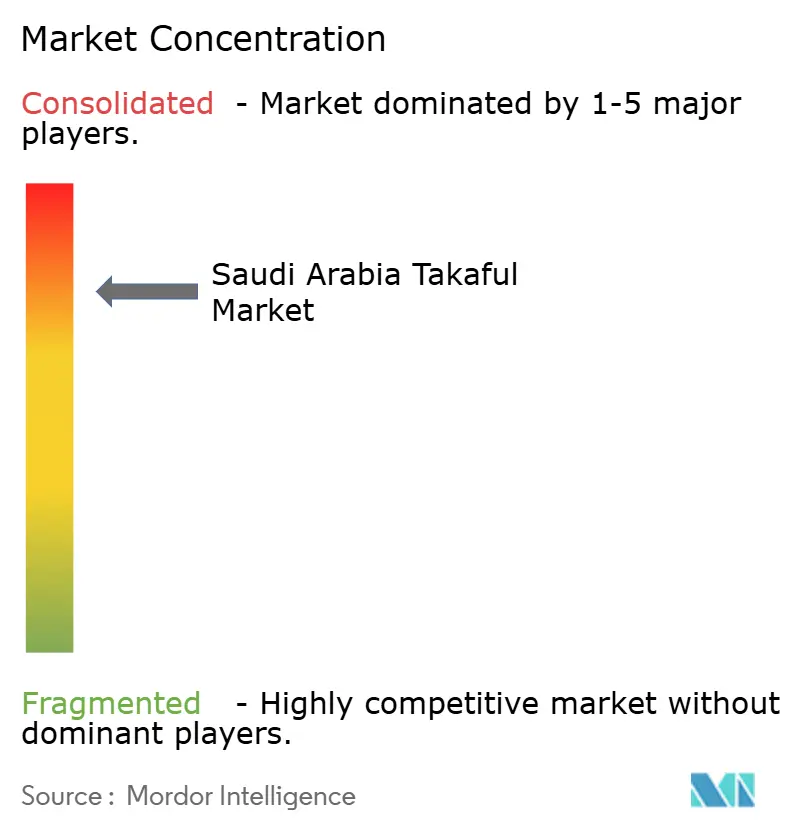
| Market Concentration | High |
Major Players *Disclaimer: Major Players sorted in no particular order Image © Mordor Intelligence. Reuse requires attribution under CC BY 4.0. | |
Saudi Arabia Takaful Market Analysis by Mordor Intelligence
The Saudi Arabia Takaful Market size is projected to be USD 15.80 billion in 2026, USD 17.40 billion in 2027, and reach USD 27.80 billion by 2032, growing at a CAGR of 9.80% from 2027 to 2032.
The National Insurance Sector Strategy supports this expansion by seeking to increase insurance penetration in non-oil GDP to 3.6% by 2030, while penetration reached 3.1% in the first quarter of 2026. Saudi Arabia requires licensed insurance activities to operate under cooperative, Sharia-compliant principles, which places takaful at the center of the country’s insurance system. Mandatory health and motor coverage provide a large recurring premium base, while infrastructure projects create demand for engineering, property, marine, liability, travel, personal accident, and credit cover as new assets enter construction and then operation. The Saudi Arabia takaful market is also moving toward a more capital-intensive structure as the Risk-Based Capital framework becomes mandatory on January 1, 2027. Digital distribution, household savings products, visitor insurance, and domestic reinsurance capacity give insurers additional routes to grow beyond established corporate health contracts.
Key Report Takeaways
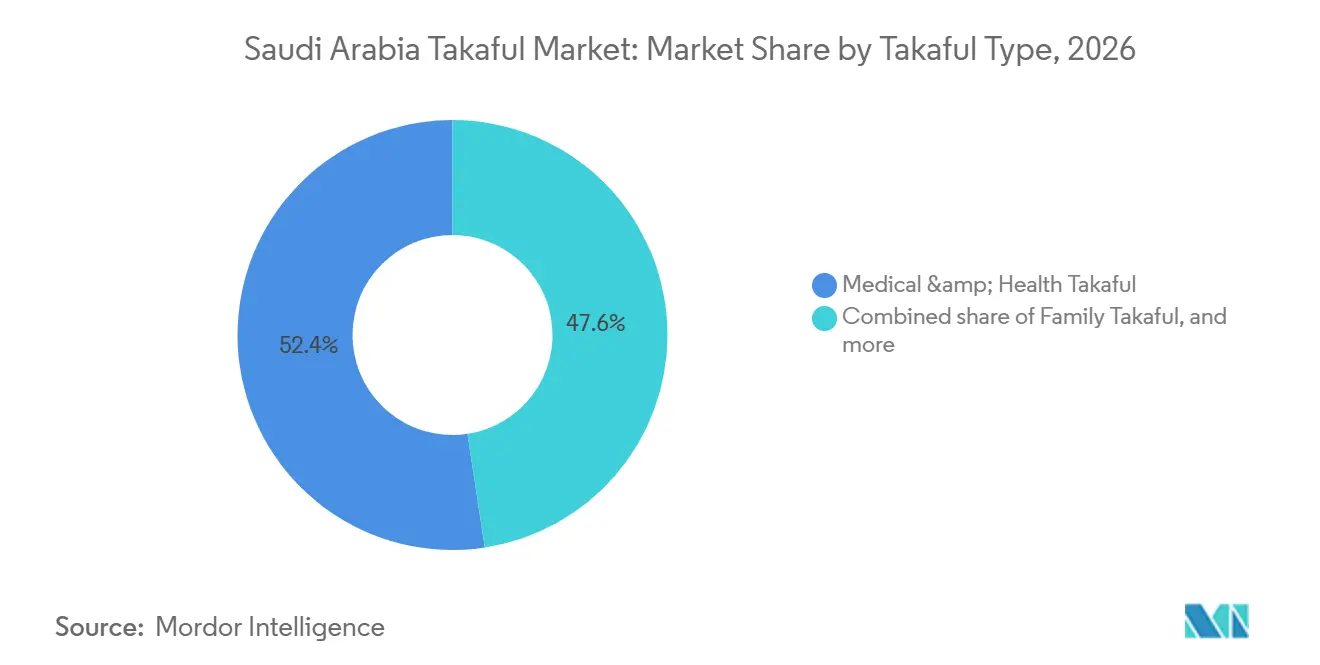
- By takaful type, medical and health takaful captured 52.4% of the Saudi Arabia takaful market share in 2026, while savings and investment-linked takaful is projected to grow at 12.5% CAGR through 2032.
- By distribution channel, agents and brokers held 55.6% of the Saudi Arabia takaful market share in 2026, while embedded, affinity, and other non-bank partnerships are projected to grow at 13.2% CAGR through 2032.
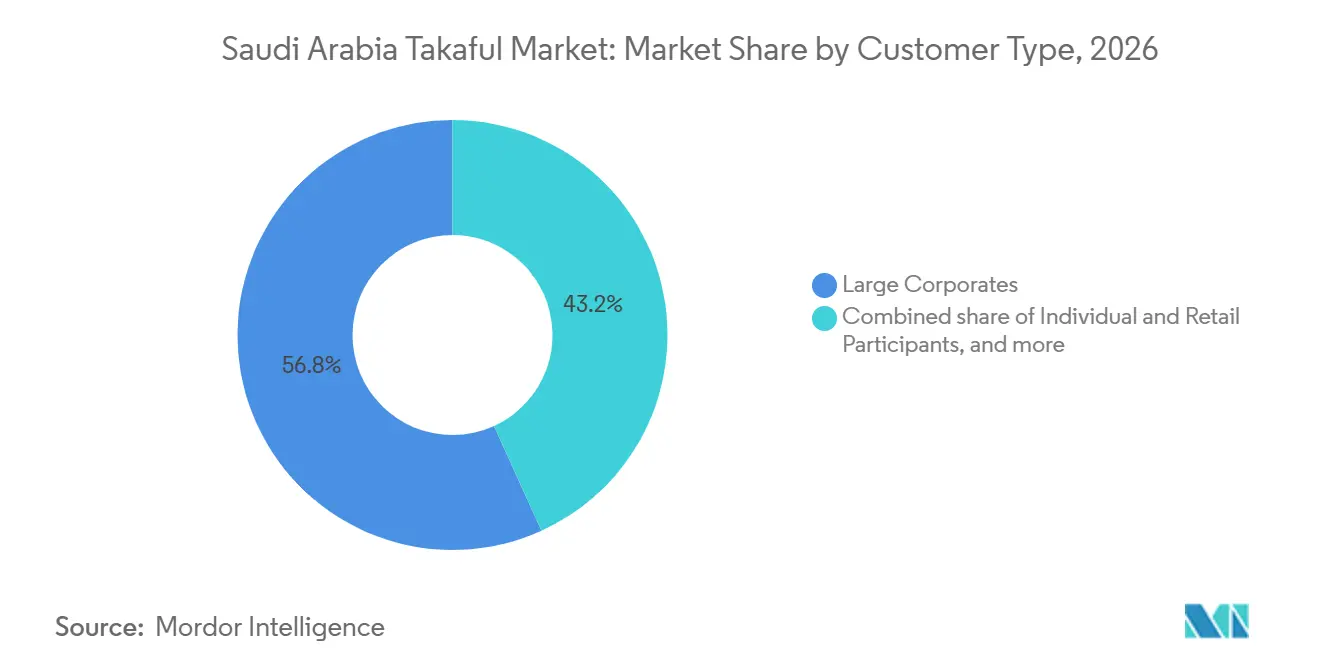
- By customer type, large corporates captured 56.8% of the Saudi Arabia takaful market share in 2026, while individual and retail participants are projected to grow at 13.8% CAGR through 2032.
Note: Market numbers in this report are based on Mordor Intelligence's proprietary estimation framework, which combines nine months of actuals with Q4 projections for base year 2026.
Saudi Arabia Takaful Market Trends and Insights
Drivers Impact Analysis*
| Driver | (~) % Impact on CAGR Forecast | Geographic Relevance | Impact Timeline |
|---|---|---|---|
| Mandatory Health and Motor Insurance Expansion | +3.0% | National, with concentration in Riyadh, Jeddah, Dammam, and secondary cities | Short term (≤ 2 years) |
| Vision 2030 Economic Diversification and Insurable Asset Growth | +2.0% | National, including NEOM, Red Sea, and Qiddiya corridors | Medium term (2-4 years) |
| Demand for Sharia-Compliant Risk Protection | +1.5% | National, with a concentration in metropolitan expatriate communities | Medium term (2-4 years) |
| Digital and Embedded Takaful Distribution Expansion | +1.2% | National, led by urban digital adoption | Short term (≤ 2 years) |
| Untapped Protection and Savings Takaful Potential | +1.0% | National, with demand concentrated among salaried Saudi nationals | Long term (≥ 4 years) |
| Growth in Hajj, Umrah, Tourism, and Visitor Insurance | +0.8% | Makkah, Madinah, and the Red Sea tourism corridor | Short term (≤ 2 years) |
| Source: Mordor Intelligence | |||
Mandatory Health and Motor Insurance Coverage Expansion
Mandatory health insurance remains the principal premium driver in the Saudi Arabia takaful market. Health insurance represented 62% of gross written premiums in the first quarter of 2026, reaching SAR 18.5 billion (USD 4.9 billion)[1]. The employer-paid health requirement includes domestic workers with more than 4 dependents, extending insurance participation through formal employment relationships. This framework supports recurring renewals because coverage is linked to corporate payrolls and workforce obligations across the Saudi Arabia takaful market. Motor coverage reached 11.2 million vehicles in the first quarter of 2026, and the national strategy targets 16 million vehicles before 2030. The expansion of mandatory lines gives large insurers a stable base from which to develop other takaful products.
Vision 2030 Economic Diversification and Insurable Asset Growth
Saudi Arabia’s Vision 2030 development agenda creates opportunities for insurers by expanding economic activity and the assets requiring protection. Construction and infrastructure projects can generate demand for engineering, property, marine, and liability coverage, although growth varies by project and risk type. The National Insurance Sector Strategy comprises 11 strategic and enabling programs and 72 initiatives, targeting insurance penetration of 3.6% of non-oil gross domestic product by 2030[2]. Separately, the Financial Sector Development Program promotes financial planning, savings, and a wider range of financial products. Together, these initiatives could broaden opportunities for Saudi Arabia’s takaful market beyond compulsory health and motor insurance, including corporate general takaful and protection and savings products.
Digital and Embedded Takaful Distribution Expansion
Digital infrastructure is improving insurance administration and creating new distribution channels in Saudi Arabia. The National Platform for Health Information Exchange Services (NPHIES) supports electronic claims and healthcare information exchange, with published platform indicators reporting more than 6,400 provider facilities, 25 insurers, and a 98% share of claims processed through the platform[3]. In July 2025, Saudi insurtech company Yasmina raised USD 2 million in seed funding to expand its API-based embedded insurance platform, which enables digital businesses to offer insurance products at checkout in under 48 hours. Tawuniya also announced a partnership with Abwab.ai to enhance underwriting efficiency and support embedded-finance capabilities for the small and medium-sized enterprise sector. These developments may improve access to insurance through digital platforms and reduce reliance on standalone sales channels, creating potential distribution opportunities for the Saudi cooperative insurance market, including takaful products where offered.
Demand for Sharia-Compliant Risk Protection
Sharia compliance is a regulatory requirement for insurance companies in Saudi Arabia, making product breadth, pricing, surplus distribution, and service quality important areas of competition. Demand for individual family protection and savings products represents a potential growth opportunity. Aljazira Takaful offers protection and savings products, including retirement and youth plans, with monthly contributions starting at SAR 300 (USD 80)[4]. These flexible contribution options may make family protection and long-term savings products more accessible to younger consumers.
Restraints Impact Analysis*
| Restraint | (~) % Impact on CAGR Forecast | Geographic Relevance | Impact Timeline |
|---|---|---|---|
| Medical Claims Inflation and Healthcare Cost Escalation | -1.5% | National, with greater exposure in Riyadh, Jeddah, and the Eastern Province | Short term (≤ 2 years) |
| Motor Pricing Pressure and Claims Volatility | -1.2% | National, with exposure in the Eastern Province and major urban corridors | Short term (≤ 2 years) |
| Risk-Based Capital and Smaller-Operator Capital Pressure | -0.7% | National, with pressure on tier-2 and tier-3 operators | Medium term (2-4 years) |
| Competition in Mandatory Insurance Lines | -0.5% | National, particularly in health and motor lines | Short term (≤ 2 years) |
| Source: Mordor Intelligence | |||
Medical Claims Inflation and Healthcare Cost Escalation
Medical claims costs are a central earnings risk in Saudi Arabia’s insurance market, including its cooperative insurance segment. A 2025 peer-reviewed study examined the relationship between medical insurance penetration, macroeconomic factors, and healthcare expenditure, while the Insurance Authority has identified health insurance claims-cost inflation as a key issue for 2026. In 2025, health and motor insurance together accounted for approximately 89% of total gross written premium growth, with health insurance contributing about 68%. This concentration exposes insurers to changes in healthcare utilization, treatment costs, and provider pricing. The National Insurance Sector Strategy targets health insurance coverage for 23 million beneficiaries by 2030, increasing the importance of sustainable pricing and claims management as coverage expands. Insurers must manage treatment costs, benefit design, and claims monitoring while maintaining access to covered healthcare services.
Motor Pricing Pressure and Claims Volatility
Motor insurance remains a significant underwriting challenge in Saudi Arabia’s insurance market. The motor net combined ratio reached 107.3% in 2025, comprising an 84% claims ratio and a 22.3% expense ratio, indicating underwriting losses. The Insurance Authority has reinforced the importance of actuarially adequate pricing and risk assessment to improve underwriting discipline. These developments highlight the importance of pricing discipline and claims management across Saudi Arabia’s cooperative insurance market.
*Our forecasts treat driver/restraint impacts as directional, not additive. The impact forecasts reflect baseline growth, mix effects, and variable interactions.
Segment Analysis
By Takaful Type Medical Cover Leads While Savings Products Gain Ground
Medical and Health Takaful held 52.4% of the Saudi Arabia takaful market size in 2026. Saudi Arabia’s overall insurance market recorded SAR 18.5 billion (USD 4.9 billion) in health insurance gross written premiums and 14.5 million beneficiaries in the first quarter of 2026. These figures cover the overall insurance market, not the takaful segment alone. Motor takaful remains a major general takaful line, while property, fire, marine, engineering, construction, liability, travel, personal accident, and credit coverage offer opportunities to diversify underwriting as infrastructure projects become operational. Motor insurance’s net combined ratio was 102.5% in the first quarter of 2026, indicating that claims and expenses continued to exceed insurance revenue despite recent price increases.
Savings and Investment-Linked Takaful is projected to expand at 12.5% CAGR through 2032. These products combine Sharia-compliant protection with savings and investment features. Al Rajhi Takaful reported a protection and savings insurance service surplus of SAR 224.7 million (USD 59.9 million) in 2025, up from SAR 134.2 million (USD 35.8 million) in 2024. Digital enrollment and accessible contribution levels may help providers expand retail uptake and diversify beyond mandatory insurance lines.
By Distribution Channel Agents Retain Scale While Embedded Models Expand Access
Agents and brokers accounted for 55.6% of distribution in 2026. The channel remains important for large corporate health, engineering, and property programs that require advisory support and claims coordination. MEDGULF secured a health contract with the Saudi Electricity Company valued at more than SAR 1.07 billion (USD 285.3 million), illustrating the value of established corporate relationships. Bancatakaful can cross-sell protection and savings products to banking customers. Direct distribution is also expanding as digital rules make issuance and renewal easier for policyholders. These routes allow operators to serve different customer needs while retaining the advisory role needed for complex commercial cover.
Embedded, affinity, and other non-bank partnerships are expected to grow at 13.2% CAGR through 2032. Yasmina’s platform allows businesses to offer takaful at the transaction point through a single application programming interface. Tawuniya’s partnership with Abwab.ai incorporated coverage into small and medium-sized enterprise credit processes. These approaches can lower customer acquisition costs and improve access to protection within commerce, mobility, lending, and pilgrimage services. Agents and brokers will remain relevant where service and claims support are important. The Saudi Arabia takaful market can use both traditional and digital channels to increase penetration without replacing all existing distribution relationships.
By Customer Type Corporate Demand Anchors Premiums While Retail Participation Accelerates
Large corporates captured 56.8% of the sector share in 2026. Group health contracts are the main reason for this lead because health coverage is an employer responsibility rather than a discretionary purchase. Government and institutional customers also support health, engineering, and property demand through public programs and project activity. Small and medium-sized enterprises remain underinsured outside mandatory health and motor requirements. The National Insurance Sector Strategy identifies wider small and medium-sized enterprise coverage as a growth priority. These customer groups give insurers a route to broaden their portfolios beyond the country’s largest employers.
Individual and retail participants are projected to grow at 13.8% CAGR through 2032. Mandatory visitor coverage, financial literacy programs, and digital savings products are supporting consumer participation. The 90-day health requirement for international Hajj and Umrah pilgrims produced 180,000 policies during its first 10 operating days. Retail savings products with contributions from SAR 300 (USD 80) per month can make participation easier for consumers with limited initial budgets. The Saudi Arabia takaful industry can serve this group through simple digital products, transparent terms, and Sharia-compliant investment structures. Growth in retail demand also reduces the sector’s dependence on a small number of large corporate contracts.
Geography Analysis
National gross written premiums reached SAR 29.8 billion (USD 7.9 billion) in the first quarter of 2026, rising 14.4% year over year. Insurance penetration reached 3.1% of non-oil GDP during the period. Riyadh holds the largest concentration of commercial insurance activity because it brings together the regulator, major listed insurers, corporate headquarters, and national project administration. Tawuniya had 31% of the overall Saudi insurance market at the end of the first quarter of 2025. Riyadh, therefore, remains the main center for underwriting, claims management, retakaful capacity, and digital insurance development.
Jeddah and the Western Region are central to the country’s visitor and pilgrimage protection business. The 90-day pilgrimage health requirement creates a large number of short-duration policies through the Nusuk platform. Makkah and Madinah are particularly important because international Hajj and Umrah visitors require cover before travel. The Eastern Province supports demand for marine, engineering, liability, and property protection through its energy and petrochemical base. Domestic reinsurance retained 37% of total premiums in the first quarter of 2026, which shows the policy focus on keeping more risk capacity within Saudi Arabia.
Saudi Arabia’s insurance sector operates under a national regulatory framework overseen by the Insurance Authority. Risk assessment, pricing, and capital allocation remain important as insurers cover different exposures across urban, industrial, and infrastructure markets. Riyadh is also a significant center for insurance technology and sector development. The United Kingdom, the United States, and the Asia-Pacific remain relevant reference markets for international reinsurers and technology providers, although local regulatory requirements determine participation in Saudi Arabia’s insurance market.
Competitive Landscape
The Saudi Arabia takaful market is consolidated. Tawuniya and Bupa Arabia together accounted for 59% of sector insurance revenue in mid-2026, while the 5 largest operators held 77%. The top 3 operators generated SAR 789 million (USD 210.4 million) of aggregate net profit in the first quarter of 2026, compared with SAR 20 million (USD 5.3 million) for the remaining listed operators. Scale matters because large insurers can invest in provider networks, technology, capital, and underwriting capability. This gap in earnings also makes it harder for smaller competitors to match larger companies in mandatory health and commercial lines.
Tawuniya established Riyadh Reinsurance Company in November 2025 with SAR 550 million (USD 146.7 million) of capital. The company is wholly owned by Tawuniya and provides treaty and facultative reinsurance capacity for commercial risks. Al Rajhi Takaful approved a 100% capital increase to SAR 2 billion (USD 533.3 million) in June 2026. MEDGULF completed its merger with Buruj Cooperative Insurance in October 2025 at SAR 584.6 million (USD 155.9 million). The combined business had more than SAR 4.1 billion (USD 1.1 billion) in gross written premiums and added scale in retail and small and medium-sized enterprise insurance.
GIG Saudi received approval for a Tourist Visa product in June 2026, which positions it to participate in visitor and pilgrimage cover. Al Rajhi Takaful and Neutrinos received the InsureTek Golden Shield Excellence Award for Digital Takaful Transformation in March 2026. These moves show that competitive positioning increasingly includes capital strength, reinsurance capacity, digital service, and targeted products. White space remains in small and medium-sized enterprise protection, long-term retail savings, and embedded personal lines. Operators with lower-cost digital distribution can compete in these areas without relying only on established agency networks.
Saudi Arabia Takaful Industry Leaders
-
Al Rajhi Takaful
-
Walaa Cooperative Insurance Company
-
MEDGULF
-
Bupa Arabia for Cooperative Insurance
-
The Company for Cooperative Insurance (Tawuniya)
- *Disclaimer: Major Players sorted in no particular order
Recent Industry Developments
- April 2026: The Insurance Authority announced the formal transition to the mandatory Risk-Based Capital framework effective January 1, 2027, replacing the existing solvency assessment regime.
- January 2026: Saudi Arabia made 90-day health insurance mandatory for all Hajj and Umrah pilgrims arriving from overseas through the Nusuk digital visa platform.
- November 2025: Tawuniya received Insurance Authority approval and launched Riyadh Reinsurance Company with SAR 550 million (USD 146.7 million) share capital.
- October 2025: MEDGULF and Buruj Cooperative Insurance finalized their merger, valued at SAR 584.6 million (USD 155.9 million).
Saudi Arabia Takaful Market Report Scope
| Family Takaful | Family Protection / Life Takaful |
| Savings and Investment-Linked Takaful | |
| Medical and Health Takaful | |
| General Takaful | Motor Takaful |
| Property and Fire Takaful | |
| Marine and Aviation Takaful | |
| Engineering and Construction Takaful | |
| Liability Takaful | |
| Travel and Personal Accident Takaful | |
| Credit and Other General Takaful |
| Agents and Brokers |
| Bancatakaful |
| Direct Distribution |
| Embedded, Affinity and Other Non-Bank Partnerships |
| Individual and Retail Participants |
| Small and Medium Enterprises |
| Large Corporates |
| Government and Institutional Participants |
| By Takaful Type | Family Takaful | Family Protection / Life Takaful |
| Savings and Investment-Linked Takaful | ||
| Medical and Health Takaful | ||
| General Takaful | Motor Takaful | |
| Property and Fire Takaful | ||
| Marine and Aviation Takaful | ||
| Engineering and Construction Takaful | ||
| Liability Takaful | ||
| Travel and Personal Accident Takaful | ||
| Credit and Other General Takaful | ||
| By Distribution Channel | Agents and Brokers | |
| Bancatakaful | ||
| Direct Distribution | ||
| Embedded, Affinity and Other Non-Bank Partnerships | ||
| By Customer Type | Individual and Retail Participants | |
| Small and Medium Enterprises | ||
| Large Corporates | ||
| Government and Institutional Participants | ||
Key Questions Answered in the Report
What is the Saudi Arabia takaful market size?
The Saudi Arabia takaful market size is USD 15.8 billion in 2026 and is projected to reach USD 27.8 billion by 2032 at a 9.8% CAGR.
Which takaful type has the largest share in Saudi Arabia?
Medical and Health Takaful leads with 52.4% share in 2026, supported by compulsory employer-sponsored health coverage.
What is the fastest-growing takaful segment in Saudi Arabia?
Savings and Investment-Linked Takaful is forecast to grow at 12.5% CAGR through 2032.
Which distribution channel is expanding fastest?
Embedded, Affinity, and Other Non-Bank Partnerships are projected to grow at 13.2% CAGR through 2032.
Why is retail takaful demand growing in Saudi Arabia?
Individual and Retail Participants are forecast to grow at 13.8% CAGR, supported by visitor insurance, digital products, and savings offerings.
How concentrated is Saudi Arabia’s takaful sector?
The 5 largest operators held 77% of sector revenue in mid-2026, supporting a market concentration score of 7 out of 10.