
Saudi Arabia Sukuk Market Size and Share
Market Overview
| Study Period | 2021 - 2032 |
|---|---|
| Forecast Data Period | 2027 - 2032 |
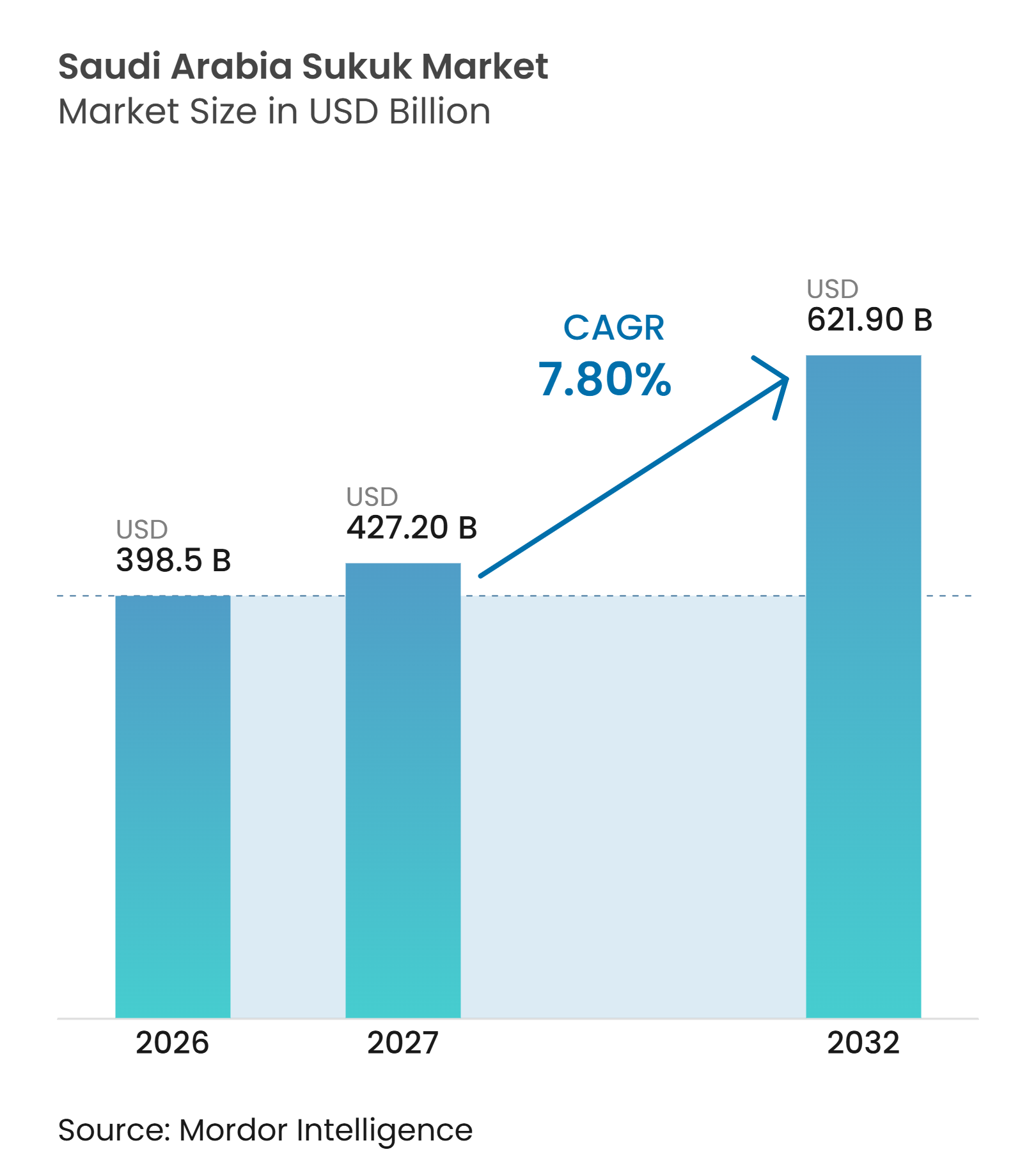
| Base Year Market Size (2026) | USD 398.5 Billion |
| Market Size (2027) | USD 427.20 Billion |
| Market Size (2032) | USD 621.90 Billion |
| Growth Rate (2027 - 2032) | 7.80 % |
| Market Concentration | High |
Major Players *Disclaimer: Major Players sorted in no particular order Image © Mordor Intelligence. Reuse requires attribution under CC BY 4.0. | |
Saudi Arabia Sukuk Market Analysis by Mordor Intelligence
The Saudi Arabia Sukuk Market size was valued at USD 398.5 billion in 2026 and is estimated to grow from USD 427.20 billion in 2027 to reach USD 621.90 billion by 2032, at a CAGR of 7.80% during the forecast period (2027-2032).
The Saudi Arabia sukuk market is supported by sovereign funding needs, a broader domestic yield curve, and demand for Shariah-compliant investments. Saudi Arabia held an 18% share of emerging-market United States dollar debt issuance excluding China in 2025, while its 26% share of ESG United States dollar debt issuance placed it among the leading issuers in that category. Vision 2030 projects in renewable energy, logistics, tourism, and major developments require long-term financing and widen the opportunity for sukuk issuance. The 2026 annual borrowing plan provides for SAR 217 billion (USD 57.86 billion) of financing needs, including SAR 165 billion (USD 43.97 billion) for the fiscal deficit and SAR 52 billion (USD 13.86 billion) for principal repayments. Regular Saudi riyal auctions also give corporate issuers a clearer local benchmark for pricing and maturity selection.
Key Report Takeaways
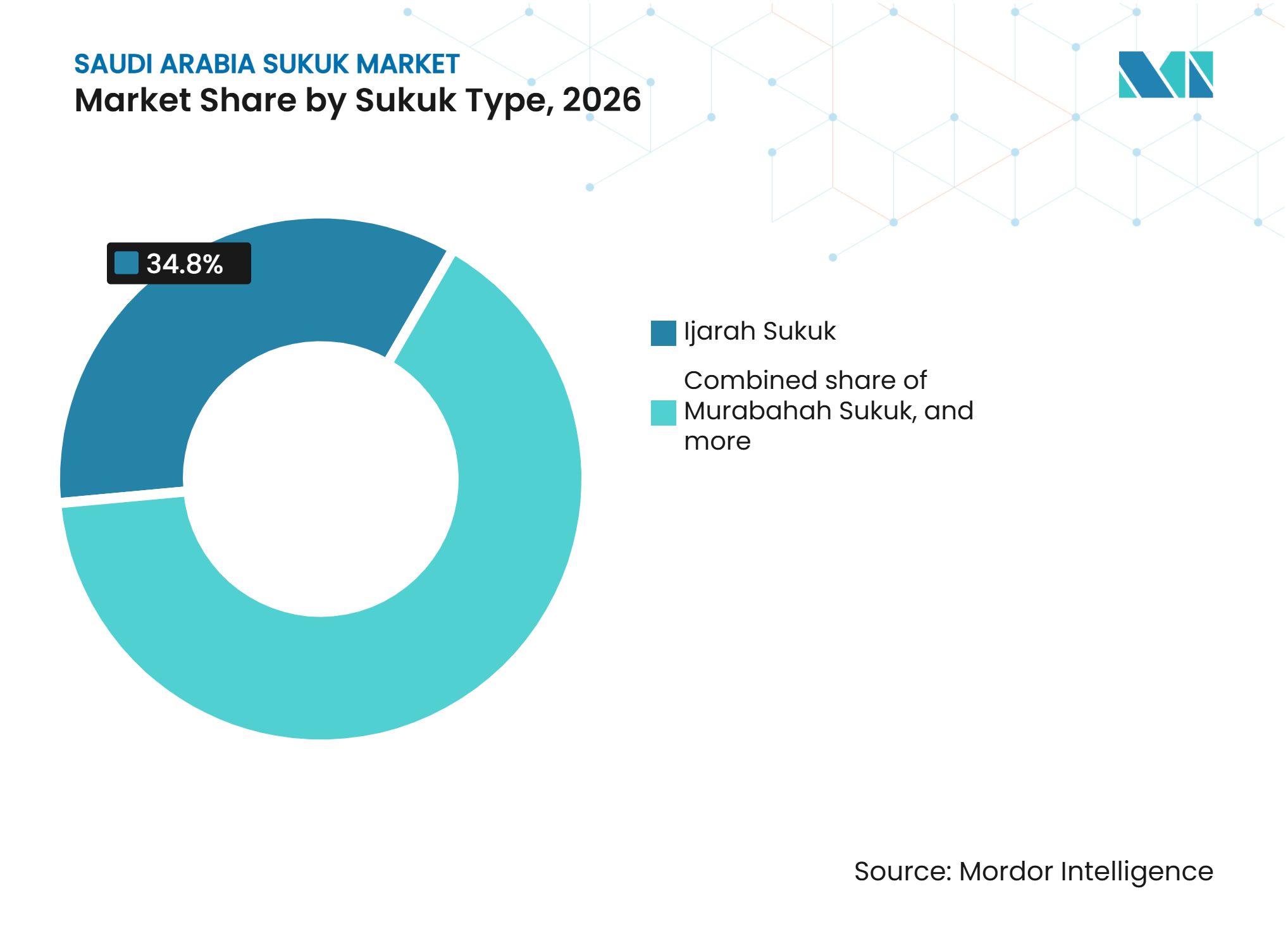
- By sukuk type, Ijarah captured 34.8% of the Saudi Arabia sukuk market in 2026, while Wakalah is projected to grow at an 8.7% CAGR through 2032.
- By issuer type, sovereign issuers captured 65.3% of the Saudi Arabia sukuk market in 2026, while non-financial corporate issuers are projected to grow at a 9.8% CAGR through 2032.
- By market type, domestic sukuk captured 74.6% of the Saudi Arabia sukuk market in 2026, while international sukuk is projected to grow at an 8.7% CAGR through 2032.
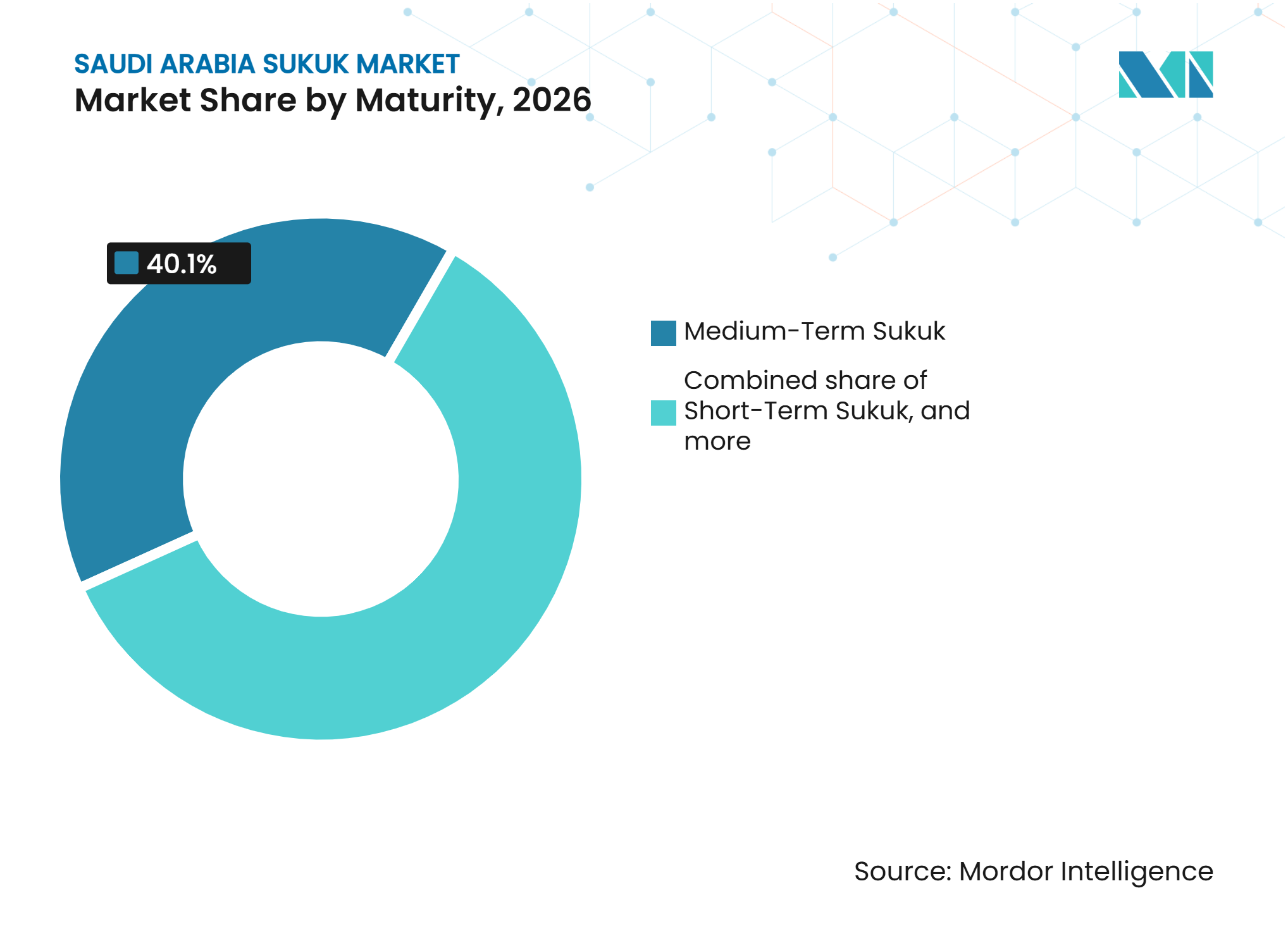
- By maturity, medium-term sukuk captured 40.1% of the Saudi Arabia sukuk market in 2026, while perpetual sukuk is projected to grow at a 9.3% CAGR through 2032.
- By label, plain or unlabelled sukuk captured 87.6% of the Saudi Arabia sukuk market in 2026, while green sukuk is projected to grow at an 11.6% CAGR through 2032.
Note: Market numbers in this report are based on Mordor Intelligence's proprietary estimation framework, which combines nine months of actuals with Q4 projections for base year 2026.
Market Trends and Insights
Drivers Impact Analysis of Saudi Arabia Sukuk Market*
| Driver | (~) % Impact on CAGR Forecast | Geographic Relevance | Impact Timeline |
|---|---|---|---|
| Vision 2030 Infrastructure Investment and Economic Diversification | +2.3% | National, with international capital-market spillover | Long term (≥ 4 years) |
| Sovereign Borrowing Requirements and Debt Refinancing | +1.7% | National, with access to Middle East and North Africa, Europe, and Asia-Pacific investors | Medium term (2-4 years) |
| Bank Funding Diversification and Credit-Growth Financing Needs | +1.4% | National | Short term (≤ 2 years) |
| Capital-Market Reforms and Expanded Foreign-Investor Access | +1.2% | National, with inflows from the Middle East and North Africa, Asia-Pacific, and Europe | Medium term (2-4 years) |
| Corporate Sukuk Issuance and Private-Sector Financing Diversification | +0.9% | National | Medium term (2-4 years) |
| Development of Domestic and International Sukuk Issuance Channels | +0.5% | Global, centered on Saudi Arabia | Medium term (2-4 years) |
| Source: Mordor Intelligence | |||
Vision 2030 Infrastructure Investment and Economic Diversification
Vision 2030 investment needs provide a long-term basis for issuance across infrastructure, utilities, logistics, renewable energy, tourism, and major developments. The National Debt Management Center finalized a USD 13 billion, 7-year syndicated loan in December 2025 to support power, water, and utility financing. The transaction shows the scale and duration of financing requirements alongside the Saudi Arabia sukuk market. The Public Investment Fund completed 3 international sukuk offerings from 2023 through April 2025 and raised USD 1.25 billion through a Wakalah offering in April 2025[1]. Orders exceeded USD 9 billion, or 6.5 times the issue size, showing the depth of investor demand for Saudi quasi-sovereign paper. The 2034 FIFA World Cup award extends the project-financing pipeline beyond the forecast period and supports continuing demand for structured financing.
Sovereign Borrowing Requirements and Debt Refinancing
Saudi Arabia’s fiscal financing requirements and debt refinancing needs drive regular sovereign sukuk issuance, supporting market liquidity and providing benchmark instruments for investors. In July 2026, the National Debt Management Center (NDMC) completed a domestic early repurchase transaction involving approximately SAR 17.1 billion (USD 4.56 billion) in outstanding sukuk and issued replacement sukuk worth approximately SAR 17.2 billion (USD 4.59 billion) across five tranches maturing between 2031 and 2041[2]. In September 2026, the NDMC also completed a USD 3.25 billion international sukuk issuance, attracting an order book exceeding USD 16.5 billion. These recurring domestic and international transactions strengthen investor familiarity, improve pricing references, and support corporate and quasi-sovereign issuers seeking access to the Saudi sukuk market.
Bank Funding Diversification and Credit-Growth Financing Needs
Saudi banks use sukuk to manage regulatory capital, diversify funding, and support lending growth. This recurring requirement makes bank issuance less dependent on the fiscal cycle than sovereign issuance. Riyad Bank issued SAR 10 billion (USD 2.67 billion) of Tier 1 sukuk in 2026 at 6.50%, while Al Rajhi Bank and Alinma Bank also used Tier 1 structures. Al Rajhi Bank placed USD 1.6 billion across social Tier 1 and Tier 2 instruments, and Alinma Bank raised SAR 4.88 billion (USD 1.3 billion) through 2 Additional Tier 1 offerings. Wakalah and Mudarabah structures remain important for Additional Tier 1 issuance because they fit the equity-participation features required for bank capital. The Saudi Central Bank capital framework supports a recurring cycle of capital issuance as bank balance sheets expand.
Capital-Market Reforms and Expanded Foreign-Investor Access
The opening of the Saudi capital market to all categories of foreign investors from February 1, 2026, is expected to broaden participation in the Saudi Arabia sukuk market. The Capital Market Authority (CMA) removed the Qualified Foreign Investor framework, allowing eligible non-resident investors to access the Main Market without meeting previous qualification requirements. International investments in the Main Market reached SAR 519 billion (USD 138 billion) at the end of the third quarter of 2025. According to Fitch, foreign investors held more than 10% of the Saudi government's outstanding direct domestic issuance in primary local markets at the end of 2025. In October 2025, Tradeweb launched a CMA-licensed electronic trading platform for sukuk and Saudi riyal-denominated debt instruments, improving transparency, trading efficiency, and access for international institutional investors[3].
Restraints Impact Analysis of Saudi Arabia Sukuk Market*
| Restraint | (~) % Impact on CAGR Forecast | Geographic Relevance | Impact Timeline |
|---|---|---|---|
| Government-Related Issuer Concentration and Limited Corporate Market Depth | -0.4% | National | Long term (≥ 4 years) |
| Limited Secondary-Market Liquidity and Incomplete Price Discovery | -0.3% | National | Medium term (2-4 years) |
| Narrow Investor Base and Concentrated Institutional Holdings | -0.2% | National | Medium term (2-4 years) |
| Corporate Sukuk Structuring and Issuance Barriers | -0.1% | National | Medium term (2-4 years) |
| Source: Mordor Intelligence | |||
Government-Related Issuer Concentration and Limited Corporate Market Depth
The Saudi Arabia sukuk market remains concentrated in sovereign and government-related issuers, limiting the diversity of available corporate credit exposures. As of April 2026, government sukuk and bonds accounted for SAR 724.97 billion (USD 193.33 billion) of the listed sukuk and debt market, compared with SAR 19.21 billion (USD 5.12 billion) in corporate instruments. Government-related entities and large corporates, including the Public Investment Fund, Saudi Electricity Company, Ma’aden, Almarai, and Dar Al Arkan, contribute to the broader issuer base. Smaller companies may face barriers associated with documentation, Shariah structuring, credit ratings, and issuance costs, making capital-market funding less economical for smaller transactions. Market-development initiatives, including regulatory reforms to expand debt instruments and potential corporate sukuk exchange-traded funds, could broaden investor access and support greater issuer diversification.
Limited Secondary-Market Liquidity and Incomplete Price Discovery
Limited secondary trading encourages many institutional investors to hold sukuk until maturity. Secondary turnover reached 9% of outstanding issuance in 2025, with annual trading of SAR 50 billion (USD 13.3 billion), showing improvement from previous levels. Market participants still lack universal access to live two-way electronic pricing and broad Level 2 market information. Available pricing can also be delayed by up to 15 minutes. The absence of a functioning repo market reduces market makers’ ability to finance inventory and support continuous trading. Broader bilateral repo arrangements between nonbank firms could improve liquidity and price formation.
*Our forecasts treat driver/restraint impacts as directional, not additive. The impact forecasts reflect baseline growth, mix effects, and variable interactions.
Saudi Arabia Sukuk Market Segment Analysis
By Sukuk Type:
Ijarah Retains the Largest Position While Wakalah ExpandsIjarah held 34.8% of the Saudi Arabia sukuk market size in 2026. Its position reflects broad use in sovereign international programs and the familiarity of its lease-based structure among global investors. The National Debt Management Center has used Ijarah in major international offerings, including the USD 3.25 billion transaction completed in September 2026. Murabahah remains important in domestic bilateral and syndicated arrangements. Musharakah and Mudarabah are commonly used in Additional Tier 1 bank capital structures. Salam and Istisna serve more specialized commodity and construction financing requirements.
Wakalah is projected to record an 8.7% CAGR through 2032. The structure allows issuers to appoint an agent to manage a pool of assets, which gives it flexibility for bank capital and sovereign wealth fund transactions. The Public Investment Fund priced a USD 1.25 billion Wakalah sukuk in April 2025, with demand exceeding USD 9 billion. Its USD 2 billion Wakalah transaction in January 2026 attracted orders above USD 11 billion. Al Rajhi Bank also used Wakalah and Mudarabah features in its USD 1.5 billion sustainable Additional Tier 1 issuance in 2025. Tokenized issuance may give Wakalah further scope because the structure can accommodate varied asset pools.


By Issuer Type:
Sovereign Issuance Sets the Benchmark and Corporates Grow FasterSovereign issuers accounted for 65.3% of the Saudi Arabia sukuk market share in 2026. Their regular issuance sets reference yields for other issuers and supports a curve extending to 2041. Government-related entities such as the Public Investment Fund, Saudi Electricity Company, and Saudi Real Estate Refinance Company form the next tier of credit supply. Financial institutions add recurring Additional Tier 1 and Tier 2 issuance as they manage capital requirements. Multilateral and supranational borrowers add another route for Riyadh to develop as an Islamic capital markets center. This issuer structure gives investors a range of credit quality, although sovereign-related risk remains dominant.
Non-financial corporate issuers are projected to grow at a 9.8% CAGR through 2032. Ma'aden’s USD 1.25 billion inaugural sukuk in February 2025 was 9.2 times oversubscribed, with orders exceeding USD 11.5 billion. Almarai’s USD 500 million offering in September 2025 recorded the tightest spread for a BBB minus and Baa3 Gulf Cooperation Council corporate, at United States Treasury plus 85 basis points. Dar Al Arkan’s USD 750 million 5-year sukuk attracted USD 2.6 billion in demand. These transactions provide useful comparisons for issuers in mining, consumer goods, real estate, and utilities. They also show that international demand can support credits beyond the sovereign and banking sectors.
By Market Type:
Domestic Funding Remains Central While International Issuance BroadensDomestic sukuk held 74.6% of the Saudi Arabia sukuk market in 2026. Monthly Saudi riyal auctions by the National Debt Management Center form the foundation of the domestic channel. These auctions raised SAR 24.6 billion (USD 6.6 billion) in the first 7 months of 2025. The iBoxx Tadawul SAR Government Sukuk Index provides a standardized reference for Saudi riyal government sukuk across the curve. Foreign participation in domestic government primary issuance exceeded 10% by the end of 2025. The broader foreign-investor framework introduced in 2026 may support further participation.
International sukuk is projected to grow at an 8.7% CAGR through 2032. Saudi United States dollar sukuk issuance reached USD 100 billion in 2025, with sukuk expanding faster than conventional bonds. International programs connect Saudi issuers to institutions in the United States, United Kingdom, Asia-Pacific, Europe, and the Middle East and North Africa. For higher-rated issuers, United States dollar sukuk can price more tightly than domestic Saudi riyal alternatives because the global investor pool is deeper. Established listing and disclosure practices have made the international route more systematic for the National Debt Management Center, Public Investment Fund, Saudi Electricity Company, and corporate issuers. This channel complements domestic funding rather than replacing the role of local-currency issuance.
By Maturity:
Medium-Term Issues Lead and Perpetual Capital Instruments ExpandMedium-term sukuk accounted for 40.1% of the Saudi Arabia sukuk market size in 2026. The segment includes 5-year and 10-year corporate tranches, as well as domestic sovereign maturities. Ma'aden, Almarai, and Dar Al Arkan each used 5-year structures in recent international transactions. Long-term issuance is more closely associated with sovereign domestic financing and institutional investors seeking duration. The February 2026 National Debt Management Center auction raised a total of SAR 7.86 billion (USD 2.09 billion), with the largest portion being the SAR 3.197 billion (USD 852.5 million) fifth tranche maturing in 2041. Short-term sukuk remain constrained by the limited depth of the Saudi riyal money-market ecosystem.
Perpetual sukuk is projected to grow at a 9.3% CAGR through 2032. Saudi banks use perpetual Additional Tier 1 instruments to meet capital needs as lending portfolios grow. Riyad Bank issued SAR 10 billion (USD 2.67 billion) of perpetual Tier 1 sukuk in 2026 at 6.50%. Al Rajhi Bank, Alinma Bank, Arab National Bank, Bank AlJazira, and Bank Albilad also issued Additional Tier 1 instruments. Call features typically create refinancing requirements after 5 years. That recurring capital cycle can sustain issuance when sovereign or corporate activity slows.

By Label:
Plain Instruments Dominate and Green Sukuk Records the Highest GrowthPlain or unlabelled sukuk accounted for 87.6% of the Saudi Arabia sukuk market share in 2026. Sovereign funding, bank capital management, and general corporate financing do not always require a use-of-proceeds framework. These instruments span issuer categories and maturity profiles. They also provide the main investable universe for domestic banks, pension funds, and insurance companies. Their scale supports liquidity, although much of the investor base continues to hold securities to maturity. Plain instruments therefore remain central to the Saudi Arabia sukuk market even as labeled finance expands.
Green sukuk is projected to grow at an 11.6% CAGR through 2032. The Capital Market Authority approved guidelines for green, social, sustainable, and sustainability-linked debt instruments in May 2025. The guidelines require external review, ongoing reporting, and environmental, social, and governance performance information. Saudi Arabia recorded USD 6.25 billion in green, social, sustainable, and sustainability-linked issuance in the first half of 2025. Saudi Electricity Company issued a USD 1.25 billion 10-year green sukuk in February 2025, taking its cumulative green sukuk issuance to USD 3.75 billion since 2020. Labeled instruments can attract allocations from investors with formal environmental, social, and governance mandates.
Geography Analysis
Saudi Arabia represented 20% to 30% of global sukuk issuance in recent years. Riyadh hosts the Capital Market Authority, National Debt Management Center, Saudi Exchange, and Edaa, which together support domestic and international issuance. The country’s institutional framework supports the Saudi Arabia sukuk market across regulation, debt management, trading, settlement, and custody. The iBoxx Tadawul SAR Government Sukuk Index tracks Saudi riyal-denominated government securities over a curve that extends to 2041. This benchmark supports institutional portfolio construction and passive investment strategies.
Saudi Arabia remains the largest regional issuer despite a decline in issuance during the first half of 2026. Total Saudi sukuk issuance fell 18% year-over-year to USD 34.2 billion during that period. Sovereign issuance declined 29% to USD 18.4 billion, while corporate issuance rose 59% to USD 8.8 billion. The split shows that non-sovereign activity has become more resilient even when sovereign issuance is disrupted. The National Debt Management Center had secured 90% of its 2026 annual borrowing plan before geopolitical disruption affected issuance conditions. It used private channels and local markets to continue funding operations.
Global participation is widening through United States, United Kingdom, Asia-Pacific, European, and Middle East and North Africa investor channels. Ma'aden issued its USD 1.25 billion debut under Rule 144A and Regulation S, extending access to United States institutional investors. Almarai’s September 2025 transaction drew 90% international investor participation. Saudi Real Estate Refinance Company’s USD 2.75 billion issuance in July 2026 was 6.8 times oversubscribed, with demand led by international investors. Tradeweb’s October 2025 marketplace launch addresses a prior access gap in Saudi riyal instruments. Its further expansion, subject to regulatory consent, can narrow the difference between domestic and international investor access.
Competitive Landscape
Market Concentration
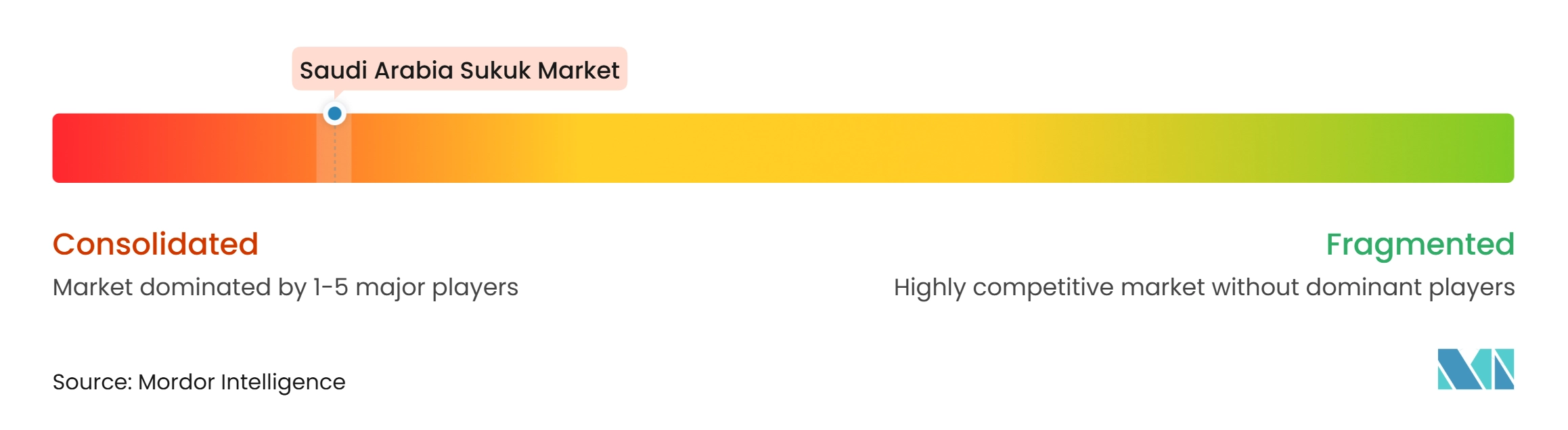
The Saudi Arabia sukuk market is concentrated among sovereign, quasi-sovereign, and major financial institution issuers. The National Debt Management Center, Public Investment Fund, and Saudi Electricity Company set reference spreads that influence other issuers. Al Rajhi Bank, Riyad Bank, and Alinma Bank lead Additional Tier 1 and Tier 2 issuance among listed banks. Ma'aden, Almarai, and Dar Al Arkan provide corporate reference points at different credit levels. Corporate issuers still face higher fixed costs for documentation, Shariah structuring, and credit ratings. The USD 200 million to USD 500 million funding range remains difficult for firms without regular capital-market programs.
Several recent transactions show how leading issuers are expanding their funding reach. The National Debt Management Center completed a USD 3.25 billion international Ijarah sukuk in September 2026, with orders exceeding USD 16.5 billion. The Public Investment Fund’s April 2025 USD 1.25 billion Wakalah issuance was 6.5 times oversubscribed. Saudi Real Estate Refinance Company expanded its international sukuk program to USD 10 billion when it priced a USD 2.75 billion deal in July 2026. Al Rajhi Bank completed a USD 600 million Tier 2 social sukuk in September 2026. These actions show that sovereign, government-related, and bank issuers are using international programs to maintain diversified funding access.
Technology and labeled issuance are becoming additional areas of competition. The Saudi Exchange has operated a digital securities platform in pilot mode since the second quarter of 2025, with atomic delivery-versus-payment settlement. A tokenized Ijarah government sukuk of SAR 500 million (USD 133.3 million) was listed in the pilot environment. Saudi Awwal Bank completed blockchain-based repo transactions in the Gulf Cooperation Council region. The Capital Market Authority Digital Assets Framework governs sandbox-based tokenized issuance, while broader deployment depends on disclosure and custody safeguards. The green and sustainable debt guidelines also encourage issuers to use labeled structures when seeking environmental, social, and governance-focused allocations.
Saudi Arabia Sukuk Industry Leaders
-
Saudi Electricity Company
-
Saudi Aramco
-
Al Rajhi Bank
-
Alinma Bank
-
Saudi National Bank
- *Disclaimer: Major Players sorted in no particular order
Saudi Arabia Sukuk Market Companies Covered in this Report
- Saudi Electricity Company
- Saudi Aramco
- Al Rajhi Bank
- Alinma Bank
- Saudi National Bank
- Riyad Bank
- Saudi Awwal Bank
- Bank AlJazira
- Arab National Bank
- Bank Albilad
- Almarai Company
- Dar Al Arkan Real Estate Development Company
- ACWA Power Company
- Bidaya Finance Company
- Rawasi Albina Investment Company
- Arabian Centres Company (Cenomi Centres)
- Middle East Healthcare Company (Saudi German Health)
- Red Sea International Company
- Sadara Chemical Company
- Al Kathiri Holding Company
Recent Industry Developments in Saudi Arabia Sukuk Market
- October 2026: The NDMC closed its October 2026 SAR-denominated sukuk issuance, allocating SAR 6.749 billion (USD 1.8 billion) across 4 tranches maturing from 2031 to 2039, continuing its monthly domestic program to meet fiscal requirements.
- September 2026: The NDMC completed a USD 3.25 billion international Ijarah sukuk with an order book exceeding USD 16.5 billion, which was more than 5 times oversubscribed.
- June 2026: Saudi Real Estate Refinance Company priced a USD 2.75 billion international sukuk across 5.5-year and 10-year tranches, which was 6.8 times oversubscribed, and expanded its International Sukuk Program to USD 10 billion.
- February 2026: The NDMC closed a SAR 7.86 billion (USD 2.1 billion) domestic sukuk issuance across 5 tranches maturing from 2031 to 2041.
Saudi Arabia Sukuk Market Report Scope
Segmentation Overview
| Murabahah Sukuk |
| Ijarah Sukuk |
| Wakalah Sukuk |
| Musharakah Sukuk |
| Mudarabah Sukuk |
| Salam Sukuk |
| Istisna Sukuk |
| Hybrid / Composite Sukuk |
| Other Sukuk Types |
| Sovereign |
| Sovereign-Related / Quasi-Sovereign |
| Financial Institution |
| Non-Financial Corporate |
| Multilateral / Supranational |
| Domestic Sukuk |
| International Sukuk |
| Short-Term Sukuk |
| Medium-Term Sukuk |
| Long-Term Sukuk |
| Perpetual Sukuk |
| Plain / Unlabelled Sukuk |
| Green Sukuk |
| Sustainability / Sustainability-Linked / Social / Other labelled Sukuk |
| By Sukuk Type | Murabahah Sukuk |
| Ijarah Sukuk | |
| Wakalah Sukuk | |
| Musharakah Sukuk | |
| Mudarabah Sukuk | |
| Salam Sukuk | |
| Istisna Sukuk | |
| Hybrid / Composite Sukuk | |
| Other Sukuk Types | |
| By Issuer Type | Sovereign |
| Sovereign-Related / Quasi-Sovereign | |
| Financial Institution | |
| Non-Financial Corporate | |
| Multilateral / Supranational | |
| By Market Type | Domestic Sukuk |
| International Sukuk | |
| By Maturity | Short-Term Sukuk |
| Medium-Term Sukuk | |
| Long-Term Sukuk | |
| Perpetual Sukuk | |
| By Label | Plain / Unlabelled Sukuk |
| Green Sukuk | |
| Sustainability / Sustainability-Linked / Social / Other labelled Sukuk |
Key Questions Answered in the Report
What is the forecast for Saudi Arabia sukuk through 2032?
The Saudi Arabia sukuk market is projected to rise from USD 427.2 billion in 2027 to USD 621.9 billion by 2032, at a 7.8% CAGR.
Which sukuk structure has the largest position in Saudi Arabia?
Ijarah held 34.8% in 2026, supported by its use in major sovereign international issuance.
Why do Saudi banks issue Additional Tier 1 sukuk?
Banks use Additional Tier 1 sukuk to manage capital requirements, diversify funding, and support credit growth.
How important is domestic issuance in Saudi Arabia?
Domestic sukuk held 74.6% in 2026, reflecting the role of recurring Saudi riyal auctions in fiscal funding and benchmark development.
How is foreign investor access changing in Saudi Arabia?
The Capital Market Authority opened the capital market to all foreign investor categories from February 1, 2026, widening potential access to Saudi securities.
Which Saudi sukuk segment is projected to grow the fastest?
Green sukuk is projected to grow at 11.6% CAGR through 2032, ahead of other identified segments.