
Saudi Arabia Reverse Logistics Market Size and Share
Market Overview
| Study Period | 2021 - 2032 |
|---|---|
| Forecast Data Period | 2027 - 2032 |
| Base Year Market Size (2026) | USD 1.51 Billion |
| Market Size (2027) | USD 1.65 Billion |
| Market Size (2032) | USD 2.33 Billion |
| Growth Rate (2027 - 2032) | 7.18 % |
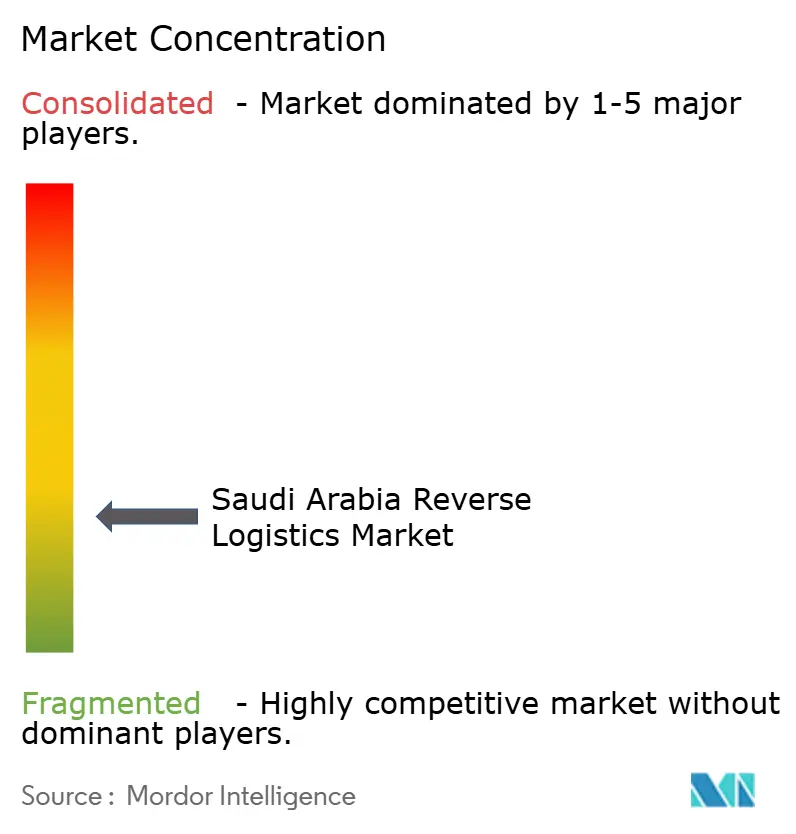
| Market Concentration | Low |
Major Players *Disclaimer: Major Players sorted in no particular order Image © Mordor Intelligence. Reuse requires attribution under CC BY 4.0. | |
Saudi Arabia Reverse Logistics Market Analysis by Mordor Intelligence
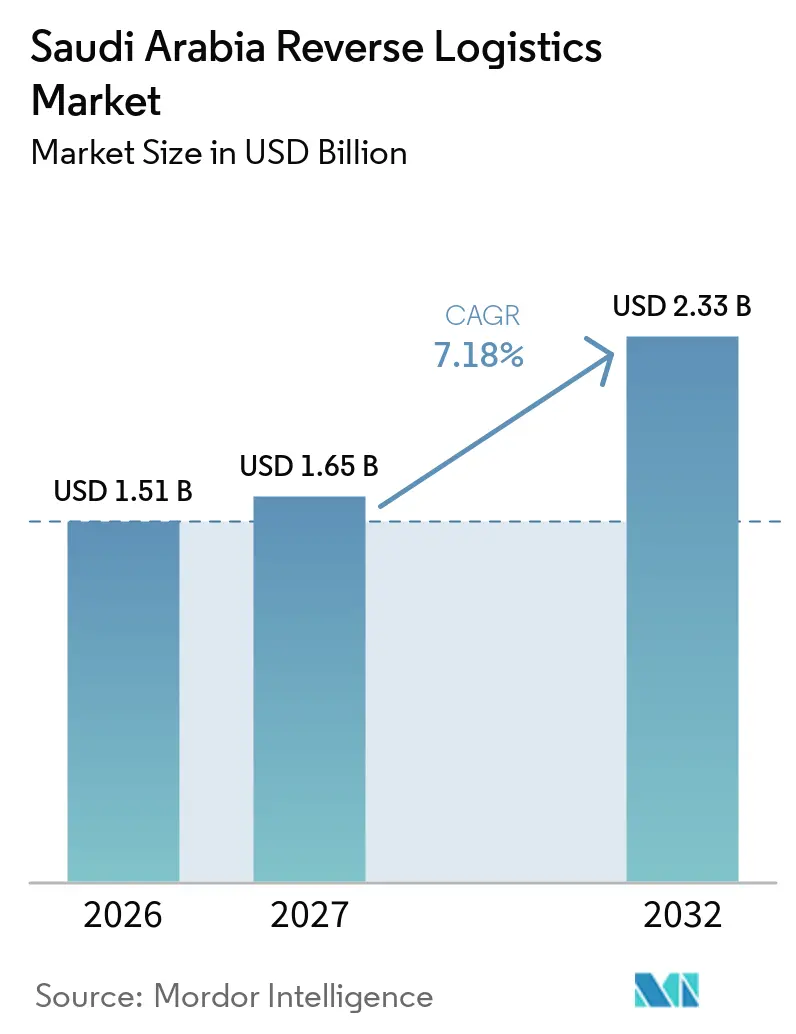
The Saudi Arabia reverse logistics market size is valued at USD 1.51 billion in 2026 and is estimated to grow from USD 1.65 billion in 2027 to reach USD 2.33 billion by 2032, at a CAGR of 7.18% during the forecast period (2027-2032).
The Saudi Arabia reverse logistics market is moving beyond basic return collection toward recovery, resale, and compliant disposal. E-commerce raises the volume and geographic spread of returns, while retailers are placing greater value on faster refunds and inventory recovery. New fulfillment capacity, digital address coverage, and circular-economy infrastructure improve the conditions for organized reverse flows. The Saudi Arabia reverse logistics market therefore offers the strongest opportunity to providers that combine collection, inspection, restocking, and recovery rather than compete only on pickup price.
Key Report Takeaways
- By reverse logistics function, transportation accounts for 46.34% of the Saudi Arabia reverse logistics market share in 2026, while other value-added services are forecast to register a 9.87% CAGR through 2032.
- By end-user industry, consumer and retail accounts for 49.48% of the Saudi Arabia reverse logistics market size in 2026, while healthcare and pharmaceuticals are projected to expand at an 8.98% CAGR through 2032.
- By geography, the Central region accounts for 38.63% of the Saudi Arabia reverse logistics market size in 2026, while the Eastern Province is forecast to advance at a 9.85% CAGR through 2032.
Note: Market numbers in this report are based on Mordor Intelligence's proprietary estimation framework, which combines nine months of actuals with Q4 projections for base year 2026.
Saudi Arabia Reverse Logistics Market Trends and Insights
Drivers Impact Analysis*
| Driver | (~) % Impact on CAGR Forecast | Geographic Relevance | Impact Timeline |
|---|---|---|---|
| E-Commerce Growth Increasing Product Return Volumes | +2.1% | National, with concentration in Riyadh, Jeddah, and Dammam | Short term (≤ 2 years) |
| Consumer Convenience Expectations Expanding Returns Service Demand | +1.1% | National, strongest in urban Central and Western regions | Short term (≤ 2 years) |
| Fulfillment Network Expansion Strengthening Reverse Logistics Reach | +1.0% | National, with early gains in Riyadh, Jeddah, Dammam, and SPARK in the Eastern Province | Medium term (2-4 years) |
| Circular Economy Initiatives Supporting Product Recovery Activities | +0.8% | National, with early infrastructure in Jeddah Port and Riyadh industrial zones | Long term (≥ 4 years) |
| Device Trade-In Growth Expanding Recommerce Logistics Demand | +0.7% | National, with highest penetration in Central and Western regions | Medium term (2-4 years) |
| Recovery Value Growth Increasing Reverse Flow Economics | +0.6% | GCC-wide, with Saudi Arabia as the principal origination market | Long term (≥ 4 years) |
| Source: Mordor Intelligence | |||
E-Commerce Growth Increasing Product Return Volumes
The Saudi Arabia reverse logistics market is receiving more return volumes as online commerce reaches customers beyond the largest cities. Mobile-led purchasing can increase sizing errors and product-expectation gaps, especially in fashion and footwear. These categories also require fast sorting because returned inventory loses value when resale windows close. Broader delivery coverage shifts the point of return origination from Riyadh and Jeddah into smaller cities. Providers with consolidated collection and local handoff points can reduce the cost of bringing these parcels into their networks. This makes e-commerce growth a demand driver for the Saudi Arabia reverse logistics market and a test of providers’ unit economics.
Consumer Convenience Expectations Expanding Returns Service Demand
Easy returns are becoming part of the shopping proposition rather than a back-office service. Retailers are increasingly interested in pickup, visible tracking, rapid inspection, and faster refunds. Those services require reverse logistics operators to connect couriers, warehouses, and retailer systems. Local fulfillment capacity can place processing nearer to the original delivery point. That can shorten inspection and restocking cycles for returned goods. Similar operating models strengthen the Saudi Arabia reverse logistics market by supporting dependable customer communication and inventory visibility.
Circular Economy Initiatives Supporting Product Recovery Activities
The Saudi Arabia reverse logistics market gains value when returned products are repaired, reused, resold, or routed into formal recycling channels. This raises the importance of grading, traceability, and controlled disposition after collection. Basatne acquired Cartlow in March 2025 to expand circular device management in the Middle East. The acquisition brought Cartlow’s refurbishment and resale capabilities into Basatne’s closed-loop model. In June 2025, Basatne MENA and Likewize introduced Upgrade & Protect, a subscription program combining device collection, trade-in, grading, refurbishment, and resale. Such programs support more structured recovery flows and reduce reliance on informal channels[1].
Fulfillment Network Expansion Strengthening Reverse Logistics Reach
New logistics assets expand the facilities available for holding, inspecting, and redirecting returned goods. DHL Supply Chain signed a 26-year lease in November 2025 for a 78,000 m² multi-user warehouse in the Special Integrated Logistics Zone near King Khalid International Airport. The EUR 130 million (USD 152.92 million) investment is scheduled for completion in Q2 2027 and will serve technology, retail, automotive, energy, and e-commerce customers. ASMO and Arcapita agreed in February 2026 to develop a 1.4 million m² logistics facility at SPARK. Temperature-controlled areas, bonded space, and inventory systems within such sites can improve control over returned stock. The Saudi Arabia reverse logistics market can use these assets for consolidation, rework, and disposition.
Restraints Impact Analysis*
| Restraint | (~) % Impact on CAGR Forecast | Geographic Relevance | Impact Timeline |
|---|---|---|---|
| Remote Collection Costs Increasing Reverse Logistics Expenses | -1.2% | Northern regions, Southern regions, and secondary cities across all provinces | Short term (≤ 2 years) |
| Fragmented Returns Data Reducing Processing Efficiency | -0.8% | National | Short term (≤ 2 years) |
| Limited Refurbishment Capacity Restricting Recovery Operations | -0.7% | National, with a bottleneck in the Central region | Medium term (2-4 years) |
| Cross-Border Compliance Complexity Increasing Returns Processing Costs | -0.6% | National, with the highest effect on cross-border e-commerce corridors | Medium term (2-4 years) |
| Source: Mordor Intelligence | |||
Remote Collection Costs Increasing Reverse Logistics Expenses
Saudi Arabia’s large geographic area and uneven distribution of collection infrastructure increase the cost of reverse logistics, particularly for e-commerce returns originating outside major cities. Compared with Riyadh, Jeddah, and Dammam, lower-density locations in the Northern and Southern regions may have fewer return collection points and less opportunity to consolidate parcels across routes. This can increase pickup distances, fuel consumption, and labor costs per returned shipment, making individual returns less economical to process. Reverse logistics providers must therefore balance nationwide return coverage with collection efficiency by using regional drop-off points, shared collection networks, and local fulfillment hubs. The ability to consolidate returned parcels and manage first-mile collection costs remains important for improving the operational efficiency and economic viability of Saudi Arabia’s reverse logistics market.
Fragmented Returns Data Reduces Processing Efficiency
Returns require accurate information on the item, condition, reason for return, and intended disposition. When the information arrives late or is incomplete, inspection, routing, and restocking become reactive; mobile commerce and cash-on-delivery transactions can add complexity where data fields are inconsistent across the customer, carrier, and warehouse. OTO’s network integrates more than 400 delivery providers across the Middle East, North Africa, and Turkey, creating a broad connection layer for shipment information. Salasa is also scaling AI-driven fulfillment infrastructure following its USD 30 million Series B round in August 2025[2]. The Saudi Arabia reverse logistics market will benefit when these types of connections produce shared return records rather than isolated carrier data.
*Our forecasts treat driver/restraint impacts as directional, not additive. The impact forecasts reflect baseline growth, mix effects, and variable interactions.
Segment Analysis
By Reverse Logistics Function: Transportation Leads While Value-added Services Accelerate
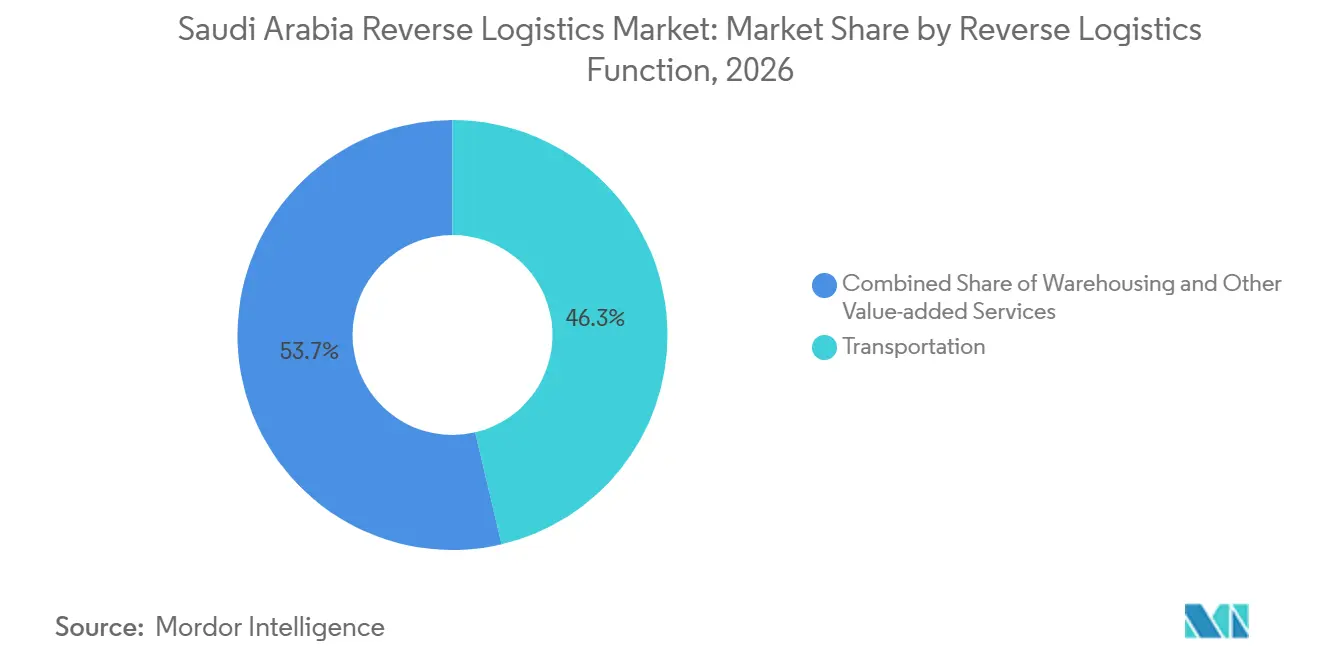
Transportation accounts for 46.34% of the Saudi Arabia reverse logistics market size in 2026. The segment reflects the high volume of last-mile collection across a large national geography. Road freight is the main mode for domestic reverse collection because it connects consumers, service points, fulfillment centers, and sorting facilities. Air services are more relevant for high-value and time-sensitive items, including electronics and pharmaceuticals. Warehousing provides the holding and consolidation layer for goods awaiting inspection and disposition. DHL's planned 53,000 m² SILZ facility shows the continuing addition of multi-user capacity near Riyadh. Its location near King Khalid International Airport can support integrated transport and storage flows[3]. The Saudi Arabia reverse logistics market depends on this physical layer before any value recovery process can begin.
Other value-added services are forecast to record a 9.87% CAGR through 2032, the fastest rate in this function grouping. This category includes return processing, restocking, refurbishment, and disposition. Retailers use these services to restore inventory, recover materials, and limit losses on products that cannot return directly to sale. Basatne’s Cartlow acquisition brought refurbishment processes closer to a structured resale route. Cartlow Wholesale processed 50,000 units each month in 2025 within a broader workflow for refurbishment, diagnostics, logistics, and traceability. Automated diagnostics and grading can reduce the time between return receipt and resale readiness. The Saudi Arabia reverse logistics industry benefits when these services are embedded in retailer channels rather than left to informal resale activity.

By End-user Industry: Consumer and Retail Leads While Healthcare Drives Fastest Expansion
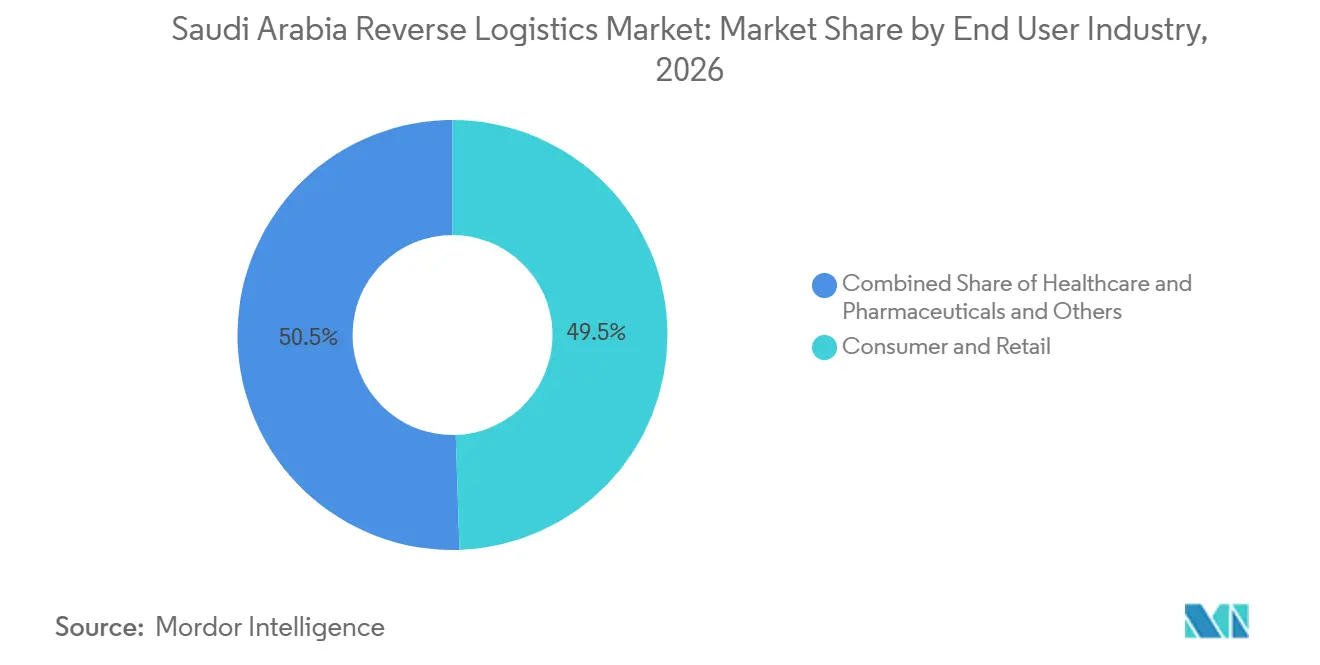
Consumer and retail accounts for 49.48% of the Saudi Arabia reverse logistics market share in 2026. Fashion, electronics, home appliances, and beauty products generate regular returns in consumer commerce. Each product group needs different handling because the potential for resale and the risks of damage vary widely. Home and decor returns can be bulky and may involve transport-damage or dimension-mismatch claims. FMCG returns need quick movement when they concern near-expiry products, recalls, or excess inventory. Consumer categories therefore require flexible parcel, warehousing, and inventory controls. This makes the Saudi Arabia reverse logistics market sensitive to retailers’ return policies and product mix. It also creates demand for operators that can recover resale value without delaying the customer refund.
Healthcare and pharmaceuticals are forecast to expand at an 8.98% CAGR through 2032. This is the fastest-growing end-user segment because returns and recalls must preserve product integrity and documentation. In June 2025, the Saudi Food and Drug Authority and the General Transport Authority launched temperature and humidity tracking through the Wasel platform for food and drug vehicles. This requirement increases the control needed across pharmaceutical transport and return handling. AJEX opened a 3,000 m² GMP-GxP-compliant depot in Riyadh in October 2025 with monitored temperature-controlled chambers and documentation aligned with SFDA requirements. Healthcare returns, biologics, and direct-to-patient supply chains require more specialized handling than general consumer goods. The Saudi Arabia reverse logistics industry can earn higher value from these services when operators can show compliant temperature records and traceable disposition. This supports a shift toward certified handling capacity.
Geography Analysis
The Central region accounts for 38.63% of the Saudi Arabia reverse logistics market share in 2026. Riyadh serves as a commercial and logistics center, which gives the region dense access to retailers, service providers, and fulfillment assets. DHL’s SILZ warehouse investment adds a major multi-user site near the city’s airport. Local fulfillment capacity can reduce the distance between collection, inspection, and restocking. The Central region benefits from both large consumer demand and the concentration of logistics decision-makers. This position supports its leading revenue contribution within the Saudi Arabia reverse logistics market.
The Western region is another important return-handling cluster because it includes Jeddah and the country’s main import gateway. It also carries seasonal consumer flows related to Hajj and Umrah in Makkah and Medina. Operators need flexible capacity during these periods because demand can change sharply. Automated parcel-sorting capacity at the gateway can support consistent high-volume movement. The Saudi Arabia reverse logistics market can use such nodes to process return parcels more consistently. Western-region infrastructure also supports flows between import distribution and domestic returns.
The Eastern Province is forecast to register a 9.85% CAGR through 2032, the highest rate among the geographic segments. Logistics investments around Dammam, Jubail, and SPARK support regional logistics activity growth. ASMO and Arcapita’s 1.4 million m² SPARK project expands the area’s prospective logistics base. The region can connect energy-sector supply chains, ports, industrial activity, and GCC transport corridors. Northern and Southern regions remain smaller revenue bases and face more difficult collection economics. Their lower density creates an opening for providers that can build pooled pickup points and optimized routes. The Saudi Arabia reverse logistics market will become more geographically balanced only when those networks become commercially sustainable.
Competitive Landscape
The Saudi Arabia reverse logistics market is fragmented because no single operator leads transport, warehousing, refurbishment, and recommerce at the same time. Global integrators, domestic express companies, and recommerce platforms often compete on adjacent services. Scale in parcel transport does not automatically create an advantage in product grading or repair. DSV completed the integration of DB Schenker operations in Saudi Arabia in February 2026, combining the two organizations under the DSV brand. The combined operation covers 29 facilities and 1,150 logistics specialists in the Kingdom. This adds contract-logistics scale that can pressure mid-sized warehousing providers. Competition in the Saudi Arabia reverse logistics market is therefore strongest where physical network scale and technology are combined.
There is still room for specialized providers in certified pharmaceutical handling, broader recommerce categories, and remote-area collection. AJEX opened a life-sciences facility with GMP-GxP controls, which creates a clear positioning advantage in regulated returns. DHL eCommerce finalized a minority investment in AJEX in August 2025, giving DHL board representation and an option to increase to a majority position[4]. The partnership combines DHL’s international e-commerce capabilities with AJEX’s domestic network. Basatne provides another example through its acquisition of Cartlow and its focus on device recovery and resale. Those actions show that competitive advantage can be built through local network access, certified handling, or recovery capabilities. The Saudi Arabia reverse logistics market rewards companies that can link these strengths in a single service offer.
Technology investment is also shaping service quality and operating costs. Starlink and Geekplus completed RoboShuttle8 deployment in Riyadh in August 2025 using 39 RoboShuttle8, 126 P40, and 90 S20C robots. Geekplus reported 3x picking speed, 4x storage density, and near-perfect picking accuracy from the deployment. NAQEL Express connected with Anchanto in September 2026 to automate fulfillment, returns, and shipment tracking through order, warehouse, and parcel systems. Providers that connect carrier, warehouse, and retailer data can reduce manual handoffs during return processing. Pure transport services may face more price pressure where networks overlap. Value-added services can offer more pricing flexibility when they shorten recovery cycles or meet regulated requirements.
Saudi Arabia Reverse Logistics Industry Leaders
-
Saudi Post | SPL (including NAQEL Express)
-
SMSA Express Transportation Company Ltd
-
Saudi Investment Recycling Company (SIRC)
-
DHL Group
-
DSV A/S (including DB Schenker)
- *Disclaimer: Major Players sorted in no particular order
Recent Industry Developments
- September 2026: NAQEL Express partnered with Anchanto to connect with its order management, warehouse management, and parcel tracking platforms.
- February 2026: DSV completed the integration of DB Schenker operations in Saudi Arabia and launched the combined organization under the DSV brand.
- February 2026: ASMO and Arcapita agreed to develop a 1.4 million m² logistics facility at SPARK in the Eastern Province.
- November 2025: DHL Supply Chain signed a 26-year land lease in the Special Integrated Logistics Zone, committing EUR 130 million (USD 152.92 million) to a 78,000 m² warehouse near King Khalid International Airport.
Saudi Arabia Reverse Logistics Market Report Scope
| Transportation | Road |
| Air | |
| Other Modes | |
| Warehousing (Storage, Distribution, Consolidation) | |
| Other Value-added Services (Return Processing, Restocking, Refurbishment, Disposition) |
| Consumer and Retail |
| Home and Decor |
| Healthcare and Pharmaceuticals |
| FMCG |
| Other End Users |
| Central (Riyadh, Al-Qassim, and Hail) |
| Eastern (Ash-Sharqiyah) |
| Western (Al-Bahah, Makkah, Medina, and Tabuk) |
| Northern (Al-Jouf and Arar) |
| Southern (Asir, Jazan, and Najran) |
| By Reverse Logistics Function | Transportation | Road |
| Air | ||
| Other Modes | ||
| Warehousing (Storage, Distribution, Consolidation) | ||
| Other Value-added Services (Return Processing, Restocking, Refurbishment, Disposition) | ||
| By End-user Industry | Consumer and Retail | |
| Home and Decor | ||
| Healthcare and Pharmaceuticals | ||
| FMCG | ||
| Other End Users | ||
| By Region | Central (Riyadh, Al-Qassim, and Hail) | |
| Eastern (Ash-Sharqiyah) | ||
| Western (Al-Bahah, Makkah, Medina, and Tabuk) | ||
| Northern (Al-Jouf and Arar) | ||
| Southern (Asir, Jazan, and Najran) |
Key Questions Answered in the Report
What is the Saudi Arabia reverse logistics market size?
The Saudi Arabia reverse logistics market size is estimated at USD 1.65 billion in 2027 and is forecast to reach USD 2.33 billion by 2032, at a 7.18% CAGR.
Which reverse logistics function leads in Saudi Arabia?
Transportation leads with a 46.34% revenue share in 2026, while other value-added services have the highest projected growth at 9.87% CAGR through 2032.
Which end-user segment is growing fastest in Saudi reverse logistics?
Healthcare and pharmaceuticals are projected to register an 8.98% CAGR through 2032, supported by the need for controlled and traceable handling.
Which Saudi region has the fastest reverse logistics growth?
The Eastern Province is projected to register a 9.85% CAGR through 2032, supported by expanding logistics infrastructure and industrial activity.
What is driving returns services in Saudi Arabia?
E-commerce activity, consumer demand for convenient returns, fulfillment investment, circular recovery programs, and device trade-in activity support service demand.
How competitive is Saudi Arabia’s reverse logistics sector?
The sector is fragmented because global integrators, domestic specialists, and recommerce platforms compete across different service layers.