
Saudi Arabia Ocean Freight Transport Market Size and Share
Market Overview
| Study Period | 2021 - 2032 |
|---|---|
| Forecast Data Period | 2027 - 2032 |
| Base Year Market Size (2026) | USD 9.61 Billion |
| Market Size (2027) | USD 10.17 Billion |
| Market Size (2032) | USD 13.25 Billion |
| Growth Rate (2027 - 2032) | 5.43 % |
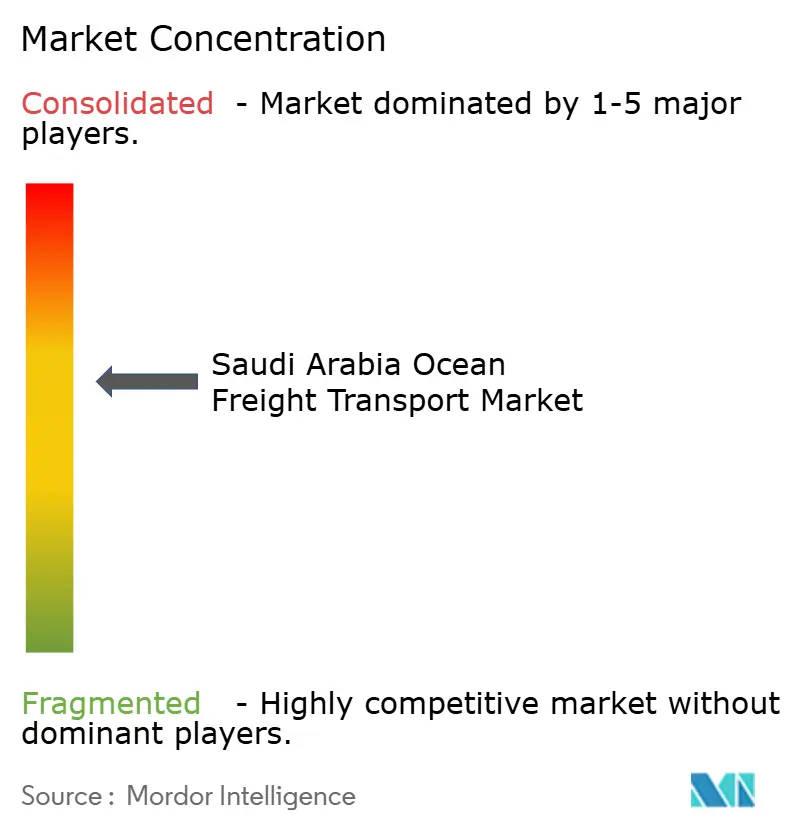
| Market Concentration | Medium |
Major Players *Disclaimer: Major Players sorted in no particular order Image © Mordor Intelligence. Reuse requires attribution under CC BY 4.0. | |
Saudi Arabia Ocean Freight Transport Market Analysis by Mordor Intelligence
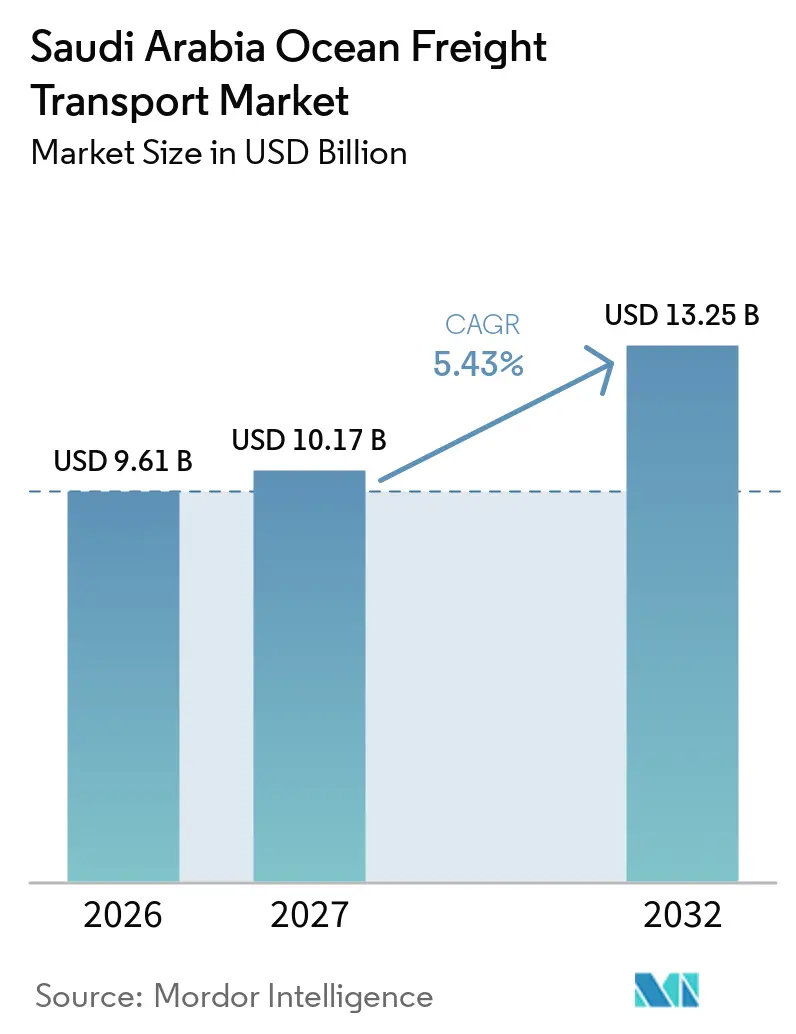
The Saudi Arabia ocean freight transport market size is valued at USD 9.61 billion in 2026. It is estimated to grow from USD 10.17 billion in 2027 to reach USD 13.25 billion by 2032, at a CAGR of 5.43% during the forecast period (2027-2032).
Saudi Arabia’s coastlines along the Red Sea and the Arabian Gulf provide strategic access to maritime routes connecting Asia, Africa, Europe, and Gulf export markets. Under Vision 2030, investments in port capacity, terminal equipment, and logistics infrastructure are strengthening the country’s ocean freight transport capabilities. Growing container traffic, consumer goods imports, and specialized cargo requirements are driving demand for ocean freight services. The market also benefits from significant bulk cargo volumes and increasing demand for reliable containerized and temperature-controlled transport services. However, Red Sea security risks and limitations in inland connectivity can disrupt vessel schedules, increase insurance costs, and constrain cargo distribution across ports.
Key Report Takeaways
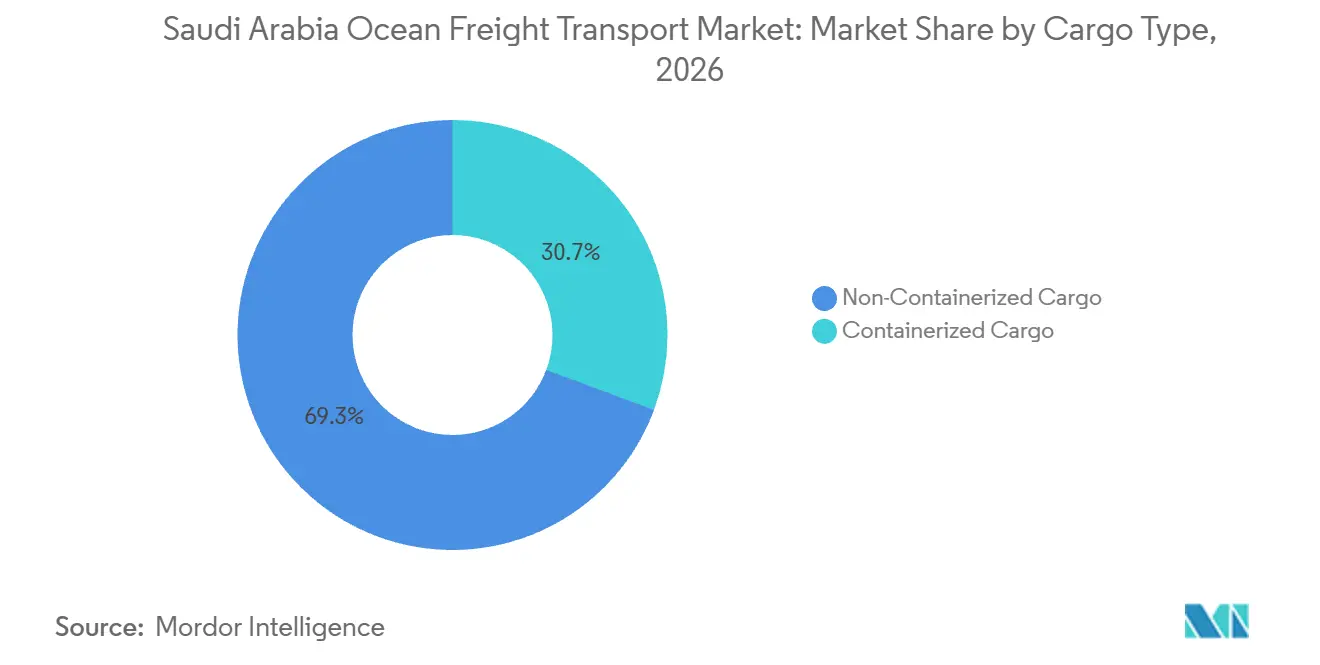
- By cargo type, non-containerized cargo accounts for 69.35% of the Saudi Arabia ocean freight transport market share in 2026, while containerized cargo is forecast to register a 7.25% CAGR through 2032.
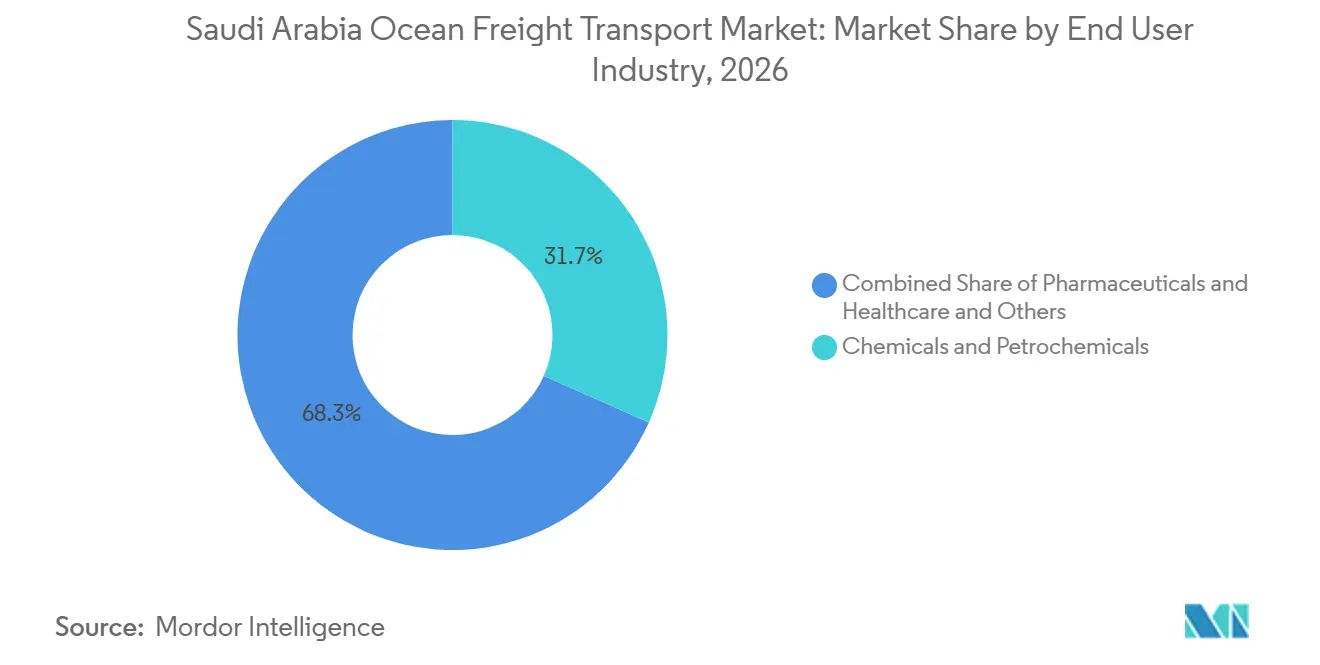
- By end-user industry, chemicals and petrochemicals account for 31.67% of the Saudi Arabia ocean freight transport market share in 2026, while pharmaceuticals and healthcare are forecast to register an 8.35% CAGR through 2032.
- By region, the Eastern Region accounts for 33.83% of the Saudi Arabia ocean freight transport market size in 2026, while the Northern Region is forecast to register a 6.98% CAGR through 2032.
Note: Market numbers in this report are based on Mordor Intelligence's proprietary estimation framework, which combines nine months of actuals with Q4 projections for base year 2026.
Saudi Arabia Ocean Freight Transport Market Trends and Insights
Drivers Impact Analysis*
| Driver | (~) % Impact on CAGR Forecast | Geographic Relevance | Impact Timeline |
|---|---|---|---|
| Vision 2030 Port Investment Expanding Ocean Freight Capacity | +2.0% | National; concentrated gains at Jeddah, Dammam, Jubail, Yanbu, and Ras Al-Khair | Long term (≥ 4 years) |
| Red Sea and Gulf Position Strengthening Trade Connectivity | +1.5% | Western (Red Sea corridor) and Eastern (Arabian Gulf corridor) coastal regions | Medium term (2-4 years) |
| Non-Oil Export Growth Increasing Industrial Cargo Volumes | +1.2% | Eastern Province (petrochemicals), Western (industrial export ports), emerging Central-to-coast corridors | Medium term (2-4 years) |
| Retail and Food Imports Expanding Containerized Freight | +1.0% | Jeddah Islamic Port (Western), King Abdulaziz Port (Eastern), last-mile spill-over to Central | Short term (≤ 2 years) |
| Port Automation Improving Maritime Cargo Handling Efficiency | +0.8% | South Container Terminal Jeddah, KAPD Dammam, Port of NEOM (Northern/Western) | Long term (≥ 4 years) |
| Maritime Localization Strengthening Domestic Shipping Industry Capacity | +0.5% | National; IMI shipyard at Ras Al-Khair (Eastern Province) as primary node | Long term (≥ 4 years) |
| Source: Mordor Intelligence | |||
Vision 2030 Port Investment Expanding Ocean Freight Capacity
Saudi Arabia is expanding port and terminal capacity through public and private investment. In March 2025, DP World and the Saudi Ports Authority (Mawani) inaugurated the South Container Terminal at Jeddah Islamic Port following a SAR 3 billion (USD 799.38 million) investment[1]. The expansion increased the terminal’s annual capacity from 1.8 million to 4 million TEUs and added automation and refrigerated-container infrastructure. The terminal also has a long-term expansion pathway, subject to further development. In August 2026, Red Sea Gateway Terminal (RSGT), CMA CGM Group, and Mawani advanced the development of Terminal 4 at Jeddah Islamic Port. The project carries an initial investment of USD 434 million and aims to add up to 2.6 million TEUs of annual capacity, supported by deep-water berths and 10 ship-to-shore cranes. These investments are expected to strengthen capacity availability for shipping lines and cargo owners.
Red Sea and Gulf Position Strengthening Trade Connectivity
Saudi Arabia’s access to both the Red Sea and the Arabian Gulf provides shippers with western and eastern port gateways. This geographic position offers routing alternatives when schedules or operating conditions change along either corridor. Jeddah Islamic Port serves Red Sea trade, while King Abdulaziz Port in Dammam and industrial ports in the Eastern Province support cargo movements through the Arabian Gulf. However, access to two coastal corridors does not eliminate the impact of disruptions on international shipping routes. Security risks can alter vessel schedules, increase insurance costs, and influence port-call decisions. Shippers and carriers must therefore assess route reliability, cargo type, and inland transport connectivity when selecting gateways. The volume of cargo shifting between western and eastern ports will depend on the duration of disruptions and the service capabilities available at each port.
Non-Oil Export Growth Increasing Industrial Cargo Volumes
Saudi Arabia’s non-oil exports drive demand for maritime services that transport industrial products and manufactured goods to international markets. Chemicals and petrochemicals remain key cargo categories, while industrial diversification may expand the range of goods moving through Saudi ports. In January 2026, Bahri and Saudi Iron and Steel Company signed a letter of intent to explore maritime transport solutions for iron ore shipments. This proposed collaboration demonstrates how industrial cargo owners can develop shipping arrangements tailored to their supply chain requirements. Export growth can also influence container availability and vessel utilization. When export cargo complements inbound shipments, carriers can better balance equipment movements and reduce empty-container repositioning. The extent of this benefit depends on export volumes, trade routes, and the balance between import and export cargo. Industrial activity supports demand for bulk, breakbulk, and containerized transport.
Retail and Food Imports Expanding Containerized Freight
Retail activity, e-commerce growth, and food imports drive demand for regular container services and reliable cargo-handling operations. In July 2025, Maersk and Saudi Post announced a strategic partnership to support international e-commerce businesses operating in Saudi Arabia. Under the partnership, Maersk’s Jeddah Integrated Logistics Park serves as a bonded fulfillment hub for origin services and international transportation. The expansion of the South Container Terminal at Jeddah has also strengthened refrigerated-container infrastructure. The terminal’s reefer plug capacity increased from 1,200 to 2,340 points, while its reefer inspection facility can handle 75 refrigerated containers simultaneously[2]. These capabilities support the handling of temperature-sensitive cargo, including food products and selected healthcare goods.
Restraints Impact Analysis*
| Restraint | (~) % Impact on CAGR Forecast | Geographic Relevance | Impact Timeline |
|---|---|---|---|
| Red Sea Security Risks Increasing Route Volatility | -0.8% | Western region (Jeddah, Yanbu, Jazan); dampens transshipment recovery and elevates Red Sea insurance costs | Medium term (2-4 years) |
| Port and Inland Bottlenecks Limiting Freight Efficiency | -0.5% | National; acute at Jeddah during peak periods and in Central-to-port landbridge corridors | Short to medium term (≤ 4 years) |
| Fuel and Charter Costs Increasing Operating Expenses | -0.3% | Global impact; highest on Middle East-Europe and Middle East-Asia lanes using extended Cape of Good Hope routings | Short term (≤ 2 years) |
| Cargo Imbalances Increasing Empty-Container Repositioning Costs | -0.2% | Eastern and Western ports; structural Saudi import surplus worsened by Red Sea rerouting | Short to medium term (≤ 4 years) |
| Source: Mordor Intelligence | |||
Red Sea Security Risks Increasing Route Volatility
Security risks in the Red Sea, Bab el-Mandeb Strait, Gulf of Aden, and surrounding waters continue to disrupt commercial shipping operations. Vessel rerouting extends voyage times and increases fuel consumption, insurance costs, and port-call schedule disruptions. Disruptions also alter cargo distribution between western and eastern ports. However, the scale and duration of these impacts depend on carrier routing decisions, prevailing security conditions, service availability, and customer requirements. Shippers need to account for additional transit times and schedule changes when planning shipments. Alternative gateways provide viable options, although the suitability of each route depends on the cargo destination and inland transportation requirements.
Port and Inland Bottlenecks Limiting Freight Efficiency
Additional berth capacity alone does not ensure efficient cargo movement from ports to final destinations. Ocean freight performance also depends on customs clearance, truck availability, rail connectivity, dry ports, and warehouse capacity. These factors are particularly important in Saudi Arabia, where many distribution centers and industrial locations are situated inland from coastal gateways. Digital terminal systems can enhance planning and visibility; however, they cannot independently address congestion or capacity constraints across the broader logistics chain. Seasonal peaks and uneven cargo arrivals can still extend dwell times and delay onward distribution. Port operators must therefore coordinate terminal operations with inland transport networks and customs processes to ensure that new terminal capacity delivers improved end-to-end freight performance.
*Our forecasts treat driver/restraint impacts as directional, not additive. The impact forecasts reflect baseline growth, mix effects, and variable interactions.
Segment Analysis
By Cargo Type: Non-Containerized Cargo Leads, Containerized Freight Grows Faster
Non-containerized cargo accounts for 69.35% of the Saudi Arabia ocean freight transport market share in 2026, making it the largest cargo category. This segment includes liquid bulk, dry bulk, breakbulk, and project cargo. Liquid bulk covers crude oil, refined petroleum products, and petrochemical liquids that require suitable vessels and specialized terminal infrastructure. Dry bulk and breakbulk services also support industrial materials, equipment, and cargo that cannot be transported efficiently in standard containers. Demand for these services is linked to energy exports, industrial production, construction activity, and project schedules.
Containerized cargo is forecast to register at a 7.25% CAGR through 2032, the fastest rate among cargo types. Standard containers support the movement of retail goods, electronics, industrial components, and other manufactured products. Refrigerated containers are also important for food and temperature-sensitive cargo. Investment in terminal capacity and reefer infrastructure can support these flows, although demand will depend on import activity, export growth, service frequency, and the reliability of inland connections. Containerized freight is therefore positioned to benefit from supply-chain diversification and demand for standardized cargo handling.

By End-User Industry: Chemicals and Petrochemicals Lead, Healthcare Grows Faster
Chemicals and petrochemicals account for 31.67% of the Saudi Arabia ocean freight transport market size in 2026. Production clusters in Jubail and Yanbu generate demand for maritime transport of chemical products, petrochemical liquids, and related industrial materials. These shipments may require liquid bulk tankers, ISO tanks, breakbulk services, or specialized handling procedures, depending on the product. The segment's position reflects the importance of industrial and energy-related trade to the Kingdom's maritime freight activity. In January 2026, Bahri and Saudi Iron and Steel Company signed a letter of intent to explore maritime transport solutions for iron ore shipments, illustrating the role of tailored shipping arrangements for industrial customers.
Pharmaceuticals and healthcare are forecast to register an 8.35% CAGR through 2032, the fastest rate among end-user categories. These shipments can require temperature control, documented custody, and reliable handling during port storage and inland distribution. In October 2025, AJEX Logistics announced a pharmaceutical logistics depot in Riyadh with temperature-controlled storage for biologics and frozen products[3]. Such facilities can support the wider logistics chain for healthcare cargo, but ocean shipments also depend on suitable containers, reefer plug availability, monitoring, customs clearance, and onward transport. Other end-user industries include food and beverages, electronics and semiconductors, retail and e-commerce, and manufacturing.
Geography Analysis
The Eastern Region accounts for 33.83% of the Saudi Arabia ocean freight transport market share in 2026, making it the largest regional contributor. Its position is supported by access to the Arabian Gulf, King Abdulaziz Port in Dammam, Jubail's industrial base, and chemical and petrochemical exports. In February 2026, MSC inaugurated MEDLOG 1 at King Abdulaziz Port in Dammam. The integrated logistics park covers more than 100,000 m² and has an annual handling capacity exceeding 300,000 TEUs. It is designed to handle containerized, general, and bulk cargo. The facility adds logistics and storage capacity near an important industrial and maritime gateway.
The Western Region remains important to the market because it includes Jeddah Islamic Port and Yanbu's industrial port facilities. In March 2025, DP World and Mawani inaugurated the expanded South Container Terminal at Jeddah Islamic Port, increasing its annual capacity to 4 million TEUs. In August 2026, RSGT, CMA CGM Group, and Mawani advanced plans for Terminal 4, which is expected to add up to 2.6 million TEUs of annual capacity[4]. These developments strengthen the port's ability to handle container traffic and larger vessels. Security conditions affecting the Red Sea remain a relevant consideration for vessel schedules, routing decisions, and the reliability of western gateways.
The Northern Region is forecast to record a 6.98% CAGR through 2032, the highest among the regions. Its growth depends on logistics corridors linking inland demand and production to coastal ports, rather than on direct access to major seaports. The Central Region also supports market demand through distribution networks serving Riyadh and other inland centers. In November 2025, DHL Supply Chain announced a EUR 130 million (USD 152.92 million) investment in a multi-user warehouse at Saudi Arabia's Special Integrated Logistics Zone in Riyadh. The planned facility includes a 53,000 m² warehouse within a larger 78,000 m² site, with completion expected in the second quarter of 2027. The development supports logistics capacity near Riyadh, although it is not itself a seaport investment.
Competitive Landscape
The Saudi Arabia ocean freight transport market is consolidated and includes global shipping lines, integrated logistics providers, port terminal operators, and domestic maritime companies. Competition is influenced by vessel capacity, port access, terminal efficiency, freight-forwarding services, and the ability to coordinate ocean transport with warehousing and inland distribution. In August 2026, RSGT, CMA CGM Group, and Mawani advanced plans for Terminal 4 at Jeddah Islamic Port. The proposed investment links shipping services with terminal infrastructure and includes deep-water berths and 10 ship-to-shore cranes. Such projects influence port capacity and the range of services available to shipping lines and cargo owners.
MSC has expanded its logistics presence in Dammam through MEDLOG 1, an integrated facility near King Abdulaziz Port that handles containerized, general, and bulk cargo. Bahri continues to develop its maritime operations and domestic industry relationships. In October 2025, Bahri ordered 6 geared Ultramax dry bulk carriers from International Maritime Industries for SAR 762 million (USD 203 million), with delivery scheduled between 2028 and 2029. Together, these developments strengthen Saudi Arabia’s maritime logistics capabilities by expanding cargo-handling infrastructure and adding dedicated dry-bulk vessel capacity. Such investments can improve service flexibility, support industrial cargo movements, and reinforce the role of domestic maritime services in meeting evolving shipping demand.
Freight forwarders and integrated logistics providers compete through customs expertise, transport coordination, storage, and cargo-specific handling. In May 2025, Kuehne+Nagel announced that it had obtained Saudi Arabia's Authorized Economic Operator Customs Brokerage certification. Maersk's partnership with Saudi Post, announced in July 2025, added an e-commerce logistics option using Maersk's Jeddah Integrated Logistics Park as a bonded fulfillment hub. For healthcare and other temperature-sensitive cargo, providers can also differentiate their services through suitable handling processes and cold-chain coordination.
Saudi Arabia Ocean Freight Transport Industry Leaders
-
Bahri
-
SAL Saudi Logistics Services Company
-
A.P. Moller - Maersk
-
Mediterranean Shipping Company (MSC)
-
CMA CGM Group
- *Disclaimer: Major Players sorted in no particular order
Recent Industry Developments
- August 2026: RSGT, CMA CGM Group, and Mawani announced plans to develop Terminal 4 at Jeddah Islamic Port, with an initial investment of USD 434 million. The project is expected to add up to 2.6 million TEUs of annual capacity and includes deep-water berths and 10 ship-to-shore cranes.
- August 2026: Bahri Logistics announced new ship-agency offices at Yanbu Commercial and Industrial Ports and Ras Tanura Industrial Port, expanding its presence on both the Red Sea coast and the Arabian Gulf.
- February 2026: MSC opened an integrated logistics park covering more than 100,000 m² at King Abdulaziz Port, with an annual handling capacity exceeding 300,000 TEUs. The facility supports containerized, general, and bulk cargo.
- January 2026: Bahri and Saudi Iron and Steel Company signed a letter of intent to explore maritime transport solutions for Hadeed's iron ore requirements.
Saudi Arabia Ocean Freight Transport Market Report Scope
| Containerized Cargo | Dry |
| Reefer | |
| Non-Containerized Cargo | Dry Bulk Cargo |
| Liquid Bulk Cargo | |
| Breakbulk and General Cargo |
| Electronics and Semiconductors |
| Chemicals and Petrochemicals |
| Food and Beverage |
| Pharmaceuticals and Healthcare |
| Retail and E-commerce |
| Others |
| Central (Riyadh, Al-Qassim, and Hail) |
| Eastern (Ash-Sharqiyah) |
| Western (Al-Bahah, Makkah, Medina, and Tabuk) |
| Northern (Al-Jouf and Arar) |
| Southern (Asir, Jazan, and Najran) |
| By Cargo Type | Containerized Cargo | Dry |
| Reefer | ||
| Non-Containerized Cargo | Dry Bulk Cargo | |
| Liquid Bulk Cargo | ||
| Breakbulk and General Cargo | ||
| By End-User Industry | Electronics and Semiconductors | |
| Chemicals and Petrochemicals | ||
| Food and Beverage | ||
| Pharmaceuticals and Healthcare | ||
| Retail and E-commerce | ||
| Others | ||
| By Region | Central (Riyadh, Al-Qassim, and Hail) | |
| Eastern (Ash-Sharqiyah) | ||
| Western (Al-Bahah, Makkah, Medina, and Tabuk) | ||
| Northern (Al-Jouf and Arar) | ||
| Southern (Asir, Jazan, and Najran) | ||
Key Questions Answered in the Report
What is the forecast growth rate for Saudi Arabia's ocean freight transport market?
The market is forecast to register a CAGR of 5.43% from 2027 to 2032, increasing from USD 10.17 billion in 2027 to USD 13.25 billion by 2032. Port investment, trade activity, and demand for containerized and specialized cargo services support the market outlook.
Which cargo type holds the largest share of the market?
Non-containerized cargo accounts for a 69.35% share in 2026. Liquid bulk, dry bulk, breakbulk, and project cargo support this segment through Saudi Arabia's energy, industrial, and infrastructure-related trade.
Which cargo type is expected to grow fastest through 2031?
Containerized cargo is forecast to record a 7.25% CAGR through 2032. Demand for retail goods, food shipments, and manufactured products supports the need for reliable container services, while reefer infrastructure helps handle temperature-sensitive cargo.
Which end-user industry is expected to grow fastest?
Pharmaceuticals and healthcare are forecast to record an 8.35% CAGR through 2032. These shipments require reliable handling, suitable temperature control, and coordination between maritime transport, port operations, and inland logistics.
Which region has the largest share of the market?
The Eastern Region accounts for a 33.83% share in 2026. Arabian Gulf access, Dammam port infrastructure, Jubail's industrial activity, and petrochemical exports support the region's position.
Which region is expected to grow fastest through 2032?
The Northern Region is forecast to record a 6.98% CAGR through 2032. Its growth depends on logistics corridors connecting inland demand and production centers to coastal ports and broader distribution networks.