
Saudi Arabia Mechanical, Electrical, and Plumbing (MEP) Services Market Size and Share
Market Overview
| Study Period | 2020 - 2031 |
|---|---|
| Forecast Data Period | 2026 - 2031 |
| Base Year Market Size (2025) | USD 2.43 Billion |
| Market Size (2026) | USD 2.71 Billion |
| Market Size (2031) | USD 4.68 Billion |
| Growth Rate (2026 - 2031) | 11.55 % |
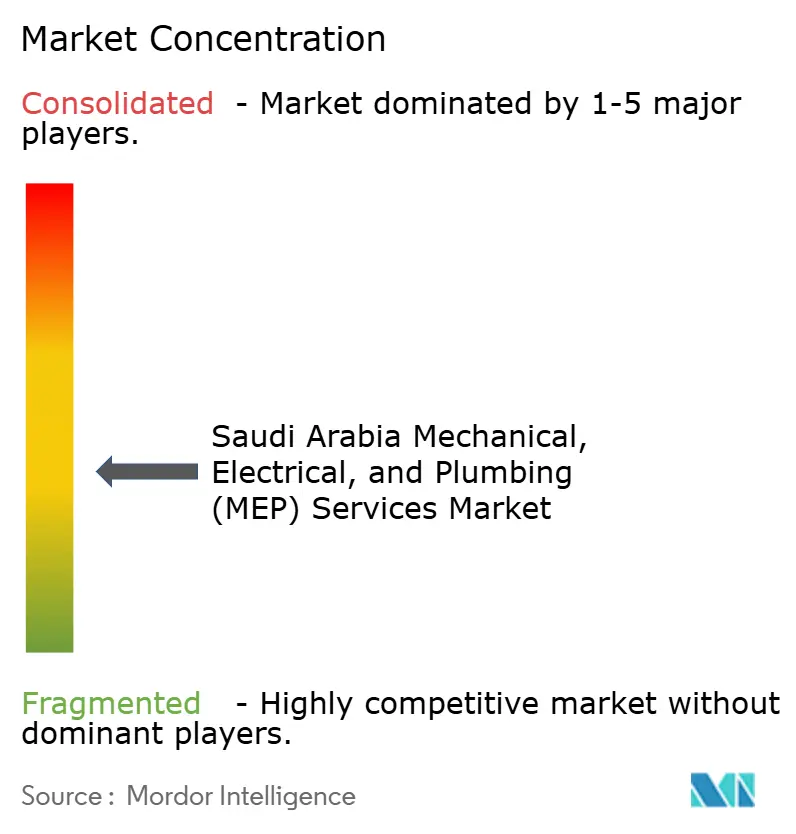
| Market Concentration | Medium |
Major Players *Disclaimer: Major Players sorted in no particular order Image © Mordor Intelligence. Reuse requires attribution under CC BY 4.0. | |
Saudi Arabia Mechanical, Electrical, and Plumbing (MEP) Services Market Analysis by Mordor Intelligence
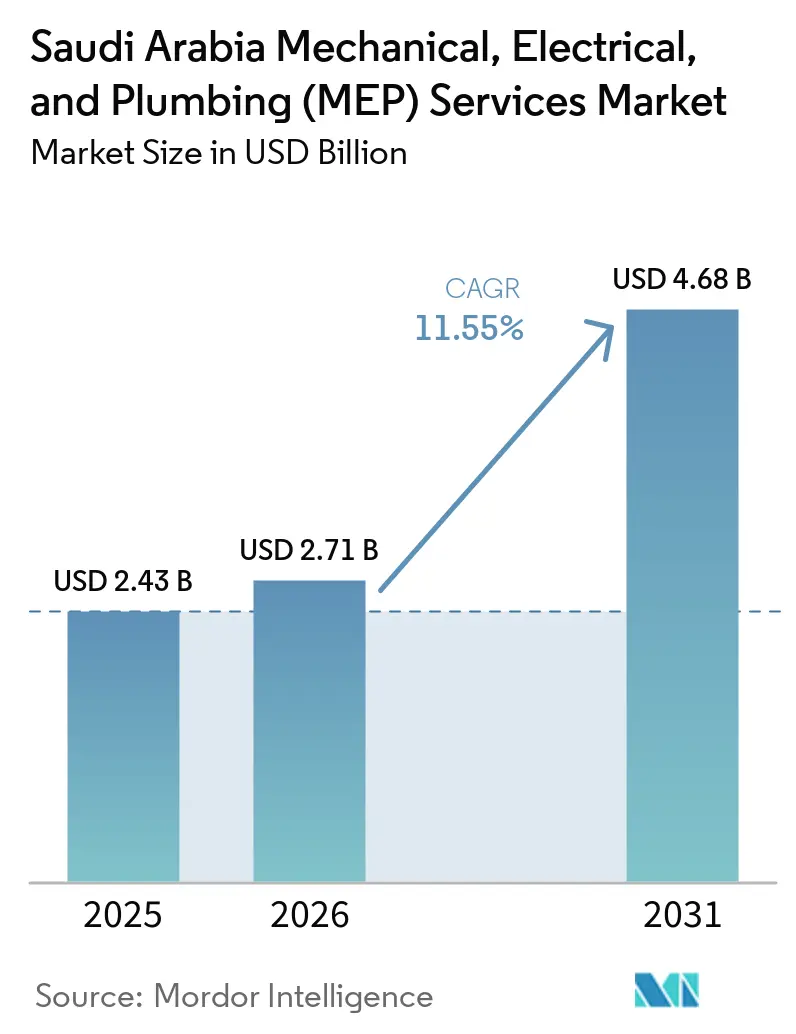
The Saudi Arabia Mechanical, Electrical, And Plumbing Services Market size is expected to grow from USD 2.43 billion in 2025 to USD 2.71 billion in 2026 and is forecast to reach USD 4.68 billion by 2031 at 11.55% CAGR over 2026-2031.
The Saudi Arabia MEP services market is being supported by the move from early civil works into building completion, fit-out, systems installation, testing, and handover across large developments, where the value of coordinated building services becomes more visible. This shift places mechanical, electrical, and plumbing packages earlier in project schedules because owners need to coordinate complex systems with structural, architectural, fire-safety, controls, and operating requirements before buildings are finished. Demand is also becoming less dependent on a single building type as commercial projects, hotels, hospitals, transport assets, industrial facilities, and data centers require specialized systems, reliable commissioning, and ongoing maintenance after opening. Contractors with local production, commissioning skills, integrated delivery models, and the capacity to support operational assets are better placed to compete for higher-value work and to meet procurement expectations that extend beyond a basic installation scope. Equipment availability, technical labor shortages, payment timing, and incomplete asset information remain important limits on execution, particularly when several complex developments enter the installation stage at the same time.
Key Report Takeaways
- By type, Mechanical Services held 41.3% of the Saudi Arabia MEP services revenue in 2025, while Integrated MEP Services is forecast to grow at a 12.21% CAGR through 2031.
- By service type, Maintenance, Repair, and Retrofit held 35.4% of Saudi Arabia MEP services revenue in 2025, while Managed and Performance-Based Services are forecast to grow at a 12.56% CAGR through 2031.
- By end-user industry, Commercial held 42.6% of Saudi Arabia MEP services revenue in 2025, while Infrastructure is forecast to grow at a 12.67% CAGR through 2031.
- By geography, Riyadh held 36.7% of Saudi Arabia's MEP services revenue in 2025 and is forecast to grow at a 12.91% CAGR through 2031.
Note: Market size and forecast figures in this report are generated using Mordor Intelligence’s proprietary estimation framework, updated with the latest available data and insights as of January 2026.
Saudi Arabia Mechanical, Electrical, and Plumbing (MEP) Services Market Trends and Insights
Drivers Impact Analysis*
| Drivers | (~) % Impact on CAGR Forecast | Geographic Relevance | Impact Timeline |
|---|---|---|---|
| Vision 2030 Giga-Project MEP Package Demand | +3.0% | National, with the highest concentration in Riyadh, the NEOM corridor, and Diriyah | Short term (≤ 2 years) |
| Riyadh Commercial and Mixed-Use Build-Out | +2.5% | Riyadh, with spillover to Jeddah | Short term (≤ 2 years) |
| Hospitality, Pilgrimage, and Tourism Infrastructure Expansion | +1.8% | Makkah, Madinah, and the Red Sea coast | Medium term (2-4 years) |
| Data Center, Industrial Cooling, and Power-Quality Demand | +1.5% | Riyadh and Eastern Province, with spillover to NEOM | Medium term (2-4 years) |
| Building Information Modeling, Digital Commissioning, and Smart-Building Adoption | +0.8% | National, with early gains in Riyadh and Jeddah | Medium term (2-4 years) |
| Localized MEP Manufacturing and Modular Delivery | +0.6% | National, with activity in King Abdullah Economic City and Dammam | Long term (≥ 4 years) |
| Source: Mordor Intelligence | |||
Vision 2030 Giga-Project MEP Package Demand
The Saudi Arabia MEP services market is gaining work from NEOM, Qiddiya, Diriyah, New Murabba, and King Salman International Airport, whose size and technical requirements make building-services coordination a central project task. These programs have moved MEP work from a late construction activity to an early planning requirement because structural, architectural, mechanical, electrical, plumbing, and control systems must be aligned before installation begins. Owners are dividing major works into separate MEP packages, creating demand for contractors that can manage design coordination, procurement, installation, testing, commissioning, and handover while working with several construction teams. The package structure gives specialist firms a clearer role in developments that previously relied on broad construction scopes, and it makes delivery records, interface plans, and responsibility for system performance more important during procurement. It also creates a larger group of subcontractors and suppliers whose work is directly linked to whether a whole building or district can enter testing on time. Expo 2030 Riyadh and FIFA 2034 provide fixed delivery dates that can support continuity in the project pipeline and reduce the risk that work is deferred without a clear endpoint.
Riyadh Commercial and Mixed-Use Build-Out
Riyadh is creating recurring demand for installation, commissioning, retrofit, and operations work within the Saudi Arabia MEP services market, rather than demand limited to the initial shell-and-core construction stage[1]. Office towers, mixed-use districts, hotels, medical facilities, data centers, retail centers, and corporate campuses require systems that are more complex and more closely monitored than those used in basic building construction. The King Abdullah Financial District, the Mukaab development, and projects along King Fahad Road add to the city’s installed base of cooling, power, plumbing, controls, and life-safety assets. That installed base generates follow-on work after the original construction contract is complete because systems need testing, adjustment, replacement, performance management, and documented service history during operation. This also gives owners a stronger reason to select providers that can understand a whole building’s systems rather than respond only when one asset fails. International specialists are attracted by the scale of technically demanding work and by the need for strong coordination among design, procurement, site delivery, and facilities teams.
Hospitality, Pilgrimage, and Tourism Infrastructure Expansion
Hospitality investment in Makkah and Madinah is expanding the Saudi Arabia MEP services market through hotel, residence, and visitor infrastructure projects that must operate consistently during periods of very high demand. These assets need dependable cooling, water, sanitation, power, fire protection, controls, and life-safety systems because they serve large visitor volumes in challenging climatic conditions[2]. Rua Al Haram, Rua Al Madinah, Dar Al Hijrah Pilgrim City, Masar Makkah, and Thakher Makkah were identified in the supplied research as important development programs that require substantial building-services packages. The demand profile extends beyond installation because hotel assets need regular maintenance, commissioning support, water-system checks, performance monitoring, and careful coordination with operating staff after opening. Peak visitor periods make downtime in cooling, water, sanitation, or electrical systems especially difficult, which increases the importance of preventive work and rapid response capability. Contractors with experience in district cooling, plumbing, high-capacity air-conditioning, and large operating portfolios can address these requirements more effectively[3].
Data Center, Industrial Cooling, and Power-Quality Demand
Data centers and industrial facilities are adding specialized work to the Saudi Arabia MEP services market because their systems must operate with a level of resilience that is not required in many standard buildings. These facilities require high-capacity cooling, power distribution, redundant electrical arrangements, thermal management, monitoring, carefully tested backup systems, and controls that can maintain stable operations. Oracle’s announced local infrastructure commitment and Humain’s planned compute capacity point to continuing demand for mission-critical installation and commissioning in the supplied research. The desert environment raises the engineering requirements for cooling and electrical systems, while industrial sites also require attention to process loads, power quality, and equipment performance under continuous operation. These conditions create a need for specialized design review, detailed testing, and commissioning records that can demonstrate that the facility will perform as required once it is occupied. Saudi standards for cooling equipment increase the value of local technical capability and of equipment that can meet required conformity conditions.
Restraints Impact Analysis*
| Restraints | (~) % Impact on CAGR Forecast | Geographic Relevance | Impact Timeline |
|---|---|---|---|
| Imported Equipment Lead Times and Price Volatility | -1.2% | National, with the strongest effect in Riyadh and Eastern Province | Short term (≤ 2 years) |
| Skilled MEP Labor and Site-Execution Bottlenecks | -1.0% | National, with the strongest effect in the NEOM corridor and Riyadh | Short term (≤ 2 years) |
| Payment-Cycle and Contractor Cash-Flow Pressure | -0.8% | National, concentrated in government-funded projects | Medium term (2-4 years) |
| Fragmented Asset Data Limits Performance-Based Contracting | -0.5% | National, concentrated in older commercial and industrial stock | Long term (≥ 4 years) |
| Source: Mordor Intelligence | |||
Imported Equipment Lead Times and Price Volatility
Imported chillers, medium-voltage switchgear, building management system controllers, and custom electrical panels can delay the Saudi Arabia MEP services market when project programs are tightly sequenced, and a single item is needed before testing can begin. A late component can prevent testing and commissioning for a wider package, delay work by other trades, and leave completed areas unable to move into handover. This creates pressure on contractors because completion milestones are often linked to payment triggers, while suppliers may face different payment and delivery terms. Product registration and conformity steps add to the lead time for equipment that has not previously been registered in the Kingdom. Local production and modular assembly can reduce some exposure, but they do not yet cover every specialized product required for hospitals, data centers, infrastructure, and industrial sites. Procurement planning, early technical approval, and clear supplier coordination, therefore, remain central to cost control and schedule reliability.
Skilled MEP Labor and Site-Execution Bottlenecks
The Saudi Arabia MEP services market needs commissioning engineers, electrical specialists, plumbing technicians, controls experts, and project managers with experience in complex facilities and high-volume construction programs. Data centers, hospitals, giga-projects, hotels, industrial facilities, and other major developments compete for the same limited specialist talent, particularly when they reach installation and handover stages at the same time. This can increase subcontractor costs, constrain the number of crews available to a contractor, and leave critical positions open during active construction periods. Remote project locations create an added need for logistics, housing, supervision, spare parts, and technical support, which makes site deployment more demanding. Training, local hiring, standardized design, repeatable prefabricated assemblies, and stronger site planning can ease some of the pressure over time. Until capacity improves, labor availability will continue to shape delivery quality, project sequencing, and contractor margins.
*Our forecasts treat driver/restraint impacts as directional, not additive. The impact forecasts reflect baseline growth, mix effects, and variable interactions.
Segment Analysis
By Type: Mechanical Services Lead While Integrated Delivery Gains Ground
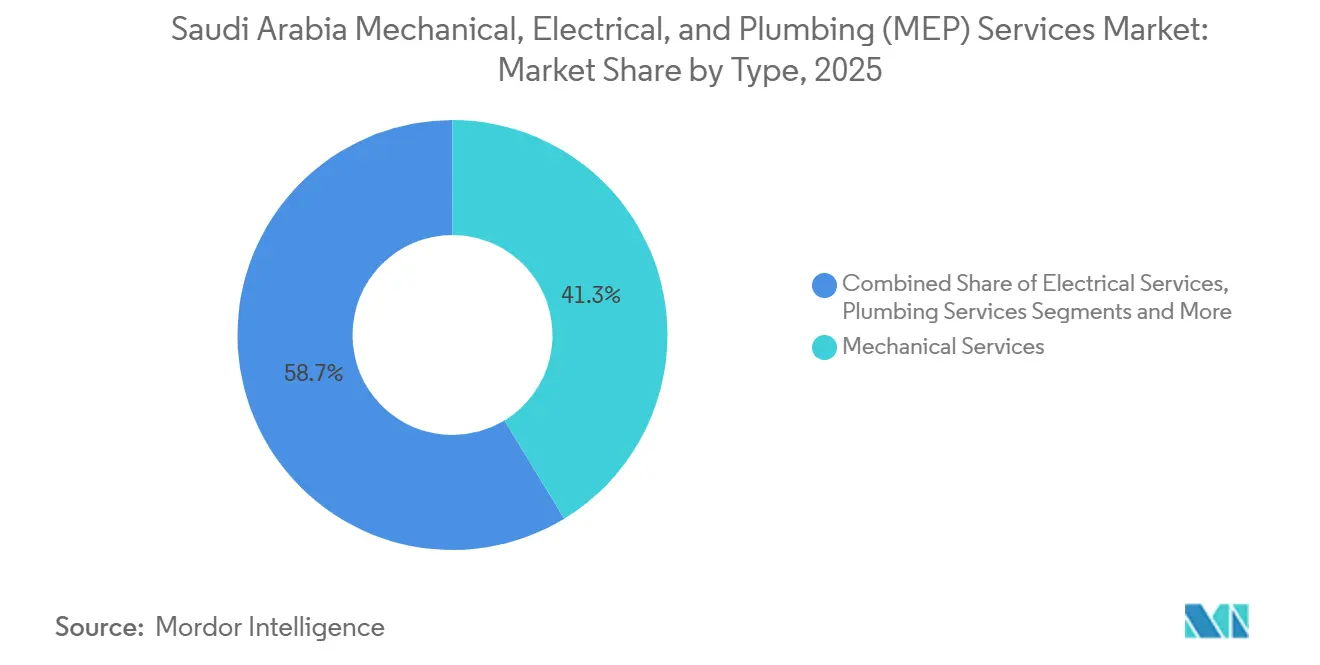
Mechanical Services held 41.3% of Saudi Arabia's MEP services revenue in 2025, supported by the wide need for heating, ventilation, air-conditioning, and refrigeration systems. Cooling is an operating requirement across commercial, healthcare, residential, hospitality, industrial, and public properties, which keeps mechanical scope prominent in new construction and asset operation. Hospitals and data centers increase the value of this work because they need dependable cooling, redundancy, testing, controls, and documented commissioning. Mechanical packages also interact closely with plumbing, electrical, fire protection, and building management systems, so contractors must manage interfaces even when their formal scope is limited. The size of the mechanical category reflects both the volume of cooling equipment and the need to maintain its performance in operating buildings.
Integrated MEP Services is forecast to grow at a 12.21% CAGR from 2026 to 2031 as owners seek a single delivery party to coordinate mechanical, electrical, and plumbing work. This approach can reduce interface disputes, clarify responsibility during testing and handover, and give owners one point of accountability for systems coordination. Electrical Services and Plumbing Services retain steady demand because every major building needs power distribution, water systems, drainage, controls, and compliant installation. Local manufacturing activity supports integrated delivery by improving access to selected equipment and reducing dependence on separate supply channels. The Saudi Arabia MEP services industry is moving toward broader service packages without reducing the central role of specialist mechanical expertise.

By Service Type: Maintenance and Retrofit Hold the Largest Base, While Managed Contracts Expand
Maintenance, Repair, and Retrofit held 35.4% of the Saudi Arabia MEP services market share in 2025. The category is supported by the growing stock of commercial buildings, healthcare facilities, hotels, industrial plants, and public assets that need routine technical servicing. These assets require inspection, repairs, energy-related adjustments, cleaning, replacement of aging equipment, and response to operating issues. The work is often recurring, which can create a steadier revenue base than a single installation project and requires contractors to understand the operating condition of each asset. This broad installed base helps explain why maintenance and retrofit services remain the largest service category.
Managed and Performance-Based Services are forecast to grow at a 12.56% CAGR through 2031. Building owners are looking for contracts that place more responsibility for operating outcomes, asset availability, and energy performance with specialist providers. Such agreements depend on dependable asset information, service teams, monitoring systems, and the ability to measure the condition of equipment over time. Design and Engineering and Installation, Testing, and Commissioning remain essential during construction, but their relative contribution can moderate as more assets enter operation. Kabbani Construction Group’s COSMA facility-management offering shows how contractors can extend support from installation into multi-year operations. The Saudi Arabia MEP services market is consequently creating more value for firms that can manage an asset after construction is finished.
By End-User Industry: Commercial Demand Leads While Infrastructure Grows Fastest
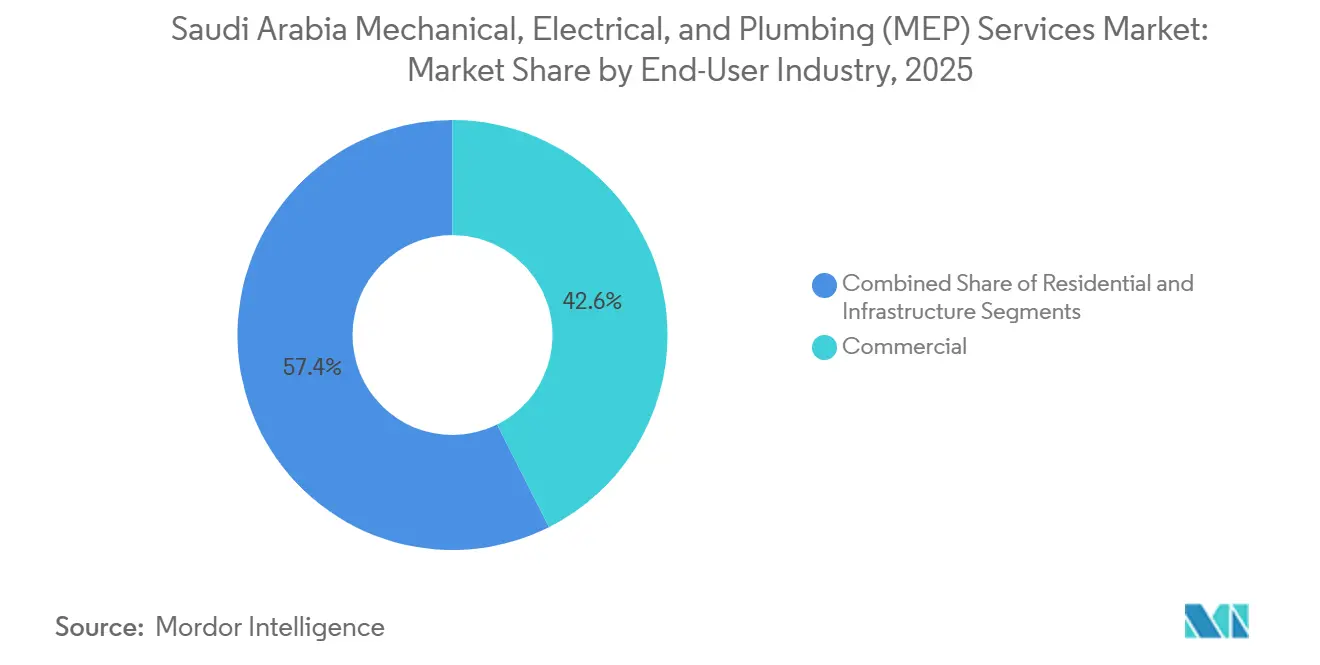
The Commercial sector accounted for 42.6% of the Saudi Arabia MEP services market size in 2025. Riyadh’s office, retail, hospitality, and mixed-use projects are important contributors, while development activity in Jeddah and the Eastern Province adds to the demand base. Commercial properties require coordinated cooling, power, plumbing, fire protection, controls, ventilation, and regular maintenance, often within buildings that must remain attractive and comfortable for occupants. The value of these systems rises in premium offices, hotels, retail centers, and medical buildings because their technical requirements and service expectations are more demanding. New commercial stock also produces future work in commissioning, retrofit, replacement, and facilities operation.
Infrastructure is forecast to grow at a 12.67% CAGR from 2026 to 2031. Airports, mass transit, water treatment facilities, and utility networks require major mechanical, electrical, and plumbing systems with demanding testing, safety, reliability, and operational requirements. These projects are linked to wider economic diversification programs and to delivery schedules for major events, which increases the importance of timely commissioning. Residential demand remains supported by the national housing rollout and homeownership objectives in the supplied research. Transport terminals, stadiums, and other public facilities also include retail, hospitality, and visitor functions that add commercial-grade systems complexity. The Saudi Arabia MEP services industry benefits when infrastructure work combines public functions with complex building-service requirements.
Geography Analysis
Riyadh held 36.7% of the Saudi Arabia MEP services market share in 2025 and is forecast to grow at a 12.91% CAGR through 2031. The city brings together giga-projects, commercial real estate, healthcare facilities, hospitality assets, data center development, corporate offices, retail destinations, and mixed-use districts, which creates a broad local base for technical building systems. This combination supports both a large volume of work and high technical requirements because these buildings need cooling, power, plumbing, life-safety systems, controls, testing, and later operating support. New Murabba and King Salman International Airport are among the projects that strengthen demand for coordinated systems, while other commercial projects add recurring maintenance and retrofit needs. Riyadh also has a deep concentration of corporate, retail, and mixed-use development, allowing contractors to build local teams and serve several asset types from the same operating base.
Makkah and Madinah support a distinct part of the Saudi Arabia MEP services market because hotel and pilgrimage projects need high-capacity water, sanitation, cooling, electrical, ventilation, and life-safety systems that can operate during periods of intense visitor demand. The supplied research identifies major hotel development in Makkah and the Rua Al Madinah project in Madinah as important additions to this pipeline. These buildings must serve high visitor volumes in a demanding climate, so reliable cooling, water availability, drainage, and maintenance capability are essential from the time of opening. This work can continue after construction through commissioning, system adjustment, equipment replacement, preventive maintenance, and operating support. The Eastern Province has a different profile because its demand is linked to industrial cooling, process electrical systems, power quality, and facilities associated with petrochemicals and advanced manufacturing. Contractors in this region need capabilities that address industrial certification, process safety, and disciplined maintenance conditions, as well as standard commercial building work.
Other regions are contributing from a smaller base through Red Sea International Airport, Turaif Industrial City, regional hospitals, education facilities, and other distributed projects. NEOM’s footprint in Tabuk is bringing high-specification MEP work to locations that historically had more limited construction requirements, increasing the need for local supply arrangements and specialized field teams. Remote locations can raise delivery costs because teams need logistics, accommodation, supervision, spare parts, dependable transport, and technical support before construction and commissioning can proceed smoothly. This distribution of projects broadens the Saudi Arabia MEP services market beyond the largest cities and connects it to a wider group of public, tourism, industrial, and regional development programs. It also rewards contractors that can mobilize skilled teams across several locations while maintaining common design, quality, safety, and testing practices. Geographic expansion will depend on whether suppliers can manage those operational demands without weakening schedule control, equipment availability, or the quality of final handover.
Competitive Landscape
The Saudi Arabia MEP services market has a mixed concentration profile because the largest giga-project packages tend to favor contractors with established execution capacity, strong backlogs, access to equipment, and the ability to coordinate complex systems across a large site. Commercial and residential work remains more fragmented across mid-sized and smaller firms, especially where projects are smaller, more localized, or require only part of the full mechanical, electrical, and plumbing scope. Competition is based on delivery reliability, technical credentials, local content, pricing, supplier relationships, and the ability to manage interfaces among multiple trades without delaying critical tests. BIM, or building information modeling, is becoming a baseline requirement for complex work because it helps contractors review physical conflicts among systems before installation and maintain usable information through handover. Contractors that can show reliable testing, commissioning, documentation, and handover processes have an advantage in high-value projects where building performance after opening is a key concern.
Local manufacturing has become a practical competitive factor in the Saudi Arabia MEP services market because it can improve access to selected products, support procurement requirements, and reduce the operational risk created by imported equipment delays. Johnson Controls Arabia inaugurated a 600-ton air-cooled chiller production line and an AHRI-certified testing laboratory at its YORK Manufacturing Complex. The same company also agreed to supply more than 133 Saudi-manufactured, AHRI-certified air-cooled chillers for Saudi Entertainment Ventures destinations. These moves support faster equipment access, stronger local-content credentials, and a more complete testing pathway for equipment used in the Kingdom. Nemetschek Group and buildingSMART Saudi Arabia also entered a partnership to support openBIM practices and ISO 19650-aligned standards in the architecture, engineering, construction, and operations sector. Such moves make digital coordination, traceable project data, local technical infrastructure, and familiarity with structured delivery standards more important in contractor selection.
Opportunities remain in integrated operations and maintenance for large commercial and mixed-use portfolios and in prefabricated MEP systems for residential and hospitality projects, where repeated building layouts can support more standardized delivery. Owners managing large asset portfolios can prefer unified agreements over several disconnected specialist contracts because they want clearer operating responsibility and a simpler service relationship after construction. Technology-enabled facilities managers can differentiate through equipment monitoring and predictive maintenance. Still, the usefulness of these approaches depends on the quality of underlying asset data and the ability to act on warnings in time. Compliance with the Saudi Building Code and Leadership in Energy and Environmental Design requirements is also becoming a useful differentiator in complex projects because contractors must show that systems have been designed, installed, and documented correctly. Kabbani Construction Group expanded its SOGEC subsidiary’s services to include overhead power line work, widening its electrical infrastructure offering. The Saudi Arabia MEP services market, therefore, remains competitive across both project delivery and long-term asset support, with firms seeking to build an advantage through local capability, integrated services, and dependable operating performance.
Saudi Arabia Mechanical, Electrical, and Plumbing (MEP) Services Industry Leaders
-
SaudiTaab Contracting Co.
-
Specialized MEP Co. Ltd. (SMEP)
-
Huda Arabia Contracting Co.
-
BEC Arabia
-
Integrated Holistic Construction Company (IHCC)
- *Disclaimer: Major Players sorted in no particular order
Recent Industry Developments
- May 2026: Kabbani Construction Group’s subsidiary SOGEC expanded its service portfolio by adding overhead power line services to its integrated electrical infrastructure capability in Saudi Arabia.
- April 2026: Johnson Controls Arabia inaugurated the Kingdom’s largest 600-ton air-cooled chiller production line at the YORK Manufacturing Complex in King Abdullah Economic City. The company also launched Saudi Arabia’s first AHRI-certified performance-testing laboratory for equipment up to 600 tons.
- February 2026: Johnson Controls Arabia and Saudi Entertainment Ventures signed an agreement for the supply of more than 133 Saudi-manufactured, AHRI-certified air-cooled chillers for entertainment destinations across the Kingdom.
Saudi Arabia Mechanical, Electrical, and Plumbing (MEP) Services Market Report Scope
| Mechanical Services |
| Electrical Services |
| Plumbing Services |
| Integrated MEP Services |
| Design and Engineering |
| Installation, Testing, and Commissioning |
| Maintenance, Repair, and Retrofit |
| Managed / Performance-Based Services |
| Residential |
| Commercial |
| Infrastructure |
| Riyadh |
| Makkah |
| Eastern Province |
| Rest of Saudi Arabia |
| By Type | Mechanical Services |
| Electrical Services | |
| Plumbing Services | |
| Integrated MEP Services | |
| By Service Type | Design and Engineering |
| Installation, Testing, and Commissioning | |
| Maintenance, Repair, and Retrofit | |
| Managed / Performance-Based Services | |
| By End-User Industry | Residential |
| Commercial | |
| Infrastructure | |
| By Region | Riyadh |
| Makkah | |
| Eastern Province | |
| Rest of Saudi Arabia |
Key Questions Answered in the Report
What is the forecast for Saudi Arabia MEP services?
The Saudi Arabia MEP services market is forecast to reach USD 4.68 billion by 2031, expanding at an 11.55% CAGR from 2026 to 2031 as building completion, fit-out, commissioning, and asset operations work increase across several project types.
Which service type had the largest share in 2025?
Maintenance, Repair, and Retrofit led service types with 35.4% share in 2025. The large installed base of commercial, healthcare, hospitality, industrial, and public assets supports recurring inspection, repair, adjustment, replacement, and service work after construction has been completed.
Which type leads Saudi Arabia MEP services?
Mechanical Services led with 41.3% share in 2025, supported by the broad need for cooling and ventilation systems. Its role is especially important in commercial properties, hospitals, hotels, industrial facilities, and data centers that depend on controlled environments.
What end-user category is growing fastest?
Infrastructure is projected to grow at a 12.67% CAGR through 2031, supported by airports, transit, water systems, and utility projects. These facilities require coordinated systems that are tested for safety, resilience, reliable operation, and effective maintenance over time.
Which Saudi region is growing fastest for MEP work?
Riyadh is the fastest-growing regional area, with a projected CAGR of 12.91% through 2031. Its development pipeline includes giga-projects, commercial districts, healthcare facilities, hospitality assets, data centers, and a growing stock of operating buildings.
What factors limit MEP project delivery in Saudi Arabia?
Equipment lead times, price volatility, skilled labor shortages, payment pressure, and incomplete asset data can limit execution. These factors are most disruptive when complex projects need specialized equipment, testing, commissioning, tightly coordinated field teams, and dependable decisions across contractors and suppliers.