
Saudi Arabia Less-than-container Load Market Size and Share
Market Overview
| Study Period | 2021 - 2032 |
|---|---|
| Forecast Data Period | 2027 - 2032 |
| Base Year Market Size (2026) | USD 1.20 Billion |
| Market Size (2027) | USD 1.28 Billion |
| Market Size (2032) | USD 1.71 Billion |
| Growth Rate (2027 - 2032) | 6.03 % |
| Market Concentration | Low |
Major Players *Disclaimer: Major Players sorted in no particular order Image © Mordor Intelligence. Reuse requires attribution under CC BY 4.0. | |
Saudi Arabia Less-than-container Load Market Analysis by Mordor Intelligence
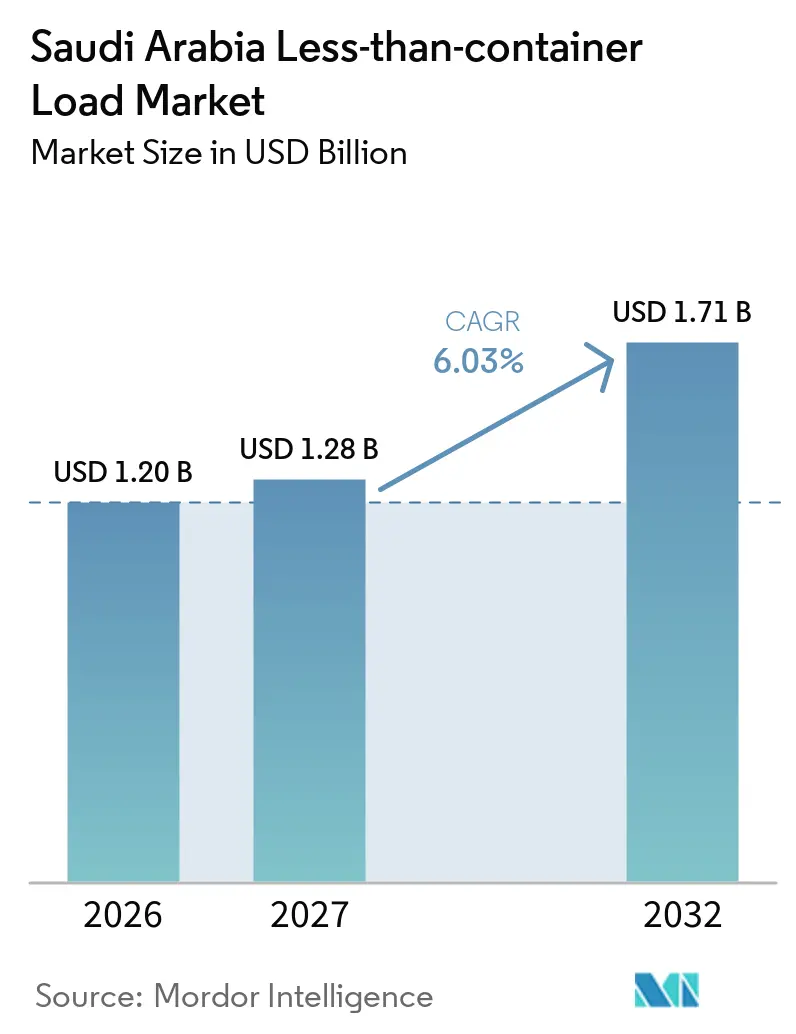
The Saudi Arabia less-than-container load market size is valued at USD 1.20 billion in 2026. It is estimated to grow from USD 1.28 billion in 2027 to reach USD 1.71 billion by 2032, at a CAGR of 6.03% during the forecast period (2027-2032).
The Saudi Arabia less-than-container load market is supported by a broader shift toward manufacturing, retail, and pharmaceutical supply chains that require frequent replenishment in smaller lots. Container traffic and new shipping connections are increasing the pool of inbound, transit, and re-export cargo that can be consolidated at Saudi ports. Investment in ports, warehouses, logistics zones, and inland links is widening the operational reach of consolidation and distribution providers. At the same time, the benefits are uneven because road costs, customs documentation, and lower shipment density outside major hubs can weaken lane economics. Large forwarders are responding with integrated customs, warehousing, and transport offers, while NVOCCs and specialist consolidators are using direct services and digital booking to compete on dense corridors.
Key Report Takeaways
- By service type, consolidation services account for 58.93% of the Saudi Arabia less-than-container load market share in 2026, while the de-consolidation and distribution segment is projected to register a 7.35% CAGR through 2032.
- By destination, international LCL accounts for 72.83% of the Saudi Arabia less-than-container load market size in 2026 and is forecast to expand at a 6.72% CAGR through 2032.
- By nature of business, freight forwarding accounts for 79.03% of the Saudi Arabia less-than-container load market size in 2026, while NVOCCs are forecast to record the highest CAGR at 8.79% through 2032.
- By end user, the manufacturing and automotive segment accounts for 34.82% of the Saudi Arabia less-than-container load market share in 2026, while the retail and e-commerce segment is forecast to register a 7.71% CAGR through 2032.
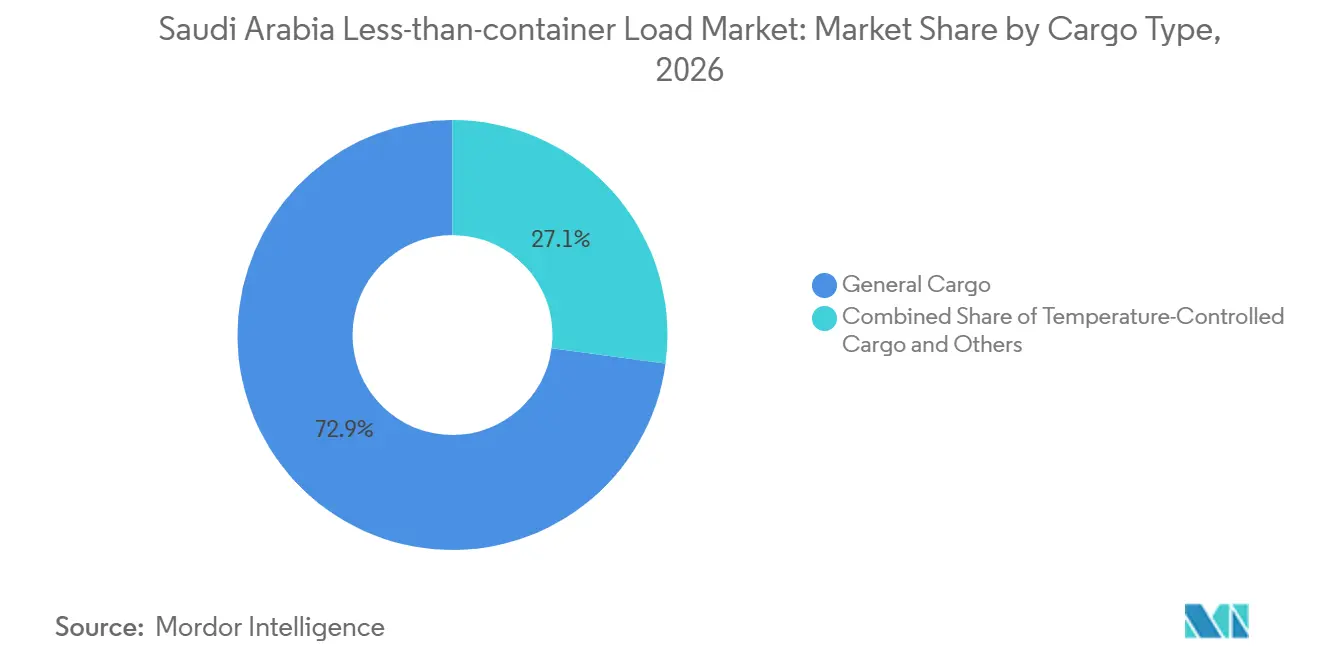
- By cargo type, general cargo accounts for 72.89% of the Saudi Arabia less-than-container load market size in 2026, while temperature-controlled cargo is forecast to register at an 8.22% CAGR through 2032.
- By geography, the Western region accounts for 45.73% of the Saudi Arabia less-than-container load market share in 2026, while the Northern region is forecast to register at an 8.64% CAGR through 2032.
Note: Market numbers in this report are based on Mordor Intelligence's proprietary estimation framework, which combines nine months of actuals with Q4 projections for base year 2026.
Market Trends and Insights
Drivers Impact Analysis of Saudi Arabia Less-than-container Load Market*
| Driver | (~) % Impact on CAGR Forecast | Geographic Relevance | Impact Timeline |
|---|---|---|---|
| E-Commerce Growth Increasing Cross-Border LCL Shipment Demand | +1.4% | National, concentrated in Riyadh and Jeddah | Short term (≤ 2 years) |
| Vision 2030 Investment Strengthening LCL Logistics Infrastructure | +1.2% | National, with hub impact at Jeddah, Dammam, and Riyadh | Long term (≥ 4 years) |
| Industrial Diversification Expanding Smaller-Lot Freight Movements | +1.0% | National, led by Central and Eastern regions with spillover to the Western region. | Medium term (2-4 years) |
| Trade Hub Connectivity Increasing Regional Consolidation Opportunities | +0.8% | Western region and Eastern region, with GCC spillover | Medium term (2-4 years) |
| Port-Rail Integration Improving Smaller-Lot Freight Connectivity | +0.5% | Eastern and Central regions, with early gains at Riyadh Dry Port | Long term (≥ 4 years) |
| Digital Customs Adoption Improving LCL Shipment Visibility | +0.4% | National, concentrated at major port entry points | Short term (≤ 2 years) |
| Source: Mordor Intelligence | |||
E-Commerce Growth Increasing Cross-Border LCL Shipment Demand
Saudi Arabia’s e-commerce activity is making import replenishment more frequent and lowering the average shipment size required by retailers. Mada-card e-commerce sales reached SAR 30.7 billion (USD 8.18 billion) in October 2025, an all-time monthly record and a 68% increase from the prior year, according to Saudi Central Bank data[1]. Sales through Mada cards totaled SAR 88.3 billion (USD 23.53 billion) in the third quarter of 2025, up 15.2% from the preceding quarter. These flows support the Saudi Arabia less-than-container load market because sellers need inventory from multiple suppliers rather than periodic bulk orders. Returns also add demand for de-consolidation and reverse logistics, particularly around Riyadh and Jeddah.
Vision 2030 Investment Strengthening LCL Logistics Infrastructure
Port and warehouse investment is expanding the points where groupage cargo can be consolidated, inspected, stored, and distributed. DP World and Mawani inaugurated the upgraded South Container Terminal at Jeddah Islamic Port in March 2025, raising annual capacity to 4 million TEUs and increasing reefer slots from 1,200 to 2,340. This capacity supports temperature-controlled handling as well as general cargo flows in the Saudi Arabia less-than-container load market. SAL Saudi Logistics Services and Sela signed a SAR 4 billion (USD 1.07 billion) agreement in March 2025 for a logistics zone in Falcon City north of Riyadh, covering more than 1.5 million m². DHL Supply Chain also signed a lease in November 2025 to develop a 78,000-m² multi-user warehouse in Riyadh with EUR 130 million (USD 152.92 million) in investment. These projects increase service expectations and place greater pressure on smaller providers to invest in systems and compliance.
Industrial Diversification Expanding Smaller-Lot Freight Movements
New factories and industrial clusters are creating component flows that are often too small for full containers but too large for express services. Saudi Arabia’s Industrial Production Index rose 6.5% year over year in July 2025, led by manufacturing activity. More than 12,000 factories operate across more than 40 industrial cities, and the national target is 36,000 factories by 2035. The King Salman Automotive Cluster in King Abdullah Economic City includes Ceer, Lucid Motors, and an automated Hyundai factory under construction, and it is expected to contribute SAR 92 billion (USD 24.51 billion) to GDP by 2035. Variable component demand by model and supplier makes smaller consolidated imports practical for these supply chains. Manufacturing expansion therefore gives the Saudi Arabia Less-than-Container Load market a broader base beyond consumer imports.
Trade Hub Connectivity Increasing Regional Consolidation Opportunities
Saudi ports are gaining a larger role in transit and re-export cargo moving between Asia, Europe, Africa, and the Gulf. Mawani added new shipping services at Jeddah, Dammam, and King Abdullah Port during 2025, including links that connect Saudi gateways with Asian, Mediterranean, and East African markets. Each additional route improves options for consolidating cargo at origin, at a Saudi port, or before inland distribution. MSC introduced a Europe-Gulf multimodal route in May 2026 through Jeddah Islamic Port and King Abdullah Port, with trucking to Dammam for Gulf distribution. This operating model adds handoff points where cargo can be sorted and combined for different destinations. The Saudi Arabia Less-than-Container Load market can benefit from these transit flows, although service reliability still depends on port capacity, customs processing, and road coordination.
Restraints Impact Analysis of Saudi Arabia Less-than-container Load Market*
| Restraint | (~) % Impact on CAGR Forecast | Geographic Relevance | Impact Timeline |
|---|---|---|---|
| Fuel Cost Volatility Increasing Inland LCL Expenses | -0.5% | National, amplified in Northern and Southern regions | Short term (≤ 2 years) |
| Customs Complexity Increasing LCL Documentation Burden | -0.4% | National, concentrated at Jeddah and Dammam entry points | Medium term (2-4 years) |
| Damage and Transit Risks Reducing LCL Reliability | -0.3% | National, higher in interregional road LCL segments | Medium term (2-4 years) |
| Secondary-City Density Gaps Limiting Consolidation Efficiency | -0.3% | Northern and Southern regions, and inland secondary cities | Long term (≥ 4 years) |
| Source: Mordor Intelligence | |||
Fuel Cost Volatility Increasing Inland LCL Expenses
Inland LCL distribution relies heavily on road transport, making door-delivery costs sensitive to fuel price fluctuations. Smaller cargo volumes reduce payload efficiency and limit consolidators’ ability to absorb surcharges compared with full-container operators. Long-distance deliveries to secondary cities can further increase per-unit transportation costs, particularly where rail alternatives are limited. Restrictions affecting foreign truck drivers under the Saudization program may also constrain driver availability and put additional pressure on freight pricing. These cost uncertainties can shorten quotation validity periods and make it harder to maintain consistent shipment volumes across transport lanes, reducing consolidation efficiency.
Customs Complexity Increasing LCL Documentation Burden
Each shipper in a consolidated container requires separate invoices, packing lists, and relevant conformity documents, creating multiple points of failure. Fasah 2.0 requires advance electronic submission for incoming goods and links customs processing more closely with other government systems. A missing or inaccurate record can delay the release of co-loaded shipments and expose the forwarder to demurrage or customer claims. Product conformity requirements add a further pre-arrival task for smaller importers. Kuehne+Nagel obtained Authorized Economic Operator certification for Customs Brokerage in Saudi Arabia in May 2025, giving it priority clearance and fewer physical inspections[2]. The Saudi Arabia Less-than-Container Load market consequently favors operators that can spread compliance costs across larger shipment volumes.
*Our forecasts treat driver/restraint impacts as directional, not additive. The impact forecasts reflect baseline growth, mix effects, and variable interactions.
Saudi Arabia Less-than-container Load Market Segment Analysis
By Service Type:
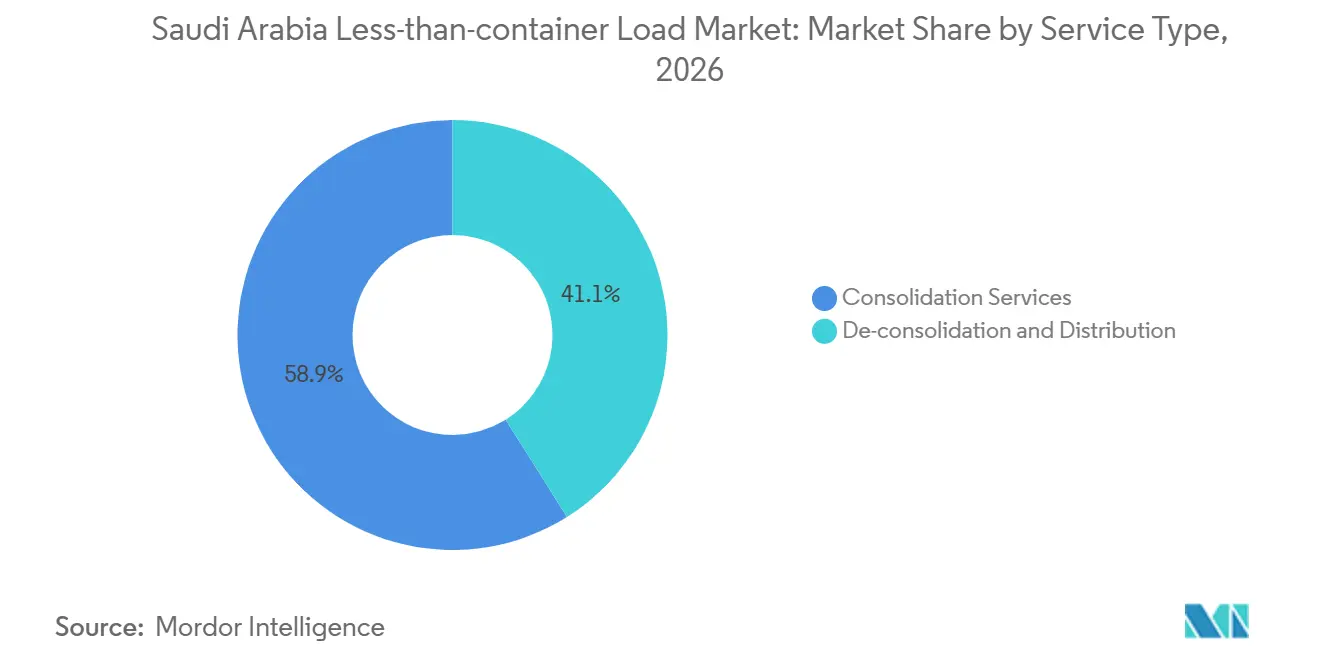
Consolidation Retains the Largest Role While Distribution ExpandsConsolidation services account for 58.93% of the Saudi Arabia less-than-container load market share in 2026. The segment is anchored in groupage operations at Jeddah, Dammam, and Riyadh, where shipments from several suppliers can be combined for importers and exporters. Small and medium-sized enterprises depend on consolidation because many cannot fill a container for each order. More than 1.3 million active small and medium-sized enterprises operate in Saudi Arabia, which broadens the pool of companies with smaller shipment requirements. Manufacturing diversification also supports inbound consolidation for parts sourced from several Asian and European suppliers.
De-consolidation and distribution is forecast to register at a 7.35% CAGR through 2032. E-commerce sellers increasingly need goods separated and delivered to multiple fulfillment points rather than placed in a single bonded warehouse. DHL Global Forwarding launched a direct LCL box service from Milan to Jeddah, Riyadh, and Dammam in November 2025, combining origin consolidation with destination distribution. This service design brings ocean freight and inland delivery into a single operating chain. The faster growth of distribution reflects the need to break bulk cargo closer to end customers.

By Destination:
International Trade Anchors Volumes While Domestic Lanes DevelopInternational LCL accounts for 72.83% of the Saudi Arabia less-than-container load market size in 2026 and is forecast to register a 6.72% CAGR through 2032. Machinery, consumer goods, pharmaceuticals, and food products arrive from Asia, Europe, and North America in partial loads. This creates a durable base of inbound demand that is linked to the country’s non-oil consumption and industrial supply chains. New services to Jeddah, Dammam, and Jubail expanded route options for international cargo during 2025. The segment’s large role also reflects the importance of customs brokerage and port-side handling in international freight.
Domestic LCL is smaller but is becoming more relevant as freight generation spreads beyond coastal gateways. Logistics centers and warehouse projects create inland origin-destination pairs that make consolidated road movements more feasible. The Riyadh Dry Port provides a freight rail connection to Jeddah, which can support multimodal movements for Central region customers. Hapag-Lloyd added the SE4 service to Jeddah in March 2026, connecting the port with Tianjin, Qingdao, Shanghai, and Busan[3]. International flows are still expected to lead because Saudi Arabia seeks a larger role in regional re-export trade.
By Nature of Business:
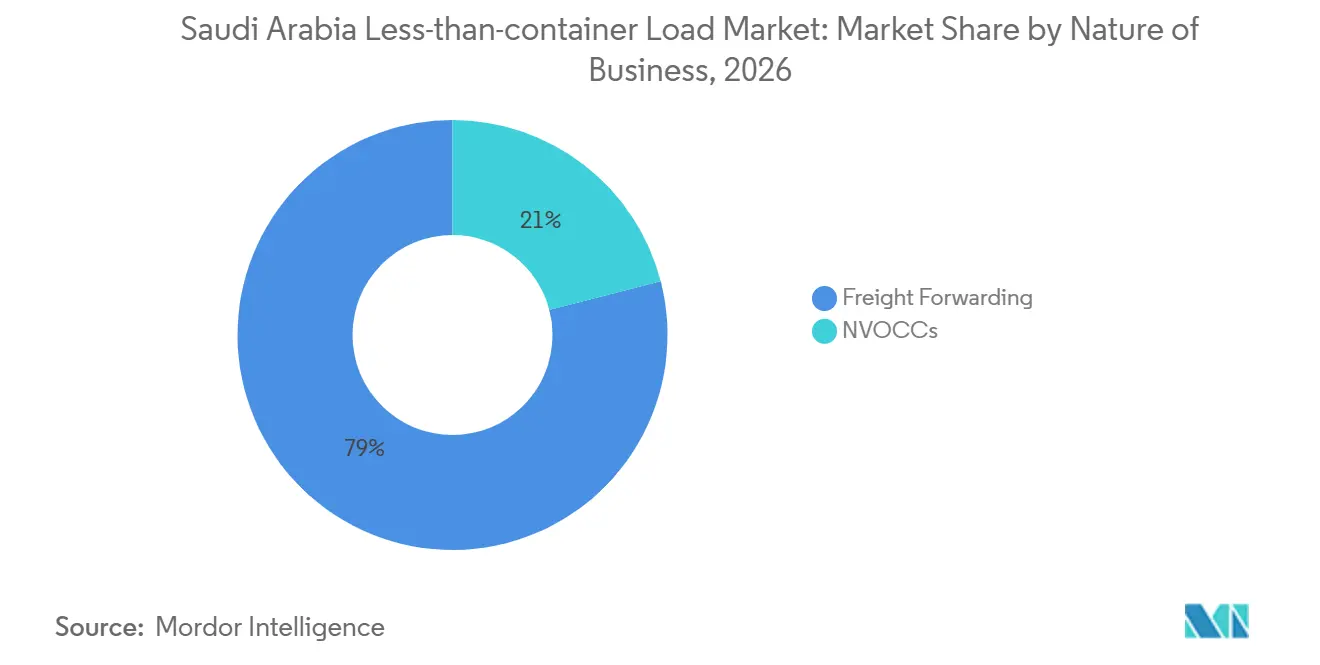
Forwarders Lead While NVOCCs Gain GroundFreight forwarding accounts for 79.03% of the Saudi Arabia less-than-container load market size in 2026. Major forwarders combine customs brokerage, warehousing, ocean freight, and inland delivery within client contracts. DHL, Kuehne+Nagel, DSV, and Maersk can use this broad service range to serve manufacturing and retail customers with complex requirements. Kuehne+Nagel’s May 2025 customs certification provides a specific advantage in priority clearance and inspection management. Compliance systems administered by ZATCA and Mawani favor providers that have dedicated documentation teams and established operating procedures.
NVOCCs are forecast to record the highest CAGR at 8.79% through 2032. The model uses purchased carrier capacity and shipment aggregation, which can be competitive on dense India-Saudi Arabia and Europe-Saudi Arabia lanes. Wilhelmsen Port Services started NVOCC operations across Dammam, Jeddah, and Riyadh in April 2025, adding feeder and mainline connections for customers. ECU Worldwide expanded the Dammam business activity in September 2025 and introduced a direct LCL service from Fos-sur-Mer to Jeddah in March 2026. Digital booking and direct services may help NVOCCs win contestable lanes in the Saudi Arabia Less-than-Container Load market.
By End User:
Manufacturing Leads While Retail and E-Commerce Add GrowthManufacturing and automotive accounts for 34.82% of the Saudi Arabia less-than-container load market size in 2026. Automotive, petrochemical, construction, and industrial equipment operations import components in loads that sit between courier volumes and full containers. Manufacturing output increased in July 2025, and planned factory additions can make these source patterns more common. The King Salman Automotive Cluster will require varied parts and inventory levels across vehicle programs. This supports steady demand for freight forwarding, consolidation, customs brokerage, and delivery services.
Retail and e-commerce is forecast to register at a 7.71% CAGR through 2032. Retailers in the Saudi Arabia less-than-container load market use mixed-origin sourcing and need regular replenishment for fast-moving product lines. Saudi e-commerce registrations reached 52,259 by the third quarter of 2026, up 25% year over year. Stronger online sales support smaller import cycles and more destination distribution work. Healthcare and pharmaceuticals also offer an important specialist opportunity because temperature controls and regulatory approvals raise the value of compliant handling.
By Cargo Type:
General Cargo Leads While Cold Chain Demand RisesGeneral Cargo accounts for 72.89% of the Saudi Arabia less-than-container load market size in 2026. Consumer goods, machinery, textiles, and automotive parts form the core of this category. The diversified import basket gives operators a broad consolidation base across multiple customer groups. General cargo is less dependent on specialized equipment than temperature-controlled or hazardous loads. The scale also allows operators to use regular groupage schedules on established trade lanes.
Temperature-controlled cargo is forecast to expand at an 8.22% CAGR through 2032. Pharmaceutical imports, food-security sourcing, and organized retail are raising demand for cargo that remains within specified temperature ranges. Jeddah’s South Container Terminal increased reefer slots to 2,340 in 2025, and the program includes a reefer inspection facility able to handle 75 containers at the same time. These assets improve handling options for cold-chain LCL cargo. Hazardous and high-value cargo require separate protocols and limit the number of qualified providers.
Geography Analysis
The Western region accounts for 45.73% of the market in 2026. Jeddah Islamic Port is the country’s largest container gateway and gives the region a substantial port-side consolidation base. DP World’s South Container Terminal handled more than 1.3 million TEUs in 2025 and set a monthly record of 221,200 TEUs in July 2026[4]. The region also includes 62 multipurpose berths, a planned 415,000 m² Jeddah Logistics Park, and Maersk’s Integrated Logistics Park.
The Eastern region of the Saudi Arabia less-than-container load market is centered on King Abdulaziz Port in Dammam and Jubail Commercial Port. It serves industrial and energy-sector importers in the Eastern Province’s petrochemical and manufacturing clusters. Mawani agreed in 2025 to develop a SAR 200 million (USD 53.29 million) logistics zone at King Abdulaziz Port covering 197,000 m². DHL’s Riyadh warehouse project and the SAL logistics zone will add distribution capacity for Central region consignees. The Riyadh Dry Port’s freight rail link with Jeddah offers an alternative to some road movements and can improve multimodal delivery options.
The Northern region is forecast to post the highest regional CAGR at 8.64% through 2032. Trade links toward Jordan, Iraq, and the Levant support its growth prospects. The Southern region remains smaller, though commercial activity around Jazan can gradually add cargo volumes. The lower density and distance from core hubs mean that service frequency and road costs remain important constraints. The Saudi Arabia Less-than-Container Load market is therefore likely to retain a Western and Eastern hub structure while Northern and Southern corridors develop more gradually.
Competitive Landscape
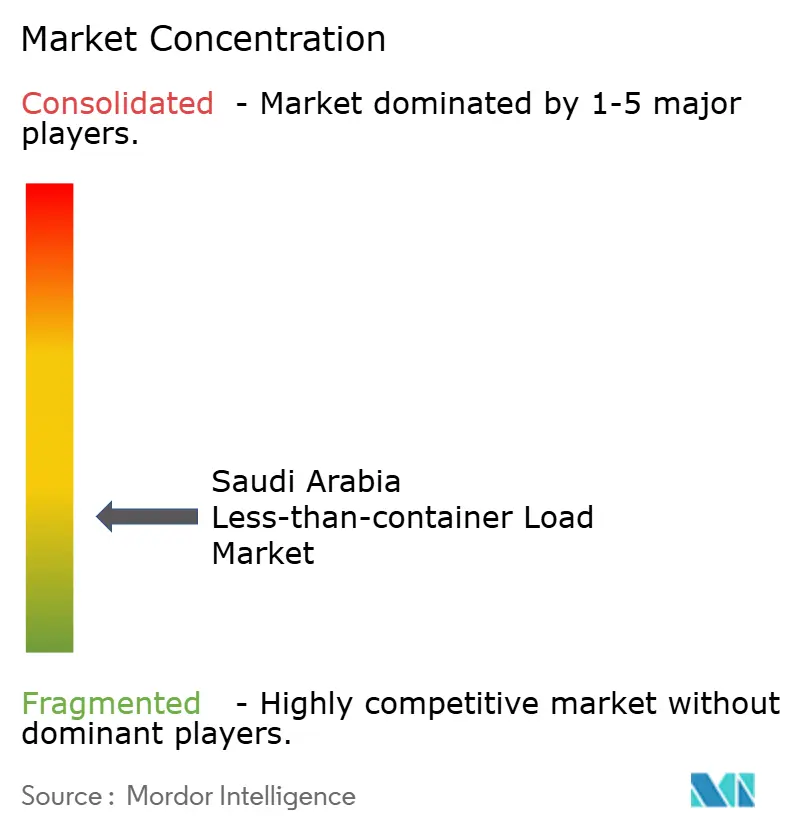
The Saudi Arabia less-than-container load market is fragmented, with local, regional, and international logistics providers competing across different customer segments and trade routes. Maersk, DHL Global Forwarding, DSV, and Kuehne+Nagel have advantages in network coverage, customs credentials, digital tools, and related warehousing services. APM Terminals acquired a 37.5% minority stake in Jeddah’s South Container Terminal in February 2026, while DP World retained a 62.5% stake and operational control under the existing agreement. Kuehne+Nagel’s AEO certification gives it a practical advantage in customs clearance for eligible shipments.
DSV completed the acquisition of Schenker in April 2025, and the combined organization went live in Saudi Arabia in February 2026. The integrated Air and Sea, Contract Logistics, and Road structure allows DSV to offer LCL, storage, and inland delivery in a single client relationship. DHL Supply Chain is adding warehouse capacity in Riyadh, which improves the ability to connect freight forwarding with distribution. Maersk and Saudi Post signed a memorandum of understanding in July 2025 to connect international transport and bonded fulfillment with domestic clearance and last-mile delivery.
Specialist LCL companies and NVOCCs have room to compete in the Saudi Arabia less-than-container load market where customers need direct corridor services or simpler booking. ECU Worldwide’s expansion in Dammam and new France-to-Jeddah service are examples of this corridor approach. Temperature-controlled freight is another area where certification, facility quality, and port access matter more than broad scale. The Fasah 2.0 compliance process raises the value of operators that can manage documentation accurately before arrival.
Saudi Arabia Less-than-container Load Industry Leaders
-
SAL Saudi Logistics Services Company
-
Bahri
-
DHL Global Forwarding
-
Kuehne+Nagel
-
DSV A/S (including DB Schenker)
- *Disclaimer: Major Players sorted in no particular order
Saudi Arabia Less-than-container Load Market Companies Covered in this Report
- A.P. Moller - Maersk
- AJEX Logistics Services
- Aramex PJSC
- BAFCO International Shipping & Logistics Co. Ltd
- Bahri
- C.H. Robinson Worldwide, Inc. (via EFS Logistics Saudi Arabia)
- CMA CGM Group (including CEVA Almajdouie Logistics)
- DHL Global Forwarding
- DP World
- DSV A/S (including DB Schenker)
- ECU Worldwide
- Expeditors International of Washington, Inc.
- Four Winds Saudi Arabia Limited
- GAC Saudi Arabia
- GEODIS
- Hellmann Worldwide Logistics
- Kintetsu World Express (Saudi Arabia) Ltd
- Kuehne+Nagel
- MSC Group (including MEDLOG)
- Munawla Cargo Co. Ltd
- SAL Saudi Logistics Services Company
- Wared Logistics
Recent Industry Developments in Saudi Arabia Less-than-container Load Market
- July 2026: DP World opened the first multi-client logistics warehouse in Saudi Arabia at Riyadh’s Al Mashael Logistics Hub, providing more than 17,000 pallet positions, inventory management, and integrated distribution services.
- March 2026: DP World added 3 semi-automated quay cranes at Jeddah South Container Terminal, increasing the ship-to-shore fleet from 14 to 17 cranes. The terminal plans to reach 22 cranes as annual capacity moves toward 5 million TEUs.
- February 2026: APM Terminals, part of A.P. Moller-Maersk, acquired a 37.5% minority stake in the South Container Terminal at Jeddah Islamic Port from DP World, which retains 62.5% majority operations under a 30-year BOT agreement.
- April 2025: DSV A/S formally completed the EUR 14.3 billion (USD 15.7 billion) acquisition of Schenker from Deutsche Bahn, creating one of the world’s largest logistics companies.
Saudi Arabia Less-than-container Load Market Report Scope
Segmentation Overview
| Consolidation Services |
| De-consolidation and Distribution |
| Domestic |
| International |
| Freight Forwarding |
| NVOCCs |
| Manufacturing and Automotive |
| Retail and E-commerce |
| Healthcare and Pharmaceuticals |
| Agriculture and Forestry |
| Other End Users |
| General Cargo |
| Temperature-Controlled Cargo |
| Hazardous Cargo |
| High-Value and Sensitive Cargo |
| Other End Users |
| Central (Riyadh, Al-Qassim, and Hail) |
| Eastern (Ash-Sharqiyah) |
| Western (Al-Bahah, Makkah, Medina, and Tabuk) |
| Northern (Al-Jouf and Arar) |
| Southern (Asir, Jazan, and Najran) |
| By Service Type | Consolidation Services |
| De-consolidation and Distribution | |
| By Destination | Domestic |
| International | |
| By Nature of Business | Freight Forwarding |
| NVOCCs | |
| By End User | Manufacturing and Automotive |
| Retail and E-commerce | |
| Healthcare and Pharmaceuticals | |
| Agriculture and Forestry | |
| Other End Users | |
| By Cargo Type | General Cargo |
| Temperature-Controlled Cargo | |
| Hazardous Cargo | |
| High-Value and Sensitive Cargo | |
| Other End Users | |
| By Region | Central (Riyadh, Al-Qassim, and Hail) |
| Eastern (Ash-Sharqiyah) | |
| Western (Al-Bahah, Makkah, Medina, and Tabuk) | |
| Northern (Al-Jouf and Arar) | |
| Southern (Asir, Jazan, and Najran) |
Key Questions Answered in the Report
What is the expected growth rate for less-than-container load services in Saudi Arabia?
The sector is forecast to register a 6.03% CAGR from 2027 to 2032, rising from USD 1.28 billion in 2027 to USD 1.71 billion by 2032.
Which service type plays the largest role in Saudi Arabia’s LCL sector?
Consolidation services led with a 58.93% share in 2026, supported by groupage demand from importers, exporters, and small and medium-sized enterprises.
Which customer group is growing fastest for Saudi LCL providers?
Retail and e-commerce is forecast to expand at a 7.71% CAGR through 2032 as online sellers require frequent inventory replenishment and distribution.
Why is temperature-controlled cargo growing faster than general cargo?
Temperature-controlled cargo is forecast to register an 8.22% CAGR because pharmaceutical imports, food-security sourcing, and organized retail require more cold-chain capacity.
Which Saudi region offers the strongest LCL growth outlook
The Northern region is forecast to register an 8.64% CAGR through 2032, supported by developing trade links toward Jordan, Iraq, and Levant markets.
How do customs rules affect LCL operations in Saudi Arabia?
Fasah 2.0 requires advance electronic manifest submissions, increasing the importance of accurate documentation and experienced customs management for consolidated shipments.