
Saudi Arabia Islamic Finance Market Size and Share
Market Overview
| Study Period | 2020 - 2031 |
|---|---|
| Forecast Data Period | 2026 - 2031 |
| Base Year Market Size (2025) | USD 1.40 Trillion |
| Market Size (2026) | USD 1.51 Trillion |
| Market Size (2031) | USD 2.28 Trillion |
| Growth Rate (2026 - 2031) | 8.50 % |
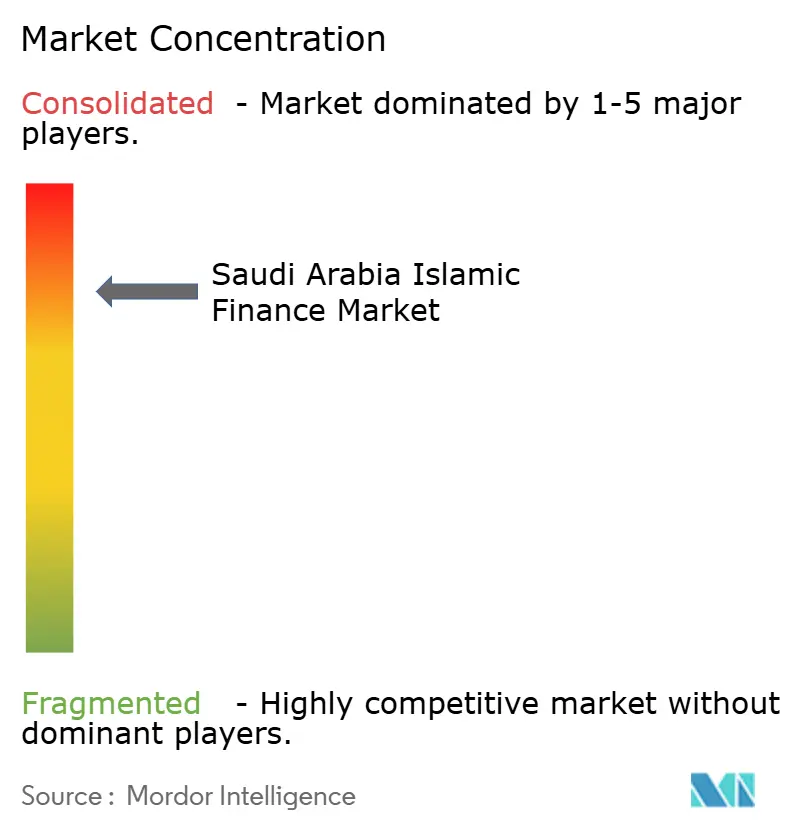
| Market Concentration | High |
Major Players *Disclaimer: Major Players sorted in no particular order Image © Mordor Intelligence. Reuse requires attribution under CC BY 4.0. | |
Saudi Arabia Islamic Finance Market Analysis by Mordor Intelligence
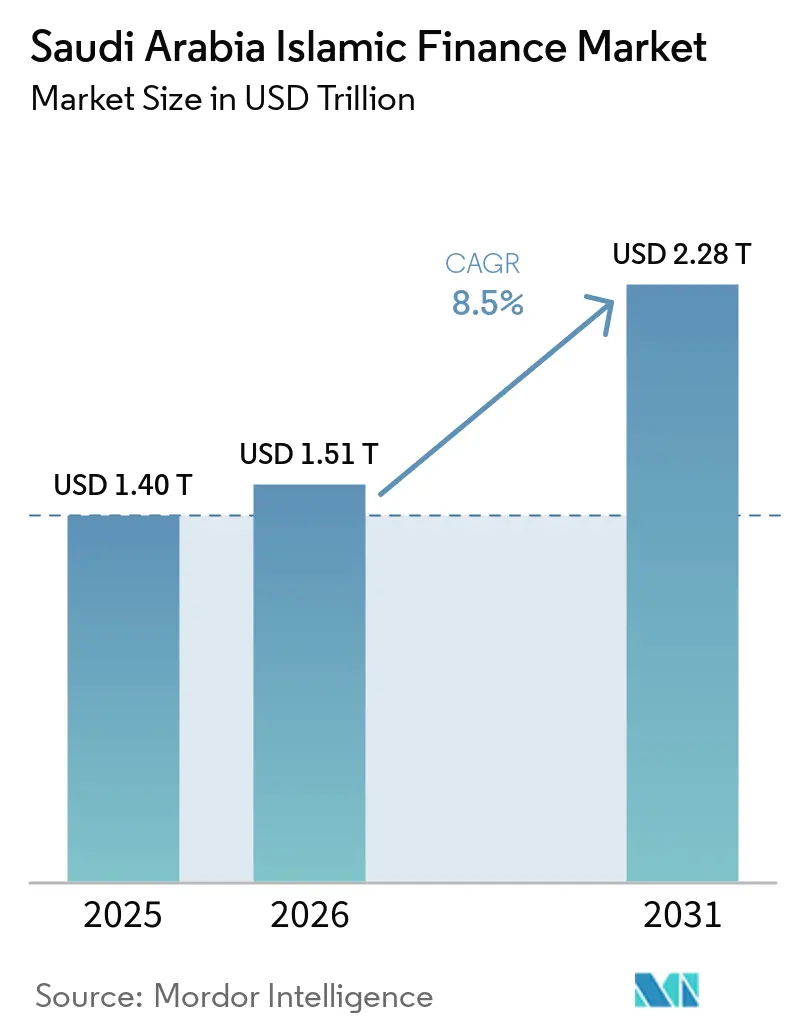
The Saudi Arabia Islamic Finance Market size was valued at USD 1.40 trillion in 2025 and is estimated to grow from USD 1.51 trillion in 2026 to reach USD 2.28 trillion by 2031, at a CAGR of 8.5% during the forecast period (2026-2031).
The Saudi Arabia Islamic finance market is supported by the use of Shariah-compliant structures in infrastructure, housing, corporate finance, and investment activity. Vision 2030 places financial-sector development within the national reform agenda, which supports demand for Murabaha, Ijara, and Istisna'a structures in large development programs. The Saudi Arabia Islamic finance market also benefits from a deeper domestic sukuk curve and a growing range of fund and digital-finance products. Large lenders are extending their capital-market activity, while asset managers and financial-technology providers are expanding access to products for retail customers and smaller businesses. Liquidity conditions in sukuk trading and differing Shariah interpretations remain important constraints because both can increase execution costs and slow product development.
Key Report Takeaways
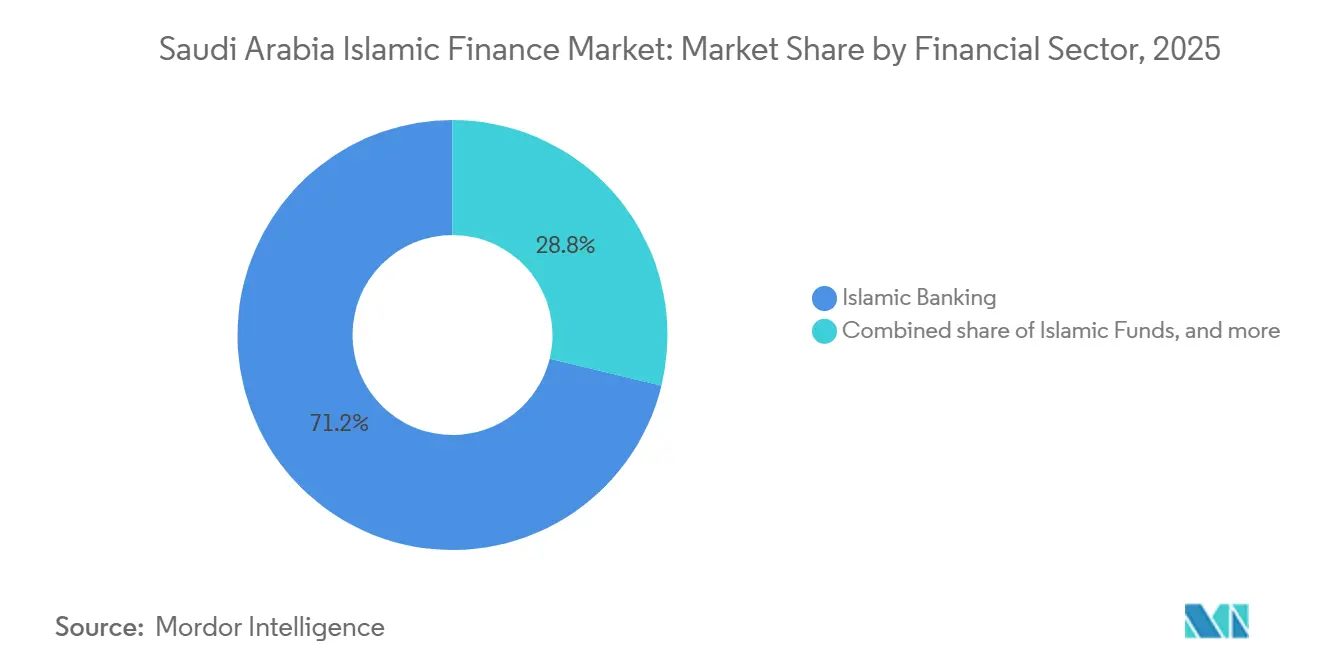
- By financial sector, Islamic banking captured 71.2% of the Saudi Arabia Islamic finance market share in 2025, while Islamic funds are projected to grow at 13.9% CAGR through 2031.
- By customer type, retail and individual customers captured 40.7% of the Saudi Arabia Islamic finance market share in 2025, while MSMEs are projected to grow at 11.7% CAGR through 2031.
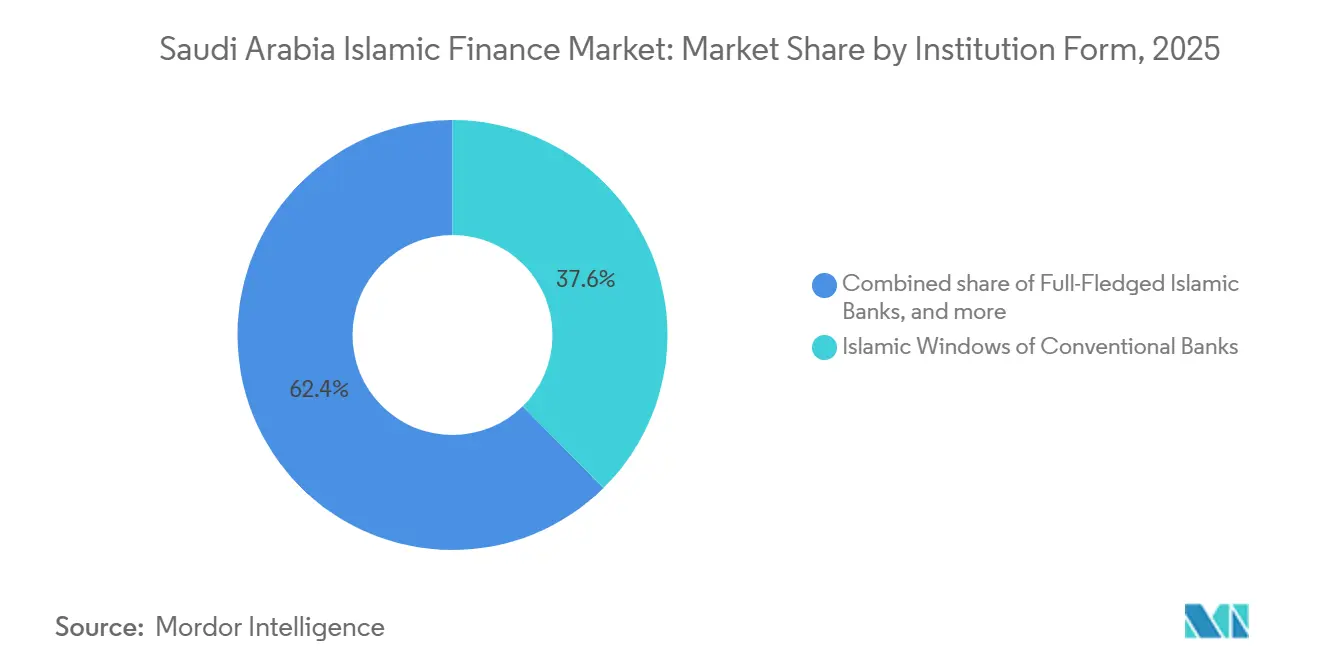
- By institution form, Islamic windows of conventional banks captured 37.6% of the Saudi Arabia Islamic finance market share in 2025, while Islamic fund managers are projected to grow at 13.5% CAGR through 2031.
- By geography, the central region captured 44.8% of the Saudi Arabia Islamic finance market share in 2025, while the northern region is projected to grow at 10.8% CAGR through 2031.
Note: Market size and forecast figures in this report are generated using Mordor Intelligence’s proprietary estimation framework, updated with the latest available data and insights as of January 2026.
Saudi Arabia Islamic Finance Market Trends and Insights
Drivers Impact Analysis*
| Driver | (~) % Impact on CAGR Forecast | Geographic Relevance | Impact Timeline |
|---|---|---|---|
| Vision 2030 Demand for Shariah-Compliant Financing | +2.3% | National, with early gains in Riyadh, Jeddah, and Tabuk | Medium term (2-4 years) |
| Expansion of Sovereign and Corporate Sukuk Issuance | +1.7% | National, with spillover to the Gulf Cooperation Council, Asia-Pacific, and Europe | Short term (≤ 2 years) |
| Digitalization of Islamic Financial Services | +1.5% | National, concentrated in Riyadh and the Eastern region | Medium term (2-4 years) |
| Growth in Shariah-Compliant Banking Finance | +1.1% | National, with concentration in Riyadh, Jeddah, and the Eastern Province | Short term (≤ 2 years) |
| Sustainable and ESG-Linked Islamic Financing | +0.9% | National, with early gains in Riyadh and Jeddah, and international investor participation | Long term (≥ 4 years) |
| Regulatory Development of the Islamic Capital Market | +0.7% | National, with spillover to the Gulf Cooperation Council and cross-border Islamic capital markets | Long term (≥ 4 years) |
| Source: Mordor Intelligence | |||
Vision 2030-Driven Demand for Shariah-Compliant Financing
Vision 2030 is supporting demand for Islamic finance through projects that require substantial long-term funding. The Financial Sector Development Program identifies a more effective and diversified financial sector as part of the broader national agenda[1]. This policy direction increases the use of Shariah-compliant financing in real estate, infrastructure, tourism, and industrial projects. The Saudi Arabia Islamic finance market therefore receives demand from projects that require both domestic bank funding and capital market instruments. A SAR 10 billion (USD 2.67 billion) Murabaha revolving credit facility for NEOM demonstrated how domestic Islamic lenders can provide large project financing structures. This activity also builds transaction experience that lenders can apply to future regional projects.
Expansion of Sovereign and Corporate Sukuk Issuance
Sovereign sukuk issuance has become an established tool for managing the Kingdom's debt profile. In July 2026, the National Debt Management Center completed an early repurchase of SAR 17.1 billion (USD 4.56 billion) in domestic sukuk and issued SAR 17.2 billion (USD 4.59 billion) in replacement instruments across five tranches that extend to 2041[2]. The transaction extended the domestic maturity profile and supported price references across the sukuk curve. It also replaced instruments that were due over the 2026 to 2030 period with securities that have longer final maturities. This form of liability management supports the regularity that investors need when assessing domestic sukuk across different tenors. In September 2026, the National Debt Management Center completed a USD 3.25 billion two-tranche international Ijarah sukuk issuance with an order book of USD 16.5 billion. Such issuance broadens the investor base for Saudi instruments and reinforces the Saudi Arabia Islamic finance market as a source of sovereign-grade Shariah-compliant securities. Corporate issuers can use the same market infrastructure to diversify funding beyond bank credit. A broader issuer base would give investors more opportunities to allocate funds across sovereign, financial, and corporate instruments. It would also make the domestic market less dependent on a limited set of borrowers and issuance formats.
Digitalization of Islamic Financial Services
Digital delivery is widening access to Islamic financial products among consumers and smaller companies. Digital channels can reduce the cost of distributing Murabaha-based consumer finance, crowdfunding, and wealth-management products. This is especially relevant where branch-based models do not serve customers efficiently. The Saudi Arabia Islamic finance market is also seeing digital tools used in payment processing, underwriting, and product onboarding. Digital service models can make product access more convenient where customers prefer remote interactions. Their role is most meaningful when speed does not weaken the required product review and customer protections. Providers still need to explain how the underlying transaction works and how payments are structured. That requirement is particularly important in consumer and small-business products, where simple delivery should not obscure contractual terms. Wider adoption will depend on licensing, data protections, customer trust, and product-level Shariah approval.
Development of Sustainable and ESG-Linked Islamic Financing
Sustainable sukuk connect Shariah-compliant funding with environmental and social project objectives. Saudi Electricity Company has used green sukuk to support renewable-energy and energy-efficiency investment. Its February 2025 financing included a USD 1.25 billion green tranche within a wider USD 2.75 billion sukuk transaction[3]. The Saudi Arabia Islamic finance market can use these instruments to attract investors that assess both Shariah compliance and sustainability use of proceeds. The January 2026 Saudi Electricity Company USD 2.4 billion triple-tranche sukuk also directed proceeds toward grid strengthening, renewable-energy integration, and smart-grid technologies[4]. Continued growth in this area requires clear reporting on use of proceeds and project outcomes. Investors need to be able to connect the financing instrument with the projects it funds. Consistent disclosure can also help issuers demonstrate that sustainable financing commitments are being applied in practice rather than only in product labels.
Restraints Impact Analysis*
| Restraint | (~) % Impact on CAGR Forecast | Geographic Relevance | Impact Timeline |
|---|---|---|---|
| Limited Secondary-Market Liquidity for Sukuk | -1.2% | National and Gulf Cooperation Council-wide, most acute for sub-investment-grade and longer-duration instruments | Short to medium term (≤ 4 years) |
| Limited Availability of Shariah-Compliant Liquidity-Management Instruments | -0.8% | National, concentrated in the interbank and central bank liquidity management segment | Short to medium term (≤ 4 years) |
| Shariah Structuring and Product-Standardisation Complexity | -0.7% | National, with cross-border spillover limiting sukuk internationalisation | Long term (≥ 4 years) |
| Cost and Complexity of Structuring Islamic Financial Products | -0.5% | National, with heightened impact on corporate and project finance structuring | Long term (≥ 4 years) |
| Source: Mordor Intelligence | |||
Limited Secondary-Market Liquidity for Sukuk
Secondary-market liquidity is limited because many institutional investors retain sukuk until maturity. This reduces the tradable supply and can make price discovery more difficult for corporate and lower-rated issuers. The Saudi Exchange provides fixed-income market information, highlighting the importance of a functioning domestic trading environment. Wider bid-ask spreads may increase refinancing costs for borrowers that cannot access sovereign-grade pricing. Geopolitical uncertainty and lower trading activity can further reduce liquidity when investors prioritize holding existing positions. The Saudi Arabia Islamic finance market needs more consistent benchmark issuance and active participation from a broader group of investors to improve secondary trading. Regular supply can make it easier for market participants to compare securities with similar maturities. A larger active investor base would also reduce dependence on a small number of holders that follow buy-and-hold strategies.
Shariah Structuring and Product-Standardization Complexity
Saudi institutions use their own Shariah boards to review and approve financial products. This preserves institutional responsibility for Shariah governance but can produce differences in product acceptance. A structure approved by one institution may require additional review at another institution. These differences can lengthen documentation and raise transaction costs for cross-border project finance and structured products. The Saudi Arabia Islamic finance market is affected most when complex products need input from domestic and foreign counterparties. Greater alignment in documentation and governance practices could reduce execution time without changing the underlying Shariah requirements. Clearer common practices would be valuable for issuers that need to coordinate with several lenders, investors, advisers, and Shariah boards. This is especially relevant when a transaction uses several jurisdictions or a complex asset-financing structure.
*Our forecasts treat driver/restraint impacts as directional, not additive. The impact forecasts reflect baseline growth, mix effects, and variable interactions.
Segment Analysis
By Financial Sector: Banking Remains the Largest Segment While Funds Expand Faster
Islamic banking captured 71.2% of the share of the Saudi Arabia Islamic finance market in 2025, reflecting its role in deposit services, mortgages, and corporate finance. Al Rajhi Bank, Alinma Bank, Bank AlBilad, and Bank AlJazira are among the large full-fledged Islamic lenders that support this position. Al Rajhi Bank reported total assets of SAR 1,055 billion (USD 281 billion) and net income of SAR 24.8 billion (USD 6.6 billion) in 2025. The bank also reported 15% corporate credit growth and 51% year-on-year growth in SME financing. Mortgage lending, consumer finance, and project finance keep banking at the center of the Saudi Arabia Islamic finance market. This leadership reflects the ability of banks to combine everyday transaction services with long-duration financing. It also gives bank-led providers a direct relationship with both households and commercial borrowers. This relationship allows banks to offer financing, payment services, deposits, and investment products through the same operating platform. The breadth of these relationships helps explain why banking remains the largest financial-sector category. Takaful and sukuk continue to provide complementary services for risk coverage and long-term funding.
Islamic funds are projected to grow at a 13.9% CAGR through 2031, making them the fastest-growing financial-sector segment. Fund growth reflects demand for professionally managed Shariah-compliant exposure to equities, sukuk, real estate, and private assets. The development of simpler fund-formation processes can support new domestic products and international participation. It can also give institutional and retail investors more choices beyond direct deposits and bank financing. More fund options can improve the allocation of savings across different risk preferences and investment periods. Fund structures also allow asset managers to package specialist strategies for investors that do not wish to select individual securities. Takaful insurers provide another demand channel because premium pools can be invested in Shariah-compliant securities and funds. This combination supports a broader capital-market role within the Saudi Arabia Islamic finance market.
By Customer Type: Retail Leads While MSMEs Build Momentum
Retail and individual customers captured 40.7% of the share of the Saudi Arabia Islamic finance market in 2025. Islamic mortgage structures and personal-finance products underpin this position. Al Rajhi Bank served more than 21.7 million customers through its retail franchise. Retail demand is supported by the availability of Murabaha, Tawarruq, Istisna'a, and Ijara structures. Large corporates, government-related entities, and financial institutions also account for meaningful activity because they require financing and liquidity-management services. These customer groups tend to use a broader set of facilities, including working capital, project funding, and investment products. Their participation links retail-oriented banking activity to the larger funding needs of national development programs. In particular, corporate and government-related customers require financing structures that can match the scale and duration of their operating and project needs. Their demand also supports use of sukuk, treasury, and liquidity-management services alongside conventional bank facilities. Waqf endowments and charitable entities remain smaller customers but can use Islamic asset-management products.
MSMEs are projected to grow at an 11.7% CAGR through 2031. Their expansion reflects unmet financing demand and public programs that reduce lender risk. Kafalah guarantees can cover up to 80% of qualifying Shariah-compliant MSME facilities, helping lenders extend finance to underserved businesses. Smaller companies also benefit when digital platforms lower onboarding and documentation burdens. Better access to financing can help firms manage working capital and pursue expansion without relying only on informal funding. It can also widen the base of borrowers that banks and other finance providers can serve with standardized products. A SAR 4 billion (USD 1.1 billion) financing initiative launched by Tarmeez Capital and Monsha'at in November 2025 used Islamic sukuk structures for SME funding. These developments can make MSMEs a more material source of financing demand in the Saudi Arabia Islamic finance market.
By Institution Form: Islamic Windows Lead While Fund Managers Grow Faster
Islamic windows of conventional banks captured 37.6% of the share of the Saudi Arabia Islamic finance market in 2025. Their scale reflects the growing use of Shariah-compliant products by banks that also operate conventional businesses. These windows serve retail and corporate customers through established branch networks, digital channels, and treasury operations. Full-fledged Islamic banks remain important because of their specialist positioning and large deposit, mortgage, and corporate-finance franchises. Their business models give customers a dedicated option where Shariah-compliant banking is the central proposition. The coexistence of windows and full-fledged banks also encourages institutions to improve products and service quality. Takaful insurers, sukuk issuers, and other providers make up the remaining institutional base. The distribution of institution types gives the Saudi Arabia Islamic finance market a mix of bank-led delivery and capital-market intermediation.
Islamic fund managers are projected to grow at a 13.5% CAGR through 2031. They are positioned to serve demand for managed portfolios, real-estate funds, sukuk funds, and financing vehicles. The expansion of the product range can draw more investors into Saudi-domiciled Shariah-compliant funds. New fund vehicles can support different return objectives, liquidity needs, and investment horizons. Fund managers also benefit when retail distribution becomes more digital and accessible. Strong governance remains necessary because Islamic funds require Shariah committee oversight and product-level certification. Their growth will further shift part of the Saudi Arabia Islamic finance market toward asset-management services.
Geography Analysis
The Central region captured 44.8% of the Saudi Arabia Islamic finance market share in 2025. Riyadh concentrates national government institutions, financial regulators, banks, corporate headquarters, and market infrastructure. This concentration supports sovereign sukuk activity, corporate lending, and investment fund management. The King Abdullah Financial District strengthens the city's role as a financial center. The Western region is the second-largest geographic area, supported by trade finance through Jeddah, pilgrimage-linked services, hospitality finance, and a large retail customer base. These activities create demand for household products and commercial financing. They also connect the region to domestic and international flows of goods, visitors, and investment.
The Eastern region supports corporate Islamic finance linked to energy, petrochemicals, industrial businesses, and supply chains. Dhahran, Dammam, and Al Khobar host institutions serving these sectors. The Northern region is projected to grow at a 10.8% CAGR through 2031, the highest rate among the geographic segments. NEOM's SAR 10 billion (USD 2.7 billion) Murabaha revolving credit facility highlights the scale of Shariah-compliant financing needed in Tabuk. The wider Tabuk Special Economic Zone and Red Sea tourism development can sustain demand for Ijara, Istisna'a, and Murabaha structures. The Southern region remains smaller but is gaining activity in retail banking and micro-enterprise finance. Its development depends on extending practical access to financial services for households and small businesses. This can support the wider objective of more balanced regional development. Retail access, local lending capacity, and products for smaller enterprises will remain relevant as economic activity extends beyond the largest financial centers.
SAMA licensing applies to full-fledged Islamic banks and Islamic windows across the Kingdom. National requirements provide a common compliance base for deposit-taking institutions in every region. Capital market governance requirements also shape activity beyond Riyadh by requiring Shariah oversight and product certification. Regional differences therefore reflect economic activity and project pipelines more than differences in the core regulatory structure. The Central region is likely to remain the operational center of the Saudi Arabia Islamic finance market because it has the highest institutional density. Northern-region growth can bring more banking and project finance capability to an area that has historically had less financial-sector activity.
Competitive Landscape
The Saudi Arabia Islamic finance market is consolidated. Al Rajhi Bank has a leading position in retail and SME banking, supported by a large branch, ATM, and point-of-sale network. Alinma Bank, Bank AlBilad, and Saudi National Bank are also significant providers in corporate and institutional business. Al Rajhi Bank issued USD 1.5 billion in sustainable AT1 sukuk and USD 1 billion in Tier 2 social sukuk in 2025. These transactions show how large lenders are using capital markets to support balance-sheet growth and sustainability financing. Competition therefore centers on funding access, product range, digital delivery, and Shariah governance.
Opportunities remain in MSME and micro-enterprise finance, family takaful, tokenized sukuk, and digital Islamic capital-market services. Smaller firms can gain traction where their products reach customers that traditional branch networks serve less efficiently. Digital providers are using consumer finance, crowdfunding, and investment tools to improve accessibility. This activity increases competitive pressure on established lenders but can also extend the addressable customer base. A standardized Master Double Wa'ad Repo Agreement would support more consistent Islamic liquidity management across participants. Broader access to listed Shariah-compliant instruments can also increase the range of investors using the Saudi Arabia Islamic finance market.
Competition is likely to stay strongest among large banks that have established capital, distribution, and compliance capabilities. Asset managers can differentiate through specialized funds and stronger digital access. Takaful providers can compete by developing longer-term protection products that complement banking and investment offerings. New entrants must still meet licensing, governance, and product-certification requirements before scaling. Large issuers retain an advantage in attracting domestic and international investor demand. Their established distribution and funding capabilities make it harder for new providers to compete on every product type at once. New entrants are more likely to focus on specific customer gaps, delivery channels, or investment products. This leaves room for specialist firms while established institutions continue to dominate services that require large balance sheets, broad distribution, and extensive compliance resources.
Saudi Arabia Islamic Finance Industry Leaders
-
Al Rajhi Bank
-
Saudi National Bank
-
Alinma Bank
-
Saudi Awwal Bank (SAB)
-
Riyad Bank
- *Disclaimer: Major Players sorted in no particular order
Recent Industry Developments
- September 2026: The National Debt Management Centre completed a USD 3.25 billion two-tranche international Ijarah Sukuk issuance under the Kingdom's Global Trust Certificate Issuance Programme, attracting an order book of USD 16.5 billion, 5× oversubscribed, with tranches maturing in 2031 and 2036. The issuance marks the Kingdom's second international Ijarah-structured sukuk, diversifying the sovereign sukuk format beyond Murabaha-linked structures.
- July 2026: he National Debt Management Centre completed a SAR 17.1 billion (USD 4.6 billion) early repurchase of domestic sukuk maturing from 2026 to 2030. It simultaneously issued SAR 17.2 billion (USD 4.6 billion) in replacement sukuk across five tranches through 2041, extending the Kingdom's Shariah-compliant domestic debt maturity profile.
- January 2026: Saudi Electricity Company completed a USD 2.4 billion triple-tranche sukuk issuance. The proceeds were allocated to grid strengthening, renewable-energy integration, and smart-grid technologies in support of Vision 2030 energy targets.
- November 2025: Tarmeez Capital and Monsha'at launched a SAR 4 billion (USD 1.1 billion) Shariah-compliant SME financing initiative. The initiative primarily used Islamic sukuk structures and targeted the Kingdom's MSME ecosystem.
Saudi Arabia Islamic Finance Market Report Scope
| Islamic Banking |
| Takaful / Islamic Insurance |
| Sukuk |
| Islamic Funds |
| Retail / Individual Customers |
| MSMEs |
| Large Corporates |
| Government & Government-Related Entities |
| Financial Institutions |
| Other Customer Types |
| Full-Fledged Islamic Banks |
| Islamic Windows of Conventional Banks |
| Takaful / Cooperative Insurers |
| Islamic Fund Managers |
| Sukuk Issuers |
| Central Region |
| Western Region |
| Eastern Region |
| Northern Region |
| Southern Region |
| By Financial Sector | Islamic Banking |
| Takaful / Islamic Insurance | |
| Sukuk | |
| Islamic Funds | |
| By Customer Type | Retail / Individual Customers |
| MSMEs | |
| Large Corporates | |
| Government & Government-Related Entities | |
| Financial Institutions | |
| Other Customer Types | |
| By Institution Form | Full-Fledged Islamic Banks |
| Islamic Windows of Conventional Banks | |
| Takaful / Cooperative Insurers | |
| Islamic Fund Managers | |
| Sukuk Issuers | |
| By Region | Central Region |
| Western Region | |
| Eastern Region | |
| Northern Region | |
| Southern Region |
Key Questions Answered in the Report
What is the forecast growth rate for Islamic finance in Saudi Arabia?
The Saudi Arabia Islamic finance market is forecast to grow at an 8.5% CAGR from 2026 to 2031 and reach USD 2.28 trillion by 2031.
Which financial sector has the largest share in Saudi Arabia?
Islamic banking led with a 71.2% share in 2025, supported by its role in deposits, mortgages, consumer finance, and corporate lending.
Which customer group will grow fastest through 2031?
MSMEs are projected to grow at an 11.7% CAGR through 2031 as guarantees, digital delivery, and sukuk-based financing improve access to funding.
Which Saudi region is growing fastest for Shariah-compliant financial services?
The Northern region is forecast to grow at a 10.8% CAGR through 2031, supported by financing needs associated with NEOM and related development activity.
What is driving demand for sustainable sukuk in Saudi Arabia?
Thin secondary-market sukuk liquidity and differing product approvals between Shariah boards can raise transaction costs and slow product development.
What limits the expansion of Shariah-compliant capital markets?
Thin secondary-market sukuk liquidity and differing product approvals between Shariah boards can raise transaction costs and slow product development.