
Saudi Arabia Industrial Asset Inspection Services Market Size and Share
Market Overview
| Study Period | 2021 - 2032 |
|---|---|
| Forecast Data Period | 2027 - 2032 |
| Base Year Market Size (2026) | USD 1.46 Billion |
| Market Size (2027) | USD 1.57 Billion |
| Market Size (2032) | USD 2.46 Billion |
| Growth Rate (2027 - 2032) | 9.40 % |
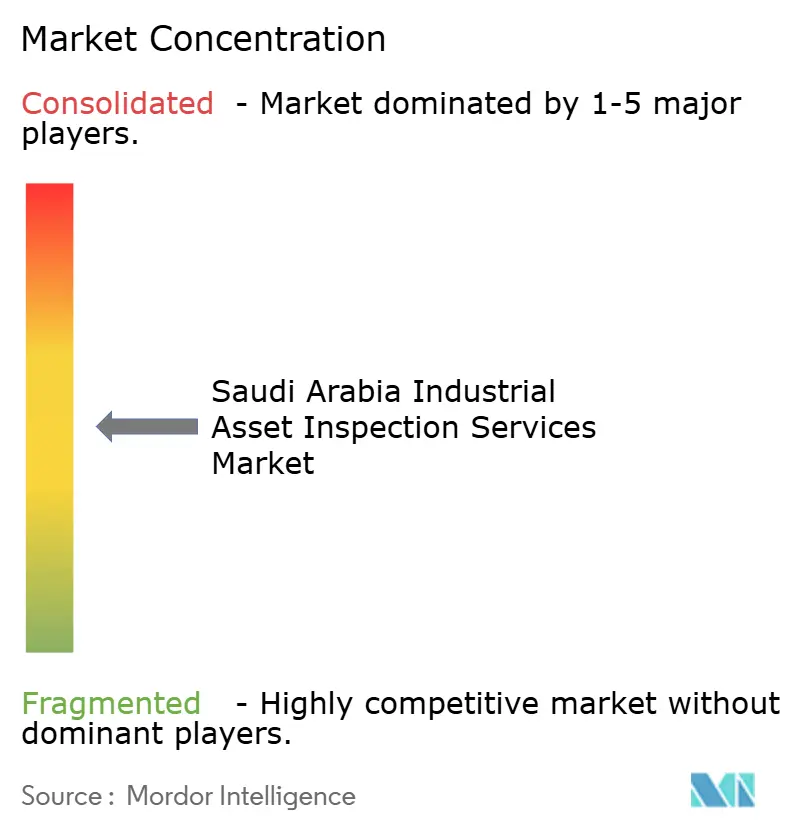
| Market Concentration | Medium |
Major Players *Disclaimer: Major Players sorted in no particular order Image © Mordor Intelligence. Reuse requires attribution under CC BY 4.0. | |
Saudi Arabia Industrial Asset Inspection Services Market Analysis by Mordor Intelligence
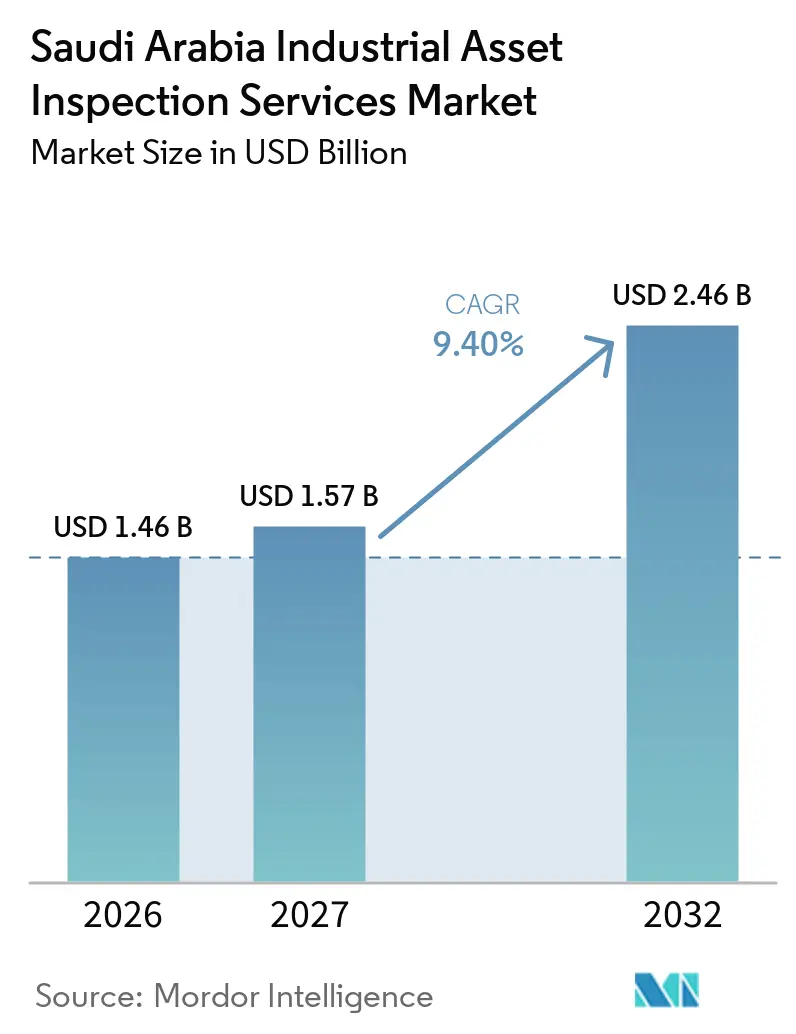
The Saudi Arabia Industrial Asset Inspection Services Market size was valued at USD 1.46 billion in 2026 and is estimated to grow from USD 1.57 billion in 2027 to reach USD 2.46 billion by 2032, at a CAGR of 9.40% during the forecast period (2027-2032).
The Saudi Arabia Industrial Asset Inspection Services market is supported by industrial investment, a large base of mature hydrocarbon and utility assets, and closer compliance requirements for operating facilities. Saudi Arabia's National Industrial Strategy identifies more than 800 industrial opportunities. It targets SAR 979 billion (USD 260.99 billion) in private-sector investment by 2035, which expands the base of assets needing commissioning and periodic integrity work. New facilities add inspection work at commissioning and later risk-based integrity work, while existing plants require recurring surveys as equipment ages. The Saudi Arabia industrial asset inspection services market also benefits from inspection requirements linked to Saudi Aramco procedures, SASO accreditation, and Royal Commission operating rules. Larger providers are strengthening their local workforce, technology coverage, and long-term client agreements because these capabilities increasingly shape eligibility for major contracts.
Key Report Takeaways
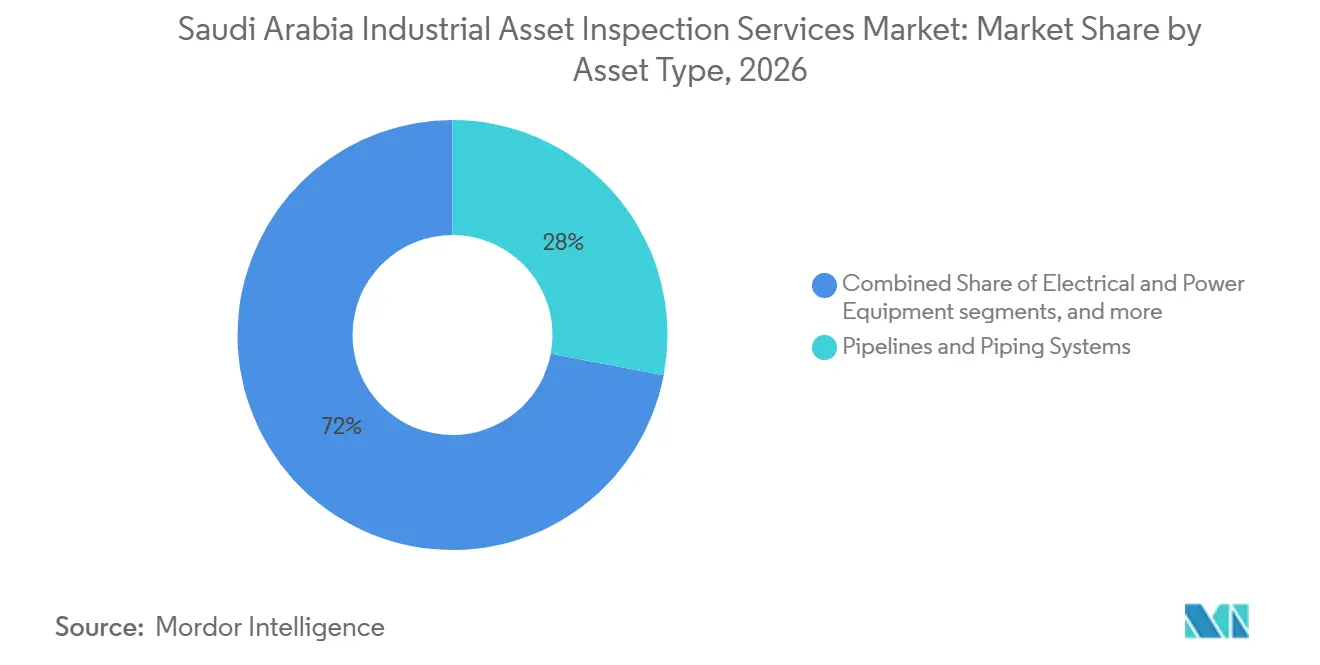
- By asset type, pipelines and piping systems held 28% of the Saudi Arabia industrial asset inspection services market share in 2026, while electrical and power equipment is forecast to expand at a 10.5% CAGR through 2032.
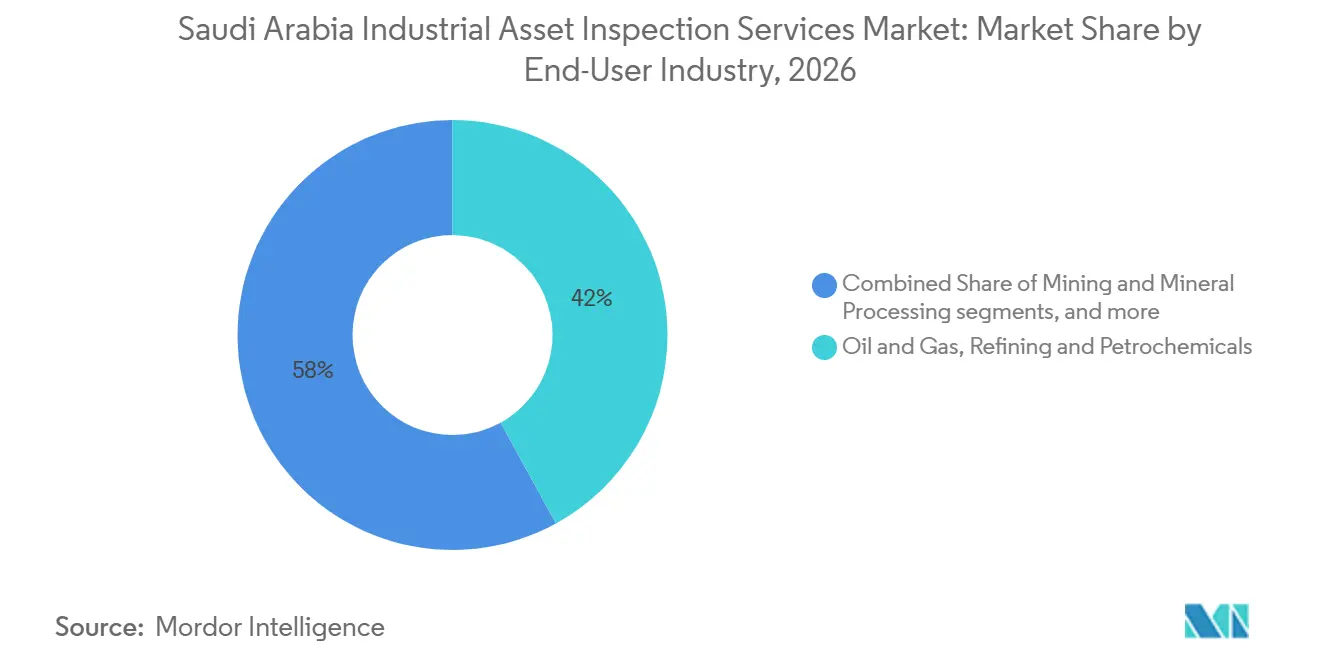
- By end-use industry, oil and gas, refining and petrochemicals accounted for 42% of the Saudi Arabia industrial asset inspection services market size in 2026, while power generation, renewable energy and electrical utilities are forecast to expand at an 11% CAGR through 2032.
Note: Market numbers in this report are based on Mordor Intelligence's proprietary estimation framework, which combines nine months of actuals with Q4 projections for base year 2026.
Saudi Arabia Industrial Asset Inspection Services Market Trends and Insights
Drivers Impact Analysis*
| Driver | (~) % Impact on CAGR Forecast | Geographic Relevance | Impact Timeline |
|---|---|---|---|
| Expansion of Saudi Industrial Capacity and Critical-Asset Base | +2.3% | National, concentrated in Eastern Province, Jubail, Yanbu, and the NEOM corridor. | Long term (≥ 4 years) |
| Aging Hydrocarbon, Power, Desalination, and Utility Assets | +1.8% | Eastern Province, Ras Tanura, Jubail, and Yanbu | Short term (≤ 2 years) |
| Vision 2030 Localization and IKTVA Procurement Requirements | +1.6% | National, concentrated in Aramco's Eastern Province supply chain | Medium term (2-4 years) |
| Saudi Industrial Mega-Projects and New-Asset Commissioning | +1.3% | NEOM, Red Sea coast, Riyadh, and Jubail | Long term (≥ 4 years) |
| Digitization of Inspection Records and Environmental Compliance | +0.9% | National, with greater activity in Aramco and RCJY industrial zones | Medium term (2-4 years) |
| Mining, Renewable Energy, and Advanced Manufacturing Diversification | +0.7% | Al Jalamid, Ras Al Khair, Yanbu, and the Western Province | Long term (≥ 4 years) |
| Source: Mordor Intelligence | |||
Expansion of Saudi Industrial Capacity and Critical-Asset Base
Saudi Arabia's National Industrial Strategy targets SAR 979 billion (USD 260.99 billion) in private-sector industrial investment across more than 800 opportunities by 2035[1]. The Saudi Arabia industrial asset inspection services market gains traction when refining, chemical, metal, and manufacturing facilities move from construction into service. Jubail and Yanbu have received cumulative investment above USD 400 billion, creating a broad installed base of equipment that requires inspection and compliance work. Each new facility needs commissioning checks before operation and later integrity surveys as it enters routine service. This pattern supports recurring demand beyond one-time construction activity.
Aging Hydrocarbon, Power, Desalination, and Utility Assets
A large share of Saudi Arabia's hydrocarbon, power, desalination, and utility infrastructure was commissioned between the late 1970s and early 1990s. The age of these installations increases the importance of risk-based inspection programs for pressure vessels, piping, and storage tanks. API 580 and API 581 support approaches that connect inspection scope to asset condition and operating risk. Asset owners therefore require field testing, engineering assessments, and stronger inspection records rather than simple fixed-interval checks. Saudi Aramco's personnel qualification requirements favor providers that can supply certified NDT staff for this work.
Vision 2030 Localization and IKTVA Procurement Requirements
Aramco reported an IKTVA procurement score of 67% in 2024 and set a 70% target for the end of 2025. These requirements make local employment, training investment, and in-country capability important factors in the Saudi Arabia industrial asset inspection services market. International providers seeking Aramco work need to show credible localization plans alongside technical qualifications. The ASNT and ITQAN partnership provides NDT training and credentialing in Saudi Arabia across UT, MT, PT, RT, and advanced methods. ITQAN's May 2026 program at Al Juaymah adds a local route for Saudi professionals to gain recognized NDT skills.
Saudi Industrial Mega-Projects and New-Asset Commissioning
NEOM, SPARK, green hydrogen, mining, and advanced manufacturing projects add equipment classes to the Saudi Arabia industrial asset inspection services market. They require checks for structural steel, electrical systems, mechanical equipment, offshore facilities, hydrogen piping, ammonia vessels, and material-handling systems. NEOM's industrial development introduces facilities that need multi-disciplinary inspection before and after commissioning. Baker Hughes announced deployment of its Cordant Asset Performance Management suite across four Aramco Booster Gas Compression Stations in November 2025, linking asset health findings to maintenance planning. Ma'aden reported that Phosphate 3 Phase I was 50% complete in the third quarter of 2025 and remained scheduled for a 2027 production ramp-up.
Restraints Impact Analysis*
| Restraint | (~) % Impact on CAGR Forecast | Geographic Relevance | Impact Timeline |
|---|---|---|---|
| Shortage of Saudi-Certified NDT and Asset-Integrity Specialists | -1.8% | National, most acute in Aramco's Eastern Province, Jafurah, and offshore projects | Short term (≤ 2 years) |
| Procurement Fragmentation and Extended Vendor-Approval Cycles | -1.4% | National, with separate approval tracks at Aramco, SEC, SABIC, and SWCC | Medium term (2-4 years) |
| High Cost of Advanced NDT Equipment and Radiation-Controlled Work | -1% | National, with a greater effect on domestic small and medium-sized inspection firms | Medium term (2-4 years) |
| Harsh Desert Conditions, Access Constraints, and Data-Quality Risk | -0.7% | Remote upstream, offshore, and desert installations across multiple regions | Long-term (≥ 4 years) |
| Source: Mordor Intelligence | |||
Shortage of Saudi-Certified NDT and Asset-Integrity Specialists
A shortage of Saudi-certified NDT and asset-integrity specialists restricts the speed at which providers can mobilize for inspection assignments. The Saudi Arabia industrial asset inspection services market requires personnel who meet client and technical qualification standards, particularly on Aramco-related work. The training and supervised fieldwork needed for certification take time, even as ITQAN expands access to training[2]. Advanced techniques such as phased-array ultrasonic testing, time-of-flight diffraction, guided-wave ultrasonics, and digital radiography also require specialized equipment and trained staff. The cost can limit smaller domestic firms to conventional inspection work and favor providers that can spread technology costs across wider client portfolios.
Procurement Fragmentation and Extended Vendor-Approval Cycles
Aramco, SABIC, Saudi Electricity Company, and Saline Water Conversion Corporation maintain separate vendor approval and procurement processes. A new provider may need to complete several qualification tracks before it can bid for a broad range of contracts. This lengthens entry timelines and gives established frame agreements a clear advantage in the Saudi Arabia industrial asset inspection services market. Remote sites, offshore locations, desert heat, restricted access, and challenging data collection conditions add further risk to inspection programs.
*Our forecasts treat driver/restraint impacts as directional, not additive. The impact forecasts reflect baseline growth, mix effects, and variable interactions.
Segment Analysis
By Asset Type: Pipelines Anchor Revenue While Power Equipment Leads Growth
Pipelines and piping systems held 28% of the Saudi Arabia industrial asset inspection services market share in 2026, supported by Saudi Arabia's upstream, midstream, downstream, and process piping networks. Pipelines remain a large source of recurring work because their inspection needs extend across transmission lines, process piping, offshore risers, and gas gathering networks. Baker Hughes received an order for six gas compression trains and six propane compressors for Phase 3 of Aramco's Jafurah field in January 2025.
Electrical and power equipment is forecast to grow at a 10.5% CAGR through 2032. The segment benefits from new solar, wind, electrolysis, and gas-fired power assets requiring commissioning inspections and periodic condition assessments. Transformers, switchgear, inverters, high-voltage cables, and related systems introduce work that differs from conventional vessel or piping inspections. The Saudi Arabia industrial asset inspection services market size for these electrical assets expands as renewable and power projects move into operation. Pressure vessels, boilers, heat exchangers, storage tanks, rotating equipment, and industrial structures remain important because of the concentration of refining, petrochemical, offshore, and marine facilities. TCR Arabia's Saudi Aramco-approved RT Crawler Technique shows the value of technology approvals for pipeline inspection methods. Accreditation and personnel qualifications set a consistent service threshold across asset categories, while digital condition monitoring can add predictive triggers for compressors, turbines, and pumps.

By End-Use Industry: Hydrocarbons Hold Share While Power Leads Growth
Oil and gas, refining, and petrochemicals held 42% of the Saudi Arabia industrial asset inspection services market share in 2026. Power generation, renewable energy, and electrical utilities are projected to grow at an 11% CAGR through 2032. Hydrocarbons retain their leading role because Saudi Aramco's large asset base and approved-vendor structure direct significant inspection spending toward qualified providers. The Jafurah development adds work across well completions, gathering systems, processing facilities, and compression equipment. This base provides a continuing flow of integrity and compliance assignments for established service companies.
The faster growth in power and renewable assets reflects the expansion of operating renewable capacity and the addition of green hydrogen facilities. Vision 2030 reported 6.5 GW of operational renewable energy capacity by mid-2025. NEOM Green Hydrogen Company's facility is planned to begin commercial production in 2027, adding electrolyzers, high-pressure hydrogen piping, and ammonia synthesis equipment. Mining, chemical manufacturing, metals, water and wastewater, food and beverage, pharmaceuticals, and transportation add incremental demand, which broadens the Saudi Arabia industrial asset inspection services market size beyond the two principal end-use groups. Their smaller but varied requirements help diversify the customer base when project timing changes in a major sector.[3]
Geography Analysis
The Saudi Arabia industrial asset inspection services market is primarily domestic, but revenue is concentrated in a limited number of industrial corridors. The Eastern Province holds the largest share of inspection activity because it includes Dhahran, Dammam, Al Khobar, Ras Tanura, and Jubail. Jubail has more than 540 industrial facilities and annual production capacity above 500 million tons. This concentration supports work on refineries, petrochemicals, pipelines, tanks, rotating equipment, and utility systems.
Jafurah adds greenfield demand in the Eastern Province for gathering systems, compression stations, and gas processing facilities. Baker Hughes and Aramco announced an agreement in October 2025 to expand integrated coiled tubing drilling operations across Saudi natural gas fields. Yanbu is another important inspection hub because of its refining base and growing role in hydrogen development. The Saudi Arabia industrial asset inspection services market size in these areas is supported by installed process assets as well as new construction and commissioning work. RCJY's industrial plans point to continued development across its managed cities.
The NEOM area in Tabuk Province is the highest-growth geography for new-asset commissioning, with inspection needs across structures, offshore assets, mechanical equipment, and electrical systems. Riyadh is expanding as a non-hydrocarbon center through industrial estates serving food, pharmaceutical, and advanced manufacturing activities. SASO conformity requirements extend inspection touchpoints for regulated equipment and operating facilities. Mining areas such as Al Jalamid, Ras Al Khair, and the broader Arabian Shield create new work at remote desert and coastal sites. SGS began rolling out geochemistry sample preparation services in Saudi Arabia in 2025, strengthening local support for mining and exploration clients.
Competitive Landscape
The Saudi Arabia industrial asset inspection services market is moderately concentrated at the top tier. SGS Saudi Arabia, Bureau Veritas, Intertek, DNV Saudi Arabia, TÜV Rheinland Arabia, TÜV NORD, Applus+ Velosi, and Baker Hughes Inspection Technologies are positioned for major Aramco and mega-project assignments through approvals, local capability, and multi-year client relationships. These companies compete on breadth of service, compliance systems, qualified staff, and digital inspection tools. They also benefit from established client records, which are valuable where approval requirements are extensive.
Technology has become a visible part of competitive positioning. Baker Hughes announced its first enterprise Cordant Asset Performance Management deployment in Saudi Arabia in November 2025, covering four booster gas compression stations under the Master Gas System Phase 3 expansion. The platform integrates asset health, strategy, and defect elimination tools into gas infrastructure management. This type of deployment may raise client expectations for predictive insights, structured inspection data, and connections to maintenance planning. Localization is another important factor because Aramco signed 145 agreements and memoranda of understanding valued at USD 9 billion at its 2025 IKTVA forum. International companies need in-Kingdom hiring, training, and technology-transfer efforts, while domestic and regional providers can compete through stronger localization scores and customer proximity.
TCR Arabia offers an example of targeted innovation through its RT Crawler Technique, which received Saudi Aramco approval for pipeline radiography applications. ACES International acquired Inspection Technology Company in January 2025, adding Aramco-approved NDT capability to its service portfolio. There remains room for specialized providers in environmental compliance, corrosion, structural integrity, and AI-assisted defect detection. The Saudi Arabia industrial asset inspection services market rewards firms that can meet technical, digital, and local-content requirements while delivering dependable work across dispersed sites.
Saudi Arabia Industrial Asset Inspection Services Industry Leaders
-
SGS Saudi Arabia
-
Bureau Veritas Saudi Arabia Co. Ltd.
-
Intertek Saudi Arabia Ltd.
-
Applus+ Velosi Arabia Ltd.
-
TCR Arabia Company Limited
- *Disclaimer: Major Players sorted in no particular order
Recent Industry Developments
- May 2026: Applus+ demonstrated drone-mounted ultrasonic testing (UT), dry-film-thickness measurement and pulsed eddy current (PEC) inspection for elevated tank surfaces and insulated piping at a major Saudi oil and gas operator. Verified readings showed close correlation with conventional measurements. The approach reduced reliance on scaffolding and rope access and lowered personnel exposure to work at height.
- November 2025: Baker Hughes announced a multi-year contract with CPECC on behalf of Aramco to deploy its Cordant Asset Performance Management suite across four booster gas compression stations under the Master Gas System Phase 3 expansion. The scope covers Asset Health, Asset Strategy, and Asset Defect Elimination modules. It is the company's first enterprise Cordant deployment in Saudi Arabia and establishes a digital asset management reference case for inspection analytics in the Kingdom.
- October 2025: SGS commissioned a geochemistry analytical laboratory in Jeddah with Golden Compass. The facility offers gold, base metals, and multi-element assays for mining and exploration clients in Saudi Arabia. It reduces reliance on export-based geochemical testing and supports the Kingdom's mining development goals. SGS operates across seven Saudi locations.
Saudi Arabia Industrial Asset Inspection Services Market Report Scope
| Pipelines and Piping Systems | Oil, Gas and Industrial Transmission Pipelines |
| Process Piping and Industrial Utility Piping | |
| Offshore Pipelines, Risers and Flowlines | |
| Pressure Vessels, Boilers and Heat Exchangers | Pressure Vessels and Process Reactors |
| Industrial Boilers and Steam Systems | |
| Heat Exchangers and Pressurized Thermal Equipment | |
| Storage Tanks and Containment Systems | Aboveground and Underground Industrial Storage Tanks |
| Industrial Containment and Bulk Storage Systems | |
| Rotating and Mechanical Equipment | Pumps, Compressors and Industrial Turbines |
| Conveyors, Drives and Fixed Production Machinery | |
| Other Installed Mechanical Equipment | |
| Electrical and Power Equipment | Transformers, Switchgear and Power Distribution Equipment |
| Generators and Electrical Installations | |
| Power Transmission and Electrical Utility Assets | |
| Industrial Structures and Fixed Installations | Industrial Structural Steel and Equipment Supports |
| Offshore Platforms and Fixed Energy Installations | |
| Industrial Towers, Stacks and Supporting Structures | |
| Other Fixed Industrial Assets | Process Furnaces and Refractory Systems |
| Industrial Instrumentation and Control Installations | |
| Other Specialized Installed Industrial Assets |
| Oil and Gas, Refining and Petrochemicals |
| Power Generation, Renewable Energy and Electrical Utilities |
| Chemical Manufacturing (Excluding Petrochemicals) |
| Metals and Other Industrial Manufacturing |
| Mining and Mineral Processing |
| Water and Wastewater Utilities |
| Food and Beverage Processing |
| Pharmaceuticals and Bioprocessing |
| Transportation, Logistics and Port Operations |
| Other Industrial End Users |
| By Asset Type | Pipelines and Piping Systems | Oil, Gas and Industrial Transmission Pipelines |
| Process Piping and Industrial Utility Piping | ||
| Offshore Pipelines, Risers and Flowlines | ||
| Pressure Vessels, Boilers and Heat Exchangers | Pressure Vessels and Process Reactors | |
| Industrial Boilers and Steam Systems | ||
| Heat Exchangers and Pressurized Thermal Equipment | ||
| Storage Tanks and Containment Systems | Aboveground and Underground Industrial Storage Tanks | |
| Industrial Containment and Bulk Storage Systems | ||
| Rotating and Mechanical Equipment | Pumps, Compressors and Industrial Turbines | |
| Conveyors, Drives and Fixed Production Machinery | ||
| Other Installed Mechanical Equipment | ||
| Electrical and Power Equipment | Transformers, Switchgear and Power Distribution Equipment | |
| Generators and Electrical Installations | ||
| Power Transmission and Electrical Utility Assets | ||
| Industrial Structures and Fixed Installations | Industrial Structural Steel and Equipment Supports | |
| Offshore Platforms and Fixed Energy Installations | ||
| Industrial Towers, Stacks and Supporting Structures | ||
| Other Fixed Industrial Assets | Process Furnaces and Refractory Systems | |
| Industrial Instrumentation and Control Installations | ||
| Other Specialized Installed Industrial Assets | ||
| By End-Use Industry | Oil and Gas, Refining and Petrochemicals | |
| Power Generation, Renewable Energy and Electrical Utilities | ||
| Chemical Manufacturing (Excluding Petrochemicals) | ||
| Metals and Other Industrial Manufacturing | ||
| Mining and Mineral Processing | ||
| Water and Wastewater Utilities | ||
| Food and Beverage Processing | ||
| Pharmaceuticals and Bioprocessing | ||
| Transportation, Logistics and Port Operations | ||
| Other Industrial End Users | ||
Key Questions Answered in the Report
What is the size of Saudi Arabia industrial asset inspection services in 2026?
The sector is valued at USD 1.46 billion in 2026 and is forecast to reach USD 2.46 billion by 2032, at a 9.4% CAGR. The outlook reflects new industrial assets, mature equipment, and tighter qualification requirements.
Which asset category has the largest revenue share?
Pipelines and piping systems lead with 28% revenue share in 2026. The category covers transmission networks, process piping, offshore risers, and gas infrastructure that need commissioning and recurring integrity work.
Which end-use sector is expanding the fastest?
Power generation, renewable energy, and electrical utilities are forecast to grow at 11% CAGR through 2032. New solar, wind, electrical, hydrogen, and gas assets create inspection needs that differ from traditional refinery assignments.
Why are inspection services needed for mature Saudi assets?
Mature hydrocarbon, power, desalination, and utility assets need more detailed integrity assessments, recurring surveys, and qualified NDT work. Risk-based inspection helps asset owners align inspection scope with equipment condition and operating risk.
How does localization affect service providers?
Aramco's IKTVA program makes local hiring, training, and in-country capability important for suppliers seeking major contracts. Providers with certified Saudi teams and credible training programs are better placed to meet procurement expectations.
What technologies are shaping asset inspection work?
Advanced NDT methods, digital radiography, predictive condition monitoring, and asset performance management systems are expanding in use. These tools help operators connect inspection results with planned maintenance and defect elimination activities.