
Saudi Arabia Healthcare Logistics Market Size and Share
Market Overview
| Study Period | 2021 - 2032 |
|---|---|
| Forecast Data Period | 2027 - 2032 |
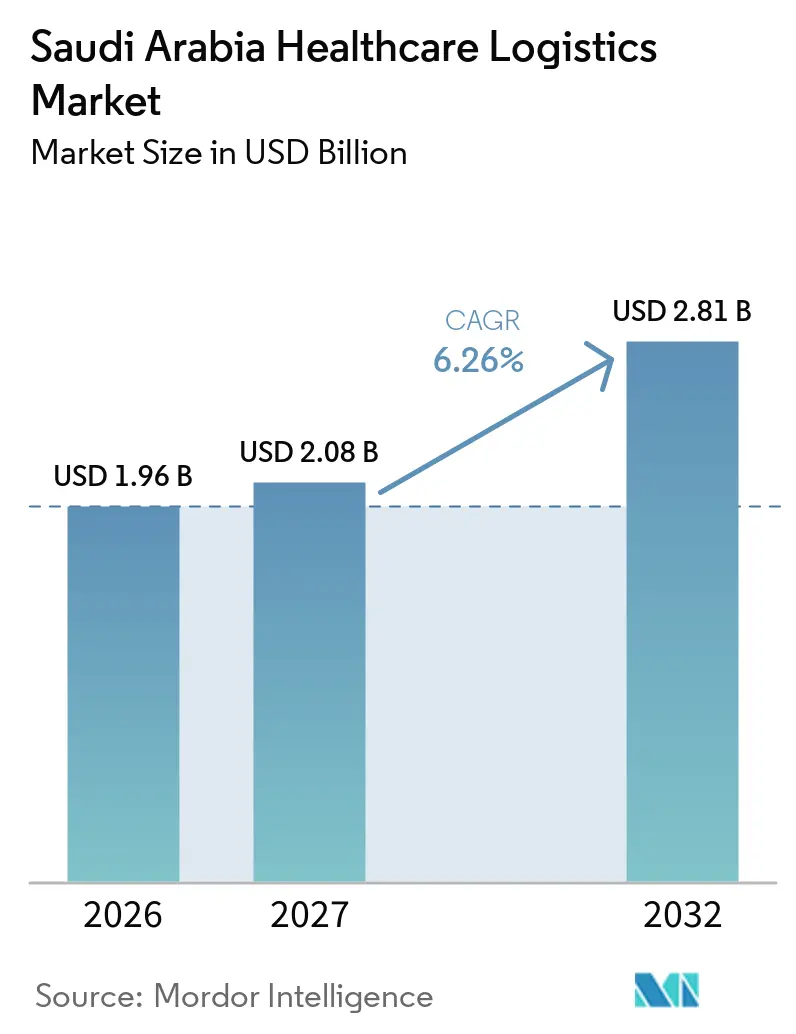
| Base Year Market Size (2026) | USD 1.96 Billion |
| Market Size (2027) | USD 2.08 Billion |
| Market Size (2032) | USD 2.81 Billion |
| Growth Rate (2027 - 2032) | 6.26 % |
| Market Concentration | Medium |
Major Players *Disclaimer: Major Players sorted in no particular order Image © Mordor Intelligence. Reuse requires attribution under CC BY 4.0. | |
Saudi Arabia Healthcare Logistics Market Analysis by Mordor Intelligence
The Saudi Arabia healthcare logistics market size is valued at USD 1.96 billion in 2026. It is estimated to grow from USD 2.08 billion in 2027 to reach USD 2.81 billion by 2032, at a CAGR of 6.26% during the forecast period from 2027 to 2032.
The Health Sector Transformation Program shapes the Saudi Arabia healthcare logistics market, tighter distribution rules, and pharmaceutical localization. These forces increase demand for verified storage, transport, and documentation across the supply chain. Compliance requirements raise the barrier to entry for general freight providers and favor operators with temperature-controlled assets and established regulatory processes. Localization is also changing the flow of products from import-led movement toward domestic distribution between manufacturing sites, distributors, and care facilities. This creates an investment need in validated cold chain capacity, direct hospital delivery, and technology that improves traceability.
Key Report Takeaways
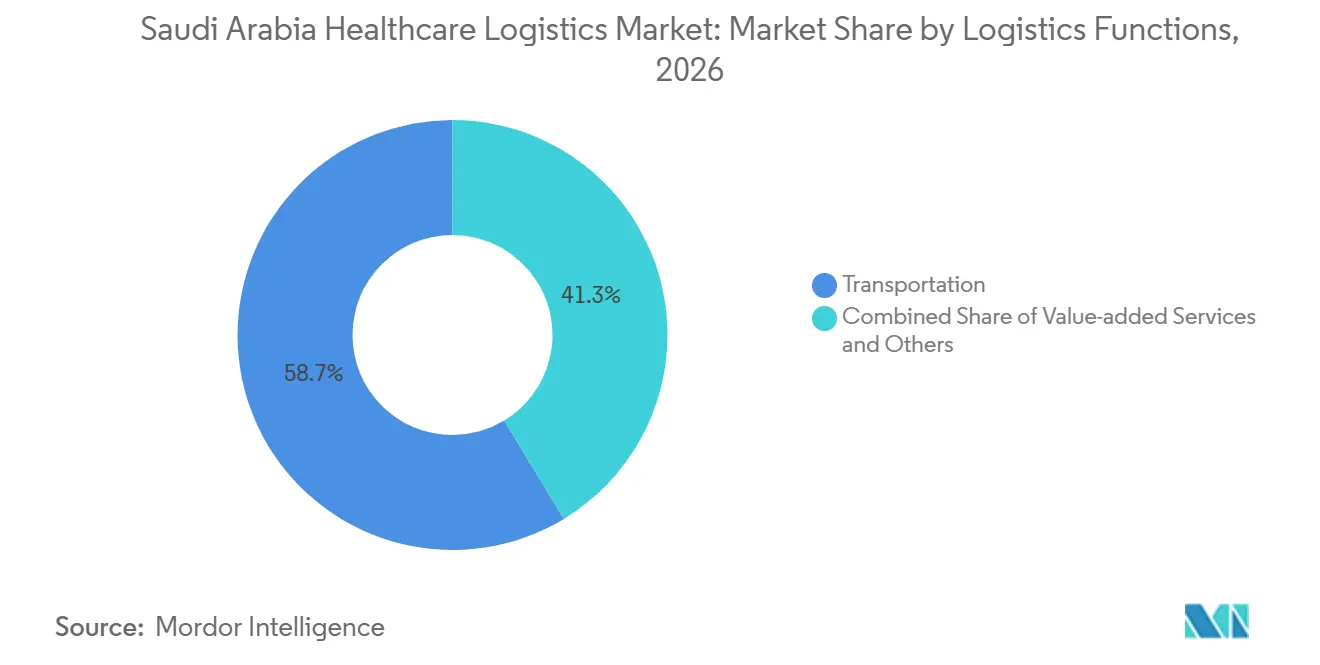
- By logistics function, transportation accounts for 58.67% of the Saudi Arabia healthcare logistics market share in 2026, while value-added services and others are forecast to expand at an 8.89% CAGR through 2032.
- By temperature type, non-temperature-controlled logistics accounts for 52.41% of the Saudi Arabia healthcare logistics market size in 2026, while temperature-controlled logistics recorded the highest projected CAGR at 8.45% through 2032.
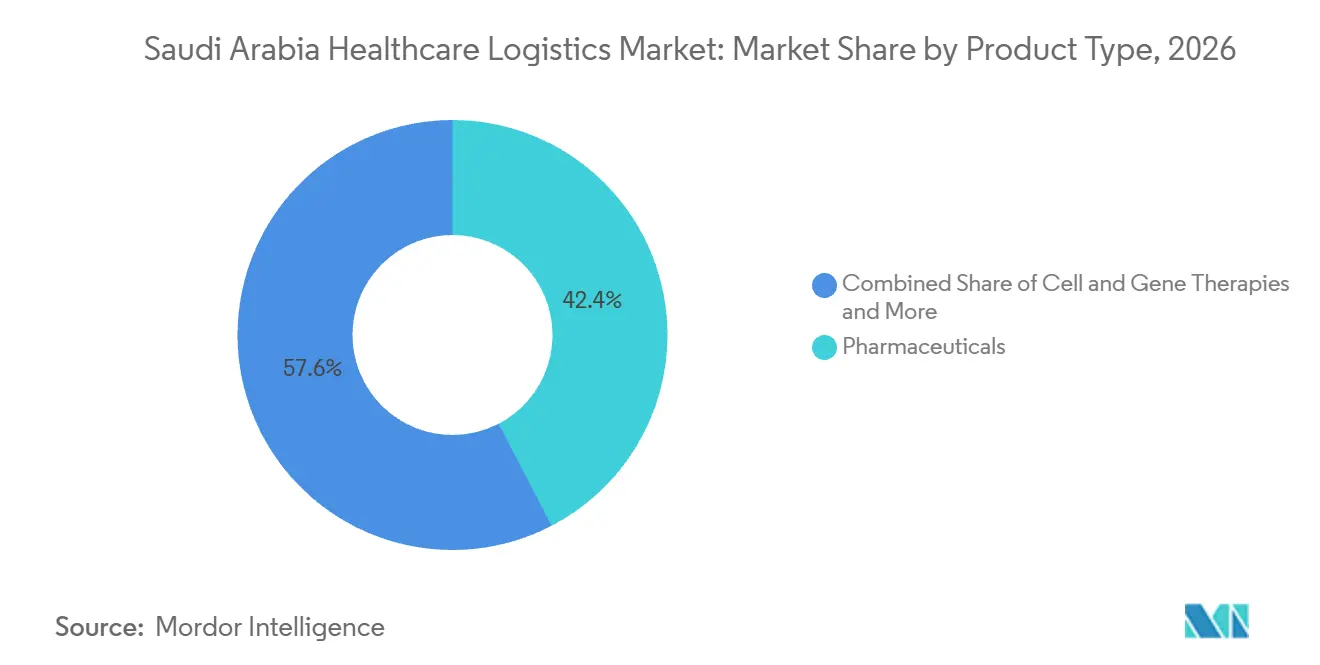
- By product type, pharmaceuticals account for 42.37% of the Saudi Arabia healthcare logistics market share in 2026, while cell and gene therapies are forecast to register at a 7.75% CAGR through 2032.
- By destination, domestic logistics accounts for 68.69% of the Saudi Arabia healthcare logistics market size in 2026, while international logistics is projected to register at an 8.68% CAGR through 2032.
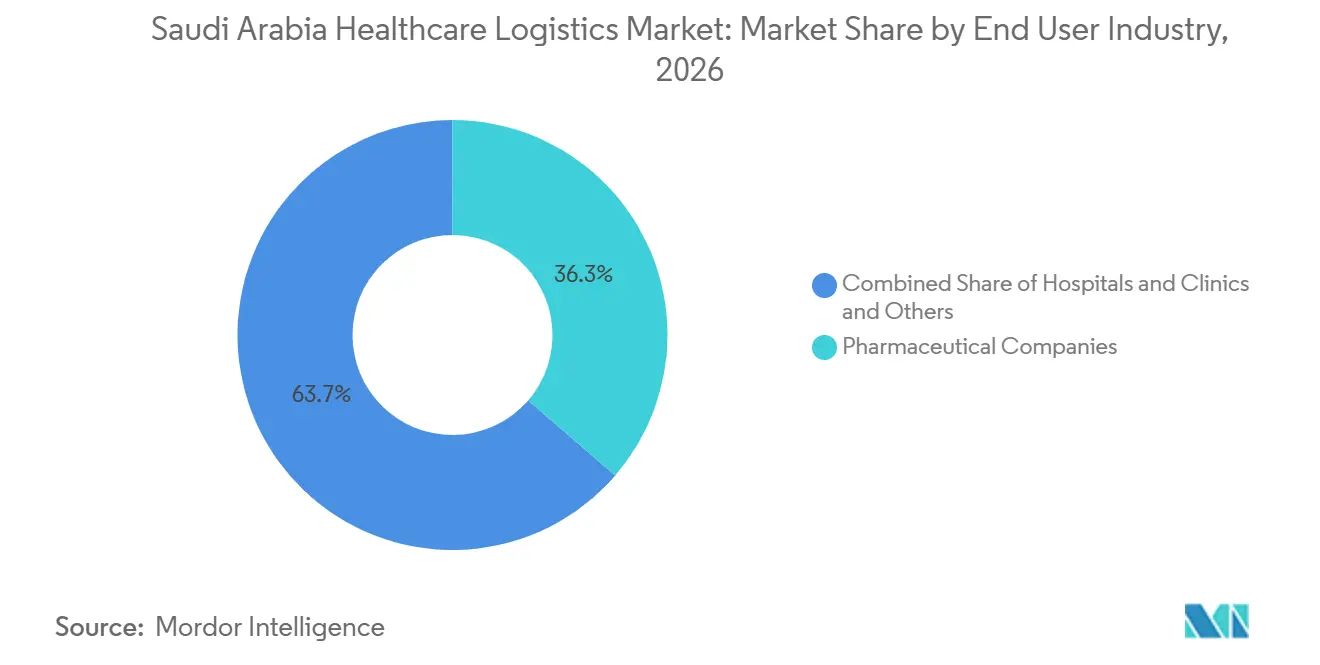
- By end user, pharmaceutical companies account for 36.38% of the Saudi Arabia healthcare logistics market size in 2026, while hospitals and clinics are forecast to expand at a 7.29% CAGR through 2032.
- By geography, the Central region accounts for 38.61% of the Saudi Arabia healthcare logistics market size in 2026, while the Western region is projected to register a 7.92% CAGR through 2032.
Note: Market numbers in this report are based on Mordor Intelligence's proprietary estimation framework, which combines nine months of actuals with Q4 projections for base year 2026.
Market Trends and Insights
Drivers Impact Analysis of Saudi Arabia Healthcare Logistics Market*
| Driver | (~) % Impact on CAGR Forecast | Geographic Relevance | Impact Timeline |
|---|---|---|---|
| Vision 2030 Expanding Healthcare Logistics Demand | +1.8% | National, concentrated in Riyadh, Jeddah, and Eastern Province | Long term (≥ 4 years) |
| SFDA Compliance Strengthening Regulated Distribution Requirements | +1.2% | National, acute in Riyadh, Jeddah, and Dammam logistics corridors | Medium term (2-4 years) |
| Biologics Growth Increasing Temperature-Controlled Logistics Demand | +1.0% | National, with GCC re-export spillover through Jeddah | Medium term (2-4 years) |
| Pharmaceutical Localization Expanding Domestic Healthcare Supply Chains | +0.9% | Central Riyadh industrial zones and Western Jeddah port cluster | Long term (≥ 4 years) |
| E-Pharmacy Growth Increasing Direct-to-Patient Delivery Demand | +0.7% | Riyadh, Jeddah, and Dammam urban cores, extending to secondary cities | Short term (≤ 2 years) |
| Logistics Hub Development Strengthening Regional Healthcare Distribution | +0.8% | SILZ Riyadh and King Abdulaziz International Airport cluster in Jeddah | Long term (≥ 4 years) |
| Source: Mordor Intelligence | |||
Vision 2030 Expanding Healthcare Logistics Demand
The Health Sector Transformation Program links healthcare access, infrastructure, and service delivery objectives with larger needs for product movement across Saudi Arabia. NUPCO centrally procures and distributes pharmaceuticals, medical devices, and clinical supplies, creating recurring nationwide flows for the Saudi Arabia healthcare logistics market. Those flows call for dependable movement between suppliers, central distribution points, regional facilities, and care locations. Centralized purchasing puts pressure on routine distribution margins while increasing the value of specialized cold-chain services. E-pharmacy growth and direct supply to hospital departments reinforce the need for providers that can manage shorter delivery windows and verified handoffs. Hub development in Riyadh and Jeddah can support these delivery models by placing controlled facilities closer to major demand points.
SFDA Compliance Strengthening Regulated Distribution Requirements
SFDA requirements cover transport and storage of pharmaceutical products handled through customs ports, including the controls needed to protect product quality. Documented temperature monitoring, traceability, and deviation procedures make compliance systems central to participation in the Saudi Arabia healthcare logistics market. The Drug Track and Trace System requires electronic integration with the national pharmaceutical tracking infrastructure. In October 2025, the SFDA said that technology-enabled monitoring of drug availability supports the country’s health objectives. These requirements favor operators that can demonstrate consistent GDP and GSP processes across clearance, warehousing, and final delivery. They also increase the importance of Arabic documentation, regulatory liaison capability, and audit-ready digital records.
Biologics Growth Increasing Temperature-Controlled Logistics Demand
Biologics, biosimilars, insulin, vaccines, and advanced therapies require closer control of temperature and custody than many conventional medicines. The Saudi Arabia healthcare logistics market therefore has a growing need for monitored transport and storage from the manufacturer to the care site. King Faisal Specialist Hospital and Research Centre and Germfree Laboratories agreed to develop an advanced therapy manufacturing campus in Riyadh, which would increase the need for specialized domestic handling. Deep-frozen and ultra-low-temperature capacity is important because cell and gene therapy logistics requires a materially different operating model from routine pharmaceutical delivery.
Pharmaceutical Localization Expanding Domestic Healthcare Supply Chains
Localization shifts the Saudi Arabia healthcare logistics market from an import-centered model to a domestic network connecting production, quality release, distribution, and healthcare facilities. In October 2025, the Local Content and Government Procurement Authority signed 5 agreements covering localization of biologics and orthopedic implants[1]. Lifera also announced partnerships with companies including MSD, Pfizer, Sanofi, and GSK for vaccine and biopharmaceutical manufacturing, as well as an agreement with King Faisal Specialist Hospital and Research Centre for cell and gene therapy development. The new production base requires validated cold-chain lanes within the Kingdom rather than only import-air-freight handling. It also supports distribution hubs beyond Riyadh as manufacturing and demand become more geographically dispersed. The Saudi Arabia healthcare logistics market can capture this demand through value-added packaging, labeling, release support, and local delivery services.
Restraints Impact Analysis of Saudi Arabia Healthcare Logistics Market*
| Restraint | (~) % Impact on CAGR Forecast | Geographic Relevance | Impact Timeline |
|---|---|---|---|
| Extreme Heat Increasing Cold-Chain Operating Costs | -0.8% | National, most acute in Eastern Province and Southern regions | Long term (≥ 4 years) |
| Customs Complexity Delaying Imported Healthcare Product Clearance | -0.6% | Jeddah Islamic Port, King Abdulaziz International Airport, and Dammam Port | Medium term (2-4 years) |
| Certified Cold-Chain Talent Shortages Limiting Service Capacity | -0.5% | National, concentrated in secondary cities outside Riyadh, Jeddah, and Dammam. | Medium term (2-4 years) |
| Remote Last-Mile Economics Increasing Healthcare Distribution Costs | -0.4% | Northern, Southern, and remote Western sub-regions | Long term (≥ 4 years) |
| Source: Mordor Intelligence | |||
Extreme Heat Increasing Cold-Chain Operating Costs
High summer temperatures create a persistent operating burden for temperature-controlled transport in the Saudi Arabia healthcare logistics market. Refrigeration equipment must maintain the required range during road transit, which increases energy use and maintenance needs. The cost exposure is significant where a temperature excursion can compromise high-value biologics. Providers also need qualified staff who can operate validated refrigeration systems and respond to alarms. This capability is more limited outside Riyadh, Jeddah, and Dammam. The combination of climate conditions and workforce shortages can delay capacity growth even when demand for cold-chain services rises.
Customs Complexity Delaying Imported Healthcare Product Clearance
Imported pharmaceuticals remain important for hospital procurement, so clearance performance at Jeddah, Riyadh, and Dammam affects supply reliability. SFDA customs-port requirements apply additional controls to narcotics, psychotropic substances, and controlled biologics. Delays can increase safety-stock requirements and warehousing costs for importers. In May 2025, Kuehne+Nagel became the first company in Saudi Arabia certified as both an Authorized Economic Operator logistics operator and customs broker[2]. Remote Northern and Southern locations add another cost layer because low delivery density and limited cold-chain infrastructure make distribution less efficient. Central hubs remain useful, but they do not fully resolve the economics of final delivery to distant healthcare sites.
*Our forecasts treat driver/restraint impacts as directional, not additive. The impact forecasts reflect baseline growth, mix effects, and variable interactions.
Saudi Arabia Healthcare Logistics Market Segment Analysis
By Logistics Function:
Transportation Holds the Largest Position While Value-added Services Expand FasterTransportation accounts for 58.67% of the Saudi Arabia healthcare logistics market share in 2026. Road transport supports regular distribution between central warehouses, pharmacies, clinics, and hospitals across the Kingdom. Air freight is used for time-sensitive biologics, urgent clinical materials, and high-value consignments. Warehousing and distribution provide the controlled inventory base needed before downstream deliveries. The Saudi Arabia healthcare logistics market depends on these functions working together because every handoff must protect product integrity.
Value-added services and others are forecast to expand at an 8.89% CAGR through 2032. Pharmaceutical companies increasingly require secondary labeling, Arabic-language documentation, and packaging tailored to the destination market. AJEX opened a GMP-GxP-compliant facility in Riyadh in October 2025 with temperature-controlled chambers and a dedicated labeling room[3]. These facilities enable providers to combine product preparation with validated storage and distribution. This integrated model helps customers reduce the number of compliance-sensitive handoffs before products reach care sites.

By Temperature Type:
Non-Temperature Controlled Logistics Leads While Cold Chain Gains ImportanceNon-temperature controlled logistics accounts for 52.41% of the Saudi Arabia healthcare logistics market in 2026. Ambient-stable medicines, medical devices, and diagnostics account for a substantial volume of products that do not need refrigerated transport. These categories support routine distribution through established road and warehousing networks. Their broad use gives ambient logistics an important role in nationwide healthcare supply. However, the operating requirements become stricter when products require chilled, frozen, or ultra-low-temperature conditions.
Temperature-controlled logistics is projected to register an 8.45% CAGR through 2032. Biologics, vaccine programs, and the emergence of domestic advanced-therapy production are driving this demand. The deep-frozen and ultra-low-temperature tier serves the most demanding requirements, while chilled and frozen services support other pharmaceutical categories. Operators need validated equipment, monitored storage, trained staff, and procedures for responding to excursions. The Saudi Arabia healthcare logistics industry will need additional certified capacity as the treatment mix moves toward products that require verified conditions.
By Product Type:
Pharmaceuticals Form the Core Demand Base While Cell and Gene Therapies Grow FastestPharmaceuticals account for 42.37% of the Saudi Arabia healthcare logistics market in 2026. Prescription medicines move through established NUPCO procurement routes and private distribution channels. Major demand centers include Riyadh, Jeddah, and Dammam, where hospitals, distributors, and import facilities are concentrated. Biopharmaceuticals are a related high-value product group because biologics and biosimilars require strong temperature control and batch-level traceability. Medical devices, vaccines, diagnostics, clinical-trial materials, blood products, and tissues each require different handling processes.
Cell and gene therapies are forecast to register at a 7.75% CAGR through 2032. The planned Riyadh advanced-therapy manufacturing campus provides the domestic context for more specialized logistics needs. Autologous therapies require an unbroken chain between patient collection, manufacturing, and infusion. This is different from routine wholesale pharmaceutical distribution. It requires cryogenic handling, strict timing, and documented custody at each stage. The Saudi Arabia healthcare logistics market must build these skills before advanced therapies can be supported at a broader domestic scale.
By Destination:
Domestic Logistics Is the Main Volume Base While International Logistics Expands FasterDomestic logistics accounts for 68.69% of the Saudi Arabia healthcare logistics market in 2026. The position reflects NUPCO’s centralized procurement model and the onward movement of cleared imports to regional hospitals, clinics, and pharmacies. Domestic delivery is also becoming more important as localization creates supply flows within Saudi Arabia. Road-based distribution connects central and regional warehouses with care facilities. The Saudi Arabia healthcare logistics market size for domestic operations is therefore supported by the need to reach a geographically dispersed provider network.
International logistics is forecast to register an 8.68% CAGR through 2032. Cross-border clinical material movement and the role of Saudi Arabia as a GCC pharmaceutical gateway support this trajectory. In July 2025, Maersk and Saudi Post agreed that Maersk would manage international transport while Saudi Post handled in-Kingdom final-mile delivery through the Jeddah logistics park. FedEx began direct-serve operations in Saudi Arabia in September 2025 and introduced a dedicated flight connection from the United States and Europe. These developments strengthen the link between international entry points and domestic healthcare distribution.
By End User:
Pharmaceutical Companies Lead Spending While Hospitals and Clinics Drive GrowthPharmaceutical companies account for 36.38% of the Saudi Arabia healthcare logistics market in 2026. Their contracts tend to have demanding requirements for validated transport, product traceability, and controlled inventory. Biopharmaceutical manufacturers need dedicated cold-chain services for biologics and biosimilars. Healthcare distributors and wholesalers remain important, but their role changes when direct delivery from centralized procurement systems becomes more common. The Saudi Arabia healthcare logistics market continues to rely on specialized third-party logistics contracts for high-value and regulated products.
Hospitals and clinics are forecast to expand at a 7.29% CAGR through 2032. Hospital expansion in secondary cities creates demand for reliable supply routes outside the main distribution hubs. Direct-to-ward delivery reduces intermediary handling and places greater importance on delivery precision. E-pharmacy also creates a distinct last-mile need for licensed providers. These changes move the Saudi Arabia healthcare logistics market toward more frequent and smaller deliveries that still require strong compliance controls.
Geography Analysis
The Central region accounts for 38.61% revenue share in 2026. Riyadh has structural advantages because it hosts NUPCO procurement and distribution operations, airport cargo capacity, and the Special Integrated Logistics Zone. DHL Supply Chain’s planned EUR 130 million (USD 152.92 million) hub at SILZ is scheduled for completion in 2027 and will serve life sciences alongside other sectors[4]. This planned capacity reinforces the region’s role in controlled storage and onward distribution. The Eastern region complements this position through Dammam port access and industrial demand for healthcare supplies.
The Western region is forecast to register a 7.92% CAGR through 2032. Jeddah’s airport and port infrastructure supports pharmaceutical imports and transit flows. Makkah and Madinah also create continuing medical supply needs, including higher demand during Hajj. Maersk’s partnership with Saudi Post connects international transport with domestic final-mile distribution from Jeddah. These investments strengthen the Saudi Arabia healthcare logistics market as a route for international products entering the Kingdom.
Northern and Southern areas have sparse cold-chain infrastructure and higher last-mile delivery costs. Their dispersed populations make conventional distribution less efficient than in the Riyadh and Jeddah corridors. The Saudi Arabia healthcare logistics market has an opportunity to improve service coverage as healthcare capacity expands in these locations. Digital visibility can help operators coordinate fragmented regional activity and reduce handoff delays. The Hajj drone deployment provides a practical model for addressing urgent supply needs beyond major urban centers. A multi-hub network centered on Riyadh and Jeddah can reduce delivery lead times for hospitals outside the principal cities.
Competitive Landscape
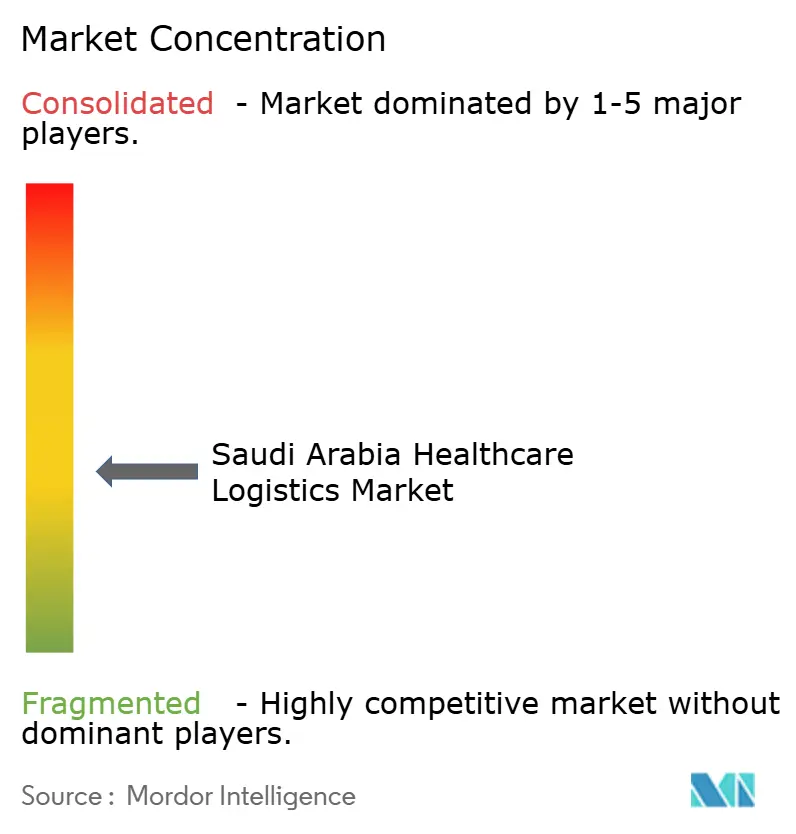
The Saudi Arabia healthcare logistics market is fragmented and includes multinational providers and Saudi-origin specialists. DHL Group, DSV, Kuehne+Nagel, FedEx, and UPS Healthcare compete through international pharmaceutical networks and GxP capabilities. AJEX, SAL Saudi Logistics, Tamer Logistics, and SMSA compete through domestic knowledge, last-mile coverage, and experience with local requirements. DSV completed its acquisition of DB Schenker on April 30, 2025, expanding its combined global logistics footprint. The transaction strengthened the scale of the DSV network available to Saudi healthcare customers.
Local capability remains important because regulated healthcare distribution requires Arabic documentation, SFDA coordination, and familiarity with NUPCO procurement processes. DSV completed the integration go-live of DSV and DB Schenker in Saudi Arabia in February 2026, unifying air and sea, contract logistics, and road operations. Kuehne+Nagel’s dual AEO certification offers a clearance advantage for pharmaceutical imports at Saudi entry points. AJEX’s Riyadh facility added certified temperature-controlled and pharmaceutical labeling capability. These moves show that service quality depends on compliance capability as well as network scale.
Opportunity areas include ultra-cold handling for cell and gene therapies, last-mile delivery to remote facilities, and clinical-trial logistics. The 2025 IOPscience study on RFID, GPS, and cloud-enabled cold-chain monitoring offers an applicable approach for improving shipment visibility. SFDA rules require continued investment because compliance expectations apply throughout the supply chain. The Saudi Arabia healthcare logistics market therefore rewards investment in validated facilities, trained personnel, reliable digital tracking, and operating discipline.
Saudi Arabia Healthcare Logistics Industry Leaders
-
Tamer Logistics
-
AJEX Logistics Services
-
Proceed Logistics
-
DHL Group
-
Kuehne+Nagel
- *Disclaimer: Major Players sorted in no particular order
Saudi Arabia Healthcare Logistics Market Companies Covered in this Report
- AJEX Logistics Services
- Aramex PJSC
- BAFCO International Shipping & Logistics Co. Ltd
- CEVA Almajdouie Logistics (CMA CGM Group)
- DHL Group
- DSV A/S (including DB Schenker)
- Expeditors International of Washington, Inc.
- FedEx Corporation
- Four Winds Saudi Arabia Limited
- Hellmann Worldwide Logistics
- Kuehne+Nagel
- Medical Support Logistics Company (MSCT)
- Mosanada Logistics Services
- Proceed Logistics
- SAL Saudi Logistics Services Company
- Saudi Post | SPL (including NAQEL Express)
- Saudia Cargo
- SMSA Express Transportation Company Ltd
- Takhzeen Logistics
- Tamer Logistics
- United Parcel Service, Inc. (UPS Healthcare)
- Wared Logistics
Recent Industry Developments in Saudi Arabia Healthcare Logistics Market
- April 2026: Saudia Cargo partnered with the Saudi Food and Drug Authority (SFDA) to strengthen pharmaceutical and medical-supply transportation, offering shipping-cost reductions of up to 50% while supporting temperature-controlled air cargo and uninterrupted medicine imports.
- April 2026: Kanoo Logistics opened a temperature-controlled warehouse near King Abdulaziz Port in Dammam, expanding specialized storage capacity for pharmaceuticals, food, and other sensitive products while strengthening cold-chain distribution capabilities in Saudi Arabia's Eastern Province.
- February 2026: CJ Logistics partnered with iHerb to operate an 18,000 m² climate-controlled, cGMP-compliant fulfillment center in Riyadh's Special Integrated Logistics Zone, supporting the storage and distribution of health and wellness products across Saudi Arabia and regional markets.
- February 2026: DSV completed the integration go-live of DSV and DB Schenker in Saudi Arabia, unifying air and sea, contract logistics, and road operations under a single organization.
Saudi Arabia Healthcare Logistics Market Report Scope
Segmentation Overview
| Transportation | Road |
| Air | |
| Sea and Inland Waterways | |
| Rail | |
| Warehousing and Distribution | |
| Value-added Services and Others |
| Temperature Controlled | Chilled (0-5 °C) |
| Frozen (-20-0 °C) | |
| Ambient | |
| Deep-Frozen / Ultra-Low (less than-20 °C) | |
| Non-Temperature Controlled |
| Pharmaceuticals | Prescription and Specialty Drugs |
| OTC Drugs | |
| Biopharmaceuticals (Biologics and Biosimilars) | |
| Vaccines | |
| Clinical Trial Materials | |
| Cell and Gene Therapies | |
| Medical Devices | |
| Veterinary Medicine | |
| Blood, Plasma and Blood Components | |
| Diagnostic and Laboratory Products | |
| Organs and Human Tissues | |
| Others |
| Domestics |
| International |
| Pharmaceutical Manufacturers |
| Biopharmaceutical Manufacturers |
| Hospitals and Clinics |
| Hospitals and Retail Pharmacies |
| Healthcare Distributors and Wholesalers |
| Others |
| Central (Riyadh, Al-Qassim, and Hail) |
| Eastern (Ash-Sharqiyah) |
| Western (Al-Bahah, Makkah, Medina, and Tabuk) |
| Northern (Al-Jouf and Arar) |
| Southern (Asir, Jazan, and Najran) |
| By Logistics Function | Transportation | Road |
| Air | ||
| Sea and Inland Waterways | ||
| Rail | ||
| Warehousing and Distribution | ||
| Value-added Services and Others | ||
| By Temperature Type | Temperature Controlled | Chilled (0-5 °C) |
| Frozen (-20-0 °C) | ||
| Ambient | ||
| Deep-Frozen / Ultra-Low (less than-20 °C) | ||
| Non-Temperature Controlled | ||
| By Product Type | Pharmaceuticals | Prescription and Specialty Drugs |
| OTC Drugs | ||
| Biopharmaceuticals (Biologics and Biosimilars) | ||
| Vaccines | ||
| Clinical Trial Materials | ||
| Cell and Gene Therapies | ||
| Medical Devices | ||
| Veterinary Medicine | ||
| Blood, Plasma and Blood Components | ||
| Diagnostic and Laboratory Products | ||
| Organs and Human Tissues | ||
| Others | ||
| By Destination | Domestics | |
| International | ||
| By End User | Pharmaceutical Manufacturers | |
| Biopharmaceutical Manufacturers | ||
| Hospitals and Clinics | ||
| Hospitals and Retail Pharmacies | ||
| Healthcare Distributors and Wholesalers | ||
| Others | ||
| By Region | Central (Riyadh, Al-Qassim, and Hail) | |
| Eastern (Ash-Sharqiyah) | ||
| Western (Al-Bahah, Makkah, Medina, and Tabuk) | ||
| Northern (Al-Jouf and Arar) | ||
| Southern (Asir, Jazan, and Najran) | ||
Key Questions Answered in the Report
What is the 2032 outlook for healthcare logistics in Saudi Arabia?
The Saudi Arabia healthcare logistics market is forecast to reach USD 2.81 billion by 2032, rising from USD 2.08 billion in 2027 at a 6.26% CAGR. Growth is linked to healthcare infrastructure, regulated distribution, pharmaceutical localization, and greater need for verified cold-chain and last-mile services.
Which logistics function holds the largest position in Saudi Arabia?
Transportation leads with a 58.67% share in 2026 because road and air networks connect central warehouses with hospitals, clinics, pharmacies, and regional distribution centers. Warehousing, distribution, and value-added services remain necessary because healthcare products need compliant storage, documentation, preparation, and handoff before final delivery.
Why is cold-chain capacity important for Saudi healthcare distribution?
Temperature-controlled logistics is forecast to register at 8.45% through 2032 as biologics, vaccines, insulin, and advanced therapies require validated handling. Providers need monitored equipment, qualified personnel, traceability systems, and documented processes that protect product quality during storage and transport.
What is driving pharmaceutical localization in Saudi Arabia?
Agreements involving Lifera and the Local Content and Government Procurement Authority support domestic production of vaccines, biologics, and medical products. Local manufacturing creates more movement within the Kingdom between production sites, quality functions, central distribution facilities, regional hubs, hospitals, pharmacies, and clinics.
Which region is growing fastest for healthcare logistics services?
The Western region is projected to register a 7.92% CAGR through 2032, supported by Jeddah import flows and healthcare demand in Makkah and Madinah. Airport and port access, recurring seasonal demand, and connections to domestic final-mile networks reinforce its role as an important gateway.
How are companies improving pharmaceutical delivery in Saudi Arabia?
Providers are investing in compliant facilities, customs capability, direct-serve air links, digital tracking, controlled storage, and time-sensitive delivery models. Current activity also includes larger logistics hubs, certified pharmaceutical depots, more integrated transport services, and technology that improves visibility across complex distribution routes.