
Saudi Arabia Full Truckload (FTL) Market Size and Share
Market Overview
| Study Period | 2021 - 2032 |
|---|---|
| Forecast Data Period | 2027 - 2032 |
| Base Year Market Size (2026) | USD 9.71 Billion |
| Market Size (2027) | USD 10.22 Billion |
| Market Size (2032) | USD 13.15 Billion |
| Growth Rate (2027 - 2032) | 5.17 % |
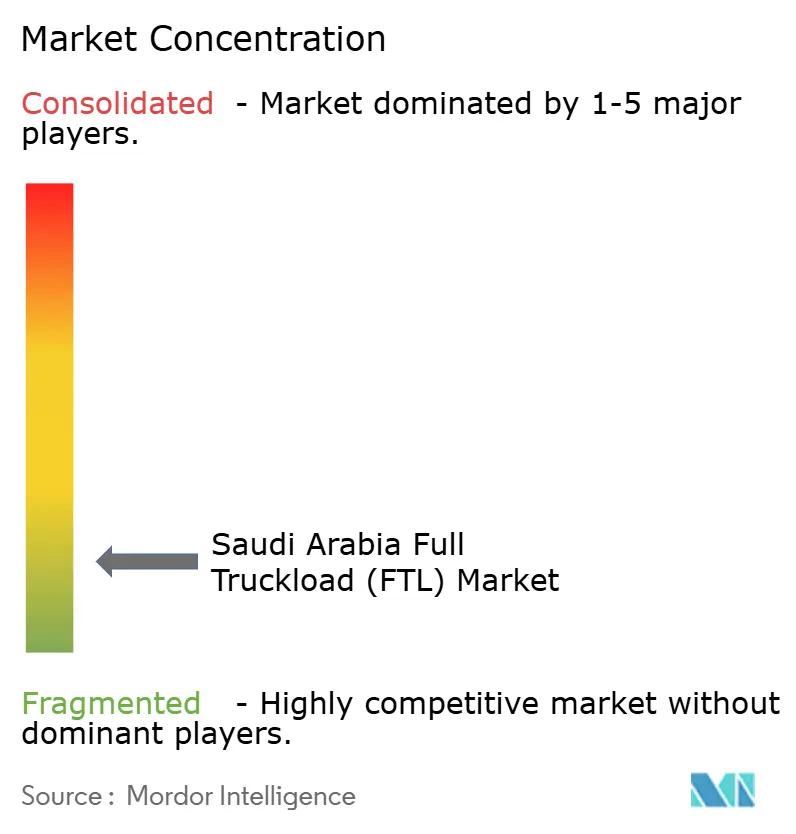
| Market Concentration | Low |
Major Players *Disclaimer: Major Players sorted in no particular order Image © Mordor Intelligence. Reuse requires attribution under CC BY 4.0. | |
Saudi Arabia Full Truckload (FTL) Market Analysis by Mordor Intelligence
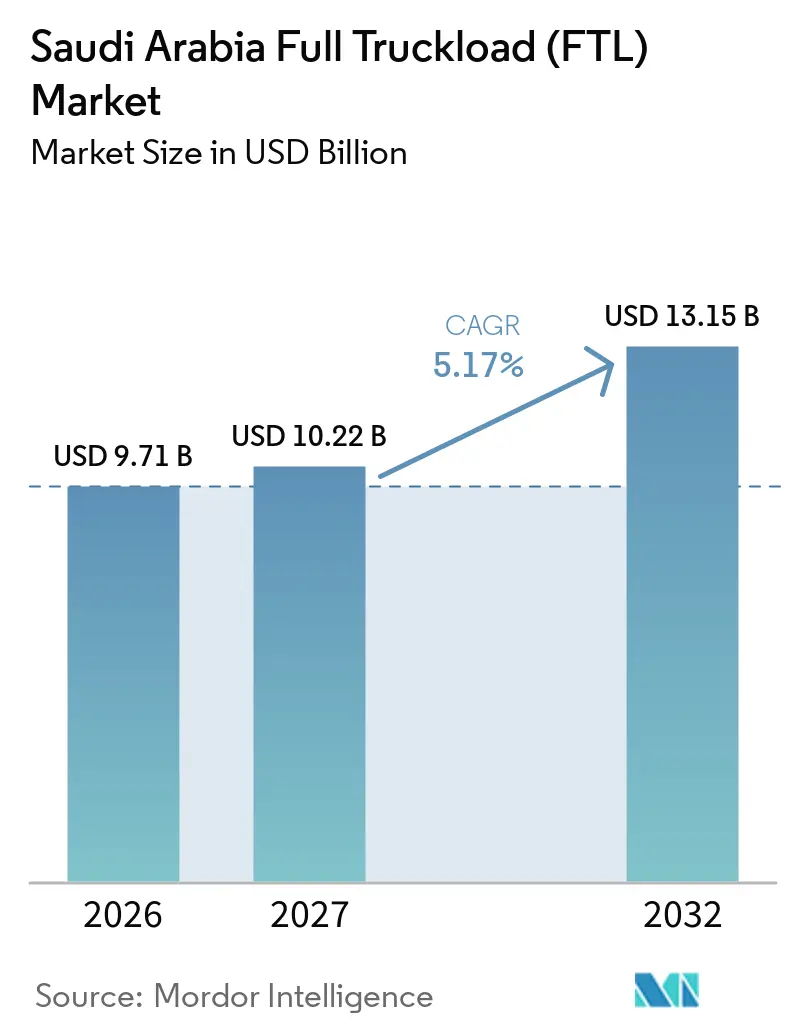
The Saudi Arabia full truckload (FTL) market size is valued at USD 9.71 billion in 2026. It is estimated to grow from USD 10.22 billion in 2027 to reach USD 13.15 billion by 2032, at a CAGR of 5.17% during the forecast period (2027-2032).
Market growth is supported by investment in transport and logistics infrastructure under Saudi Arabia's Vision 2030 program, construction activity associated with large-scale development projects, and demand for the movement of industrial, retail, and consumer goods. Road freight remains important for shipments requiring direct delivery to locations that are not served by rail. Growth in e-commerce and distribution infrastructure is increasing the need for scheduled freight movements between ports, warehouses, industrial facilities, and retail distribution centers. The expansion of temperature-controlled logistics is also creating opportunities for carriers equipped to transport food and pharmaceutical products under specified conditions. However, higher fuel prices, driver availability, fleet compliance requirements, and operating costs continue to pressure carrier margins. These conditions increase the importance of route optimization, fleet utilization, backhaul planning, and reliable contracted volumes.
Key Report Takeaways
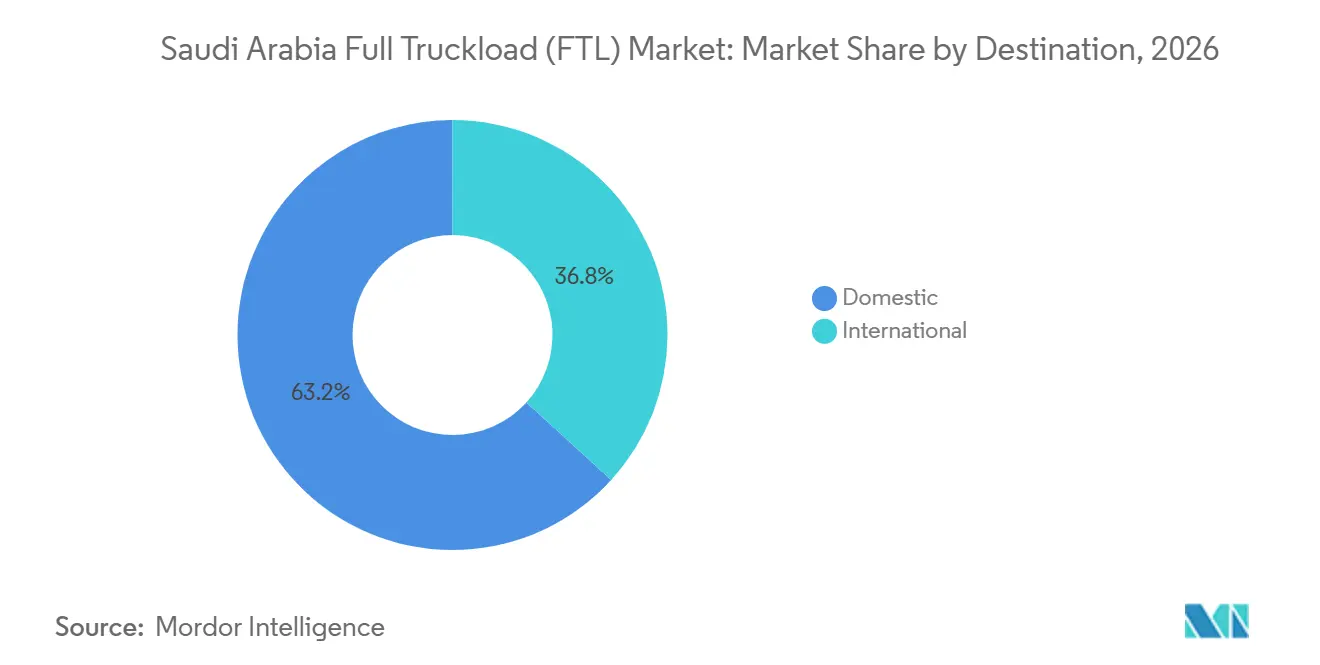
- By destination, domestic hauls account for 63.23% of the Saudi Arabia full truckload (FTL) market size in 2026, while international hauls are projected to register a CAGR of 6.36% through 2032.
- By temperature control, dry freight accounts for 72.18% of the Saudi Arabia full truckload (FTL) market share in 2026, while reefer freight is projected to register at a CAGR of 7.83% through 2032.
- By haul length, long-haul freight accounts for 72.86% of the Saudi Arabia full truckload (FTL) market size in 2026, while local hauls of less than 100 miles are projected to register at a CAGR of 6.97% through 2032.
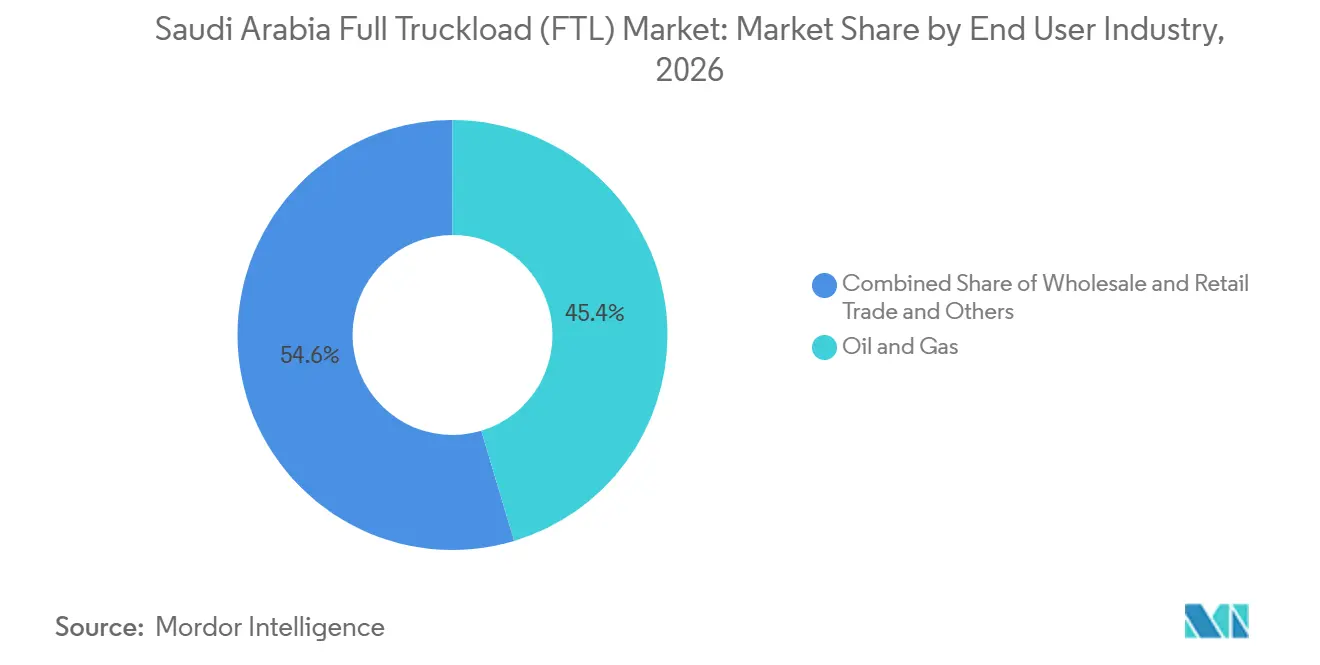
- By end-user industry, oil and gas accounts for 45.36% of the Saudi Arabia full truckload (FTL) market share in 2026, while wholesale and retail trade is projected to register at a CAGR of 6.23% through 2032.
- By region, the Central region accounts for 32.45% of the Saudi Arabia full truckload (FTL) market size in 2026, while the Northern region is projected to register at a CAGR of 6.96% through 2032.
Note: Market numbers in this report are based on Mordor Intelligence's proprietary estimation framework, which combines nine months of actuals with Q4 projections for base year 2026.
Saudi Arabia Full Truckload (FTL) Market Trends and Insights
Drivers Impact Analysis*
| Driver | (~) % Impact on CAGR Forecast | Geographic Relevance | Impact Timeline |
|---|---|---|---|
| Vision 2030 Infrastructure Accelerating Giga-Project Freight Demand | +1.4% | National, concentrated in Western (NEOM, Red Sea) and Central (Riyadh) corridors. | Long term (≥ 4 years) |
| E-Commerce and Omnichannel Growth Expanding FTL Demand | +1.1% | Central (Riyadh) and Western (Jeddah) primary; spill-over to Eastern and Northern | Medium term (2–4 years) |
| Industrial Diversification and Localization Increasing FTL Demand | +0.9% | Eastern (Jubail, Dammam), Western (Yanbu), with emerging Northern industrial zones | Long term (≥ 4 years) |
| Temperature-Controlled Food and Pharma Distribution Expanding FTL Demand | +0.7% | National; with early intensity in Central (Riyadh), Western (Jeddah, Makkah, Medina) | Medium term (2–4 years) |
| SME Fleet Digitization Improving FTL Orchestration Efficiency | +0.5% | National; most pronounced across Central and Eastern logistics corridors | Short term (≤ 2 years) |
| Port-Industrial Backhaul Matching Improving Empty-Mile Monetization Economics | +0.4% | Western (Jeddah Islamic Port, NEOM Port), Eastern (Dammam, Jubail), spill-over to Central | Medium term (2–4 years) |
| Source: Mordor Intelligence | |||
Vision 2030 Infrastructure Accelerating Giga-Project Freight Demand
Saudi Arabia's infrastructure and development programs support demand for dedicated truckload movements of construction materials, industrial equipment, and project cargo. Developments associated with NEOM and other large-scale projects require coordination between ports, suppliers, construction sites, and industrial facilities. Depending on the cargo, these movements may require flatbed trailers, low-bed equipment, heavy-haul vehicles, or standard dry freight capacity. Such demand is relevant to the FTL market because large consignments often require dedicated vehicles, specialized handling, and scheduled delivery windows. The scale and timing of individual projects determine how much incremental demand reaches road carriers.
E-Commerce and Omnichannel Growth Expanding FTL Demand
The expansion of e-commerce and omnichannel retail is increasing the need to replenish fulfillment centers, warehouses, and retail distribution facilities. Although individual parcel deliveries are generally handled through parcel and last-mile networks, upstream movements of palletized inventory and bulk merchandise can require FTL services. Riyadh, Jeddah, and the Eastern Province are important logistics and consumption centers, connecting import gateways with inland distribution networks. As retailers and logistics providers develop distribution capacity, contracted truckload services can support regular replenishment, interfacility transfers, and scheduled movements between warehouses. The effect on FTL demand depends on inventory volumes, warehouse locations, and the proportion of freight moved in dedicated loads.
Temperature-Controlled Food and Pharma Distribution Expanding FTL Demand
Saudi Arabia's food transport requirements create a need for vehicles that can maintain specified conditions during the movement of regulated products. In June 2025, the Saudi Food and Drug Authority published requirements for transporting food products. These requirements reinforce the importance of suitable vehicles, handling procedures, and temperature control where applicable[1]. Refrigerated FTL operators can support shipments that require dedicated transportation and documented operating conditions. However, reefer operations incur additional costs for specialized equipment, maintenance, monitoring, and regulatory compliance. Carriers with these capabilities are better positioned to secure food and pharmaceutical contracts, provided they meet applicable product-specific requirements.
Port-Industrial Backhaul Matching Improving Empty-Mile Utilization
Port-linked logistics facilities can improve coordination between import cargo, industrial demand, and outbound shipments. When carriers match an outbound delivery with a suitable return load, they can reduce empty running and improve vehicle utilization. This is particularly relevant to routes connecting Western and Eastern port facilities with industrial and distribution centers in the Central region. Effective backhaul matching depends on shipment timing, cargo compatibility, vehicle availability, and shipper locations. Digital freight platforms and closer coordination between shippers and carriers can support this process, although the extent of savings varies by route and operating conditions.
Restraints Impact Analysis*
| Restraint | (~) % Impact on CAGR Forecast | Geographic Relevance | Impact Timeline |
|---|---|---|---|
| Fuel Price Volatility Increasing Line-Haul Operating Costs | -0.8% | National, with most acute exposure on Central–Western and Central–Eastern long-haul corridors | Short term (≤ 2 years) |
| Heavy-Goods Driver Shortages Increasing Saudization Compliance Costs | -0.6% | National; Saudization intensity highest in Central (Riyadh) and Eastern (Dammam) markets | Medium term (2–4 years) |
| Saudi-GCC Backhaul Imbalances Reducing Return-Load Utilization Efficiency | -0.4% | Cross-border corridors: Saudi–UAE, Saudi–Bahrain, Saudi–Kuwait primary | Long term (≥ 4 years) |
| Reefer Data Gaps Weakening Temperature Chain-of-Custody Compliance | -0.3% | National; most acute in routes serving Northern and Southern regions with sparse monitoring infrastructure | Medium term (2–4 years) |
| Source: Mordor Intelligence | |||
Fuel Price Volatility Increasing Line-Haul Operating Costs
Fuel prices are an important determinant of road freight operating costs in Saudi Arabia. The domestic diesel price increased to SAR 1.66 (USD 0.44) per liter effective January 2025, before rising again to SAR 1.79 (USD 0.48) per liter in January 2026[2]. Higher diesel expenditure can reduce carrier margins where contracts do not allow timely fuel-cost adjustments. Route planning, vehicle maintenance, load consolidation, and backhaul matching can improve efficiency, but they do not eliminate exposure to fuel price changes. Long-distance routes are particularly sensitive because fuel consumption accumulates over extended journeys.
Heavy-Goods Driver Availability and Localization Costs
Saudi Arabia's logistics sector faces workforce development and localization requirements as demand for transport services expands. The Ministry of Human Resources and Social Development has identified demand for labor and specialized skills in its logistics and transportation sector skills framework. Localization initiatives affecting bus and truck driver positions can influence recruitment, training, and retention requirements. For FTL operators, these factors affect operating costs and available fleet capacity. Specialized operations, including hazardous-material transport and refrigerated freight, require additional capabilities. Larger fleets are better positioned to distribute training and recruitment costs across a broader customer base, while smaller carriers may have less flexibility.
*Our forecasts treat driver/restraint impacts as directional, not additive. The impact forecasts reflect baseline growth, mix effects, and variable interactions.
Segment Analysis
By Destination: Domestic Hauls Anchor Demand, International Lanes Expand
Domestic hauls account for 63.23% of the Saudi Arabia full truckload (FTL) market size in 2026. Demand is supported by recurring movements of industrial products, construction materials, petrochemical-related cargo, and consumer goods between major economic centers. Riyadh, Jeddah, and Dammam connect important industrial, commercial, port, and distribution activities. Domestic road transport also serves facilities and delivery points that lack direct rail access. International hauls serve cross-border movements that require appropriate customs documentation, border coordination, and reliable delivery schedules.
International hauls are projected to register at a CAGR of 6.36% from 2027 to 2032. Cross-border trade and logistics connections between Saudi Arabia and neighboring Gulf markets support demand for international road freight. Electronic customs processes and improved coordination can reduce avoidable delays, although performance depends on border conditions and shipment documentation. Rail and multimodal services may provide alternatives on selected routes, but road transport remains important for direct collection and delivery, first-mile movements, and final delivery beyond rail terminals.

By Temperature Control: Dry Freight Leads, Reefer Demand Grows Faster
Dry freight accounts for 72.18% of the Saudi Arabia full truckload (FTL) market share in 2026. Its leading position reflects the range of non-temperature-sensitive goods transported across the Kingdom, including industrial products, construction materials, packaged merchandise, and general cargo. Standard dry freight vehicles can serve a broad range of customers and routes without the additional equipment and monitoring requirements associated with refrigerated transport. Dry freight demand is therefore linked to industrial activity, construction, wholesale distribution, and the movement of consumer goods.
Reefer freight is projected to register a CAGR of 7.83% from 2027 to 2032. Demand is supported by food distribution, pharmaceutical logistics, and the need to maintain appropriate transport conditions for temperature-sensitive products. The Saudi Food and Drug Authority's food transport requirements, published in June 2025, reinforce the importance of suitable transport arrangements and product-specific compliance. Reefer operators must manage refrigeration equipment, temperature monitoring, maintenance, and operating costs. Growth will depend on the expansion of cold-chain distribution and customers' requirements for reliable, documented transport conditions.
By Haul Length: Long-Haul Dominates, Local Movements Expand
Long-haul freight accounts for 72.86% of the Saudi Arabia full truckload (FTL) market size in 2026. The Kingdom's geographical scale and the distribution of industrial facilities, ports, construction sites, and population centers support demand for intercity trucking. Long-distance movements can include industrial supplies, construction materials, consumer goods, and project cargo. Carriers operating on these routes must manage fuel expenditure, driver availability, maintenance schedules, delivery timing, and the availability of suitable return loads. Rail freight can provide an alternative for certain bulk and long-distance movements, while trucks remain necessary for locations outside the rail network and for collection and delivery.
Local hauls of less than 100 miles are projected to register at a CAGR of 6.97% from 2027 to 2032. Warehouses, industrial zones, ports, and retail distribution facilities generate short-distance freight movements that connect major transport networks with their final destinations. Port drayage and transfers between distribution facilities can also require dedicated trucks when shipment volumes or cargo characteristics justify a full vehicle. The growth of urban logistics facilities can support local FTL demand, although some smaller consignments are served by less-than-truckload or parcel networks. Rail expansion is more likely to change the mix of transport activity on selected corridors than to eliminate the need for local trucking.
By End-User Industry: Oil and Gas Leads, Retail Trade Expands
Oil and gas accounts for 45.36% of the Saudi Arabia full truckload (FTL) market size in 2026. The sector generates demand for the movement of industrial supplies, energy equipment, maintenance materials, and petrochemical-related cargo. Some shipments require dedicated vehicles, specialist trailers, heavy-haul planning, or specific safety procedures. Industrial clusters around the Eastern Province and other energy-related locations support recurring transport requirements. These operations can involve complex loading and unloading arrangements, controlled site access, and coordination with project schedules, making equipment availability and operational reliability important selection criteria.
Wholesale and retail trade is projected to register at a CAGR of 6.23% from 2027 to 2032. Retail distribution, inventory replenishment, and the expansion of e-commerce fulfillment networks can increase demand for movements between ports, warehouses, distribution centers, and stores. FTL services are particularly relevant when shipment volumes are sufficient to justify a dedicated vehicle or when customers require direct delivery and predictable transit times. Manufacturing, mining and quarrying, agriculture, fishing and forestry, and other industries also contribute to freight demand. Their requirements vary by shipment size, cargo characteristics, equipment needs, and delivery schedules.
Geography Analysis
The Central region accounts for 32.45% of the Saudi Arabia full truckload (FTL) market share in 2026. Riyadh serves as an important inland distribution center, connecting consumer markets, industrial facilities, warehouses, and commercial activity with ports and production centers elsewhere in the Kingdom. Al-Qassim and Hail contribute agricultural, food, and regional distribution movements. The region's central position supports road connections between the Western and Eastern economic corridors and links to northern destinations. A combination of intercity freight, industrial supply movements, and distribution activity supports FTL demand.
The Western and Eastern regions are important gateways for domestic and international freight. Jeddah Islamic Port and other Western logistics facilities connect maritime imports with inland distribution networks, while the Eastern Province combines port operations with energy, petrochemical, and industrial activity. Road carriers provide onward transport from these gateways to warehouses, manufacturing facilities, construction sites, and retail distribution centers. The Southern region generates demand through agriculture, regional commerce, and industrial activity, although freight volumes vary by location and industry. Investment in logistics facilities can support these regions by improving cargo handling, storage, and the connection between maritime and road transport[3].
The Northern region is projected to register a CAGR of 6.96% from 2027 to 2032, making it the fastest-growing region. Its outlook is supported by potential demand from mining, industrial development, regional distribution, and logistics links with neighboring markets. Rail infrastructure can facilitate selected freight flows, while road transport remains necessary for sites and customers without direct rail access.
Competitive Landscape
The Saudi Arabia FTL market is fragmented, with a broad mix of industrial, retail, construction, and consumer-goods customers. Competition involves domestic transport operators, regional logistics providers, international third-party logistics companies, and technology-enabled freight platforms. Operators compete on network coverage, vehicle availability, pricing, safety, service reliability, and their ability to handle specialized cargo.
In February 2026, DSV announced that the integration of DB Schenker's Saudi Arabian operations had reached go-live, bringing the teams and operating capabilities together under one organization[4]. The integration strengthened DSV's ability to coordinate road transport with air and sea freight and contract logistics. Kuehne+Nagel's customs and cross-border capabilities are also relevant to international freight services, while domestic transport companies compete through local operating knowledge and customer relationships.
Technology and compliance remain important competitive factors. Digital freight platforms can help connect shippers with available trucks, improve shipment visibility, and support price discovery and vehicle utilization. Larger operators may benefit from broader networks, established customer contracts, and investment capacity, while smaller carriers can compete through regional specialization and flexible service. As customers increasingly require reliable tracking, documentation, and consistent service levels, operators that can meet these requirements are better positioned to win recurring contracts.
Saudi Arabia Full Truckload (FTL) Industry Leaders
-
CEVA Almajdouie Logistics
-
ALDREES Petroleum & Transport Services Co.
-
Al-Khaldi Logistics Company
-
DSV A/S
-
DHL Group
- *Disclaimer: Major Players sorted in no particular order
Recent Industry Developments
- October 2026: Port of NEOM and CEVA Almajdouie Logistics signed a memorandum of understanding to explore end-to-end logistics solutions along a multimodal corridor connecting Europe, Egypt, Saudi Arabia, the Gulf Cooperation Council region, and Iraq.
- July 2026: Mawani signed seven contracts worth a combined SAR 1 billion (USD 267 million) with national and international companies to build and expand logistics centers at Jeddah Islamic Port and the Al-Khumrah zone, covering over 384,000 m² of storage, consolidation, and re-export capacity
- February 2026: DSV announced that the integration of DB Schenker's Saudi Arabian operations had reached go-live. The development combined teams and capabilities under a unified organization.
- August 2025: DHL eCommerce finalized its acquisition of a minority stake in AJEX Logistics Services. The transaction strengthened the companies' strategic cooperation in the Saudi Arabian and wider regional e-commerce logistics market. AJEX's regional operations and DHL's international e-commerce logistics capabilities provide a basis for expanding services as cross-border and domestic parcel volumes develop.
Saudi Arabia Full Truckload (FTL) Market Report Scope
| Domestic |
| International |
| Dry |
| Reefer |
| Long-Haul (More than 500 miles) |
| Regional (100-500 miles) |
| Local (Less than 100 miles) |
| Agriculture |
| Fishing and Forestry |
| Construction |
| Manufacturing |
| Oil and Gas |
| Mining and Quarrying |
| Wholesale and Retail Trade |
| Others |
| Central (Riyadh, Al-Qassim, and Hail) |
| Eastern (Ash-Sharqiyah) |
| Western (Al-Bahah, Makkah, Medina, and Tabuk) |
| Northern (Al-Jouf and Arar) |
| Southern (Asir, Jazan, and Najran) |
| By Destination | Domestic |
| International | |
| By Temperature Control | Dry |
| Reefer | |
| By Haul Length | Long-Haul (More than 500 miles) |
| Regional (100-500 miles) | |
| Local (Less than 100 miles) | |
| By End-User Industry | Agriculture |
| Fishing and Forestry | |
| Construction | |
| Manufacturing | |
| Oil and Gas | |
| Mining and Quarrying | |
| Wholesale and Retail Trade | |
| Others | |
| By Region | Central (Riyadh, Al-Qassim, and Hail) |
| Eastern (Ash-Sharqiyah) | |
| Western (Al-Bahah, Makkah, Medina, and Tabuk) | |
| Northern (Al-Jouf and Arar) | |
| Southern (Asir, Jazan, and Najran) |
Key Questions Answered in the Report
What is the forecast growth rate for Saudi Arabia full truckload services?
The Saudi Arabia FTL market is projected to register a CAGR of 5.17% from 2027 to 2032, reaching USD 13.15 billion by 2032.
Which destination segment leads Saudi Arabia full truckload freight?
Domestic hauls account for 63.23% of the Saudi Arabia FTL market in 2026. Freight movements between industrial centers, ports, warehouses, retail distribution facilities, and construction locations support demand.
Which temperature-control segment is growing fastest in Saudi Arabia?
Reefer freight is projected to register a CAGR of 7.83% through 2032. Temperature-sensitive food distribution, pharmaceutical logistics, and the need for compliant refrigerated transport support demand.
Why does long-haul transport account for most Saudi truckload demand?
Long-haul freight accounts for 72.86% of the Saudi Arabia FTL market in 2026. The geographical distribution of industrial facilities, ports, construction projects, and population centers creates demand for intercity transport.
Which end-user sector creates the greatest demand for dedicated truckload transport?
Oil and gas accounts for 45.36% of the Saudi Arabia FTL market in 2026. Energy-related supply chains require movements of industrial equipment, maintenance materials, and other cargo, sometimes involving specialized vehicles and handling arrangements.
What is the key operational challenge for carriers in Saudi Arabia?
Fuel expenditure and driver availability are important operating challenges for Saudi Arabian FTL carriers. Higher diesel prices can pressure margins, while recruitment, training, and localization requirements affect workforce costs and fleet availability.