
Saudi Arabia Full Container Load (FCL) Market Size and Share
Market Overview
| Study Period | 2021 - 2032 |
|---|---|
| Forecast Data Period | 2027 - 2032 |
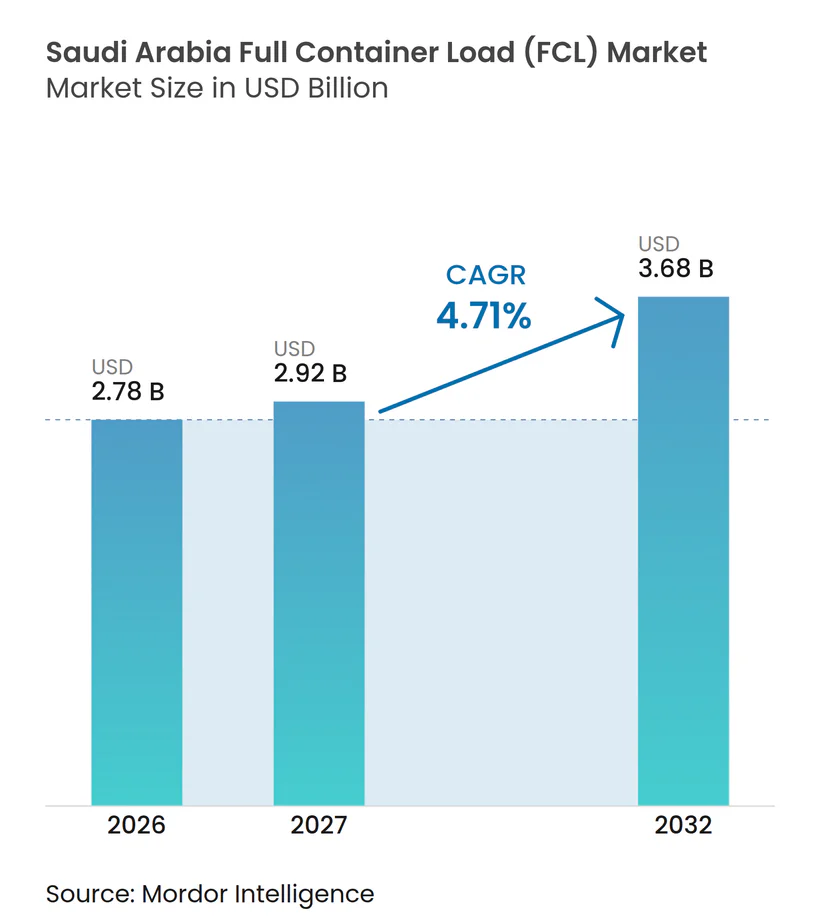
| Base Year Market Size (2026) | USD 2.78 Billion |
| Market Size (2027) | USD 2.92 Billion |
| Market Size (2032) | USD 3.68 Billion |
| Growth Rate (2027 - 2032) | 4.71 % |
| Market Concentration | Medium |
Major Players *Disclaimer: Major Players sorted in no particular order Image © Mordor Intelligence. Reuse requires attribution under CC BY 4.0. | |
Saudi Arabia Full Container Load (FCL) Market Analysis by Mordor Intelligence
The Saudi Arabia full container load market size is valued at USD 2.78 billion in 2026 and is estimated to grow from USD 2.92 billion in 2027 to reach USD 3.68 billion by 2032, at a CAGR of 4.71% during the forecast period 2027-2032.
The Saudi Arabia full container load market is being reshaped by port investment, stronger non-oil trade, and larger direct shipping connections. Container handling across Mawani-supervised ports increased 10.58% in 2025 to 8.3 million standard containers, while transshipment rose 11.78% to 1.9 million TEUs. This growth supports higher utilization of gateway infrastructure, especially when cargo shifts between Red Sea and Gulf routes. Higher-value manufactured goods and temperature-sensitive cargo are also increasing the need for reliable handling, storage, and inland transport. Competition now depends on network reach, terminal capacity, digital compliance capability, and the ability to manage disruptions without delaying cargo.
Key Report Takeaways
- By trade flow, international FCL accounts for 85.32% of the Saudi Arabia full container load market share in 2026 and is projected to register a 6.24% CAGR through 2032.
- By container type, dry containers account for 81.25% of the Saudi Arabia full container load market size in 2026, while refrigerated containers are forecast to expand at a 5.38% CAGR through 2032.
- By container size, 20-foot containers account for 53.86% of the Saudi Arabia full container load market size in 2026, while 40-foot containers recorded the highest projected CAGR at 5.12% through 2032.
- By end-user industry, manufacturing and industrial accounts for 32.79% of the Saudi Arabia full container load market share in 2026, while healthcare and pharmaceuticals is projected to advance at a 6.36% CAGR through 2032.
- By region, Eastern accounts for 40.03% of the Saudi Arabia full container load market share in 2026, while Western is forecast to register at a 6.62% CAGR through 2032.
Note: Market numbers in this report are based on Mordor Intelligence's proprietary estimation framework, which combines nine months of actuals with Q4 projections for base year 2026.
Market Trends and Insights
Drivers Impact Analysis of Saudi Arabia Full Container Load (FCL) Market*
| Driver | (~) % Impact on CAGR Forecast | Geographic Relevance | Impact Timeline |
|---|---|---|---|
| Vision 2030 Investment Expanding FCL Port Capacity | +1.2% | Global, concentrated in Jeddah and Dammam | Long term (≥ 4 years) |
| Non-Oil Diversification Increasing Containerized Export Cargo Demand | +0.9% | National, with early gains in Jeddah Islamic Port and Jubail | Medium term (2-4 years) |
| Gateway Cargo Growth Strengthening Jeddah-Dammam FCL Flows | +0.8% | Western Jeddah and Eastern Dammam provinces | Short term (≤ 2 years) |
| Retail Expansion Increasing Containerized Replenishment Freight Demand | +0.6% | National, concentrated in Riyadh, Jeddah, and Dammam metro areas | Medium term (2-4 years) |
| Digital Customs Improving FCL Documentation and Clearance | +0.4% | National, across all seaports | Short term (≤ 2 years) |
| Port-Rail Integration Strengthening East-West Container Connectivity | +0.5% | Eastern Province to Central Saudi Arabia, with spillover to Western Saudi Arabia | Medium term (2-4 years) |
| Source: Mordor Intelligence | |||
Vision 2030 Investment Expanding FCL Port Capacity
The Saudi Arabia full container load market is supported by Vision 2030 investment that is expanding terminal capacity and modernizing operations. Mawani signed privatization contracts exceeding SAR 2.2 billion (USD 586.21 million) in 2025 for multipurpose cargo terminals across 8 ports under a Build-Operate-Transfer model[1]. Private-sector operators manage terminal operations under Mawani’s regulatory oversight. Ongoing port expansion in Dammam is increasing container-handling capacity and strengthening Saudi Arabia’s maritime logistics infrastructure. As volumes grow, efficient inland transport connections will become increasingly important for moving cargo between ports and inland markets.
Non-Oil Diversification Increasing Containerized Export Cargo Demand
Non-oil trade is creating additional outbound demand for the Saudi Arabia full container load market. Non-oil exports, including re-exports, reached SAR 366.08 billion (USD 97.54 billion) in 2025, increasing 18.9% from the prior year. Saudi Arabia’s re-export activity is expanding, supported by its growing role as a regional distribution hub. Rising exports of machinery and electrical equipment are creating additional demand for container services suited to higher-value cargo. King Fahad Industrial Seaport in Jubail also contributes to non-oil export movements. More balanced import and export flows can improve equipment utilization and reduce reliance on import-driven cargo demand.
Gateway Cargo Growth Strengthening Jeddah-Dammam FCL Flows
Jeddah and Dammam remain the core gateways for the Saudi Arabia full container load market. Jeddah Islamic Port handled 4.3 million TEUs in 2025, or 47.3% of national container throughput. King Abdulaziz Port in Dammam processed 2.58 million TEUs during the year, making the two gateways central to import, export, and transshipment activity. Mawani added Hapag-Lloyd’s SE4 service at Jeddah in March 2026, connecting the port directly with major East Asian ports and Tanjung Pelepas. The service can deploy vessels of up to 17,000 TEUs. Direct calls can reduce reliance on third-country transshipment hubs and improve schedule options for shippers.
Port-Rail Integration Strengthening East-West Container Connectivity
Port-rail integration is expanding the effective reach of Dammam for the Saudi Arabia full container load market. Saudi Arabia Railways began operational testing of a new freight line in Al-Ahsa in January 2025. The connection improves the corridor between King Abdulaziz Port and Riyadh Dry Port. Saudi Global Ports operates up to 7 daily rail services between these locations. The service gives shippers an alternative to road-only inland movements. A stronger rail corridor can lower handling complexity and widen Dammam’s access to central Saudi demand centers.
Restraints Impact Analysis of Saudi Arabia Full Container Load (FCL) Market*
| Restraint | (~) % Impact on CAGR Forecast | Geographic Relevance | Impact Timeline |
|---|---|---|---|
| Red Sea Disruptions Increasing FCL Rerouting Volatility | -0.7% | Western ports, including Jeddah and King Abdullah, with spillover to all Saudi gateways | Short term (≤ 2 years) |
| Port Congestion Increasing Container Dwell-Time Risks | -0.5% | Jeddah Islamic Port and King Abdulaziz Port in Dammam | Short term (≤ 2 years) |
| Compliance Complexity Increasing FCL Documentation Burden | -0.3% | National, across all FCL ports and customs posts | Medium term (2-4 years) |
| Empty-Container Imbalances Increasing Coastal Repositioning Costs | -0.3% | Eastern Province, including Dammam and Jubail, with spillover to Jeddah | Short term (≤ 2 years) |
| Source: Mordor Intelligence | |||
Red Sea Disruptions Increasing FCL Rerouting Volatility
Security disruptions create an immediate constraint for the Saudi Arabia full container load market because both coastal routes can face pressure. MSC declared an End of Voyage for Arabian Gulf-bound shipments in March 2026. The measure interrupted established routing patterns for container shippers. Maersk also changed empty return procedures at Gulf Saudi ports during the same period. Rerouting can add storage, repositioning, and scheduling costs. Capacity additions at ports remain valuable, but they cannot fully remove the cost of concurrent disruption across Red Sea and Gulf corridors.
Empty-Container Imbalances Increasing Coastal Repositioning Costs
Equipment availability remains a practical challenge for the Saudi Arabia full container load market. Maersk suspended empty-container returns at Dammam and Jubail in March 2026 and directed returns to Jeddah[2]. Ocean Network Express also required empty returns at Jeddah or Sohar under temporary arrangements. These changes increase the distance between cargo delivery and equipment return for some shippers. Import-led trade patterns can leave equipment in the wrong location for exporters. Continued non-oil export growth is therefore important because it can create more regular outbound use for available containers.
*Our forecasts treat driver/restraint impacts as directional, not additive. The impact forecasts reflect baseline growth, mix effects, and variable interactions.
Saudi Arabia Full Container Load (FCL) Market Segment Analysis
By Trade Flow:
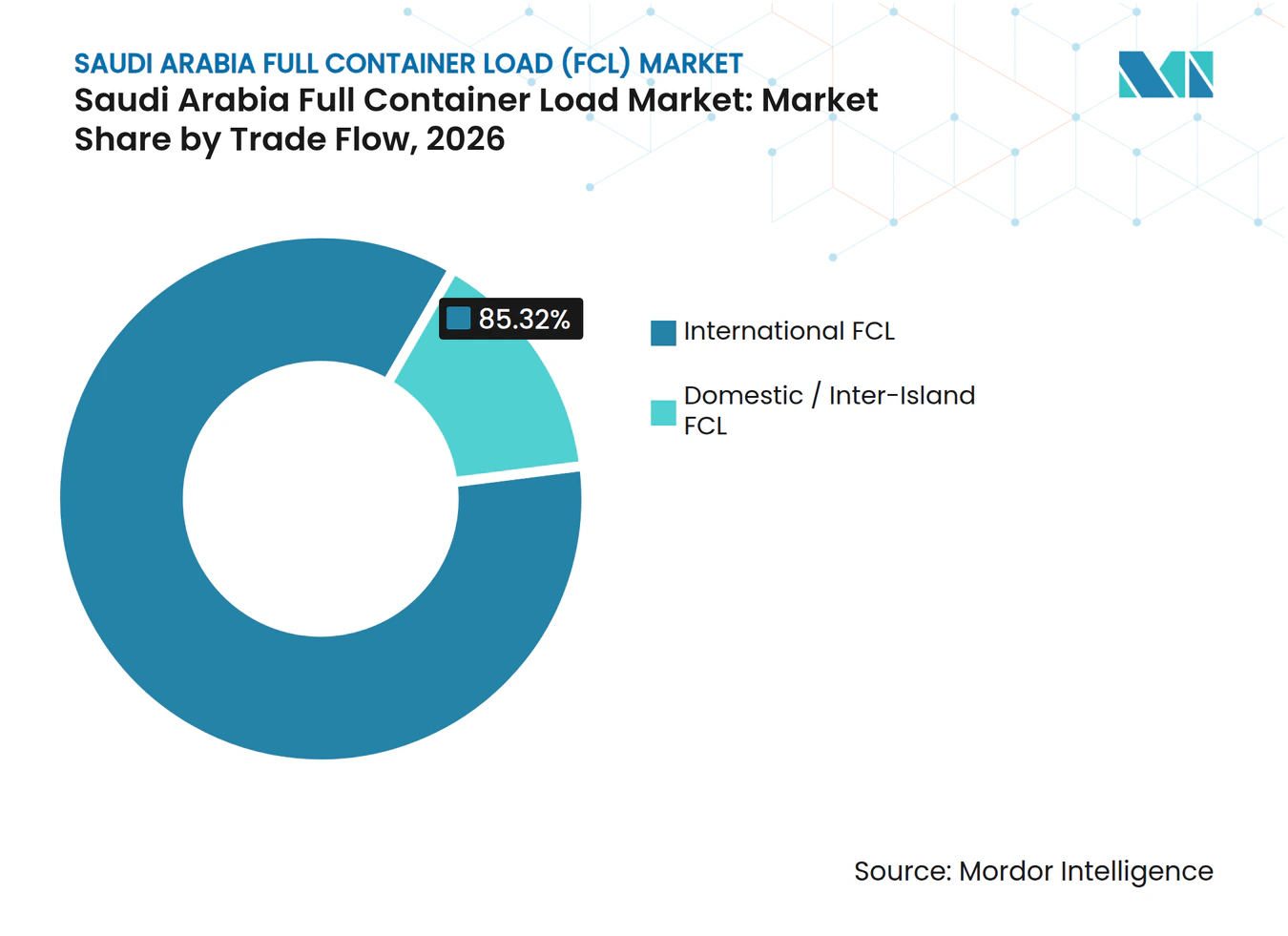
International FCL Anchors Saudi Containerized CommerceInternational FCL accounts for 85.32% of the Saudi Arabia full container load market share in 2026 and is forecast to register at a 6.24% CAGR through 2032. Machinery and electrical equipment represented 29.0% of imports in 2025, while transportation equipment accounted for 13.6%. These categories need regular connections with manufacturing centers outside the Kingdom. International services also support industrial projects, retail replenishment, and pharmaceutical imports. Direct mainline connections therefore remain central to service quality and equipment availability.
Domestic and inter-island FCL services gain value as ports, rail corridors, and dry ports create more multimodal options. Riyadh Dry Port integration provides Dammam cargo with a more direct route to central Saudi Arabia. Re-export activity adds container movements through distribution and processing before another international journey.



By Container Type:
Reefer Growth Reflects a Changing Cargo MixDry containers account for 81.25% of the Saudi Arabia full container load market share in 2026. Refrigerated containers are projected to register a 5.38% CAGR through 2032. General merchandise and industrial cargo continue to form most containerized trade. Pharmaceutical, food, and other perishable products need more controlled transport. Carriers and terminals with dependable power, inspection processes, and cargo visibility have a stronger position in the Saudi Arabia full container load market.
DP World increased reefer capacity at its South Container Terminal in Jeddah from 1,200 to 2,340 units in March 2025[3]. The terminal also added a facility that can inspect up to 75 refrigerated containers at the same time. Tank and Special Equipment Containers serve petrochemical and project cargo needs. Saudi Food and Drug Authority requirements for temperature integrity and Good Distribution Practice documentation favor operators with established cold-chain controls. This can limit participation by providers without specialized facilities or validated procedures.
By Container Size:
Larger Boxes Gain Ground Through Volume Efficiency20-foot containers account for 53.86% of the Saudi Arabia full container load market size in 2026. The 40-foot container segment is forecast to register a 5.12% CAGR through 2032. The 20-foot format suits mixed cargo and established handling systems across Saudi gateways. Retail, automotive, and electronics shipments can benefit from moving larger volumes in fewer boxes. This can reduce freight cost per unit when cargo uses available space efficiently.
Hapag-Lloyd’s SE4 service at Jeddah can deploy vessels with a capacity of up to 17,000 TEUs. The Gemini Cooperation made Jeddah a hub within a network of 340 vessels across 57 services. Larger services support frequent sailings for consumer and industrial cargo. E-commerce fulfillment and retail replenishment support space-efficient loads. Maersk identified retail expansion as an important logistics demand factor in 2025.
By End-User Industry:
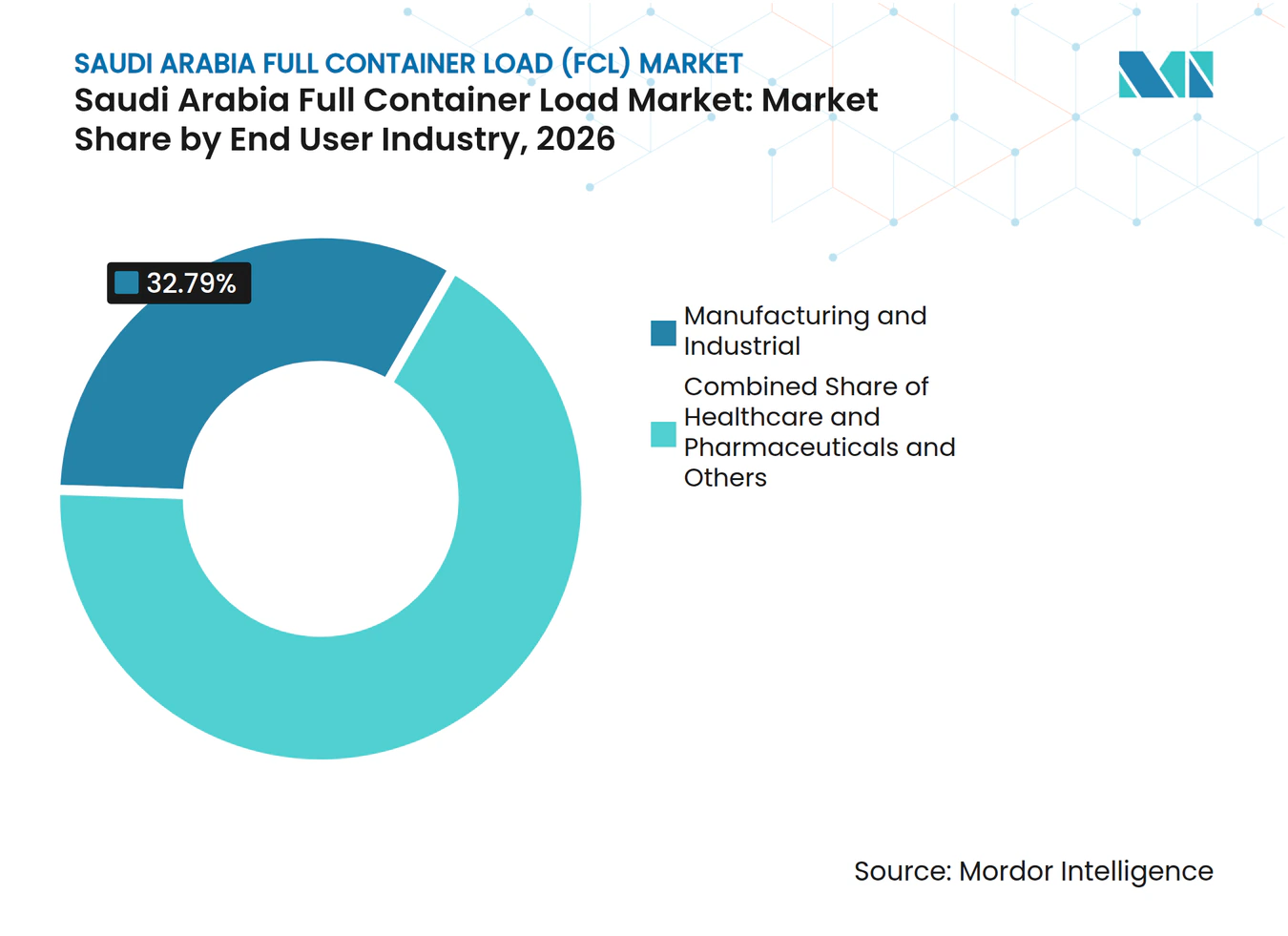
Healthcare and Pharmaceuticals Create High-Value DemandManufacturing and industrial accounts for 32.79% of the Saudi Arabia full container load market share in 2026. The segment is supported by petrochemical activity and machinery imports. Healthcare and pharmaceuticals are forecast to register a 6.36% CAGR through 2032. Rising biologics imports and pharmaceutical localization are increasing demand for controlled freight and storage. This work requires coordination between shipping lines, terminals, forwarders, warehouses, and customs processes.
AJEX Logistics Services opened a 3,000 m² pharmaceutical depot in Riyadh in October 2025. The facility includes 2-8 °C chambers for refrigerated biologics and -20 °C chambers for frozen cell therapies. Retail and consumer goods remain an important source of inbound volumes. Chemicals, automotive components, food and beverage, electronics, agriculture, and forestry also sustain regular container demand. Operators combining ocean freight, customs handling, and specialized inland distribution can address this range of cargo needs.

Geography Analysis
Eastern accounts for 40.03% of the Saudi Arabia full container load market in 2026. Its lead reflects industrial concentration and King Abdulaziz Port’s Gulf gateway role in the Saudi Arabia full container load market. Dammam handled 39.2 million tons of inbound cargo in 2025. Saudi Global Ports raised second-terminal capacity from 2.5 million to 3.8 million TEUs in November 2025. Rail services to Riyadh Dry Port extend the region’s reach into central Saudi Arabia.
The Western region is expected to advance at a 6.62% CAGR through 2032, supported by continued investment in port infrastructure and container-handling capacity. Jeddah Islamic Port handled 4.3 million TEUs in 2025, accounting for 47.3% of national throughput and reinforcing its role as a major gateway for international trade and cargo distribution. In March 2025, DP World and Mawani opened the SAR 3 billion (USD 799.38 million) South Container Terminal, strengthening the port’s ability to accommodate growing container volumes and improve cargo-handling efficiency. The facility has a long-term capacity target of 5 million TEUs, providing scope to support future trade growth and larger shipping requirements. In addition, the Terminal 4 development agreement represents another planned capacity addition at Jeddah, further supporting the region’s position as a key maritime logistics hub and strengthening its ability to handle rising import, export, and transshipment activity.
Central Saudi Arabia is moving from an inland destination toward a connected logistics node. The Riyadh Dry Port Ecosystem targets more than 1.5 million containers of annual capacity by 2030. Northern areas mainly serve cross-border links toward Iraq and Jordan. RSGT’s 20-year concessions provide an operating framework for Jazan and other Red Sea terminals.
Competitive Landscape
Market Concentration
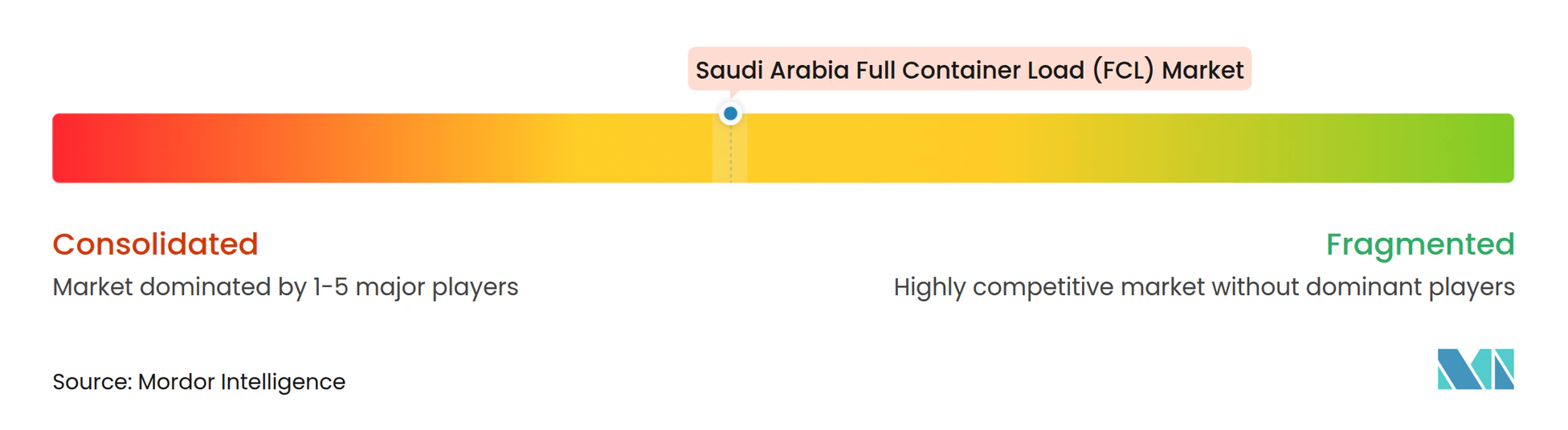
The Saudi Arabia full container load market is consolidated among mainline carriers. Maersk, CMA CGM, MSC, and Hapag-Lloyd anchor major flows through Jeddah and Dammam. Their scale supports direct calls, equipment availability, and broad sailing networks. Maersk and Hapag-Lloyd placed Jeddah within the Gemini Cooperation network of 340 vessels across 57 services. ZIM, Wan Hai, Yang Ming, and Evergreen compete on feeder and secondary mainline connections.
Terminal operators compete through capacity and digital processes. DP World’s Jeddah terminal uses cargo tallying and real-time tracking systems. CMA CGM and RSGT agreed to develop Terminal 4 at Jeddah with an initial USD 434 million investment[4]. The project will add deepwater berths and 10 ship-to-shore cranes. These moves make capacity, technology, and long-term terminal access central to competition in the Saudi Arabia full container load market.
Forwarders compete through customs expertise, shipment visibility, and integrated logistics coverage. ZATCA requires advance submission of customs declarations for incoming sea cargo, making documentation accuracy and regulatory compliance essential for efficient clearance. DSV completed its DB Schenker integration go-live in Saudi Arabia in February 2026, strengthening its integrated freight and logistics capabilities. DHL Supply Chain also committed EUR 130 million (USD 152.92 million) to a Riyadh logistics and distribution hub, expanding storage and distribution capacity. These developments highlight the importance of customs handling, network integration, and end-to-end logistics coverage in the Saudi Arabia full container load market.
Saudi Arabia Full Container Load (FCL) Industry Leaders
-
Bahri
-
Folk Maritime
-
A.P. Moller - Maersk
-
Mediterranean Shipping Company (MSC)
-
CMA CGM Group
- *Disclaimer: Major Players sorted in no particular order
Saudi Arabia Full Container Load (FCL) Market Companies Covered in this Report
- A.P. Moller - Maersk
- Aramex PJSC
- Bahri
- CMA CGM Group
- COSCO Shipping Lines
- DHL Group
- DP World
- DSV A/S (including DB Schenker)
- Evergreen Marine Corporation
- Expeditors International of Washington, Inc.
- Folk Maritime
- GAC Saudi Arabia
- Hapag-Lloyd AG
- Hellmann Worldwide Logistics
- Kuehne+Nagel
- Mediterranean Shipping Company (MSC)
- Ocean Network Express (ONE)
- Pacific International Lines (PIL)
- SAL Saudi Logistics Services Company
- Wan Hai Lines
- Yang Ming Marine Transport Corporation
- ZIM Integrated Shipping Services Ltd
Recent Industry Developments in Saudi Arabia Full Container Load (FCL) Market
- August 2026: Red Sea Gateway Terminal (RSGT) and CMA CGM Group signed definitive agreements for a USD 434 million joint development of Terminal 4 at Jeddah Islamic Port, adding up to 2.6 million TEUs of annual handling capacity with 10 new ship-to-shore cranes and deepwater berths.
- February 2026: DSV A/S completed the Saudi Arabia go-live of its DB Schenker integration, creating a unified logistics organization across air and sea freight, contract logistics, and road in the Kingdom.
- December 2025: Mawani signed a memorandum of understanding with MSC, Maersk, and CMA CGM on the sidelines of the Made in Saudi Expo 2025, aiming to boost carrier commitment to Saudi national export lanes and widen service access for Saudi exporters across multiple commodity corridors.
- November 2025: Saudi Global Ports inaugurated the SAR 1.5 billion (USD 399.69 million) expansion of the second container terminal at King Abdulaziz Port in Dammam, raising capacity from 2.5 million to 3.8 million TEUs.
Saudi Arabia Full Container Load (FCL) Market Report Scope
Segmentation Overview
| Domestic / Inter-Island FCL | |
| International FCL | Import Flow |
| Export Flow |
| Dry Containers |
| Refrigerated Containers |
| Tank Containers |
| Special Equipment Containers |
| 20-Foot Containers |
| 40-Foot Containers |
| Manufacturing and Industrial |
| Retail and Consumer Goods |
| Food and Beverage |
| Automotive and Components |
| Chemicals and Petrochemicals |
| Electronics and Electrical |
| Agriculture and Forestry |
| Healthcare and Pharmaceuticals |
| Other End Users |
| Central (Riyadh, Al-Qassim, and Hail) |
| Eastern (Ash-Sharqiyah) |
| Western (Al-Bahah, Makkah, Medina, and Tabuk) |
| Northern (Al-Jouf and Arar) |
| Southern (Asir, Jazan, and Najran) |
| By Trade Flow | Domestic / Inter-Island FCL | |
| International FCL | Import Flow | |
| Export Flow | ||
| By Container Type | Dry Containers | |
| Refrigerated Containers | ||
| Tank Containers | ||
| Special Equipment Containers | ||
| By Container Size | 20-Foot Containers | |
| 40-Foot Containers | ||
| By End-User Industry | Manufacturing and Industrial | |
| Retail and Consumer Goods | ||
| Food and Beverage | ||
| Automotive and Components | ||
| Chemicals and Petrochemicals | ||
| Electronics and Electrical | ||
| Agriculture and Forestry | ||
| Healthcare and Pharmaceuticals | ||
| Other End Users | ||
| By Region | Central (Riyadh, Al-Qassim, and Hail) | |
| Eastern (Ash-Sharqiyah) | ||
| Western (Al-Bahah, Makkah, Medina, and Tabuk) | ||
| Northern (Al-Jouf and Arar) | ||
| Southern (Asir, Jazan, and Najran) | ||
Key Questions Answered in the Report
What is the projected value of Saudi Arabia’s full container load sector by 2032?
It is projected to reach USD 3.68 billion by 2032, growing at a 4.71% CAGR from 2027 as port capacity, direct services, and non-oil trade expand.
Which trade flow leads containerized freight in Saudi Arabia?
International FCL leads with an 85.32% share in 2026 and is forecast to register at a 6.24% CAGR through 2032, supported by import demand and expanding export links.
Which container type is expected to grow fastest in Saudi Arabia?
Refrigerated containers are forecast to register a 5.38% CAGR through 2032, supported by food and pharmaceutical cargo that requires controlled handling at ports and inland facilities.
Why is Jeddah important for container shipping in Saudi Arabia?
Jeddah handled 4.3 million TEUs in 2025 and is receiving major terminal investment, direct East-West services, reefer capacity, and deeper transshipment links.
What is driving demand for pharmaceutical container logistics?
Rising biologics imports and pharmaceutical localization are increasing demand for temperature-controlled transport, storage, documentation, and specialized facilities that can preserve product integrity.
What risks affect container freight operations in Saudi Arabia?
Route disruptions, port congestion, documentation requirements, and empty-container imbalances can raise costs, reduce schedule predictability, and delay cargo releases for shippers.