
Saudi Arabia Freight Forwarding Market Size and Share
Market Overview
| Study Period | 2021 - 2032 |
|---|---|
| Forecast Data Period | 2027 - 2032 |
| Base Year Market Size (2026) | USD 6.13 Billion |
| Market Size (2027) | USD 6.49 Billion |
| Market Size (2032) | USD 8.42 Billion |
| Growth Rate (2027 - 2032) | 5.36 % |
| Market Concentration | Low |
Major Players *Disclaimer: Major Players sorted in no particular order Image © Mordor Intelligence. Reuse requires attribution under CC BY 4.0. | |
Saudi Arabia Freight Forwarding Market Analysis by Mordor Intelligence
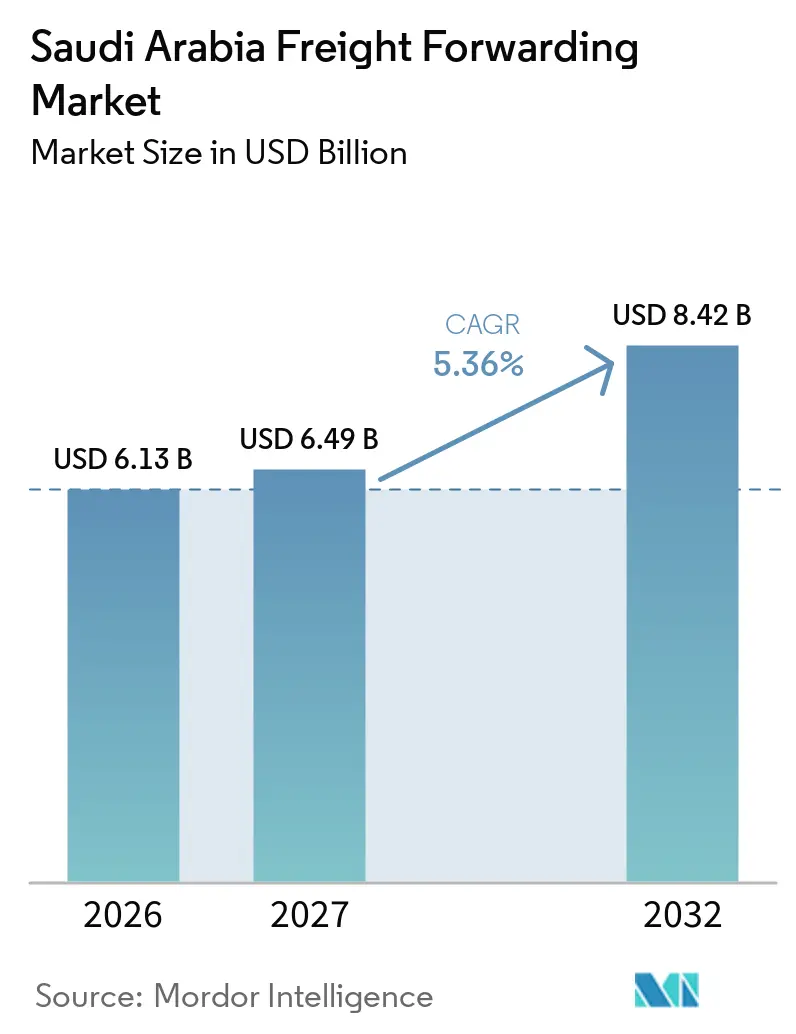
The Saudi Arabia freight forwarding market size is valued at USD 6.13 billion in 2026. It is estimated to grow from USD 6.49 billion in 2027 to reach USD 8.42 billion by 2032, at a CAGR of 5.36% during the forecast period from 2027 to 2032.
The Saudi Arabia freight forwarding market is supported by the National Transport and Logistics Strategy, which seeks to strengthen the country’s position across Asia, Europe, and Africa trade routes. Investment in logistics zones, rail links, port assets, and customs systems is shifting freight activity beyond commodity exports toward manufacturing, e-commerce, and re-export flows. Saudi ports handled more than 341 million tons of cargo in 2025, while inbound volumes increased 5.0% from the previous year. This growing cargo base increases demand for customs brokerage, bonded storage, multimodal coordination, and temperature-controlled handling. Competitive advantage is moving toward operators that combine reliable capacity with digital customs integration, specialized compliance capability, and local delivery partnerships.
Key Report Takeaways
- By mode of transport, ocean freight forwarding accounts for 68.64% of the Saudi Arabia freight forwarding market share in 2026, while air freight forwarding is projected to register a 6.83% CAGR through 2032.
- By enterprise size, large enterprises account for 64.87% of the Saudi Arabia freight forwarding market size in 2026, while small and medium enterprises are projected to register a 7.95% CAGR through 2032.
- By forwarder model, traditional asset-light forwarders account for 70.21% of the Saudi Arabia freight forwarding market share in 2026, while digital-first and online platforms are projected to register a 7.73% CAGR through 2032.
- By end-user industry, retail and e-commerce accounts for 39.46% of the Saudi Arabia freight forwarding market size in 2026, while healthcare and pharmaceuticals are projected to register a 6.47% CAGR through 2032.
- By geography, the Central region held 39.03% of the Saudi Arabia freight forwarding market share in 2026, while the Southern region is projected to register a 7.42% CAGR through 2032.
Note: Market numbers in this report are based on Mordor Intelligence's proprietary estimation framework, which combines nine months of actuals with Q4 projections for base year 2026.
Market Trends and Insights
Drivers Impact Analysis of Saudi Arabia Freight Forwarding Market*
| Driver | (~) % Impact on CAGR Forecast | Geographic Relevance | Impact Timeline |
|---|---|---|---|
| Vision 2030 Investment Strengthening Multimodal Freight Connectivity | +1.2% | National, concentrated in Riyadh, Jeddah, Dammam, and the Eastern Province. | Long term (≥ 4 years) |
| E-Commerce Growth Expanding Cross-Border Forwarding Demand | +1.1% | Riyadh, Jeddah, Dammam, with spillover to Makkah and Madinah | Short term (≤ 2 years) |
| Industrial Diversification Increasing Complex Cargo Forwarding Requirements | +0.7% | Eastern Province, Western region, and Southern region | Long term (≥ 4 years) |
| Logistics Outsourcing Expanding Third-Party Forwarding Service Demand | +0.9% | National, with early gains in Riyadh and Jeddah logistics zones | Medium term (2-4 years) |
| Port-Rail Integration Improving Inland Freight Connectivity Efficiency | +0.8% | Red Sea-Gulf corridor, Riyadh Dry Port, and Northern and Eastern gateways | Medium term (2-4 years) |
| Specialized Cargo Growth Increasing Compliance-Driven Forwarding Demand | +0.5% | Riyadh, Jeddah, and the Eastern Province | Medium term (2-4 years) |
| Source: Mordor Intelligence | |||
Vision 2030 Investment Strengthening Multimodal Freight Connectivity
The Saudi Arabia freight forwarding market benefits from transport projects that turn national policy into additional freight routes and operating capacity. The National Transport and Logistics Strategy supports logistics zones, port development, rail investment, and private-sector participation in logistics assets. The Landbridge project is intended to connect the Red Sea and Gulf coasts through Riyadh, creating a new inland option for cargo that otherwise moves by road. Forwarders will need to coordinate terminal handling, rail capacity, truck delivery, customs processes, and shipment visibility across these routes. Better transit reliability can help shippers reduce inventory buffers and place greater value on predictable delivery. This raises the importance of digital tracking, bonded cargo services, and value-added logistics within the Saudi Arabia freight forwarding market.
E-Commerce Growth Expanding Cross-Border Forwarding Demand
Saudi Arabia’s delivery sector recorded 79.6 million orders in the first quarter of 2025, up 22% from the prior year, and volumes exceeded 101 million orders in the second quarter[1]. International merchants require more than domestic parcel delivery when they enter Saudi Arabia. They need origin collection, international transport, customs brokerage, bonded fulfillment, and integrated delivery to the final customer. Maersk and Saudi Post agreed in July 2025 to develop an integrated e-commerce logistics offering that combines Maersk’s Jeddah Integrated Logistics Park with Saudi Post’s customs clearance and domestic delivery coverage. This model demonstrates why the Saudi Arabia freight forwarding market increasingly depends on links between global freight networks and local parcel operators. Forwarders with bonded-zone access, customs connectivity, and dependable delivery partners are better placed to serve these cross-border flows.
Industrial Diversification Increasing Complex Cargo Forwarding Requirements
Saudi Arabia’s industrial expansion is producing cargo that requires more planning than routine container movements. The Ministry of Industry and Mineral Resources reported 40 industrial cities and more than 12,000 factories, with a target of 36,000 factories by 2035 across automotive, aviation, food, mining, and petrochemicals. The King Salman Automotive Cluster at King Abdullah Economic City includes Hyundai, Lucid Motors, and Ceer, creating demand for components, finished vehicles, and service parts logistics. Mining, petrochemical, and industrial projects also require oversized, out-of-gauge, and time-controlled shipments. These requirements favor operators that can manage permits, specialized equipment, carrier coordination, and site delivery. The Saudi Arabia freight forwarding market therefore has opportunities in project logistics, automotive flows, industrial inputs, and export-oriented manufacturing cargo.
Logistics Outsourcing Expanding Third-Party Forwarding Service Demand
Manufacturers and retailers increasingly need licensed specialists to manage clearance, documentation, temperature control, and dangerous-goods procedures. This need supports third-party forwarding because maintaining in-house customs and compliance teams can be difficult for many shippers. DHL Group announced a commitment of more than EUR 500 million (USD 588.16 million) for fast-growing Middle East markets through 2030, with Saudi Arabia identified as a key investment destination. Aramex opened a robotic sorting facility at Jeddah Islamic Port in January 2025 that processes 4,000 shipments per hour through 120 robotic guided vehicles. Such facilities can improve throughput and make outsourced logistics services more attractive for shippers with growing order volumes. The Saudi Arabia freight forwarding market gains when service providers can combine operational scale with customs and delivery expertise.
Restraints Impact Analysis of Saudi Arabia Freight Forwarding Market*
| Restraint | (~) % Impact on CAGR Forecast | Geographic Relevance | Impact Timeline |
|---|---|---|---|
| Geopolitical Disruptions Increasing Freight Rate Volatility | -0.8% | Red Sea and Hormuz trade lanes, Jeddah Islamic Port, and Eastern Province gateways | Short term (≤ 2 years) |
| Customs Complexity Increasing Cross-Border Documentation Burden | -0.5% | All ports of entry, concentrated at Jeddah Islamic Port and King Abdulaziz Port Dammam. | Medium term (2-4 years) |
| Driver Shortages Increasing Inland Forwarding Capacity Constraints | -0.4% | National, most acute on long-haul Central-to-Western and Central-to-Eastern corridors | Medium term (2-4 years) |
| Port Dwell Variability Reducing End-to-End Reliability | -0.3% | Jeddah Islamic Port and spillover locations at King Abdullah Port | Short term (≤ 2 years) |
| Source: Mordor Intelligence | |||
Geopolitical Disruptions Increasing Freight Rate Volatility
Disruption across the Red Sea and Hormuz shipping lanes can change routes, transit times, and freight costs with little notice. These changes place pressure on Jeddah Islamic Port and affect inland distribution plans for cargo that arrives through the Western region. Higher inland transport costs can add pressure to forwarder margins when freight surcharges do not fully recover them. Operators with alternatives across Dammam, King Abdullah Port, rail services, and road networks can respond more effectively than firms reliant on one gateway. The Saudi Arabia freight forwarding market needs stronger multimodal planning when disruptions affect vessel schedules or port operations. Diversified routing also helps forwarders protect service reliability for importers, exporters, and time-sensitive cargo owners.
Customs Complexity Increasing Cross-Border Documentation Burden
Saudi customs modernization supports long-term efficiency, but it creates immediate compliance demands for forwarders and their customers. ZATCA required advance cargo-manifest submissions at seaports from October 29, 2025, with deadlines of 72 hours for distant ports and 24 hours for nearby ports[2]. The SABER Shipment Certificate became mandatory for Saudi imports from October 1, 2025, extending conformity documentation requirements across imported freight categories. Smaller forwarders may find it harder to maintain dedicated compliance teams and connected customs systems. Errors or late filings can lead to holds, fines, shipment delays, and weaker shipper relationships. The Saudi Arabia freight forwarding market is likely to favor providers that offer reliable documentation support and direct system integration.
*Our forecasts treat driver/restraint impacts as directional, not additive. The impact forecasts reflect baseline growth, mix effects, and variable interactions.
Saudi Arabia Freight Forwarding Market Segment Analysis
By Mode of Transport:
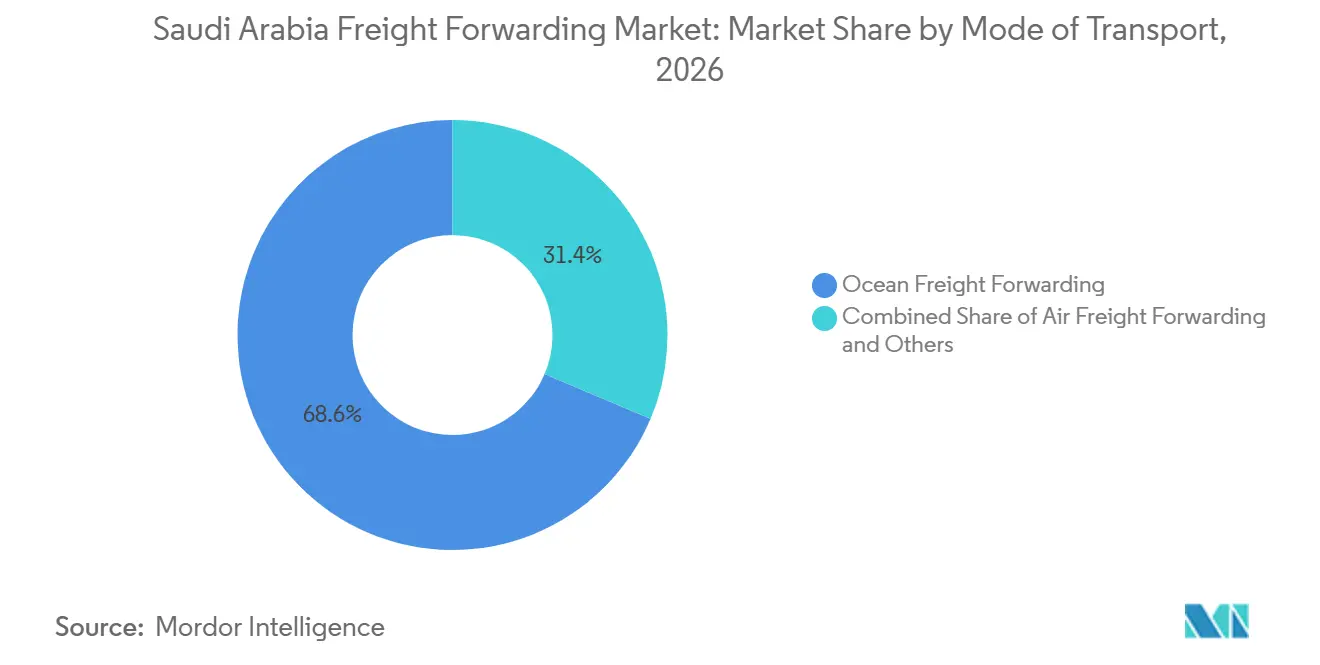
Ocean Dominates, Air Captures Time-Sensitive GrowthOcean freight forwarding accounts for 68.64% of the Saudi Arabia freight forwarding market size in 2026. The segment depends on deep-water gateways that handle manufactured goods, consumer products, food imports, and containerized cargo. Full-container services support large manufacturers and retail chains, while less-than-container services help smaller exporters, importers, and e-commerce merchants consolidate cargo. The Saudi Arabia freight forwarding industry continues to rely on ocean transport because trade volumes are concentrated through maritime gateways.
Air freight forwarding is projected to expand at a 6.83% CAGR from 2027 to 2032. It serves pharmaceutical products, cross-border parcels, industrial spare parts, and other time-sensitive shipments. FedEx expanded its Saudi Arabia presence in September 2025 and launched a dedicated nonstop cargo flight connecting the Kingdom with the United States and Europe. Road forwarding remains essential for full-truckload and less-than-truckload distribution, while developing rail and multimodal services can provide more predictable inland transit. Forwarders that integrate air, ocean, road, and rail legs can better manage service demands across the Saudi Arabia freight forwarding market.

By Enterprise Size:
Large Enterprises Lead, SMEs Accelerate on Digital AccessLarge enterprises account for 64.87% of the Saudi Arabia freight forwarding market share in 2026. Their scale allows them to negotiate dedicated forwarding contracts, use bonded logistics zones, and absorb compliance and planning costs. Aramco-related supply chains, SABIC industrial inputs, and Saudi Electricity Company equipment imports generate regular cargo flows that support established forwarders. These customers require dependable capacity, clear delivery commitments, and specialized handling across regular international movements. The Saudi Arabia freight forwarding industry retains a strong large-enterprise base because these accounts combine volume with frequent international movements.
Small and medium enterprises are forecast to register at a 7.95% CAGR through 2032. E-commerce participation, expanding industrial activity, and secondary-city logistics development are bringing more smaller businesses into cross-border trade. Government-backed logistics centers in secondary cities are extending freight generation beyond the Riyadh, Jeddah, and Dammam triangle. Smaller shippers often need customs advice and bundled documentation support, especially under the SABER certification requirement. Digital platforms can reach this segment through online booking, price visibility, document tools, and customer support.
By Forwarder Model:
Traditional Players Dominant, Digital Platforms DisruptTraditional asset-light forwarders account for 70.21% of the Saudi Arabia freight forwarding market size in 2026. Their position reflects established carrier relationships, customs brokerage networks, and experience with Saudi Arabia’s regulatory requirements. These operators understand the documentation needed for industrial project cargo, temperature-controlled goods, and periods of high seasonal activity. Their local knowledge and manual exception handling remain important when port conditions or clearance processes change. The Saudi Arabia freight forwarding market continues to give traditional providers an advantage in complex account management.
Digital-first and online platforms are projected to register a 7.73% CAGR through 2032. Mandatory electronic transport documents and the FASAH customs platform support faster booking, shipment visibility, and compliance management. The strongest model combines online tools with carrier partnerships and physical operating capability. DSV completed the integration of DB Schenker’s Saudi Arabia operations in February 2026, creating a unified organization across Air and Sea, Contract Logistics, and Road operations. Hybrid providers can offer asset-backed capacity and flexible broker-model services, increasing pressure on mid-tier conventional forwarders.
By End-User Industry:
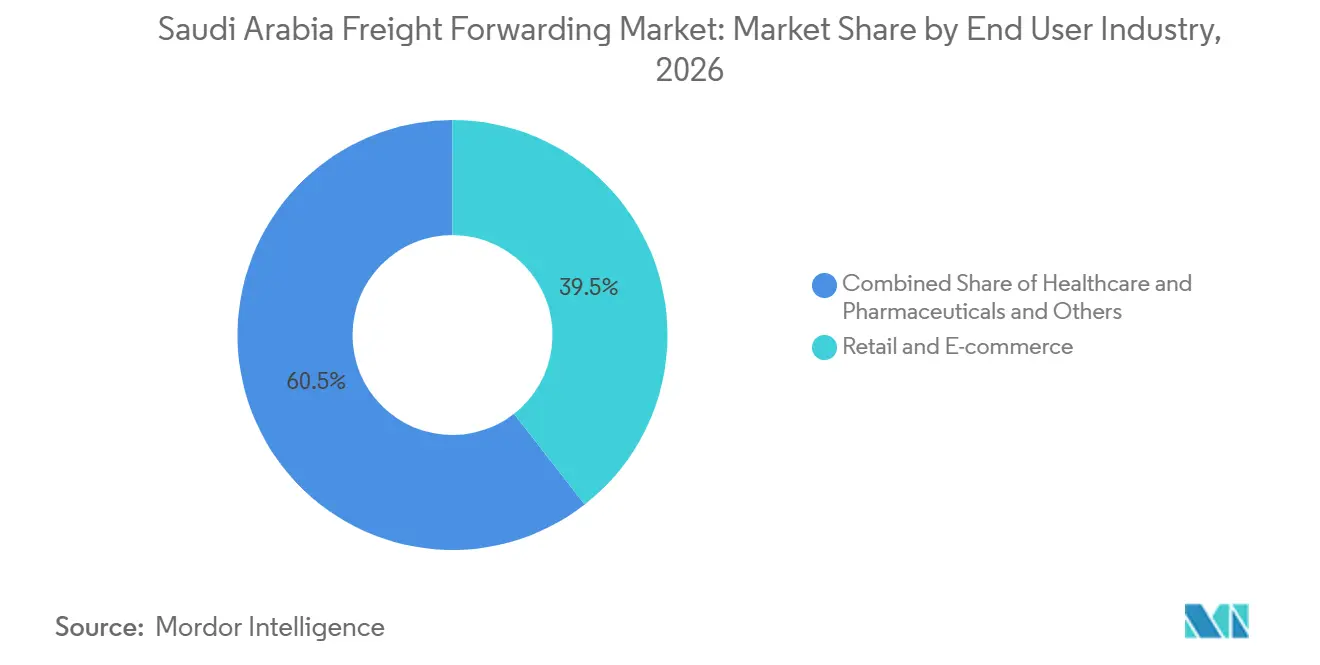
Retail Anchors Volume, Healthcare Commands Premium MarginsRetail and e-commerce accounts for 39.46% of the Saudi Arabia freight forwarding market size in 2026. Organized retailers, specialty chains, apparel brands, and online merchants need regular imports and dependable replenishment. Cross-border e-commerce adds demand for bonded storage, express clearance, parcel sorting, and final-mile coordination. Delivery volumes reported by the Transport General Authority show the scale of orders that supports these supply chains. Maersk and Saudi Post’s partnership illustrates the integrated freight, clearance, and domestic-delivery service needed for international e-commerce cargo.
Healthcare and pharmaceuticals are projected to register a 6.47% CAGR from 2027 to 2032. The segment requires validated temperature control, traceability, qualified handling procedures, and documentation aligned with Saudi Food and Drug Authority requirements. AJEX opened Saudi Arabia’s first GMP-GxP certified logistics depot in Riyadh in October 2025, with validated 2 °C to 8 °C and -20 °C storage chambers[3]. Oil and gas, industrial manufacturing, food and beverages, and automotive activity also contribute important freight volumes. Food requirements and automotive component, vehicle, and service-part flows support specialized services across the Saudi Arabia freight forwarding market.
Geography Analysis
The Central region accounts for 39.03% of the Saudi Arabia freight forwarding market share in 2026. Riyadh is the country’s main inland logistics hub, supported by warehousing, corporate demand, customs clearance, and links to national transport corridors. DHL Supply Chain signed a 26-year land lease at SILZ in November 2025 for a EUR 130 million (USD 152.92 million) regional logistics hub with 78,000 m² of space[4]. Riyadh Dry Port supports inland clearance and is expected to remain important as rail connections develop. The Central region serves retailers, e-commerce operators, government-linked entities, and large corporate supply chains, giving providers access to national distribution demand rather than only port-related cargo.
The Eastern region is the main industrial and energy corridor, with King Abdulaziz Port in Dammam, Jubail Commercial Port, and Ras Al-Khair supporting industrial exports and project cargo. It is important for petrochemicals, mining, equipment, and energy-related freight that needs specialist handling. Rail and cross-border connections can increase the region’s role in cargo movements toward Jordan and northern Gulf markets. The Western region is anchored by Jeddah Islamic Port, which processed 47.3% of national container throughput in 2025. Its operating environment is shaped by import activity, Hajj-season cargo rules, food certification, and product-conformity procedures, so port congestion or shipping disruptions can affect a broad portion of Saudi trade activity.
The Southern region is projected to register a 7.42% CAGR through 2032. Jazan Industrial City, Jazan Economic City, and road connections to neighboring trade corridors support this momentum and can attract more industrial and cross-border freight as infrastructure develops. Jazan Port ranked first among Saudi ports for passenger traffic in 2025, showing the corridor’s improving connectivity. The Northern region remains the smallest area, but cross-border rail development can increase its relevance for transit cargo toward Jordan, Turkey, and the Levant, requiring the Saudi Arabia freight forwarding market to balance central demand with specialized port, industrial, and border-corridor services.
Competitive Landscape
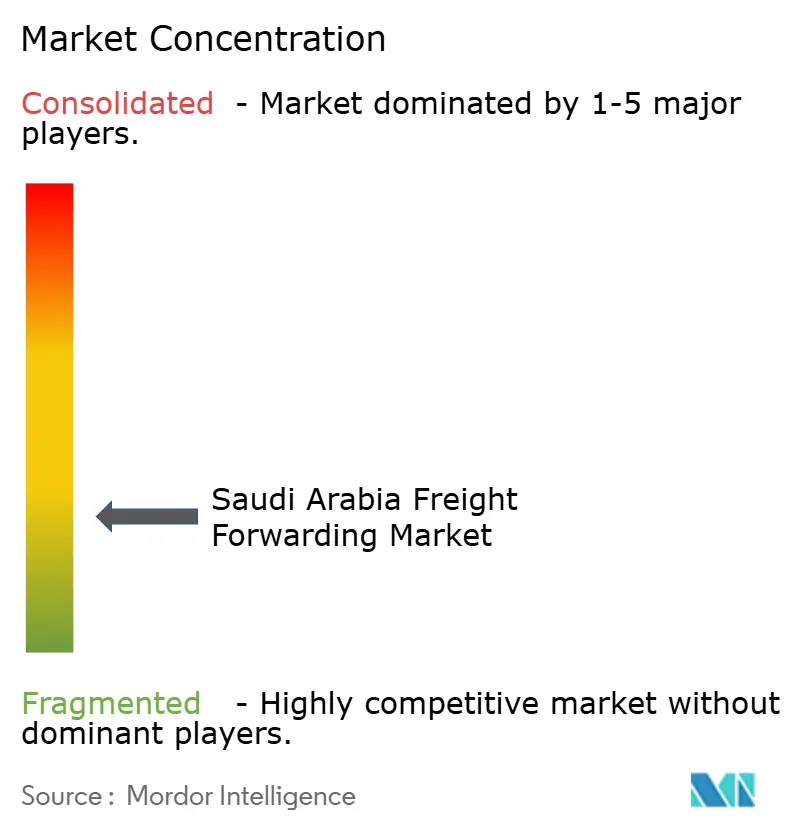
The Saudi Arabia freight forwarding market is fragmented across licensed brokers, domestic logistics firms, regional operators, and global integrators. DHL Global Forwarding, Kuehne+Nagel, DSV, Maersk, and CEVA Almajdouie Logistics compete for large enterprise and multinational contracts. Their competitive strengths include network coverage, digital visibility, customs capability, and service consistency across borders. Domestic operators such as SAL Saudi Logistics Services and Bahri hold advantages in local infrastructure, government relationships, and established energy-sector activity. The Saudi Arabia freight forwarding market is consolidating in higher-value services as compliance and technology requirements rise.
DSV completed the integration of DB Schenker’s Saudi Arabia operations in February 2026, strengthening its Air and Sea, Contract Logistics, and Road offering in the Kingdom and creating a broader platform for multinational accounts. SAL signed a renewable cargo-handling agreement with DSV in February 2026 for ground handling, cargo acceptance, documentation, airside coordination, and warehousing. The agreement shows how domestic infrastructure providers can support global forwarder operations. DHL eCommerce finalized a minority investment in AJEX in August 2025, strengthening its parcel and e-commerce delivery presence in Saudi Arabia.
Pharmaceutical handling, customs integration, and multimodal design are becoming major points of differentiation. Aramex’s robotic sorting facility at Jeddah Islamic Port processes up to 96,000 shipments daily and demonstrates the role of automation in higher-volume logistics operations. Digital providers such as Wared Logistics and Flow Progressive Logistics target smaller shippers through online booking and price visibility, while expanding compliance and carrier-connectivity features for mid-market accounts. New entrants can focus on pharmaceutical forwarding or e-commerce fulfillment where integrated bonded storage, compliance documentation, customs clearance, and delivery services remain important. This competitive structure leaves room for specialists while placing pressure on generalist operators with limited technology or compliance resources.
Saudi Arabia Freight Forwarding Industry Leaders
-
SAL Saudi Logistics Services Company
-
CEVA Almajdouie Logistics
-
DHL Global Forwarding
-
DSV A/S (including DB Schenker)
-
Kuehne+Nagel
- *Disclaimer: Major Players sorted in no particular order
Saudi Arabia Freight Forwarding Market Companies Covered in this Report
- A.P. Moller - Maersk
- AJEX Logistics Services
- Aramex PJSC
- BAFCO International Shipping & Logistics Co. Ltd
- Bahri
- CEVA Almajdouie Logistics
- DHL Global Forwarding
- DP World
- DSV A/S (including DB Schenker)
- Expeditors International of Washington, Inc.
- FedEx Corporation
- Flow Progressive Logistics
- Four Winds Saudi Arabia Limited
- GAC Saudi Arabia
- GEODIS
- Hellmann Worldwide Logistics
- Kintetsu World Express (Saudi Arabia) Ltd
- Kuehne+Nagel
- Munawla Cargo Co. Ltd.
- SAL Saudi Logistics Services Company
- United Parcel Service, Inc. (UPS)
- Wared Logistics
Recent Industry Developments in Saudi Arabia Freight Forwarding Market
- July 2026: Mawani signed a partnership with DP World and Red Sea Gateway Terminal for a SAR 641 million (USD 170 million) investment to expand cargo handling capacity at Jeddah Islamic Port, directly targeting the landside congestion that had elevated berth stays and suppressed forwarding reliability.
- July 2026: SAL Saudi Logistics Services and Riyadh Air Cargo signed an interline cargo agreement, combining SAL’s established air cargo network with Riyadh Air’s international destinations, London, Dubai, Cairo, Madrid, and Malaga, to expand freight routing options for forwarders seeking alternatives to congested Jeddah.
- April 2026: SAR, Mawani, and Bahri Logistics launched an integrated multimodal logistics service combining rail freight, port handling, and national shipping. The first phase involves transporting over 45,000 tons of DAP fertilizer inputs via specialized containers from Ras Al-Khair to the Hail cargo yard
- February 2026: DSV A/S completed the integration of DB Schenker’s Saudi Arabia operations into a single unified organization, strengthening its Air and Sea, Contract Logistics, and Road forwarding presence across the Kingdom.
Saudi Arabia Freight Forwarding Market Report Scope
Segmentation Overview
| Ocean Freight Forwarding | Full Container Load (FCL) |
| Less-Than-Container Load (LCL) | |
| Road Freight Forwarding | Full Truck Load (FTL) |
| Less-Than-Truck Load (LTL) | |
| Air Freight Forwarding | |
| Rail Freight Forwarding | |
| Multimodal and Intermodal Forwarding |
| Small and Medium Enterprises |
| Large Enterprises |
| Traditional Asset-Light Forwarders |
| Digital-First / Online Platforms |
| Hybrid Asset-Enabled Forwarders |
| Industrial and Manufacturing |
| Retail and E-commerce |
| Healthcare and Pharmaceuticals |
| Oil, Gas and Energy |
| Food and Beverages |
| Automotive |
| Chemicals |
| Other End-Users |
| Central (Riyadh, Al-Qassim, and Hail) |
| Eastern (Ash-Sharqiyah) |
| Western (Al-Bahah, Makkah, Medina, and Tabuk) |
| Northern (Al-Jouf and Arar) |
| Southern (Asir, Jazan, and Najran) |
| By Mode of Transport | Ocean Freight Forwarding | Full Container Load (FCL) |
| Less-Than-Container Load (LCL) | ||
| Road Freight Forwarding | Full Truck Load (FTL) | |
| Less-Than-Truck Load (LTL) | ||
| Air Freight Forwarding | ||
| Rail Freight Forwarding | ||
| Multimodal and Intermodal Forwarding | ||
| By Enterprise Size | Small and Medium Enterprises | |
| Large Enterprises | ||
| By Forwarder Model | Traditional Asset-Light Forwarders | |
| Digital-First / Online Platforms | ||
| Hybrid Asset-Enabled Forwarders | ||
| By End-User Industry | Industrial and Manufacturing | |
| Retail and E-commerce | ||
| Healthcare and Pharmaceuticals | ||
| Oil, Gas and Energy | ||
| Food and Beverages | ||
| Automotive | ||
| Chemicals | ||
| Other End-Users | ||
| By Region | Central (Riyadh, Al-Qassim, and Hail) | |
| Eastern (Ash-Sharqiyah) | ||
| Western (Al-Bahah, Makkah, Medina, and Tabuk) | ||
| Northern (Al-Jouf and Arar) | ||
| Southern (Asir, Jazan, and Najran) | ||
Key Questions Answered in the Report
What is the value of freight forwarding services in Saudi Arabia?
The Saudi Arabia freight forwarding market is valued at USD 6.13 billion in 2026 and is projected to reach USD 8.42 billion by 2032, at a 5.36% CAGR.
Which transport mode leads freight forwarding in Saudi Arabia?
Ocean freight forwarding leads with a 68.64% share in 2026 because Saudi trade depends heavily on maritime gateways and containerized imports.
Why is air freight expanding in Saudi Arabia?
Air freight is projected to register a 6.83% CAGR through 2032, supported by pharmaceutical cargo, e-commerce parcels, and time-sensitive industrial shipments.
Which customer sector creates the most demand for forwarding services?
Retail and e-commerce account for 39.46% of 2026 demand, driven by imports, bonded fulfillment, customs clearance, and final-mile delivery needs.
Which Saudi region leads freight forwarding activity?
The Central region leads with a 39.03% share in 2026, supported by Riyadh’s warehousing base, inland clearance role, and national distribution demand.
What capabilities matter most for freight forwarders in Saudi Arabia?
Customs integration, bonded logistics, temperature-controlled handling, multimodal coordination, and dependable local delivery partnerships are increasingly important.