
Saudi Arabia Fourth-Party Logistics (4PL) Market Size and Share
Market Overview
| Study Period | 2021 - 2032 |
|---|---|
| Forecast Data Period | 2027 - 2032 |
| Base Year Market Size (2026) | USD 1.23 Billion |
| Market Size (2027) | USD 1.31 Billion |
| Market Size (2032) | USD 1.79 Billion |
| Growth Rate (2027 - 2032) | 6.45 % |
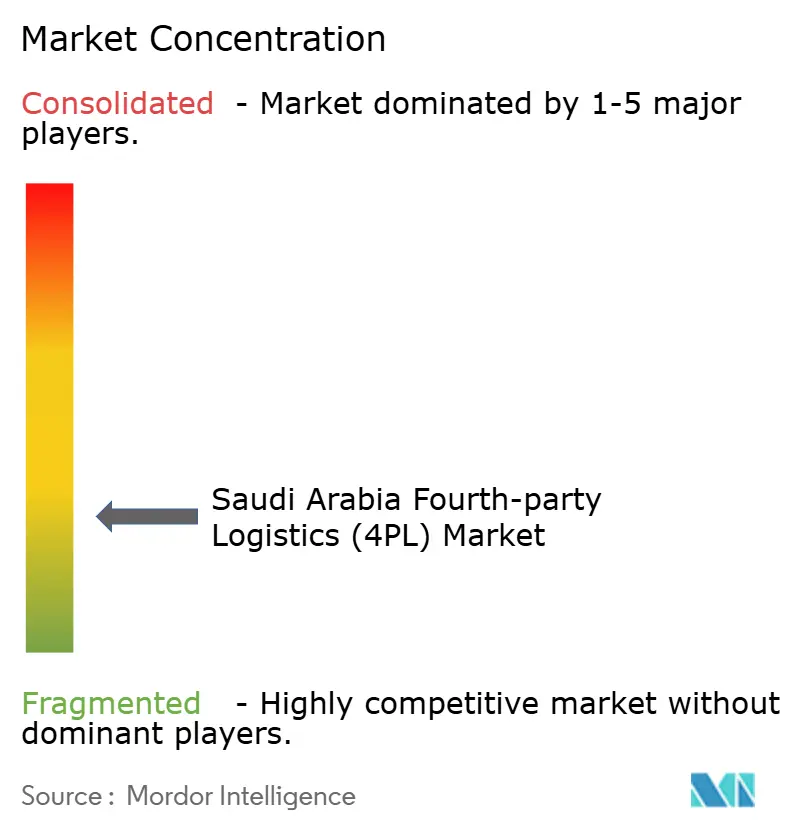
| Market Concentration | Low |
Major Players *Disclaimer: Major Players sorted in no particular order Image © Mordor Intelligence. Reuse requires attribution under CC BY 4.0. | |
Saudi Arabia Fourth-Party Logistics (4PL) Market Analysis by Mordor Intelligence
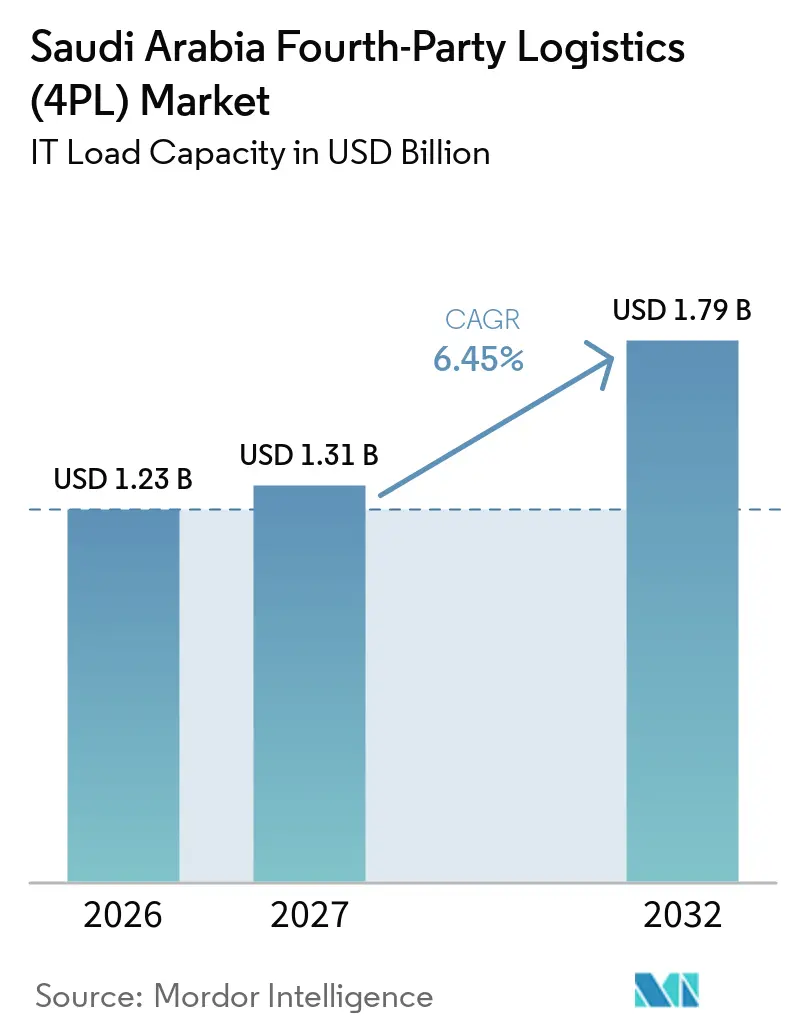
The Saudi Arabia fourth-party logistics market size is valued at USD 1.23 billion in 2026. It is estimated to grow from USD 1.31 billion in 2027 to reach USD 1.79 billion by 2032, at a CAGR of 6.45% during the forecast period (2027-2032).
The Saudi Arabia fourth-party logistics market is supported by the National Industrial Development and Logistics Program, which has allocated USD 36 billion to logistics infrastructure and USD 28 billion to industrial zones. Growth is broadening from multinational customers to domestic manufacturers entering export channels, while retail, healthcare, and technology companies adopt more formal supply chain coordination. Faster customs procedures and the national address system are also making real-time planning more useful for shippers that previously managed delivery and compliance tasks separately. The Saudi Arabia fourth-party logistics market therefore favors providers that can combine multi-carrier oversight, digital visibility, and sector-specific operating knowledge.
Key Report Takeaways
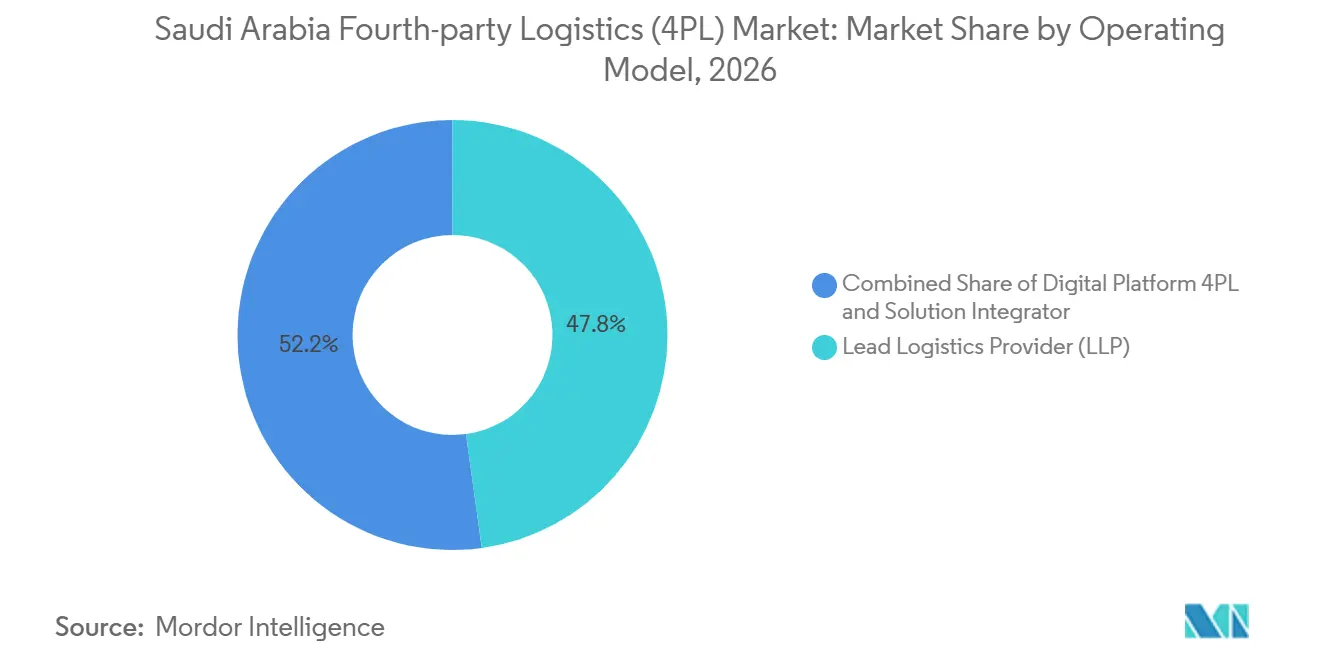
- By operating model, lead logistics providers account for a 47.83% share in 2026, while digital platform 4PL is projected to expand at an 8.91% CAGR through 2032.
- By end-user industry, the retail and e-commerce segment accounts for 34.86% of the Saudi Arabia fourth-party logistics market size in 2026, while refrigerated and pharma is forecast to register an 8.89% CAGR through 2032.
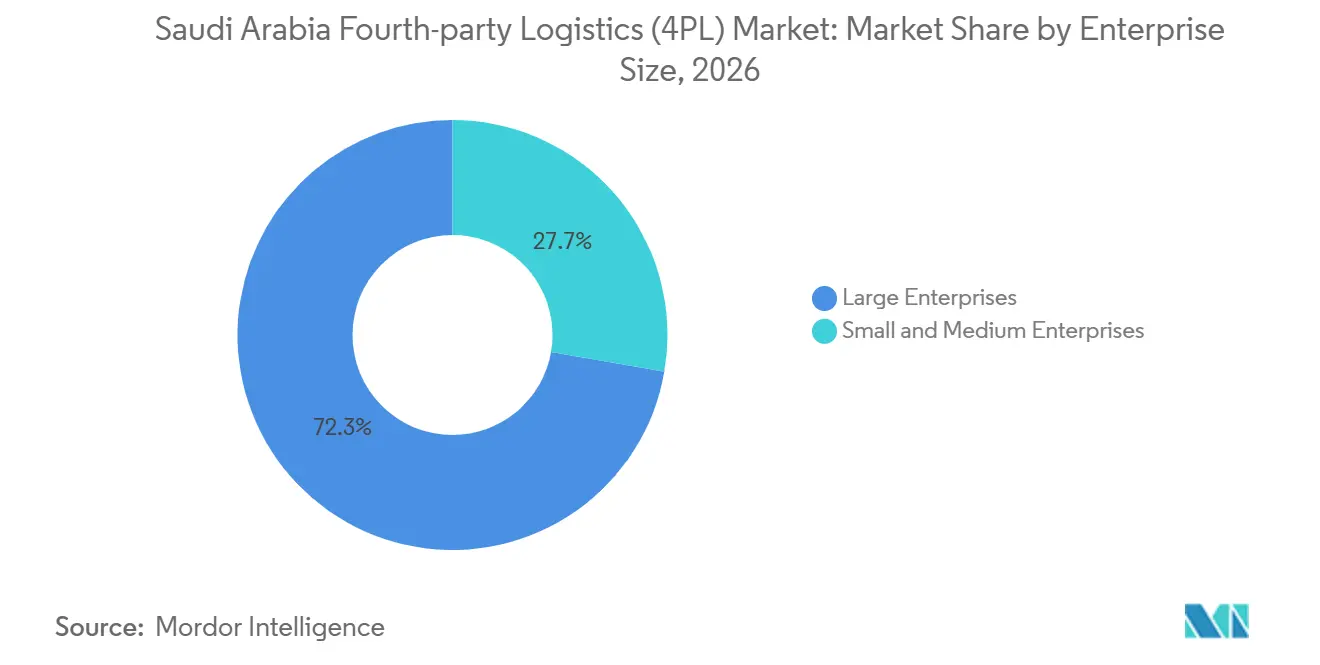
- By enterprise size, large enterprises account for 72.28% of the Saudi Arabia fourth-party logistics market share in 2026, while small and medium enterprises are projected to record a 7.24% CAGR through 2032.
- By geography, Central Saudi Arabia accounts for 42.42% of the Saudi Arabia fourth-party logistics market size in 2026, while Western Saudi Arabia is projected to register a 9.11% CAGR through 2032.
Note: Market numbers in this report are based on Mordor Intelligence's proprietary estimation framework, which combines nine months of actuals with Q4 projections for base year 2026.
Saudi Arabia Fourth-Party Logistics (4PL) Market Trends and Insights
Drivers Impact Analysis*
| Driver | (~) % Impact on CAGR Forecast | Geographic Relevance | Impact Timeline |
|---|---|---|---|
| Vision 2030 Investment Expanding Integrated Logistics Demand | +1.9% | National, with concentrated gains in Riyadh, Jeddah, and Dammam | Long term (≥ 4 years) |
| E-Commerce Complexity Increasing End-to-End Orchestration Requirements | +1.4% | Central and Western regions, with emerging gains in Eastern Province | Short term (≤ 2 years) |
| Multi-Provider Networks Increasing Supply Chain Coordination Demand | +0.9% | National, spill-over to cross-border corridors via Jeddah and SILZ | Medium term (2-4 years) |
| Manufacturing Localization Expanding Complex Logistics Management Needs | +0.7% | Eastern and Central provinces (SPARK, Jubail, Yanbu) | Long term (≥ 4 years) |
| Digital Supply Chains Accelerating Control-Tower Adoption | +0.8% | National, driven by Riyadh's technology and logistics cluster | Medium term (2-4 years) |
| Regional Trade Growth Increasing Cross-Border Orchestration Demand | +0.6% | Western region and Northern borders | Medium term (2-4 years) |
| Source: Mordor Intelligence | |||
Vision 2030 Investment Expanding Integrated Logistics Demand
In 2025, 24 national logistics centers were operational out of 59 planned, strengthening connectivity among ports, warehouses, industrial parks, and customer facilities. The Special Integrated Logistics Zone near King Khalid International Airport has attracted logistics and technology companies, increasing demand for coordinated inbound, bonded, and outbound operations. DHL Supply Chain’s November 2025 agreement to develop a regional facility within the zone reflects growing investment in multi-user logistics infrastructure[1]. Manufacturing localization further supports Saudi Arabia’s fourth-party logistics market, as raw materials, maintenance supplies, project cargo, and finished goods move across multiple service providers. Demand is expected to increase as businesses seek integrated oversight of compliance, procurement, inventory, and freight operations.
E-Commerce Complexity Increasing End-to-End Orchestration Requirements
E-commerce has raised the number of delivery handoffs and increased the importance of returns, delivery scheduling, and carrier allocation across Saudi Arabia. The Saudi Arabia fourth-party logistics market is well placed to support retailers that need a shared view of inventory, fulfillment centers, courier capacity, and customer returns. A.P. Moller Maersk and Saudi Post formed a July 2025 partnership in which Maersk handles origin activity and international transportation, while Saudi Post manages customs clearance and last-mile delivery within the Kingdom. This model illustrates why cross-border commerce often relies on coordinated roles rather than one provider performing every task. The national address system that took effect in January 2026 reduces a last-mile data constraint and gives operators a more consistent basis for address-level routing. Cold-chain retail and pharmaceutical delivery add temperature and traceability requirements that can make specialized coordination more valuable than conventional parcel handling.
Multi-Provider Networks Increasing Supply Chain Coordination Demand
Saudi Arabia’s logistics expansion has increased the number of transport modes, service providers, and regulatory touchpoints that a shipment can involve. The Saudi Arabia fourth-party logistics market benefits when an importer or manufacturer requires one party to oversee air freight, ocean freight, road transport, warehouse activity, and customs processes. ASMO expanded procurement services for Aramco during 2025 by adding 120 procurement agreements, following a July pilot and forming part of a phased expansion through 2027. Its operating model combines procurement and warehouse management with logistics execution, which reduces the number of separate coordination points for industrial clients. The Saudi Arabia fourth-party logistics industry gains from this type of long-term arrangement because it creates demand for broader operational oversight rather than individual freight movements. More maritime services and expanding cross-border trade also raise the need to manage handoffs between local and international partners.
Digital Supply Chains Accelerating Control-Tower Adoption
Digital supply chain tools are becoming more relevant as clients ask for live shipment status, inventory data, and carrier performance comparisons. SAP launched a data center in Saudi Arabia in February 2025 and completed a public-sector deployment of SAP Business Network in October 2025 with local data sovereignty compliance. This in-country data foundation can reduce the amount of bespoke integration work for platforms serving regulated customers. SAL Saudi Logistics Services and Elm agreed in August 2025 to develop a digital logistics platform with scheduling, payment management, delivery notifications, and appointment booking. Digital systems help control towers identify and manage exceptions across multiple carriers and facilities while supporting physical logistics operations. The Saudi Arabia fourth-party logistics market is likely to favor providers that can turn data from multiple sources into clear operating actions for customers.
Restraints Impact Analysis*
| Restraint | (~) % Impact on CAGR Forecast | Geographic Relevance | Impact Timeline |
|---|---|---|---|
| Advanced Logistics Skill Shortages Limiting 4PL Scalability | -1.2% | National, with acute pressure in Riyadh and Jeddah operational hubs | Medium term (2-4 years) |
| Data Interoperability Gaps Restricting End-to-End Visibility | -0.9% | National, severity higher in Eastern Province industrial corridors | Medium term (2-4 years) |
| Uneven Digital Readiness Slowing Platform Integration | -0.8% | Northern and Southern regions, spill-over to smaller cities | Long term (≥ 4 years) |
| Data Governance Complexity Increasing Implementation and Compliance Costs | -0.6% | National, heaviest burden in regulated sectors (pharma, defense) | Medium term (2-4 years) |
| Source: Mordor Intelligence | |||
Advanced Logistics Skill Shortages Limiting 4PL Scalability
Saudi Arabia’s Human Resources Development Fund supported employment for 74,000 citizens in transport and logistics between 2020 and mid-2025[2]. The remaining challenge is the availability of people who can use planning systems, interpret data, manage customer exceptions, and oversee multi-provider networks. Fourth-party logistics contracts require skills that combine operations knowledge with digital decision-making, which may not be available evenly across all regions. High workloads can also limit the time that logistics operators devote to formal training and new system adoption. This constraint can delay the rollout of control-tower services even where infrastructure and client demand are in place. The Saudi Arabia fourth-party logistics market may therefore scale more quickly in established hubs than in smaller cities where digital logistics skills are less mature.
Data Interoperability Gaps Restricting End-to-End Visibility
Many logistics networks still use separate warehouse systems, carrier tracking tools, and data exchange formats that do not work together without client-specific integration. This weakens the end-to-end visibility that customers expect from a 4PL operating model. SAP’s local infrastructure and public-sector network support can improve standardization for some users, but the participating private-sector ecosystem remains uneven. Data residency obligations also require foreign providers to design local data storage and governance arrangements for Saudi logistics data. These requirements can increase implementation time and cost, particularly for regulated healthcare, defense, and energy customers. The Saudi Arabia fourth-party logistics market may see slower adoption where subcontractors cannot provide timely and standardized operating data.
*Our forecasts treat driver/restraint impacts as directional, not additive. The impact forecasts reflect baseline growth, mix effects, and variable interactions.
Segment Analysis
By Operating Model: LLP Holds the Largest Share While Digital Platforms Grow Faster
The lead logistics provider accounts for 47.83% of the Saudi Arabia fourth-party logistics market share in 2026. This model appeals to industrial, government, and enterprise customers that want a single accountable operator across air, sea, road, rail, warehouse, and customs activities. Long-term agreements can support stable service design and make it easier to integrate procurement, inventory, and transportation workflows. ASMO’s procurement expansion for Aramco illustrates this approach because the company is building services across general supply, maintenance, drilling, chemicals, and project materials through 2027. These relationships make coordinated operating responsibility more useful than managing several standalone freight contracts.
Digital platform 4PL is forecast to register an 8.91% CAGR from 2027 to 2032, the highest rate among operating models. The model is relevant for retailers, e-commerce firms, and pharmaceutical shippers that need rapid status updates and carrier comparisons. Solution Integrators sit between conventional 3PL arrangements and full 4PL outsourcing, serving customers that seek an integrated service design while retaining internal procurement control. Local data platforms can make subscription-based control towers more practical for mid-market customers because they reduce the need for a custom system deployment. The model makes digital access more practical for customers with smaller or less predictable volumes. It also gives shippers a way to introduce shared visibility before committing to a fully dedicated operating model.

By End-User Industry: Retail Leads Demand While Refrigerated and Pharma Grow Fastest
Retail and e-commerce accounts for 34.86% of the Saudi Arabia fourth-party logistics market size in 2026. These customers need coordinated carrier management, returns processing, inventory positioning, and peak-period capacity planning. Cross-border sales add origin management, customs handling, bonded fulfillment, and domestic delivery to the same customer journey. The Maersk and Saudi Post partnership combines those responsibilities between international transportation and in-Kingdom execution. This is the kind of operating structure that expands the value of a central coordination role. Fashion and lifestyle companies also require seasonal inventory positioning, while technology and electronics firms need traceability and compliance across multiple supply tiers.
Refrigerated and pharma is projected to register an 8.89% CAGR through 2032. The segment requires temperature-controlled storage, secure product handling, compliant distribution, and reliable visibility across the supply chain. Automotive and mobility customers depend on timely inbound parts management, while industrial manufacturers need project-linked materials coordination during construction and expansion programs. FMCG operations are also moving toward more frequent replenishment and smaller shipment sizes as modern retail formats expand. Providers can serve these varied needs by combining sector-specific compliance capabilities with multi-provider planning.
By Enterprise Size: Large Enterprises Provide Volume While SME Platforms Improve Access
Large enterprises account for 72.28% of the Saudi Arabia fourth-party logistics market share in 2026. Their leading position reflects the data infrastructure, contract volume, and change-management capacity needed to support broad logistics outsourcing. Large clients are also more likely to have complex procurement operations, multiple facilities, and international trade flows. ASMO’s combined procurement, warehousing, inventory, and logistics model for Aramco reflects the direction taken by mature customers that seek one operational intelligence layer. These customers often value accountability and continuity because a disruption in one area can affect production, project delivery, or regulated supply chains. The Saudi Arabia fourth-party logistics market remains anchored by these high-volume enterprise relationships.
Small and medium enterprises are expected to register a 7.24% CAGR through 2032. Digital platforms can make control-tower services accessible through subscriptions rather than dedicated software investment. Salasa raised USD 30 million in August 2025 to expand its fulfillment centers, dark stores, and bonded-zone capabilities for cross-border e-commerce activity. The national address system can also lower manual routing work for smaller firms with fragmented delivery data. SME customers may not need a large dedicated account team, but they can still benefit from shipment visibility, fulfillment coordination, and exception management. Providers need tiered service designs to serve enterprises without excluding smaller customers.
Geography Analysis
Central Saudi Arabia accounts for 42.42% of the Saudi Arabia fourth-party logistics market share in 2026. Riyadh is the center of corporate procurement, government contracting, large distribution programs, and several major logistics investments. The Special Integrated Logistics Zone, Sino-Saudi Logistics Zone, and SPARK make the region a dense cluster for logistics, industrial, and energy-related activity. DHL Supply Chain agreed in November 2025 to invest EUR 130 million (USD 149 million) in a 78,000 m² logistics and distribution hub at the Special Integrated Logistics Zone[3]. This concentration raises the need to coordinate freight, warehousing, customs, and value-added processes for tenants operating near each other.
Western Saudi Arabia is projected to register at a 9.11% CAGR through 2032, making it the fastest-growing regional part of the Saudi Arabia fourth-party logistics market. Jeddah is strengthening its role as a Red Sea gateway where port, warehouse, customs, and onward distribution activity can be managed as connected flows. DP World and APM Terminals announced a February 2026 partnership at the Southern Container Terminal of Jeddah Islamic Port, under which APM Terminals acquired a 37.5% stake, and DP World retained a 62.5% stake. Maersk’s Jeddah Integrated Logistics Park also supports a combined approach to international transportation, bonded fulfillment, customs, and final-mile delivery. These investments give 4PL providers a larger base of cross-border activities to coordinate.
The Eastern Province has intensive industrial logistics demand because it serves energy and manufacturing supply chains in Dammam, Jubail, and nearby industrial locations. ASMO began warehouse operations at the Aramco Jazan Refinery Complex in August 2025, extending its multi-site operations into the Southern region. Northern and Southern regions currently contribute smaller revenue shares, but industrial localization is creating demand in areas that had fewer advanced logistics options.
Competitive Landscape
The Saudi Arabia fourth-party logistics market is fragmented, with global providers serving large enterprise accounts and a diverse mix of players competing in the mid-market. DHL, DSV after its Schenker integration, Kuehne+Nagel, and A.P. Moller Maersk compete through international network coverage, contract logistics capabilities, and compliance expertise. ASMO has a distinct position because its Aramco and DHL backing ties procurement services to industrial logistics infrastructure. DSV completed the go-live of its Schenker integration in Saudi Arabia in February 2026, creating a unified organization across air and sea freight, contract logistics, and road operations. Regional operators compete through local operating knowledge, government relationships, and specialized service delivery.
Technology is an important basis for competition because a 4PL provider must show customers how it can identify exceptions and coordinate decisions across several carriers. Aramex opened an automated robotic sorting facility at Jeddah Islamic Port in January 2025, with 120 robotic guided vehicles and a stated capacity of 4,000 shipments per hour[4]. It also selected Softeon in January 2026 as a warehouse management system partner for more than 70 facilities, including key Saudi Arabia hubs. Kuehne+Nagel became the first company in Saudi Arabia to gain Authorized Economic Operator certification for customs brokerage in May 2025. These moves show that automation, digital warehouse execution, and customs capability are becoming connected elements of competitive positioning. They also reduce the operational friction that can arise when customers use several warehouses, carriers, and border entry points. For the provider, this combination can support more consistent service management across the customer supply chain.
DHL eCommerce finalized a strategic investment in AJEX in August 2025, expanding access to a Saudi delivery network of more than 60 facilities and 1,200 vehicles. ASMO and Arcapita also agreed in February 2026 to develop a 1.4 million m² logistics facility at SPARK, with ASMO set to develop, lease, and operate the site. The strongest opportunities remain in cold-chain coordination, SME-oriented digital platforms, and cross-border e-commerce flows connecting Saudi Arabia with GCC destinations.
Saudi Arabia Fourth-Party Logistics (4PL) Industry Leaders
-
ASMO (Advanced Supply Management Operations)
-
SAL Saudi Logistics Services Company
-
CEVA Almajdouie Logistics
-
DHL Group
-
DSV A/S (including DB Schenker)
- *Disclaimer: Major Players sorted in no particular order
Recent Industry Developments
- February 2026: DP World and APM Terminals, a subsidiary of A.P. Moller Maersk, announced a strategic partnership at the Southern Container Terminal of Jeddah Islamic Port. APM Terminals acquired a 37.5% minority stake while DP World retained a 62.5% majority and continued terminal operations, combining complementary capabilities to reinforce Jeddah's role as a Red Sea hub connecting Asia, Europe, and Africa.
- February 2026: ASMO, the Aramco-DHL joint venture, partnered with Arcapita Group Holdings to develop a 1.4 million m² purpose-built logistics facility at SPARK in Dammam. Arcapita funds and retains ownership via a forward funding arrangement. At the same time, ASMO develops, leases, and operates the facility under a 22-year occupational lease that includes a 43,000 m² temperature-controlled Grade-A warehouse, 3,000+ sqm of office space, and over 1.2 million m² of open yard.
- August 2025: DHL eCommerce finalized a strategic investment in AJEX, a Saudi logistics leader with over 60 facilities, 1,200 vehicles, and a team of 2,000 professionals. The partnership positions DHL eCommerce to capture anticipated double-digit e-commerce growth in Saudi Arabia, directly expanding its last-mile delivery capability and 4PL service proposition for online retail clients across the Kingdom.
- August 2025: SAL Saudi Logistics Services and Elm signed an agreement to develop a fully integrated digital logistics platform covering shipment scheduling, payment management, delivery notifications, and appointment booking across SAL's airport station network.
Saudi Arabia Fourth-Party Logistics (4PL) Market Report Scope
| Lead Logistics Provider (LLP) |
| Solution Integrator |
| Digital Platform 4PL |
| FMCG |
| Retail and E-commerce |
| Fashion and Lifestyle |
| Technology and Electronics |
| Refrigerated and Pharma |
| Automotive and Mobility |
| Industrial Manufacturing |
| Others |
| Small and Medium Enterprises |
| Large Enterprises |
| Central (Riyadh, Al-Qassim, and Hail) |
| Eastern (Ash-Sharqiyah) |
| Western (Al-Bahah, Makkah, Medina, and Tabuk) |
| Northern (Al-Jouf and Arar) |
| Southern (Asir, Jazan, and Najran) |
| By Operating Model | Lead Logistics Provider (LLP) |
| Solution Integrator | |
| Digital Platform 4PL | |
| By End-User Industry | FMCG |
| Retail and E-commerce | |
| Fashion and Lifestyle | |
| Technology and Electronics | |
| Refrigerated and Pharma | |
| Automotive and Mobility | |
| Industrial Manufacturing | |
| Others | |
| By Enterprise Size | Small and Medium Enterprises |
| Large Enterprises | |
| By Region | Central (Riyadh, Al-Qassim, and Hail) |
| Eastern (Ash-Sharqiyah) | |
| Western (Al-Bahah, Makkah, Medina, and Tabuk) | |
| Northern (Al-Jouf and Arar) | |
| Southern (Asir, Jazan, and Najran) |
Key Questions Answered in the Report
What is the projected value of Saudi Arabia fourth-party logistics in 2032?
The Saudi Arabia fourth-party logistics market is projected to reach USD 1.79 billion by 2032, growing at a 6.45% CAGR from 2027.
Which operating model leads Saudi Arabia fourth-party logistics?
The lead logistics provider is the largest operating model, holding a 47.83% share in 2026.
Which customer sector is expanding most rapidly for 4PL services?
Refrigerated and pharma is the fastest-growing end-user segment, with an 8.89% CAGR projected through 2032.
Why is Western Saudi Arabia growing quickly for 4PL activity?
Western Saudi Arabia is forecast to register a 9.11% CAGR as Jeddah strengthens its role in port, bonded, customs, and cross-border logistics.
How do digital platforms affect 4PL adoption in Saudi Arabia?
Digital platform 4PL is projected to register an 8.91% CAGR because shippers need shared visibility, carrier benchmarking, and faster exception management.
What limits the expansion of 4PL services in Saudi Arabia?
Skills shortages and disconnected logistics data systems can delay the rollout of integrated control-tower operations.