
Market Overview
| Study Period | 2020 - 2031 |
|---|---|
| Forecast Data Period | 2026 - 2031 |
| Base Year Market Size (2025) | USD 2.59 Billion |
| Market Size (2026) | USD 2.77 Billion |
| Market Size (2031) | USD 3.92 Billion |
| Growth Rate (2026 - 2031) | 7.14 % |
| Market Concentration | Medium |
Major Players *Disclaimer: Major Players sorted in no particular order Image © Mordor Intelligence. Reuse requires attribution under CC BY 4.0. | |
Saudi Arabia Event Management Market Analysis by Mordor Intelligence
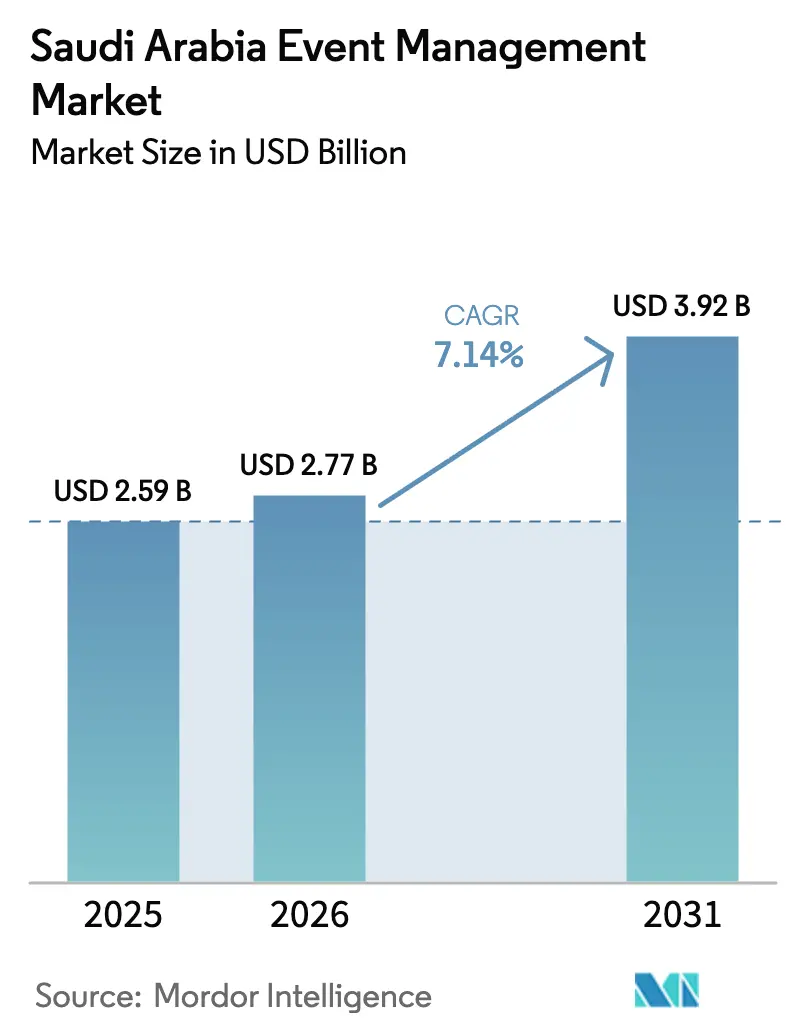
The Saudi Arabia Event Management market size is expected to grow from USD 2.59 billion in 2025 to USD 2.77 billion in 2026 and is forecast to reach USD 3.92 billion by 2031 at 7.14% CAGR over 2026-2031.
The growth is backed by the sector’s fast transition from nascent growth to mainstream scale. Vision 2030 has made large-scale public and private investment in venues, digital infrastructure, and tourism promotion the central catalyst, while streamlined licensing now allows foreign organizers to establish local subsidiaries in under one week[1]General Entertainment Authority, “Riyadh Season 2024 Attracts 12 Million Visitors,” gea.gov.sa. Stadium construction for the FIFA 2034 World Cup, rising inbound tourism, and the localization of multinational corporate events are creating a durable pipeline of bookings that has lifted average venue utilization to 68% in Riyadh and 61% in Jeddah as of 2025. Ticketing platforms leveraging artificial intelligence (AI) have driven a 15% uplift in average revenue per attendee by personalizing offers and dynamic pricing, while sponsorship income is growing at double-digit rates as global brands seek exposure to the Kingdom’s youthful, digitally engaged population.
Key Report Takeaways
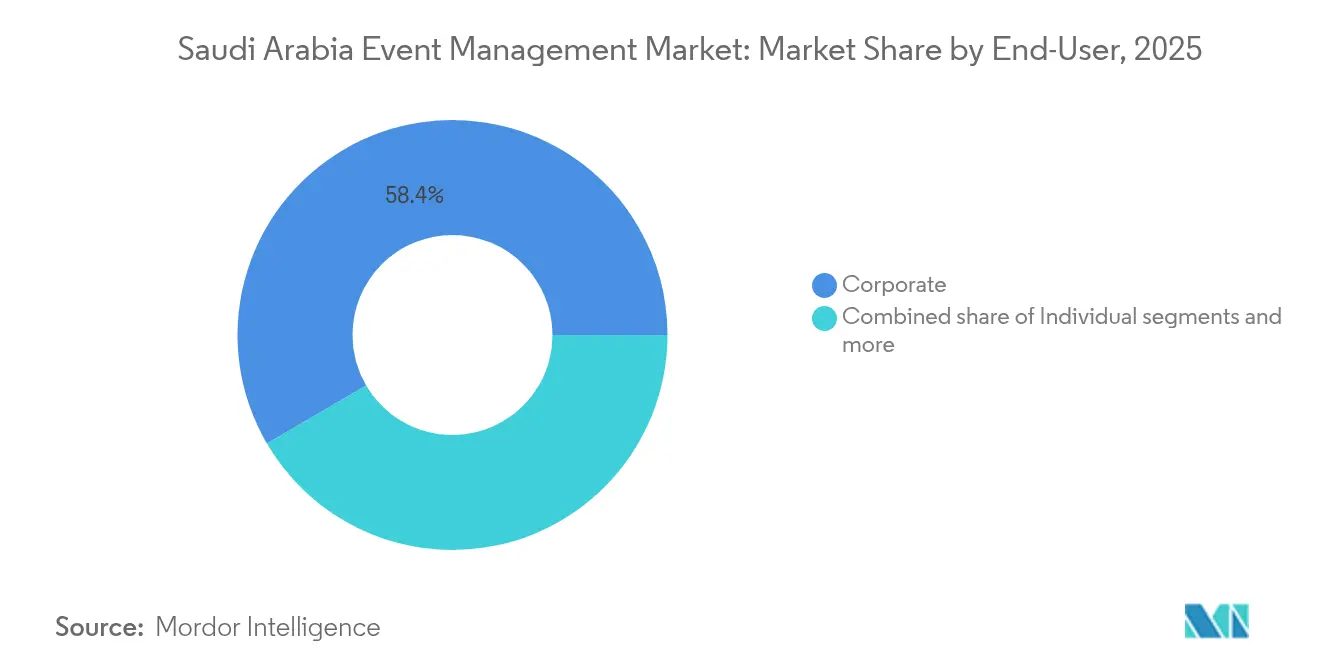
- By end-user, corporate accounted for 58.42% of the Saudi Arabia event management market share in 2025, while the individual segment is projected to grow at the fastest CAGR of 11.74% between 2026 and 2031.
- By type, exhibitions & conferences and sports collectively captured 36.94% of the Saudi Arabia event management market share in 2025, whereas exhibitions & conferences alone is forecast to expand at a CAGR of 13.79% during 2026–2031.
- By revenue source, ticket sales represented 54.92% of the Saudi Arabia event management market share in 2025, while sponsorships is expected to increase at a CAGR of 12.85% between 2026 and 2031.
- By geography, the Western, Northern, and Central regions together accounted for 42.05% of the Saudi Arabia event management market share in 2025, while the Northern & Central region is projected to grow at the highest CAGR of 11.23% over 2026–2031.
Note: Market size and forecast figures in this report are generated using Mordor Intelligence’s proprietary estimation framework, updated with the latest available data and insights as of 2026.
Saudi Arabia Event Management Market Trends and Insights
Drivers Impact Analysis*
| Driver | (~) % Impact on CAGR Forecast | Geographic Relevance | Impact Timeline |
|---|---|---|---|
| Rapid ramp-up of giga-projects driving venue supply | +2.1% | Riyadh, Jeddah, NEOM | Long term (≥ 4 years) |
| Vision 2030 tourism targets boosting inbound demand | +1.8% | Nationwide, GCC spill-over | Medium term (2-4 years) |
| Corporate localization mandates expanding MICE spend | +1.2% | Riyadh, Jeddah, Dammam | Short term (≤ 2 years) |
| Esports World Cup anchoring year-round gaming events | +0.9% | Riyadh, global online reach | Medium term (2-4 years) |
| Seasonality-mitigation via Saudi Seasons festival model | +0.7% | Multi-city national program | Short term (≤ 2 years) |
| AI-powered ticketing and crowd analytics improving organizer ROI | +0.5% | Nationwide, tech-ready venues | Medium term (2-4 years) |
| Source: Mordor Intelligence | |||


Rapid Ramp-Up of Giga-Projects Driving Venue Supply
More than 100 new event-ready facilities are slated for completion under giga-projects such as NEOM, Qiddiya, and the Red Sea destination, including King Salman International Stadium’s 92,760-seat bowl that will redefine capacity benchmarks in the region. Continuous construction milestones create recurring demand for groundbreaking ceremonies and stakeholder showcases, while Public Investment Fund backing lowers financing risk for organizers. The resulting venue surplus is expected to compress rental rates and stimulate experimentation with niche formats, propelling the Saudi Arabia event management market beyond oil-centric corporate gatherings into lifestyle, culture, and tech verticals.
Vision 2030 Tourism Targets Boosting Inbound Demand
Saudi Arabia welcomed 27.4 million international visitors in 2024—up 65% year over year—signaling strong progress toward the 150 million-visitor targets for 2030. Large-scale business events such as LEAP drew 215,000 attendees, validating the Kingdom’s readiness for mega-conferences. Simplified e-visa processes and five-day event-licensing windows reduce friction for global planners, while hotel groups have announced 80,000 new keys under construction to accommodate MICE travellers. The Saudi Arabia event management market, therefore, benefits from a broadened prospect pool that includes both leisure-driven tourists and high-spending corporate delegates.
Corporate Localization Mandates Expanding MICE Spend
Employment quotas under the Nitaqat program require multinationals to train and engage Saudi nationals, prompting an uptick in internal conferences, workshops, and shareholder meetings held locally[2]TASC Outsourcing, “Everything You Need to Know About Saudi Tourism & Hospitality Sector,” tascoutsourcing.sa. In-country board sessions and product launch now constitute standard compliance practice, turning corporate events from discretionary expense to regulatory imperative. This predictable demand has enabled service providers to lock in multi-year agreements, underpinning revenue visibility within the Saudi Arabia event management market.
Esports World Cup Anchoring Year-Round Gaming Events
Government sponsorship of the Esports World Cup positions Riyadh as a permanent hub on the international gaming circuit, filling calendar gaps between seasonal festivals. Dedicated esports arenas with professional broadcast infrastructure support hybrid physical-digital events that monetize both on-site tickets and global streaming rights. Multinational publishers establishing regional studios add corporate off-sites, hackathons, and fan conventions, reinforcing the Saudi Arabia event management market’s diversification away from purely traditional live entertainment.
Restraints Impact Analysis*
| Restraint | (~) % Impact on CAGR Forecast | Geographic Relevance | Impact Timeline |
|---|---|---|---|
| Shortage of certified event professionals | −1.1% | Nationwide, acute in giga-project hubs | Medium term (2-4 years) |
| High climate-control costs for outdoor events | −0.8% | Central & eastern regions | Long term (≥ 4 years) |
| Sponsorship fatigue amid the proliferation of new festivals | −0.6% | Nationwide, corporate budgeting cycles | Short term (≤ 2 years) |
| Data-privacy compliance gaps in fast-growing event tech stacks | −0.3% | Nationwide, international client events | Medium term (2-4 years) |
| Source: Mordor Intelligence | |||
Shortage of Certified Event Professionals
The National Events Center’s talent-pipeline programs delivered 3,200 graduates in 2025, yet labor demand outstrips supply by nearly 2:1, especially for technical directors and multilingual project managers[3]TASC Outsourcing, “Everything You Need to Know About Saudi Tourism & Hospitality Sector,” tascoutsourcing.sa. Wage inflation of 12-15% for specialist roles is raising project budgets and elongating planning timelines. International agencies must import expertise, elevating cost bases but also accelerating knowledge transfer to local staff, a dynamic that will persist until domestic training capacity scales.
High Climate-Control Costs for Outdoor Events
Summer temperatures topping 45 °C can push cooling expenses to 70% of operational budgets, with medium-scale outdoor concerts incurring up to USD 200,000 in temporary HVAC outlay[4]TASC Outsourcing, “Everything You Need to Know About Saudi Tourism & Hospitality Sector,” tascoutsourcing.sa. While next-generation stadiums integrate passive shading and solar-powered chillers, retrofitting legacy venues remains capital-intensive. Seasonality compression into cooler months places upward pressure on booking rates and availability, complicating scheduling across the Saudi Arabia event management market.
*Our forecasts treat driver/restraint impacts as directional, not additive. The impact forecasts reflect baseline growth, mix effects, and variable interactions.
Segment Analysis
By End-User: Corporate Events Maintain Structural Lead
Corporate gatherings represented 58.42% of the Saudi Arabia event management market in 2025, reflecting entrenched localization mandates and the Kingdom’s ascent as a regional headquarters destination. Individual celebrations—weddings, graduations, and milestone parties—posted the highest forecast expansion at a 11.74% CAGR, signalling cultural liberalization and rising disposable income among Saudi nationals. Public sector events, although smaller in absolute value, remain a constant driver of civic engagement and national branding. The Saudi Arabia event management market size for corporate functions is expected to climb from USD 1.51 billion in 2026 to USD 2.06 billion by 2031, anchoring venue occupancy across Riyadh and Jeddah.
Corporate clients now demand international-grade production, multilingual interpretation, and hybrid streaming, lifting average spend per delegate. Individual clients are shifting from home-based festivities to professionally staged experiences that incorporate themed décor and live entertainment. Public institutions continue to commission cultural showcases and national day celebrations at scale, creating baseline demand even during economic fluctuations.


By Type: Exhibitions & Conferences Outpace Sports Formats
Exhibitions and conferences collectively held 36.94% of revenue in 2025 and are projected to grow 13.79% annually, topping all other event types. Sports events command substantial visibility owing to high-profile investments, yet venue construction lags keep supply tight until 2027. Music concerts and festivals have gained momentum under expanded visa options for international performers. The Saudi Arabia event management market share for exhibitions is anticipated to reach 40.62% by 2031 as trade fair organizers relocate Middle East editions from Dubai to Riyadh to comply with in-country procurement incentives.
Rapid uptake of digital twin technology allows exhibitors to extend reach to remote audiences, boosting sponsorship appeal. Sports promoters benefit from guaranteed government underwriting for marquee tournaments, although tight calendars constrain frequency. Live music continues to flourish under the General Entertainment Authority’s streamlined content-approval regime, fostering a vibrant ecosystem of ticketing, merchandising, and secondary hospitality sales.

By Revenue Source: Sponsorship Accelerates, Tickets Still Core
Ticket sales accounted for 54.92% of 2025 turnover, but sponsorship is on track for a 12.85% CAGR as global and domestic brands align with Vision 2030. Merchandise, hospitality suites, and digital streaming rights jointly contribute an expanding share, driven by AI-enabled customer segmentation that maximizes per-capita spend. The Saudi Arabia event management market size for sponsorship is expected to cross USD 1 billion by 2030, illustrating the shift toward brand-funded experiences.
Dynamic pricing algorithms integrated into government-approved ticketing gateways have trimmed average unsold inventory to below 8%, releasing working capital for organizers. Meanwhile, bundled hospitality packages—including gourmet catering and backstage access—command premiums of 150-200% over standard admission, appealing to high-net-worth residents and visiting executives.
Geography Analysis
Riyadh and its surrounding northern & central regions generated 42.05% of sector revenue in 2025, a lead reinforced by the concentration of government ministries, corporate headquarters, and flagship venues such as Kingdom Arena. The region’s 11.23% forecast CAGR reflects multi-billion-dollar investments in transport and hospitality that streamline delegate mobility. Jeddah anchors the western region, leveraging King Abdulaziz International Airport’s expanded capacity and ongoing waterfront redevelopment to attract cultural festivals and seaside sporting events. The Saudi Arabia event management market size in the western corridor is expected to rise from USD 930 million in 2026 to USD 1.35 billion by 2031, supported by cruise tourism and pilgrimage spill-over traffic.
The eastern region benefits from industrial clusters around Dammam and Al Khobar, where Saudi Aramco’s supplier ecosystem underwrites a steady stream of technical conferences and supplier expos. Newly announced stadiums in Dammam will diversify the region’s event mix and ease reliance on corporate gatherings. Southern provinces such as Asir and Jizan remain nascent yet show strong potential as heritage and eco-tourism hubs; public investments in airport upgrades and boutique venues signal a strategic intent to diffuse visitor flows.
Regional rivalry is intensifying as each zone seeks to cultivate a distinct positioning with Riyadh for policy and technology summits, Jeddah for international culture and lifestyle events, the east for industrial trade shows, and soon NEOM for futuristic, sustainability-themed gatherings. Balanced regional development prevents over-crowding of the capital’s calendar while broadening the addressable base for suppliers within the Saudi Arabia event management market.
Regulatory Landscape
Saudi Arabia's entertainment-event activity is regulated primarily by the General Entertainment Authority (GEA), established by Royal Decree No. (A/133) on 7 May 2016. For commercial live entertainment, festivals, and performance-led events, organizers and supporting service providers operate under GEA regulations and supervision, with licensing and permitting routed through the GEA Entertainment Portal as the mandatory digital platform for approvals and compliance.
In practice, the GEA's Events Management Division provides oversight across the event lifecycle, including planning support, operational plan development, and monitoring of pre-launch and live event execution. This approach places emphasis on compliant documentation, approved operating procedures, and coordination with the portal-based workflow for timelines, staffing, and vendor readiness, especially for large public events and multi-venue seasonal programs.
Value Chain Analysis
The Saudi Arabia event management value chain starts with public-sector regulation and enablement, notably the General Entertainment Authority and its Entertainment Portal licensing workflow. From there, public investment and destination developers build and aggregate venues and event-ready districts, including PIF-backed developers such as Saudi Entertainment Ventures (SEVEN), which help shape the supply of programmable venues and anchor attractions that feed multi-event calendars.
Downstream, event owners and operators, including MDLBEAST, Live Nation Middle East, SELA, and Rotana Live, convert venue access and content rights into marketable formats across ticketed festivals, corporate programs, and hybrid productions. Specialist subcontractors then cover staging, AV and broadcast, security, crowd management, and hospitality. Ticketing and marketing platforms sit close to the consumer interface and convert demand through digital ticketing, dynamic pricing, and audience analytics, with increasing integration into venue operations and sponsorship activation to improve yield per attendee and inventory utilization.
Competitive Landscape
Innovation and Adaptability Drive Future Success
Success in the Saudi Arabia event management market increasingly depends on companies' ability to adapt to changing consumer preferences and technological advancements. Incumbent players are focusing on strengthening their digital capabilities, developing specialized expertise in emerging event categories, and building strong relationships with key stakeholders across government and private sectors. The ability to offer integrated solutions, combining traditional event management with digital capabilities and sustainable practices, is becoming crucial for maintaining market position. Companies are also investing in building robust supply chain networks and developing strategic partnerships to enhance their service delivery capabilities.
For new entrants and growing players, success lies in identifying and capitalizing on niche segments while building technological capabilities to compete effectively. The market presents significant opportunities in specialized segments such as corporate events, sports management, and cultural festivals, where expertise and innovation can help companies establish strong positions. Companies need to focus on developing strong local teams while leveraging international expertise through strategic partnerships. The regulatory environment, particularly regarding entertainment and cultural events, continues to evolve, creating both opportunities and challenges for market players. Building strong relationships with government entities and understanding the regulatory landscape is crucial for long-term success in the market.
Saudi Arabia Event Management Industry Leaders
Saudi Entertainment Ventures (SEVEN)
MDLBEAST
SELA
Rotana Live
Live Nation Middle East
- *Disclaimer: Major Players sorted in no particular order


Market Opportunities and Future Outlook
New multi-experience entertainment destinations create room for operators and service providers to package recurring programming, such as seasonal calendars, resident concepts, and branded attractions, into repeatable delivery models across cities. SEVEN's announced rollout of five entertainment destinations in 2026 (Riyadh, Tabuk, Yanbu, Madinah, and Abha, with the first opening in Abha on 5 August 2026) points to venue clusters that combine attractions, retail, and dining, which increases demand for integrated event operations, guest-flow design, content scheduling, and on-site commercial partnerships.
A second opportunity appears in professional services tied to content, rights, and experience design, as organizers expand from one-off productions into broader portfolios covering live events, hospitality-led activations, and media tie-ins. MDLBEAST's expansion across live events, hospitality venues, and music services, including label, publishing, and artist services, reflects demand for capabilities such as music IP and licensing workflows, venue code and safety consulting, and sonic branding for hospitality and destination venues. As more events run through digital licensing and ticketing systems, agencies serving international corporate clients and high-attendance public formats can differentiate through compliance-ready event tech stacks and stronger data governance.
Recent Industry Developments
- July 2026: Saudi Entertainment Ventures (SEVEN) schedules to open its first entertainment destination in Abha on 5 August 2026. The expansion of entertainment venue capacity in KSA supports giga-projects' live-event capacity and adds capacity to the regional entertainment ecosystem.
- December 2025: MDLBEAST strategic partnership with Telfaz11 for music licensing and integration across feature films and original productions. The partnership supports a broader content pipeline and licensing framework for live events in KSA.
- October 2025: Sela final usufruct agreement with SAL Logistics Services to lease approximately 1.57 million square meters in Falcons City, Riyadh, representing a 4 billion SAR investment. The deal supports large-scale event capacity and integrated logistics for the Saudi market.


Research Methodology Framework and Report Scope
Market Definition and Coverage
For this study, the market includes revenue earned from planning, organizing, producing, and managing events in Saudi Arabia, across corporate, public, and private formats, including on-ground and hybrid delivery.
Scope exclusions: The model excludes venue rental and hotel room revenue when it is booked separately from event management services.
Segmentation Overview
- By End-User
- Corporate
- Individual
- Public
- By Type
- Music Concert
- Festivals
- Sports
- Exhibitions and Conferences
- Corporate Events and Seminars
- Other Types
- By Revenue Sources
- Ticket Sale
- Sponsorship
- Other Revenue Sources
- By Geography
- Northern & Central Region
- Western Region
- Eastern Region
- Southern Region
Data Sources, Market Sizing, and Validation
Desk Research
Desk research was used to frame the size of the addressable demand pool and to anchor the model to real activity in Saudi Arabia. We reviewed government and public sources such as the General Authority for Statistics, Ministry of Tourism releases, General Entertainment Authority updates, and data shared through the Saudi Press Agency, which help confirm visitor volumes, event calendars, and travel and leisure demand.
To refine assumptions, we also reviewed company annual reports, investor presentations, reputable local and international press, and association websites covering exhibitions, meetings, and live entertainment. Select paid subscriptions were used only for company financials and news screening, and to cross-check occasional import-export shipment signals for temporary event equipment where relevant. The sources listed above are illustrative and not exhaustive, and many other public and private references were consulted for data collection, validation, and clarification.
Primary Interviews and Surveys
Primary work focused on confirming what portion of event spending flows to management services, and how pricing changes by event type and scale. We spoke with organizers, production and logistics partners, venue-side stakeholders, sponsors, and corporate buyers across key Saudi demand centers, and then used follow-up questions to align assumptions on typical service bundles, outsourcing rates, and seasonality.
The insights were also used to sanity-check desk-based signals, close gaps where public data is limited, and triangulate the final model outputs against what practitioners are seeing in bookings and pipeline.
Distribution of primary research fieldwork respondents
| Company type | Respondent position |
|---|---|
| Top tier: 34% | CXOs: 13% |
| Mid tier: 51% | Functional/Unit leaders: 40% |
| Smaller Players: 15% | Managers: 47% |
Market-Sizing & Forecasting
Sizing started from a top-down build where national event activity and tourism and entertainment demand signals are reconstructed into a serviceable revenue pool for event management. That pool is then split using interview-backed shares for outsourced management, typical service scope per event, and the mix between corporate events, exhibitions and conferences, festivals, and other formats.
Key inputs used in the model include event counts and seasonality patterns, inbound and domestic visitor trends, major program calendars tied to public initiatives, typical staffing and production intensity by format, and observed price ranges for planning and execution packages. To keep the total grounded, selective bottom-up checks were run using sampled pricing times estimated event volumes and a roll-up of disclosed revenue for a small set of visible operators, with gaps handled using conservative proxy assumptions that were validated through follow-up calls.
Forecasting relies mainly on scenario analysis, since the pipeline depends on scheduled mega-events, venue additions, and corporate budget cycles. Growth paths were adjusted using expert views on capacity build-out, sponsorship appetite, and expected normalization in pricing after high-demand peaks, and then rechecked for plausibility against demand signals from tourism and entertainment activity.
Data Validation & Update Cycle
Outputs are cross-checked against independent indicators such as tourism volumes, public event schedules, and observed pricing for common service bundles, and then variances are investigated before sign-off. When the model shows sharp shifts, analysts re-contact selected respondents to confirm whether the change is real or a data artifact, and assumptions are revised in a controlled way.
Each report is refreshed annually, and interim updates are made when material events occur, such as regulatory changes, major program announcements, or sudden demand shocks. Before delivery, an analyst completes a final update pass so clients receive the most current view available at the time of publication.
Mordor Intelligence's Saudi Arabia Event Management Market Size Measured Against Other Published Estimates
Published market values for Saudi Arabia event management can vary widely, and this usually happens because researchers do not count the same revenue streams, do not use the same timing for currency and inflation, or do not refresh assumptions at the same pace.
Some estimates blend in wider event economy revenue, like ticketing, venue income, or broader entertainment spend, which can inflate the number beyond service-provider earnings. Others assume aggressive pipeline conversion for mega-events, or they apply uniform price growth without checking what buyers are actually paying for planning and execution packages across different event formats.
Benchmark comparison
| Source | Market Size | Gaps in Research Methodology |
|---|---|---|
| Mordor Intelligence | USD 2.59 B (2025) | |
| Industry Report A | USD 2.50 B (2024) | Uses an earlier base year and may blend organizer revenue with adjacent event spending, with limited clarity on what is counted as pure management services versus venue and ticket-led income. |
| Market Publisher B | USD 23.36 B (2025) | Appears to define the market as the wider events industry, which likely includes direct attendee spending and entertainment receipts, thereby moving beyond event management service revenue. |
The table shows a very large spread between service-focused sizing and broader event-economy sizing, and in Mordor Intelligence's model the market is counted as event management service revenue earned for planning and execution, not total event turnover that includes ticketing or venue-led receipts. With clearer boundaries and cross-checks on activity and pricing, the result stays traceable to inputs that a buyer can challenge and reproduce.


Key Questions Answered in the Report
How big is the Saudi Arabia event management market in 2026?
The sector is valued at USD 2.77 billion in 2026 and is projected to reach USD 3.92 billion by 2031.
What is the expected growth rate for Saudi event services?
The market is forecast to grow at a 7.14% CAGR between 2026 and 2031, driven by Vision 2030 investments and inbound tourism.
Which event type is expanding fastest?
Exhibitions and conferences lead with a 13.79% projected CAGR, reflecting rising corporate demand and trade-show relocation.
Why do corporate events dominate revenue?
Localization rules require in-country training and meetings, pushing corporate gatherings to 58.42% of 2025 market share.
What are the main challenges for organizers?
A shortage of certified talent and high cooling costs for outdoor events place downward pressure on margins and scheduling flexibility.
Which regions attract the most events?
Riyadh and its surrounding northern & central region account for 42.05% of revenue due to superior infrastructure and policy focus.
Page last updated on:




