
Saudi Arabia Embedded Insurance Market Size and Share
Market Overview
| Study Period | 2021 - 2032 |
|---|---|
| Forecast Data Period | 2027 - 2032 |
| Base Year Market Size (2026) | USD 266.46 Million |
| Market Size (2027) | USD 317.10 Million |
| Market Size (2032) | USD 763.10 Million |
| Growth Rate (2027 - 2032) | 19.20 % |
| Market Concentration | High |
Major Players *Disclaimer: Major Players sorted in no particular order Image © Mordor Intelligence. Reuse requires attribution under CC BY 4.0. | |
Saudi Arabia Embedded Insurance Market Analysis by Mordor Intelligence
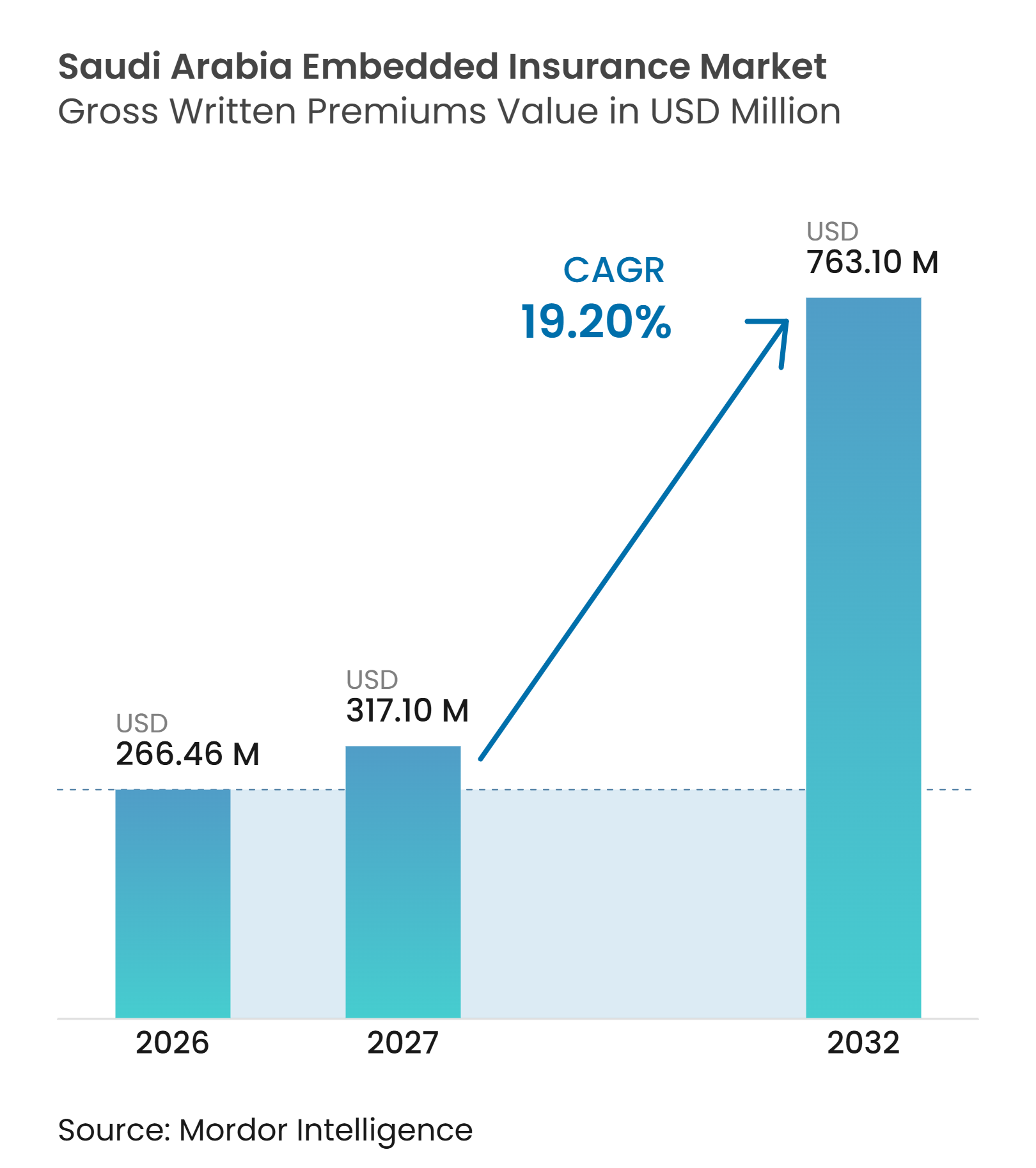
The Saudi Arabia Embedded Insurance Market size in terms of gross written premiums value is projected to be USD 266.46 million in 2026, USD 317.10 million in 2027, and reach USD 763.10 million by 2032, growing at a CAGR of 19.20% from 2027 to 2032.
The Saudi Arabia embedded insurance market is growing as insurance is offered during vehicle financing, retail purchases, travel bookings, and digital payments. Mandatory motor and health coverage supports recurring policy issuance. Digital channels also reduce customer-acquisition costs and enable providers to offer relevant coverage without redirecting customers. The Insurance Authority’s electronic services support system integration between regulated entities. This enables data exchange among platforms, insurers, payment providers, and customers with limited manual intervention. High smartphone use, e-commerce, online payments, and connected platforms expand the market for insurance embedded in purchases, lending, travel, and subscriptions.
Key Report Takeaways
- By insurance line, Motor and mobility captured 34.6% of the Saudi Arabia embedded insurance market share in 2026, while goods and device protection is projected to grow at a 23.3% CAGR through 2032.
- By embedding partner channel, physical retail and OEM points of sale held a 26.5% share in 2026, while banks, fintechs, and buy now, pay later checkout platforms are projected to grow at a 24.2% CAGR through 2032.
- By policyholder, personal and consumer policyholders captured an 82.3% share in 2026, while commercial and business policyholders are projected to grow at a 21.8% CAGR through 2032.
- By policy duration, annual and multi-year policies captured a 55.4% share in 2026, while short-term and activity-specific policies are projected to grow at a 22.3% CAGR through 2032.
- By integration model, API-integrated distribution captured a 45.2% share in 2026 and is projected to grow at a 24.6% CAGR through 2032.
Note: Market numbers in this report are based on Mordor Intelligence's proprietary estimation framework, which combines nine months of actuals with Q4 projections for base year 2026.
Market Trends and Insights
Drivers Impact Analysis of Saudi Arabia Embedded Insurance Market*
| Driver | ~% Impact on CAGR Forecast | Geographic Relevance | Impact Timeline |
|---|---|---|---|
| Expansion of Compulsory Motor and Health Insurance Coverage | +4.2% | National, with intensity in Riyadh, Jeddah, and Eastern Province | Medium term (2–4 years) |
| Vision 2030 Insurance-Sector Digitalisation and API-Based Distribution | +4.8% | National, early gains in Riyadh fintech hub | Medium term (2–4 years) |
| High Smartphone Penetration and Digital Insurance Purchasing Adoption | +2.9% | National, urban-led | Short term (≤ 2 years) |
| E-Commerce, Mobility, Travel and BNPL Ecosystems as Embedded Insurance Channels | +3.5% | National, with BNPL concentration in Riyadh and Jeddah e-commerce | Short term (≤ 2 years) |
| Hajj, Umrah and International Visitor Insurance Integration Across Travel Journeys | +1.8% | Makkah, Madinah, Jeddah; spill-over to all visa-processing touchpoints | Short term (≤ 2 years) |
| Giga-Project, Contractor, SME and Supply-Chain Risk Protection Demand | +1.5% | Eastern Province, NEOM corridor, Riyadh Metro cluster | Long term (≥ 4 years) |
| Source: Mordor Intelligence | |||
Expansion of Compulsory Motor and Health Insurance Coverage
Mandatory motor and health insurance provides a structural foundation for embedded insurance distribution in Saudi Arabia by linking coverage to vehicle ownership, employment, and other regulated activities. According to the Insurance Authority's Q1 2026 market report, motor insurance covered 11.2 million vehicles, while health insurance served 14.5 million beneficiaries[1]. The National Insurance Sector Strategy targets 16 million insured vehicles and 23 million health insurance beneficiaries by 2030, indicating scope for further expansion of insurance distribution through vehicle sales, leasing, employer onboarding, and other relevant customer journeys. These targets represent policy ambitions rather than guaranteed additions to the insured base, and the number of future vehicle purchases or financing transactions cannot be inferred directly from the gap between current coverage and the 2030 target. For embedded insurance providers, the opportunity lies in integrating compliant policy issuance and renewal into existing transactions, while maintaining appropriate insurer oversight and claims-service standards.
Vision 2030 Insurance-Sector Digitalisation and API-Based Distribution
Saudi Arabia's insurance-sector digitalization is creating a more accessible regulatory and operational environment for technology-enabled distribution. The Insurance Authority launched its TAMEEN electronic-services portal in February 2025 with 22 services related to licensing and approvals and added 15 services in December 2025[2]. The additional services included electronic sales, electronic integration, and processes relating to bancassurance agreements, demonstrating the regulator's move toward digitized sector administration and connectivity. In August 2026, the Authority also launched the first phase of its Innovation Lab and opened applications through its Regulatory Sandbox, providing a supervised environment for startups and innovators to test insurance products and services. Faster and more reliable connections can shorten implementation work for platforms that add insurance at checkout or within their existing service flow. The regulatory structure therefore makes technical readiness and operational compliance central requirements for prospective distribution partners.
E-Commerce, Mobility, Travel and BNPL Ecosystems as Embedded Insurance Channels
Digital commerce provides a broad channel base for the Saudi Arabia embedded insurance market because insurance can be placed near the transaction that creates the related risk. Saudi Arabia’s digital economy had more than 99% internet penetration, 99% smartphone penetration, and e-commerce gross merchandise value above USD 13 billion in 2025[3]. High smartphone use allows consumers to receive policy information and complete payment without leaving a retail, financing, or travel experience. Payment reliability is also relevant, as Wataniya Insurance reported an 80% improvement in successful payments after integrating Tabby, STC Pay, and Apple Pay. Mobility platforms, online retailers, travel providers, and buy now, pay later operators can use these links to attach cover where the customer already expects a rapid digital process. Their value lies in matching the policy to a specific purchase, service, trip, or financing arrangement.
Visitor, Giga-project, Small Business, and Supply-chain Protection Demand
Travel-related insurance gives the Saudi Arabia embedded insurance market a separate growth path because visitors encounter insurance during visa and booking steps. Hajj and Umrah journeys create repeat occasions for health and travel protection to be attached to a formal travel process. Project activity and commercial procurement also create insurance needs for contractors, employees, equipment, and supply chains. Small and medium-sized enterprises can encounter insurance through procurement platforms, employment systems, and financing tools rather than through a traditional broker relationship. The resulting products can be simpler to place when the platform already holds verified transaction details. This pattern broadens embedded distribution beyond retail policies and gives insurers access to commercial cases that are connected to a defined operating activity.
Restraints Impact Analysis of Saudi Arabia Embedded Insurance Market*
| Restraint | ~% Impact on CAGR Forecast | Geographic Relevance | Impact Timeline |
|---|---|---|---|
| Legacy Insurer Systems and Integration Costs Across Digital Distribution Platforms | −2.3% | National, with disproportionate effect on smaller regional carriers | Medium term (2–4 years) |
| Insurance Authority Approvals, Product Governance and Digital-Distribution Compliance | −1.9% | National; regulatory influence applies to all licensed entities | Short term (≤ 2 years) |
| Fragmented Identity, Health, Vehicle and Claims Data Across Ecosystems | −1.4% | National, with highest friction in multi-line SME and gig-worker products | Long term (≥ 4 years) |
| Low Voluntary Insurance Penetration, Price Sensitivity and Digital Claims Trust Barriers | −1.2% | National, strongest in non-compulsory lines in Tier-2 cities | Medium term (2–4 years) |
| Source: Mordor Intelligence | |||
Legacy Systems and Integration Costs
Legacy systems can constrain the Saudi Arabia embedded insurance market, as embedded transactions require rapid pricing, underwriting, payment processing, and policy issuance. Older carrier platforms often rely on processes designed for manual administration rather than real-time digital requests. Platform partners may hesitate to test policy attachment when service reliability varies among underwriting counterparties. This constraint is particularly significant for low-ticket products, where even a brief delay can lead customers to abandon a purchase. Modernization can strengthen integration between carriers and distribution partners; however, it requires technology investments and careful implementation. This constraint remains relevant, as platform-native intermediaries continue to depend on carrier systems for policy issuance and servicing.
Product Governance, Data, and Digital Distribution Compliance
Regulatory requirements protect customers but can lengthen the time required to design and approve embedded insurance products. The Insurance Authority has stated that offering or selling extended warranty products outside licensed insurance companies constitutes a violation. Consequently, retail and automotive partnerships must establish appropriate licensing, product design, and clear accountability for policy issuance. The National Cybersecurity Authority’s Essential Cybersecurity Controls also impose requirements that digital participants must meet when handling regulated systems and information. Fragmented identity, health, vehicle, and claims records can create additional friction when insurers need to validate customers or risks in real time. These requirements may favor organizations with established compliance capabilities, secure technology infrastructure, and experience operating within regulated insurance processes.
*Our forecasts treat driver/restraint impacts as directional, not additive. The impact forecasts reflect baseline growth, mix effects, and variable interactions.
Saudi Arabia Embedded Insurance Market Segment Analysis
By Insurance Line:
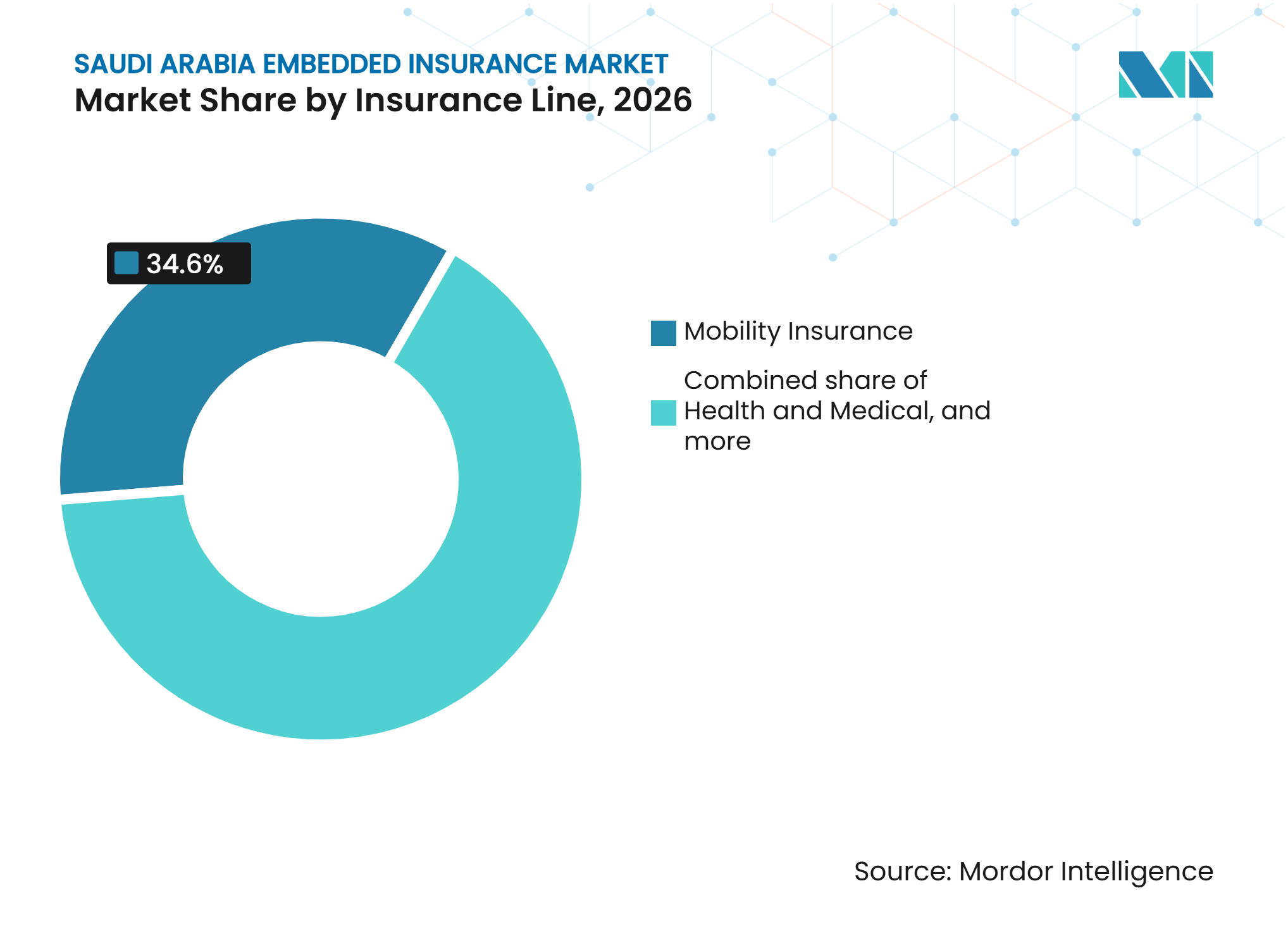
Compulsory Cover Supports Scale While Device Protection Leads GrowthMotor and mobility is projected to hold a 34.6% share of the Saudi Arabia embedded insurance market in 2026, making it the largest insurance line. This position reflects the compulsory nature of motor coverage and the multiple points at which insurers can embed coverage into vehicle financing, dealership sales, registration, leasing, and related transactions. Health and medical insurance also plays a significant role, as coverage is linked to employment-related processes. Travel and assistance benefits from the connection between insurance, visas, and visitor journeys. Protection and savings products remain less developed in this distribution model because their purchase process is less easily linked to a single transaction.
Goods and device protection is projected to grow at a CAGR of 23.3% through 2032, making it the fastest-growing insurance line. Samsung Care+ program launched in Saudi Arabia in February 2026 through a partnership between Chubb Arabia and Samsung Saudi Electronics[4]. The offer places coverage at the point of device purchase and provides a monthly subscription option rather than only an annual premium, linking protection payments to device ownership and usage. This format aligns with product replacement, repair, and service needs that arise at the time of purchase. Therefore, the Saudi Arabia embedded insurance market is expected to leverage device sales as a practical channel for low-friction protection products.


By Embedding Partner Channel:
Financial Platforms Have the Highest Growth OutlookPhysical retail and OEM points of sale are expected to hold a 26.5% share in 2026, representing the largest position among embedded partner channels. Retail outlets and original equipment manufacturer (OEM) channels are well positioned to bundle devices, warranties, and automotive protection products at the point of purchase. Their role is strongest when product details, payment information, customer contact information, and the relevant point of sale are established within the same purchase journey. E-commerce marketplaces, travel platforms, mobility providers, and telecommunications companies create additional contexts in which insurance coverage may be relevant. These channels allow insurers to engage customers before they begin a separate search for insurance.
Banks, financial technology companies, and buy now, pay later (BNPL) checkout platforms are projected to grow at a CAGR of 24.2% through 2032. This growth reflects the direct link between insurance and loans, mortgages, installment payments, and lease financing. These providers can offer insurance when customers commit to financing an asset or service, increasing policy relevance and directly linking coverage to the customer’s financial obligation. The Saudi Arabia embedded insurance market size for this channel is supported by broader digital payment adoption and reliable online payment options. The channel may gain further importance as lenders and payment providers develop insurance partnerships that integrate with their existing customer journeys.
By Policyholder:
Consumer Policies Retain Scale While Commercial Demand RisesPersonal and consumer policyholders are projected to account for an 82.3% share in 2026, reflecting the importance of motor, health, device, and travel coverage. These policies serve a large number of individual customers and can be offered through standardized digital processes that reduce the effort required to obtain basic, transaction-linked coverage. Mandatory motor and health insurance strengthen the consumer base, as policy issuance is often linked to a required activity. Visa-related travel insurance also brings individual policyholders into the channel. The Saudi Arabia embedded insurance market remains consumer-led, as consumer transactions occur frequently across retail, transportation, payments, and travel.
Commercial and business policyholders are projected to grow at a CAGR of 21.8% through 2032. Demand is driven by small-business digitization, workforce requirements, contractor activity, and supply chain transactions. Digital procurement systems can offer relevant coverage for equipment, liability, personnel, contractors, and commercial activities within a transaction journey where the business purpose is already known. This approach creates a route to commercial insurance that does not rely exclusively on traditional broker outreach. The Saudi Arabia embedded insurance industry has opportunities to expand where business platforms already manage defined commercial processes.
By Policy Duration:
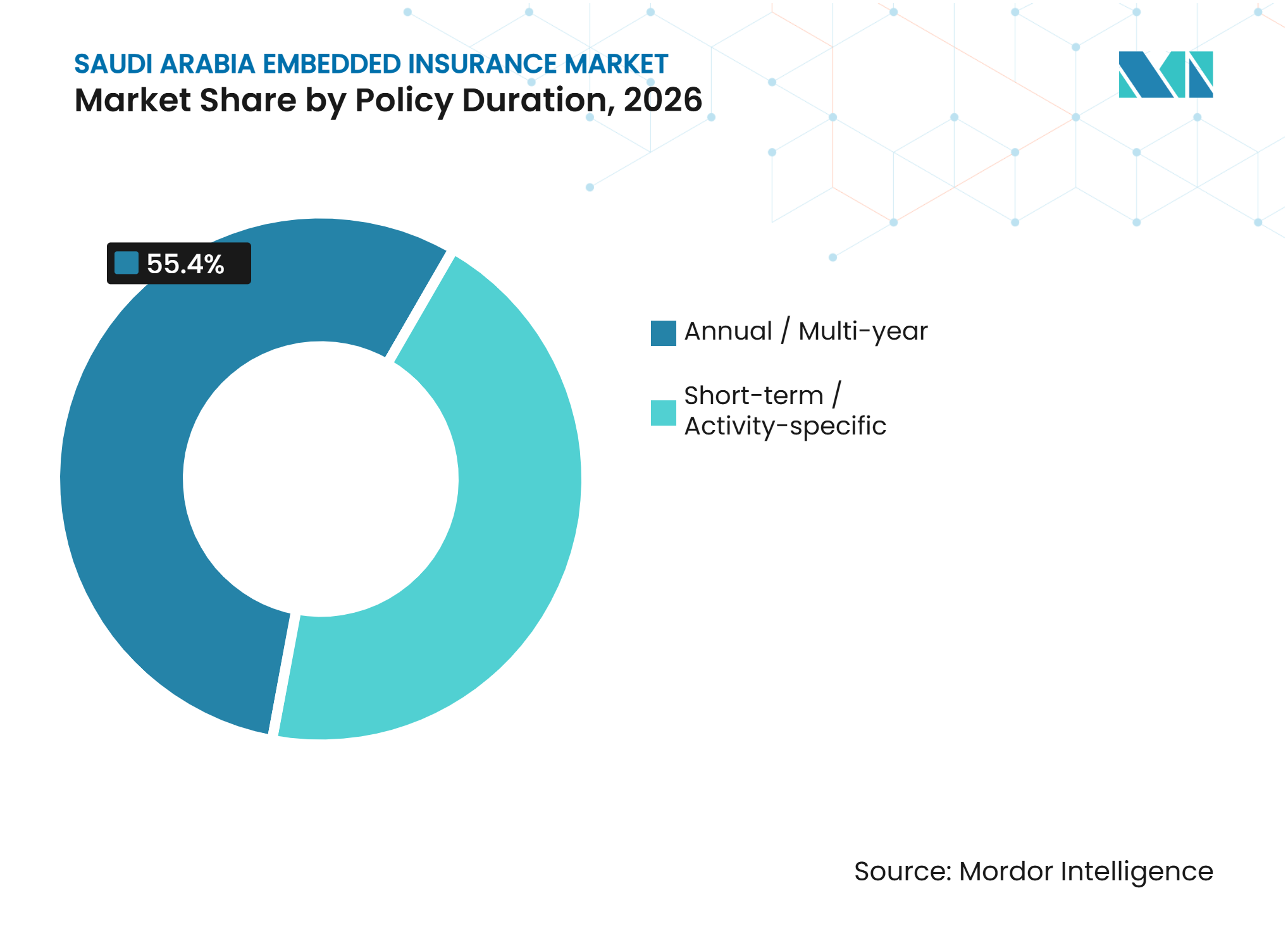
Annual Policies Lead While Short-Term Cover Gains GroundAnnual and multi-year policies accounted for a 55.4% share in 2026, making them the largest policy-duration category. Motor and employer-linked health policies typically follow annual regulatory or contractual cycles, giving annual coverage a stable position in embedded distribution. These policies also enable insurers to link renewals with existing financing, employment, customer management, and asset-related relationships, supporting continuity when the underlying arrangement is renewed. Longer policy periods remain important when coverage aligns with an ongoing asset or employment obligation.
Short-term and activity-specific policies are projected to expand at a 22.3% CAGR through 2032. These products can cover a trip, device subscription, temporary activity, or other limited exposure. Lower premiums and shorter coverage periods can make these offerings easier to present at the point of need. This model requires efficient pricing, immediate policy issuance, reliable payment collection, and a process that presents the policy without disrupting the related customer activity. It also requires reinsurance capacity to support small, recurring risks without making the product uneconomical.

By Integration Model:
API-integrated Distribution Leads on Both Scale and GrowthAPI-integrated distribution accounted for 45.2% of the Saudi Arabia embedded insurance market in 2026 and is projected to grow at a CAGR of 24.6% through 2032. Its leading position is supported by the increasing integration of insurance products into digital platforms operated by banks, fintech companies, e-commerce providers, travel platforms, and automotive businesses. The growing adoption of digital payments, online purchases, and real-time service transactions is encouraging platform operators to embed insurance offers directly into existing customer journeys. API-based integration enables automated customer-data exchange, eligibility verification, premium calculation, policy issuance, and claims notifications, reducing manual intervention and improving transaction efficiency. The Insurance Authority's TAMEEN portal supports system-to-system API integrations between sector entities, reinforcing the regulatory and technological infrastructure for connected insurance distribution.
White-label and affinity distribution also benefit from partnerships between insurers and established customer-facing businesses, particularly banks, retailers, telecommunications providers, and employers seeking to offer insurance under their own brands. Growth in embedded financial services and demand for customized insurance propositions support these arrangements, particularly where partners want to leverage existing customer relationships without developing underwriting capabilities. Point-of-sale staff-assisted distribution remains relevant in automotive dealerships, insurance intermediaries, and physical retail outlets, where customers may require product explanations, documentation assistance, and support during policy selection. However, the increasing preference for seamless digital transactions and automated policy issuance strengthens the scalability of API-integrated distribution, supporting its continued leadership in the Saudi Arabia embedded insurance market.
Geography Analysis
Riyadh is the largest demand center for the Saudi Arabia embedded insurance market because it combines major insurers, banks, regulators, and technology companies. The city is home to the Insurance Authority and key financial institutions that can support insurance links in lending, payment, vehicle finance, and other digital customer journeys. Its large, digitally active population also supports demand for motor, health, retail, travel, and financing-related cover that can be integrated into everyday transactions. The concentration of financial technology businesses gives Riyadh a leading role in API development and platform partnerships. Saudi Arabia’s insurance penetration reached 3.1% of non-oil GDP in the first quarter of 2026, underscoring the wider role of insurance in the national economy.
Jeddah, Makkah, and Madinah have a distinct demand profile that is shaped by visitor, pilgrimage, and travel activity. Travel-related cover can be attached to visa and booking journeys, which creates recurring opportunities for policy issuance across travel arrangements that already require identity, payment, and itinerary information. Jeddah also supports trade-related activity through its port economy and related commercial transactions, where the movement of goods can create a defined requirement for protection. These conditions can create demand for cargo, travel, and other protection linked to specific movements of people and goods. The Saudi Arabia embedded insurance market size in these locations is therefore shaped by transaction flows that differ from the employment and financial services concentration in Riyadh.
The Eastern Province supports industrial employment, contractor activity, and large supply-chain relationships. Project and workforce needs can create demand for contractor, liability, employee, equipment, and related protection that is connected to a defined commercial or construction activity. NEOM, ROSHN, and other large developments extend the opportunity for insurance that is linked to procurement and project delivery. Smaller cities such as Dammam, Abha, and Tabuk can benefit as digital distribution reduces reliance on local intermediaries. National rules and online channels allow customers outside the largest cities to access insurance through the same purchase, travel, employment, financing, and service journeys available in larger urban centers.
Competitive Landscape
Market Concentration
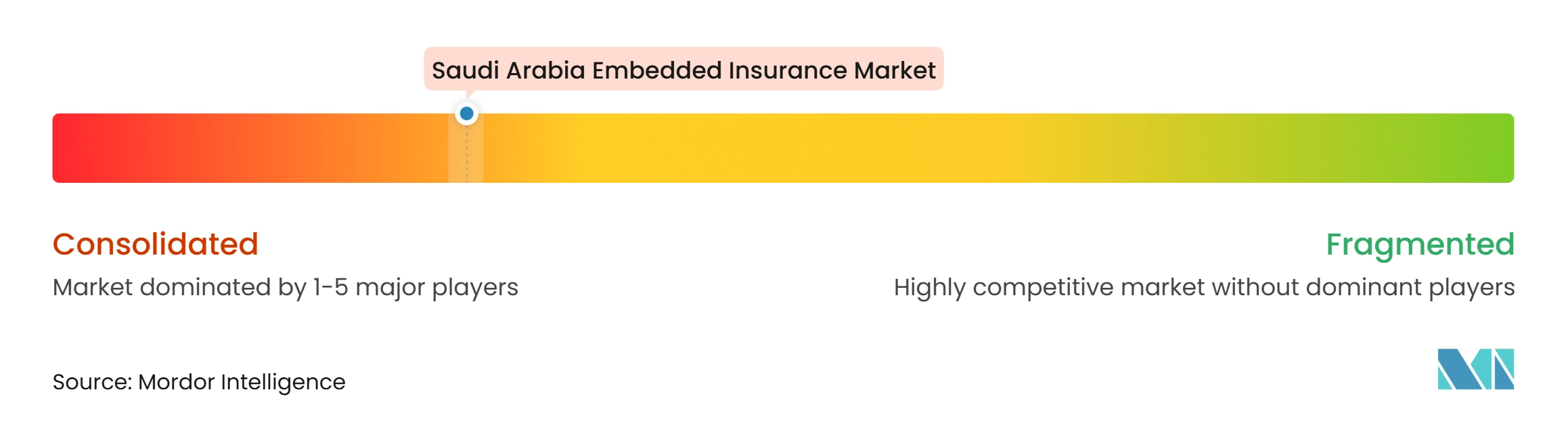
The Saudi Arabia embedded insurance market is consolidated in established digital insurance brokerage and vehicle-leasing technology, while dedicated API-based embedded distribution remains an emerging competitive segment. Rasan Information Technology, through Tameeni and Treza, has an established position in digital insurance aggregation and leasing-related policy distribution. Other digital platforms, including Yasmina and Shory, compete through online insurance access, technology-enabled distribution, and partnerships. Yasmina specifically positions itself as an Insurance Authority-approved embedded insurance platform connecting digital businesses with licensed insurers through a single API. Competition increasingly depends on regulatory compliance, insurer relationships, integration reliability, product breadth, and the ability to place insurance within existing customer journeys.
Rasan reported FY 2025 revenue of SAR 653 million (USD 174.1 million), up 82% year on year, and gross written premiums of SAR 8.5 billion (USD 2.27 billion), up 30%. In the first half of 2026, revenue increased 111% year on year to SAR 517.5 million (USD 138 million), reflecting growth in existing products and contributions from newly launched offerings. Its Tameeni and Treza platforms connect customers, insurers, banks, and vehicle-leasing companies, demonstrating the commercial value of established digital distribution infrastructure. In device protection, Samsung's Saudi operations offer Samsung Care+ Monthly, enabling eligible customers to purchase subscription-based protection alongside device purchases. These examples illustrate how established platforms and point-of-sale partnerships can strengthen distribution, although they do not establish the market share of embedded insurance as a separate market.
Opportunities remain in commercial small-business cover, workforce-related protection, supplementary travel insurance, and insurance embedded in retail and mobility transactions. Insurers with dependable policy-issuance systems, competitive underwriting, efficient claims handling, and secure integration capabilities are well placed to support distribution partners. Technology partnerships also reinforce the importance of operational infrastructure: in February 2025, ZainTECH partnered with Diamond Insurance Broker and SHAHIN Platform to strengthen cloud infrastructure, cybersecurity, analytics, and digital claims processing in Saudi insurance brokerage. These developments indicate that competition extends beyond customer acquisition to the technology and service capabilities required to support digital distribution. Providers that cannot meet regulatory, security, and operational requirements may struggle to secure and retain platform partnerships.
Saudi Arabia Embedded Insurance Industry Leaders
-
Rasan Information Technology Company
-
Yasmina
-
Tameeni
-
Tree Digital Insurance Agency
-
Gonsure
- *Disclaimer: Major Players sorted in no particular order
Saudi Arabia Embedded Insurance Market Companies Covered in this Report
- Yasmina
- Rasan Information Technology Company (Tameeni)
- Tawuniya
- Al Rajhi Takaful
- Tree Digital Insurance Agency
- Shory
- Rommana
- Gonsure
- BCare
- Tameen Link
- Walaa
- Bupa Arabia
- MedGulf
Recent Industry Developments in Saudi Arabia Embedded Insurance Market
- February 2026: Samsung Care+ Monthly subscription launched in Saudi Arabia through a Chubb Arabia and Samsung Saudi Electronics partnership, embedding device protection at the point of purchase on the Samsung eStore and ShopApp with coverage for up to 36 months, unlimited repair claims, and a door-to-door service model.
- February 2025: ZainTECH partnered with Diamond Policy and SHAHIN Platform at LEAP 2025 to integrate cloud computing, data analytics, and cybersecurity capabilities into Saudi insurance brokerage operations, enhancing digital claims processing and infrastructure resilience.
- January 2025: Najm and the National Insurance Brokerage signed a partnership agreement at Money20/20 Middle East to develop digital insurance solutions, integrate vehicle data, and accelerate automotive insurance procedures.
Saudi Arabia Embedded Insurance Market Report Scope
Segmentation Overview
| Motor and Mobility |
| Health and Medical |
| Goods and Device Protection |
| Travel and Assistance |
| Protection and Savings |
| Other Insurance Covers |
| E-commerce Marketplaces and Specialist Online Retailers |
| Physical Retail and OEM Points of Sale |
| Travel, Ticketing, and Mobility Platforms |
| Banks, Fintechs, and Buy Now, Pay Later (BNPL) Checkout Platforms |
| Telecommunications and Utility Providers |
| Other Non-Insurance Partners |
| Personal/Consumer |
| Commercial/Business |
| Short-term / Activity-specific |
| Annual / Multi-year |
| API-integrated |
| White-label / Affinity |
| Point-of-sale staff-assisted |
| By Insurance Line | Motor and Mobility |
| Health and Medical | |
| Goods and Device Protection | |
| Travel and Assistance | |
| Protection and Savings | |
| Other Insurance Covers | |
| By Embedding Partner Channel | E-commerce Marketplaces and Specialist Online Retailers |
| Physical Retail and OEM Points of Sale | |
| Travel, Ticketing, and Mobility Platforms | |
| Banks, Fintechs, and Buy Now, Pay Later (BNPL) Checkout Platforms | |
| Telecommunications and Utility Providers | |
| Other Non-Insurance Partners | |
| By Policyholder | Personal/Consumer |
| Commercial/Business | |
| By Policy Duration | Short-term / Activity-specific |
| Annual / Multi-year | |
| By Integration Model | API-integrated |
| White-label / Affinity | |
| Point-of-sale staff-assisted |
Key Questions Answered in the Report
What is the projected value of embedded insurance in Saudi Arabia by 2032?
The Saudi Arabia embedded insurance market is projected to reach USD 763.1 million by 2032, expanding at a 19.2% CAGR from 2027.
Which insurance line has the largest share in Saudi Arabia?
Motor and Mobility held the largest share at 34.6% in 2026, supported by compulsory cover and vehicle-related transactions.
Which segment has the highest growth forecast through 2032?
API-integrated distribution has the highest projected growth at 24.6% CAGR through 2032.
Why are banks and financial technology companies important for embedded insurance?
They can present cover during lending, installment payments, mortgages, and vehicle financing, when the customer is already completing a related transaction.
What are the main barriers to wider adoption of embedded insurance?
Legacy carrier systems, product governance requirements, cybersecurity obligations, and fragmented data can delay integrations and policy issuance.
Which Saudi cities are most relevant for embedded insurance demand?
Riyadh leads due to its financial and technology concentration, while Jeddah, Makkah, Madinah, and the Eastern Province support travel, trade, workforce, and project-related demand. Smaller cities can also benefit when online distribution removes the need for a local intermediary.