
Market Overview
| Study Period | 2021 - 2031 |
|---|---|
| Forecast Data Period | 2026 - 2031 |
| Base Year Market Size (2025) | USD 4.72 Billion |
| Market Size (2026) | USD 4.94 Billion |
| Market Size (2031) | USD 6.23 Billion |
| Growth Rate (2026 - 2031) | 4.74 % |
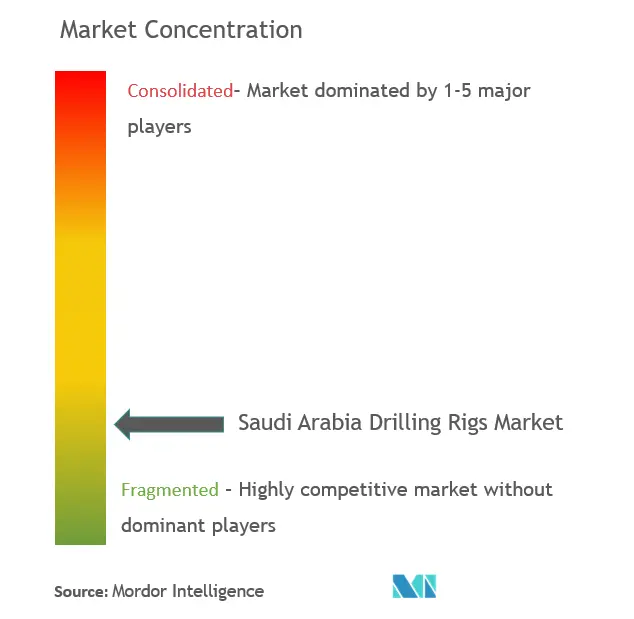
| Market Concentration | Medium |
Major Players *Disclaimer: Major Players sorted in no particular order Image © Mordor Intelligence. Reuse requires attribution under CC BY 4.0. | |
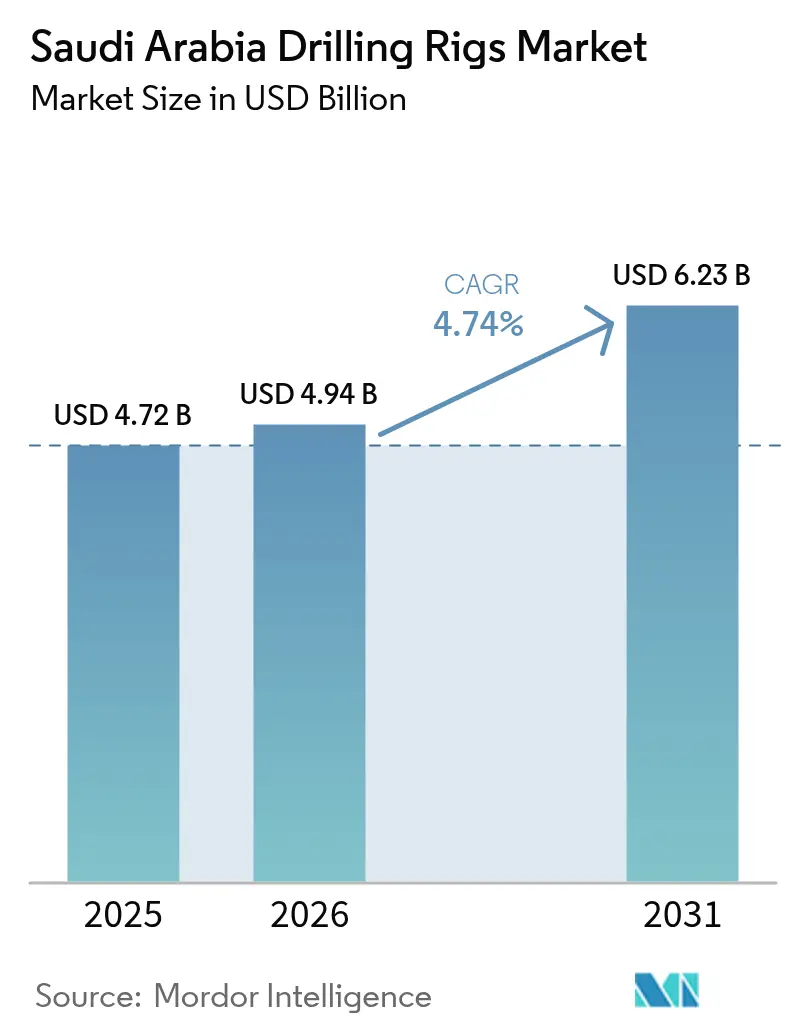
Saudi Arabia Drilling Rigs Market Analysis by Mordor Intelligence
The Saudi Arabia Drilling Rigs Market size is expected to grow from USD 4.72 billion in 2025 to USD 4.94 billion in 2026 and is forecast to reach USD 6.23 billion by 2031 at 4.74% CAGR over 2026-2031.
The Saudi Arabian drilling rigs industry continues to demonstrate robust activity across both onshore and offshore operations, supported by the kingdom's strategic focus on maintaining its position as a global energy leader. The sector has witnessed significant technological advancements, particularly in rig modernization, with companies implementing sophisticated control systems and automated drilling technologies. A notable example is ARO Drilling's deployment of IFS Applications software across their fleet of 16 drilling rigs in 2023, enhancing operational efficiency through improved asset lifecycle management and business intelligence capabilities.
The industry landscape is characterized by a diverse mix of rig specifications and capabilities, reflecting the complex requirements of Saudi Arabia's varied oil and gas fields. As of 2024, approximately 40% of the country's drilling rig fleet consists of high-speed 2,000 hp-3,000 hp rigs, demonstrating the industry's emphasis on high-performance equipment. This technical composition enables operators to effectively address the challenging drilling conditions encountered in both conventional and unconventional resources, particularly in the kingdom's deep and ultra-deep formations.
Saudi Arabia's drilling sector has witnessed substantial capital investments and strategic developments, particularly in offshore operations. The industry's commitment to expansion is exemplified by International Maritime Industries' (IMI) recent contracts for the construction of two LETOURNEAU Super 116E Class offshore jack-up drilling rigs, representing a significant advancement in domestic manufacturing capabilities. These developments are complemented by the ongoing operations at the Safaniya oilfield, the world's largest offshore conventional oil field, which maintains a production capacity of 1-1.5 million barrels of heavy crude oil per day.
The market is experiencing a fundamental shift in rig technology and operational methodologies, with a growing emphasis on multi-well pad drilling capabilities and enhanced efficiency measures. Modern rigs are being equipped with advanced power supply mechanisms, though the majority of onshore rigs in Saudi Arabia continue to utilize SCR (Silicon Controlled Rectifier) systems, which are particularly well-suited to the region's hot and dry climate. This technological evolution is further supported by the integration of digital solutions, as evidenced by the increasing adoption of automated drilling systems and real-time monitoring capabilities across the kingdom's rig fleet. The role of drilling contractors in Saudi Arabia is pivotal in driving these advancements, ensuring that the latest drilling equipment is utilized to optimize operations.
Note: Market size and forecast figures in this report are generated using Mordor Intelligence’s proprietary estimation framework, updated with the latest available data and insights as of 2026.
Saudi Arabia Drilling Rigs Market Trends and Insights
Growing Onshore Exploration and Production Activities
The Saudi Arabian drilling rigs market is primarily driven by extensive onshore exploration and production activities across the kingdom's vast oil and gas fields. The country's flagship asset, the Ghawar field, which is the world's largest conventional onshore oil field, continues to be a major driver for demand for oil rigs in Saudi Arabia as it maintains its impressive production capacity of 3.8 million barrels per day. This sustained production level, expected to continue beyond 2050, necessitates continuous drilling operations and well maintenance activities, creating a steady demand for drilling rigs. The field's longevity and production requirements have made it a cornerstone of Saudi Arabia's drilling operations since 1951, demonstrating the long-term sustainability of onshore drilling activities.
The robust demand for onshore drilling rigs is further evidenced by the significant presence of land rigs in Saudi Arabia. According to Baker Hughes statistics from November 2023, Saudi Arabia maintained approximately 70 land rigs, positioning it as one of the leading countries in the Middle Eastern region for land-based drilling operations. The market is particularly driven by the increasing adoption of mobile drilling rigs, which offer superior operational flexibility and cost-effectiveness compared to conventional rigs. These mobile units, capable of drilling up to 30,000 feet, are preferred by operators due to their ease of relocation between exploration sites, resulting in reduced logistical complications and financial overhead.
Understand The Key Trends Shaping This Market
Download PDF
Increasing Natural Gas Demand for Power Generation
The transformation of Saudi Arabia's power generation sector towards cleaner energy sources has emerged as a significant driver for the Saudi oil rigs market. In 2022, natural gas dominated the country's electricity generation mix, contributing 270 TWh out of the total 401 TWh of electricity generated, highlighting the critical role of gas in meeting the kingdom's power needs. This substantial reliance on natural gas for power generation has created a strong impetus for increased gas exploration and production activities, directly driving the demand for specialized drilling rigs capable of accessing deep gas reservoirs.
The market is further propelled by Saudi Aramco's ambitious plans to boost its gas production capacity by 50% by 2030, primarily through the development of the landmark Jafurah project. This USD 100 billion-plus initiative aims to achieve a production capacity of 2 billion cubic feet per day of gas by 2030, representing one of the largest gas development projects in the region. The project's significance is underscored by the interest from major international players, as evidenced by the May 2023 discussions between China's Sinopec, French supermajor TotalEnergies, and Saudi Aramco regarding potential investments in the Jafurah unconventional gas development. This large-scale project, combined with Saudi Aramco's plans to explore blue hydrogen and liquefied natural gas production from the same field, is expected to sustain long-term demand for advanced drilling rigs capable of handling unconventional gas extraction.
Segment Analysis
Onshore Segment in Saudi Arabia Drilling Rigs Market
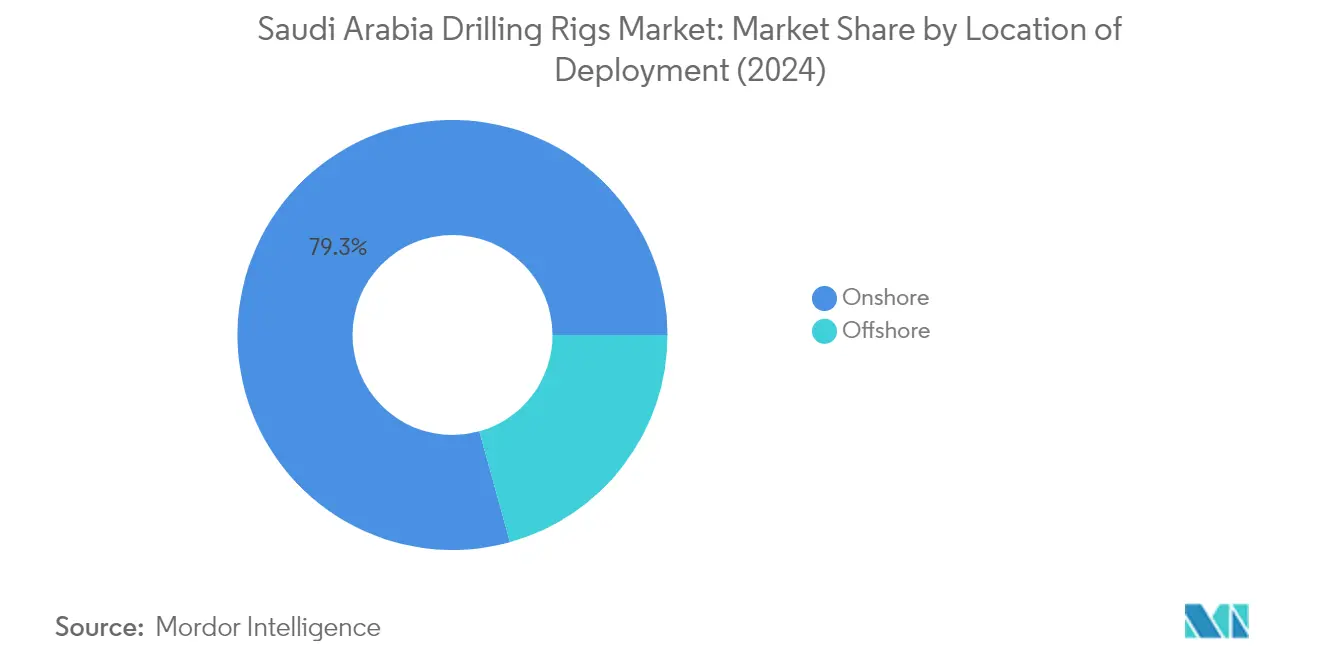
The onshore segment dominates the Saudi Arabia drilling rigs market, accounting for approximately 78.42% of the total market share in 2025. This significant market position is primarily driven by Saudi Arabia's extensive onshore oil and gas operations, particularly in the Ghawar field, which remains the world's largest conventional onshore oil field. The country's onshore drilling operations are characterized by the deployment of high-speed rigs, with approximately 40% being 2,000 HP-3,000 HP rigs, while 25% are 1,500 HP-2,000 HP rigs. The segment's strength is further reinforced by Saudi Aramco's continuous investments in expanding crude production capacity from 12 million b/d to 13 million b/d, along with the discovery of new unconventional resources. The onshore segment's dominance is also reflected in the operational statistics, with the kingdom maintaining around 51 active land rigs in Saudi Arabia compared to 9 offshore rigs, demonstrating the sector's robust infrastructure and operational capacity.
Offshore Segment in Saudi Arabia Drilling Rigs Market
The offshore segment represents a vital component of Saudi Arabia's drilling rigs market, particularly with its strategic offshore assets like the Safaniya oilfield, which stands as the world's largest offshore conventional oil field. This segment is characterized by its sophisticated floating structure operations, with a particular emphasis on jack-up rigs for smaller, shallower offshore deposits. The sector has witnessed significant technological advancement, exemplified by companies like ARO Drilling implementing advanced IFS Applications software across their fleet of offshore rigs in Saudi Arabia, enhancing operational efficiency and asset management capabilities. The segment's development is further supported by strategic partnerships and joint ventures with Saudi Aramco, which has been instrumental in modernizing offshore drilling capabilities and maintaining operational excellence in the region's challenging marine environments. Leading oil rig companies in Saudi Arabia, including ARO Drilling, continue to drive innovation and efficiency in this segment.
Regulatory Landscape
Saudi Arabia’s upstream drilling activity is primarily governed by the Ministry of Energy (MOE), which oversees petroleum and energy supply activities and administers licensing for activities connected to natural gas, its liquids, hydrogen, and petroleum products. The regulatory framework is complemented by economy-wide energy supply and petroleum/petrochemical product laws updated in 2025, which reinforce formal licensing and compliance obligations for operating entities and contractors in the Kingdom.
Equipment and operational compliance also sit within national standards. The Saudi Standards, Metrology and Quality Organization (SASO) sets technical regulations and aligns applicable standards with international frameworks, and Saudi Arabia is an ISO member country. Alongside this, Saudi Aramco’s In-Kingdom Total Value Add (IKTVA) program operates as a commercial compliance gate for suppliers and contractors serving Aramco, linking drilling-rig procurement, maintenance, and service contracting to localization requirements. The program reported about 70% supply-chain localization in early 2026 and is connected with industrial hubs such as Jazan Economic City and the King Salman International Complex for Maritime Industries & Services.
Value Chain Analysis
The value chain begins with rig design, capital equipment, and critical inputs, including steel and specialty alloys, power systems, hydraulics, and drilling control electronics. It then moves through rig construction or refurbishment, certification or acceptance, and mobilization into field operations. In-country assembly and industrial capability are being reinforced through localization pathways tied to Saudi Aramco programs and industrial nodes, while imported components remain important for high-spec systems, which can introduce exposure to lead-time and customs or logistics variability.
Downstream of manufacturing and sourcing, the operational chain is driven by Saudi Aramco tendering and contracting, followed by drilling contractors, including Arabian Drilling Company, ADES International Holding, ARO Drilling, and Shelf Drilling, executing day-to-day rig operations. Service providers such as directional drilling, cementing, stimulation, bits, and digital drilling systems support these activities, with local maintenance bases in the Eastern Province, notably around Dammam and Al-Khobar. On the project delivery side, Aramco’s April 2026 move to establish Long Term Agreement pools for project management consultancy and brownfield EPC services improves integration across planning, brownfield modifications, and sustainment work that affects rig uptime and redeployment cycles. The chain also reflects periodic rig suspension and reactivation dynamics, including the 2024 suspension of 22 jack-up rigs across multiple contractors after Aramco’s sustained capacity direction, which cascaded into maintenance scheduling, stacking logistics, and later reactivation work.
Competitive Landscape
Top Companies in Saudi Arabia Drilling Rigs Market
The Saudi Arabian drilling rigs market features prominent players like ARO Drilling, Saipem S.p.A., Sinopec Zhongyuan Petroleum Engineering, Arabian Drilling Company, ADES International Holding, and Shelf Drilling. These companies demonstrate a strong market presence through continuous technological advancements in drilling capabilities, particularly in deep and ultra-deep well operations. The industry witnesses ongoing investment in fleet modernization and expansion, with companies developing specialized rigs for challenging environments and high-pressure conditions. Strategic partnerships and joint ventures, especially with Saudi Aramco, have become crucial for market penetration and sustained growth. Companies are increasingly focusing on localizing their operations in alignment with Saudi Vision 2030, while simultaneously expanding their service portfolios to include integrated drilling solutions and specialized well services.
Market Dominated by Strategic Joint Ventures
The Saudi Arabian drilling rigs market exhibits a unique structure characterized by strong local-international partnerships and joint ventures. Saudi Aramco, as the state-owned oil giant, plays a pivotal role in shaping market dynamics through its In-Kingdom Total Value Add (IKTVA) program, which encourages foreign entities to establish local manufacturing and research capabilities. The market demonstrates moderate consolidation, with major players operating through strategic alliances to combine international expertise with local market knowledge. Joint ventures like ARO Drilling, formed between Saudi Aramco and international partners, exemplify this trend and set precedents for market entry and expansion.
Recent market activities highlight a trend toward restructuring and financial reorganization among key players, particularly in response to market challenges. Companies are pursuing strategic acquisitions and partnerships to strengthen their market position and expand their operational capabilities. The industry has witnessed several significant mergers and acquisitions, with companies like ADES International Holding and Arabian Drilling Company actively expanding their fleet size and geographical presence through strategic purchases and collaborations. These consolidation activities are reshaping the competitive landscape while ensuring operational efficiency and market stability.
Innovation and Localization Drive Future Success
Success in the Saudi Arabian drilling rigs market increasingly depends on companies' ability to align with national development goals while maintaining technological leadership. Incumbent players must focus on developing advanced drilling technologies, particularly for challenging environments and deep-water operations, while simultaneously investing in local manufacturing and training facilities. The market demands continuous innovation in areas such as automated drilling systems, high-temperature resistant tools, and intelligent well monitoring capabilities. Companies must also demonstrate a strong commitment to environmental sustainability and safety standards while maintaining cost competitiveness through operational efficiency.
For new entrants and growing players, success hinges on developing strong relationships with Saudi Aramco and other key stakeholders while offering differentiated services and technologies. The market presents significant barriers to entry, primarily due to high capital requirements and the need for established relationships with key clients. Future growth opportunities lie in specializing in niche segments such as ultra-deep drilling or developing innovative solutions for challenging geological formations. Companies must also navigate regulatory requirements while building local content and capabilities in alignment with Saudi Vision 2030, making strategic partnerships and local investment crucial for long-term success.
Saudi Arabia Drilling Rigs Industry Leaders
ADES International Holding PLC
Arabian Drilling Company
Shelf Drilling Holdings, Ltd.
ARO Drilling
Saipem S.p.A.
- *Disclaimer: Major Players sorted in no particular order


Market Opportunities and Future Outlook
Unconventional gas development is emerging as a key demand anchor for high-intensity onshore drilling and related rig capability upgrades, with the Jafurah program central to this shift. There is also visible whitespace in integrated well delivery and performance-linked packages that combine drilling with completion and stimulation execution, supported by Halliburton’s multi-year award at Jafurah. That award includes deployment of OCTIV Auto Frac and Sensori monitoring platforms, alongside the operational need for walking rigs and advanced bits in abrasive desert formations.
On the supply side, opportunities concentrate around fleet renewal, reactivation services, and premium offshore jack-up availability aligned to long-duration programs. SANAD (the Nabors/Aramco joint venture) deploying its 15th newbuild land rig in Q1 2026, together with additional newbuilds scheduled within 2026, indicates continued absorption of modern land rigs and related spares, training, and digital systems. Offshore, contractor actions such as ADES agreeing to acquire five jack-up rigs from Saipem (Saudi Arabian Saipem) and the return-to-work activity for previously suspended offshore units point to an active market for rig upgrades, life-extension work, and localized maintenance support under Aramco-facing contracting conditions, including IKTVA-linked in-Kingdom sourcing and fabrication pathways.
Recent Industry Developments
- June 2026: ADES Holding Company entered into a binding agreement to acquire five jack-up rigs from Saipem (Saudi Arabian Saipem). The transaction expands ADES’s premium jack-up footprint in the Kingdom and supports contractor-led fleet repositioning toward longer-duration Saudi offshore programs.
- January 2026: Arabian Drilling Company secured three land rig contract extensions with Saudi Aramco totaling SAR 1.4 billion, including one rig that had been suspended and is scheduled to resume operations during 2026. The extensions improve backlog visibility and keep a larger share of the land fleet under long-term utilization frameworks tied to Aramco’s drilling program.
- May 2024: Saudi Aramco suspended 22 offshore jack-up rigs across eight contractors following its direction to cap sustained production capacity at 12 million barrels per day. The suspensions affected near-term offshore utilization, triggered stacking and reactivation work scopes, and influenced contractor strategies around asset mix and contract resilience.


Research Methodology Framework and Report Scope
Market Definition and Coverage
For this study, the market covers revenue linked to drilling rig systems used in Saudi Arabia to drill oil and gas wells, including major rig packages and supporting equipment across onshore and offshore deployment.
Scope exclusions: We exclude the offshore vessel or platform itself and count only the drilling rig and its associated components.
Segmentation Overview
- Location of Deployment
- Onshore
Data Sources, Market Sizing, and Validation
Desk Research
Desk work started by mapping Saudi drilling activity to a simple demand picture, so our sizing stays tied to observable upstream signals. We used public sources such as OPEC publications, the International Energy Agency, the U.S. Energy Information Administration, and the World Bank for production, capacity, and macro context that influences drilling spend.
We also reviewed official Saudi energy policy updates and government communications, alongside company annual reports, investor presentations, and reputable energy press coverage to understand contracting cycles and equipment spending patterns. When needed, paid subscriptions for company financials and news intelligence, patent databases, and global contracts and tenders were used to cross-check project timing and procurement signals. These examples are illustrative only, and many other sources were also referred to for data collection, validation, and research clarification.
Primary Interviews and Surveys
Primary work was used to pressure test what we saw in desk findings, especially around near term rig demand, offshore activity ramp ups, and how day-rate movements translate into billed revenue. We spoke with a mix of rig operators, drilling contractors, equipment suppliers, and industry advisers, and then we re-checked assumptions on utilization, rig mix, and typical contract terms so the model stays practical for Saudi conditions.
Distribution of primary research fieldwork respondents
| Company type | Respondent position |
|---|---|
| Top tier: 37% | CXOs: 14% |
| Mid tier: 46% | Functional/Unit leaders: 37% |
| Smaller Players: 17% | Managers: 49% |
Market-Sizing & Forecasting
Sizing was built using a top-down and bottom-up model structure, where Saudi drilling activity indicators were reconstructed into a revenue pool by deployment, followed by adjustments for what is typically counted inside the rig package. To keep totals realistic, we then compared outputs with selective bottom-up checks such as sampled day-rates multiplied by active rig counts, plus supplier and channel feedback on how much of the rig package is billed in-country versus bundled elsewhere.
Key inputs used in the model included the onshore versus offshore rig mix, active rig counts and utilization ranges, contract day-rate direction, drilling program intensity (development versus exploration weighting), and the cadence of offshore project awards. Where interview feedback suggested gaps in public signals, we applied conservative ranges and used scenario analysis to bracket outcomes, and the final forecast was set after the base case was agreed across multiple expert views. Forecasts were guided by ARIMA on activity and pricing proxies, which were then refined with scenario overlays for step changes from major campaign starts or deferrals.
Data Validation & Update Cycle
Before sign-off, we cross-checked outputs against independent signals such as public upstream spending direction, observed rig activity trends, and the pacing of project awards, which helps spot results that look too high or too low. Any large variance triggers a re-check of the main drivers, and when needed, follow-up calls are done to confirm whether the swing is from utilization, pricing, or scope treatment.
A second analyst reviews the model math, assumptions, and year-to-year movements, and then a final review confirms that the narrative matches the numbers and that unit logic is consistent. Reports are refreshed annually, and interim updates are made when material events occur, such as major contract awards, policy changes, or sharp oil price shifts. Right before delivery, we do a fresh pass so clients receive the latest updated view.
Mordor Intelligence's Saudi Arabia Drilling Rigs Market Size Measured Against Other Published Estimates
Published market values for drilling rigs in Saudi Arabia can look far apart because different studies do not count the same items, and they also use different activity and pricing assumptions. The spread is usually explained by what is treated as rig revenue versus adjacent offshore assets, the year chosen for the estimate, and how fast day-rates and utilization are assumed to move.
The main gap comes from offshore scope, where Mordor Intelligence counts the drilling rig package but excludes the offshore vessel or platform, and that difference can shift totals when another estimate blends the full offshore unit into one number. Variations also show up when some figures lean on an aggressive offshore ramp, or when they use a single-year day-rate snapshot without re-checking how contracts reset across Saudi drilling cycles.
Benchmark comparison
| Source | Market Size | Gaps in Research Methodology |
|---|---|---|
| Mordor Intelligence | USD 4.72 B (2025) | |
| Industry Research House A | USD 4.90 B (2023) | Uses an earlier base year and applies broad rig-type and drilling-method cuts, which can shift value when utilization and day-rates are changing across cycles. |
| Trade Journal B | USD 4.45 B (2024) | Presents a headline estimate with a higher long-term growth path, and the offshore inclusion rules are not fully clear, which can change whether adjacent offshore assets are implicitly counted. |
The table indicates that year selection and offshore scope treatment explain most of the spread, followed by how utilization and day-rates are carried forward into the forecast. By keeping those variables explicit and re-checking them through field feedback, we deliver a number that can be traced back to clear inputs and repeated steps.


Key Questions Answered in the Report
How big is the Saudi Arabia Drilling Rigs Market?
The Saudi Arabia Drilling Rigs Market size is expected to reach USD 4.94 billion in 2026 and grow at a CAGR of 4.74% to reach USD 6.23 billion by 2031.
What is the current Saudi Arabia Drilling Rigs Market size?
In 2026, the Saudi Arabia Drilling Rigs Market size is expected to reach USD 4.94 billion.
Who are the key players in Saudi Arabia Drilling Rigs Market?
ADES International Holding PLC, Arabian Drilling Company, Shelf Drilling Holdings, Ltd., ARO Drilling and Saipem S.p.A. are the major companies operating in the Saudi Arabia Drilling Rigs Market.
What years does this Saudi Arabia Drilling Rigs Market cover, and what was the market size in 2025?
In 2025, the Saudi Arabia Drilling Rigs Market size was estimated at USD 4.72 billion. The report covers the Saudi Arabia Drilling Rigs Market historical market size for years: 2020, 2021, 2022, 2023, 2024 and 2025. The report also forecasts the Saudi Arabia Drilling Rigs Market size for years: 2026, 2027, 2028, 2029, 2030 and 2031.
Page last updated on:




