
Saudi Arabia Construction Logistics Market Size and Share
Market Overview
| Study Period | 2021 - 2032 |
|---|---|
| Forecast Data Period | 2027 - 2032 |
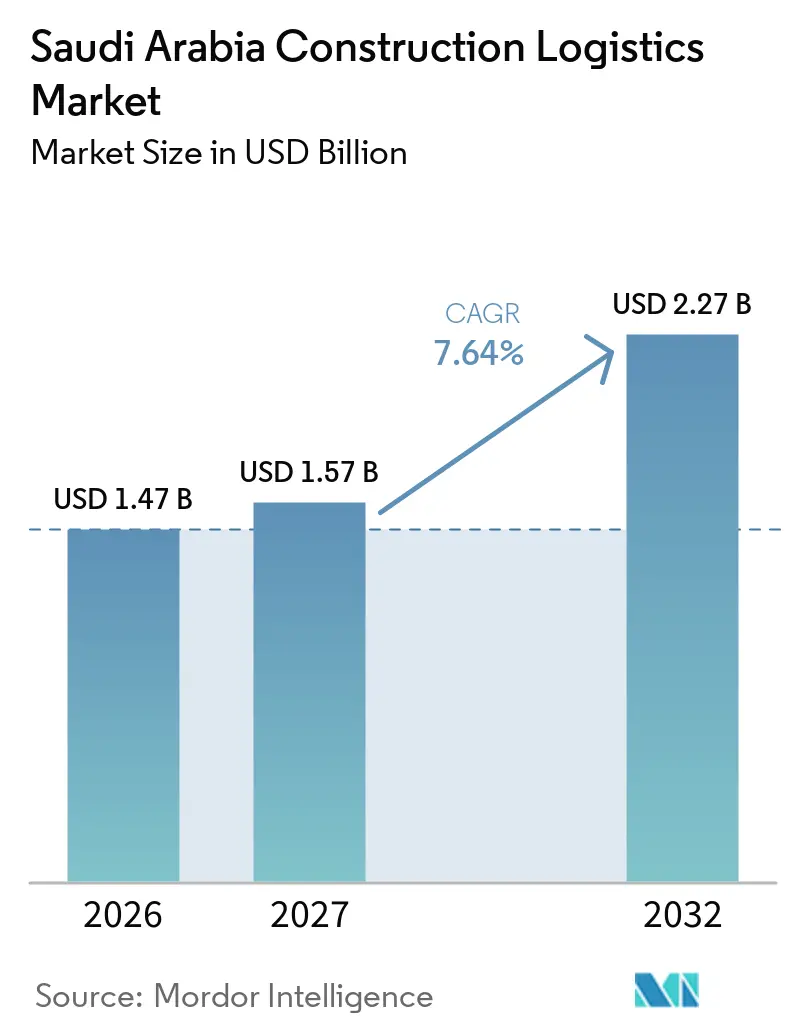
| Base Year Market Size (2026) | USD 1.47 Billion |
| Market Size (2027) | USD 1.57 Billion |
| Market Size (2032) | USD 2.27 Billion |
| Growth Rate (2027 - 2032) | 7.64 % |
| Market Concentration | Medium |
Major Players *Disclaimer: Major Players sorted in no particular order Image © Mordor Intelligence. Reuse requires attribution under CC BY 4.0. | |
Saudi Arabia Construction Logistics Market Analysis by Mordor Intelligence
The Saudi Arabia construction logistics market size is valued at USD 1.47 billion in 2026. It is estimated to grow from USD 1.57 billion in 2027 to reach USD 2.27 billion by 2032, at a CAGR of 7.64% during the forecast period from 2027 to 2032.
The Saudi Arabia construction logistics market is supported by a large pipeline of construction, real estate, power, transport, industrial, and utility projects. Contract awards are moving projects from planning into delivery, which increases demand for freight, storage, customs handling, and site coordination. Localization is shifting more material movement inside the kingdom and raises the value of inland distribution, staging, and consolidation. Red Sea disruption continues to increase uncertainty for imported cargo and raises the value of providers with local storage and route options. The Saudi Arabia construction logistics market also favors providers that can combine port handling, permits, heavy lifting, and remote-site delivery under one contract.
Key Report Takeaways
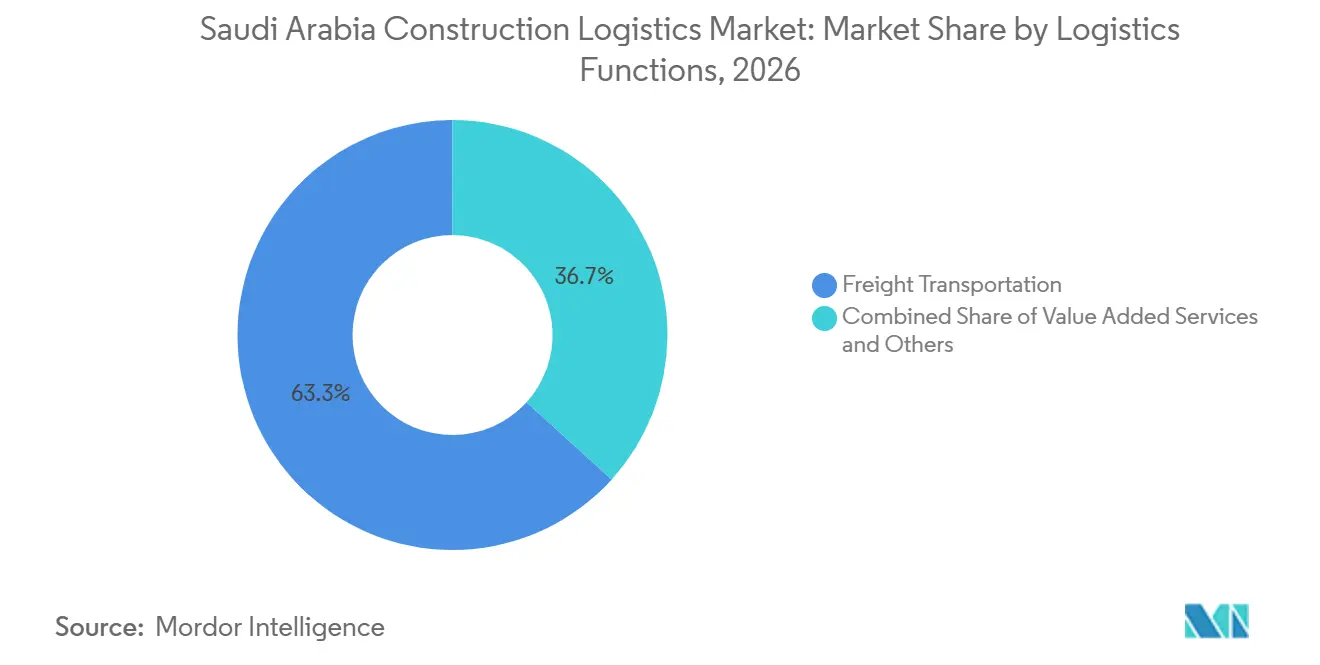
- By logistics function, freight transportation accounts for 63.27% of the Saudi Arabia construction logistics market share in 2026, while other value-added services are projected to register an 8.45% CAGR through 2032.
- By project type, residential buildings account for 37.94% of the Saudi Arabia construction logistics market size in 2026, while energy and utilities infrastructure is forecast to expand at an 8.23% CAGR through 2032.
- By cargo type, machinery and construction equipment account for 30.14% of the Saudi Arabia construction logistics market size in 2026, while heavy-lift and project cargo is expected to register an 8.96% CAGR through 2032.
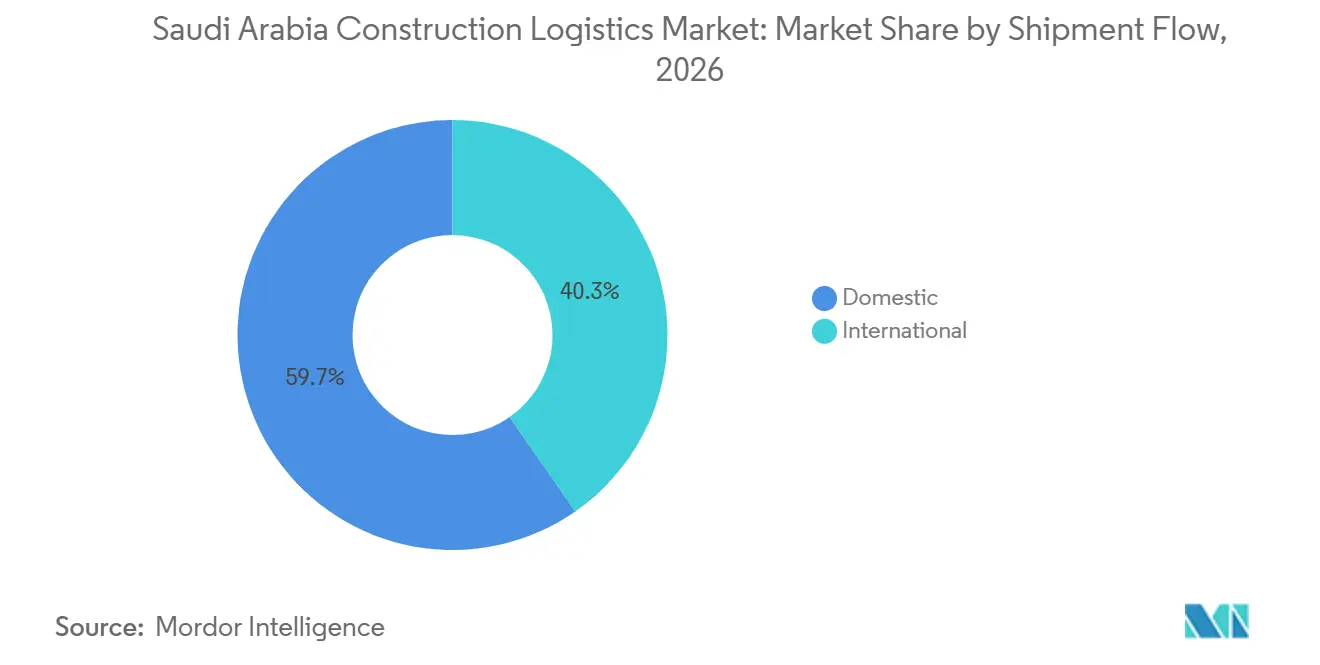
- By shipment flow, domestic shipments account for 59.68% of the Saudi Arabia construction logistics market share in 2026, while international shipments are projected to register at a 9.36% CAGR through 2032.
- By geography, the Eastern Province accounts for 36.83% of the Saudi Arabia construction logistics market share in 2026, while the Western region is forecast to register at an 8.51% CAGR through 2032.
Note: Market numbers in this report are based on Mordor Intelligence's proprietary estimation framework, which combines nine months of actuals with Q4 projections for base year 2026.
Market Trends and Insights
Drivers Impact Analysis of Saudi Arabia Construction Logistics Market*
| Driver | (~) % Impact on CAGR Forecast | Geographic Relevance | Impact Timeline |
|---|---|---|---|
| Vision 2030 Projects Expanding Construction Logistics Demand | +2.0% | National, with activity in Tabuk, the Eastern Province, and Riyadh | Medium term (2-4 years) |
| Transport Investment Strengthening Project Freight Connectivity | +1.4% | National, with concentration in Riyadh, Jeddah, and Dammam corridors | Long term (≥ 4 years) |
| Supply-Chain Localization Increasing Domestic Logistics Requirements | +1.0% | National, including MODON industrial cities and SPARK | Medium term (2-4 years) |
| Specialized Transport Outsourcing Expanding Heavy-Lift Logistics Demand | +0.9% | Eastern Province and Western giga-project sites | Short term (≤ 2 years) |
| Digital Visibility Improving Integrated Project Logistics Coordination | +0.7% | National, with early adoption at NEOM and Qiddiya | Short term (≤ 2 years) |
| Modular Construction Increasing Remote-Site Delivery Requirements | +0.6% | Western Region and Eastern Province | Medium term (2-4 years) |
| Source: Mordor Intelligence | |||
Vision 2030 Projects Expanding Construction Logistics Demand
The Saudi Arabia construction logistics market draws demand from concentrated projects that need more planning than standard commercial deliveries. Contract awards across Vision 2030 projects reached USD 196 billion in 2025, increasing 20% from the previous year[1]. Project locations span Tabuk, the Eastern Province, Riyadh, Mecca, and the Red Sea coast, so providers need more than one operating corridor. This distribution makes regional staging capacity and local delivery coordination important during tendering. Contractors must also manage customs, SABER certification, and FASAH pre-arrival requirements before materials reach sites. Port of NEOM became operational in 2026 and created a northern Red Sea gateway for construction cargo serving Tabuk developments.
Transport Investment Strengthening Project Freight Connectivity
Transport projects expand the Saudi Arabia construction logistics market by improving access between ports, industrial centers, and project locations. The Landbridge project is planned as a 1,400 km rail connection between Jeddah, Riyadh, and Dammam, with logistics centers at major industrial nodes. The route can reduce dependence on road-only movement for breakbulk materials and project cargo. Mawani began the SAR 689 million (USD 183.51 million) Jeddah truck corridor in July 2025, linking Jeddah Islamic Port with the Al Khomra Logistics Zone. The 17 km corridor includes 12 bridges and is projected to increase port handling capacity by 10%. Better port access also supports faster transfer of imported equipment into inland staging networks.
Supply-Chain Localization Increasing Domestic Logistics Requirements
Localization changes the Saudi Arabia construction logistics market from an import-led model toward a more balanced domestic distribution system. Aramco reported 67% local content in its procurement in 2025. More local procurement increases factory-to-site movement, consolidation, and materials staging. PIF acquired a 30% stake in Masdar Building Materials in February 2025 to support supply-chain transformation and local distribution expansion. China Harbour opened a modular precast factory at Sedra with a 200,000 m² footprint and annual capacity of up to 400,000 m³ of panels. These factory-scale supply points increase the need for planned inland transport and site delivery.
Specialized Transport Outsourcing Expanding Heavy-Lift Logistics Demand
The Saudi Arabia construction logistics market needs specialist providers as project components become larger and harder to move. Turbines, nacelles, transformer assemblies, modules, and structural steel require engineered routes and lifting plans. Mammoet expanded its Al Jubail fleet in 2026 with 60 Goldhofer axle lines, 7 trucks, and 8 cranes to serve local requirements[2]. Sarens handled 34 modules weighing 18,535 tons and 108 further heavy items weighing 12,283 tons at Jafurah. Local asset depth reduces mobilization time when several projects require the same equipment. Digital cargo visibility and modular construction reinforce this requirement because remote sites need timed delivery, clear material status, and coordinated lifting windows.
Restraints Impact Analysis of Saudi Arabia Construction Logistics Market*
| Restraint | (~) % Impact on CAGR Forecast | Geographic Relevance | Impact Timeline |
|---|---|---|---|
| Oversized-Load Permitting Delays Disrupting Project Logistics Schedules | -0.5% | National, especially Tabuk access routes and remote desert crossings | Short term (≤ 2 years) |
| Specialized Asset Shortages Limiting Heavy-Lift Logistics Capacity | -0.4% | Eastern Province and Western Region project clusters | Short term (≤ 2 years) |
| Maritime Route Disruptions Increasing Project Cargo Uncertainty | -0.7% | Red Sea, Bab al-Mandeb, and Western Saudi ports | Short term (≤ 2 years) |
| Remote-Site Constraints Increasing Staging and Delivery Complexity | -0.3% | Northern and Southern regions, the NEOM corridor, and Rub' al-Khali sites | Medium term (2-4 years) |
| Source: Mordor Intelligence | |||
Maritime Route Disruptions Increasing Project Cargo Uncertainty
Maritime disruption constrains the Saudi Arabia construction logistics market because imported equipment must arrive within narrow site schedules. Bab al-Mandeb vessel traffic declined by 24% in August 2026, while insurance costs for Saudi-linked tankers increased. Longer routes around Africa can add 20 days to normal Red Sea movement, increasing the risk of material gaps at project sites. DEUGRO rerouted 42 out-of-gauge units through Jeddah in October 2026 when direct ocean transport was not feasible. Bonded warehouses near Jeddah Islamic Port and King Abdullah Port can limit the effect of delayed arrivals. Asset shortages and remote terrain add further pressure when substitute routes require more specialist trucks and lifting equipment.
Oversized-Load Permitting Delays Disrupting Project Logistics Schedules
Oversized-load permits remain a direct scheduling constraint for the Saudi Arabia construction logistics market. The General Authority for Roads introduced financial charges in January 2025 for exceptional-load permits, including SAR 10 (USD 2.66) per ton above 45 tons and SAR 5 (USD 1.33) per additional meter of length[3]. The rules add a measurable cost to moving heavy equipment and large modules. September 2025 guidance introduced GIS-based route planning, time restrictions, and coordination with security, traffic, and municipal agencies. Projects with many concurrent moves can face cumulative delays when approvals do not align with crane or site schedules. Providers in the Saudi Arabia construction logistics market with pre-approved corridors and digital permit workflows can reduce this exposure, but remote crossings and limited specialist assets remain a constraint.
*Our forecasts treat driver/restraint impacts as directional, not additive. The impact forecasts reflect baseline growth, mix effects, and variable interactions.
Saudi Arabia Construction Logistics Market Segment Analysis
By Logistics Function:
Freight Transportation Anchors Revenue, Value-Added Services Scale FastestFreight transportation accounts for 63.27% of the Saudi Arabia construction logistics market share in 2026 and remains the core service for project cargo movement. Road freight moves rebar, cement, aggregates, and fabricated components between industrial areas and construction corridors. Sea freight remains important for imported machinery, prefabricated modules, and specialist equipment. The size of the freight transportation base reflects the number of active projects and their dispersed locations. Rail is emerging as an additional option for container and bulk flows that previously moved only by truck. This change gives the Saudi Arabia construction logistics market another way to move materials between key industrial locations and ports. Saudi ports added 13 shipping services in April 2026, providing combined import capacity of 97,099 TEUs[4]. This expansion broadens the entry points available to freight providers. Freight transportation therefore remains central to cost control and site continuity. It links suppliers, ports, consolidation facilities, and sites where construction sequences leave little room for missed delivery windows, while responding to changing site priorities and delivery restrictions.
Other value-added services are forecast to register at an 8.45% CAGR, the fastest rate within logistics functions. Material handling, customs clearance, and consolidation become more valuable when cargo must meet stricter documentation and delivery schedules. ZATCA digitalization, SABER certification, and FASAH pre-arrival procedures make compliance support part of the service offer. Kuehne+Nagel received Saudi Arabia's first AEO Customs Brokerage certification in May 2025. Providers with this capability can reduce clearance uncertainty for project imports. Warehousing and materials staging also gain importance when contractors stock materials closer to site. The Saudi Arabia construction logistics industry therefore depends on both physical movement and document control. Integrated providers can link freight, clearance, staging, and delivery in a single operating plan. This model reduces the handoffs that can slow cargo movement when separate parties manage documentation, inventory status, and final-mile scheduling. It gives contractors a single party that can address a delayed release, a change in delivery timing, or a materials consolidation requirement.

By Project Type:
Residential Holds Largest Share, Energy and Utilities Leads Growth TrajectoryResidential buildings account for 37.94% of the Saudi Arabia construction logistics market size in 2026. Sakani, ROSHN, and the National Housing Program support continued movement of common building materials across many locations. Housing projects create recurring needs for cement, steel, prefabricated components, and finishing materials. Their broad geographic spread requires local trucking capacity rather than a single port-to-site route. Commercial buildings add demand for mechanical, electrical, and plumbing equipment, glazing, and specialist finishes. Hotels and retail projects connected with Riyadh and Red Sea development have higher requirements for controlled handling. Institutional and public projects add stadium, hospital, and university deliveries. This mix supports a steady base of routine materials movement. Housing delivery also creates repetitive delivery patterns that allow providers to plan fleet use, warehouse replenishment, and regional subcontractor coverage. The volume of common materials makes execution discipline important because late delivery can affect several work packages on the same site.
Energy and utilities infrastructure is forecast to register an 8.23% CAGR through 2032, the highest rate among project types. Aramco's Jafurah work, renewable energy projects, and grid expansion require oversized components and precise delivery sequencing. These projects frequently sit far from established urban distribution networks. The Saudi Arabia construction logistics market size for this project type benefits from engineering-heavy cargo that needs route studies and specialized lifting. Industrial facilities in MODON cities and SPARK also require repeated deliveries during several construction phases. Transport infrastructure, including rail, creates demand for its own construction materials while improving future freight connectivity. National transport planning shapes permits and capacity needs across all project types. Providers that work across residential and energy projects can balance high-volume materials flows with higher-value project cargo work. The operating requirements differ, but both depend on accurate timing, safe handling, and visibility over material status before site arrival. A broad project portfolio can also support use of shared storage, transport planning, and local operations teams.
By Cargo Type:
Machinery Holds Dominant Share, Heavy-Lift Cargo Drives Fastest ExpansionMachinery and construction equipment accounts for 30.14% of the Saudi Arabia construction logistics market size in 2026, making it the largest cargo category. Active sites require cranes, excavators, piling rigs, batching plants, and supporting equipment. These assets have high logistics value because they require careful loading, transport, delivery, and return planning. Equipment availability affects project productivity, which makes timely movement important to contractors. Imported machinery also needs customs coordination and controlled port release. Machinery flows therefore support both freight forwarding and domestic specialized transport. The segment creates regular work across construction locations rather than one-time deliveries. It remains a leading contributor to logistics revenue even where bulk materials dominate physical tonnage. Construction equipment needs attention throughout its movement cycle, including delivery, deployment, repositioning, and removal once a work package has finished. Providers that coordinate these stages can help contractors limit idle equipment time and avoid unnecessary site congestion.
Heavy-lift and project cargo is expected to register an 8.96% CAGR through 2032. Turbine nacelles, transformer banks, reactor vessels, and large modules often require SPMTs, crane engineering, and route clearance. These jobs cannot be treated as normal road freight because each movement needs a defined engineering plan. A 2026 study found that IoT deployment can reduce delay and cost variability in Saudi giga-project cargo operations. The Saudi Arabia construction logistics industry benefits when real-time tracking is combined with experienced heavy-lift operations. Construction materials continue to generate high volumes but lower revenue intensity per ton. Other cargo includes chemicals, safety supplies, and consumables that may need temperature-controlled or hazardous-material handling. The growth of complex energy and industrial projects strengthens the case for specialized cargo services. Each project may need a different combination of route assessment, lifting plans, escort coordination, and controlled delivery to a defined installation point. That work rewards operators with in-country equipment, experienced crews, and established coordination procedures.
By Shipment Flow:
Domestic Flows Lead, International Segment Registers Fastest ExpansionDomestic shipments represent 59.68% of the Saudi Arabia construction logistics market in 2026. This share reflects simultaneous project execution across five regional clusters and growing local manufacturing. Factory-to-site movements need consolidation, staging, and predictable road delivery. Domestic logistics also supports materials transferred from ports into regional distribution facilities. Local procurement programs can increase this activity even when total import volumes remain important. The domestic shipment share benefits from the need to reposition equipment and materials between active sites. Inland operators with fleets, warehouses, and regional site access are well placed to capture this work. The shift favors operating networks that extend beyond the main ports. Domestic flows can be disrupted when materials are not available at the required location, even if they have already cleared the port or left a factory. Regional storage and a reliable local transport base therefore help providers respond to changes in site consumption and delivery schedules.
International shipments are forecast to register at a 9.36% CAGR through 2032. Specialized equipment, engineered materials, and high-value components still require overseas sourcing. Maersk applied booking restrictions and temporarily suspended selected services in March 2026, affecting Gulf port operations and redirecting some Saudi cargo through Jeddah and King Abdullah Port. These changes make route flexibility important for import-dependent projects in the Saudi Arabia construction logistics market. Saudi Global Ports tested an east-west rail-road route in 2025 that links Gulf and Red Sea ports. Localization can reduce the relative role of imports over time, but project requirements will keep international freight relevant during the forecast period. The fastest growth rate reflects the continuing need for equipment and components that are not yet fully made locally. Providers must manage customs, port options, and contingency routing alongside standard freight forwarding. International movements may need revised port calls, additional storage, or alternative inland transfer arrangements when maritime conditions change. These operating requirements make communication between suppliers, freight providers, project teams, and site teams essential.
Geography Analysis
The Eastern Province accounts for 36.83% of the Saudi Arabia construction logistics market share in 2026. Aramco programs, Jafurah development, SPARK, and Jubail create a concentrated source of industrial and energy project cargo. Jubail Commercial Port started container operations under Saudi Global Ports in April 2026. The region benefits from established heavy-lift bases in Al Jubail and rail links to Riyadh's dry port. ASMO managed more than 56,000 material items through 380 agreements in April 2026, showing the scale of local procurement activity. The region can support both high-volume materials distribution and engineered cargo movement. This strength gives the Saudi Arabia construction logistics market a reliable base for serving capital-intensive industrial work. Its industrial base helps reduce the distance between suppliers, logistics facilities, and construction sites. This makes the Eastern Province a key operating center for providers serving energy and utilities projects. Its established industrial activity gives operators access to specialist labor, equipment, suppliers, and operating knowledge that are harder to establish near newer project locations.
The Western region is forecast to register an 8.51% CAGR through 2032, the fastest rate among geographic areas. NEOM, Amaala, The Red Sea, and Jeddah port expansion create demand for both marine entry and remote-site delivery. The Port of NEOM expects its T1 container terminal to reach 1.5 million TEUs of capacity by 2027. This facility can shorten the road haul for Tabuk-area construction cargo. CEVA Almajdouie and the Port of NEOM signed an October 2026 memorandum to explore logistics solutions across the Europe, Egypt, Saudi Arabia, GCC, and Iraq corridor. The region needs staging and route management because its projects are spread across long distances. Stronger port capacity can improve cargo absorption but does not remove the complexity of site access. Providers must coordinate marine, road, storage, and final delivery work. The sequence is especially important when cargo arrives for sites that have limited access, incomplete supporting infrastructure, or restricted delivery windows. A well-planned western network can reduce inland handling, but it must still account for site conditions and schedule changes.
The Central region is the second-largest geographic area by revenue and is anchored by Riyadh's construction, industrial, and transport programs. DHL announced a EUR 130 million (USD 152.92 million) investment in a 78,000 m² multi-user warehouse at the Special Integrated Logistics Zone, with completion expected in the second quarter of 2027. Central distribution facilities can serve urban project sites as well as wider inland corridors. The Northern and Southern regions are smaller but remain active through utility, economic-city, and Red Sea corridor projects. GAC opened its 10th Saudi office at Jizan port in November 2025. These regions need tailored planning because distance, terrain, and fewer logistics nodes can raise delivery complexity. The Saudi Arabia construction logistics market needs national coverage instead of a port-centered operating model.
Competitive Landscape
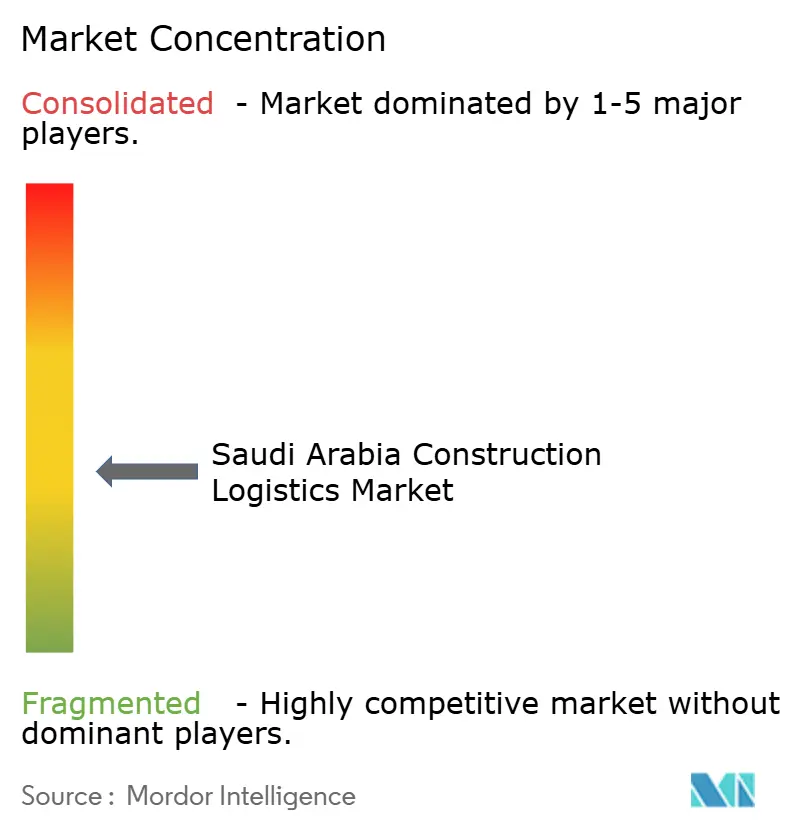
The Saudi Arabia construction logistics market is fragmented, with global freight integrators, heavy-lift specialists, and Saudi carriers serving different needs. DSV, DHL, and Kuehne+Nagel compete in international forwarding, contract logistics, and customs brokerage. DSV completed its integration of DB Schenker in Saudi Arabia in February 2026. DHL is building a multi-user warehouse in Riyadh, which will add regional storage and distribution capacity. Kuehne+Nagel's AEO certification provides a differentiated customs brokerage capability. These companies use global networks and multi-mode service offers to serve construction and industrial customers. Their position is strongest where imports, customs requirements, and multi-country supplier coordination are central. Specialist firms compete where physical capability and engineering knowledge matter more than network scale.
Mammoet and Sarens operate in the heavy-lift tier, where asset depth, engineering certification, and permit management are essential. Mammoet added vehicles, axle lines, and cranes in Al Jubail to improve in-country availability. Sarens used cranes with a capacity of up to 1,250 tons and a 120-axle SPMT for Jafurah work. These moves show that local equipment availability can determine response time and delivery feasibility. An underserved service area remains integrated port-to-site logistics that combines handling, permits, lifting, and remote-site staging. Compliance with customs and product standards adds a barrier for firms without established Saudi operating structures. Digital tracking is becoming important at large projects and supports more reliable coordination. Smaller domestic haulers can continue to serve as subcontractors where tier-one firms focus on management and specialized work.
Saudi-heritage operators use domestic relationships, warehouses, and port access to protect their local roles. Bahri Logistics signed an agreement with Red Sea Global and opened a bonded zone at Jeddah Islamic Port. CEVA Almajdouie and the Port of NEOM are positioning for a western multimodal corridor through their October 2026 memorandum. FTE Logistics, ASR Logistics, and Maxx Arabia can support domestic hauling as integrated providers coordinate broader project scopes. This structure creates competition between network breadth, specialist assets, and local delivery reach. The Saudi Arabia construction logistics market has room for firms that link these capabilities without passing cargo through several subcontractors. Digital tools can improve route planning, equipment status, and material visibility, but they do not replace permit knowledge or site execution. Competition is therefore based on practical delivery capability as well as scale. In the Saudi Arabia construction logistics market, this allows firms with defined specialist or local roles to compete alongside network-led providers. Contractors will evaluate whether a provider can maintain visibility from port through final delivery, resolve permit issues, and deploy assets when work fronts change. This leaves room for global firms, specialists, and local carriers that can demonstrate dependable execution in their selected service areas.
Saudi Arabia Construction Logistics Industry Leaders
-
CEVA Almajdouie Logistics
-
Bahri Integrated Logistics
-
Mammoet Saudi Arabia
-
Kuehne+Nagel
-
deugro (KSA) Ltd
- *Disclaimer: Major Players sorted in no particular order
Saudi Arabia Construction Logistics Market Companies Covered in this Report
- A.P. Moller - Maersk
- Aertssen Machinery Services
- Al Jaber Heavy Lift & Transport
- Al Khaldi-Bertling Logistics Ltd
- ASR Logistics
- Bahri Integrated Logistics
- CEVA Almajdouie Logistics (CMA CGM Group, including Fagioli)
- deugro (KSA) Ltd
- DHL Global Forwarding
- DSV A/S (including Schenker)
- Expeditors International of Washington, Inc.
- FTE Logistics
- GAC Saudi Arabia
- GEODIS
- Hellmann Worldwide Logistics
- JAS Worldwide
- Kanoo Shipping & Logistics (YBA Kanoo)
- Kuehne+Nagel
- Mammoet Saudi Arabia
- Maxx Arabia
- Sarens
- SMG Logistics & Transport Company
Recent Industry Developments in Saudi Arabia Construction Logistics Market
- October 2026: Port of NEOM and CEVA Almajdouie Logistics signed a Memorandum of Understanding to explore integrated logistics solutions along the Europe-Egypt-Saudi Arabia-GCC-Iraq multimodal corridor, combining Port of NEOM's Red Sea location with CEVA Almajdouie's road transport, customs brokerage, and bonded warehousing networks.
- April 2026: Mawani launched 13 new shipping services to three Saudi ports with Maersk, MSC, and CMA CGM, adding combined capacity exceeding 97,099 TEUs.
- March 2026: Sarens completed 124 precision lifts at Saudi Aramco's Shaybah NGL plant in the Rub' al-Khali desert, deploying an LR1750 crane with 750 tons of capacity and a CC2400 with 400 tons of capacity, transported 750 km from Jubail, with individual lifts reaching 205 tons, restoring plant production from 1,800 to 2,400 MMSCFD.
- February 2026: DSV completed the full integration of DB Schenker in Saudi Arabia, creating a unified Air & Sea, Contract Logistics, and Road organization with enhanced scale and capability for construction and industrial customer requirements across the kingdom.
Saudi Arabia Construction Logistics Market Report Scope
Segmentation Overview
| Freight Transportation | Road |
| Rail | |
| Sea | |
| Others | |
| Warehousing and Material Staging | |
| Other Value Added Services (Material Handling, Customs Clearance, Consolidation, etc.) |
| Residential Buildings | Villas and Single-Family Houses |
| Apartments and Multi-Family Buildings | |
| Commercial Buildings | Office Buildings |
| Retail and Shopping Centers | |
| Hotels and Hospitality Buildings | |
| Other Commercial Buildings (Leisure, Entertainment, etc.) | |
| Institutional and Public Buildings | Healthcare Facilities |
| Education Facilities | |
| Government and Administrative Buildings | |
| Other Institutional and Public Facilities (Religious, Cultural, Civic Buildings, etc.) | |
| Industrial Facilities | |
| Transport Infrastructure | |
| Energy and Utilities Infrastructure | |
| Other Construction Projects |
| Construction Materials |
| Machinery and Construction Equipment |
| Heavy-Lift and Project Cargo |
| Others |
| Domestic |
| International |
| Central (Riyadh, Al-Qassim, and Hail) |
| Eastern (Ash-Sharqiyah) |
| Western (Al-Bahah, Makkah, Medina, and Tabuk) |
| Northern (Al-Jouf and Arar) |
| Southern (Asir, Jazan, and Najran) |
| By Logistics Function | Freight Transportation | Road |
| Rail | ||
| Sea | ||
| Others | ||
| Warehousing and Material Staging | ||
| Other Value Added Services (Material Handling, Customs Clearance, Consolidation, etc.) | ||
| By Project Type | Residential Buildings | Villas and Single-Family Houses |
| Apartments and Multi-Family Buildings | ||
| Commercial Buildings | Office Buildings | |
| Retail and Shopping Centers | ||
| Hotels and Hospitality Buildings | ||
| Other Commercial Buildings (Leisure, Entertainment, etc.) | ||
| Institutional and Public Buildings | Healthcare Facilities | |
| Education Facilities | ||
| Government and Administrative Buildings | ||
| Other Institutional and Public Facilities (Religious, Cultural, Civic Buildings, etc.) | ||
| Industrial Facilities | ||
| Transport Infrastructure | ||
| Energy and Utilities Infrastructure | ||
| Other Construction Projects | ||
| By Cargo Type | Construction Materials | |
| Machinery and Construction Equipment | ||
| Heavy-Lift and Project Cargo | ||
| Others | ||
| By Shipment Flow | Domestic | |
| International | ||
| By Region | Central (Riyadh, Al-Qassim, and Hail) | |
| Eastern (Ash-Sharqiyah) | ||
| Western (Al-Bahah, Makkah, Medina, and Tabuk) | ||
| Northern (Al-Jouf and Arar) | ||
| Southern (Asir, Jazan, and Najran) | ||
Key Questions Answered in the Report
What is driving Saudi Arabia construction logistics demand?
Vision 2030 project delivery, transport investment, local procurement, and complex energy projects support demand for freight, storage, clearance, and heavy-lift services. Together, these activities require close coordination among project owners, contractors, ports, suppliers, and site delivery teams.
How large is the Saudi Arabia construction logistics market?
The sector is valued at USD 1.47 billion in 2026 and is forecast to reach USD 2.27 billion by 2032 at a 7.64% CAGR. This forecast reflects the continued execution of construction projects, greater domestic distribution needs, and demand for more complex project cargo services.
Which logistics function has the largest revenue share?
Freight transportation leads with a 63.27% revenue share in 2026 because it moves materials, machinery, and equipment between ports, suppliers, and sites. Road-based delivery remains important because projects are distributed across urban, industrial, coastal, and remote locations.
Which project type is growing fastest?
Energy and utilities infrastructure is projected to register an 8.23% CAGR through 2032, supported by gas, renewable energy, and grid projects. These programs require engineered transport, heavy lifting, and coordinated delivery for high-value equipment.
Which region offers the strongest growth outlook?
The Western region is projected to register an 8.51% CAGR through 2032, supported by NEOM, Red Sea developments, and expanding port capacity. The region requires integrated marine, road, storage, and final-mile coordination because many developments are located far from traditional logistics hubs.
What risks affect construction cargo delivery in Saudi Arabia?
Red Sea disruption, oversized-load permits, specialist asset availability, and remote project locations can extend delivery times and increase coordination needs. Operators can reduce exposure by using planned staging, documented permit processes, available specialist assets, and alternative routing options.