
Market Overview
| Study Period | 2020 - 2031 |
|---|---|
| Forecast Data Period | 2026 - 2031 |
| Base Year Market Size (2025) | USD 2.17 Billion |
| Market Size (2026) | USD 2.26 Billion |
| Market Size (2031) | USD 2.76 Billion |
| Growth Rate (2026 - 2031) | 4.12 % |
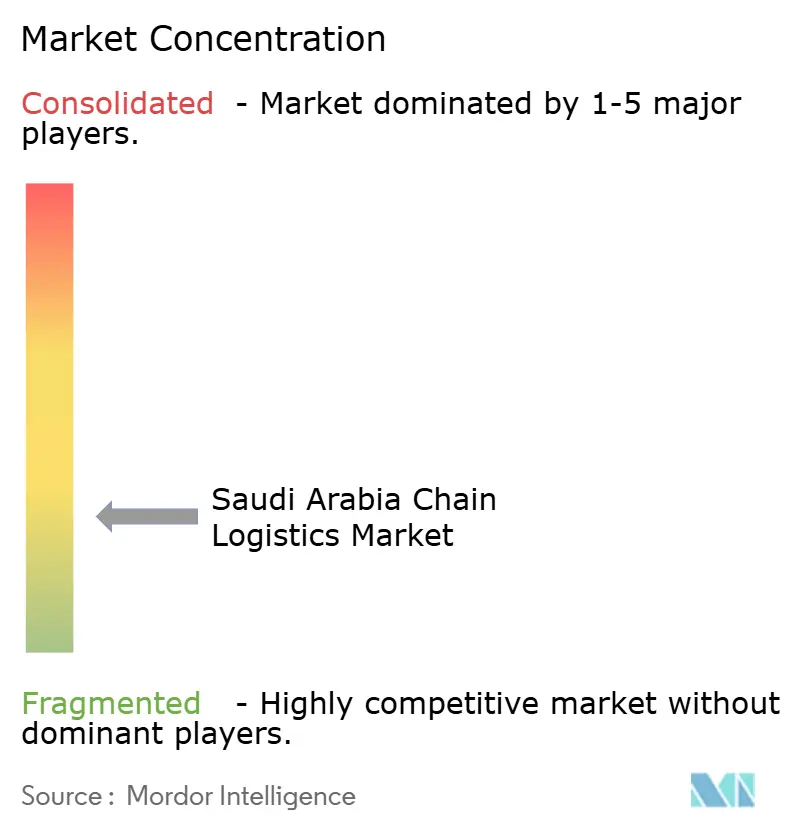
| Market Concentration | Low |
Major Players *Disclaimer: Major Players sorted in no particular order Image © Mordor Intelligence. Reuse requires attribution under CC BY 4.0. | |
Saudi Arabia Cold Chain Logistics Market Analysis by Mordor Intelligence
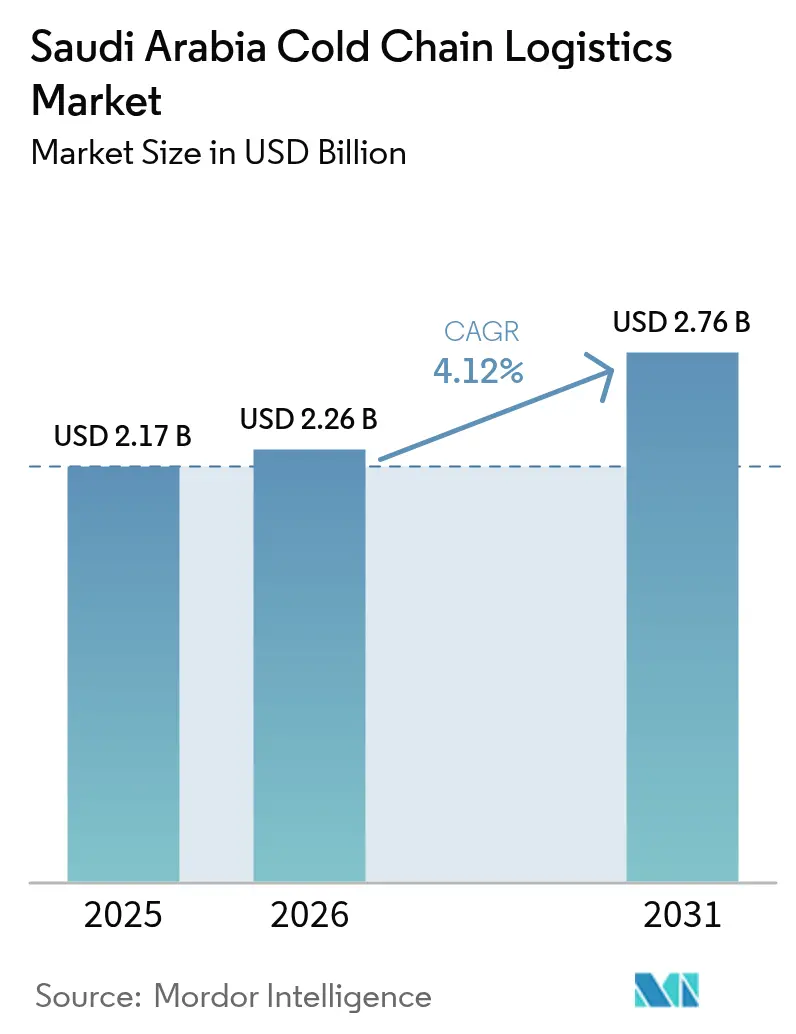
Saudi Arabia Cold Chain Logistics Market size in 2026 is estimated at USD 2.26 billion, growing from 2025 value of USD 2.17 billion with 2031 projections showing USD 2.76 billion, growing at 4.12% CAGR over 2026-2031.
The growth trajectory mirrors Vision 2030’s goal of economic diversification, which frames cold chain infrastructure as a cornerstone for safeguarding food security, modernizing healthcare distribution, and deepening regional trade integration. Government targets, such as achieving 80% poultry self-sufficiency by 2025, compel investment in temperature-controlled networks that can handle 950,000 MT (metric tons) of chicken production and simultaneously support imported protein flows[1]U.S. Department of Agriculture, “Poultry and Products Annual,” apps.fas.usda.gov. Regulatory tightening by the Saudi Food and Drug Authority (SFDA) stimulates specialized storage for biologics and vaccines, while AI/ML-enabled energy-optimization pilots cut refrigeration energy use by 20%, showing direct operating-cost advantages. Logistics corridors anchored on the 5,500 km rail network harness multimodal efficiencies, lowering long-haul costs by 15% versus road-only freight and improving service reliability for temperature-sensitive cargo.
Key Report Takeaways
- By service type, refrigerated storage led with 46.35% of the Saudi Arabia cold chain logistics market share in 2025; value-added services are poised to grow at a 4.42% CAGR through 2031.
- By temperature range, frozen applications captured 30.55% share of the Saudi Arabia cold chain logistics market size in 2025, while deep-frozen/ultra-low operations are forecast to advance at a 4.68% CAGR to 2031.
- By application, meat & poultry held 23.60% of the Saudi Arabia cold chain logistics market share in 2025; pharmaceuticals & biologics will expand at a 5.22% CAGR through 2031.
- By region, Makkah accounted for a 28.65% share of the Saudi Arabia cold chain logistics market size in 2025, whereas Riyadh is projected to post the fastest 4.15% CAGR between 2026 and 2031.
Note: Market size and forecast figures in this report are generated using Mordor Intelligence’s proprietary estimation framework, updated with the latest available data and insights as of 2026.
Saudi Arabia Cold Chain Logistics Market Trends and Insights
Drivers Impact Analysis*
| Driver | % Impact on CAGR Forecast | Geographic Relevance | Impact Timeline |
|---|---|---|---|
| Pharma cold-chain requirements | +1.2% | Riyadh & Makkah | Medium term (2-4 years) |
| Online grocery & food delivery expansion | +0.8% | Riyadh, Jeddah, Dammam | Short term (≤ 2 years) |
| Vision 2030 logistics investments | +1.0% | National | Long term (≥ 4 years) |
| Stricter SFDA traceability rules | +0.6% | National | Medium term (2-4 years) |
| Poultry self-sufficiency push | +0.4% | Eastern production clusters | Medium term (2-4 years) |
| AI/ML-based energy optimization | +0.3% | Industrial zones | Long term (≥ 4 years) |
| Source: Mordor Intelligence | |||


Vision 2030 Logistics Infrastructure Investments Drive Capacity Expansion
The government has earmarked USD 133 billion for new roads, ports, airports, and 59 logistics centers spanning 100 million m² to be delivered by 2030[2]American Journal of Transportation, “Vision 2030 Logistics Investments,” ajot.com. Twenty-one of these centers are already in execution, and their integration with the Fasah customs portal will compress import dwell times that have historically jeopardized cargo integrity. Coupling these hubs with the national rail grid lowers inland transport costs and widens cold storage access for food importers and pharmaceutical distributors. As each hub comes online, small and mid-sized shippers gain entry to GDP-certified facilities without investing in proprietary assets, a dynamic expected to accelerate competitive intensity.
Pharmaceutical Cold Chain Requirements Accelerate Specialized Infrastructure Development
SFDA’s Breakthrough Medicine Program compels logistics firms to meet GDP standards, spurring EUR 500 million (USD 581.56 million) of regional spending under DHL’s global health-logistics initiative. NAQEL Express mirrors this focus with an SAR 200 million (USD 53.25 million) warehouse in Jeddah featuring multi-temperature zones dedicated to biologics and vaccines. These investments underpin the segment’s 5.40% CAGR, outstripping overall market growth, while also raising the entry bar for non-certified competitors. Future demand will intensify as Saudi Arabia positions itself as a regional clinical-trials center requiring ultra-low storage down to –80 °C.
Government Push for Poultry Self-Sufficiency Creates Domestic Cold Chain Demand
To reach 80% self-sufficiency, producers must handle 950,000 MT (metric tons) of chicken via temperature-controlled links from slaughterhouses to retailers, a logistical requirement accentuated by the Kingdom’s desert climate. Subsidized loans tethered to cold-chain compliance promote adherence to food-safety standards even among small growers. The coexistence of domestic and imported poultry elevates inventory complexity, driving uptake of warehouse-management systems capable of segregating different origin lots and expiry dates.
AI/ML-Driven Optimization Systems Enable Energy Efficiency Breakthroughs
Pilot sites deploying IoT sensors and machine-learning algorithms report 20% cuts in cooling energy and 31% reductions in cost without compromising temperature set-points. As energy charges constitute up to 35% of cold-storage OPEX, these savings directly widen margins. Wider adoption is aided by the Saudi Energy Efficiency Center’s SEER framework, which guides HVAC upgrades toward high-efficiency units. Integrating predictive analytics for demand forecasting further optimizes load profiles, reducing both waste and carbon intensity.
Restraints Impact Analysis*
| Restraint | % Impact on CAGR Forecast | Geographic Relevance | Impact Timeline |
|---|---|---|---|
| High capital & energy intensity | –0.9% | National; acute in secondary cities | Long term (≥ 4 years) |
| Skilled-labor shortage | –0.7% | Eastern & Al-Medinah | Medium term (2-4 years) |
| Grid reliability issues | –0.5% | Secondary cities | Short term (≤ 2 years) |
| Refrigerant import licensing | –0.3% | National | Medium term (2-4 years) |
| Source: Mordor Intelligence | |||
High Capital and Energy Intensity Constrain Market Entry for Smaller Players
Grade-A cold-storage projects can exceed USD 50 million, deterring smaller entrants without a deep balance sheet. Energy accounts for 25–35% of OPEX, and HVAC alone consumes 65% of facility electricity in peak summer months. Upgrading to SEER-compliant chillers raises up-front costs but reduces life-cycle expenses, creating a capital-versus-operating cost trade-off that many mid-tier operators find difficult to balance.
Skilled Workforce Shortage Threatens Operational Efficiency and Safety Standards
Saudization quotas amplify an already tight supply of refrigeration technicians and GDP-compliant drivers. TVET programs have not kept pace with digitalization, leaving skill gaps in data analytics, IoT troubleshooting, and hazardous-material protocols. Shortfalls elevate safety risks, particularly when handling biologics that can lose efficacy after minor temperature excursions. Larger players respond by launching in-house academies, but smaller firms struggle to fund similar initiatives.
*Our forecasts treat driver/restraint impacts as directional, not additive. The impact forecasts reflect baseline growth, mix effects, and variable interactions.
Segment Analysis
By Service Type: Storage Infrastructure Dominance Meets Value-Added Growth
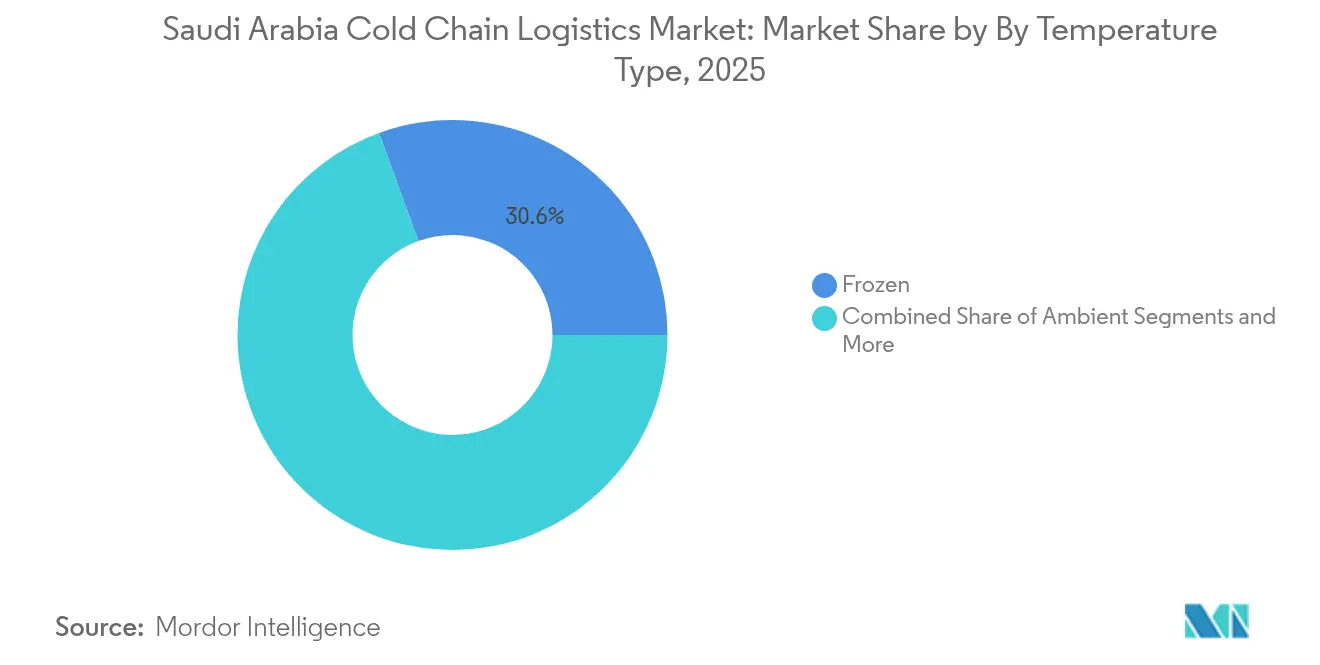
Refrigerated storage controlled 46.35% of the Saudi Arabian cold chain logistics market share in 2025 by virtue of the country’s heavy reliance on warehousing for both imported and domestically produced temperature-sensitive goods. Public warehouses capture smaller shippers seeking economies of scale, whereas private facilities like Almarai’s integrated network ensure quality control across vertically linked dairy and poultry lines. Road transport remains essential for last-mile delivery, yet rail is gaining favor as the rail grid extends its reach to inland consumption centers.
Value-added services, while holding a modest share today, are expanding at a 4.42% CAGR and encompass kitting, relabeling, and quality testing tailored to SFDA rules. Multi-temperature vehicles able to segregate SKUs within single trips lower transport costs and curb product spoilage. Intermodal solutions that stitch together sea-rail-road legs now differentiate full-service providers from asset-light competitors. Growing demand for e-commerce fulfillment accelerates take-up of cross-docking and pick-and-pack services that shorten delivery lead times to same-day or next-day standards in major cities.


By Temperature Type: Frozen Dominance Challenged by Ultra-Low Growth
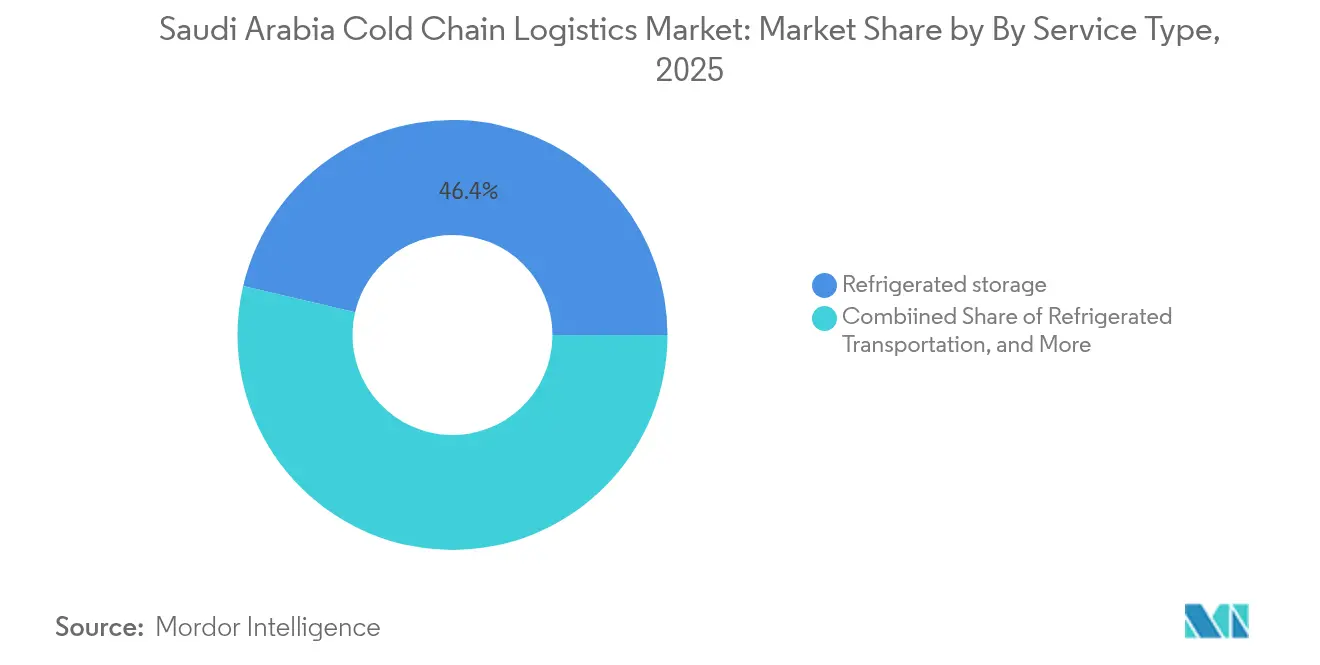
Frozen operations held 30.55% of the Saudi Arabian cold chain logistics market size in 2025, reflecting strong imports of protein and expanding domestic poultry output. Latest UNEP guidelines favor low-GWP refrigerants, nudging operators toward CO₂ and propane systems that also improve energy efficiency. Chilled storage benefits from national food-waste reduction campaigns, creating new demand for produce and dairy chains.
Deep-frozen/ultra-low operations stand out with a 4.68% CAGR as pharmaceutical and biotech sectors install –20 °C to –80 °C rooms to accommodate vaccines and clinical-trial samples. Ambient storage remains relevant for temperature-stable drugs and acts as overflow for mixed-load facilities. Growing use of R-452A in transport refrigeration aligns fleets with Kigali Amendment timelines, future-proofing assets against regulatory risks associated with high-GWP blends.
By Application: Pharmaceuticals, Surge Challenges Meat & Poultry Leadership
Meat & poultry constituted 23.60% of the Saudi Arabia cold chain logistics market share in 2025, anchored by Vision 2030 support for domestic growers and ongoing imports from Brazil. Stringent food-safety norms increase demand for controlled-atmosphere chilling that lengthens shelf life in hot climates.
Pharmaceuticals & biologics, expanding at a 5.22% CAGR, capitalize on Riyadh’s role as a distribution hub and the proliferation of GDP-certified warehouses . Fruits & vegetables gain from public-private partnerships aimed at halving food waste, while dairy producers leverage brand premiumization to command refrigerated shelf space. Ready-to-eat meal logistics benefit from rising urban lifestyles requiring convenience foods, accelerating the adoption of small-format multi-temperature vehicles.
Geography Analysis
Makkah retained 28.65% of the Saudi Arabia cold chain logistics market size in 2025, thanks to Jeddah Port’s role as the Kingdom’s primary maritime gateway and the dense consumption profile of the western corridor. Planned multimodal hubs linking port, airport, and rail facilities reduce hand-off times for transshipped goods, ensuring the integrity of chilled and frozen cargo despite desert temperatures.
Riyadh posts the fastest 4.15% CAGR through 2031, propelled by King Salman International Airport’s cargo complex and SAL’s USD 215 million air-freight expansio. Pharmaceutical shippers gravitate to the capital because SFDA, customs, and major healthcare buyers are co-located, simplifying regulatory and tender processes. AI/ML pilots in Riyadh warehouses demonstrate 20% energy savings, positioning the region as a technology proving ground for the wider network.
The Eastern Region leverages Dammam Port and industrial cities to serve petrochemical and halal-certified food exports throughout the Gulf, while the Jubail-Dammam rail link boosts container throughput to 1.1 million annually, lowering inland freight costs. Al-Medinah and secondary markets trail in infrastructure, but targeted projects under the National Transport and Logistics Strategy aim to correct grid reliability and road-network gaps, unlocking latent demand for multi-temperature storage and last-mile services. United Warehousing’s BRC-certified site exemplifies rising standards even in emerging sub-markets.
Regulatory Landscape
Cold chain compliance in Saudi Arabia centers on the Saudi Food and Drug Authority (SFDA) for temperature-controlled foods, pharmaceuticals, and other regulated health products, with the Transport General Authority (TGA) setting the wider freight-transport framework. SFDA guidance stresses controlled storage and transport of temperature-sensitive products using calibrated monitoring devices, temperature mapping, and record retention (including multi-year archiving for electronically recorded environmental data in certain regulated facilities), which increases documentation and audit-readiness requirements for operators.
Operational requirements also cover transport conditions and digital monitoring. SFDA guidance specifies temperature bands for refrigerated food transport (chilled maintained within 1.5 degrees C to 10 degrees C, and frozen maintained at a maximum of minus 18 degrees C). In March 2026, TGA approved the entry of empty refrigerated trucks from GCC countries, a policy change that affects cross-border cold-chain capacity utilization and how operators plan regional distribution for temperature-sensitive cargo.
Value Chain Analysis
The cold chain value chain in Saudi Arabia runs from import gateways (Red Sea and Gulf ports, as well as airports) to temperature-controlled warehousing (public and private multi-temperature facilities), then onward to line-haul and last-mile refrigerated transport (road-dominant with growing multimodal links). It also includes value-added services such as labeling, kitting, and quality checks aligned with SFDA requirements. Demand is tied to food security supply chains (including meat, poultry, dairy, produce, and grain-linked networks) and to pharmaceuticals and biologics that require GDP-aligned handling, packaging, and continuous monitoring.
Government programs influence how capacity is built and integrated across these participants. The National Transport and Logistics Strategy (NTLS) and the National Industrial Development and Logistics Program (NIDLP) support logistics sector reform and infrastructure buildout, including the master plan for 59 integrated logistics centers covering more than 100 million square meters by 2030. Digitization and corridor initiatives coordinated with ZATCA, together with partnerships between state-affiliated entities (for example, SALIC and Aramco) and global logistics and packaging specialists (for example, DHL Supply Chain and Sonoco ThermoSafe), are pushing adoption of standardized pharma shippers, smart tracking, and integrated end-to-end cold chain service models.
Competitive Landscape
Competition is fragmented, with no single company exceeding a double-digit share, creating space for regional specialists and global integrators alike. Almajdouie and CEVA’s joint venture blends local fleet depth with international network reach, pooling more than 2,000 assets to serve end-to-end contracts that include GDP compliance and value-added packaging.
DHL leverages its EUR 2 billion (USD 2.32 billion) global health-logistics fund to scale ultra-low temperature hubs near Jeddah and Riyadh, while its ASMO venture with Aramco introduces blockchain-enabled procurement solutions for temperature-sensitive chemicals in the energy sector. Local contenders such as NAQEL Express raise the bar by integrating IoT sensors and AI-driven maintenance, allowing real-time intervention before temperature breaches occur.
Technology becomes the primary differentiator as providers deploy predictive analytics for demand planning, route optimization to minimize empty miles, and remote monitoring to satisfy SFDA’s documentation audits. Sustainability credentials increasingly influence bidding outcomes, with players touting lower carbon footprints through electric last-mile fleets and refrigerant upgrades to low-GWP gases.
Saudi Arabia Cold Chain Logistics Industry Leaders
Coldstores Group of Saudi Arabia
NAQEL Express
Mosanada Logistics Services
Agility Logistics
Tamer Logistics
- *Disclaimer: Major Players sorted in no particular order

Market Opportunities and Future Outlook
Capacity additions and port-linked logistics zones create room for operators that can deliver integrated refrigerated container handling, bonded cold storage, and faster transload into multi-temperature domestic distribution. Jeddah is a current example of this shift: in 2026, Mawani signed a contract with Sultan Logistics to establish a 200,000 square meter logistics zone with specialized facilities for refrigerated container handling. Mawani also announced a SAR 641 million (USD 170 million) investment to expand Jeddah Islamic Port capacity, including increasing cold storage rooms from eight to 75. Together, these projects support opportunities across cold-chain warehousing, reefer plug management, inspection-ready staging, and value-added services that reduce dwell time and help protect product integrity during hot-climate peak seasons.
Pharma and food-security networks are also expanding lanes and facility needs beyond the traditional western corridor. LogiPoint began construction in June 2026 on a 12,000 square meter temperature-controlled logistics facility in Jeddah (completion targeted by December 31, 2026). SABIL completed a first wheat shipment unloading at NEOM Port in July 2026, indicating northern routing flexibility for staple cargo flows that can increase demand for temperature-controlled handling adjacent to broader food logistics. Across these investments, compliance-led digitization (SFDA monitoring and documentation expectations) and multimodal integration under NTLS create space for specialized providers offering validated monitoring, temperature mapping, and controlled cross-dock services for mixed food and healthcare consignments.
Recent Industry Developments
- July 2026: Saudi Ports Authority (Mawani) announced a SAR 641 million (USD 170 million) investment to expand cargo-handling capacity at Jeddah Islamic Port, including increasing cold storage rooms from eight to 75. The upgrade strengthens port-centric cold chain throughput and helps reduce bottlenecks for refrigerated imports that depend on reliable plug-in and staging capacity.
- June 2026: LogiPoint started construction of a new 12,000 square meter temperature-controlled logistics facility in Jeddah 1st Industrial City, with completion scheduled by December 31, 2026. The site adds modern multi-temperature warehousing capacity closer to key consumption zones, supporting faster replenishment cycles for food and healthcare shippers.
- April 2026: Saudia Cargo and the Saudi Food and Drug Authority (SFDA) launched a strategic initiative to support pharmaceutical supply chains with enhanced cold chain capabilities and up to a 50% reduction in shipping costs. The collaboration links carrier capacity with regulator-aligned handling practices, strengthening Saudi Arabia's attractiveness for time- and temperature-sensitive pharma distribution.


Research Methodology Framework and Report Scope
Market Definition and Coverage
For this study, the Saudi Arabia cold chain logistics market is counted as the paid services needed to store, handle, and move temperature-sensitive products under controlled conditions across the Kingdom, from origin pickup through delivery.
Scope exclusions: We do not count the value of the goods, packaging manufacturing, or the sale of refrigeration equipment used inside warehouses or vehicles.
Segmentation Overview
- By Service Type
- Refrigerated Storage
- Public Warehousing
- Private Warehousing
- Refrigerated Transportation
- Road
- Rail
- Sea
- Air
- Value-Added Services
- Refrigerated Storage
- By Temperature Type
- Chilled (0–5 °C)
- Frozen (-18–0 °C)
- Ambient
- Deep-Frozen / Ultra-Low (less than-20 °C)
- By Application
- Fruits & Vegetables
- Meat & Poultry
- Fish & Seafood
- Dairy & Frozen Desserts
- Bakery & Confectionery
- Ready-to-Eat Meals
- Pharmaceuticals & Biologics
- Vaccines & Clinical Trial Materials
- Chemicals & Specialty Materials
- Other Applications
- By Region (Saudi Arabia)
- Makkah Region
- Riyadh Region
- Eastern Region
- Al-Medinah Region
- Others
Data Sources, Market Sizing, and Validation
Desk Research
Desk research helped us build the base demand picture and set realistic boundaries for what is being sized. We referred to public statistics and sector notes such as Saudi government releases (for logistics infrastructure and food security programs), the Saudi Food and Drug Authority guidance on temperature control, and the Saudi General Authority of Civil Aviation updates for air cargo activity.
To connect logistics demand with end markets, we also looked at sources such as FAOSTAT for food supply indicators, UN Comtrade for trade flows of temperature-sensitive categories, and peer reviewed papers that discuss cold chain loss rates and compliance requirements. Alongside this, company annual reports, investor presentations, and trusted business press were used to understand service mix, expansion plans, and pricing direction, with selective checks from paid databases for company financials and shipment-level import/export patterns. These are examples of reference types used, and many additional sources were reviewed for data collection, validation, and clarification.
Primary Interviews and Surveys
Primary work was used to stress-test what the desk inputs implied and to fill gaps that public sources usually do not cover well, such as utilization, typical contract structures, and the split between chilled and frozen movements. We spoke with a mix of cold storage operators, refrigerated transport providers, distributors, and large end users in food and healthcare, then rechecked key assumptions across the main demand centers in Saudi Arabia to avoid over-weighting one corridor or customer type.
Distribution of primary research fieldwork respondents
| Company type | Respondent position |
|---|---|
| Top tier: 38% | CXOs: 18% |
| Mid tier: 40% | Functional/Unit leaders: 23% |
| Smaller Players: 22% | Managers: 59% |
Market-Sizing & Forecasting
Our sizing starts with a top-down build that reconstructs the addressable cold chain service pool from temperature-sensitive food and pharma throughput in Saudi Arabia, and then converts it into logistics spend using service intensity and typical rate cards. Inputs used (as examples) include cold storage capacity additions and utilization ranges, reefer truck availability and average trip length, import dependence for chilled and frozen categories, pharma distribution compliance needs, and seasonality linked to retail and HORECA demand.
Once that total was formed, it was corroborated through selective bottom-up approximations, such as sampling warehouse storage tariffs by pallet position and throughput fees, and cross-checking transport pricing by lane and vehicle type, before totals were adjusted for gaps. Where company disclosures or interviews were incomplete, we used conservative ranges and applied them only to the portion of the market that could be tied back to observable capacity, trade, or consumption signals.
For forecasting, we relied on scenario analysis because growth is shaped by a few clear drivers that can move at different speeds, such as new cold store openings, retail expansion, healthcare distribution needs, and import volumes. The final trend path was aligned with the direction shared by interviewees on utilization, pricing progression, and the pace of new capacity coming online.
Data Validation & Update Cycle
Results were checked through triangulation across independent indicators, including comparisons of implied cold storage revenue per cubic meter, transport revenue per reefer trip, and the split of demand coming from food versus healthcare. If a metric looked out of line, the assumption behind it was revisited, and where needed, follow-up calls were done to confirm whether the change was real or caused by a modeling mismatch.
Before sign-off, the model and key assumptions go through multiple analyst reviews so arithmetic, scope boundaries, and year mapping stay consistent. Reports are refreshed annually, and interim updates are made when material events occur, such as large capacity announcements, regulation shifts, or major trade pattern changes. Right before delivery, a fresh pass is done so clients receive the latest updated view.
Mordor Intelligence's Saudi Arabia Chain Logistics Market Size Measured Against Other Published Estimates
It is common to see different market sizes published for cold chain logistics because analysts may not be counting the same services, the same temperature ranges, or the same timing for prices and currency. Differences also show up when one estimate mixes equipment sales with logistics services, or when it assumes aggressive capacity ramp-ups without checking utilization.
By tracking capacity additions, utilization signals, and average rate movement across lanes and storage formats, Mordor Intelligence keeps the market value focused on paid cold storage and refrigerated transport services in Saudi Arabia, instead of blending in adjacent cold chain items that do not earn logistics revenue in the same way.
Benchmark comparison
| Source | Market Size | Gaps in Research Methodology |
|---|---|---|
| Mordor Intelligence | USD 2.26 B (2026) | |
| Trade Journal A | USD 2.71 B (2024) | This estimate appears to use a broader service envelope and a faster growth path, and the base year differs, which can lift the value when earlier price points and utilization are not reconciled. |
| Regional Consultancy B | USD 1.35 B (2023) | The scope looks closer to a narrower cold chain view and may undercount outsourced logistics by excluding parts of third-party warehousing or long-haul refrigerated transport tied to modern retail expansion. |
The spread in the table is mainly explained by scope boundaries and the year used for valuation, which affects assumed pricing and the level of operating utilization. When service definitions are kept tight and cross-checked against observable capacity and throughput indicators, the final market size stays easier to replicate and track over time.


Key Questions Answered in the Report
How big is the Saudi Arabia Chain Logistics Market?
The Saudi Arabia Chain Logistics Market size is expected to reach USD 2.26 billion in 2026 and grow at a CAGR of 4.12% to reach USD 2.76 billion by 2031.
What is the current Saudi Arabia Chain Logistics Market size?
In 2026, the Saudi Arabia Chain Logistics Market size is expected to reach USD 2.26 billion.
Who are the key players in Saudi Arabia Chain Logistics Market?
Coldstores Group of Saudi Arabia, NAQEL Express, Mosanada Logistics Services, Agility Logistics and Tamer Logistics are the major companies operating in the Saudi Arabia Chain Logistics Market.
What years does this Saudi Arabia Chain Logistics Market cover, and what was the market size in 2025?
In 2025, the Saudi Arabia Chain Logistics Market size was estimated at USD 2.26 billion. The report covers the Saudi Arabia Chain Logistics Market historical market size for years: 2020, 2021, 2022, 2023, 2024 and 2025. The report also forecasts the Saudi Arabia Chain Logistics Market size for years: 2026, 2027, 2028, 2029, 2030 and 2031.
Page last updated on:




