
Market Overview
| Study Period | 2019 - 2031 |
|---|---|
| Forecast Data Period | 2026 - 2031 |
| Historical Data Period | 2019 - 2024 |
| Market Size (2026) | USD 509.66 Million |
| Market Size (2031) | USD 687.36 Million |
| Growth Rate (2026 - 2031) | 6.18 % |
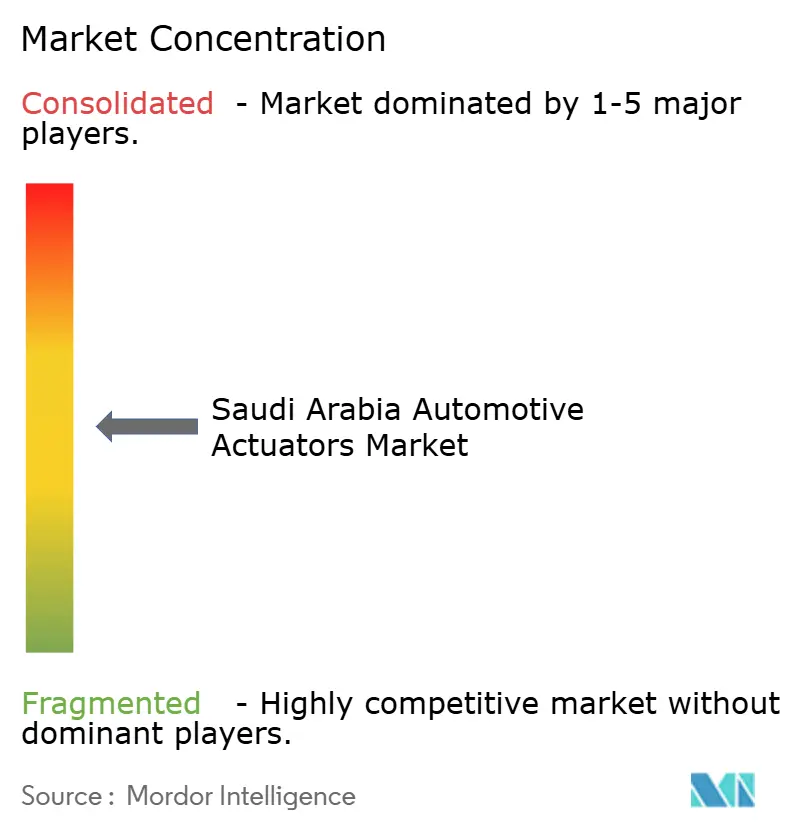
| Market Concentration | Medium |
Major Players
*Disclaimer: Major Players sorted in no particular order Image © Mordor Intelligence. Reuse requires attribution under CC BY 4.0. |
|
Saudi Arabia Automotive Actuators Market Analysis by Mordor Intelligence
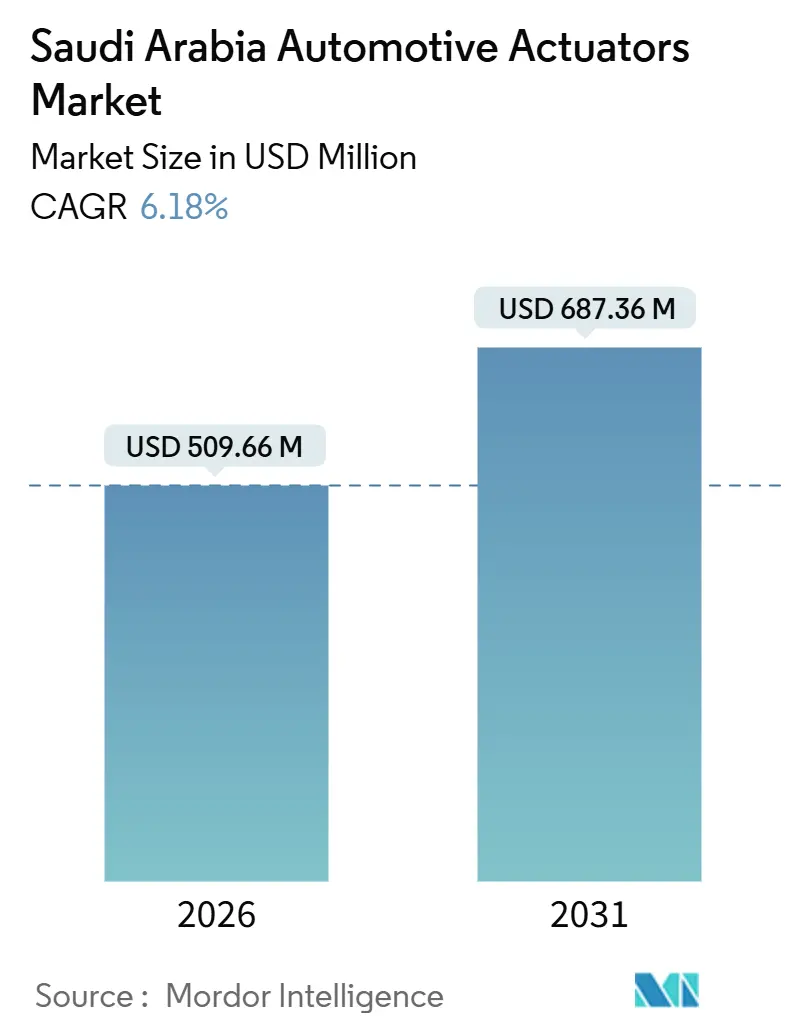
The Saudi Arabia automotive actuators market size stood at USD 509.66 million in 2026 and is projected to reach USD 687.36 million by 2031, reflecting a 6.18% CAGR. This trajectory positions the Saudi Arabian automotive actuators market as a pivotal enabler of the Kingdom’s dual objectives: stricter CAFE standards that tighten by about 4% every year and Vision 2030’s goal to localize 40% of the automotive value chain. Propulsion electrification accelerates actuator demand because every battery-electric vehicle (BEV) needs 30-40% more actuators than a comparable internal-combustion-engine (ICE) platform.
Key Report Takeaways
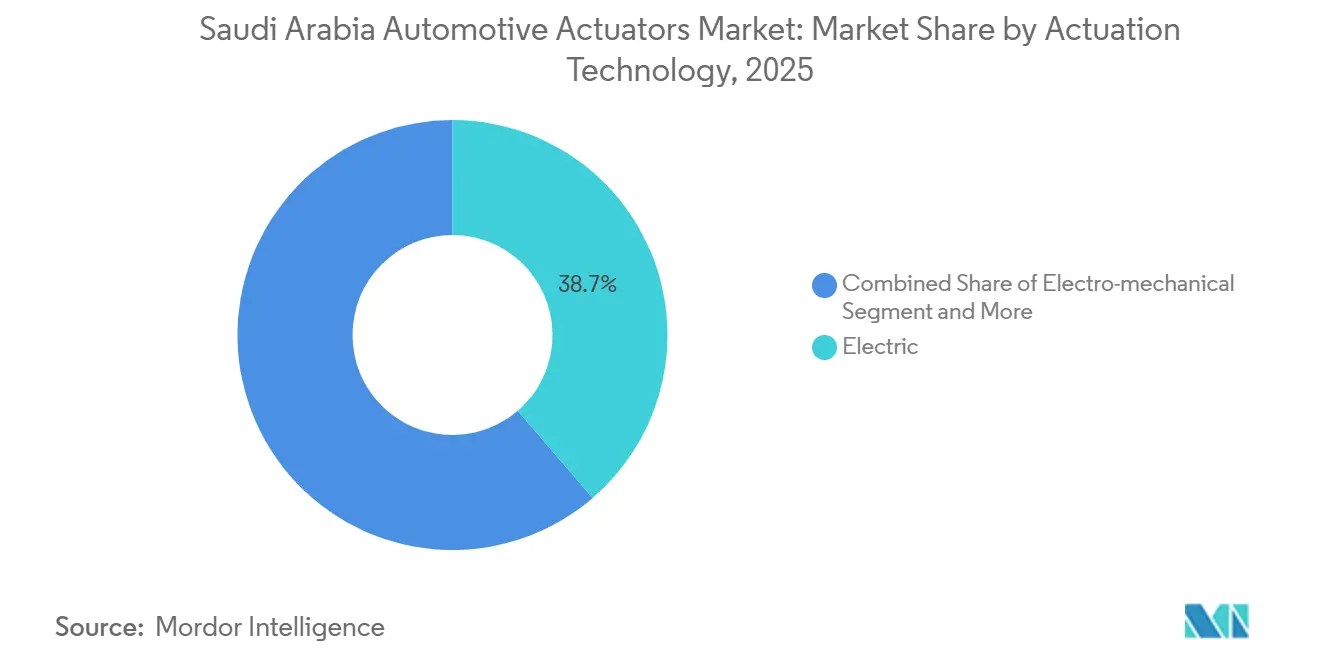
- By actuation technology, electric solutions dominated with 38.67% Saudi Arabia automotive actuators market share in 2025, while piezoelectric types posted the fastest 12.83% CAGR through 2031.
- By motion type, linear actuators led with a 64.92% slice of the Saudi Arabia automotive actuators market size in 2025; rotary actuators are projected to expand at a 9.26% CAGR to 2031.
- By application, throttle devices commanded 22.58% of the Saudi Arabian automotive actuators market share in 2025, whereas brake actuators are set to grow at a 9.94% CAGR.
- By propulsion, ICE vehicles still generated 51.74% of the 2025 value, but BEV applications will surge at a 14.68% CAGR.
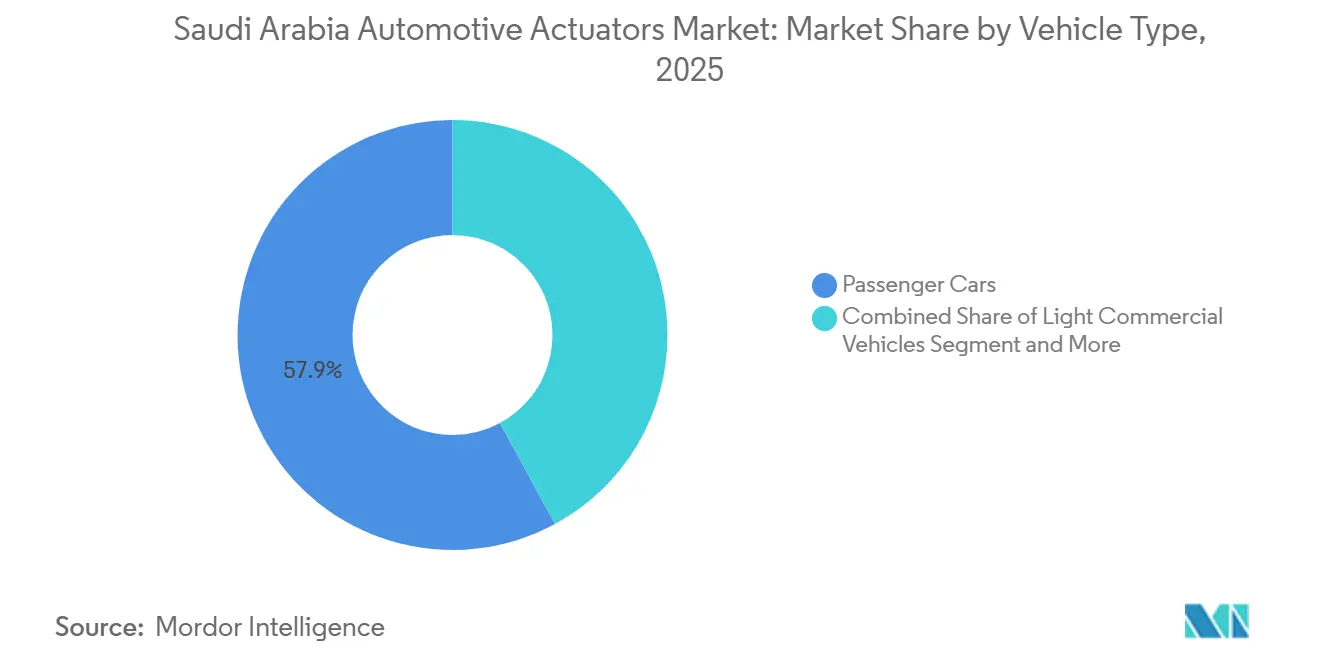
- By vehicle type, passenger cars retained 57.93% revenue in 2025, yet medium and heavy commercial fleets will surge at the highest 8.41% CAGR.
- By sales channel, OEMs accounted for 86.47% of 2025 shipments, although aftermarket revenues are poised to demonstrate 11.42% CAGR as inspections and e-commerce uptake spur replacements.
Note: Market size and forecast figures in this report are generated using Mordor Intelligence’s proprietary estimation framework, updated with the latest available data and insights as of January 2026.
Saudi Arabia Automotive Actuators Market Trends and Insights
Drivers Impact Analysis*
| Driver | (~) % Impact on CAGR Forecast | Geographic Relevance | Impact Timeline |
|---|---|---|---|
| Rising Demand for Advanced Safety Features | +2.2% | Saudi Arabia, spillover to GCC | Medium term (2-4 years) |
| Surge in Vehicle Electrification | +2.1% | KAEC, Jeddah, Riyadh | Long term (≥ 4 years) |
| Stricter Emission Targets | +0.9% | National | Short term (≤ 2 years) |
| OEM Local-Content Mandates | +0.8% | King Salman Automotive Cluster | Medium term (2-4 years) |
| Retrofit Demand from Giga-Projects | +0.6% | NEOM, Oxagon, Qiddiya | Long term (≥ 4 years) |
| OTA-Calibrated Software-Defined Actuators Cut Downtime | +0.5% | Riyadh, Jeddah premium segments | Medium term (2-4 years) |
| Source: Mordor Intelligence | |||
Rising Demand for Advanced Safety and Comfort Features
Saudi consumers pivot toward active-safety technology as the nation’s 2024 road-fatality rate of 12.13 per 100,000[1]Harry Stuckler, "The Ministry of Interior released the 2024 Annual Traffic Safety Report," KSA News, ksa.com. remains one of the highest in the G20. Brake actuators supporting automatic emergency braking and adaptive cruise control now appear in mainstream trims after Hyundai’s PIF joint venture confirmed Level 2 ADAS will be standard across 50,000 units annually from 2025. Comfort is equally decisive; 68% of new-vehicle sales in 2025 were mid-size SUVs and full-size sedans, both averaging 25-30 actuators per vehicle versus 15-18 in compact hatchbacks. ISO 26262 ASIL-D redundancy further lifts actuator counts by mandating dual brake devices per car. Together, safety and comfort embed a structural floor beneath actuator demand even while overall light-vehicle sales rise only 3-4% a year.
Surge in Vehicle Electrification and EV Production
Lucid’s Saudi Arabia facility in King Abdullah Economic City (KAEC) exists and began operations assembling Lucid Air vehicles from semi-knockdown (SKD) kits, but its annual capacity is around 5,000 units per year in the initial phase[2]"Lucid Group Makes History in Saudi Arabia as it Opens Country's First-Ever Car Manufacturing Facility," LUCID, ir.lucidmotors.com.. With the Public Investment Fund committing to buy 50,000 Lucid vehicles over ten years and CEER budgeting USD 1.3 billion to commission a 150,000-unit BEV plant, the Saudi Arabian automotive actuators market will see actuator intensity peak between 2026 and 2028. Yet solid-state batteries arriving post-2028 could cut cooling-loop actuators by 25-30% per BEV. Local battery capacity targets of 15 GWh by 2028 and a USD 800 million lithium-hydroxide facility in Yanbu favor co-located actuator assembly to secure LCGPA’s 10-20% price preference.
Stricter Saudi CAFE and Emission Targets
Regulatory compliance under SASO 2864:2022 requires importers and manufacturers of light-duty vehicles in Saudi Arabia to meet progressively stricter fuel-economy standards through 2028[3]"List of GSO Technical Regulations for Motor Vehicles," GCC Standardization Organization (GSO), gso.org.sa.. Penalties of SAR 5,000 per kilometer-per-liter shortfall for high-volume OEMs incentivize over-specification of actuators even if consumer willingness to pay lags. Real-world driving-emission testing introduced in 2025 under 45-50 °C summer conditions already boosted validation budgets at Continental and ZF by around 12%.
OEM Local-Content Mandates Driving Actuator Localization
The Local Content and Government Procurement Authority targets 40% domestic value by 2030 and weights local sourcing at 40% in bid evaluations, pressing tier-ones to open regional plants or risk market exit. Bosch responded with a Middle East competence center that localizes software and final assembly, while Denso feeds KAEC modules from its USD 300 million Thailand plant to qualify for content credit without duplicating capital-heavy motor-winding lines. Yet only three of the twenty profiled suppliers had committed manufacturing footprints by early 2026, reflecting uncertainty over whether domestic production would reach the 300,000-unit goal.
Restraints Impact Analysis*
| Restraint | (~) % Impact on CAGR Forecast | Geographic Relevance | Impact Timeline |
|---|---|---|---|
| High BOM Cost of Next-Gen Smart Actuators | -0.7% | Saudi Arabia | Short term (≤ 2 years) |
| Reliability Issues in Extreme Desert Duty-Cycles | -0.5% | Saudi Arabia, UAE, Kuwait | Medium term (2-4 years) |
| Solid-State E-Drivetrains Lowering Actuator Counts | -0.4% | Premium BEV segment | Long term (≥ 4 years) |
| Rare-Earth Magnet Supply-Chain Volatility | -0.3% | Saudi Arabia, Global | Medium term (2-4 years) |
| Source: Mordor Intelligence | |||
High BOM Cost of Next-Gen Smart Actuators
Smart actuators integrating sensors and controllers carry a 30-50% premium; Bosch’s 2025 line averages EUR 50-150 versus EUR 30-80 for legacy units. With 62% of 2025 light-vehicle sales below SAR 100,000, OEMs struggle to absorb the cost delta. ISO 26262 validation adds up to two years, and cybersecurity mandates under UNECE R155 require secure boot and encrypted OTA channels, restricting price relief. Continental’s integrated brake control enters luxury BEVs at a 40% premium, illustrating affordability barriers in mass segments.
Reliability Issues in Extreme Desert Duty-Cycles
Summer ambient temperatures of 45-50 °C push under-hood peaks past 120 °C, doubling actuator failure rates relative to temperate climates. Thermal cycling accelerates backlash in gear trains and dust ingress degrades brushless motors; ZF’s 2025 Riyadh field study recorded 22% HVAC-actuator failure within 36 months, twice the global average. Mitigation such as conformal coatings and high-temperature lubricants adds USD 8-12 per actuator, squeezing margins in entry trims. Extended warranties introduced by SASO in 2024 transfer liability upstream, pressuring suppliers to over-specify thermal derating.
*Our forecasts treat driver/restraint impacts as directional, not additive. The impact forecasts reflect baseline growth, mix effects, and variable interactions.
Segment Analysis
By Actuation Technology: Piezoelectric Gains on Precision Needs
Electric systems accounted for 38.67% of 2025 revenue, as brushless DC motors balance torque density with 10,000-hour lifespans in roles such as seats, mirrors, and HVAC systems. Hydraulic brake actuators are expected to hold a single-digit share as brake-by-wire layouts proliferate. At the same time, pneumatic solutions continue to persist in medium and heavy trucks for ABS-ready air-brake modulation. Piezoelectric devices, forecast at 12.83% CAGR, satisfy microsecond valve control in gasoline direct-injection engines and 800 V battery thermal loops. The Saudi Arabia automotive actuators market size for piezoelectric types is projected to expand with a CAGR of 12.83% by 2031, cementing their status despite dependence on lead-zirconate-titanate ceramics. Shape-memory-alloy concepts remain niche because 60-90 °C activation temperatures overlap with the under-hood heat in Saudi Arabia, demanding cooling hardware that offsets weight savings.
Second-order effects include Bosch allocating 8% of its EUR 1.4 billion annual actuator R&D to piezoelectric and SMA technologies, protecting future earnings should solid-state battery packs shrink electric-motor demand. Meanwhile, suppliers like Valeo use Morocco plants for cost-optimized 48 V HVAC actuators, reserving French lines for high-margin 800 V piezoelectric units, creating a bifurcated supply chain poised to converge only if BEV uptake meets Vision 2030 targets.



By Motion Type: Rotary Demand Climbs in Multi-Axis HVAC
Linear units held a 64.92% market share in 2025 shipments, driven by dominance in throttle, brake, and seat applications. Yet, rotary actuators, projected to grow at a 9.26% CAGR through 2031, benefit from tri-zone HVAC systems that utilize up to eight blend doors to manage 45°C desert heat. The Saudi Arabia automotive actuators market size attached to rotary devices is poised to surpass USD 220 million by 2031. ZF’s universal actuator platform merges linear and rotary stages on a common motor-controller, cutting SKUs by 40% and aligning with LCGPA’s push for regional assembly. Competition intensifies as Nidec and Johnson Electric price integrated motor-sensor modules 20% cheaper than CTS stand-alone sensors, pressuring mid-tier specialists.
Within HVAC, Valeo’s 2024 system for the Lucid Air leverages rotary motion to lower cold-start energy by 18%, directly extending BEV range in high-temperature urban cycles. Adoption accelerates alongside digital mirror laws across the GCC, which require real-time camera repositioning actuators.
By Application Type: Brake Devices Accelerate on Safety Push
Throttle actuators retained a 22.58% market share in 2025 but are expected to decline as BEV penetration increases. Brake units are advancing at a 9.94% CAGR, supported by UNECE R13-H electronic brake distribution and energy-recovery mandates that demand redundancy. Continental’s integrated brake control adds USD 180 per vehicle yet doubles pad life through wear optimization, illustrating the cost-benefit calculation for ADAS-ready platforms. HVAC and thermal actuators account for 15% of volume but risk a 37% drop per vehicle if solid-state batteries remove liquid cooling hardware by 2029.
Seat-adjustment devices, steady at 12% share, confront price compression—average unit prices fell from SAR 420 to SAR 310 between 2020 and 2025. Door, closure, and active-aero actuators collectively grow in mid-single digits as SUVs drive demand for power liftgates and grille shutters, each improving highway fuel economy by 2-3%.
By Vehicle Propulsion: BEV Intensity Defines Upside
ICE platforms still generated the most 2025 revenues, with a 51.74% market share; however, the Saudi Arabia automotive actuators market size tied to BEVs is expected to surge at a 14.68% CAGR. Each Lucid Air carries 38 actuators, compared to 24 in a hybrid and 18 in a contemporary ICE sedan, thereby increasing the per-unit value. Plug-in hybrids struggle with the complexity of dual drivetrains, while fuel-cell trucks remain experimental, despite NEOM’s USD 5 billion green-hydrogen initiative.
Supply bifurcates: Denso, Bosch, and Valeo emphasize high-volume ICE and hybrid orders, whereas Continental and ZF target low-volume, high-margin BEV smart actuators. Managing R&D parity across both tiers poses a challenge to EBIT targets, especially for mid-cap players.
By Vehicle Type: Commercial Fleets Outpace Passenger Growth
Passenger cars held 57.93% of the 2025 turnover. Medium and heavy commercial fleets exhibit the highest 8.41% CAGR as e-commerce giants Noon and Jarir electrify their last-mile vans to meet the Green Riyadh mandates. Each electric light commercial vehicle carries 22-26 actuators, including load-leveling suspension and telematics-enabled locks, compared with 15-18 in diesel equivalents. Medium and heavy trucks gain market share through NEOM autonomous logistics, utilizing redundant actuators that meet ISO 26262 ASIL-D standards.
ZF’s 2026 modular chassis, which shares 70% of its parts across vehicle classes, supports local assembly economics, crucial for suppliers balancing low-volume, heavy-duty orders with those of passenger cars.
By Sales Channel: Aftermarket Expands on Retrofits
OEM shipments represented 86.47% of 2025 units, while the aftermarket segment is poised to rise at 11.42% CAGR as the seven-year average vehicle age aligns with peak actuator failure. Fahes safety inspections identify inoperable HVAC dampers and mirror folding units, while Jarir and Noon compress price gaps, siphoning share from dealer networks. SASO’s 2026 QR-code traceability combats a 12-15% counterfeit share yet raises compliance costs that small distributors struggle to meet.
Retrofits tied to giga-projects create a lucrative sub-segment: Valeo’s eight-actuator HVAC kit enables diesel bus upgrades to comply with low-emission zones at one-third OEM cost, highlighting price-value arbitrage in fleet conversions.
Geography Analysis
Riyadh, Makkah, and the Eastern Province concentrated 74% of 2025 demand, mapping the Kingdom’s population nodes and assembly hubs in KAEC and Jeddah. Riyadh alone targets 30% EV penetration by 2030 under the Green Riyadh plan, stimulating brake-by-wire and thermal-management actuator orders for last-mile fleets. The Eastern Province’s oil fleet—12,000 vehicles—requires IP68-rated devices capable of 120 °C under-hood operation; Saudi Aramco tendered 2,400 electric SUVs in 2024 with such specifications.
NEOM contributes less than 2% of present sales yet sets strategic direction. Its 100% electric, autonomous mobility mandate across THE LINE will need up to 2 million actuators by 2030, many with safety integrity levels exceeding current passenger-car norms. Oxagon’s tax-free industrial zone priced at SAR 10 per square meter lures Valeo and Schaeffler to contemplate regional assembly, but capital commitments hinge on Hyundai and CEER delivering on volume promises. The geography, therefore, splits into mature metros with established aftermarket ecosystems and giga-projects offering greenfield upside but schedule risk.
Standardization under the GCC umbrella aligns local rules with UNECE, lowering technical hurdles for Turkish and Indian entrants. Mako Elektrik and Minda Corporation opened Saudi sales offices in 2025, bringing price competition that threatens incumbent margins.
Regulatory Landscape
Saudi Arabia regulates automotive actuators largely through the Saudi Standards, Metrology and Quality Organization (SASO) framework for vehicles and spare parts, with conformity assessment, labeling, and packaging requirements applying to both imported and locally manufactured components. Within the report scope, compliance pressure is reinforced by Saudi fuel-economy and emission requirements referenced in the study (SASO 2864:2022 for progressively tightening light-duty fuel-economy requirements through 2028), and by the market-side shift toward traceability in the parts ecosystem, including the report-noted SASO QR-code traceability requirement effective January 2026, which increases compliance and documentation needs for legitimate aftermarket actuator supply.
Industrial policy also shapes the operating environment through localization and procurement rules. Vision 2030 and the National Industrial Development and Logistics Program (NIDLP) set the national framework for building a domestic automotive supply chain, while the Local Content and Government Procurement Authority (LCGPA) targets 40% domestic value by 2030 and local-content weighting in government-linked procurement influence where tier suppliers place assembly, calibration, and final test activities for actuator modules used by OEMs and fleets.
Value Chain Analysis
The Saudi automotive actuator value chain is import-heavy in upstream inputs (motors, sensors, magnets, electronics, and precision plastics), followed by module assembly and calibration by tier suppliers, then integration at OEM assembly sites and distribution through dealer and independent aftermarket channels. In-country industrial clustering has become a defining feature of downstream localization, centered on King Abdullah Economic City (KAEC) and the King Salman Automotive Cluster. These hubs anchor OEM activity and give parts makers pathways to colocate kitting, final assembly, and validation capabilities closer to vehicle production and large fleet buyers.
In 2026, ecosystem build-out at KAEC accelerated through MASARAT Mobility Park and TASARU Supplier Hub activity that brings tier suppliers into shared infrastructure rather than stand-alone greenfield sites. This includes development lease agreements to host global tier suppliers, a manufacturing facility commitment by FPI Gulf for advanced automotive parts processes (for example, plastic injection molding and painting), and TASARU Supplier Hub partnerships with Lear Corporation, Shin Young, JVIS, BENTELER, and Guangxi Fangxin Automobile Technology Co., Ltd. These moves tighten local lead times for actuator-adjacent subassemblies (housings, brackets, trim, and body hardware) and strengthen the domestic logistics layer supporting OEM-bound shipments and the growing e-commerce aftermarket channel.
Competitive Landscape
The largest suppliers, Bosch, Denso, Continental, and ZF, held a significant share of the 2025 shipment value. Localization mandates, however, spur fragmentation as regional assemblers emerge. Bosch’s asset-light competence center focuses on calibration and final assembly; Denso ships sub-assemblies from Thailand to KAEC; Continental opened a Dubai service hub to support in-region OTA updates. White-space lies in retrofit actuators for 12 million vehicles on Saudi roads, IP69K-rated devices for NEOM’s autonomous fleets, and piezoelectric fuel-injection modules underserved by electromotor-centric suppliers.
Technology differentiates winners. Continental’s 2024 patent for wear-sensing brake-by-wire actuators doubles service intervals, shifting revenue toward uptime guarantees. ZF earmarked USD 14 billion through 2028 for actuator intelligence, embedding machine-learning fault prediction into hardware. Yet cybersecurity compliance under UNECE R155 adds USD 12-18 per smart actuator—an expense smaller firms like CTS and Sensata struggle to absorb, threatening consolidation via regulatory cost pressure.
SASO’s QR-code traceability requirement from January 2026 further favors scale players who can amortize labeling and database costs. Nevertheless, Chinese disruptors Inovance and Leadrive captured 8% of the 2025 LCV aftermarket by pricing 25-30% below incumbents—evidence that cost leadership can still carve share despite regulatory headwinds.
Saudi Arabia Automotive Actuators Industry Leaders
-
Robert Bosch GmbH
-
Denso Corporation
-
Nidec Corporation
-
Aptiv
-
Mitsubishi Electric Corp.
- *Disclaimer: Major Players sorted in no particular order

Market Opportunities and Future Outlook
Localization programs and KAEC cluster build-out create whitespace for actuator suppliers that can shift from pure import distribution to local assembly, calibration, and testing aligned with Saudi procurement preferences and traceability requirements. A near-term opportunity is concentrated in actuator-heavy body and comfort systems that are being localized in the domestic supply chain, including HVAC components, window regulators, and door hinges. In these areas, local manufacturing and subassembly can be integrated with actuator modules to raise local content and reduce replenishment cycles for OEM and fleet demand.
Evidence of supply-chain mobilization is visible in 2026 initiatives around KAEC. TASARU Supplier Hub announced agreements with five global tier suppliers to localize production at MASARAT Mobility Park, and FPI Gulf signed a development lease for an advanced automotive parts facility with capabilities such as plastic injection molding and painting. Together, these steps support local availability of actuator-adjacent components and assemblies. Separately, CEER publicized 16 commercial agreements valued at more than SAR 3.7 billion to build its domestic supply chain, including localization steps for HVAC components, window regulators, and door hinges. This broadens the addressable ecosystem for actuator module suppliers and their sub-tier partners serving Saudi-based OEM ramps and the aftermarket replacement channel.
Recent Industry Developments
- April 2026: CEER announced a package of 16 commercial agreements to build its domestic supply chain, including localization activities tied to HVAC components, window regulators, and door hinges. The emphasis on localizing high-run-rate body and comfort components widens the pull-through for actuator modules and actuator-adjacent subassemblies in the Kingdom as suppliers align designs, tooling, and quality systems to OEM sourcing requirements.
- December 2025: Saudi Arabia signed a memorandum of understanding with Stellantis and Petromin Corporation to study the feasibility of establishing a full vehicle manufacturing plant in the Kingdom. This collaboration points to renewed focus on in-country integration of mechatronic components and assembly capabilities for actuator-intensive systems.
- January 2024: Robert Bosch GmbH inaugurated its new regional headquarters in Riyadh. The expanded in-country footprint supports closer customer engineering, compliance management, and aftermarket coordination, which is material as Saudi programs tighten requirements around local content and parts traceability.


Research Methodology Framework and Report Scope
Market Definition and Coverage
For this study, the market covers the value of automotive actuators sold for use in vehicles in Saudi Arabia, across major vehicle systems that convert electrical, hydraulic, or pneumatic input into controlled motion.
Scope exclusions: We exclude actuators used in non-automotive equipment (such as industrial machinery and building automation) and we do not count standalone repair labor as market value.
Segmentation Overview
-
By Actuation Technology
- Electric
- Electro-mechanical
- Piezoelectric
- Others
-
By Motion Type
- Linear
- Rotary
-
By Application Type
- Throttle
- Brake
- Transmission/Drivetrain
- Seat Adjustment
- Door/Closure
- HVAC and Thermal
- Suspension and Chassis
- Mirror and Lighting
-
By Vehicle Propulsion
- Internal-Combustion (ICE)
- Hybrid Electric (HEV)
- Battery-Electric (BEV)
- Plug-in Hybrid (PHEV)
- Fuel-Cell Electric (FCEV)
-
By Vehicle Type
- Passenger Cars
- Light Commercial Vehicles
- Medium and Heavy Commercial Vehicles
- Off-Highway and Special-Purpose
-
By Sales Channel
- OEM
- Aftermarket
Data Sources, Market Sizing, and Validation
Desk Research
Desk work starts with building a clean view of the vehicle demand pool in Saudi Arabia, then mapping which actuator applications typically scale with that pool. We use public statistics and official releases to anchor the basics, including vehicle registrations, import trends, and manufacturing or assembly activity.
We typically rely on sources such as the Saudi General Authority for Statistics, Saudi Customs trade statistics, SAMA macro indicators, relevant Saudi standards and regulatory releases (for example SASO), and technical papers from peer-reviewed engineering journals. To round out the picture, we also use company annual reports, investor presentations, reputable news coverage, and a paid subscription for company financials and corporate actions. Where it helps validate parts movement, we add a paid import-export shipment-level database. These sources are illustrative only, and during data collection, validation, and clarification, we also check many other public and paid references.
Primary Interviews and Surveys
Primary calls and surveys help test how actuator demand is behaving across passenger and commercial vehicles, and how sourcing differs between OEM-fitment and replacement channels. We speak with component suppliers, distributors, service network stakeholders, and technical experts across the Kingdom. Based on what respondents report, we adjust secondary assumptions on mix, pricing, and adoption to better reflect the on-ground market.
Distribution of primary research fieldwork respondents
| Company type | Respondent position |
|---|---|
| Top tier: 34% | CXOs: 18% |
| Mid tier: 44% | Functional/Unit leaders: 24% |
| Smaller Players: 22% | Managers: 58% |
Market-Sizing & Forecasting
Sizing is built using a top-down demand reconstruction that starts from Saudi Arabia vehicle parc, new vehicle additions, and the related replacement cycle. We then convert that demand pool into actuator demand using application-level fitment and penetration. Once the unit demand is established, value is estimated using representative price bands for key actuator families, followed by adjustments for sales channel mix and local distribution margins.
To keep totals realistic, we run selective bottom-up checks. For example, we sample actuator pricing from distributor quotes, validate unit trends through import patterns for relevant parts categories, and perform a supplier roll-up for a limited set of commonly used actuator applications. Key model inputs include new vehicle sales and registrations, vehicle parc age profile, service and repair intensity, the mix shift toward vehicles with more comfort and safety features, and average selling price movement tied to material and electronics content. Forecasting uses scenario analysis, with base, high, and low cases linked to vehicle sales expectations, replacement behavior, and pricing progression that is validated through expert feedback. If bottom-up evidence is missing for a niche application, we fill gaps using ratios from comparable applications and then re-check that the implied actuator spend per vehicle remains within a sensible range.
Data Validation & Update Cycle
Validation is done in layers. We start by comparing market totals against independent signals such as changes in vehicle population, direction of parts trade, and implied actuator spend per vehicle. If an outlier appears, we trace the issue back to the underlying driver (fitment, penetration, or price) and review the assumption before accepting the number.
A second analyst review stress tests the logic and checks that the narrative matches the figures. After that, we trigger targeted re-contacts when a key variable has moved or when feedback is inconsistent. The report is refreshed annually, and we also monitor material events for interim adjustments. Before delivery, we run a final pass to ensure clients get an updated view with consistent definitions and the latest available inputs.
Mordor Intelligence's Saudi Arabia Automotive Actuators Market Size Measured Against Other Published Estimates
It is normal to see different market values for the same topic, even when the country and product label looks identical. The gap usually comes from how each publisher sets the year, the included actuator scope, and how pricing and channel markups are treated.
Import trend checks for relevant auto parts categories, plus a spend-per-vehicle sanity test tied to registrations and parc movement, help keep Mordor Intelligence's 2026 estimate aligned to a realistic demand pool rather than an aggressive feature-content assumption. Differences can also come from using a shorter forecast window with a strong EV narrative, from folding adjacent mechatronic modules that include actuators, or from unclear currency timing and inflation handling.
Benchmark comparison
| Source | Market Size | Gaps in Research Methodology |
|---|---|---|
| Mordor Intelligence | USD 509.66 M (2026) | |
| Global Consultancy A | USD 231.31 M (2025) | Uses an earlier base year and a different forecast window, and it appears to apply tighter actuator scope and/or lower price bands, which reduces implied actuator spend per vehicle. |
| Industry Publisher B | USD 216.00 M (2024) | Anchors valuation on 2024 and mixes revenue and volume framing, with limited clarity on channel margin treatment and which actuator applications are counted inside versus adjacent modules. |
Overall, the spread is explained by timing and scope choices first, and then by how price progression and channel margins are applied. By keeping the demand pool traceable to vehicle activity signals and then cross-checking value through practical price and mix checks, the market total can be repeated and debated in clear steps.


Key Questions Answered in the Report
How fast is actuator demand growing in Saudi vehicles?
The Saudi Arabia automotive actuators market is forecast to post a 6.18% CAGR from 2026 to 2031, outpacing overall vehicle sales due to electrification and ADAS uptake.
Which actuator type will expand the quickest?
Piezoelectric devices are set for a 12.83% CAGR through 2031 as gasoline direct-injection and 800 V battery platforms require microsecond valve control.
How many actuators does a typical BEV in the Kingdom use?
A Lucid Air assembled at KAEC integrates about 38 actuators, roughly 30-40% more than a comparable ICE sedan.
What drives aftermarket growth for actuators?
Mandatory inspections, a seven-year average vehicle age, and e-commerce price transparency lift aftermarket sales at an 11.42% CAGR through 2031.
How do local-content rules affect suppliers?
LCGPA’s 40% domestic-value target forces tier-ones to establish regional assembly or risk penalties, fragmenting supply chains and shifting some production to KAEC and Oxagon.
Page last updated on:


 Your data is secure and never sold or shared.


